The Demigod Files Summary, Characters and Themes
The Demigod Files by Rick Riordan is a companion book to the Percy Jackson series, built like a survival file for young demigods. It collects three action-filled side stories from Percy’s life, along with camp interviews and extra material from Camp Half-Blood.
The book gives readers more time with Percy, Annabeth, Clarisse, Nico, Thalia, Grover, Beckendorf, and Silena while expanding the world of gods, monsters, quests, and camper rivalries. Written with Riordan’s quick humor and mythological energy, The Demigod Files works as both a bonus adventure collection and a bridge between major events in Percy’s story.
Notes
- The book is framed as a confidential Camp Half-Blood file compiled by Rick Riordan (as the scribe), with extras like maps, puzzles, and a Last Olympian preview.
- The stories are set between Battle of the Labyrinth and The Last Olympian (with “Bronze Dragon” overlapping fireworks from the former).
Summary
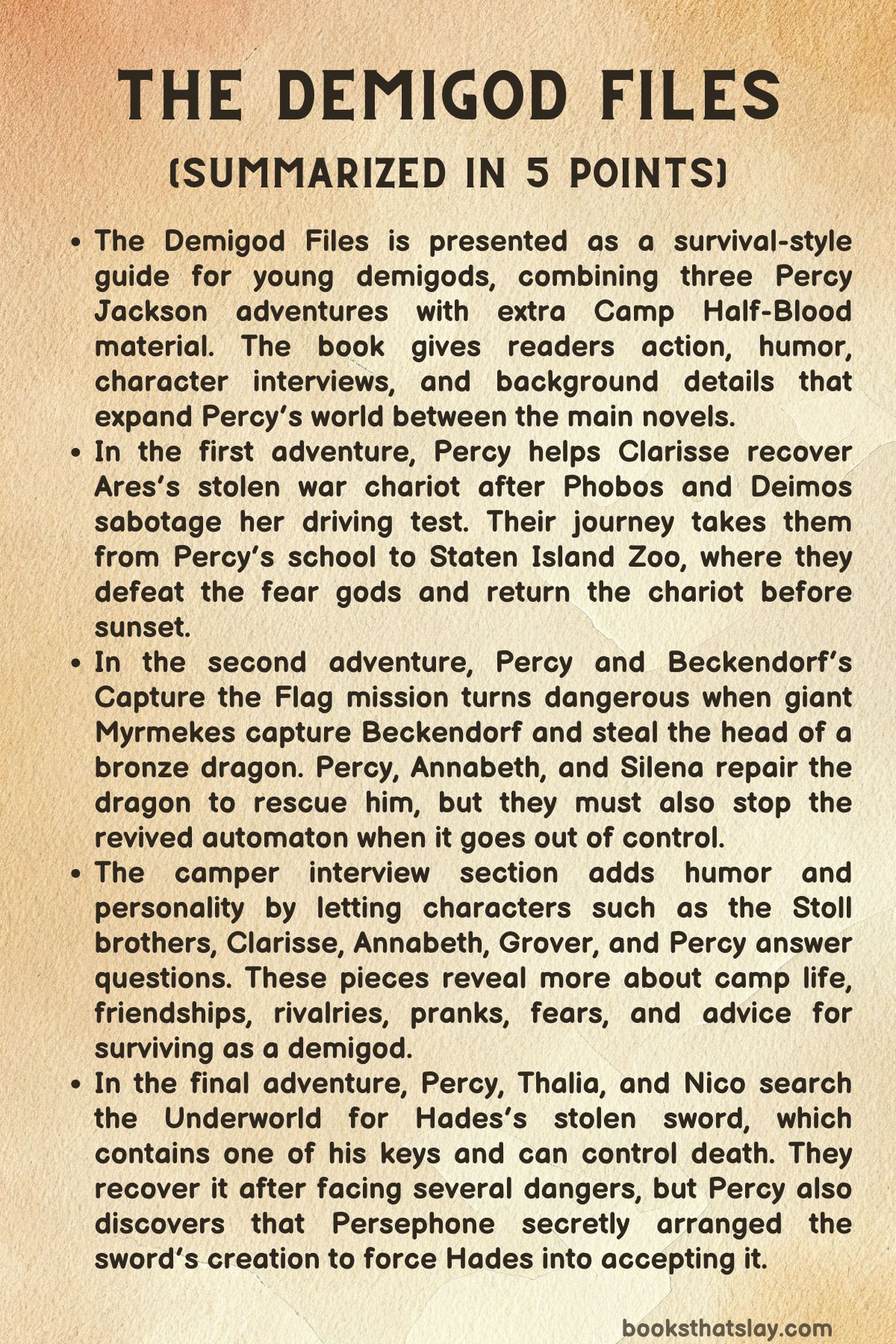
The Demigod Files presents three dangerous adventures from Percy Jackson’s life, framed as a guide for young demigods who need to understand the risks of the mythological world. The book mixes action, humor, camp life, and hidden details about the children of the Greek gods.
Each adventure tests Percy in a different way: through an uneasy alliance with Clarisse, a rescue mission involving a lost bronze dragon, and a journey into the Underworld with Thalia and Nico.
The first adventure begins while Percy is trying to get through an ordinary school day. During science class, he notices something strange outside: Clarisse La Rue, daughter of Ares, is fighting a flock of vicious black birds.
Percy leaves class and runs to help her. Even though he and Clarisse are usually rivals, the danger is real, and together they destroy the monsters.
Clarisse then explains the problem. During her driving test, her immortal brothers, Phobos and Deimos, stole Ares’s war chariot.
If she cannot return it before sunset, Ares will punish her. Clarisse is proud and angry, but she is also scared of failing her father.
Percy agrees to help her, even though working with Clarisse is never easy.
Phobos appears and uses fear against Clarisse, showing her the thing she dreads most. He also gives a clue that the chariot is hidden “across the water” in a place with small wild animals.
Percy and Clarisse decide the clue points to Staten Island Zoo. They take the ferry, but Deimos attacks them with a sea serpent.
Percy uses his power over water to fight back, while Clarisse takes on Deimos directly.
At the zoo, they find the missing chariot, but Phobos and Deimos are waiting. Phobos attacks Percy by shifting the chariot into different forms, including a tank and Ares’s motorcycle.
He traps Percy in a vision of Camp Half-Blood burning, forcing Percy to face his own fears. Percy manages to break free and defeat him.
At the same time, Deimos disguises himself as Ares to frighten Clarisse. Percy encourages her to stand up to him, and Clarisse finds the courage to fight back.
She defeats Deimos and takes back the chariot.
Percy helps Clarisse ride the chariot across the harbor so she can return it before sunset. They succeed just in time.
The adventure does not make them close friends, but it changes how they see each other. Percy understands Clarisse’s pressure to prove herself, and Clarisse shows that beneath her anger and pride, she has courage and loyalty.
The second adventure takes place during a game of Capture the Flag at Camp Half-Blood. Percy joins Beckendorf, Annabeth, Silena, and other campers in the competition.
Beckendorf and Percy sneak through enemy territory using camouflage armor, hoping to gain an advantage. Instead, they discover something much more serious: the Ant Hill, home to giant Myrmekes.
The ants are carrying away the severed head of a legendary bronze dragon, an old guardian of the camp. Beckendorf, who loves machines and metalwork, tries to save the dragon’s head, but the ants capture him and drag him into their nest.
Percy realizes the situation has turned from a camp game into a rescue mission.
Annabeth decides that their best chance is to find the dragon’s body, reconnect the head, and use the automaton to help save Beckendorf. Percy, Annabeth, and Silena follow the trail and locate the buried body.
They manage to repair the dragon enough to wake it. Once active, the bronze dragon attacks the Ant Hill, distracting the Myrmekes and giving the demigods a chance to enter the tunnels.
Inside the nest, they find Beckendorf alive but paralyzed by the ants’ venom. They rescue him and escape while the dragon continues smashing through the colony.
But the rescue creates another problem: the dragon becomes uncontrollable. It chases the demigods and threatens to cause even more destruction.
Beckendorf, despite being weakened, acts quickly. He leaps onto the dragon’s neck and pulls out a wire, shutting it down.
His bravery impresses Silena, who kisses him afterward. Beckendorf asks her to the fireworks, and she accepts.
Percy nearly asks Annabeth the same thing, but the Capture the Flag game has not officially ended. Annabeth captures him instead, proving once again that she is always thinking ahead.
Still, she hints that they will meet later at the fireworks, leaving Percy with a small but hopeful moment.
Between the major adventures, the book includes interviews with campers from Camp Half-Blood. Connor and Travis Stoll talk about pranks and mischief.
Clarisse discusses fighting, revenge, and her aggressive approach to problems. Annabeth talks about architecture and Percy, revealing her sharp mind and guarded feelings.
Grover answers questions about nature and his unusual eating habits, including his love of tin cans. Percy gives advice about surviving as a demigod, using his usual humor while also making it clear that life as a half-blood is dangerous and unpredictable.
The final adventure begins when Mrs. O’Leary, Percy’s giant hellhound, interrupts his exam and leads him away. Percy soon meets Thalia and Nico, bringing together three children of the Big Three: Poseidon, Zeus, and Hades.
They are taken to Persephone, who tells them that Hades’s new sword has been stolen. The weapon is extremely dangerous because it contains one of Hades’s keys and has power over death.
Persephone sends them to recover it, guided by a magical carnation. Their search takes them through the Underworld, where they face strange and dangerous figures from myth.
They question Sisyphus, battle death spirits called Keres, cross the River Lethe, and confront Melinoe, who uses ghosts and fear to unsettle them. The quest is especially difficult for Nico, who is still connected to the Underworld and struggling with his place as Hades’s son.
The trail eventually leads them to Ethan Nakamura, who has the sword, and the Titan Iapetus. Ethan is already tied to darker forces, and Iapetus is a powerful threat.
Percy fights Iapetus near the River Lethe, whose waters erase memory. Percy drags the Titan into the river, wiping his mind clean.
When Iapetus no longer remembers who he is, Percy renames him Bob. The moment is strange but important, because Percy turns a deadly enemy into someone harmless, at least for the time being.
Ethan escapes, but Nico recovers the sword. When they return to Hades’s palace, Percy forces Hades to swear that he will not use the sword against the gods.
This matters because the weapon could upset the balance between Olympus and the Underworld. Then the demigods realize that Persephone arranged the sword’s creation without Hades fully understanding her plan.
She used Percy, Thalia, and Nico to make Hades accept the weapon.
By the end, The Demigod Files has shown several sides of Percy’s world beyond the main quests. The stories reveal rivalries, friendships, hidden fears, camp traditions, and threats that exist even between major battles.
Percy remains funny, brave, and impulsive, but the book also shows how often he helps others face their own fears. Clarisse learns to stand up to her brothers.
Beckendorf proves his courage and skill. Nico shows the weight of being connected to death.
Through these extra adventures, the book gives readers a wider look at Camp Half-Blood and the dangerous life of a demigod.
Characters
Percy Jackson
Percy Jackson is the central hero of The Demigod Files, and his character is defined by courage, loyalty, humor, and a strong instinct to protect others even when he has little reason to help them. In the first adventure, his decision to help Clarisse shows that he is not guided only by friendship or personal comfort; he helps because he understands danger and responsibility.
Even though Clarisse is often hostile toward him, Percy recognizes that she is in real trouble and chooses to stand beside her. His bravery is not shown as fearlessness, because he is frightened by Phobos’s vision of Camp Half-Blood burning, but his strength comes from resisting fear and returning to action.
Percy’s water powers also reveal his connection to Poseidon, yet the book makes it clear that his greatest strength is not only magical ability but emotional steadiness under pressure.
Percy is also important because he often brings out hidden qualities in other characters. With Clarisse, he helps her move past shame and fear so she can face Deimos.
With Beckendorf, Annabeth, and Silena, he acts as a dependable ally during the Ant Hill rescue. With Nico and Thalia, he becomes part of a tense alliance between the children of the Big Three.
Percy’s humor keeps the story lively, but beneath that humor is a serious moral center. He questions gods, resists manipulation, and even makes Hades swear not to use the sword against Olympus.
This shows that Percy is not blindly obedient to divine authority. He respects power, but he also challenges it when innocent lives or the balance of the world are at risk.
Clarisse La Rue
Clarisse La Rue is one of the most forceful and emotionally layered characters in the book. At first, she appears aggressive, proud, and difficult to approach, but her adventure with Percy reveals the pressure she carries as a daughter of Ares.
Her failure during the driving test is not merely embarrassing; it threatens her standing with her father and exposes her fear of being seen as weak. This makes her conflict with Phobos and Deimos especially personal, because they attack her pride and confidence rather than just her body.
Clarisse’s toughness is real, but the story shows that it partly protects a deep insecurity about disappointing Ares.
Her growth comes when she stops allowing fear to control her. Deimos terrifies her by disguising himself as Ares, using her fear of her father’s judgment against her.
Percy’s encouragement helps her recognize the trick, but the victory is Clarisse’s own. When she stands up to Deimos, she proves that her courage is not simply loudness or violence; it is the ability to confront the thing that makes her feel powerless.
By the end of the adventure, Clarisse remains fierce and competitive, but she becomes more sympathetic. The story allows readers to see that her harsh personality comes from pressure, pride, and a desire to be worthy in the eyes of a demanding parent.
Phobos
Phobos represents fear as a weapon. As one of Ares’s immortal sons, he does not rely only on physical strength; he attacks Percy and Clarisse by forcing them to experience their worst fears.
His power is especially dangerous because it makes enemies doubt themselves before they can fight back. When he traps Percy in a vision of Camp Half-Blood burning, he strikes at Percy’s deepest concern: the safety of his friends and home.
This shows that Phobos understands fear not as a simple emotion, but as something that can paralyze even brave people.
As a character, Phobos is cruel, mocking, and manipulative. He enjoys watching others lose control, and his shifting forms during the chase suggest that fear itself is unstable and hard to pin down.
Percy defeats him not because he is immune to fear, but because he refuses to accept the illusion as truth. Through Phobos, the story explores the idea that fear becomes powerful when characters believe it completely.
His defeat shows that courage is not the absence of frightening images, but the ability to see through them and act anyway.
Deimos
Deimos represents terror, panic, and intimidation. While Phobos often works through visions and psychological fear, Deimos uses shock, aggression, and disguise to overwhelm his opponents.
His attack with the sea serpent on the ferry creates immediate danger, but his most important moment comes when he disguises himself as Ares to frighten Clarisse. This choice reveals how well he understands her emotional weakness.
He knows that Clarisse’s fear is tied to her father’s approval, so he uses that fear to make her feel small and helpless.
Deimos is important because he forces Clarisse into her defining test. His cruelty is not random; it is targeted, personal, and humiliating.
He wants Clarisse to believe that she has already failed before the fight is finished. When she defeats him, the victory becomes more than a physical success.
It becomes a rejection of the fear that has controlled her. Deimos therefore functions as both an enemy and a mirror of Clarisse’s inner struggle.
His defeat proves that intimidation loses power when the person being intimidated refuses to accept its authority.
Ares
Ares is a powerful presence even when he is not always directly involved in the action. As the god of war and Clarisse’s father, he represents aggression, pride, competition, and harsh expectations.
His war chariot becomes the object around which the first adventure revolves, but its importance is symbolic as well as practical. For Clarisse, returning the chariot is a way to prove that she is capable and worthy.
Ares’s threat of punishment creates the pressure that drives her desperation.
Ares’s influence helps explain Clarisse’s personality. Her anger, competitiveness, and fear of humiliation are shaped by the values associated with her father.
In this sense, Ares affects the story not only as a god but as a parental force. The fact that Clarisse fears disappointing him shows the emotional burden of being the child of a war god.
He embodies a world where strength is rewarded and failure is dangerous. Through him, the book shows how divine parents can shape their children’s fears, ambitions, and insecurities.
Charles Beckendorf
Charles Beckendorf is portrayed as brave, skilled, practical, and dependable. As a son of Hephaestus, he is deeply connected to mechanics, craftsmanship, and problem-solving.
His knowledge of machinery becomes especially important in the adventure involving the bronze dragon. Beckendorf’s attempt to rescue the dragon’s head shows his respect for machines and his willingness to take risks for something others might see as only a broken object.
To him, the dragon is not just metal; it is a guardian and a creation worth saving.
Beckendorf’s courage is quiet and action-based. He does not need to boast, and his strength comes from competence.
When he is captured by the Myrmekes, the danger becomes serious because the group loses its main mechanical expert. Yet his final act of disabling the dragon proves his resilience.
Even after being paralyzed and nearly killed, he is able to act decisively. His relationship with Silena also adds warmth to his character.
Her kiss and his invitation to the fireworks show a more gentle side beneath his strong, heroic exterior.
Annabeth Chase
Annabeth Chase is intelligent, strategic, confident, and emotionally guarded. In the Capture the Flag adventure, she quickly understands that rescuing Beckendorf requires more than rushing into danger.
Her plan to find the dragon’s body and reconnect the head shows her ability to think under pressure. Annabeth’s strength lies in seeing patterns, using available resources, and turning a dangerous situation into a solvable problem.
She is not only brave; she is disciplined and analytical.
Annabeth’s interactions with Percy reveal both competitiveness and affection. She captures him during the game, proving that she remains focused on winning even after a life-threatening rescue.
At the same time, her hint about meeting at the fireworks suggests a softer emotional connection. Annabeth often hides vulnerability behind wit and strategy, but the book shows that she cares deeply.
Her character balances intelligence with courage, and her presence often gives Percy’s impulsive bravery a more thoughtful direction.
Silena Beauregard
Silena Beauregard brings kindness, beauty, emotional warmth, and courage to the story. As a daughter of Aphrodite, she might easily be underestimated, but her role in the Ant Hill adventure shows that she is more than appearance or charm.
She joins Percy and Annabeth in a dangerous rescue mission and faces the terrifying Myrmekes despite the risk. Her bravery is quieter than Clarisse’s and less strategic than Annabeth’s, but it is still genuine.
Silena’s feelings for Beckendorf add tenderness to the adventure. Her concern for him makes the rescue emotionally meaningful, and her kiss afterward confirms the affection that has been building between them.
She represents the idea that love and courage are closely connected. Silena may be gentle, but she is not passive.
Her willingness to enter danger for someone she cares about shows loyalty and strength. In the book, she helps broaden the meaning of heroism beyond combat and cleverness.
Connor and Travis Stoll
Connor and Travis Stoll appear mainly through the camper interview section, where their mischievous personalities stand out clearly. As sons of Hermes, they represent cleverness, trickery, and a playful disregard for rules.
Their love of pranks makes them entertaining, but it also shows the restless energy of Camp Half-Blood. They are not central to the major battles in the provided adventures, yet they help create the feeling that camp is full of distinct personalities and constant chaos.
The Stoll brothers are important because they reflect a lighter side of demigod life. While many characters face monsters, death, fear, and divine manipulation, Connor and Travis remind readers that the campers are still young people with humor and mischief.
Their pranks may be annoying, but they also create community. They embody the Hermes cabin’s quick-thinking, rule-bending nature, and their presence gives the story a playful contrast to the darker dangers surrounding Percy and his friends.
Grover Underwood
Grover Underwood appears in the interview section as a character closely tied to nature, compassion, and comic relief. His answers about the natural world and tin cans reflect both his satyr identity and his gentle personality.
Grover’s love for nature is sincere, and even when he is funny, that humor comes from who he truly is rather than from mockery. He represents environmental awareness, innocence, and loyalty.
Although Grover is not at the center of the three main adventures described, his presence helps remind readers of the wider world Percy belongs to. Demigod life is not only about gods, weapons, and quests; it is also about friendships with beings like satyrs who care for the earth and guide young heroes.
Grover’s character softens the tone of the book and adds warmth. He is nervous and quirky, but also deeply good-hearted, which makes him one of the most comforting figures in Percy’s world.
Mrs. O’Leary
Mrs. O’Leary is Percy’s hellhound, and her role in the final adventure shows that she is both loyal and useful. She interrupts Percy’s exam and leads him toward Thalia and Nico, becoming the reason Percy is pulled into the Underworld conflict.
Though she is a monstrous creature by ordinary standards, she is presented as affectionate and trustworthy from Percy’s point of view. This contrast makes her charming: she is terrifying in appearance but behaves like a devoted pet.
Her character also reflects Percy’s unusual ability to form bonds with beings others might fear. Mrs. O’Leary’s loyalty shows that monsters and magical creatures in the story are not always simple enemies.
She helps connect the ordinary world of school exams with the mythological world of gods and the dead. Her presence adds humor and movement to the story while also proving that Percy’s relationships often extend beyond normal human friendships.
Thalia Grace
Thalia Grace is strong, sharp, independent, and fearless in the final adventure. As a daughter of Zeus, she carries the authority and intensity associated with the children of the Big Three.
Her presence alongside Percy and Nico creates a rare and powerful trio, since each of them is connected to one of the major gods. Thalia’s personality is direct and forceful, and she does not easily submit to intimidation.
Thalia’s importance lies in the balance she brings to the group. Percy is often instinctive and humorous, Nico is darker and more connected to the Underworld, while Thalia brings firmness and a warrior-like edge.
She is not easily impressed by gods or monsters, and her courage helps keep the quest from being dominated by fear. Even when the Underworld setting creates danger and uncertainty, Thalia remains bold.
Her character reinforces the idea that power among demigods comes with emotional toughness and a strong sense of identity.
Nico di Angelo
Nico di Angelo is one of the most emotionally complex characters in the final adventure. As a son of Hades, he is naturally connected to death, the Underworld, and shadows, but he is also still young and burdened by responsibilities that would overwhelm many others.
The stolen sword matters deeply to him because it belongs to his father’s realm and contains a key that can control death. Nico’s involvement is therefore personal as well as heroic.
Nico’s character carries a sense of loneliness and seriousness. He is not as lighthearted as Percy, and his connection to Hades makes him seem distant from the other demigods.
Yet he is not cruel. He wants to recover the sword and prevent greater danger.
His role in retrieving it shows courage and determination. Nico often exists between worlds: he is a child but tied to death, a hero but associated with darkness, powerful but emotionally isolated.
This makes him one of the most intriguing figures in The Demigod Files.
Persephone
Persephone is graceful, intelligent, and deeply manipulative in the final adventure. At first, she presents herself as someone seeking help because Hades’s sword has been stolen.
She sends Percy, Thalia, and Nico into danger, appearing to rely on them to fix a serious problem. However, the ending reveals that she arranged the sword’s creation without Hades’s knowledge and used the demigods to make him accept it.
This makes her one of the most politically clever characters in the story.
Her character shows that divine power is not always expressed through open threats. Persephone works through charm, secrecy, and emotional strategy.
She understands Hades and knows how to influence him indirectly. Her actions are questionable because she places young demigods in danger for her own purpose, yet she is not portrayed as foolish or careless.
She is calculating and effective. Persephone adds complexity to the Underworld plot because she proves that even when a quest seems simple, the gods may be using heroes as pieces in a larger game.
Hades
Hades is stern, powerful, suspicious, and deeply connected to authority over death. His stolen sword is dangerous because it contains one of his keys and has the ability to control death.
This makes the threat surrounding him far larger than a simple theft. Hades’s power is frightening because it touches the boundary between life and death, and the possibility of such a weapon being misused creates serious tension.
At the same time, Hades is also manipulated by Persephone. This makes him more than a distant god of the dead; he becomes part of a complicated divine relationship.
Percy’s insistence that Hades swear not to use the sword against the gods shows that Hades cannot be trusted automatically, but it also shows that he can be bound by oaths. His character represents dark power, pride, and danger, but not mindless evil.
He is a ruler whose authority must be watched carefully because the consequences of his choices affect both gods and mortals.
Ethan Nakamura
Ethan Nakamura is a morally troubling character because he stands on the side of rebellion and danger. His possession of Hades’s sword shows that he is involved in forces far larger than himself.
He is not merely stealing an object; he is connected to a weapon that can influence death itself. This makes him threatening despite not being as powerful as a god or Titan.
Ethan’s escape is important because it prevents the conflict from feeling completely resolved. Nico recovers the sword, but Ethan remains free, suggesting that his choices and loyalties will continue to matter.
His character reflects resentment, ambition, and the danger of demigods who feel alienated from the Olympian order. Unlike Percy, who challenges gods while still trying to protect the world, Ethan’s path places him closer to destructive rebellion.
He represents what can happen when bitterness becomes stronger than trust.
Iapetus / Bob
Iapetus begins as a dangerous Titan, a figure of ancient power and serious threat. His alliance with Ethan makes the final adventure more dangerous because Percy, Thalia, and Nico are not only dealing with a stolen sword but also with a being from an older and more terrifying generation of immortals.
As Iapetus, he represents memory, violence, and the ancient conflict between Titans and gods.
His transformation into Bob is one of the most striking character moments in the story. When Percy drags him into the River Lethe, Iapetus loses his memory and is renamed Bob.
This creates a strange mixture of humor, mercy, and unease. Percy does not destroy him in the usual heroic way; instead, he removes the identity that made him dangerous.
Bob becomes a reminder that memory shapes personality. Without his past, the fearsome Titan can become something entirely different.
This raises interesting questions about whether evil belongs to a person’s nature or to the memories and loyalties that form them.
Sisyphus
Sisyphus appears as a mythological figure whose presence deepens the Underworld setting. Known for endless punishment, he represents cleverness, frustration, and the consequences of trying to outwit divine authority.
When Percy, Thalia, and Nico question him, he becomes part of their search for the stolen sword. His role is not that of a main villain, but he adds mythic weight to the journey.
Sisyphus’s character also reinforces the idea that the Underworld is filled with old stories that continue to affect the present. He is trapped by his past actions, and his punishment makes him a symbol of endless struggle.
In the context of the adventure, he reminds readers that Greek myths are not distant legends but living realities in Percy’s world. His presence adds a darker, more ancient atmosphere to the quest.
Keres
The Keres are dangerous death spirits who intensify the threat of the Underworld adventure. They are not developed as individual personalities, but they function as embodiments of violent death and supernatural hunger.
Their battle with the demigods shows how dangerous the search for the sword becomes once Percy, Thalia, and Nico move deeper into the realm of the dead.
As figures in the story, the Keres represent the physical danger of death itself. They make the Underworld feel hostile and unpredictable.
Their presence also gives Nico’s connection to death more significance, because he is moving through a world filled with forces that would terrify most demigods. The Keres help create a darker tone and remind readers that the stolen sword is dangerous because it belongs to a realm where death is active, powerful, and terrifying.
Melinoe
Melinoe is a haunting and unsettling figure in the final adventure. As a character associated with ghosts and fear, she fits naturally into the Underworld setting.
Her confrontation with the demigods adds psychological danger to the quest, much like Phobos and Deimos do in the first adventure. She is frightening not only because she is supernatural, but because she belongs to a world of shadows, memory, and the dead.
Melinoe’s role strengthens the eerie atmosphere of the Underworld. She shows that the danger Percy and his companions face is not limited to weapons or monsters.
The Underworld challenges the mind and emotions as much as the body. Her presence also connects to the broader theme of fear, which appears throughout the book in different forms.
Whether through Phobos, Deimos, or Melinoe, characters are repeatedly forced to confront what unsettles them most.
The Myrmekes
The Myrmekes are giant ants who serve as the main monstrous threat in the Ant Hill adventure. They are dangerous because they act collectively, turning the Ant Hill into a place where individual demigods can easily be overwhelmed.
Their capture of Beckendorf creates the central rescue mission and forces Percy, Annabeth, and Silena to take serious risks. Unlike villains who taunt or manipulate, the Myrmekes are frightening because of their numbers, strength, and instinctive behavior.
They also help bring out the strengths of the human characters. Beckendorf’s mechanical skill, Annabeth’s planning, Percy’s bravery, and Silena’s loyalty all become necessary because of the threat the ants create.
The Myrmekes are not emotionally complex, but they are effective as a survival challenge. They turn the adventure into a test of teamwork, speed, and courage.
The Bronze Dragon
The bronze dragon is not human, but it functions almost like a character because of its history, power, and importance to the camp. As an old guardian of Camp Half-Blood, it represents protection, craftsmanship, and the magical technology associated with Hephaestus’s children.
Even when its head is severed and its body is buried, it remains valuable enough for Beckendorf to risk his life trying to recover it.
Once repaired, the dragon becomes both savior and threat. It helps destroy the Ant Hill and distract the Myrmekes, but then it becomes uncontrollable and chases the demigods.
This dual role makes it fascinating. It is a protector, but without control, even a protector can become dangerous.
Beckendorf’s final act of disabling it shows his mastery over machines and confirms the dragon’s importance as a test of both engineering and courage.
Themes
Courage as a Choice Made Under Pressure
Courage in The Demigod Files is shown through quick decisions made when fear, danger, and uncertainty are already present. Percy repeatedly steps into situations that are not his responsibility, such as helping Clarisse recover the war chariot even though she is usually hostile toward him.
His bravery is not shown as a lack of fear; he is frightened by visions, monsters, and the possibility of failure, but he continues acting because someone needs help. Clarisse’s courage is even more personal because she must face fear created by Phobos and Deimos, who attack her confidence and pride.
Her victory comes when she refuses to let fear control her actions. Nico also shows courage in the Underworld quest, where the danger is tied closely to his family, death, and his own identity.
The adventures suggest that courage is not about looking powerful or fearless. It is about choosing to act responsibly when the easiest option would be to step away, hide, or let someone else carry the risk.
Friendship and Loyalty in Difficult Situations
Friendship is tested through danger, rivalry, and moments when characters must trust people they do not fully understand. Percy’s decision to help Clarisse is important because their relationship is not friendly in a simple way.
They often argue, compete, and insult each other, yet he still recognizes her fear and helps her succeed. This shows that loyalty can exist even when people are not close companions.
In the camp adventure, Beckendorf’s capture brings Percy, Annabeth, and Silena together in a rescue mission where teamwork matters more than personal glory. Annabeth’s planning, Percy’s courage, Silena’s concern, and Beckendorf’s skill all become necessary.
The interviews also add to this theme by showing the campers as a community with different personalities, habits, jokes, and conflicts. Their world is dangerous, but they survive because they are not isolated.
Friendship here is active and practical: it means showing up, trusting others, risking safety, and sometimes helping someone even when the relationship is complicated.
Identity, Family, and the Burden of Divine Parentage
The demigods’ identities are shaped by their godly parents, but the text also shows that they must decide who they want to become beyond that inheritance. Clarisse lives under Ares’s expectations, where strength, success, and toughness seem to matter above everything else.
Her fear of disappointing him reveals how painful divine parentage can be. Percy’s identity as Poseidon’s son gives him power over water, yet it also pulls him into dangerous problems that ordinary children would never face.
Nico’s connection to Hades places him near death, the Underworld, and mistrust from others, making his role feel heavier than that of many campers. Thalia’s presence also reminds the reader that children of powerful gods carry special attention and special danger.
The theme becomes clear through the way each character responds to pressure from family and destiny. Their parentage gives them abilities, but it also creates expectations.
What defines them most is not only who their parents are, but how they choose to use their power.
Deception, Manipulation, and Learning to See Clearly
Many conflicts depend on false appearances, tricks, and emotional manipulation. Phobos and Deimos do not rely only on physical attacks; they use fear, disguise, and illusion to weaken their enemies from inside.
Percy is trapped by a terrifying vision of destruction, while Clarisse is shaken by a false image of Ares. These moments show how deception becomes dangerous when it targets a person’s deepest insecurity.
In the Underworld quest, the stolen sword mystery also depends on hidden motives. Persephone appears to send the demigods on a necessary mission, but later it becomes clear that she has arranged events for her own purpose.
This makes the heroes question not only enemies, but also those who seem to be helping them. The theme suggests that survival requires more than strength or speed.
The characters must learn to read situations carefully, resist panic, and recognize when someone is using fear or authority to control them. Clear thinking becomes a form of defense.