The Dragon Keeper Summary, Characters and Themes
The Dragon Keeper by Robin Hobb is a fantasy novel set in the Rain Wilds, a harsh and mysterious region where dragons have returned in a damaged and diminished form. The book follows several people whose lives are drawn toward these troubled creatures: Thymara, an outcast Rain Wilder chosen as a dragon keeper; Alise, a neglected scholar seeking truth and purpose; Sedric, a man hiding selfish motives; and Leftrin, the captain of a living barge with secrets of his own.
The novel explores survival, duty, desire, and the uneasy bond between humans and dragons.
Summary
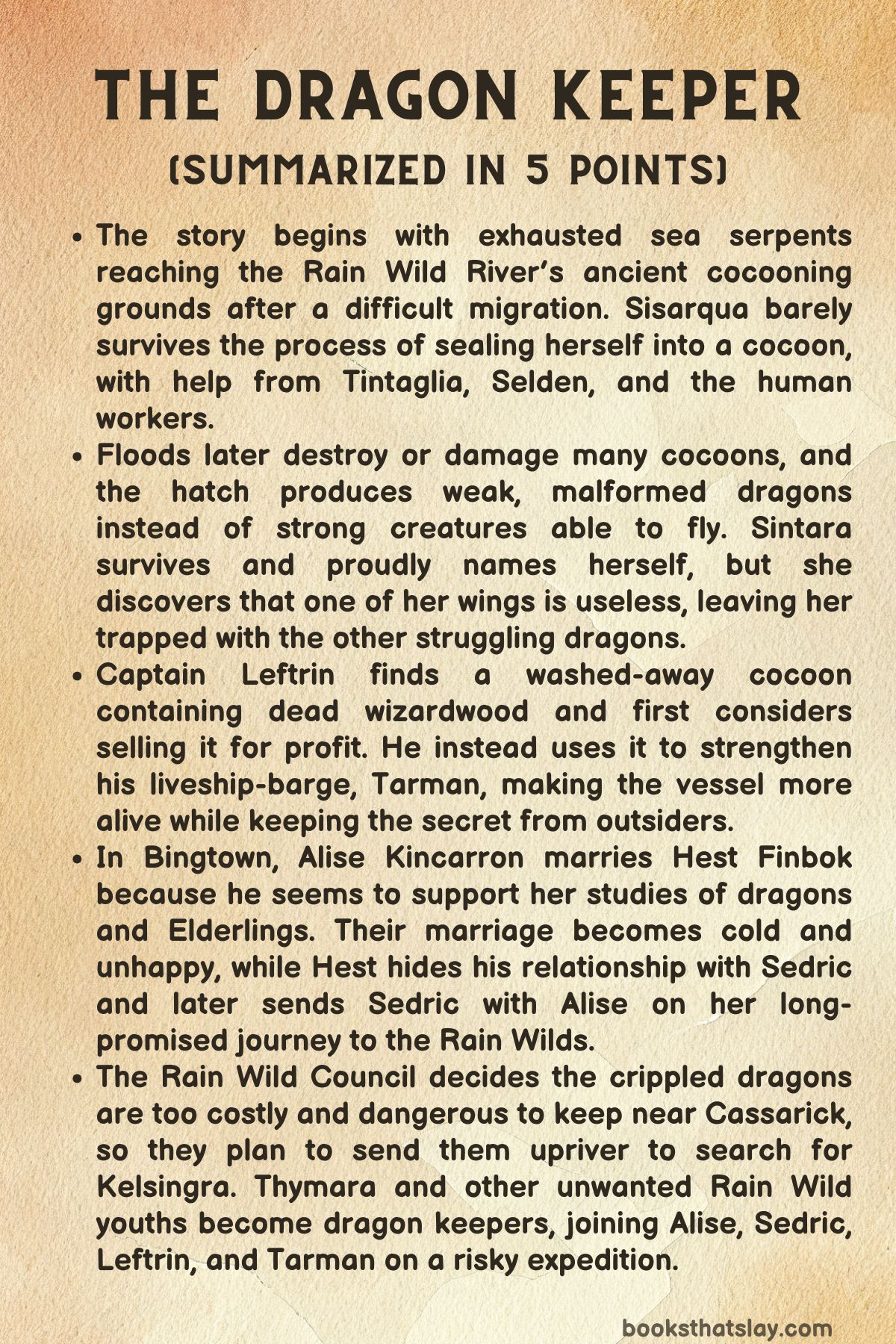
The Dragon Keeper begins with the long, difficult migration of sea serpents to their ancient cocooning grounds on the Rain Wild River. These serpents are the last hope for the rebirth of dragons, but their journey has been cruel.
They arrive too late in the season, weakened by age, injury, hunger, and the dangers of the river. Tintaglia, the only adult dragon there to guide them, tries to help, but even she cannot undo the damage caused by time and hardship.
Humans from the Rain Wilds assist by preparing the special clay mixture the serpents need to seal themselves into cocoons.
One serpent, Sisarqua, struggles badly. Her strength is nearly gone, and she cannot fully close her protective case.
If the cocoon is not sealed, she will die before transformation can begin. The young Elderling Selden notices her danger and calls for help.
Tintaglia and the workers cover Sisarqua in wet clay, giving her a chance to survive. The serpents settle into their cocoons for the winter, but nature is not kind to them.
Floods later damage many of the cases, and some are swept away. What should have been a great return of dragons becomes uncertain before it has even begun.
Captain Leftrin, master of the liveship barge Tarman, later finds one of the lost cocoons caught in the forest. Inside is a dead dragon, and the material of the cocoon is wizardwood, rare and valuable.
Leftrin understands at once that the discovery could make him rich, especially because Chalcedeans are eager to buy dragon remains and magical materials for their own purposes. For a time, he considers selling it in secret.
Instead, he decides to use the wizardwood to strengthen Tarman. He and a few trusted workers cut and fit the wood into the barge, deepening the ship’s strange life and power.
This act must remain hidden, because it is illegal and dangerous, and it links Leftrin and his crew to a secret that could destroy them.
Years later, the long-awaited hatching takes place near Cassarick. Thymara, a young Rain Wild girl, watches with her father, Jerup.
The event should have been magnificent, but it becomes a scene of shock and disappointment. Many cocoons are dead.
Many hatchlings emerge malformed, weak, starving, or unable to fly. They are not the powerful creatures people imagined.
They are damaged animals, born from damaged serpents after a failed migration. Tintaglia brings meat for them, but there is not enough food, and the hatchlings fight to survive.
Some eat dead hatchlings and failed cocoons. When Jerup tries to help one dying dragon, he nearly gets killed, and Thymara has to warn him back.
Among the surviving dragons is Sintara, who once was Sisarqua. She is proud and beautiful, with the instincts and memories of a queen, but her body betrays her.
One of her wings is useless, and she cannot fly. Like the others, she depends on humans for food, yet she resents them.
The dragons remember fragments of the lost Elderling city of Kelsingra, where dragons and Elderlings once lived in greatness. Now they are trapped near Cassarick, hungry, bitter, and humiliated by their weakness.
Thymara’s life has always been shaped by the customs of the Rain Wilds. Children born too strongly marked by the region’s strange effects are often not supposed to survive.
Thymara has claws, scaling, and other signs that make her different. Her father spared her when she was a baby, but her existence has marked her family and made her an outsider.
She has learned to live in the trees, to move carefully, and to expect judgment from others. When the Rain Wild Council decides the dragons must be moved away from Cassarick, Thymara becomes one of the young people recruited to accompany them.
The Council’s decision is practical rather than noble. The dragons are expensive to feed, dangerous to keep nearby, and a problem for the work of excavating Elderling ruins.
Tintaglia, who once helped them, has stopped caring for them regularly after finding a mate. The Council chooses to send the dragons upriver in search of Kelsingra, though no one knows whether the city can truly be found.
Since the dragons cannot survive alone, keepers are needed. The Council chooses young Rain Wilders who are heavily marked, unwanted, poor, or socially inconvenient.
Thymara accepts the role because she has few prospects where she is. Her mother sees the journey as a way to remove a burden from the household, while her father fears for her but supports her decision.
Other young keepers join as well, including Tats and Rapskal. Each has reasons for going, but all of them are being sent into danger.
They are expected to tend creatures that are proud, hungry, and often cruel. The journey may be permanent.
The keepers may never return, and the Council appears comfortable with that possibility.
Far away in Bingtown, Alise Kincarron has built her life around scholarship. She is fascinated by dragons, Elderlings, and old records, but her society expects women to marry well and manage households.
When the dragon hatching occurs, she longs to witness it, but her family obligations and courtship prevent her from going. Hest Finbok, a wealthy Trader, courts her with careful calculation.
He gives her an ancient Elderling scroll and pretends to respect her studies. He offers a practical marriage: money, independence, servants, access to resources, and eventually permission to travel to the Rain Wilds.
Alise accepts because the arrangement seems to promise the freedom she wants.
Marriage to Hest becomes a quiet prison. He is cold, dismissive, and often absent.
He belittles her interests and avoids her except when family pressure reminds him of the need for an heir. Alise is childless, lonely, and ashamed.
She suspects that Hest may have a mistress and confronts him, but she misunderstands the truth. Hest’s real lover is Sedric, his secretary and companion.
Sedric helps Hest hide the affair and protect his reputation, while Alise remains trapped in ignorance and humiliation.
After years of delay, Alise reminds Hest that he promised she could visit the Rain Wilds. Hest resists, but Sedric advises him that refusing would make him look dishonorable.
Hest finally permits the journey, partly to be rid of Alise and partly to punish Sedric by sending him along as her escort. Sedric has motives of his own.
He hopes to obtain dragon parts and profit through Chalcedean contacts. He does not share Alise’s reverence for dragons or truth; he sees opportunity where she sees wonder and knowledge.
Alise and Sedric travel first aboard Paragon, where they hear from Althea and Brashen that the dragons are not glorious beings but crippled, grounded creatures. This warning hurts Alise, but it also strengthens her resolve.
She wants to see the truth for herself and record it honestly. She and Sedric then transfer to Tarman for the journey toward Cassarick.
Sedric dislikes the rough conditions of the barge, while Alise is eager to continue. Leftrin, meanwhile, becomes part of the Council’s plan to move the dragons upriver.
His ship, already changed by hidden wizardwood, is well suited to the dangerous waters ahead.
As the expedition forms, the lives of dragons, keepers, scholars, traders, and secret-keepers come together. Sintara and the other dragons long for Kelsingra, though they are too damaged to reach it alone.
Thymara seeks a future beyond rejection. Alise seeks knowledge and a life beyond her empty marriage.
Sedric seeks profit and escape from his own tangled loyalties. Leftrin sees both risk and reward in the journey.
Tarman, more alive than anyone fully understands, carries its own mystery. The novel ends with all these forces pointed upriver, toward danger, discovery, and the uncertain hope that the dragons may yet find a place where they can become more than broken remnants of a lost age.
Characters
In The Dragon Keeper, the characters are shaped by hunger, deformity, duty, ambition, loneliness, and the difficult question of what makes a life valuable. The dragons, humans, and liveships are all connected by survival, but each character responds to hardship differently: some grow more compassionate, some become more selfish, and some are forced into roles they never expected.
Sisarqua / Sintara
Sisarqua begins as one of the exhausted sea serpents who reaches the ancient cocooning grounds after a brutal and nearly hopeless migration. As Sisarqua, she represents the fading strength of the serpent generation: old, weakened, injured, and dependent on fragile memory and human help to complete the transformation into dragonhood.
Her near failure to seal herself inside the cocoon shows how close the dragon race is to extinction. After hatching, she becomes Sintara, a proud blue queen dragon whose self-image is grander than her physical condition.
Sintara sees herself as majestic and worthy of worship, yet her damaged wing makes her unable to fly and forces her to confront weakness. This contrast between pride and helplessness is central to her character.
She is demanding, arrogant, and often cruel in attitude, but her bitterness comes from being born into a body that cannot match her inherited memories of dragon greatness. Sintara is not simply a symbol of beauty or power; she is a damaged survivor who carries the memory of greatness while living in humiliating dependence.
Tintaglia
Tintaglia is the only mature dragon present during the serpents’ transformation, and she carries the burden of being both guide and protector. She tries to help the serpents reach dragonhood, but she is limited by the weakness of the serpents, the lateness of the season, and the scale of the disaster.
Her role makes her appear powerful, but also insufficient: even a true adult dragon cannot fully restore what has been lost. Later, her inability or unwillingness to care consistently for the crippled young dragons reveals a more complicated side of her.
Tintaglia is majestic and important, but she is not a perfect guardian. She represents the old grandeur of dragons, yet she also exposes the gap between legendary power and practical responsibility.
Her eventual distance from the hatchlings deepens the young dragons’ abandonment and helps explain their hunger, resentment, and longing for Kelsingra.
Thymara
Thymara is one of the most important human figures in the book because her life mirrors the damaged condition of the dragons. As a heavily marked Rain Wilder child, she has grown up treated as someone who should not have survived.
Her physical differences make her an outsider in her own society, and even within her family she carries the burden of being seen as a problem. This makes her especially suited to understand the dragons, who are also unwanted, malformed, and treated as a burden by the Rain Wilders.
Thymara is observant, brave, and cautious. During the hatching, she notices danger quickly and warns her father, showing that she has both intelligence and courage.
Her decision to become a dragon keeper is not only an escape from rejection but also an act of self-definition. She chooses a dangerous future because remaining in her old life would mean accepting the limits others have placed on her.
Through Thymara, the story explores what it means to be judged by the body and how survival itself can become an act of defiance.
Jerup
Jerup, Thymara’s father, is a loving and protective figure whose emotions are divided between fear and pride. He understands the danger of Thymara’s marked body in Rain Wild society, yet unlike others, he values her deeply.
His attempt to help a dying hatchling during the dragon emergence shows his compassion, but it also shows his innocence about the dangerous reality of dragons. He nearly dies because he responds with human pity to a creature that does not operate by human rules.
As a father, Jerup is especially important because he does not simply discard Thymara when the Council offers her the keeper position. He fears losing her, but he also recognizes her right to choose.
His grief gives emotional weight to Thymara’s departure and shows that even in a harsh society, genuine family love still exists.
Alise Kincarron
Alise Kincarron is a deeply sympathetic character because she is intelligent, passionate, and trapped by social expectations. Her love of dragons and Elderlings is not a passing interest; it is the center of her intellectual life.
However, as a woman in Bingtown society, her ambitions are repeatedly pushed aside by marriage expectations and family pressure. Hest’s courtship succeeds because he appears to respect the very part of her that others dismiss.
His gift of an Elderling scroll and his promise of scholarly freedom make Alise believe that marriage can give her access to the life she wants. Instead, marriage becomes another cage.
Over the years, she is neglected, belittled, and emotionally starved. Her journey to the Rain Wilds is therefore not only a research trip but a movement toward self-respect.
Alise’s strength lies in her persistence: even after years of humiliation, she continues to value knowledge, truth, and her own purpose. Her character shows the quiet courage of someone who has been underestimated for a long time but has not surrendered her inner life.
Hest Finbok
Hest Finbok is one of the most selfish and manipulative figures in the story. He treats marriage not as a partnership but as an arrangement designed to protect his reputation and satisfy social expectations.
During courtship, he gives Alise exactly what she wants to hear, presenting himself as generous, cultured, and supportive of her scholarship. After marriage, his real nature becomes clearer.
He is cold, controlling, and contemptuous, using wealth and social power to keep Alise dependent while denying her affection and respect. His relationship with Sedric reveals another layer of deception, not because of the relationship itself, but because he uses lies and manipulation to maintain control over both Sedric and Alise.
Hest’s cruelty is often emotional rather than openly violent, which makes it especially corrosive. He diminishes Alise’s confidence, mocks her interests, and only gives her freedom when it serves his own convenience.
Sedric Meldar
Sedric is morally complex because he is both victim and deceiver. As Hest’s secretary and secret lover, he lives in dependence on a man who uses him, but Sedric also participates in Hest’s lies and helps humiliate Alise.
His loyalty to Hest is mixed with fear, desire, ambition, and resentment. When he accompanies Alise to the Rain Wilds, he does not begin as a noble companion; he carries secret intentions involving dragon parts and profit through Chalcedean connections.
This makes him dangerous, especially because the dragons are already vulnerable. Yet Sedric is not flatly villainous.
His weakness comes from wanting security and affection in a world where he has attached himself to someone selfish and cruel. His character is important because he shows how dependence can corrupt judgment.
He understands more than Alise does about Hest’s true nature, but he still helps preserve the false life that traps them all.
Captain Leftrin
Captain Leftrin is practical, secretive, and morally flexible, but he is not heartless. His discovery of the washed-away cocoon gives him access to dead wizardwood of immense value, and his first reaction shows temptation.
He understands how much money could be made from such a thing, especially through forbidden trade. However, his decision to use the wizardwood for Tarman instead of simply selling it shows a different kind of loyalty and ambition.
Leftrin is tied to his ship in a way that goes beyond ownership. He wants Tarman to become stronger and more alive, and his secrecy is partly protective.
As captain, he is used to making hard decisions in morally gray circumstances. He is not a pure hero, but he has warmth, competence, and a strong sense of responsibility toward his vessel and crew.
His role connects the human world of trade and profit with the mysterious living power of wizardwood.
Tarman
Tarman is not merely a barge but a liveship with growing awareness and personality. The addition of wizardwood makes him more alive and more powerful, turning him into an important presence rather than a simple means of transportation.
Tarman’s character is quiet compared with the humans and dragons, but he represents one of the story’s central mysteries: the blurred boundary between object, creature, memory, and soul. His bond with Leftrin gives emotional depth to both of them.
Tarman also becomes essential because he can carry the expedition into dangerous territory. In a story filled with damaged bodies and incomplete transformations, Tarman is another being in the process of becoming more than others expect him to be.
Selden
Selden appears briefly but meaningfully as the young Elderling who helps save Sisarqua during the cocooning. His call for help at the right moment allows Tintaglia and the workers to close the failing case.
Even though he is not central in the supplied events, his presence matters because he bridges human, Elderling, and dragon worlds. Selden represents sensitivity to dragon needs and a kind of instinctive connection that ordinary humans do not fully possess.
His intervention shows that survival sometimes depends not on strength but on attention, timing, and the willingness to act when others do not yet understand the danger.
Tats
Tats is one of the young people recruited as a dragon keeper, and his importance lies in his connection to the group of unwanted or socially marginal youths chosen for the expedition. Like Thymara, he belongs to a future that ordinary Rain Wild society does not fully value.
His decision to join the keepers places him among those who must create a new identity away from the rules that have judged them. Tats helps represent the human side of the expedition’s larger pattern: the dragons are damaged and unwanted, and so are many of the youths assigned to them.
His role suggests that the journey upriver is not only about finding Kelsingra but also about giving rejected young people a chance to become necessary.
Rapskal
Rapskal is another recruited keeper, and he brings a different energy to the group. Where Thymara is cautious and shaped by fear of rejection, Rapskal appears connected to imagination, possibility, and the dream of something greater.
His presence is important because the expedition needs more than endurance; it also needs belief. In a world where the dragons are dismissed as crippled burdens and the keepers are treated as expendable, Rapskal helps embody wonder and openness to the lost Elderling past.
He suggests that Kelsingra is not only a destination but also a dream powerful enough to pull damaged people and creatures toward transformation.
Sinad Arich
Sinad Arich represents the threat of greed from outside the Rain Wilds. As a Chalcedean trader interested in forbidden goods and dragon-related materials, he brings the wider world’s hunger for profit into the story.
His pressure on Leftrin is significant because it shows that dragons are not only endangered by weakness and neglect, but also by markets that reduce them to valuable parts. Sinad’s presence makes the danger more concrete.
The dragons’ bodies, even dead or damaged, are worth money to people who do not see them as living beings. Through him, the book shows how commerce can become predatory when rare life is treated as merchandise.
Althea
Althea appears as someone who helps bring Alise closer to the truth about the dragons. Her warning that the creatures are not glorious, perfect beings but damaged and grounded animals challenges Alise’s romantic expectations.
Althea’s role is important because she respects reality over fantasy. She does not try to preserve Alise’s idealized vision, but she also does not destroy Alise’s purpose.
Instead, she helps prepare her for the painful truth. Althea represents experience, honesty, and the kind of practical knowledge that Alise needs before entering the Rain Wild world.
Brashen
Brashen, like Althea, contributes a grounded perspective. He understands that the dragons are not the magnificent creatures Alise may have imagined from scrolls and study.
His role is not large in the supplied events, but it is meaningful because he helps mark the transition between Alise’s scholarly dream and the harsh reality she is about to face. Brashen’s presence reinforces the difference between legends and living beings.
The dragons of The Dragon Keeper are not distant symbols of wonder; they are hungry, wounded, dangerous, and real.
Paragon
Paragon serves as an important contrast to Tarman and to the dragons. As a liveship, he belongs to the same mysterious world of wizardwood, memory, and living vessels.
His presence on Alise and Sedric’s journey reminds the reader that ships in this world can possess identity, history, and emotional force. Although Paragon does not dominate the supplied events, his role helps prepare the atmosphere for Tarman’s importance.
He also connects Alise’s journey to a larger world where liveships, dragons, serpents, and Elderlings are all part of the same deep pattern of transformation and memory.
Themes
Survival and the Burden of Imperfection
Survival in The Dragon Keeper is shown as painful, uneven, and often humiliating rather than heroic. The dragons are born from a failed migration and damaged cocoons, so their lives begin with weakness, hunger, and disappointment.
They are supposed to represent power and wonder, yet many cannot fly, hunt, or even move with dignity. This changes the meaning of survival: staying alive is not enough, because the survivors must also face shame, dependence, and the judgment of others.
Thymara’s life reflects the same struggle. She has survived despite being marked in ways her society considers unacceptable, but that survival leaves her treated as a burden rather than a miracle.
The theme shows that weakness does not erase worth. The damaged dragons and unwanted keepers are not useless simply because they fail to match old ideals.
Their journey suggests that survival becomes meaningful when those who are rejected begin to claim purpose beyond what society expected from them.
Social Rejection and the Search for Belonging
Many characters live under rules that decide who is acceptable and who should be hidden, used, or sent away. Thymara is judged because of her Rain Wild markings, and her family’s love is mixed with fear, shame, and practicality.
The keepers are chosen not because they are honored, but because they are considered expendable. This makes the expedition both an opportunity and an exile.
The dragons face a similar rejection. Once imagined as magnificent beings, they become inconvenient creatures near Cassarick, too costly to feed and too damaged to inspire respect.
Alise also experiences rejection, though in a more polished social setting. Her intelligence and passion are tolerated only when they do not disturb family duty, marriage expectations, or male control.
Through these parallel lives, the narrative questions societies that value people only when they are useful, beautiful, obedient, or profitable. Belonging is not freely given here; it must be built among those who understand exclusion.
Exploitation, Greed, and Moral Compromise
The desire to profit from dragons appears in both open and hidden forms. Dragon bodies, wizardwood, ancient artifacts, and forbidden goods all attract people who see rare life as a source of wealth.
Leftrin’s discovery of the dead cocoon places him in a moral conflict: he understands its value and first considers secrecy and profit, yet he also has bonds of loyalty that complicate simple greed. Sedric’s motives are darker because he travels under the cover of service while secretly hoping to gain dragon parts for Chalcedean trade.
The Council’s decision to move the dragons also carries moral compromise. It may seem practical, but it is driven by convenience, expense, and the wish to remove a problem from Cassarick.
The theme shows how exploitation often hides behind reasonable explanations. People may call their actions business, survival, scholarship, or civic planning, but the question remains whether they are protecting vulnerable lives or turning them into resources.
Freedom, Self-Discovery, and Escape from Assigned Roles
The journey upriver becomes a path toward freedom for characters who have been trapped by expectations. Thymara accepts the keeper role because remaining at home means continuing as someone pitied, feared, or quietly unwanted.
The expedition is dangerous, but it gives her a chance to define herself through action rather than through the marks on her body. Alise’s travel to the Rain Wilds is also an escape from a marriage that has reduced her to appearances, duty, and silence.
Her scholarship, once treated like an eccentric hobby, becomes a way to reclaim judgment and purpose. Even the dragons struggle against assigned roles.
They carry memories of greatness but live in bodies that cannot fulfill those memories, forcing them to seek a new future rather than simply inherit an old one. Freedom here is not easy or romantic.
It requires leaving safety, facing painful truths, and accepting that identity must be chosen under difficult conditions.