The Gathering Storm Summary, Characters and Themes
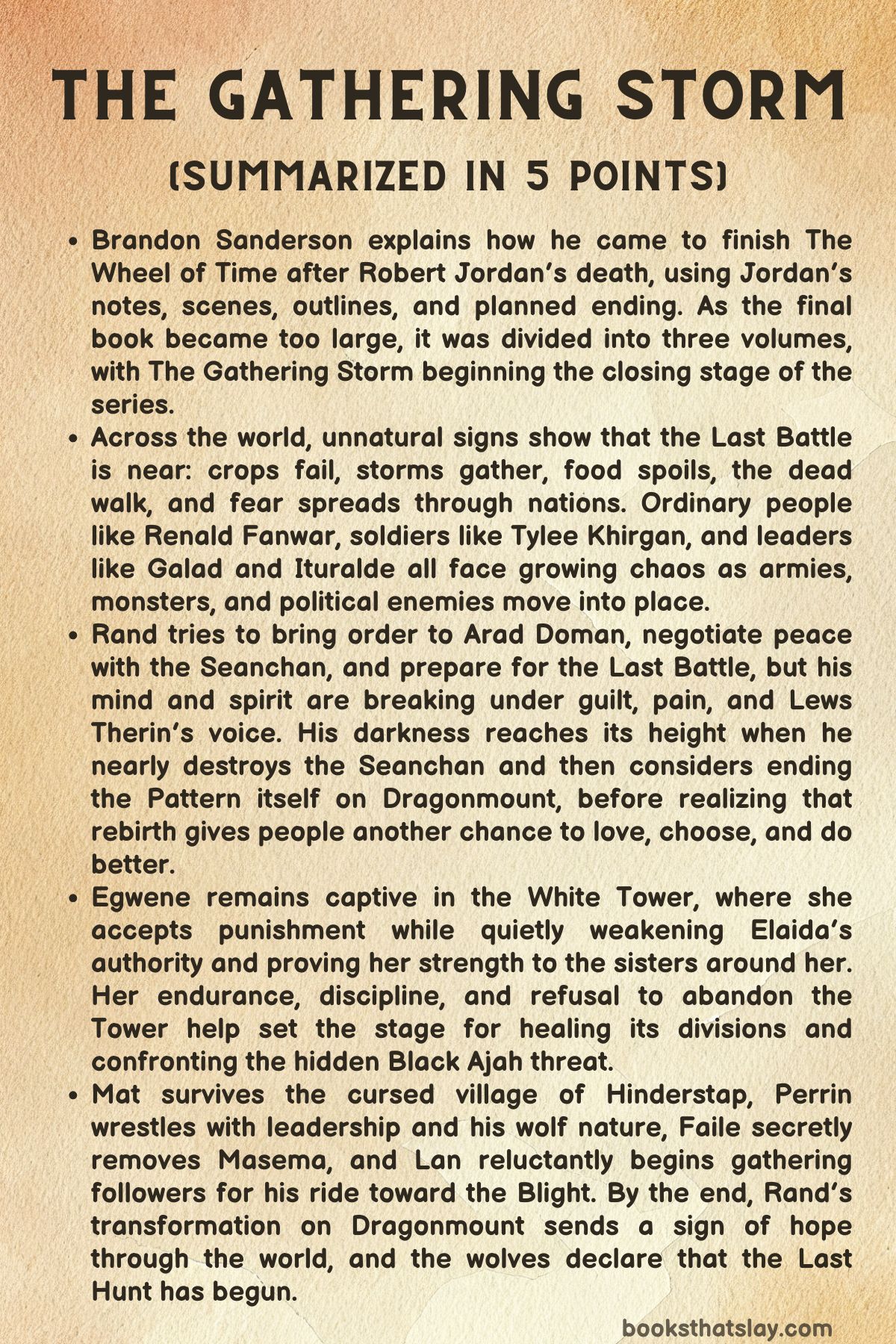
The Gathering Storm is the twelfth book in Robert Jordan’s The Wheel of Time series and the first volume completed with Brandon Sanderson after Jordan’s death. It marks the beginning of the final movement toward Tarmon Gai’don, the Last Battle.
The world is breaking under the Dark One’s touch, and every major character is pushed toward a choice that will define who they are. Rand al’Thor is at the center of the novel, struggling with fear, anger, madness, duty, and the terrible cost of being the Dragon Reborn. The book is tense, large in scale, and focused on change.
Summary
The Gathering Storm begins in a world that is visibly falling apart. Across the nations, the Dark One’s influence is no longer hidden or subtle.
Food spoils without reason, insects gather in unnatural swarms, the dead are seen walking, crops fail, animals behave strangely, and ordinary people sense that something terrible is approaching. In the Borderlands, Renald Fanwar, an old farmer, sees black and silver storm clouds gathering in the north.
The clouds seem to move closer whenever he looks away. His friend Thulin arrives with his family, livestock, and possessions, abandoning home because he believes the end has come.
Thulin urges Renald to gather supplies and weapons and go north. Renald understands that this is no ordinary storm, so he begins preparing his household and reforging a scythe into a weapon.
Lan Mandragoran rides east along the Blight, determined to face death alone. Nynaeve has arranged for him to reach the Borderlands, but she has also spread the word that the Golden Crane has been raised.
Lan wants no army, no glory, and no followers, yet men begin finding him. Bulen, a young Malkieri man, asks to ride with him and to wear his father’s hadori.
Lan resists at first but cannot deny the duty and identity that bind them both. More men later join him, and Lan realizes that his private march toward death is becoming something larger than he intended.
Rand al’Thor, meanwhile, is in a dark and unstable state after the attack by Semirhage. He sends Falendre, a Seanchan sul’dam, back to the Daughter of the Nine Moons with a message that he still wants peace.
Rand knows he must stop fighting the Seanchan before the Last Battle, but he is also angry, wounded, suspicious, and increasingly detached from those around him. He has lost a hand, his vision is troubled, his old wounds torment him, and Lews Therin’s voice continues to speak inside his mind.
Min worries over him, while Cadsuane, Nynaeve, and Alivia try to question Semirhage. Rand refuses to allow torture, even when dealing with a Forsaken, but his emotional control is clearly weakening.
The Forsaken continue their own movements. Graendal is summoned by Moridin to a black fortress in the Blight, where Demandred and Mesaana are also present.
Mesaana wants Semirhage rescued, but Moridin refuses because Semirhage disobeyed orders by harming Rand. Demandred still wants Rand alive so he can kill him personally.
Moridin then gives Graendal a special task: prevent Rand from bringing peace to Arad Doman and cause him frustration, grief, and suffering.
In Arad Doman, Rand tries to restore order to Bandar Eban. The city is starving, the port is failing, and its rulers are corrupt or frightened.
Rand installs himself in a noble mansion, questions Milisair Chadmar about King Alsalam, and searches for clues that may lead him to Graendal. His goal is to stabilize the country, negotiate with the Seanchan, and move toward the Last Battle, but his own mind is becoming one of his greatest enemies.
Egwene al’Vere remains captive in the White Tower, officially reduced to novice status but spiritually stronger than most of the sisters around her. Elaida believes she can humiliate and break Egwene, but Egwene uses every punishment as proof of her strength.
She quietly resists, speaks with calm authority, and undermines Elaida’s rule from within. At Elaida’s dinner, Egwene sees how deeply the Tower has been damaged by fear, arrogance, and division.
She learns that Elaida may try to change the Three Oaths to force obedience to the Amyrlin. Egwene is horrified but controls herself, choosing careful resistance over open defiance.
Even when beaten by Silviana, she finds a strange freedom in knowing that pain cannot truly defeat her.
Mat Cauthon travels toward Andor with Thom, Talmanes, the Redarms, and the Aes Sedai. They stop at Hinderstap, a village that first seems peaceful but carries a terrible secret.
The mayor warns all outsiders to leave before nightfall but refuses to explain why. Mat gambles with the villagers and wins food, horses, ale, and supplies, but as darkness falls the entire village descends into madness.
The villagers murder each other and attack outsiders without reason. Mat and his men fight their way through the streets, rescue Thom and the Aes Sedai, and escape.
At dawn, the dead villagers are alive again, and the village appears normal. The mayor explains that every night the people lose themselves to violence, die, and wake again in their beds.
Outsiders caught in the curse become trapped too. Mat retrieves the supplies and learns that someone in Trustair is looking for both him and Perrin.
Perrin Aybara remains burdened by leadership, guilt, and fear of the wolf within him. He dreams of Master Luhhan’s smithy, of Aram’s death, and of the people who depend on him.
He has rescued Faile from the Shaido, but he is not at peace. The Whitecloaks, now led by Galad Damodred, block his path and hold some of his people.
Galad has heard Byar’s claims that Perrin is a murderer, a creature of the Shadow, and a dangerous commander of strange forces. Perrin prepares to negotiate but also knows conflict may come.
Faile, acting secretly, arranges plans to rescue him if the Whitecloak trial becomes a trap.
Galad himself faces his own crisis. He leads thousands of Children of the Light through difficult land, trying to avoid Asunawa and bring his men toward the Last Battle.
When betrayed and trapped by Asunawa’s army, Galad surrenders to prevent Children from killing Children. He is beaten by Questioners, but his willingness to suffer for justice strengthens his moral authority.
Later, as Lord Captain Commander, he decides he must confront Perrin, not out of hatred but because he believes justice demands it.
Other fronts show the world sliding toward war. Rodel Ituralde tricks a large Seanchan force near Darluna, using hidden troops and disguised soldiers to spring a deadly trap.
Tylee Khirgan, after helping Perrin defeat the Shaido, is ambushed by Trollocs near Ebou Dar. Masema, the Prophet, flees after Malden with only a few followers left, still blaming Perrin and Darkfriends for his fall.
Faile ambushes him in the forest and kills him, deciding that Perrin must never know.
Aviendha travels with the Wise Ones through Arad Doman, troubled by her uncertain place among the Aiel. She is no longer a Maiden, not yet fully a Wise One, and still hopes to marry Rand.
The Wise Ones keep assigning her humiliating tasks, including sorting thousands of seeds by color. Aviendha struggles to understand what she has done wrong and how she can restore her honor.
Rand’s darkness reaches its most dangerous point after a failed meeting with Tam al’Thor. Cadsuane has arranged for Tam to speak with Rand, hoping his father can reach him, but Rand feels manipulated when he realizes Tam has been guided by Aes Sedai words.
In a terrifying moment, Rand nearly kills his own father. Shocked by what he has almost done, he flees with the access key to the Choedan Kal.
Rand goes to Ebou Dar intending to destroy the Seanchan. Walking through the city in disguise, he expects cruelty and misery, but he sees order, safety, and ordinary people living peacefully.
He still hates the Seanchan practice of enslaving channelers, yet the sight of people protected under their rule unsettles his certainty. Near the palace, he prepares to use the Choedan Kal to wipe out the Seanchan leadership, ships, armies, and cities.
But the sickness that strikes him when he channels overwhelms him, and he collapses. Strangers gather around him with concern.
Their simple compassion stops him from committing mass destruction.
He flees to Dragonmount, where despair nearly destroys him. Sitting at the peak, Rand thinks about all the pain of his life: Moiraine’s loss, his captivity, the deaths caused by his choices, the burden of being the Dragon Reborn, and the endless turning of the Wheel.
He considers using the Choedan Kal to destroy the Pattern itself and end all suffering forever. Then Lews Therin’s voice becomes clear and offers a different answer: people are reborn so they can have another chance.
Rand realizes that rebirth means love can return as well as pain. He understands that he is not fighting only because he must, but because he wants to do better than before.
Instead of destroying the world, he destroys the access key. The unnatural storm breaks, sunlight shines over Dragonmount, and Rand laughs with real joy.
Perrin sees this moment from the wolf dream with Hopper. He watches the darkness around Rand break apart as light spreads across Dragonmount.
The wolves howl in victory, and Hopper declares that the Last Hunt has begun. In the White Tower, Egwene also sees sunlight over Dragonmount and recognizes that something important has changed.
By the end of The Gathering Storm, the world remains near collapse, but Rand has passed through his darkest moment and returned with hope.
Characters
In The Gathering Storm, the characters are shaped by a world approaching collapse, and much of the book’s emotional force comes from watching different people respond to fear, duty, guilt, madness, faith, power, and the coming Last Battle.
Rand al’Thor
Rand is the central figure of the book’s darkest emotional arc. He is not merely a ruler preparing for war; he is a man trying to turn himself into something harder than human because he believes softness will make him fail.
His missing hand, failing vision, old wounds, and the voice of Lews Therin all show how physically and mentally broken he has become. Yet his deepest struggle is moral rather than physical.
He wants peace with the Seanchan and stability in Arad Doman, but he increasingly treats compassion as weakness. His refusal to torture Semirhage shows that some part of his old self still survives, but his near murder of Tam and his plan to destroy Ebou Dar reveal how close he comes to losing himself completely.
His moment on Dragonmount is the turning point: instead of ending existence, he understands that rebirth means the possibility of love, repair, and second chances. Rand’s laughter at the end marks not simple happiness, but spiritual release after nearly becoming the thing he was fighting.
Egwene al’Vere
Egwene is one of the strongest examples of quiet resistance in the book. Though physically powerless in the White Tower and treated like a novice, she uses discipline, dignity, and moral clarity to undermine Elaida from within.
Her strength does not come from defiance alone; it comes from patience and from her ability to understand institutions. She sees that the Tower is broken not only because of political division, but because its leaders have forgotten what Aes Sedai are supposed to represent.
Her endurance under Silviana’s punishments shows that she can transform suffering into authority. Egwene’s laughter during punishment is not madness, but a sign that Elaida can hurt her body without mastering her will.
She becomes more Amyrlin-like while technically being treated as the least powerful person in the Tower.
Perrin Aybara
Perrin’s conflict is rooted in responsibility and identity. He is haunted by Aram’s death, by the violence committed in his name, and by his fear that the wolf within him may consume the man he wants to be.
His dreams of forging metal reveal how he thinks of leadership: people are not abstract followers to him, but living burdens he must shape, protect, and sometimes fail. Perrin’s training with Hopper in the wolf dream forces him to face fear directly rather than avoid it.
His vision of Rand surrounded by darkness shows his deep connection to the larger struggle, even though his own problems feel local and personal. Perrin is a reluctant leader, but that reluctance is part of his moral strength because he understands the cost of command.
Mat Cauthon
Mat remains clever, irreverent, and outwardly careless, but the events in Hinderstap reveal his hidden seriousness. He jokes, gambles, and manipulates situations with ease, yet when Delarn is wounded, Mat risks himself without hesitation.
His luck and daring allow him to win the wager against Barlden, but his true character appears in crisis: he does not abandon his people, even when doing so would be easier and safer. The cursed village also forces Mat to confront a world where ordinary rules no longer apply.
His instinct is practical rather than philosophical, but he recognizes danger quickly and adapts faster than most. Mat’s humor masks a loyal and capable commander who often does the right thing while pretending he has no interest in heroism.
Lan Mandragoran
Lan is defined by honor, grief, and fatal purpose. He intends to ride alone toward death because he sees his life as a weapon that must be spent against the Shadow.
His refusal to gather followers is not cowardice, but a desire to spare others from sharing his doomed path. Yet Bulen and the other Malkieri expose the flaw in Lan’s thinking: he cannot separate himself from the people who still see him as their king.
His anonymity as Andra is an attempt to deny history, but history follows him. Lan’s arc shows that duty is not only a private burden; it is also a bond between leader and people.
He wants to die as a solitary warrior, but the Golden Crane makes that impossible.
Nynaeve al’Meara
Nynaeve is emotionally fierce, loyal, and deeply protective, especially toward Rand and Lan. She is one of the few characters who still responds to Rand as a person rather than only as the Dragon Reborn.
Her frustration often comes out as anger, but beneath it is fear that the people she loves are destroying themselves. With Lan, she acts decisively by sending him toward the Borderlands while ensuring he will not truly ride alone.
With Rand, she struggles because healing his body is easier than healing his spirit. Nynaeve represents a kind of compassion that refuses to be passive.
She may be abrasive, but her anger is usually rooted in love and responsibility.
Min Farshaw
Min serves as Rand’s emotional anchor, though even she cannot fully reach him during his darkest moments. Her worry for him is constant, but she is not merely a concerned companion; she observes him closely and understands the danger of his increasing hardness.
Her ability to interpret events, such as recognizing where Rand has gone after taking the access key, makes her practically important as well as emotionally central. Min’s tragedy in this part of the story is that love gives her insight but not control.
She sees Rand slipping away and can sense the disaster forming, yet she cannot force him back from the edge. Her presence emphasizes how isolated Rand has become.
Cadsuane Melaidhrin
Cadsuane is powerful, intelligent, and experienced, but her greatest weakness is her reliance on control. She understands that Rand must be taught laughter and tears, yet her methods often worsen the very hardness she wants to break.
Her confrontation with Tam exposes this flaw clearly. When Tam calls her a bully, he identifies the central problem with her approach: she treats people as tools to be placed and pushed.
Cadsuane is not malicious, and her goal is necessary, but she underestimates the emotional damage caused by manipulation. Her authority is real, yet the book shows that authority without tenderness can fail when dealing with a soul as wounded as Rand’s.
Tam al’Thor
Tam represents the simple, grounded humanity Rand has almost lost. He is not a political schemer, channeler, or legendary ruler; he is a father who knows his son as a person before knowing him as a prophecy.
His refusal to follow Cadsuane’s script is important because it shows moral honesty. Tam understands that speaking to Rand with borrowed words would be false, and Rand desperately needs truth rather than strategy.
His calmness when Cadsuane tries to intimidate him reveals quiet courage. Tam’s meeting with Rand becomes painful because it nearly ends in murder, but it also helps trigger Rand’s final crisis and transformation.
Tam’s strength lies in decency, humility, and emotional truth.
Faile Aybara
Faile is politically sharp, loyal, and capable of ruthless action when she believes Perrin must be protected. Her killing of Masema shows a side of her that is decisive and morally dangerous.
She does not act from cruelty, but from a belief that some threats cannot be allowed to continue. Her secrecy afterward reveals the burden of that choice: she knows Perrin would struggle with what she has done.
Faile’s preparations around Perrin’s trial also show her practicality. She respects Perrin, but she is not passive in his fate.
She is willing to arrange escape plans, gather allies, and make hard decisions in the shadows. Her love is active, strategic, and sometimes severe.
Hopper
Hopper is more than a guide in the wolf dream; he is a mentor who teaches Perrin how to understand fear, instinct, and identity. His lessons are harsh because the wolf dream is dangerous, but they are rooted in wisdom.
Hopper does not allow Perrin to hide from nightmares or from the wolf part of himself. He pushes Perrin toward mastery rather than denial.
His recognition of the great change at Dragonmount gives him a mythic role as well, connecting Perrin’s private training to the cosmic struggle. Hopper represents ancient knowledge, loyalty, and the fierce clarity of the wolves.
Aviendha
Aviendha’s arc centers on honor, uncertainty, and transition. She is no longer a Maiden in the way she once was, but she has not yet fully become a Wise One.
This leaves her suspended between identities, unsure of what is expected from her and frustrated by punishments she does not understand. Her desire to marry Rand is important, but it does not erase her need to earn her own place among the Aiel.
The seed-sorting punishment captures her internal struggle: she is being forced into patience, humility, and reflection. Aviendha is proud, disciplined, and sincere, but she must learn that strength is not only shown through battle or open defiance.
Rhuarc
Rhuarc is a steady and respected Aiel leader whose calm authority contrasts with the chaos spreading across the wetlands. His presence with Aviendha shows the disciplined side of Aiel leadership.
He scouts, observes, and acts without unnecessary drama. Rhuarc represents tradition, practical wisdom, and the collective seriousness of the Aiel as the world approaches the Last Battle.
He is not emotionally exposed in the same way as Rand or Perrin, but his steadiness matters because he provides structure for those around him.
Amys
Amys is one of the Wise Ones shaping Aviendha’s difficult training. Her role is not to explain every lesson, but to force Aviendha into self-examination.
She embodies the Aiel belief that wisdom must be earned through endurance, humility, and insight. Amys may appear severe, but her severity is purposeful.
She is helping transform Aviendha from a warrior who acts directly into a woman who must understand deeper obligations.
Bair
Bair contributes to the collective authority of the Wise Ones. She represents age, tradition, and uncompromising standards.
Her treatment of Aviendha may seem harsh, but it reflects the Aiel method of teaching through pressure rather than comfort. Bair’s character helps show that Wise Ones do not simply possess power; they enforce cultural continuity and demand maturity from those who would join them.
Melaine
Melaine is another Wise One whose role reinforces the communal nature of Aiel guidance. She is part of the group that refuses to give Aviendha easy answers.
Her presence suggests that Aviendha’s struggle is not personal cruelty from one mentor, but a deliberate process shaped by Aiel custom. Melaine helps represent the balance between care and severity within Wise One training.
Nadere
Nadere is linked to Aviendha’s continued instruction and discipline. Though less central than some of the other Wise Ones, she contributes to the pressure surrounding Aviendha’s transformation.
Her presence reminds the reader that Aviendha is being watched and measured by a culture that takes honor and readiness seriously.
Galad Damodred
Galad is driven by justice, but his idea of justice is both noble and dangerous. He refuses to let Children of the Light kill one another unnecessarily, even when surrender means personal suffering.
This shows real courage and self-sacrifice. At the same time, his later response to Byar’s accusations against Perrin reveals the risk of rigid moral thinking.
Galad wants to do what is right, but he can be misled by incomplete evidence because he believes truth should be clear and actionable. His strength is integrity; his weakness is that integrity can become inflexible when separated from doubt.
Gawyn Trakand
Gawyn is torn between loyalty, frustration, and wounded pride. Near Tar Valon, he shows restraint by refusing to attack a rebel patrol simply for tactical satisfaction.
This proves he is not reckless in every situation. Yet his arguments about rescuing Egwene reveal how difficult it is for him to accept her authority and choices.
He loves her, but his love is mixed with a desire to act as protector even when she has chosen a different path. Gawyn’s conflict comes from being brave and capable while not yet wise enough to understand when action becomes interference.
Elaida do Avriny a’Roihan
Elaida represents corrupted authority. Her power as Amyrlin is legal in form but spiritually empty.
Her dinner conversation, especially her interest in changing the Three Oaths to require obedience to the Amyrlin, reveals her authoritarian nature. She does not understand that leadership depends on trust, legitimacy, and service.
Elaida’s cruelty is casual, which makes it especially chilling. She sees punishment as a tool of control and dissent as personal betrayal.
In contrast to Egwene, who gains authority while imprisoned, Elaida loses moral authority while sitting at the height of power.
Silviana Brehon
Silviana is stern, disciplined, and committed to order, but she is not portrayed as petty or corrupt in the same way as Elaida. Her punishments of Egwene are severe, yet they are part of her role rather than personal sadism.
This makes her an important contrast within the Tower: she can enforce harsh rules while still possessing a sense of institutional duty. Egwene’s relationship with Silviana is complex because punishment becomes a strange arena of mutual recognition.
Silviana’s presence helps show that not all opposition to Egwene is morally rotten.
Meidani
Meidani is frightened, compromised, and trapped by Tower politics. Her fear under Elaida’s control shows the emotional cost of the Tower’s division.
She is not heroic in an obvious way, but her situation matters because it reveals how intimidation can break even experienced Aes Sedai. Egwene’s secret command to her shows Egwene’s ability to inspire action in those who have nearly lost courage.
Meidani represents the many people inside broken institutions who are not evil, but are afraid.
Alivia
Alivia is a former damane whose presence near Rand carries quiet significance. Her role in the questioning of Semirhage places her among those dealing with the most dangerous enemies in the world.
Though she does not dominate the events described, she represents survival after enslavement and the complicated power of someone shaped by Seanchan cruelty. Her existence also sharpens the moral conflict around the Seanchan: they may bring order, but their treatment of channelers remains monstrous.
Semirhage
Semirhage is terrifying because her cruelty is disciplined, intelligent, and intimate. Even as a prisoner, she remains dangerous because fear surrounds her reputation and because her actions have already wounded Rand deeply.
Her refusal to reveal much under questioning shows both arrogance and control. She is not merely an enemy general; she is a specialist in pain, humiliation, and psychological domination.
Rand’s refusal to torture her becomes morally significant precisely because she herself would never show such restraint.
Graendal
Graendal is manipulative, observant, and self-preserving. In her meeting with Moridin, Demandred, and Mesaana, she quickly reads the room and understands the hidden meanings behind status and surprise.
She is rewarded not through open praise, but through privileged information, which suits her nature as someone who thrives on secrets and emotional exploitation. Moridin’s order that she bring Rand frustration and anguish fits her talents perfectly.
Graendal is dangerous because she does not need armies to destroy people; she understands desire, weakness, and despair.
Moridin
Moridin is cold, commanding, and deeply aligned with the Shadow’s larger design. His refusal to rescue Semirhage is not carelessness, but a demonstration of ruthless hierarchy.
He values obedience and the larger plan over personal loyalty among the Forsaken. His authority over Demandred, Mesaana, and Graendal shows that he stands apart even among powerful villains.
Moridin’s menace comes from his composure. He does not need to rage to dominate; he controls by knowing more, revealing less, and making others fear the consequences of failure.
Demandred
Demandred is defined by rivalry, pride, and hidden power. His insistence that Rand be left alive because he wants to kill him personally reveals how personal his hatred is.
He is not simply serving the Shadow’s victory; he is pursuing his own vindication. His vague statement that his rule is secure and his armies are gathering suggests immense unseen preparation.
Demandred’s danger lies partly in absence: the less he reveals, the more threatening his hidden position becomes.
Mesaana
Mesaana’s claim that she is close to controlling the White Tower shows her preference for institutional corruption over open conquest. She is dangerous because she works through systems, factions, secrecy, and influence.
Her concern for Semirhage also reveals practical anxiety among the Forsaken, though Moridin refuses to indulge it. Mesaana’s presence behind Tower instability makes the internal conflict among Aes Sedai feel even more dangerous.
She represents decay from within.
Rodel Ituralde
Rodel Ituralde is a master strategist whose calm intelligence allows him to defeat stronger forces through preparation and deception. His trap at Darluna shows patience, courage, and an ability to understand enemy assumptions.
He knows the Seanchan believe they are cornering him, and he turns that confidence against them. Ituralde is not reckless; he is precise.
His character represents human military brilliance in a world increasingly dominated by supernatural threats.
Tylee Khirgan
Tylee is a capable Seanchan commander who has already shown the ability to cooperate with enemies when circumstances demand it. Her march after helping Perrin defeat the Shaido places her between discipline and uncertainty.
The strange signs she observes show that even organized military power is vulnerable to the world’s unraveling. The Trolloc ambush shatters the confidence of Seanchan order and reminds the reader that the Last Battle will not respect political boundaries.
Tylee’s competence makes the attack feel more alarming, because even skilled commanders are being overtaken by chaos.
Falendre
Falendre is a minor but revealing character because her fear shows how brutal Seanchan hierarchy can be. She is released and ordered to carry Rand’s message, but her thoughts are dominated by terror over how the disaster will be reported and whether she can avoid punishment.
Her reaction to learning that Lady Anath was actually Semirhage exposes the vulnerability of people caught inside imperial systems. Falendre is not powerful enough to shape events, but she shows how ordinary servants of empire suffer under the weight of command, failure, and fear.
Masema Dagar
Masema is a portrait of religious fanaticism curdled into delusion. He blames everyone except himself for failure and imagines divine approval for his hatred of Perrin.
His belief that Rand commanded him to kill Perrin shows how completely he has replaced reality with obsession. By the time Faile kills him, his movement has collapsed, but he remains dangerous because fanaticism can rebuild if allowed to survive.
Masema’s death is brutal, but it also closes off a threat rooted in corrupted faith.
Barlden
Barlden, the mayor of Hinderstap, is a tragic figure trapped between responsibility and helplessness. At first he appears suspicious and hostile, but the truth of the village’s curse changes the meaning of his behavior.
His insistence that outsiders leave before nightfall is an attempt to protect them from becoming part of the horror. He is ashamed, desperate, and resigned to an impossible existence.
Barlden’s return of Mat’s goods and his explanation of the curse show that he is not villainous; he is a leader of people condemned to repeat violence they cannot control.
Talmanes Delovinde
Talmanes is dry, observant, and loyal. In Hinderstap, his unease helps signal that something is wrong beneath the village’s peaceful surface.
He understands Mat well enough to follow his strange plans, but he is also sensible enough to notice danger early. Talmanes provides a steady counterweight to Mat’s flamboyance.
His loyalty is not loud or sentimental; it is shown through presence, competence, and trust under pressure.
Thom Merrilin
Thom brings experience, artistry, and deadly practicality. His performance in Hinderstap shows his ability to charm ordinary people, but when violence erupts, he becomes immediately useful in a very different way.
His thrown knives and calm under pressure reveal the dangerous man beneath the gleeman’s exterior. Thom’s discovery of the wanted poster also keeps the larger plot moving, showing that he is attentive and resourceful.
He is both storyteller and survivor.
Joline Maza
Joline’s response during the Hinderstap attack reveals the Aes Sedai instinct to intervene, even when intervention may endanger the whole group. Her desire to save the tied-up servants is morally understandable, but Mat’s urgency shows the limits of idealism in a crisis.
Joline is not heartless or foolish; rather, she represents a kind of principled impulse that can clash with battlefield practicality. Her presence also continues the tension between Mat and the Aes Sedai.
Edesina Azzedin
Edesina plays a quieter but important role through Healing. Her treatment of Delarn after the escape from Hinderstap shows the practical value of Aes Sedai power when used in direct service of survival.
She is less confrontational in the described events than Joline, but her contribution matters because without Healing, Mat’s refusal to abandon Delarn might not have been enough. Edesina represents the life-preserving side of the Power.
Delarn
Delarn matters because Mat’s treatment of him reveals Mat’s character. As a wounded Redarm thrown from his horse, he becomes a test of whether Mat will prioritize speed or loyalty.
Mat’s refusal to leave him behind confirms that his soldiers are not disposable to him. Delarn himself is not deeply explored, but his injury creates one of the clearest demonstrations of Mat’s hidden heroism.
Renald Fanwar
Renald is an ordinary man facing extraordinary signs. His fear of the unnatural storm, failed crops, dead grass, and wrongness in the world gives the book’s opening a grounded human perspective.
He is not a king or channeler, but his decision to prepare, gather people, and reforge a scythe into a weapon shows the awakening of common courage. Renald represents the ordinary people who must also face the Last Battle.
His strength lies in accepting terrible truth quickly and acting despite fear.
Auaine
Auaine’s importance comes from her immediate understanding of the danger Renald describes. She does not dismiss him or require elaborate proof.
Her reaction shows the shared emotional intelligence of people who know the land and recognize when the world has gone wrong. Auaine helps ground Renald’s decision, making the response feel communal rather than solitary.
She represents domestic steadiness at the edge of apocalypse.
Thulin
Thulin is the messenger of practical alarm in the opening movement of the story. As a smith burying his tools and abandoning home, he embodies the seriousness of the crisis.
A smith’s tools represent livelihood, identity, and stability, so burying them shows that ordinary life has been suspended. His urging Renald to come north and prepare weapons transforms fear into action.
Thulin is a practical man who understands that survival now requires accepting the impossible.
Bulen
Bulen is important because he is the first sign that Lan’s solitary ride will fail. His request to wear his father’s hadori connects personal identity to the lost nation of Malkier.
Bulen does not join Lan for glory; he joins because heritage and honor demand it. His respectful persistence forces Lan to confront the fact that he is not merely a man choosing death, but a symbol others still follow.
Bulen represents the younger generation claiming a broken legacy.
Andere
Andere is one of the men who joins Lan despite Lan’s efforts to remain anonymous. His presence reinforces the idea that Lan’s identity cannot be hidden from those who still carry Malkieri loyalty.
Andere helps turn Lan’s private death ride into the beginning of a national and symbolic gathering. He represents devotion that refuses to be dismissed.
Nazar
Nazar, like Andere and Rakim, shows that Lan’s cause belongs to more people than Lan himself. His willingness to ride with Lan suggests that memory, loyalty, and cultural identity remain alive even after the destruction of Malkier.
Nazar’s role is brief, but collectively these men make Lan face leadership as an obligation he cannot escape.
Rakim
Rakim contributes to the growing proof that the Golden Crane has meaning beyond Lan’s personal despair. His refusal to simply let Lan vanish into death helps transform the journey into something larger.
Rakim represents the persistence of a people who have lost their homeland but not their sense of duty.
Asunawa
Asunawa represents fanaticism within the Children of the Light. His willingness to trap Galad and have him beaten shows how institutions devoted to righteousness can become cruel and corrupt.
Unlike Galad, who tries to prevent Children from killing Children, Asunawa treats internal enemies as objects to be crushed. His character exposes the rot inside the Whitecloaks and makes Galad’s leadership more necessary.
Byar
Byar is dangerous because his hatred of Perrin is absolute. His accusations are shaped by prejudice, trauma, and obsession rather than balanced judgment.
To him, Perrin’s golden eyes and past conflicts are enough to mark him as Shadowspawn. Byar’s certainty is what makes him frightening.
He does not see himself as lying; he sees himself as revealing evil. His character shows how zealotry can turn partial truths into deadly falsehoods.
Jisao
Jisao serves as a contrast to Gawyn’s restraint near Dorlan. His desire to attack the rebel patrol reflects impatience and a more aggressive military instinct.
He is not presented as evil, but as someone focused on immediate tactical action. Gawyn’s refusal highlights the difference between courage and unnecessary provocation.
Jisao’s role helps show Gawyn making at least some careful decisions despite his emotional turmoil elsewhere.
Dobraine Taborwin
Dobraine is a stabilizing political servant in Bandar Eban. His restoration of order shows competence and loyalty in a city suffering from hunger, fear, and administrative collapse.
Rand sends him away, but Dobraine’s work has already mattered. He represents the kind of capable noble Rand desperately needs, even though Rand’s growing hardness makes it difficult for him to value such people properly.
Milisair Chadmar
Milisair is a political figure shaped by fear, ambition, and survival. Her imprisonment and interrogation of King Alsalam’s messenger reveal the instability and suspicion within Arad Doman’s leadership.
She is not portrayed as a grand villain, but as someone entangled in a collapsing political order. Rand’s confrontation with her shows his attempt to impose clarity on a system full of concealment.
Milisair represents the selfish and defensive habits of power during crisis.
King Alsalam
Alsalam is significant mostly through absence. His disappearance creates a vacuum that worsens Arad Doman’s chaos and allows others to maneuver around his authority.
Because he is not directly present in the described events, he functions as a symbol of failed or missing kingship. The search for him becomes part of Rand’s larger effort to restore order before the Last Battle.
Mishima
Mishima’s death during the Trolloc ambush emphasizes the sudden brutality of the Shadow’s return. As part of Tylee’s army, Mishima belongs to a disciplined military world that expects enemies to behave according to recognizable patterns.
The ambush destroys that expectation. Mishima is not developed at length, but the character’s death helps show that even organized armies are vulnerable to the chaos spreading across the world.
Aram
Aram haunts Perrin more as a memory than as an active presence. His attempt to kill Perrin and his death at Malden remain emotional wounds that Perrin has not resolved.
Aram represents Perrin’s fear that followers can be twisted by devotion, trauma, and misplaced certainty. His memory forces Perrin to question whether leadership inevitably destroys those who trust him.
Through Aram, Perrin’s guilt becomes personal and specific rather than abstract.
Lelaine Akashi
Lelaine is a political Aes Sedai who frustrates Gawyn because she refuses to rescue Egwene against Egwene’s own command. Her position may seem cold, but it also reflects respect for Egwene’s declared authority and the political reality of the rebel camp.
Lelaine represents the Aes Sedai tendency to calculate, delay, and maneuver. In this case, that caution clashes with Gawyn’s emotional urgency.
Lacile
Lacile acts as one of Faile’s sources of information during the preparations around Perrin’s trial. Her report about Galad’s intentions helps Faile assess the danger and possibility of alliance.
Lacile’s role shows the importance of quiet intelligence-gathering. She is not central, but she supports Faile’s ability to plan rather than merely react.
Dannil Lewin
Dannil is part of the Two Rivers loyalty surrounding Perrin and Faile. His involvement in Faile’s rescue preparations shows that Perrin’s people are not passive followers.
They are prepared to act if the Whitecloak trial becomes a trap. Dannil represents the dependable courage of Perrin’s home community, people who may not seek power but will stand firm when needed.
Grady
Grady’s role in Faile’s contingency planning shows the practical importance of the Asha’man allied with Perrin. His ability to create gateways and use the One Power makes escape and military planning possible in ways ordinary soldiers cannot manage.
Grady represents reliable, understated service. He is powerful, but his value here lies in disciplined cooperation.
Neald
Neald, like Grady, supports Faile’s preparations and adds channeling strength to Perrin’s side. His presence shows how Perrin’s group has become a complex alliance of Two Rivers folk, Aiel, channelers, and nobles.
Neald’s role is not emotionally central, but he helps make Faile’s plans credible and dangerous.
Themes
The Burden of Leadership
Leadership in The Gathering Storm is shown as a weight that isolates people even when they are surrounded by followers. Rand carries nations, armies, prophecies, and the fear of failure until he begins treating emotion as weakness.
His refusal to torture Semirhage shows that some moral limits remain, but his growing hardness makes him dangerous to himself and others. Perrin faces a different version of the same burden: he does not want command, yet people keep depending on him, and every death among his followers feels personal.
Lan also tries to escape leadership by riding alone, but the men who join him prove that duty cannot be abandoned simply because he wishes to die quietly. Egwene’s leadership is the most controlled and patient.
She has no army inside the Tower, yet her endurance, calm defiance, and moral clarity make her more powerful than those who hold official authority. Across these characters, leadership is not presented as glory.
It is sacrifice, responsibility, loneliness, and the constant fear of failing those who believe in you.
Despair, Hope, and Renewal
The world appears to be collapsing under signs of decay: crops fail, food spoils, dead things move, storms gather, and ordinary life becomes filled with dread. This atmosphere reflects the emotional state of many characters, especially Rand, whose despair grows until he nearly decides that existence itself is not worth preserving.
His crisis on Dragonmount is central because it turns the question of survival into a question of meaning. Rand is not merely afraid of losing the Last Battle; he is exhausted by the idea that suffering repeats endlessly.
The answer he finds is not simple optimism, but a hard-earned recognition that rebirth also allows love, correction, and second chances. Mat’s experience in Hinderstap gives a darker version of repetition, where people are trapped in nightly violence and cannot escape their curse.
Yet even there, compassion matters, as Mat risks himself for Delarn and tries to understand what has happened. Hope in the story is not the absence of darkness; it is the decision to keep choosing life despite it.
Moral Choice in a Broken World
Many characters are forced to act in situations where no option feels clean. Rand wants peace with the Seanchan because the Last Battle is approaching, but their enslavement of channelers makes any truce morally painful.
His visit to Ebou Dar complicates his hatred, because he sees order, safety, and ordinary people living under a system he still knows is cruel. Faile’s killing of Masema also raises difficult questions.
Masema is dangerous, unstable, and responsible for suffering, yet her secret execution shows how survival can push people into morally shadowed action. Galad represents another angle: he values justice so strongly that he surrenders to prevent Whitecloaks from killing one another, even though it leads to his own beating.
Egwene, too, must choose restraint over open rebellion, accepting humiliation because a larger repair matters more than personal pride. The story repeatedly shows that goodness is not proved by easy declarations.
It is tested when fear, war, loyalty, and necessity all press against conscience at once.
Identity, Duty, and Self-Mastery
Several characters struggle not only against enemies but against versions of themselves they fear becoming. Perrin worries that his bond with wolves may swallow his humanity, and his training in the wolf dream becomes a test of self-command.
He must learn that control does not come from denial, but from accepting what he is without surrendering judgment. Aviendha’s uncertainty after leaving the Maidens shows another identity crisis.
She wants honor and purpose, but cannot yet understand what the Wise Ones expect from her, so her punishments become part of a painful transition into a new self. Lan is trapped between the man who wants death and the king others still recognize in him.
Rand’s struggle is the most severe: he tries to become harder than pain, harder than guilt, harder than love, until that hardness nearly destroys him. His renewal comes when he accepts that being human is not a weakness in his role.
Duty becomes meaningful only when joined to memory, love, and the will to do better.