The Gray Man Summary, Characters and Themes
The Gray Man by Mark Greaney is a fast-moving spy thriller centered on Court Gentry, a former CIA operative turned freelance assassin. Known in the covert world as the Gray Man, Court is lethal, resourceful, and nearly impossible to catch.
The story begins with a mission that creates powerful enemies and quickly becomes a cross-continent manhunt. Greaney builds the book around action, betrayal, loyalty, and survival under extreme pressure. At its core, The Gray Man is about a hunted man who could disappear but chooses to risk everything to save people who once mattered to him.
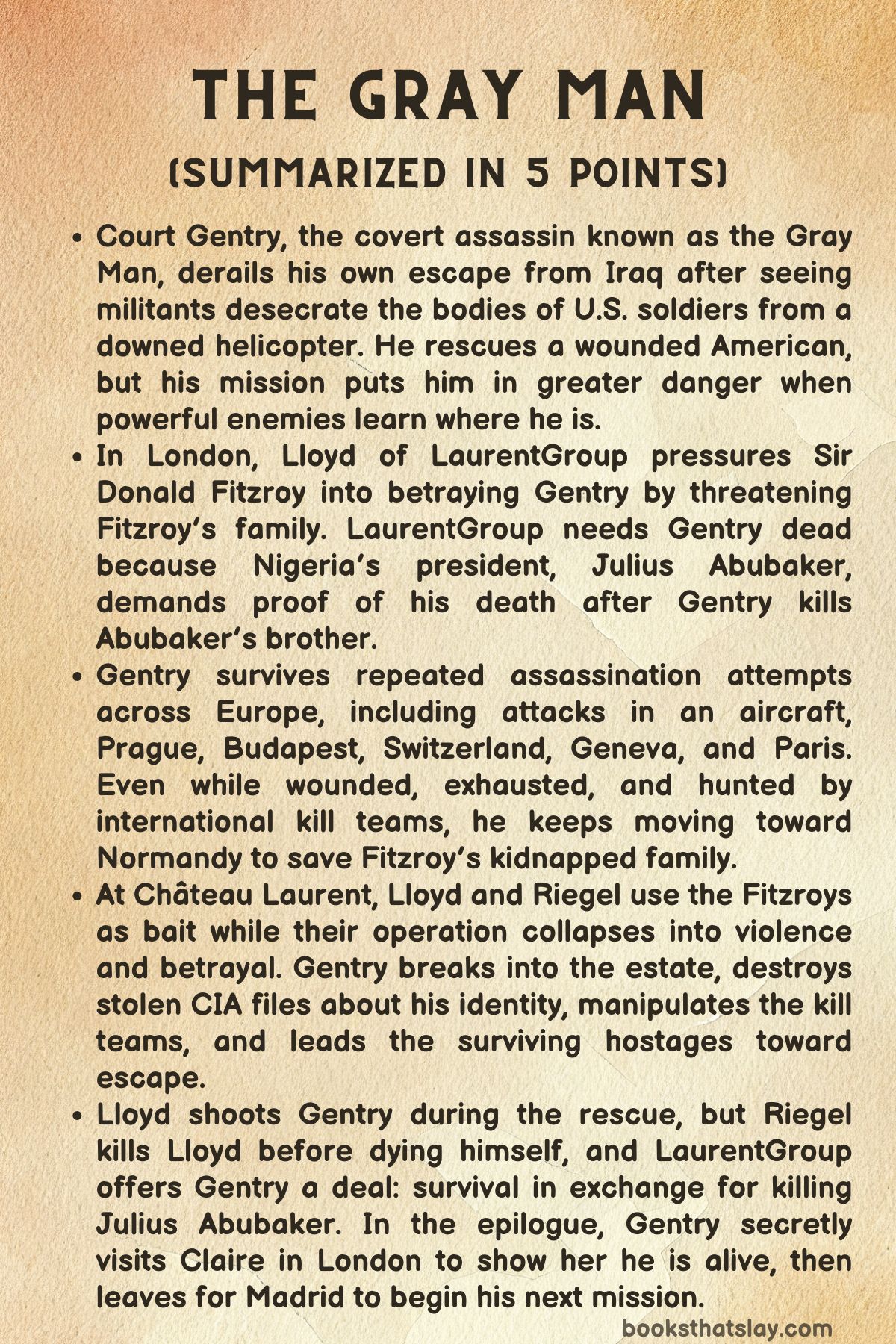
Summary
Court Gentry, the assassin known as the Gray Man, is moving through western Iraq after killing Dr. Isaac Abubaker, Nigeria’s minister of energy, in Syria. He is on his way to extraction when he sees an American Chinook helicopter shot down nearby.
Court knows the crash has nothing to do with his mission and that stopping could ruin his escape, but he cannot ignore what follows. Militants and Al Qaeda fighters gather around the wreckage, kill a wounded American survivor, abuse the bodies, and celebrate while a news crew films the scene.
Court opens fire with his sniper rifle, killing several fighters and scattering the crowd.
The attack creates a new problem for him. Surviving militants find two wounded American soldiers, Ricky Bayliss and Cleveland, hiding nearby.
They load them into a truck to use them as prisoners. Court disguises himself as a local fighter, stops the truck at a roadblock, kills the terrorists, and rescues Bayliss, though Cleveland dies.
He sends Bayliss toward a U.S. base and continues toward his own extraction.
In London, Court’s handler, Sir Donald Fitzroy, is confronted by Lloyd, an American lawyer working for LaurentGroup. Lloyd explains that Court’s target, Isaac Abubaker, was the brother of Julius Abubaker, the president of Nigeria.
Julius is threatening to cancel a huge natural gas contract with LaurentGroup unless Court is killed and his head delivered as proof. Lloyd first offers Fitzroy money to betray Court.
When Fitzroy refuses, Lloyd threatens Fitzroy’s son, daughter-in-law, and twin granddaughters.
Court reaches an abandoned Iraqi airfield, where a mercenary team led by Dulin picks him up in a cargo plane. Under pressure from Lloyd, Fitzroy orders the team to kill Court during the flight.
Court senses the attack before it begins and fights back. A violent gun battle breaks out inside the aircraft.
Court is shot in the thigh but kills the mercenaries one by one, then escapes by leaping from the rear ramp with an unconscious attacker who is wearing a parachute. The parachute opens, Court survives the landing, and Lloyd learns that the first attempt has failed.
Lloyd then kidnaps Fitzroy’s family in Normandy. Phillip Fitzroy, his wife Elise, and their daughters Claire and Kate are taken to Château Laurent.
Fitzroy is forced to tell Court that Nigerians are holding them, knowing Court will come because of his loyalty to Fitzroy and his past connection to the girls. Lloyd brings in Kurt Riegel, LaurentGroup’s security chief, who organizes a massive hunt across Europe.
Kill teams from several countries are offered huge payments to find and kill Court before he reaches France.
Court escapes Iraq with help from Kurdish police and travels through Georgia to Prague using a false Canadian identity. Injured and exhausted, he plans to recover a weapon from a cache and disappear until the Nigerian president leaves office.
In Prague, three trained killers spot him at a café and follow him into the metro. Court notices them, attacks first, and kills all three with a knife and stolen weapons.
He takes a pistol, money, and clothing from the bodies, then escapes into the city.
Fitzroy calls Court and tells him his family has been kidnapped. Court remembers Claire and Kate from an earlier assignment, when he protected them in London, and decides to go to France.
He buys an old motorcycle, retrieves supplies from a cache, and heads toward Budapest to get clean papers from Laszlo Szabo, a corrupt forger. Szabo recognizes Court from an old CIA raid and traps him in a hidden cistern beneath his workshop, hoping to sell him to the CIA or Lloyd.
Court escapes by flooding the cistern and making a crude explosive from ammunition and fabric. When a CIA team arrives, he detonates the device and blows open the trapdoor.
An Indonesian kill team arrives at the same time, causing a firefight. Szabo is killed, the Indonesians are wiped out, and Court gets away badly injured.
Fitzroy realizes Court is heading for a weapons cache in Guarda, Switzerland, and gives Lloyd the location. Court reaches the mountain village, retrieves weapons and gear, and tries to rest.
A Libyan kill team attacks the cabin. Court uses a trap, escapes through a tunnel, flees on a snowmobile, and survives by using the empty machine as a decoy before sliding down a dangerous mountain path.
He loses much of his gear but continues west.
At Château Laurent, Lloyd, Riegel, and LaurentGroup’s men hold the Fitzroys under guard. Claire tries to escape and run for help, but Phillip follows her and is shot dead by a sniper.
Lloyd hides Phillip’s death from the rest of the family. Riegel arrives and takes firmer control, treating Fitzroy better than Lloyd but making clear that Donald will probably not survive.
Donald secretly asks Claire to steal a phone from a guard so he can contact Court.
Court is caught by Swiss police on a train, but before they can transport him, Venezuelan assassins attack the station. Chained to a bench, Court breaks part of the bench loose, gets a key and a pistol from a wounded officer, kills several attackers, and helps surviving policemen before stealing one of the attackers’ vans.
He reaches Geneva and visits Maurice, his former CIA trainer. Maurice is sick and disgraced, but he helps Court with shelter, treatment, cash, a satellite phone, and access to another weapons cache.
Donald uses the stolen phone to tell Court the truth: LaurentGroup is behind the hunt, Phillip is dead, Lloyd has stolen CIA files on Court, and multiple kill teams are after him. Soon after, South African assassins arrive at Maurice’s house.
Maurice helps Court escape through a preschool next door, then stays behind. When the assassins question him, Maurice triggers a gas explosion that kills himself and the attackers.
Court collects Maurice’s weapons, vehicle, explosives, communications gear, and laptop, then drives toward France. In Paris, he shaves his head, changes his appearance, buys a suit and glasses, and researches Château Laurent.
He considers recruiting a pilot but sees the area is being watched and leaves. A watcher spots him, and more kill teams converge.
Court is attacked in a Paris alley by Song Park Kim, a Korean assassin who stabs him in the abdomen. Court fights through the wound, uses an umbrella and Kim’s own gear against him, and finally kills him with the knife pulled from his own body.
Bleeding badly, Court escapes onto the Pont Neuf, where Kazakh killers close in. He jumps into the Seine, survives by grabbing a passing barge, and later collapses on the Left Bank.
Claire calls Court from captivity and begs him to come. Fitzroy directs him to a secret emergency contact in Paris.
Court reaches a veterinary office, where Justine, a veterinary assistant, treats him. She steals blood, supplies, painkillers, and stimulants from a clinic, then helps him retrieve his Mercedes.
As Court drives toward Normandy, Justine gives him blood and stitches his wound in the moving car. He passes out and crashes, but they continue the next morning in a stolen car.
Near Château Laurent, Court hides in the trunk while Justine drives past patrols. Four Kazakh assassins stop her near the estate, and Court ambushes and kills them.
He takes their gear, climbs the wall, and enters through an orchard. Inside the château, the operation is collapsing.
The contract has changed, and different teams are now fighting for Abubaker’s money. Court calls Lloyd and Riegel to announce his arrival, then attacks across open ground under sniper fire.
Court enters the château, kills guards, destroys the stolen CIA files, and forces the technical operator to mislead the kill teams. Lloyd shoots Riegel during a confrontation and runs.
With help from McSpadden, a guard loyal to Fitzroy, Court finds Donald, Claire, Kate, and the unconscious Elise. He leads them through the house to a car.
As they escape, Lloyd shoots Court in the back. Court orders the family to leave without him.
Lloyd prepares to kill Court, but Riegel, still alive, shoots Lloyd dead before collapsing. LaurentGroup arrives by helicopter, and Marc Laurent offers to save Court’s life if Court agrees to kill Julius Abubaker.
Bleeding heavily, Court accepts.
Later, Claire is back at school in London and believes Court died. He appears in Hyde Park to show her he survived.
After reassuring her, he leaves for Madrid, where his next mission awaits: killing Julius Abubaker.
Characters
Court Gentry
Court Gentry is the central figure of The Gray Man, a covert assassin whose lethal skill is matched by a stubborn moral code that he often tries to deny. At the beginning of the book, he is focused on survival after killing Dr. Isaac Abubaker, yet his reaction to the Chinook crash immediately shows that he is not simply a detached killer.
He tells himself the dead and wounded Americans are not his responsibility, but his actions prove otherwise. By attacking the militants at the crash site and later rescuing Ricky Bayliss, Court reveals a deep instinct to protect the helpless, especially when cruelty is being displayed openly.
This contradiction defines him throughout the story: he is a man trained to disappear, kill, and endure, but he cannot fully separate himself from loyalty, compassion, and outrage.
Court’s physical endurance is one of his defining traits. Across the story, he survives a gunfight inside a cargo plane, a parachute escape, a bullet wound in his thigh, a trap in Budapest, a mountain attack in Switzerland, a station ambush, repeated assassination attempts, a knife wound in Paris, blood loss, and a final assault on Château Laurent.
His body is treated almost like a battlefield, constantly damaged but never fully defeated. However, his survival is not only physical.
Court is also mentally adaptable. He turns ordinary objects into weapons, creates escape plans under impossible pressure, uses disguises, reads surveillance patterns, and changes routes when he senses traps.
His greatest weapon is not any rifle or pistol but his ability to think clearly when wounded, hunted, and outnumbered.
Emotionally, Court is more vulnerable than he appears. His bond with Sir Donald Fitzroy, and especially his affection for Claire and Kate, gives his enemies power over him.
Lloyd and Riegel understand that Court’s loyalty can be used against him, and they are right. Court could theoretically disappear and survive, but he chooses to walk into a deadly trap because innocent people are being held because of him.
This choice shows that despite his reputation as the Gray Man, he is not invisible to guilt, memory, or responsibility. His promise to Claire while he is nearly dying in Paris becomes one of the clearest expressions of his character: he is a killer, but he refuses to abandon a child who believes in him.
By the end of the story, Court becomes almost mythic to those around him. To his enemies, he is a problem that refuses to die; to Claire, he becomes a protector who returns from death itself; to LaurentGroup, he becomes both a threat and a tool.
Yet the book does not present him as invincible in a simple heroic sense. He is exhausted, bleeding, betrayed, and repeatedly forced into moral compromises.
His acceptance of Marc Laurent’s offer to kill Julius Abubaker shows that survival has a cost and that Court remains trapped in a violent world. Still, his final appearance before Claire confirms that beneath the assassin’s identity is a man who wants the innocent to have peace, even if he himself cannot.
Sir Donald Fitzroy
Sir Donald Fitzroy is Court Gentry’s handler and one of the most conflicted characters in the story. He begins as a figure of professional loyalty, someone who has protected and employed Court through Cheltenham Security Services.
His refusal to betray Court when Lloyd first offers him money shows that Fitzroy has principles and a genuine sense of obligation. He is not merely a businessman managing assassins; he understands personal loyalty and initially resists turning on a man who has trusted him.
This makes his later betrayal more painful and more complex, because it does not come from greed but from fear for his family.
Fitzroy’s central conflict is between loyalty to Court and love for his son, daughter-in-law, and granddaughters. Lloyd exploits this weakness with precision.
Once Phillip, Elise, Claire, and Kate are threatened, Fitzroy becomes trapped in a moral nightmare. He gives up information that helps the hunters track Court, including the location of the Guarda cache, but he does so under unbearable pressure.
His betrayal is serious and has deadly consequences, yet the book presents him as a desperate grandfather rather than a villain. His guilt is obvious, especially when Court realizes what he has done.
Fitzroy knows he has damaged the trust between them, but he also knows that refusing Lloyd could mean the murder of his family.
As the hostage crisis worsens, Fitzroy regains some of his moral strength. After being beaten and chained, he still looks for a way to help Court and save his family.
His secret recruitment of Claire to steal Leary’s phone shows both courage and intelligence. Fitzroy understands the danger, but he also knows Court needs the truth.
This act becomes a turning point because it allows Court to understand the full situation: LaurentGroup’s role, Phillip’s death, the stolen CIA files, and the scale of the hunt against him. Fitzroy’s bravery here partially redeems his earlier betrayal.
Fitzroy is ultimately a tragic figure because he is punished for caring. His love for his family is used as a weapon against him, and his loyalty to Court is twisted into betrayal.
Yet he remains dignified because he never fully accepts Lloyd’s corruption. He suffers, compromises, and fails, but he also resists when he can.
His relationship with Court is built on a mixture of trust, guilt, and necessity, making him one of the book’s most emotionally layered characters.
Lloyd
Lloyd is one of the primary antagonists and represents arrogance, manipulation, and corporate ruthlessness. As an American lawyer working for LaurentGroup, he enters the story not as a battlefield commander but as a man who believes problems can be solved through money, threats, and pressure.
His demand that Fitzroy betray Court shows his transactional view of human relationships. When bribery fails, he immediately turns to threats against Fitzroy’s family, revealing that he has no real moral boundary.
Lloyd is dangerous because he combines legal polish with criminal brutality.
His greatest weakness is that he repeatedly underestimates Court Gentry. Lloyd treats Court as a target to be purchased, trapped, and eliminated, but he does not truly understand the kind of man he is hunting.
His first attempt to kill Court through Dulin’s team fails spectacularly, and each later failure makes Lloyd more unstable. Instead of becoming wiser, he becomes more desperate and reckless.
He tortures Fitzroy, mishandles the hostage situation, shoots Leary out of rage and suspicion, and eventually shoots Riegel during the final chaos. Lloyd’s violence is often impulsive rather than disciplined, which contrasts sharply with Court’s controlled lethality.
Lloyd is also a symbol of corporate moral decay. He is not personally invested in Nigeria’s politics or the suffering caused by LaurentGroup’s actions; he is invested in preserving the deal and protecting the company’s interests.
His willingness to kidnap children, manipulate governments, release assassins across Europe, and expose stolen CIA files shows how thoroughly ambition has consumed him. He hides behind professional language and corporate objectives, but his choices reveal him as cruel and cowardly.
By the end, Lloyd’s death feels like the collapse of his own arrogance. He believes he has finally beaten Court when he shoots him in the back, but he is killed by Riegel, the very partner he betrayed moments earlier.
His end is fitting because he spends the book manipulating others and is finally destroyed by the same atmosphere of distrust and violence that he helped create. Lloyd is not frightening because he is physically powerful; he is frightening because he shows how much damage a selfish, well-connected man can cause when he has money, information, and no conscience.
Kurt Riegel
Kurt Riegel is LaurentGroup’s security chief and a more disciplined, strategic antagonist than Lloyd. Unlike Lloyd, Riegel understands the scale of the problem Court represents.
He is angry when he learns how badly Lloyd has mishandled the first assassination attempt and the kidnapping of Fitzroy’s family, because he recognizes that careless brutality can create operational chaos. Riegel is ruthless, but his ruthlessness is organized.
He builds a continent-wide hunt, coordinates surveillance, deploys foreign kill teams, and reinforces Château Laurent with sensors, patrols, thermal equipment, and snipers.
Riegel’s intelligence makes him especially dangerous. He studies Court’s movements, anticipates possible routes, and understands that Court must be pressured psychologically as well as physically.
He also recognizes weaknesses in his own side, especially after Donald secretly contacts Court. Unlike Lloyd, Riegel is not blinded by ego in the same way; he sees patterns and adjusts.
His command of the operation gives the hunt its structure, turning Court’s journey across Europe into a coordinated trap.
Despite his professionalism, Riegel is still morally corrupt. He participates in the imprisonment of innocent people and accepts that Donald Fitzroy will likely be killed once the crisis ends.
His promise that Elise and the twins may be released if Court does not bring outside attention to the château sounds reasonable on the surface, but it is still the logic of a hostage-taker. He is capable of courtesy and practical thinking, yet those qualities only make his cruelty colder.
He does not rage like Lloyd; he calculates.
Riegel’s final role is complicated. After Lloyd shoots him, Riegel survives long enough to kill Lloyd before collapsing.
This does not make him heroic, but it gives his character a final note of grim justice. He recognizes Lloyd as a liability and perhaps as the man who has ruined the operation.
Riegel’s death removes one of the story’s most capable villains, and his final action shows that even among the antagonists, loyalty is thin and betrayal is inevitable.
Claire Fitzroy
Claire Fitzroy is one of the emotional centers of the story. As one of Sir Donald Fitzroy’s twin granddaughters, she begins as a hostage, but she is not portrayed as passive or helpless.
Her earlier connection to Court, formed when he protected her and Kate from Pakistani criminals in London, gives her faith in him. To Claire, Court is not merely an assassin or a rumor; he is someone who once saved her and might save her again.
This belief gives the story much of its emotional force.
Claire shows courage in captivity. Her attempt to escape from Château Laurent and reach the police demonstrates initiative and bravery, even though it leads to tragedy when Phillip is killed trying to help her.
This moment deeply affects the hostage situation because Claire’s courage exposes the danger of the captors’ control. She is young, frightened, and surrounded by armed men, yet she still acts.
Her courage is not based on physical strength but on hope and desperation.
Her secret cooperation with Sir Donald is another important moment. By stealing Leary’s phone and calling Court, Claire becomes an active participant in the rescue effort.
Her call to Court when he is nearly dying in Paris is especially powerful. She does not understand the full scale of his injuries or the tactical situation, but her plea gives him a reason to keep moving.
Court’s promise to her reveals how strongly she affects him. In a story full of mercenaries, assassins, and corporate criminals, Claire represents innocence that must be protected.
At the end, Claire’s belief that Court died shows how deeply the events have marked her. His appearance in Hyde Park gives her emotional closure and confirms that her faith in him was not misplaced.
Claire’s role is important because she humanizes Court. Through her, the reader sees him not only as a weapon but as a protector whose actions matter personally to the people he saves.
Kate Fitzroy
Kate Fitzroy, Claire’s twin sister, is less active in the events described but remains an important part of the emotional stakes. Along with Claire, she represents the innocent lives being used to control Sir Donald and lure Court into danger.
Her presence in captivity makes Lloyd’s plan especially cruel, because the threat is not abstract. These are children Court knows, children he once helped protect, and their danger forces him to act.
Kate’s character functions partly through her relationship to Claire and her family. While Claire takes the more visible role in attempting escape and contacting Court, Kate’s vulnerability deepens the horror of the hostage situation.
The twins together symbolize a domestic world far removed from Court’s world of covert killings and international contracts. Their kidnapping shows how the violence surrounding Court can invade the lives of people who have no role in espionage or corporate corruption.
Kate also helps reveal the moral lines between characters. Court risks everything to save her and the rest of the family, while Lloyd and LaurentGroup treat her as leverage.
Fitzroy betrays Court because he cannot bear the thought of Kate and Claire being harmed. In this way, Kate’s presence shapes the decisions of the adults around her, even when she is not driving the action herself.
By surviving the events at Château Laurent, Kate becomes part of the story’s fragile sense of rescue. Her survival does not erase the trauma or Phillip’s death, but it confirms that Court’s sacrifice has meaning.
She is one of the lives saved because Court chooses loyalty over self-preservation.
Phillip Fitzroy
Phillip Fitzroy is Sir Donald’s son and one of the most tragic victims in the story. He is kidnapped along with his wife and daughters because of his father’s connection to Court, making him an innocent casualty of a conflict he did not create.
His role is brief but emotionally significant because his death raises the stakes of the hostage crisis and shows the true danger of Lloyd’s plan.
Phillip’s most defining action comes when Claire attempts to escape. Seeing guards chase his daughter, he runs after her, acting out of immediate parental instinct.
This moment reveals his courage and love. He does not hesitate or calculate the risks; he sees his child in danger and moves to protect her.
His death at the hands of a Belarusian sniper is therefore especially cruel because it punishes a father for trying to save his daughter.
His murder also changes the moral atmosphere of the château. Lloyd tries to hide Phillip’s body from the rest of the family, which shows both cowardice and the practical cruelty of the captors.
Phillip becomes evidence that the hostage-takers cannot fully control the violence they have unleashed. His death is not part of a clean plan; it is a consequence of panic, militarized force, and moral collapse.
Phillip’s importance continues after his death because Donald reveals it to Court during the stolen phone call. The news intensifies Court’s commitment and confirms that the captors are willing to kill innocent people.
Phillip’s character may not dominate the action, but his final act as a father gives him dignity and makes his death one of the story’s most painful moments.
Elise Fitzroy
Elise Fitzroy is Phillip’s wife and the mother of Claire and Kate. Like her daughters, she is used as leverage against Sir Donald and Court.
Her character represents the civilian cost of the conspiracy. She has no power over the events that place her family in danger, yet she is forced to endure imprisonment, fear, and the death of her husband.
Elise’s importance lies in the way her captivity exposes the cruelty of the antagonists. Lloyd and LaurentGroup do not merely threaten a professional operative; they invade a family.
Elise becomes part of the moral burden that drives Court toward Normandy. Her unconscious state during the escape from the château emphasizes how physically and emotionally devastating the ordeal has been.
She is not an action-driven character, but her suffering matters because it reminds the reader what is at stake beyond contracts, kill teams, and corporate secrets.
Through Elise, the book shows how violence spreads outward from powerful men’s decisions. Julius Abubaker’s demand, LaurentGroup’s desperation, Lloyd’s ambition, and Fitzroy’s connection to Court all converge on a mother and her children.
Elise’s victimization is therefore not incidental; it is part of the story’s criticism of those who treat human beings as bargaining tools.
Her survival, like Kate’s and Claire’s, gives Court’s mission meaning. Court does not save everyone, and Phillip’s death leaves the family permanently wounded, but Elise’s rescue prevents the tragedy from becoming total.
Julius Abubaker
Julius Abubaker, the president of Nigeria and brother of Isaac Abubaker, is one of the major forces behind the plot even though he does not dominate the physical action. His demand that Court be killed and his head delivered as proof sets the entire manhunt in motion.
He is politically powerful, vengeful, and willing to use his influence over a massive natural gas contract to force LaurentGroup into murder.
Julius is important because he connects personal revenge with geopolitical power. His brother’s death is the immediate cause of his anger, but his leverage comes from his position as president and from LaurentGroup’s dependence on Nigerian resources.
This makes him more than a grieving brother. He is a political actor who weaponizes a business deal to obtain a private execution.
His demand reveals the corrupt overlap between government authority, corporate greed, and covert violence.
Riegel later reveals that Julius also knows damaging secrets about LaurentGroup’s exploitation of African resources. This information complicates his role.
He is not only pressuring LaurentGroup because of Isaac’s death; he also has knowledge that can threaten the company. That makes him both a client and a blackmailer, a man whose power comes from knowing the truth about corporate wrongdoing.
His presence exposes the larger corruption behind the manhunt.
By the end, Julius becomes Court’s next target when Marc Laurent offers to save Court in exchange for killing him. This ending shows that Julius remains central to the story’s cycle of violence.
Court survives one hunt only to be pulled into another mission, and Julius stands as the next embodiment of the dangerous world Court cannot escape.
Dr. Isaac Abubaker
Dr. Isaac Abubaker, Nigeria’s minister of energy, is dead before most of the action unfolds, but his assassination is the trigger for the entire book. Court kills him in Syria, and that act creates the crisis between Julius Abubaker and LaurentGroup.
Isaac’s importance is therefore structural: his death causes the demand for Court’s execution, Fitzroy’s betrayal, the kidnapping of the Fitzroys, and the international manhunt.
Although Isaac does not appear as an active character in the events described, his identity matters. As minister of energy and brother of Nigeria’s president, he is tied to political power, natural resources, and international business interests.
His death is not treated as an isolated assassination but as an event with massive consequences. Through him, the story connects Court’s covert work to global politics and corporate contracts.
Isaac’s role also emphasizes the danger of Court’s profession. Court’s missions do not end when the target dies.
The aftermath follows him across countries, threatening handlers, families, and strangers. Isaac’s death becomes a reminder that in this world, every assassination produces consequences that even a skilled operative cannot fully control.
Marc Laurent
Marc Laurent appears most decisively near the end, but his presence represents the highest level of LaurentGroup’s power. While Lloyd and Riegel manage the crisis on the ground, Marc Laurent embodies the corporate authority behind them.
His arrival by helicopter after the carnage at Château Laurent shows that the company’s leadership is prepared to intervene when its interests are threatened.
Marc is pragmatic rather than openly emotional. When he offers to save Court in exchange for killing Julius Abubaker, he reduces Court’s survival to a transaction.
This makes him different from Lloyd, who is driven by ego and panic, and from Riegel, who is driven by operational control. Marc thinks in terms of outcomes.
Court is valuable if he can solve LaurentGroup’s larger problem.
His offer also reveals the company’s moral emptiness. After the deaths, hostage-taking, torture, and failed assassination attempts, Marc does not seek justice or accountability.
He seeks another killing. In this sense, he represents the continuation of the system that created the book’s violence.
Individual villains may die, but the corporate machine remains.
Marc Laurent’s role is especially important because he keeps Court trapped in the cycle of violence. Court survives, but survival comes with a new assignment.
Marc’s bargain turns rescue into recruitment and ensures that the story ends not with freedom but with another mission.
Maurice
Maurice is Court’s former CIA trainer and one of the few characters who helps him out of personal loyalty rather than profit. Living in Geneva as a sick and disgraced ex-agency financier, Maurice is physically diminished, but he retains courage, intelligence, and affection for Court.
His home becomes a temporary refuge where Court receives shelter, medical help, money, communication equipment, and access to weapons.
Maurice’s relationship with Court reveals part of Court’s past. He is not simply a random ally; he is someone who helped shape Court’s skills.
His willingness to assist Court despite the danger shows that their bond has survived disgrace, illness, and time. Maurice understands the kind of threat Court faces, yet he does not abandon him.
In a story filled with betrayal, Maurice’s loyalty stands out sharply.
His death is one of the most sacrificial moments in the story. When the South African killers arrive, Maurice helps Court escape through a neighboring preschool and stays behind.
By loosening a gas connection and provoking the final explosion, he kills himself and the assassins, ensuring Court can continue toward France. Maurice’s final act is both tactical and deeply personal.
He uses his remaining strength to protect the man he once trained.
Maurice is tragic because he is already near the end of his life, but he chooses the terms of that end. His death is not passive.
It is deliberate, defiant, and useful. He gives Court a chance to complete the rescue mission, making him one of the story’s most honorable supporting characters.
Justine
Justine is a veterinary assistant in Paris who becomes an unexpected and crucial ally to Court. When Court reaches her after being severely wounded by Song Park Kim, she is drawn into a world far more dangerous than her own.
Her initial reluctance is understandable because helping Court means risking legal trouble, violence, and possibly death. Yet she chooses to treat him, steal medical supplies, and keep him alive.
Justine’s courage is different from Court’s. She is not a trained assassin or intelligence operative.
Her bravery comes from compassion and quick adaptation. She bandages Court, obtains blood and painkillers, and performs emergency care in a moving car while he drives toward Normandy.
The absurd difficulty of this situation emphasizes her nerve. She is terrified, but she acts anyway.
Her role also highlights Court’s dependence on ordinary people. Although Court is extraordinarily skilled, he cannot survive alone forever.
Without Justine, his abdominal wound likely would have killed him before he reached Château Laurent. She becomes one of the reasons the rescue is possible.
Her medical help bridges the gap between Court’s willpower and his body’s limits.
Justine also adds humanity to the story’s violent landscape. She is not motivated by money, revenge, or politics.
She helps because a wounded man needs help and because she gradually recognizes the urgency of his mission. Her presence reminds the reader that goodness in the book often comes from people who have the least reason to get involved.
Ricky Bayliss
Ricky Bayliss is one of the wounded American soldiers found after the Chinook crash. His role is important because he brings out Court’s protective instincts early in the story.
Court could have continued toward extraction, but after seeing the militants desecrate bodies and capture survivors, he intervenes. By rescuing Bayliss, Court reveals that his moral code is stronger than his instinct for self-preservation.
Bayliss is vulnerable, frightened, and dependent on Court’s intervention. His survival contrasts with Cleveland’s death and gives the opening Iraq sequence emotional weight.
He is not simply a rescued soldier; he is proof that Court’s choice to interfere matters. Court’s instruction that Bayliss forget his face also reinforces Court’s need to remain hidden, even when doing something honorable.
Bayliss’s character helps establish one of the book’s central tensions. Court wants to be invisible, but he repeatedly acts in ways that make invisibility impossible.
Saving Bayliss delays and complicates his escape, yet Court does it because abandoning him would violate something fundamental in him. Bayliss therefore serves as an early example of how innocent or wounded people can pull Court back into danger.
Cleveland
Cleveland is another wounded American soldier captured after the Chinook crash. Unlike Bayliss, he does not survive, and his death adds grim realism to the opening sequence.
His presence shows that Court cannot save everyone, even when he chooses to act. This limitation is important because the story does not portray Court’s morality as magically successful.
His interventions matter, but they do not erase loss.
Cleveland’s death also intensifies the brutality of the militants and the urgency of Court’s response. The fact that wounded soldiers are treated as trophies or tools by Al Qaeda fighters makes Court’s ambush of the truck feel morally driven rather than merely tactical.
Cleveland becomes part of the emotional reason Court cannot walk away.
Though his role is brief, Cleveland helps establish the stakes of the world Court moves through. Survival depends on seconds, choices, and violence.
His death remains one of the early reminders that the book’s action has human consequences, not just strategic ones.
Dulin
Dulin leads the mercenary team sent to extract Court from the abandoned Iraqi airfield. At first, he appears to be part of Court’s escape route, but under Lloyd’s pressure and Fitzroy’s compromised orders, he becomes part of the first direct betrayal.
His role is important because he turns a rescue into an assassination attempt.
Dulin represents the mercenary world’s unstable loyalty. He and his team are not driven by personal hatred of Court; they follow orders and money.
This makes them dangerous in a practical sense but morally hollow. Their attack inside the cargo plane becomes one of the first major demonstrations of Court’s survival skills against trained professionals.
The failed attempt also establishes a pattern for the rest of the story. Court is not merely being chased by enemies in front of him; he can be betrayed by the very systems meant to move and protect him.
Dulin’s team forces Court into a desperate escape that leaves him wounded and isolated, setting the tone for the larger manhunt to come.
Laszlo Szabo
Laszlo Szabo is a corrupt Hungarian forger who becomes one of the most treacherous supporting characters in the story. Court seeks him out in Budapest for clean identity papers, hoping to continue toward France under a safer cover.
Szabo initially appears useful, but his recognition of Court as the Gray Man changes everything. His past injury during a CIA raid gives him a personal reason to resent Court, even if Court is not necessarily the sole cause of his ruined life.
Szabo’s betrayal is motivated by greed, revenge, and opportunism. Rather than help Court, he traps him in a hidden cistern and contacts both the CIA and Fitzroy, hoping to profit from selling his capture.
This makes Szabo a smaller-scale version of the book’s larger betrayals. He lacks the power of LaurentGroup, but he shares the same willingness to turn a person into a commodity.
His workshop sequence also brings out Court’s improvisational brilliance. Trapped underground, Court uses heat, water, ammunition powder, cartridges, a pistol, and fabric to create an escape.
Szabo’s trap nearly works, but it also gives Court another chance to prove that confinement and injury do not make him helpless.
Szabo dies during the chaos between the CIA team and the Indonesian hit team. His death is fitting because he tries to profit from multiple dangerous sides at once and is consumed by the violence he invites.
He is clever enough to trap Court, but not wise enough to survive the consequences.
Song Park Kim
Song Park Kim is a Korean assassin and one of the most physically dangerous opponents Court faces in close combat. His attack in the Paris alley is especially significant because he manages to wound Court severely, driving a knife deep into his abdomen.
Unlike many enemies who are killed at a distance, Kim forces Court into intimate, brutal survival.
Kim’s role is important because he nearly ends Court’s mission before Court can reach Normandy. Their fight is not elegant or clean.
It is desperate, painful, and exhausting. Court uses an umbrella, the wall, Kim’s own backpack, and finally the knife from his own body to survive.
This battle shows how vulnerable Court has become after days of injury and pursuit. He wins, but the victory leaves him close to death.
Kim also represents the relentless pressure of the international kill teams. Each assassin is part of a larger bounty-driven machine, but Kim becomes memorable because of how close he gets to killing Court.
His death does not bring safety; it only creates a blood trail that other hunters follow. In this way, Kim’s attack pushes Court into the next stage of desperation, leading him to the Seine, then to Justine, and finally toward the château.
The Tech
The Tech is a LaurentGroup operations specialist who manages communications and surveillance during the hunt. Though not a frontline fighter, he is important because the manhunt depends on information as much as weapons.
He broadcasts sightings, coordinates teams, and helps turn Europe into a monitored battlefield for Court.
His role shows the modern nature of the threat against Court. The danger does not come only from men with guns; it comes from networks, files, tracking, communication systems, and real-time coordination.
The Tech is part of the machinery that makes the hunt possible. He helps transform scattered kill teams into a connected force.
During the final assault, Court forces the Tech to misdirect the kill teams, turning the enemy’s own system against itself. This moment is important because it shows that information control can be as decisive as physical combat.
The Tech’s usefulness depends on who controls him and what instructions he gives.
The Tech is not developed as emotionally as Lloyd or Riegel, but he represents a crucial part of LaurentGroup’s power. He is the operator behind the screen, helping violence move faster and more efficiently.
Felix
Felix is connected to Abubaker’s interests and plays a significant role in the collapse of order at Château Laurent. His secret offer of Abubaker’s money to whoever kills Court worsens the chaos by encouraging outside teams to turn on everyone.
This decision reveals him as opportunistic and dangerous, willing to destabilize an already volatile situation for the sake of achieving the kill.
Felix’s action is important because it breaks the fragile structure of Riegel’s operation. The various kill teams are already motivated by money, and Felix’s offer redirects their aggression.
Instead of a controlled defense of the château, the situation becomes a violent contest in which competing forces attack, betray, and interfere with one another.
As a character, Felix represents the corrupting power of bounty logic. Once Court’s death becomes a prize, loyalty and planning begin to collapse.
Felix does not need to be physically dominant to be destructive; his decision changes incentives and helps turn the final act into total chaos.
McSpadden
McSpadden is a Scottish guard loyal to Sir Donald Fitzroy. In a setting filled with hired killers and compromised professionals, his loyalty makes him stand out.
He helps Court locate the Fitzroys during the assault on Château Laurent, making him an important ally at the moment when Court most needs guidance inside the hostile building.
His character shows that not everyone connected to the château is morally lost. While many guards and operatives serve LaurentGroup’s violent agenda, McSpadden remains personally loyal to Donald.
This loyalty is practical and brave because helping Court means defying the people controlling the estate.
McSpadden’s assistance is crucial because Court’s mission is not simply to kill enemies; he must find and extract hostages in the middle of confusion and combat. Without help from someone who knows the inside situation, that task would be far harder.
McSpadden therefore becomes one of the quieter but meaningful contributors to the family’s rescue.
Leary
Leary is a guard at Château Laurent whose phone becomes central to Donald Fitzroy’s attempt to contact Court. Although Leary is not presented as a major decision-maker, his presence matters because Claire steals his phone as part of Donald’s secret plan.
That phone allows Donald to reveal the truth to Court and changes the direction of the rescue effort.
Leary’s fate also exposes Lloyd’s paranoia and cruelty. When Riegel discovers that Donald contacted Court, Lloyd assumes Leary helped and shoots him.
This reaction shows how quickly Lloyd turns suspicion into murder. Whether or not Leary fully understands what has happened, he becomes another victim of Lloyd’s unstable violence.
Leary’s role is small but useful in revealing the atmosphere inside the château. Fear, suspicion, and control dominate the captors’ side.
A single missing phone becomes enough to trigger execution, showing how fragile and brutal the operation has become.
Van Zan
Van Zan is a pilot Court considers recruiting while preparing in Paris. Court’s interest in him shows that Court is thinking tactically about reaching or attacking Château Laurent, but the area around Van Zan is covered by watchers.
Court recognizes the danger and slips away instead of walking into another trap.
Although Van Zan does not become an active ally, his role demonstrates Court’s caution and adaptability. Court is desperate and badly injured, but he does not blindly pursue a plan once he sees it has been compromised.
The surveillance around Van Zan also shows how thoroughly Riegel’s network has spread across Paris.
Van Zan functions as a missed option, a reminder that Court’s choices are constantly being narrowed. Every possible contact, route, and resource may be watched.
This increases the sense that Court is isolated and must rely increasingly on improvisation.
The Albanian Kill Team
The Albanian kill team is the first of the international teams to fail against Court after the Prague sighting. Their defeat in the metro demonstrates that even trained assassins are not prepared for Court’s speed, awareness, and violence at close range.
Court notices them before they can act, tracks them through reflections, and kills them before the ambush can fully form.
Their importance lies in launching the European phase of the hunt. Once they fail, Lloyd and Fitzroy understand that killing Court will not be simple.
The scene also shows Court’s instinctive suspicion and discipline. Even while wounded and exhausted, he reads body language, abandons untouched food and drink, and turns a trap into a counterattack.
The Albanian team’s failure sets the standard for the rest of the assassins. They are dangerous, but Court is more dangerous when cornered.
The Indonesian Kill Team
The Indonesian kill team is sent to Budapest after Szabo traps Court. Their arrival creates a chaotic three-sided confrontation involving Court, the CIA team, and Szabo.
They are part of Lloyd and Riegel’s broader strategy of using foreign teams to close in on Court wherever he appears.
Their role emphasizes the speed and reach of the bounty operation. Once Court is located, killers can be diverted rapidly, even through risky travel and emergency landings.
This shows how much money and urgency are behind the hunt.
The Indonesians are ultimately wiped out in the confusion at Szabo’s workshop. Their failure reinforces the recurring pattern: teams sent after Court often become trapped in the chaos created by trying to capture or kill him.
They are part of the machinery of pursuit, but they are also expendable pieces within it.
The Libyan Kill Team
The Libyan kill team attacks Court at the mountain cabin in Guarda, Switzerland. Their role is significant because they strike at one of Court’s hidden safe locations, proving that Fitzroy’s betrayal has real consequences.
Court believes the cache is secure, but the Libyans’ arrival shows that even his private survival network has been compromised.
Their assault forces Court into one of his most difficult escapes. He uses the cabin’s defensive trap, retreats through a basement tunnel, flees on a snowmobile, creates a decoy, and slides down a dangerous trail to survive.
The Libyans push him into the wilderness and cost him much of his gear, leaving him more vulnerable as he continues west.
This team’s attack is important because it damages Court not only physically but strategically. He loses equipment, rest, and the illusion of safety.
The Guarda sequence confirms that the enemy can reach even the places Court trusts.
The Venezuelan Killers
The Venezuelan killers are sent after Court while Riegel tracks him on the Zurich-to-Geneva train. Their role is part of the broader tightening net around Court as he moves through Switzerland.
Though they are less individually developed than some other teams, they represent the scale of the operation and the number of armed groups converging on him.
Their presence helps create the sense that Court is being hunted across every possible route. Riegel does not depend on one team alone; he layers surveillance and attackers.
The Venezuelans are one piece of that larger structure, contributing to the pressure that eventually leads to Court’s confrontation at Marnand and his desperate movement toward Geneva.
The South African Kill Team
The South African kill team attacks Maurice’s home in Geneva and becomes central to Maurice’s final sacrifice. They are dangerous enough to force Court into an escape route through the neighboring preschool, but they underestimate Maurice.
Their interrogation and violence end when Maurice triggers the gas explosion that kills them all.
Their role is important because they show how Court’s allies are placed in danger simply by helping him. Maurice’s death is caused by their arrival, but his sacrifice also removes them from the hunt and gives Court time to continue toward France.
The South Africans therefore become the instruments of both tragedy and delay.
They also demonstrate that the kill teams are not merely background threats. Each group has the potential to kill Court or destroy those around him.
In this case, they fail because Maurice chooses to die on his own terms.
The Kazakh Assassins
The Kazakh assassins appear as part of the Paris and Normandy pursuit. On the Pont Neuf, they help corner Court, forcing him to jump into the Seine to survive.
Later, four Kazakh assassins stop Justine near the estate wall, only for Court to ambush and kill them in brutal close combat.
Their repeated presence makes them one of the more visible kill teams late in the story. They contribute to Court’s physical deterioration in Paris by forcing him into the river while he is already badly wounded.
Near the château, they become the final obstacle before Court enters the estate grounds.
The Kazakhs’ defeat near the wall is important because it gives Court weapons and equipment for the final assault. Like many enemies in the story, they intend to stop him but end up supplying him with what he needs to continue.
The Botswanan Kill Team
The Botswanan kill team is one of the groups sent racing toward Court after a watcher spots him on Boulevard Saint-Germain. Their role highlights the chaos of the Paris hunt, where multiple teams converge from different directions in pursuit of the same prize.
They are significant less as individual characters and more as evidence of the bounty’s destabilizing effect. The more teams Riegel and the Tech mobilize, the harder the operation becomes to control.
The Botswanans are part of the tightening urban net that pushes Court into violent contact with other assassins and eventually toward near-fatal injury.
Their presence adds to the feeling that Paris itself has become hostile terrain. Court cannot move openly without triggering a response, and every sighting creates a race among killers.
The Belarusian Sniper
The Belarusian sniper is responsible for killing Phillip Fitzroy when Phillip runs after Claire during her escape attempt. Though the sniper is not deeply developed, his action has major emotional consequences.
The shot turns an escape attempt into a family tragedy and proves that the guards around the château are willing to use deadly force even when children and parents are involved.
The sniper represents impersonal violence. Phillip is killed not in a duel or confrontation but from a distance, by someone enforcing the captors’ control.
This makes the death feel especially cold. The sniper’s presence also shows how thoroughly the estate has been militarized, with professionals positioned to prevent any escape.
The CIA Team
The CIA team arrives at Szabo’s workshop after Szabo contacts them about Court. Their presence complicates the Budapest sequence and shows that Court is not only hunted by LaurentGroup’s paid killers but also vulnerable to interest from his former intelligence world.
They are not the main villains of the story, but they add another layer of danger.
Their arrival gives Court the opportunity to escape because they look into the cistern just as his improvised explosive is ready. The simultaneous arrival of the Indonesian team turns the scene into a violent confusion that Court exploits.
The CIA team therefore represents both threat and accidental opportunity.
Their role also hints at Court’s complicated past with American intelligence. He is not simply outside the system; he is a former asset whose identity and history remain valuable, dangerous, and contested.
The Al Qaeda Fighters and Local Gunmen
The Al Qaeda fighters and local gunmen at the Chinook crash site establish the brutal moral landscape at the beginning of the story. Their killing of a wounded American survivor, desecration of bodies, and celebration before a camera provoke Court into action.
They are the first group in the book to show cruelty so openly that Court cannot ignore it.
Their role is important because they reveal Court’s hidden conscience. If they had simply been enemy combatants in the distance, Court might have continued toward extraction.
Their sadism forces him to choose between survival and intervention. By attacking them, Court disrupts his own escape but affirms his moral line.
They also set the tone for the violence that follows. The book’s world is full of people who exploit the wounded and helpless, and Court repeatedly finds himself opposing them, even when doing so makes his own survival less likely.
Themes
Duty Beyond Self-Preservation
Court Gentry survives because he is disciplined, suspicious, and willing to abandon almost anyone or anything that threatens his escape. Yet The Gray Man repeatedly shows that his deepest instinct is not pure self-preservation.
When he sees American soldiers being mutilated and exploited, he acts even though doing so ruins his own extraction plan. Later, when Fitzroy’s family is taken hostage, he understands that the situation is designed to trap him, but he still moves toward danger because innocent people are being used against him.
This theme gives Court more moral depth than the role of an assassin might suggest. He is not guided by law, patriotism in a simple sense, or public recognition; he is guided by a private code that demands action when helpless people are in immediate danger.
His choices are costly, painful, and often irrational from a survival standpoint, but they define him. The story suggests that true duty is revealed when no one is watching and when doing the right thing offers no reward.
Betrayal and Compromised Loyalty
Loyalty in the story is never simple because almost every relationship is placed under pressure. Fitzroy does not betray Court out of greed or hatred; he does it because his family is threatened.
This makes the betrayal more painful, since it comes from someone Court trusts and depends on. Fitzroy’s actions show how loyalty can be broken when love, fear, and coercion are used as weapons.
At the same time, Court’s response is revealing. He recognizes the betrayal, but he does not reduce Fitzroy to a villain.
He understands the reason behind it, even while suffering the consequences. This creates a tense moral space where people are guilty but not entirely heartless.
Lloyd and LaurentGroup exploit human bonds, turning family affection into a tool of control. Against that, Court’s loyalty becomes more meaningful because it survives disappointment.
He continues toward Normandy not because Fitzroy deserves forgiveness in a simple way, but because the innocent family members do not deserve to die for the choices of powerful men.
Corporate Greed and Human Exploitation
LaurentGroup represents a world where money, political influence, and private violence operate together without moral restraint. The hunt for Court is not driven by justice, national security, or revenge alone; it is driven by a business deal involving Nigerian resources.
Human lives become expenses, bargaining chips, or obstacles. Lloyd treats Fitzroy’s family as bait, foreign kill teams as hired tools, and Court’s identity as leverage.
Riegel’s later explanation about exploitation in Africa expands the conflict beyond one assassination. It shows that the company’s crisis is tied to a larger pattern of resource extraction and political manipulation.
This theme gives the action plot a darker foundation: the violence is not random, but connected to systems that reward profit over human dignity. The story presents corporate power as especially dangerous because it can buy secrecy, weapons, intelligence, and international cooperation.
In this world, private companies can behave like shadow governments, and their crimes become harder to expose because they hide behind contracts, lawyers, and political relationships.
Endurance Under Extreme Physical and Moral Pressure
Court’s body is damaged again and again, yet the story keeps testing more than his physical stamina. His wounds, exhaustion, blood loss, hunger, cold, and repeated escapes show remarkable endurance, but the deeper test is psychological.
He must keep thinking clearly while betrayed, hunted, framed, and nearly dead. Each new injury narrows his options, forcing him to improvise with whatever is available: a parachute, a pipe, a snowmobile, a stolen car, an umbrella, or a phone call.
His endurance is not shown as invincibility. He suffers, collapses, makes desperate choices, and needs help from others such as Maurice and Justine.
This makes his survival feel earned rather than effortless. The moral pressure is just as severe.
Court knows that reaching Normandy may kill him, but turning away would mean abandoning children who trust him. His endurance therefore becomes a form of commitment.
He continues not because he is untouched by pain, but because he refuses to let pain decide his values.