The Last Child Summary, Characters and Themes
The Last Child by John Hart is a crime novel about loss, obsession, and the cost of refusing to let go. At its center is Johnny Merrimon, a thirteen-year-old boy whose twin sister, Alyssa, vanished a year earlier.
While adults around him fail, break down, or hide behind authority, Johnny keeps searching with a child’s faith and a survivor’s anger. The story follows his dangerous hunt for answers through woods, abandoned places, broken families, and buried secrets. Dark and tense, The Last Child explores grief, guilt, corruption, and the fragile hope that truth can still be found.
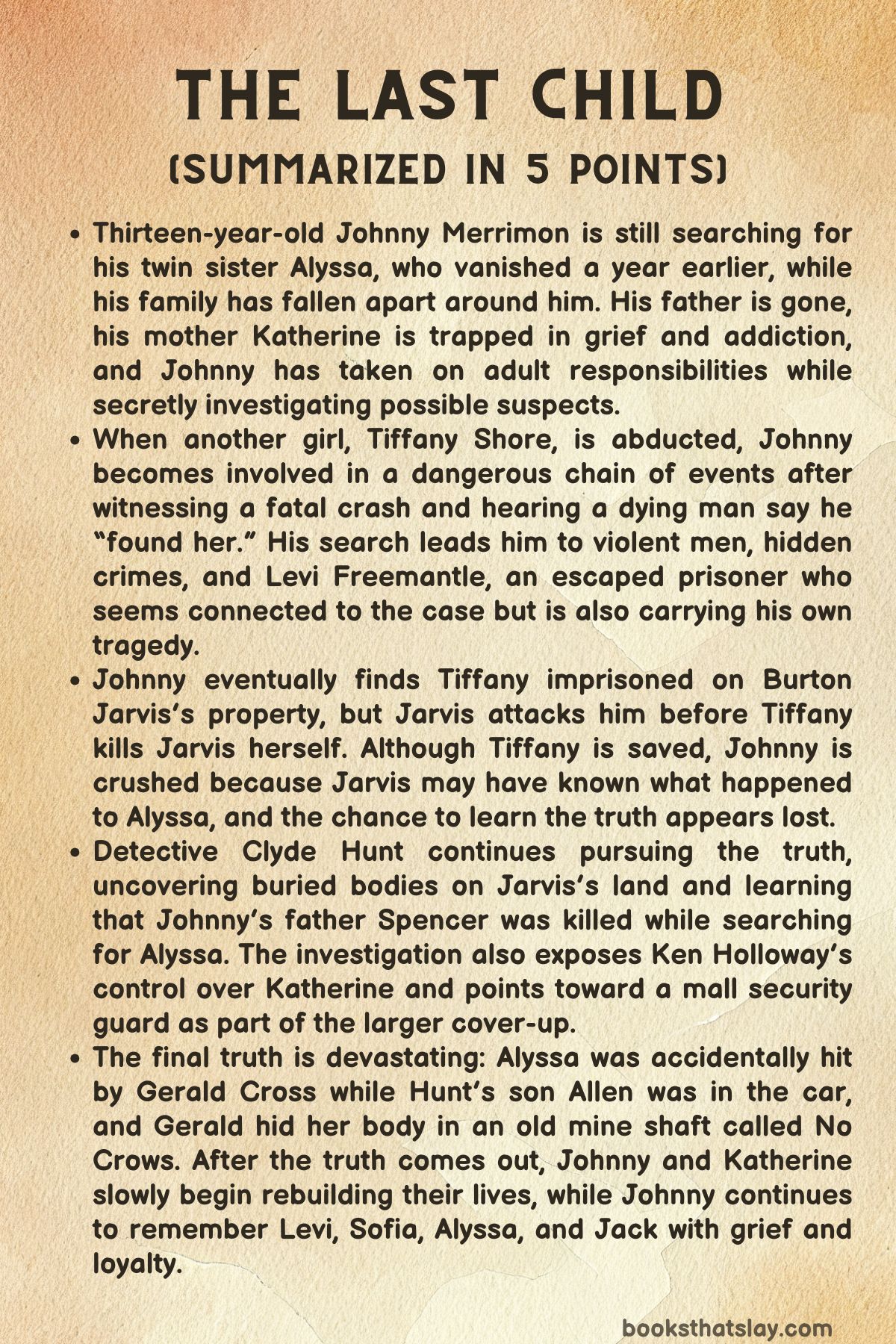
Summary
The Last Child follows Johnny Merrimon, a thirteen-year-old boy whose life has been ruined by the disappearance of his twin sister, Alyssa. A year before the main events, Alyssa was taken in broad daylight, leaving Johnny with a memory of loss that never fades.
Since then, his family has fallen apart. His father, Spencer, vanished after Alyssa’s abduction, and everyone assumes he abandoned them.
Johnny’s mother, Katherine, has been crushed by grief and now depends on alcohol and pills to get through each day. A wealthy local man named Ken Holloway has moved into her life, but his presence is possessive and ugly rather than comforting.
Johnny has become the only responsible person in the house. He buys food, cleans up, watches over his mother, and tries to protect her from Ken’s moods and drug use.
At the same time, he conducts his own search for Alyssa. He skips school, studies maps, marks houses, questions strangers, and checks on men he believes may have harmed his sister.
He is especially focused on sex offenders and lonely men living in isolated parts of the county. His best friend, Jack, helps him when he can, though Jack is frightened by Johnny’s growing recklessness.
Jack carries his own guilt because he saw Alyssa being taken into a white van but could not save her.
Detective Clyde Hunt, who led the official search for Alyssa, remains haunted by the failed case. He cares about Johnny and Katherine, but Johnny does not trust him enough to stop searching alone.
Hunt knows the boy is in danger, yet he also understands that Johnny’s need for answers is stronger than fear.
The fragile routine breaks when another girl, Tiffany Shore, is abducted from school. On the same day, Johnny witnesses a motorcycle crash near the river bridge.
The dying rider, David Wilson, tells Johnny that he has found a missing girl, but before Johnny can learn more, the driver who caused the crash returns. Johnny runs into the woods, where he is seized by Levi Freemantle, a scarred and frightening man carrying a black-wrapped box.
Johnny escapes, but the encounter adds another mystery to the case.
Police later identify David Wilson as a professor and outdoorsman. His death appears connected to the new abduction, and evidence leads Hunt toward Levi Freemantle, an escaped prisoner who has been living near the river.
At Levi’s home, police find old bodies, including that of his lover, Ronda Jeffries, and another man. The discovery suggests that Levi once killed them after learning of betrayal.
Levi himself wanders through the woods in a disturbed religious state, believing God is guiding him while he carries the remains of his dead daughter, Sofia.
Johnny refuses to wait for Hunt or the police. He goes to the property of Burton Jarvis, a known offender, and discovers a hidden fortified shed.
Jarvis catches Johnny sleeping in Katherine’s stolen car and attacks him brutally. Tiffany Shore, who has escaped from the shed while still wearing handcuffs, gets hold of a gun and shoots Jarvis.
Johnny tries to stop her because he thinks Jarvis may know something about Alyssa, but Tiffany kills him. For Johnny, the moment is devastating.
Tiffany is alive, but the man who might have had answers is dead.
Johnny drives Tiffany to the hospital, and the case explodes into public attention. Police find that Jarvis’s shed was soundproofed and hidden, built to hold victims.
The discovery raises the possibility that other missing children may be connected to him. Johnny’s injuries also force Katherine to face what her son has been carrying alone.
She throws away her pills and alcohol, tries to clean the house, and begins pushing back against Ken Holloway’s control.
Hunt’s investigation grows more complicated. Johnny tells him that someone who looked like a police officer had visited Jarvis, but the police chief and sheriff refuse to open personnel files.
They fear scandal and are not convinced by Johnny’s claims. Hunt keeps pressing because the details do not fit.
He also learns more about Levi Freemantle, including the death of Levi’s girlfriend and the disappearance of Levi’s daughter, Sofia.
After Johnny is placed temporarily with his Uncle Steve, he searches Steve’s apartment and finds alcohol, marijuana, a knife, a truck, and a gun. He looks up Levi’s address and soon steals Steve’s truck.
Meanwhile, Katherine is terrorized at home by Ken and then by a box left on her porch containing a crippled cat and a warning meant for Johnny. Johnny visits Levi’s house, sees the murder scene, returns to find police at Steve’s apartment, and then meets Jack nearby.
The two boys take Steve’s gun, gather supplies from Johnny’s house, and hide in an abandoned barn.
Using an old county history book, Johnny follows clues to Hush Arbor, a place tied to the Freemantle family and to Johnny’s own ancestor, who once saved Isaac Freemantle from lynching. There, Johnny and Jack find Levi, injured and feverish, trying to bury Sofia in a small coffin.
Johnny lowers the gun and helps him dig the grave. After the burial, Johnny questions Levi and finds Alyssa’s name tag among the cloth Levi used for bandages.
Levi says he does not know where Alyssa is, but tells Johnny that David Wilson found Sofia’s body. Johnny is shaken by the name tag and desperate for more answers, but Levi cannot give him what he needs.
At Jarvis’s property, police dogs uncover multiple buried bodies, most of them children. One body is identified as Spencer Merrimon, Johnny’s father.
This changes everything. Spencer had not abandoned his family; he had died searching for Alyssa.
The truth gives Johnny and Katherine a painful kind of relief, but it also deepens the horror of what has happened around them.
Hunt and his partner Yoakum begin to understand Johnny’s claim about the “cop.” They realize the person may not have been a police officer but a mall security guard, whose uniform, badge, gun, and handcuffs could have fooled a child. Their search leads to the mall security chief, Meechum.
At Meechum’s house, Hunt finds him burning evidence. During the confrontation, Yoakum shoots Meechum.
Later, Yoakum is arrested when evidence suggests his gun was involved, though Hunt believes someone has framed him.
Johnny and Jack move the sick Levi to the abandoned barn. Johnny later returns home, where Ken Holloway has tied up Katherine and attacks him.
Levi arrives and kills Ken with a pipe, saving Johnny and Katherine. Hunt then shoots Levi when Levi refuses to stand down.
Before dying, Levi says Sofia’s name. His final words lead Jack to remember a place called No Crows, an old mine shaft.
Searchers recover Alyssa’s remains from the shaft. They also find Jack’s old yellow bicycle, which forces Jack to confess the truth he has hidden for a year.
Alyssa was not taken by a stranger in a white van. Gerald Cross, Jack’s brother, hit Alyssa while driving, with Hunt’s son Allen in the car.
Gerald dumped Alyssa in the shaft and forced Jack to keep silent. Jack’s guilt, fear, and loyalty to Johnny have been tearing him apart ever since.
Gerald and Allen are arrested. Johnny is placed briefly with Social Services, but Katherine works to become sober and prove she can care for him again.
Hunt remains a source of support, even as he must face the damage done by his own son’s involvement. Months later, Johnny and Katherine visit the Freemantle cemetery, where Levi and Sofia are buried.
Johnny writes to Jack, still calling him his friend. By the end, The Last Child does not erase the pain of what happened, but it gives Johnny the truth he fought for, restores his father’s honor, and allows him and Katherine to begin living again.
Characters
Johnny Merrimon
Johnny Merrimon is the emotional center of The Last Child, and he is portrayed as a child forced far too early into the responsibilities of adulthood. At thirteen, he carries the burden of his twin sister Alyssa’s disappearance, his father’s absence, and his mother’s collapse into addiction and grief.
His search for Alyssa is not a childish fantasy but a desperate attempt to create order in a world that has become cruel, unreliable, and morally broken. Johnny’s maps, secret investigations, and visits to dangerous men show both his intelligence and his loneliness.
He does not trust adults because the adults around him have either failed him, used him, or been unable to protect the people he loves. His courage is extraordinary, but it is also dangerous, because it grows out of trauma rather than safety.
Johnny’s belief in rituals, signs, and strange powers reveals how deeply he needs hope when ordinary faith in police, family, and justice has failed him. By the end of the story, Johnny is not simply a brave boy who uncovers the truth; he is a wounded child who survives by sheer will, loyalty, and love.
Alyssa Merrimon
Alyssa Merrimon is absent for most of the book, yet her presence shapes nearly every major character and event. She represents innocence stolen, but she is more than just a missing girl in the story.
For Johnny, Alyssa is the lost half of himself, and his search for her becomes a way of refusing to accept a world in which love can simply vanish. For Katherine, Alyssa’s disappearance becomes the wound that destroys her stability, while for Spencer it becomes the reason he continues searching until his own death.
Alyssa’s fate also exposes the moral corruption surrounding the community, especially the way fear, guilt, and selfishness allow terrible secrets to remain hidden. Even though she does not actively speak through much of the narrative, Alyssa is central because the truth about her reveals what each character is made of.
Her death is devastating not only because she was young, but because so many people failed to protect her, tell the truth about her, or honor her suffering in time.
Katherine Merrimon
Katherine Merrimon is one of the most tragic and painfully human figures in the book. After Alyssa’s disappearance and Spencer’s absence, she collapses under grief, turning to pills, alcohol, and emotional dependence on Ken Holloway.
At first, she appears broken almost beyond repair, unable to protect Johnny or even herself. However, her weakness is not presented as simple carelessness; it is the result of unbearable loss and manipulation by a controlling man who exploits her grief.
Katherine’s relationship with Johnny is heartbreaking because the normal roles between mother and child have been reversed. Johnny shops, cleans, protects, and watches over her while she drifts through pain and addiction.
Yet Katherine’s character also contains the possibility of recovery. When she sees the damage Johnny has endured and begins resisting Ken, she shows that grief has not erased her love.
Her eventual sobriety and reunion with Johnny suggest that healing is possible, but only after she confronts both her dependence and her failures as a mother.
Spencer Merrimon
Spencer Merrimon is first understood through absence, and that absence deeply shapes the family’s suffering. For much of the story, Johnny and Katherine believe he abandoned them after Alyssa disappeared, which makes his memory painful and complicated.
However, the discovery of his body changes the meaning of his character completely. Spencer did not leave because he stopped caring; he died while still searching for his daughter.
This truth restores dignity to him and changes the emotional history of the Merrimon family. Spencer becomes a symbol of love misunderstood, a father whose devotion was hidden by tragedy.
His death also deepens the cruelty of the world Johnny inhabits, because Johnny has been carrying not only the loss of Alyssa but also the false belief that his father gave up. Spencer’s character shows how incomplete knowledge can wound the living, and how truth, even when painful, can restore a broken sense of love and loyalty.
Detective Clyde Hunt
Detective Clyde Hunt is a deeply conflicted figure whose life has been consumed by Alyssa’s disappearance. He is not a careless officer; he is haunted precisely because he failed to solve the case and because Johnny’s suffering reminds him of that failure.
Hunt’s concern for Johnny and Katherine is genuine, but it is complicated by his emotional closeness to the family and by his own troubled home life. His obsession with the case makes him relentless, yet it also blinds him at times and strains his judgment.
Hunt represents the adult world at its best and worst: he wants justice, but he is limited by procedure, politics, doubt, and personal weakness. His discovery that his own son Allen is connected to Alyssa’s death is especially devastating because it forces him to face corruption and guilt not as something outside his family, but within it.
Hunt’s character is powerful because he is neither a perfect protector nor a failed one. He is a man trying to do right in a story where doing right comes far too late.
Jack Cross
Jack Cross is Johnny’s closest friend and one of the saddest characters in the story. His loyalty to Johnny is real, but it is burdened by fear, guilt, and abuse.
Jack saw Alyssa being taken, and although he was only a child, he carries the shame of believing he failed her and failed Johnny. His relationship with his brother Gerald makes his fear more understandable, because Gerald is violent, controlling, and capable of forcing Jack into silence.
Jack’s weak arm, his emotional breakdowns, and his hesitation all reveal a boy who has been physically and psychologically dominated. Yet Jack is not cowardly in a simple sense.
He stays close to Johnny, follows him into danger, and finally tells the truth. His confession about Gerald and Allen is one of the story’s most important moral turning points.
Jack’s character shows how children can be trapped by adult-sized fear, and how courage sometimes appears not as bold action, but as finally speaking after long silence.
Ken Holloway
Ken Holloway is one of the most sinister characters in the novel because his evil hides behind wealth, charm, and social respectability. He does not appear at first as a lurking criminal in the woods, but as a man who has inserted himself into Katherine’s broken life and taken control of her through dependency, intimidation, and manipulation.
His history with Katherine explains his possessiveness, but it does not excuse it. Ken uses her grief as an opportunity to dominate her, turning her home into a place of fear and degradation.
His treatment of Johnny is especially cruel because he sees the boy as an obstacle to his control. The crippled cat and warning left for Johnny reveal his willingness to use terror against a child.
Ken’s final attack on Katherine and Johnny exposes the violence that had been present beneath his polished surface all along. He represents predatory control, the kind of evil that thrives when grief, addiction, money, and power intersect.
Levi Freemantle
Levi Freemantle is one of the most tragic and morally complex figures in the book. At first, he appears terrifying: huge, scarred, escaped, and connected to death.
Yet as the story develops, he becomes far more than a suspected killer. Levi is a man broken by betrayal, imprisonment, religious obsession, and the loss of his daughter Sofia.
His wandering with the black-wrapped box gives him an almost mythic quality, as though he exists between madness, grief, and spiritual judgment. He is dangerous, but he is also deeply wounded.
His act of burying Sofia reveals tenderness beneath his frightening exterior, and Johnny’s decision to help him dig the grave becomes one of the story’s most humane moments. Levi’s killing of Ken Holloway saves Katherine and Johnny, making him both violent and protective.
His final word, “Sofia,” reduces his entire tragic life to a father’s grief. Levi is not innocent in every way, but he is one of the story’s clearest examples of how suffering can distort a person without completely destroying his capacity for love.
Sofia Freemantle
Sofia Freemantle is another lost child whose fate expands the emotional scope of the story beyond Alyssa. She is Levi’s daughter, and her death becomes the center of his grief, madness, and spiritual fixation.
Although she is not alive during the main action, Sofia’s presence explains much of Levi’s behavior. His need to bury her properly shows that, beneath his instability, he remains devoted to her.
Sofia’s connection to David Wilson and to the larger mystery also helps link the different disappearances and deaths in the narrative. She represents the hidden victims whose stories have been ignored or misunderstood.
Through Sofia, the book shows that grief is not limited to one family and that the loss of a child can turn the world into something unbearable.
Tiffany Shore
Tiffany Shore is important because her abduction brings the old horror of Alyssa’s disappearance into the present. Unlike Alyssa, Tiffany survives long enough to act, speak, and fight back.
Her escape from Burton Jarvis’s shed is a moment of terror and strength. When she shoots Jarvis, the act is understandable because she has been brutalized and trapped, but it also destroys Johnny’s hope of learning whether Jarvis knew anything about Alyssa.
This makes Tiffany’s role emotionally complicated. She is a victim who saves herself and Johnny, yet her survival also intensifies Johnny’s despair.
Tiffany’s character shows the immediate violence of abduction, the desperate instinct to live, and the painful reality that justice and truth do not always arrive together.
Burton Jarvis
Burton Jarvis is one of the clearest embodiments of predatory evil in the story. His hidden, fortified, soundproofed shed reveals planning, secrecy, and monstrous intent.
Unlike characters whose violence comes from grief or fear, Jarvis’s cruelty is deliberate and predatory. His attack on Johnny shows that he is willing to harm a child without hesitation, and the later discovery of buried bodies confirms the scale of his crimes.
Jarvis also functions as a false answer to Johnny’s search. For a moment, Johnny believes Jarvis may be the key to Alyssa, but Jarvis’s death closes that possibility and leaves Johnny emotionally shattered.
As a character, Jarvis represents the nightmare Johnny has been hunting: the hidden man, the locked room, the adult predator, and the horror beneath ordinary property lines.
David Wilson
David Wilson is a brief but crucial character whose death pushes the mystery forward. As a biology professor and outdoorsman, he seems connected to the natural world rather than the criminal one, but his discovery of a missing girl places him in deadly danger.
His final words to Johnny become a haunting clue, suggesting that he has found someone important but cannot explain enough before he dies. Wilson’s character matters because he is one of the adults who actually finds part of the truth, even though he cannot survive it.
His murder also brings Johnny, Levi, Tiffany, and the police investigation into closer contact. He represents the danger of knowledge in a world where secrets are protected by violence.
Detective Yoakum
Detective Yoakum is a practical and loyal figure whose partnership with Hunt gives the investigation much of its force. He is less emotionally entangled with the Merrimon family than Hunt, which allows him to function as a steadier investigative presence.
His willingness to follow leads, confront suspects, and act decisively makes him important to the unraveling of the case. However, his later arrest after evidence suggests his gun was used introduces the theme of framing and institutional uncertainty.
Hunt’s belief that Yoakum is being set up shows the trust between them and also reveals how deeply corruption and deception have entered the investigation. Yoakum’s character reflects the risks faced by those who pursue truth inside a system that can itself be manipulated.
Uncle Steve
Uncle Steve provides temporary shelter for Johnny, but his character is not a simple image of stability. He gives Johnny a place to stay, yet Johnny’s search through his belongings reveals alcohol, marijuana, weapons, and other signs that Steve is not the safe adult Johnny truly needs.
Steve’s role highlights how limited Johnny’s support system is. Even when adults step in, Johnny still feels the need to investigate, steal, hide, and protect himself.
Steve also reveals important information about Katherine’s past with Ken, helping explain Ken’s obsession and possessiveness. As a character, Steve represents partial refuge: helpful in some ways, but not strong enough to stop Johnny from continuing down a dangerous path.
Gerald Cross
Gerald Cross is one of the story’s most morally corrupt young characters. His violence toward Jack, including breaking his weak arm, shows his cruelty long before the truth about Alyssa is fully revealed.
Gerald’s role in Alyssa’s death exposes him as both reckless and cowardly. He hits Alyssa while driving, helps conceal what happened, and forces Jack into silence through fear.
Gerald is frightening because he is not a distant predator like Jarvis; he is close to the children, part of Jack’s family, and able to control the truth from within an ordinary household. His character shows how evil can exist not only in strangers, but also in siblings, friends, and familiar places.
He is driven by self-preservation, and his silence causes immeasurable suffering.
Allen Hunt
Allen Hunt is important because his involvement in Alyssa’s death brings the tragedy directly into Detective Hunt’s family. As Hunt’s son, Allen complicates the detective’s pursuit of justice in the most painful way possible.
His presence in the car with Gerald makes him part of the hidden truth that has destroyed Johnny’s family. Allen’s character represents guilt protected by silence and by proximity to authority.
Whether he is less dominant than Gerald or not, his failure to come forward makes him morally responsible. Through Allen, the story shows that truth can be buried not only by criminals, but also by frightened young people whose silence is allowed to grow into catastrophe.
Meechum
Meechum, the mall security chief, is a disturbing character because he shows how appearances of authority can be used to deceive and harm. The realization that a security uniform, badge, cuffs, and gun could have made someone look like a police officer is crucial to understanding Johnny’s earlier clue.
Meechum’s burning of evidence reveals guilt and panic, and his role connects public respectability with hidden criminal involvement. He is frightening because he occupies a position that should suggest safety, especially in a public place like a mall, yet he becomes tied to the machinery of concealment and harm.
Meechum’s character reinforces one of the story’s central fears: children are vulnerable not only to obvious monsters, but also to people wearing the symbols of protection.
Ronda Jeffries
Ronda Jeffries is important mainly through her relationship with Levi Freemantle and the violence surrounding her death. As Levi’s lover, she is connected to his emotional life before his full collapse.
The discovery of her body, along with another man’s, suggests betrayal, rage, and the destructive force of jealousy or grief in Levi’s past. Ronda’s character helps explain why Levi is treated as dangerous and why the police initially view him through the lens of violence.
Yet her death also contributes to the ambiguity around Levi, because the story gradually reveals that his life cannot be reduced to one crime or one accusation. Ronda represents a buried past that continues to shape the present investigation.
Chief and Sheriff
The Chief and sheriff represent institutional caution, political fear, and the reluctance of authority to expose its own weaknesses. When Hunt asks for access to police personnel files because Johnny believes a cop may be involved, they resist.
Their refusal is not simply procedural; it reflects fear of scandal and disbelief in a child whose claims are difficult to prove. These characters are important because they show how systems can fail even without every person inside them being openly evil.
Their hesitation slows the search for truth and reveals how reputation can matter more than urgency. In a story filled with missing children and hidden crimes, their caution becomes morally troubling.
Isaac Freemantle
Isaac Freemantle belongs to the older history of the story, but his presence matters because it connects Johnny’s family to Levi’s through an act of rescue. Johnny’s ancestor once saved Isaac from lynching, and this history gives the meeting between Johnny and Levi a deeper meaning.
Isaac represents inherited memory, racial violence, and the long shadows of the past. His story helps transform Hush Arbor from merely an old family site into a place where history, suffering, debt, and mercy come together.
Through Isaac, the book suggests that the past is never fully gone; it waits beneath the present, shaping relationships in ways the living may not immediately understand.
Johnny’s Ancestor
Johnny’s ancestor is a minor but meaningful figure because his act of saving Isaac Freemantle creates a moral link between the Merrimon and Freemantle families. This connection matters when Johnny encounters Levi, because it gives their relationship a sense of inherited responsibility and grace.
Johnny does not approach Levi only as a suspect or monster; he eventually sees him as a grieving father, and the old family history helps deepen that recognition. The ancestor’s role also contrasts with the failures of many present-day adults.
In the past, someone acted courageously to save a life, while in the present, many people hesitate, hide, or protect themselves. This character’s importance lies in the moral echo of that earlier rescue.
Jack’s Father
Jack’s father is a minor but revealing character because his belief that Johnny is dangerous shows how adults misunderstand the boys’ friendship and trauma. Instead of fully seeing Jack’s fear, guilt, and suffering, he becomes suspicious of Johnny’s influence.
His reaction reflects the larger adult failure in the story: children are judged, doubted, or controlled instead of truly listened to. Jack’s father also exists in contrast to Gerald’s violence.
His inability to protect Jack from Gerald’s cruelty makes him part of the unsafe family environment that keeps Jack silent for so long. Though not a central figure, he helps explain why Jack feels trapped.
Themes
Grief and Its Damage
Grief in The Last Child does not remain private or quiet; it changes the way people live, speak, trust, and survive. Johnny’s family shows how loss can break the structure of ordinary life.
Katherine’s sorrow over Alyssa’s disappearance leaves her dependent on pills, alcohol, and Ken’s control, while Johnny is forced into a role far beyond his age. He cooks, cleans, protects his mother, and searches for his sister because the adults around him have failed to give him safety.
Spencer’s absence is first understood as abandonment, which deepens Johnny’s anger and loneliness, but the later truth proves that grief also pushed Spencer into a desperate search of his own. Detective Hunt carries another kind of grief: guilt.
His failure to solve Alyssa’s case damages his family, his judgment, and his peace. The novel shows grief as something active and dangerous.
It does not simply make characters sad; it distorts homes, weakens moral judgment, and leaves children carrying burdens adults should have carried.
Childhood Lost Too Early
Johnny’s childhood is taken from him long before he understands the full truth about Alyssa. At thirteen, he should be protected, guided, and allowed to depend on adults, but instead he becomes investigator, caretaker, provider, and protector.
His maps, secret searches, stolen trips, and confrontations with dangerous men show a child trying to act with adult courage while still being emotionally vulnerable. His belief in rituals and strange powers reveals how badly he needs hope, because ordinary systems such as family, school, and police have not given him answers.
Jack also suffers from a stolen childhood. He is trapped by fear, guilt, bullying, and silence after witnessing events he cannot fully process.
Both boys live under pressure created by adult violence and adult weakness. Their friendship becomes one of the few places where childhood still exists, yet even that friendship is marked by secrets and trauma.
The story presents childhood as fragile, easily damaged when adults fail to protect truth, innocence, and trust.
The Failure and Necessity of Justice
Justice is shown as both deeply flawed and urgently needed. The police investigation is slow, divided by politics, pride, fear of scandal, and mistakes made by people who should be responsible.
Johnny does not trust official justice because Alyssa has remained missing for a year, and that failure pushes him toward reckless action. His personal search often brings him closer to truth than the formal investigation, but it also places him in extreme danger.
Detective Hunt represents the better side of justice because he refuses to forget Alyssa and continues searching even when his superiors resist him. Still, his guilt and personal attachment complicate his judgment.
The discovery of Jarvis’s victims, Spencer’s body, Meechum’s role, and Gerald’s crime shows that justice depends on persistence, courage, and the willingness to face ugly truths. The story does not present justice as simple punishment.
It shows justice as the painful recovery of truth after lies, fear, corruption, and silence have protected the guilty.
Control, Power, and Abuse
Power in the story is often used to dominate the weak, especially children and grieving adults. Ken Holloway controls Katherine by taking advantage of her addiction, loneliness, and emotional collapse.
His wealth and confidence allow him to enter her home, shape her choices, and threaten Johnny when the boy becomes an obstacle. Burton Jarvis represents a more openly monstrous form of power, using secrecy, violence, and physical confinement against children.
Gerald Cross also abuses power through intimidation, forcing Jack into silence and letting fear protect his crime. Even institutions misuse power when officials avoid difficult truths to protect reputations.
Against these forms of control, the vulnerable characters struggle to reclaim agency. Katherine’s decision to resist Ken marks the beginning of her return to herself.
Johnny’s courage is dangerous, but it comes from his refusal to be controlled by fear. The theme shows that abuse survives through silence, dependence, and intimidation, while resistance begins when truth is spoken and control is challenged.