The Little Stranger Summary, Characters and Themes
The Little Stranger by Sarah Waters is a Gothic psychological novel set in postwar Warwickshire, where class decline, family duty, and suppressed desire gather inside a crumbling country house. The story follows Dr Faraday, a village physician whose childhood fascination with Hundreds Hall turns into adult intimacy with the Ayres family, its damaged heirs.
As the house decays, unexplained incidents disturb its remaining occupants, while Faraday keeps searching for rational answers. The novel is less a simple ghost story than a study of obsession, social change, loneliness, and the dangerous pull of a past that refuses to loosen its hold.
Summary
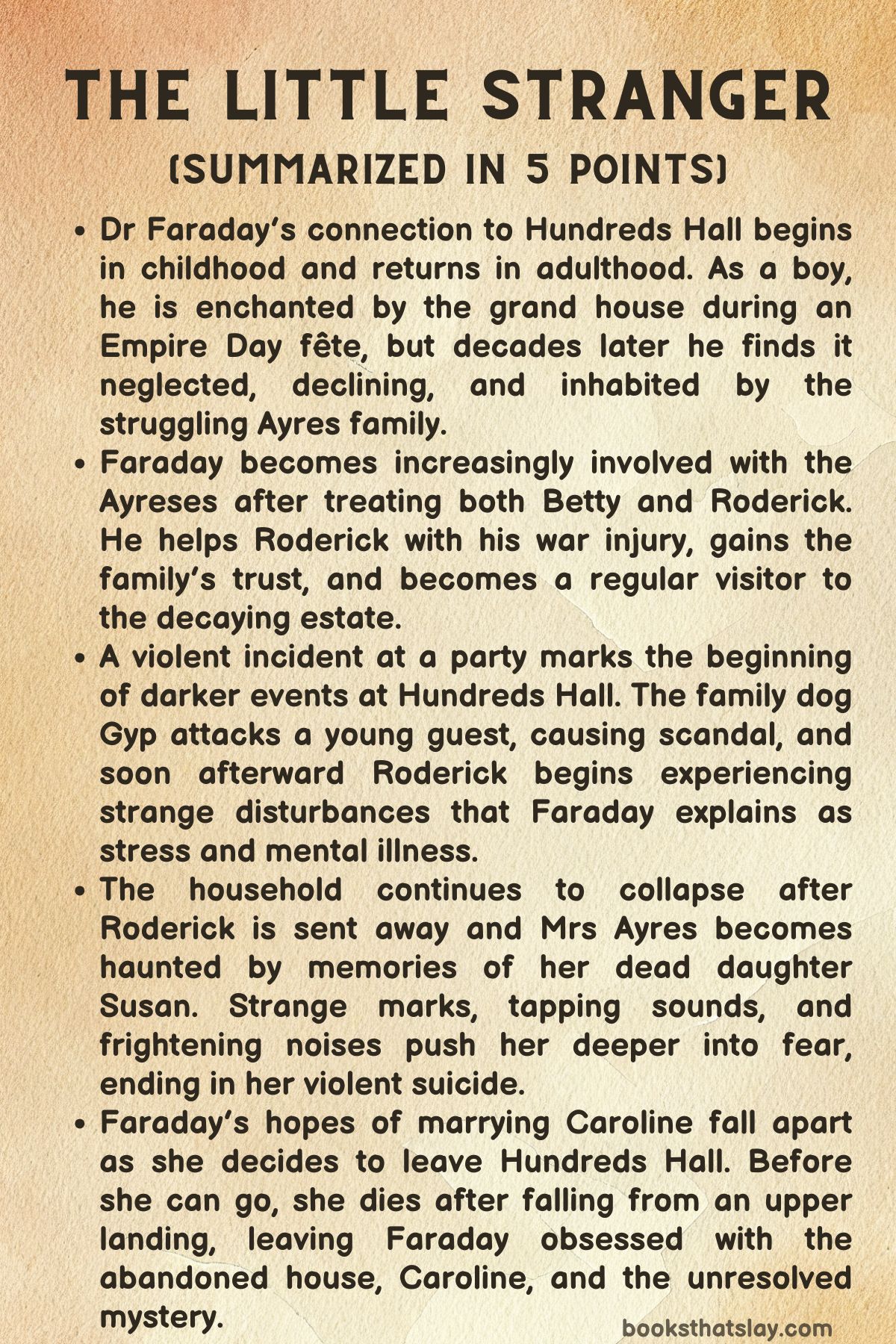
The Little Stranger opens with Dr Faraday recalling his first visit to Hundreds Hall as a child. His mother, who had once known the servants there, takes him to an Empire Day fête, and the young Faraday is struck by the beauty and authority of the old house.
Its polished rooms and decorated walls seem to him like a glimpse into another world. In a private act of longing, he secretly removes a small plaster acorn from the wall.
The theft leaves him with guilt, but it also marks the start of his lifelong attachment to Hundreds Hall and everything it represents.
Nearly thirty years pass. Faraday becomes a country doctor, his parents die, and the Ayres family, once wealthy and secure, falls into decline.
Hundreds Hall is no longer the bright, confident estate of his childhood memory. It is shut away, underused, short of money, and visibly damaged by time.
Faraday returns there professionally when he is called to examine Betty, the young maid. Betty complains of stomach pain, but Faraday quickly sees that she is not truly ill.
She is homesick, frightened, and overwhelmed by the huge, silent house. Rather than expose her, he protects her dignity and reassures the family.
During this visit, Faraday meets the remaining Ayreses: Mrs Ayres, her daughter Caroline, and her son Roderick. Mrs Ayres still carries herself with traces of old gentility, Caroline is practical and plain-spoken, and Roderick is burdened by both war injuries and the failing estate.
Faraday is invited to tea, and Mrs Ayres gives him an old photograph that may show his mother during her servant days at Hundreds. The image deepens his sense that his own family history is somehow tied to the house.
Faraday begins returning more often. After meeting Caroline on the road, he learns more about the family’s troubles.
Roderick is in chronic pain from a badly damaged leg, and the estate is sinking under financial pressure. Faraday offers to treat Roderick with electrical therapy, presenting it as medical research so that Roderick can accept without embarrassment over payment.
The treatment appears to help, and Faraday becomes a trusted visitor. Caroline shows him through the house, where each room reveals the gap between former wealth and present decay.
The grand saloon, dining room, library, and family portraits all suggest a world that is slowly collapsing.
The Ayreses try to revive some of their old social life by hosting a party in the saloon. The evening begins with effortful cheer, but disaster strikes when Gyp, Caroline’s elderly Labrador, suddenly attacks a young guest named Gillian Baker-Hyde.
The attack leaves Gillian’s face badly injured, and Faraday stitches the wound on the kitchen table. The incident becomes a scandal.
Gillian’s family demands that Gyp be destroyed. Caroline resists, devastated by the thought of killing the dog, but social pressure and fear of legal consequences leave little choice.
Faraday puts Gyp down, and the household becomes even more subdued.
After Gyp’s death, strange disturbances begin to gather around Roderick. His room appears to have been tampered with, a burned-looking mark appears on his door, and his behavior grows more unstable.
He tells Faraday that something in the house is tormenting him, moving objects, setting traps, and attacking him. Faraday tries to interpret these claims through medicine.
He suspects strain, guilt, exhaustion, and possible mental illness, especially given Roderick’s physical pain and the pressure of managing an estate that cannot be saved. Roderick later describes seeing a glass object move by itself and fly at him, but Faraday remains committed to a rational explanation.
Roderick’s condition worsens during a tense dinner. He drinks too much and speaks bitterly about his injuries, his duties, and his sense of entrapment.
Later that night, after Faraday has left, a fire breaks out in Roderick’s room. Caroline, Mrs Ayres, and Betty manage to put it out, but the damage is serious.
They then discover that Roderick has stopped paying the insurance premiums, which leaves the family exposed to another financial blow. Since he cannot clearly remember what happened and may pose a danger to himself or others, Mrs Ayres agrees to send him to a private clinic in Birmingham.
With Roderick gone, Hundreds Hall feels emptier and more vulnerable. Faraday continues to visit Mrs Ayres and Caroline, helping with practical matters and accompanying them to see Roderick.
The estate continues to shrink when part of the park is sold for council housing. Faraday and Caroline walk through the muddy grounds and talk about the new development, Roderick’s absence, and the burden of the house.
Caroline admits how hard life has become with only herself and her mother left there. Faraday’s interest in Caroline also grows, though it is mixed with his fascination with Hundreds itself.
Faraday invites Caroline to a hospital dance, hoping to give her a break from the house. She enjoys the evening, drinks, dances, and seems livelier than usual.
Faraday, however, becomes uneasy after hearing crude gossip about his connection to Caroline or her mother. On the drive home, Caroline is restless and says she does not want to return to Hundreds.
Faraday stops the car in a secluded place, and they begin an awkward physical encounter. Caroline suddenly panics and pushes him away.
He hesitates too long before stopping, and she kicks him off. They return in silence, but at the door she apologizes and kisses him, leaving him confused and longing for her.
For a while, Faraday avoids Caroline. When he returns, he recognizes that his feelings for her are serious.
Mrs Ayres notices the tension between them and assumes there is an understanding. Caroline resists at first, but later, after Faraday is called back to discuss more strange events, she and Faraday admit their attachment and become informally engaged.
Yet the house continues to deteriorate. Rain damages the saloon, and while Caroline, Mrs Ayres, Betty, and Mrs Bazeley investigate, they discover old childish scribbles.
Soon tapping sounds seem to move through the walls and guide them to more marks. Mrs Ayres becomes deeply disturbed because the writing seems connected to Susan, her dead first daughter.
Mrs Ayres begins to believe that Susan is somehow present. She hears fluttering in her dressing room and thinks a bird is trapped in the chimney, though Caroline finds nothing.
More marks appear, and Mrs Ayres becomes absorbed in memories of Susan. She spends time with old clothes and seems increasingly detached from the present.
Faraday offers ordinary explanations: damp, mice, old timber, and strained nerves. Caroline is less sure and more worried.
One night, Mrs Ayres is found badly injured after putting her hands through glass in terror. Faraday sedates her and arranges care, but soon afterward she locks herself in her room and kills herself.
After Mrs Ayres’s death, Faraday pushes forward with marriage plans. A wedding date is set, and he imagines a future in which he and Caroline live at Hundreds.
Caroline, however, becomes colder and more distant. At last she tells him she cannot marry him, does not love him, and must leave Hundreds altogether.
She plans to sell the estate and go abroad, possibly to America or Canada. Faraday is shocked and tries to argue, even consulting the solicitor Hepton in hope of stopping the sale, but Caroline remains firm.
On the night before Caroline is due to leave, Faraday is called to a medical emergency and takes a gravely ill man to hospital. Later he telephones Hundreds and briefly speaks with Caroline, who says everything is quiet.
That night she falls from an upper landing and dies. At the inquest, Betty gives an emotional account of the ghostly disturbances, while others suggest suicide or accident caused by nervous strain.
Faraday insists Caroline had been ready to leave and would not have killed herself.
In the aftermath, Hundreds Hall is abandoned and left to decay. Faraday continues to visit the empty house, unable to free himself from Caroline, the Ayres family, or the mystery of what happened.
The novel ends with uncertainty. The events may have been caused by a haunting, by mental distress, by the destructive force of the house, or by Faraday’s own hidden obsession.
That uncertainty is central to the power of The Little Stranger: it leaves the reader with a ruined house, a lonely doctor, and the troubling possibility that desire itself can become a ghost.
Characters
Dr Faraday
Dr Faraday is the central observer of The Little Stranger and one of the most psychologically complicated figures in the book. As a doctor, he presents himself as rational, practical, and controlled, constantly trying to explain the strange events at Hundreds Hall through illness, stress, decay, superstition, or nervous exhaustion.
However, his connection to the house is deeply emotional long before he returns there professionally. His childhood memory of entering the Hall during the Empire Day fête reveals his fascination with class, beauty, privilege, and belonging.
The stolen plaster acorn becomes a small but powerful symbol of his desire to possess a piece of that world. Even as an adult, he never completely frees himself from that early longing.
His medical role gives him access to the Ayres family, but his emotional attachment to Hundreds Hall gradually becomes more intense than his concern for the people living inside it.
Faraday’s character is marked by self-deception. He often believes he is acting reasonably, but his behavior suggests possessiveness, resentment, and social ambition beneath the surface.
His relationship with Caroline shows this clearly. He convinces himself that he loves her, yet his dreams of marriage are strongly tied to his fantasy of belonging to Hundreds.
He imagines a future not only with Caroline but inside the estate, as if marrying her would finally grant him the social and emotional inheritance he has wanted since childhood. His refusal to accept Caroline’s rejection reveals how little he truly understands her inner life.
Instead of respecting her need to escape, he tries to reason, pressure, and intervene. By the end of the story, Faraday remains trapped by the mystery of the house and by his own unresolved desire.
His continued visits to the abandoned Hall suggest that he has become emotionally haunted, whether by supernatural forces, guilt, class longing, or the parts of himself he cannot recognize.
Caroline Ayres
Caroline Ayres is one of the most grounded and sympathetic characters in the novel. She lacks the polished elegance traditionally associated with old aristocratic heroines, and this makes her feel unusually real.
She is practical, physically capable, emotionally restrained, and often more honest than the people around her. Caroline carries much of the daily burden of Hundreds Hall after the family’s decline.
She looks after her mother, worries about Roderick, manages household problems, and confronts the estate’s decay with a mixture of loyalty and exhaustion. Unlike Faraday, who romanticizes the house, Caroline sees its ugliness, dampness, expense, and emotional weight.
To her, Hundreds is not simply a symbol of beauty or status; it is a trap.
Caroline’s tragedy lies in her gradual realization that survival requires escape. Her bond with Faraday begins partly through loneliness and shared crisis, but she never seems fully convinced that marriage to him will save her.
After her mother’s death, Faraday pushes toward marriage while Caroline grows increasingly distant. This emotional withdrawal is important because it shows her trying to reclaim control over her own life.
Her decision to sell the estate and leave England is not an act of selfishness but a desperate attempt at freedom. She understands that remaining at Hundreds means continuing the cycle of decay, grief, and duty that has already consumed her family.
Her death just before leaving is therefore devastating because it occurs at the exact moment when escape finally seems possible. Whether her fall is supernatural, accidental, or connected to psychological strain, Caroline represents a person crushed between inheritance and independence.
Roderick Ayres
Roderick Ayres is a damaged heir whose personal suffering reflects the larger collapse of the Ayres family. Physically injured by war and emotionally burdened by responsibility, he is expected to preserve an estate that is already financially and structurally failing.
His burned and painful leg is only the most visible sign of his trauma. Beneath it lies exhaustion, shame, fear, and resentment.
Roderick knows that Hundreds Hall is beyond saving, yet he is trapped by the expectation that he must save it. This pressure isolates him from his mother and sister, who depend on him, and from Faraday, who initially treats his pain as a medical problem rather than a deeper psychological crisis.
Roderick’s strange experiences in his room mark one of the book’s clearest movements from social realism into gothic uncertainty. He believes that something in the house is persecuting him, disturbing objects, creating marks, and setting traps.
Faraday interprets this as mental illness, but the events are presented with enough ambiguity to make Roderick’s fear feel meaningful rather than simply delusional. His breakdown is connected to guilt over the estate, the horror of war, and the unbearable role of being the last male representative of a declining family.
The fire in his room becomes a turning point because it removes him from Hundreds and confirms that the family’s old order cannot continue. Roderick is tragic because he is not weak in a simple sense; he is a man destroyed by expectations no wounded person could reasonably carry.
Mrs Ayres
Mrs Ayres is a deeply tragic figure because she lives almost entirely in memory. As the mother of Roderick, Caroline, and the dead Susan, she represents the older aristocratic world of Hundreds Hall, but that world has already faded by the time the main events unfold.
She clings to manners, family history, social rituals, and the idea of the Hall’s former greatness because these are the structures that give her life meaning. Her politeness and dignity often hide grief, denial, and emotional fragility.
She loves her children, but her love is shaped by the values of class and inheritance. She wants the family to endure, yet she cannot fully acknowledge how much the house is destroying them.
Her decline becomes especially painful when the strange writing and tapping seem connected to Susan. Mrs Ayres’s grief over her dead daughter has never truly healed, and the possibility of Susan’s presence pulls her away from the present.
She begins to treat the disturbances not only as frightening but also as intimate, as if the past has returned to claim her. Her dressing room, old clothes, and memories become signs of a mind retreating into what has been lost.
Faraday tries to explain her terror through rational causes, but his explanations cannot reach the emotional truth of her suffering. Her violent suicide is one of the darkest moments in the story because it suggests a complete collapse of the boundary between grief and horror.
Mrs Ayres is destroyed by the past she cannot release and by a house that seems to feed on memory.
Betty
Betty is the young maid at Hundreds Hall and an important outsider within the household. Her first appearance shows her pretending to be ill because she is homesick and frightened by the vast, silent house.
This immediately establishes Hundreds as a place that intimidates not only its owners but also those who work there. Betty’s fear may seem childish at first, but it becomes increasingly significant as the story develops.
She senses the oppressive atmosphere of the Hall before the upper-class characters fully admit it. Her position as a servant also allows her to witness the family’s decline from a practical, everyday perspective.
Betty’s character brings social contrast into the book. She is young, working-class, vulnerable, and dependent on the decisions of others.
Unlike the Ayreses, she has no emotional inheritance binding her to the Hall, and unlike Faraday, she does not romanticize it. Her fear is direct and instinctive.
By the end, when she gives an emotional account of the supposed ghost at the inquest, her testimony becomes one of the strongest voices supporting the supernatural interpretation of events. Whether or not the reader accepts her view, Betty matters because she expresses what others suppress: that something about the house feels wrong, dangerous, and alive.
Gyp
Gyp, the Ayres family’s old Labrador, is more than a household pet; he is a symbol of loyalty, decay, and uncontrollable violence within the family space. Before the attack on Gillian, Gyp seems like part of the faded domestic life of Hundreds Hall.
He belongs to Caroline especially, and her love for him shows her tenderness and her need for companionship in a lonely environment. His sudden attack is shocking because it breaks the illusion that the Hall can still host polite society safely.
The party is meant to revive old social confidence, but Gyp’s violence turns it into scandal and humiliation.
Gyp’s destruction is also emotionally important for Caroline. She resists having him put down because she sees him not as a symbol or problem but as a beloved creature.
Faraday’s role in killing the dog places him in a morally uncomfortable position. He presents the act as necessary, but it also deepens the atmosphere of loss surrounding the house.
Gyp’s death marks the beginning of a darker phase in the story, where misfortune becomes more intimate and harder to explain. His attack suggests that violence at Hundreds does not always come from outside; it can emerge suddenly from within the familiar.
Susan Ayres
Susan Ayres is absent from the living action of the book, but her presence is emotionally powerful. As Mrs Ayres’s dead first daughter, Susan represents the family’s deepest private grief.
She belongs to the past, yet that past refuses to remain buried. The mysterious childish marks and writing that appear in the house seem connected to her, and this connection destabilizes Mrs Ayres more than any ordinary haunting might have done.
Susan becomes less a fully developed person than a wound in the family memory.
Her importance lies in what she reveals about Mrs Ayres and Hundreds Hall. The suggestion that Susan may somehow be present turns the house into a container of unresolved grief.
For Mrs Ayres, Susan is not simply dead; she is lost, idealized, and emotionally unfinished. This makes the supposed signs of her return both seductive and terrifying.
Susan’s unseen influence shows how the past can become destructive when it is preserved too intensely. In this sense, she haunts the story even if the reader remains uncertain whether she haunts the house literally.
Gillian Baker-Hyde
Gillian Baker-Hyde is a young guest whose injury changes the social atmosphere around the Ayres family. Her role is brief but crucial.
During the party, she becomes the victim of Gyp’s sudden attack, and her wounded face turns a private family decline into a public scandal. Through Gillian, the violence of Hundreds Hall reaches beyond the Ayres household and affects outsiders.
Her injury cannot be hidden or explained away as easily as financial trouble, damp walls, or nervous behavior.
Gillian also represents innocence damaged by the decaying world of the Hall. She enters as a child at a social gathering, but the event exposes her to pain and fear.
The attack forces the Baker-Hydes and the wider community to judge the Ayreses more harshly. It also places Caroline in a painful conflict between loyalty to her dog and responsibility for the harm done.
Gillian’s character matters because her suffering makes the family’s decline visible to others and begins the process by which Hundreds loses even more of its social dignity.
Mr and Mrs Baker-Hyde
The Baker-Hydes represent the outside social world that the Ayres family is trying to impress or remain connected to. Their presence at the party reflects the Ayreses’ attempt to revive the old life of dinners, gatherings, and class confidence.
However, after Gillian is attacked, the Baker-Hydes become agents of social judgment. Their demand that Gyp be destroyed is understandable from the perspective of injured parents, but it also intensifies Caroline’s emotional suffering and exposes the Ayres family’s lack of power.
They are important because they show that the Ayreses no longer control the social narrative around Hundreds Hall. In the past, the family name and estate might have protected them from scandal.
Now they are vulnerable to gossip, legal pressure, and public embarrassment. The Baker-Hydes’ reaction helps reveal how fragile the Ayreses’ status has become.
Their role is not deeply personal, but socially they are significant because they represent the changing world outside the gates of Hundreds.
Dr Graham
Dr Graham functions as a voice of medical authority and professional caution. When Faraday becomes concerned about Roderick’s behavior, Dr Graham helps frame the situation in terms of psychological illness and possible institutional treatment.
His presence supports the rational explanation of events, especially around Roderick’s breakdown. Unlike Faraday, however, Dr Graham is less emotionally entangled with the Ayres family and Hundreds Hall, which makes his judgment appear more detached.
His role also highlights Faraday’s limitations. Faraday wants to be rational, but he is personally invested in the family and the house.
Dr Graham’s involvement reminds the reader that medical explanations can be necessary without being complete. He helps move Roderick toward treatment, but he cannot resolve the deeper mystery of what is happening at Hundreds.
As a character, he represents professional order entering a space where order is already failing.
Dr Seeley
Dr Seeley is a minor but revealing character. His crude joke at the hospital dance unsettles Faraday because it exposes the gossip surrounding his relationship with Caroline and possibly Mrs Ayres.
Seeley’s comments puncture Faraday’s self-image. Faraday wants to see himself as dignified, controlled, and respectable, but Seeley’s teasing reminds him that others may view his closeness to the Ayres family in a more vulgar or suspicious way.
Seeley’s importance lies in the social pressure he introduces. His joke affects Faraday’s mood and contributes to the awkwardness of the evening with Caroline.
He represents the outside gaze of the professional and local community, a gaze that Faraday cannot fully control. Through him, the story shows how reputation, class, sexuality, and gossip shape Faraday’s behavior.
Though Seeley is not central, he helps reveal Faraday’s insecurity.
Mrs Bazeley
Mrs Bazeley is a practical working woman connected to the maintenance and domestic reality of Hundreds Hall. Her presence during the discovery of the childish scribbles in the saloon helps ground the strange events in ordinary labor.
The house is not only a gothic mansion; it is also a leaking, decaying building that requires cleaning, repair, and physical effort. Mrs Bazeley belongs to that practical world.
Her role is small, but she helps emphasize the contrast between supernatural fear and material decay. The strange marks appear while people are dealing with rain damage and household deterioration.
Mrs Bazeley’s involvement reminds the reader that the haunting, if it is a haunting, emerges through the worn fabric of the house itself. She also strengthens the sense that the disturbances are witnessed by more than one person, making them harder to dismiss as purely private delusion.
Mr Hepton
Mr Hepton, the solicitor, represents law, property, and the practical future of the estate. When Caroline decides to sell Hundreds Hall, Faraday consults Hepton in an attempt to understand or possibly prevent the sale.
Hepton’s role is important because he belongs to the world of documents, authority, and legal arrangements rather than emotion or memory. Through him, the fate of Hundreds becomes not a romantic tragedy but a matter of ownership, powers, and financial necessity.
Hepton also exposes Faraday’s desperation. Faraday’s decision to involve himself in the legal side of Caroline’s plans shows that he is no longer simply a disappointed fiancé.
He is trying to interfere with her escape. Hepton’s presence therefore clarifies the conflict between Caroline’s need for freedom and Faraday’s desire to preserve his imagined future at the Hall.
As a minor character, Hepton helps turn emotional tension into practical consequence.
Faraday’s Mother
Faraday’s mother is important because she connects him to Hundreds Hall long before he becomes the Ayres family’s doctor. She once knew the servants there, and through her, Faraday first enters the world that will obsess him for the rest of his life.
Her discovery of the stolen plaster acorn gives his childhood act a moral weight. She represents humility, working-class connection, and a sense of right and wrong that contrasts with Faraday’s later self-justifying behavior.
Her presence in the old photograph also deepens Faraday’s emotional tie to the Hall. The possibility that she appears as a servant in the family’s past makes Hundreds feel both distant and intimate to him.
He is not born into that world, but his family history brushes against it. This helps explain why the house has such power over him.
His longing is not only for beauty or status; it is also tied to memory, class shame, and the desire to cross a boundary his mother could only approach through service.
Faraday’s Father
Faraday’s father is less prominent, but he contributes to the background of class struggle that shapes Faraday’s identity. His death, along with Faraday’s mother’s death, leaves Faraday emotionally unanchored by the time he returns to Hundreds Hall as an adult.
The absence of both parents allows the house to become an even stronger object of attachment. Without his own family home holding him back, Faraday directs much of his emotional energy toward the Ayres family and their estate.
His father also belongs to the world of ordinary labor and modest ambition from which Faraday has risen through education and professional status. This matters because Faraday’s identity is built between classes.
He is not aristocratic, but he is no longer simply working-class either. His father’s background helps explain Faraday’s sensitivity to status and his hunger for recognition.
Even when the father is not active in the plot, his social position remains part of Faraday’s inner conflict.
Themes
Class, Status, and Social Decline
In The Little Stranger, Hundreds Hall stands as a fading symbol of a class system that once seemed permanent but is now losing its power. Dr Faraday’s childhood memory of entering the house shows his early awe of upper-class privilege, but his later visits reveal a place marked by decay, debt, and failure.
The Ayres family still carries the habits and pride of old gentry life, yet they no longer have the money or strength to maintain that identity. Roderick is crushed by the duty of preserving the estate, Caroline is trapped by the practical burden of survival, and Mrs Ayres clings to memories of a grander past.
Faraday’s relationship with the family is shaped by both admiration and resentment. He wants to belong to their world, but he also witnesses its collapse.
The decline of Hundreds Hall is not only physical; it shows the end of inherited authority, social distance, and old assumptions about who deserves power.
Obsession and Possession
Faraday’s connection to Hundreds Hall grows from childhood fascination into emotional possession. His desire is not limited to Caroline; it extends to the house, the family name, and the social identity attached to them.
He presents himself as helpful, rational, and loyal, yet his actions often reveal a need to control events. His medical visits allow him to enter private spaces, advise the family, and become necessary to them.
As Caroline begins to pull away from him and plans to leave, his sense of loss becomes sharper because her departure would also end his dream of becoming part of Hundreds. His attachment is troubling because it appears calm on the surface but carries deep frustration underneath.
The haunting can be read as a supernatural force, but it can also reflect Faraday’s hidden desires pressing against the household. The idea of possession therefore works in two ways: the house seems possessed, and Faraday himself seems possessed by the house.
Fear, Guilt, and Psychological Breakdown
The strange events at Hundreds Hall gain power because every character is already vulnerable. Roderick is physically injured, mentally exhausted, and burdened by debt.
His belief that something is attacking him grows from fear, shame, and the pressure of failing his family. Mrs Ayres is haunted by grief for Susan, and once the disturbances appear connected to her dead child, her longing turns into terror.
Caroline is more practical than the others, but even she becomes worn down by isolation, loss, and the heavy atmosphere of the house. Faraday repeatedly gives rational explanations, blaming nerves, damp, fatigue, or illness, but those explanations never fully settle the fear.
The uncertainty makes the psychological damage stronger because no one can prove whether the threat is real or imagined. The characters are destroyed not only by what happens, but by their inability to understand it.
Fear becomes a force that feeds on guilt, loneliness, and emotional weakness.
The Decay of Home and Family
Hundreds Hall is not a safe home; it is a place where family history becomes a burden. Its rooms, portraits, broken surfaces, and neglected grounds show how the Ayres family is trapped by the past rather than comforted by it.
The house demands money, labor, and loyalty, but gives little protection in return. Roderick sacrifices his health and peace trying to preserve it, Mrs Ayres retreats into memories, and Caroline’s only chance of freedom lies in leaving it behind.
The family’s decline is mirrored by the physical damage to the building: fires, leaks, marks, locked rooms, and empty spaces all suggest a home turning against its inhabitants. Even relationships inside the house weaken under pressure.
Love becomes mixed with duty, resentment, and grief. By the end, the house remains standing but empty, showing that a home built only on inheritance, pride, and memory cannot truly sustain life.
Its survival feels less like victory than a lingering ruin.