The Madness of Lord Ian Mackenzie Summary, Characters and Themes
The Madness of Lord Ian Mackenzie by Jennifer Ashley is a historical romance with a mystery at its center. Set among the wealth, scandals, and rigid expectations of Victorian society, it follows Ian Mackenzie, a brilliant but socially misunderstood aristocrat, and Beth Ackerley, a practical widow with money, wit, and a strong sense of justice.
Their relationship begins with a warning, turns into an impulsive marriage, and grows through danger, trust, and emotional honesty. The novel explores desire, family loyalty, trauma, reputation, and the courage it takes to love someone others have judged too quickly.
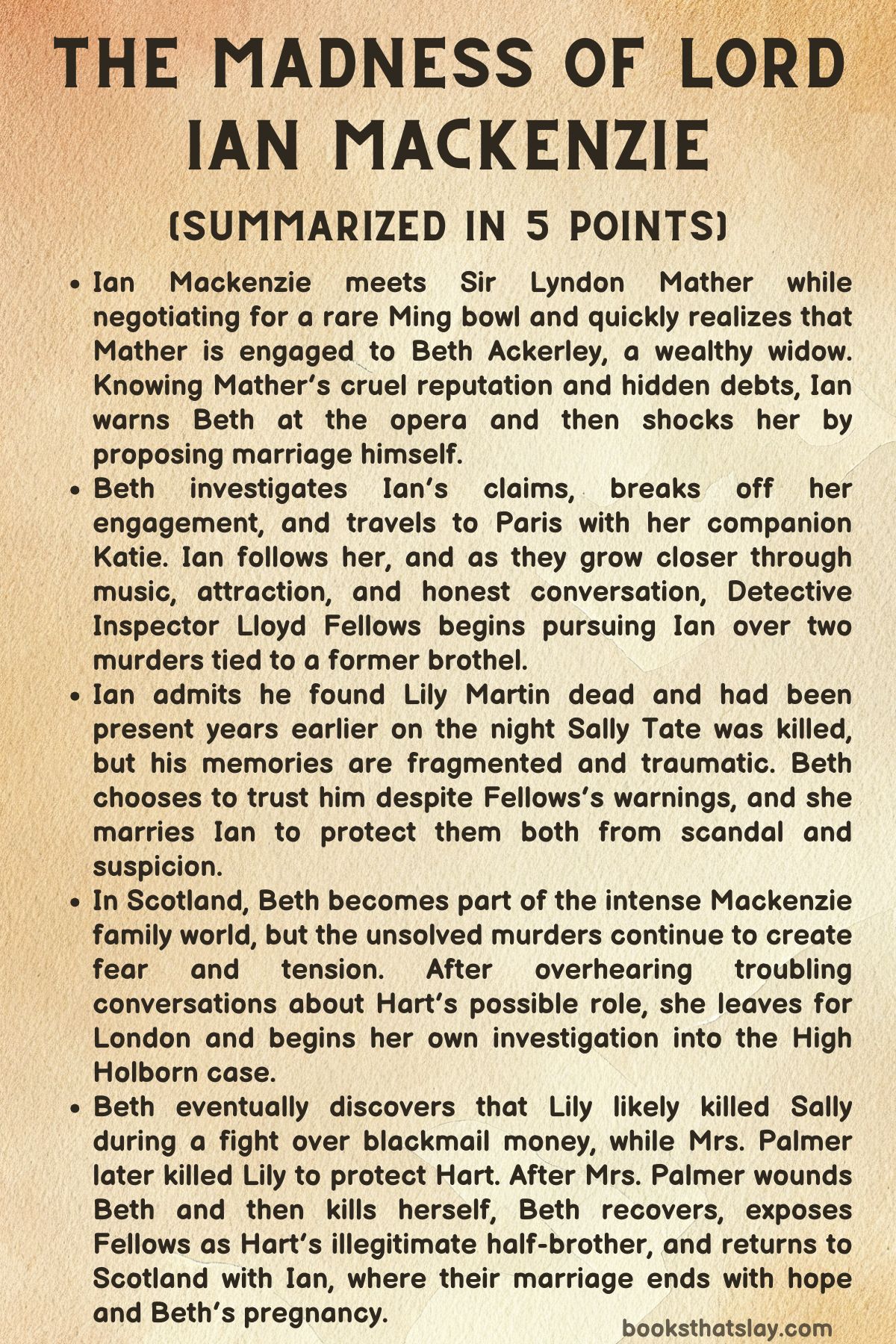
Summary
Beth Ackerley enters society with a fortune, a new sense of independence, and an engagement that seems respectable on the surface. After years spent in service to Mrs. Barrington, who leaves her a large inheritance, Beth is finally able to choose a comfortable future for herself.
Her intended husband, Sir Lyndon Mather, appears to offer that future. He is titled, socially acceptable, and eager to marry her.
Yet beneath his polished manners lies a life of debt, corruption, and cruelty.
Ian Mackenzie, the youngest brother of the Duke of Kilmorgan, discovers Beth’s connection to Mather while negotiating the purchase of a rare Ming bowl in London. Ian already knows enough about Mather to understand that Beth is in danger of tying herself to a deeply unworthy man.
Mather secretly keeps a house where women are paid to endure his degrading tastes, and he is far from the gentleman Beth believes him to be.
At the opera, Ian sees Beth for the first time and acts with his usual blunt decisiveness. He slips her a note warning her about Mather.
Beth is unsettled, not only by the message but also by Ian himself. He is unlike anyone she has met.
His manner is direct, his gaze intense, and his behavior does not fit the rules she expects from men of his class. Ian takes her into the Mackenzie family box and tells her plainly that Mather is not fit to marry her.
Then, with startling honesty, he proposes marriage himself.
Beth is shocked by the offer. Ian does not soften it with romantic language.
He admits that he wants her, but he also tells her he cannot promise love. His brother Cameron interrupts them and confirms that Ian’s warning about Mather is true.
With Cameron’s help, Beth leaves without returning to Mather. She later investigates the accusation herself, finds the truth, and breaks off the engagement.
Wanting distance from the scandal and from Ian’s unsettling effect on her, she travels to Paris with her companion, Katie.
Ian follows her to Paris. There, Beth becomes drawn into the Mackenzie world, a world marked by wealth, talent, anger, loyalty, and old wounds.
She meets Isabella, Ian’s estranged sister-in-law, and Mac, Ian’s artist brother. The more Beth sees of Ian, the more she understands that society’s judgment of him is incomplete.
He is brilliant, especially with memory and observation, but he struggles with social cues, direct eye contact, and emotional expression. People call him mad because they do not understand him.
Beth begins to see the man behind the label.
Their attraction grows quickly. Ian is open about desire, while Beth, widowed and experienced enough not to be naïve, is both tempted and cautious.
Music, conversation, stolen kisses, and private moments bring them closer. Ian’s intensity frightens Beth at times, but it also reveals a sincerity she rarely finds in others.
He does not flatter or manipulate. He says what he means, even when the truth is awkward or raw.
While their relationship develops, a murder investigation follows them. Detective Inspector Lloyd Fellows is convinced that Ian killed two women connected to a former brothel.
One of them, Sally Tate, died five years earlier at a house in High Holborn. The other, Lily Martin, has recently been murdered in Covent Garden.
Fellows believes Ian escaped justice because the Mackenzie family used power and influence to protect him. He warns Beth that Ian is dangerous and tries to persuade her to help him gather evidence.
Beth refuses to accept Fellows’s version of events without proof. Ian eventually tells her what he can remember.
He found Lily dead and fled because he feared scandal and because the scene connected him to Sally’s earlier murder. His memories of the night Sally died are broken and painful.
He had been with her, but he insists he did not kill her. He remembers blood, fear, and confusion.
He also remembers trying to protect Lily, who may have seen something important.
The matter is complicated by Hart Mackenzie, Ian’s oldest brother and the Duke of Kilmorgan. Hart had owned the High Holborn house and had once kept Mrs. Palmer, the woman who managed it and remained devoted to him.
Hart is powerful, controlling, and determined to protect the family name. His involvement raises troubling questions.
Beth begins to wonder what the brothers know, what they have hidden, and whether Ian’s loyalty to Hart might cost him his freedom.
To protect Beth from Fellows, scandal, and Mather’s lingering malice, Ian arranges for a priest. After hesitation, Beth agrees to marry him.
Their marriage begins under pressure, but it is not empty. In Scotland, Beth enters the fierce and unstable Mackenzie household.
She sees the brothers’ arguments, their protectiveness, their damage, and their strange forms of affection. The family is difficult, but Beth is not easily intimidated.
She challenges Ian, comforts him, and refuses to treat him as broken.
As husband and wife, Ian and Beth grow closer in both body and trust. Ian slowly allows Beth into parts of himself he has never shared.
He struggles to name emotions, but his actions reveal devotion. Beth learns how to read him without forcing him to become someone else.
She does not pity him; she respects him. Their marriage becomes a place where Ian can begin to believe he is not only desired but also loved.
The murder case, however, does not fade. Beth overhears Ian and Hart discussing Sally, Lily, and Hart’s possible involvement.
The conversation frightens her. Unsure how much Ian is hiding and afraid of what Hart may have done, she leaves for London with Daniel, Cameron’s son.
In London, she decides to investigate the High Holborn case herself rather than remain trapped by suspicion.
Fellows gives her more details. Sally was stabbed, Ian disappeared after the killing, and Hart may have interfered with the official inquiry.
The investigation was suppressed, strengthening Fellows’s belief that the Mackenzies bought their way out of justice. Beth follows the trail to the old house with Fellows, determined to understand what truly happened.
Ian, Hart, and Cameron soon arrive, turning the confrontation into a dangerous collision of family secrets, police suspicion, and long-buried guilt.
The truth begins to emerge through Beth’s courage and careful thinking. Mrs. Palmer, still obsessed with Hart and determined to protect him, abducts Beth and wounds her.
She takes Beth to an East End church connected to Beth’s own past. There, Beth pieces together the real sequence of events.
Ian did not murder Sally, and Hart was not the killer either. Lily most likely killed Sally after an argument involving blackmail money.
Years later, Mrs. Palmer killed Lily to keep her silent and to protect Hart from renewed scandal.
Ian finds Beth at the church. Mrs. Palmer, cornered and unable to escape the truth, kills herself in front of Hart while declaring her love for him.
The act leaves Hart shaken and confirms how destructive old obsession and secrecy have become. Beth, badly wounded, nearly dies from fever.
Ian remains at her side, refusing to leave her. His fear of losing her shows how deeply he has come to love her, even if saying the word is difficult for him.
After Beth recovers, she confronts Fellows with another truth: his hatred of the Mackenzies is personal. He is Hart’s illegitimate half-brother.
His obsession with destroying the family is rooted not only in justice but also in resentment, rejection, and blood ties he has never been able to escape. Fellows is shaken by the revelation, though it does not immediately heal the breach between him and the Mackenzies.
With the murder mystery resolved, Beth and Ian return to Scotland. Their marriage has survived suspicion, violence, family secrets, and the judgment of others.
Beth has given Ian something he never expected: acceptance without fear. Ian, in turn, has given Beth passion, loyalty, and a love that may not always speak in ordinary ways but proves itself through constancy.
In the end, Beth tells Ian she is pregnant. The news opens a future Ian had barely allowed himself to imagine.
After a life shaped by confinement, misunderstanding, and emotional isolation, he begins to accept the possibility of happiness. With Beth beside him, Ian moves toward family, love, and peace on his own terms.
Characters
Ian Mackenzie
Ian Mackenzie is the emotional center of The Madness of Lord Ian Mackenzie and one of the most unusual, wounded, and compelling figures in the book. As the youngest brother of the Duke of Kilmorgan, he belongs to a powerful family, but his social position does not protect him from inner loneliness or from the judgment of others.
Ian is direct, intense, and often unable or unwilling to follow ordinary social rules, which makes people misunderstand him. His blunt proposal to Beth reveals both his honesty and his limitation: he desires her deeply but does not know how to speak in the language of romance or emotional reassurance.
His past trauma, especially his connection to the murders of Sally Tate and Lily Martin, creates a shadow around him. Yet Ian is not portrayed as cruel or heartless; instead, he is a man whose mind works differently and whose emotions are buried beneath fear, memory, and confusion.
His love for Beth develops not through polished words but through fierce loyalty, physical tenderness, protectiveness, and his gradual willingness to trust. By the end of the story, Ian’s journey is not about becoming ordinary, but about accepting that he can be loved as he is.
Beth Ackerley
Beth Ackerley is intelligent, compassionate, brave, and emotionally grounded. As a wealthy widow who has inherited Mrs. Barrington’s fortune, she begins the book in a position of new independence, but she is also vulnerable to men like Sir Lyndon Mather, who see her wealth as an opportunity.
Beth’s strength lies in the fact that she listens, questions, and acts. When Ian warns her about Mather, she does not blindly trust either man; she investigates for herself and makes her own decision.
Her relationship with Ian shows her unusual emotional courage. Rather than being frightened away by his differences or by the accusations surrounding him, she tries to understand him as a complete person.
Beth is also active in the mystery, not merely a protected wife waiting for answers. Her investigation into the High Holborn case reveals her determination to protect Ian and uncover the truth.
She brings warmth into the Mackenzie household, but she is not passive or soft in a weak sense. Her compassion is paired with intelligence, moral firmness, and resilience.
By the end, Beth becomes the person who helps Ian believe in love, family, and future happiness.
Sir Lyndon Mather
Sir Lyndon Mather is a corrupt and predatory figure whose main function in the story is to reveal the danger Beth initially faces and to contrast sharply with Ian. Outwardly, Mather appears respectable enough to be engaged to a wealthy widow, but beneath that social surface he is dishonest, financially desperate, and morally degraded.
His secret house and his treatment of women expose his selfishness and cruelty. Mather’s interest in Beth is not based on love or respect; it is tied to her fortune and to the advantages she can bring him.
He represents the hypocrisy of polite society, where a man can appear acceptable in public while hiding deeply exploitative behavior in private. His presence also allows Ian’s character to emerge clearly.
Ian may be blunt and socially strange, but he is honest, while Mather is socially acceptable and morally rotten. Through Mather, the book shows that danger does not always come from the person who seems unusual; it often comes from the person society is willing to excuse.
Cameron Mackenzie
Cameron Mackenzie is one of Ian’s older brothers and a forceful, protective presence in the story. He confirms Mather’s vile reputation and helps Beth escape an engagement that would have harmed her, which shows his loyalty to both Ian and the truth.
Cameron carries the rough intensity associated with the Mackenzie family, but he is not careless about those he loves. His role is often practical and protective, especially when family danger rises.
As Daniel’s father, he also brings another dimension to the family structure, showing that the Mackenzies are not only passionate and scandal-ridden men but also fathers, brothers, and guardians shaped by responsibility. Cameron’s personality is less mysterious than Ian’s and less politically powerful than Hart’s, but he adds strength and urgency to the family dynamic.
He acts decisively when crisis appears, and his presence reinforces the idea that the Mackenzie brothers are deeply flawed but fiercely loyal to one another.
Hart Mackenzie
Hart Mackenzie, the Duke of Kilmorgan, is powerful, controlled, and morally complicated. As the head of the Mackenzie family, he carries authority, ambition, and a history of secrets.
His connection to the High Holborn house and to Mrs. Palmer places him at the center of the murder mystery, even when he is not the true murderer. Hart’s past choices have consequences that damage others, and his influence over the original investigation suggests a man accustomed to using power to protect the family name.
At the same time, Hart is not presented as a simple villain. His relationship with Ian is protective, though often controlling, and his connection with Mrs. Palmer reveals the destructive emotional consequences of his past.
Hart represents the darker side of aristocratic privilege: he can conceal scandal, dominate situations, and inspire obsessive loyalty, but he cannot fully escape the pain caused by his actions. His character deepens the book’s moral world by showing that love, guilt, power, and selfishness can exist in the same person.
Mac Mackenzie
Mac Mackenzie is Ian’s artist brother and contributes a more creative and emotionally expressive energy to the Mackenzie circle. His presence in Paris, especially alongside Isabella, adds warmth, complexity, and tension to the wider family world.
Mac is important because he shows that the Mackenzie brothers are not identical copies of one another. Where Hart is commanding and Cameron is forceful, Mac is associated with art, feeling, and damaged intimacy.
His relationship with Isabella suggests a history of love and estrangement, making him another example of how passion in this family can be both beautiful and destructive. Mac’s role is not as central to the murder mystery as Ian’s or Hart’s, but he helps build the emotional environment around Beth and Ian.
Through him, the story expands beyond one romance and shows a family full of unfinished wounds, strong attachments, and difficult attempts at reconciliation.
Isabella
Isabella is Ian’s estranged sister-in-law and an important figure in the Mackenzie social circle. Her presence in Paris introduces Beth to the emotional complications surrounding the family.
Isabella carries dignity, experience, and pain, especially through her connection with Mac. She is not merely a background character; she represents the cost of loving a Mackenzie man.
Her estrangement from Mac suggests that passion alone is not enough to sustain a relationship when pride, hurt, or recklessness interfere. For Beth, Isabella offers a glimpse into what it means to enter this family: love may be intense, but it is rarely simple.
Isabella’s role also helps balance the male-dominated energy of the Mackenzie household. She brings a woman’s perspective shaped by both affection and disappointment, making the family world feel more emotionally layered.
Detective Inspector Lloyd Fellows
Detective Inspector Lloyd Fellows is driven, suspicious, and personally invested in destroying the Mackenzies. On the surface, he appears to be a determined officer pursuing justice for Sally Tate and Lily Martin.
He follows Ian, pressures Beth, and repeatedly suggests that Ian is dangerous. However, his obsession is not purely professional.
The revelation that Fellows is Hart’s illegitimate half-brother changes the meaning of his pursuit. His anger toward the Mackenzies is rooted in exclusion, resentment, and the injustice of being connected by blood to a powerful family that has not accepted him.
This makes him a morally complex character. He is not entirely wrong to suspect corruption, because the family has hidden things, but his judgment is clouded by personal bitterness.
Fellows acts as both investigator and emotional antagonist. He forces buried truths into the open, but he also misreads Ian because he wants the Mackenzies to be guilty.
Mrs. Palmer
Mrs. Palmer is one of the most tragic and destructive characters in the book. Her devotion to Hart has twisted into obsession, and that obsession leads her to violence.
As the former mistress connected to the High Holborn house, she is tied directly to the secrets surrounding Sally and Lily. Her love for Hart is not healing or generous; it is possessive, desperate, and self-erasing.
She kills Lily to protect Hart and later abducts and wounds Beth, showing how far she is willing to go for a man who does not truly belong to her. Mrs. Palmer’s actions are horrifying, but they also come from emotional ruin.
She has built her identity around Hart, and when the truth closes in, she chooses death while declaring her love for him. Her character shows the danger of devotion without self-respect or moral restraint.
She is both a villain and a ruined woman, shaped by class, desire, rejection, and obsession.
Sally Tate
Sally Tate is a dead character before much of the main action unfolds, but her presence shapes the entire mystery. Her murder becomes one of the central wounds of the story, and the uncertainty around her death places suspicion on Ian and Hart.
Sally’s connection to High Holborn and the world of paid sexual arrangements reveals the darker social spaces hidden beneath aristocratic respectability. She is important not because she has a large active role, but because the truth about her death exposes the secrets and weaknesses of several living characters.
Her quarrel over blackmail money and her likely murder by Lily show how desperation, money, fear, and exploitation can turn deadly. Sally represents the women who are used, forgotten, and then reduced to scandal, even though their lives and deaths carry real moral weight.
Lily Martin
Lily Martin is another crucial victim whose death brings the old crime back into the present. Unlike Sally, Lily appears to have witnessed or known too much, and her knowledge makes her dangerous to those trying to protect Hart.
Ian’s memory of finding Lily dead is central to the suspicion against him, but it also reveals his fear and confusion. Lily’s likely role in Sally’s death complicates her character.
She is not simply an innocent victim; she may have committed violence herself during a quarrel over blackmail money. Yet her later murder by Mrs. Palmer also makes her a victim of someone else’s obsession and cover-up.
Lily’s character adds moral ambiguity to the mystery. She shows how people trapped in dangerous circumstances may become both guilty and vulnerable.
Daniel Mackenzie
Daniel Mackenzie, Cameron’s son, brings youth, movement, and family continuity into the story. His role becomes especially important when Beth leaves for London with him.
Daniel’s presence softens the intensity of the adult conflicts while also showing that the Mackenzie family extends into the next generation. He is connected to the household’s future, not just its troubled past.
In a story filled with murder, scandal, sexual danger, and emotional trauma, Daniel represents a more open and less damaged form of life within the family. His relationship to Beth also helps show her growing place among the Mackenzies.
She is not only Ian’s wife; she becomes involved in the family’s wider emotional network.
Katie
Katie is Beth’s companion and provides support during Beth’s transition from widowhood and possible remarriage into the unpredictable world of the Mackenzies. Her presence on the journey to Paris shows Beth’s social position and also gives Beth a stabilizing connection outside the intense Mackenzie family circle.
Katie is not a central driver of the mystery, but she helps ground Beth’s character. Through Katie, the reader sees that Beth is not isolated or helpless.
She has a life, a household structure, and people around her before Ian enters fully into her world. Katie’s role is quieter than that of the main characters, but she contributes to the realism of Beth’s independence and respectability.
Mrs. Barrington
Mrs. Barrington is significant even though she is not active in the main events. As Beth’s former employer and the woman from whom Beth inherits a fortune, she changes Beth’s life and indirectly sets the plot in motion.
Without Mrs. Barrington’s inheritance, Beth would not become such an attractive target for Mather, and she might not enter the same social and financial position that brings Ian into her life. Mrs. Barrington represents generosity, female influence, and the possibility of social mobility.
Her legacy gives Beth freedom, but it also exposes her to exploitation. In that sense, Mrs. Barrington’s role continues after her death because her fortune creates both opportunity and danger for Beth.
Themes
Love as Acceptance Rather Than Rescue
The Madness of Lord Ian Mackenzie presents love as a force built not on changing someone, but on seeing them clearly and choosing them fully. Beth does not treat Ian as a puzzle to solve or a damaged man who must become ordinary before he can be worthy of affection.
Instead, she learns his habits, his fears, his direct way of speaking, his difficulty with emotional expression, and his painful history without reducing him to any single part of himself. Ian’s inability to offer conventional romance at first makes their relationship unusual, but it also makes it honest.
His attraction to Beth begins in blunt desire and protectiveness, yet slowly grows into trust, dependence, and emotional openness. Beth’s love matters because it gives Ian safety without pity.
She challenges him, refuses to fear him blindly, and insists on his innocence when others define him by suspicion. Through this relationship, love becomes less about perfect words and more about loyalty, patience, physical tenderness, and the courage to remain present when fear, scandal, and trauma threaten intimacy.
The Damage Caused by Social Judgment
Reputation has enormous power in the story, shaping how people are seen long before the truth is known. Ian is judged through rumor, class expectation, and the fear surrounding his past, while Beth is also watched because of her wealth, widowhood, and sudden connection to a controversial family.
Society prefers simple labels: mad, dangerous, improper, ruined, respectable. These labels allow people like Fellows and Mather to use public opinion as a weapon.
Ian’s history makes him especially vulnerable because once a person has been marked as unstable, every action can be twisted into evidence against him. The murder accusations gain force not only because of facts, but because people are willing to believe the worst about him.
Beth’s refusal to accept easy judgment becomes morally important. She listens, observes, and questions what others present as certainty.
The theme shows how social judgment can hide real corruption while punishing those who are already misunderstood, especially when power, gender, and family status control whose story is believed.
Trauma, Memory, and the Search for Truth
The murder mystery is not only a question of who committed the crimes; it is also a study of how trauma affects memory and truth. Ian remembers pieces of violent events, but his memories are fragmented by fear, shock, and years of being told that his mind cannot be trusted.
This uncertainty makes him vulnerable to manipulation, because even he cannot always explain what he saw or felt with complete confidence. The past survives in flashes: blood, danger, guilt, and the instinct to protect someone.
Beth’s investigation becomes important because she treats memory with care rather than dismissal. She does not demand a neat confession or force Ian into a version of events that suits others.
Instead, she looks for patterns, motives, and hidden loyalties. The truth emerges slowly because it has been buried under shame, obsession, and family secrets.
This theme suggests that healing requires more than solving a crime; it requires restoring trust in one’s own experience after years of fear and doubt.
Family Loyalty and Its Moral Cost
The Mackenzie family is bound by fierce loyalty, but that loyalty often carries a heavy price. The brothers protect one another with intensity, especially when scandal threatens the family name, yet their secrecy also creates danger.
Hart’s power, Cameron’s protectiveness, and Ian’s silence all show a family trained to survive by closing ranks. Their loyalty can be loving, but it can also block justice, frighten outsiders, and allow suspicion to grow.
Beth enters this family as someone who values devotion but is not fully controlled by its rules. Her presence exposes the difference between protection and concealment.
The family’s instinct is to guard its own, even when openness might prevent greater harm. Mrs. Palmer’s actions present a darker form of loyalty: devotion twisted into violence and self-destruction.
Through these relationships, the story questions whether love for family excuses secrecy or moral compromise. True loyalty, the narrative suggests, must eventually make room for truth, accountability, and the freedom to build healthier bonds.