Fundamentals of Being a Good Girl Summary, Characters and Themes
Fundamentals of Being a Good Girl by Julie Murphy and Sierra Simone is a contemporary romance set around Astra University and a small-town bar called The Dry Bean. It follows Bram Loe, an overworked single dad trying to keep his household running, and Maddie Kowalczk, an adjunct lecturer whose life has quietly fallen apart after a high-profile breakup leaves her broke and sleeping in her car.
What begins as a messy, impulsive one-night stand turns into an arrangement neither of them can afford to want: Maddie becomes Bram’s temporary childcare lifeline, and the chemistry they promised to shut down refuses to stay quiet. Alongside the romance, the story tracks ambition, reputation, and the cost of building a life that’s actually yours. The book kickstarts the Academic Affairs series by the author.
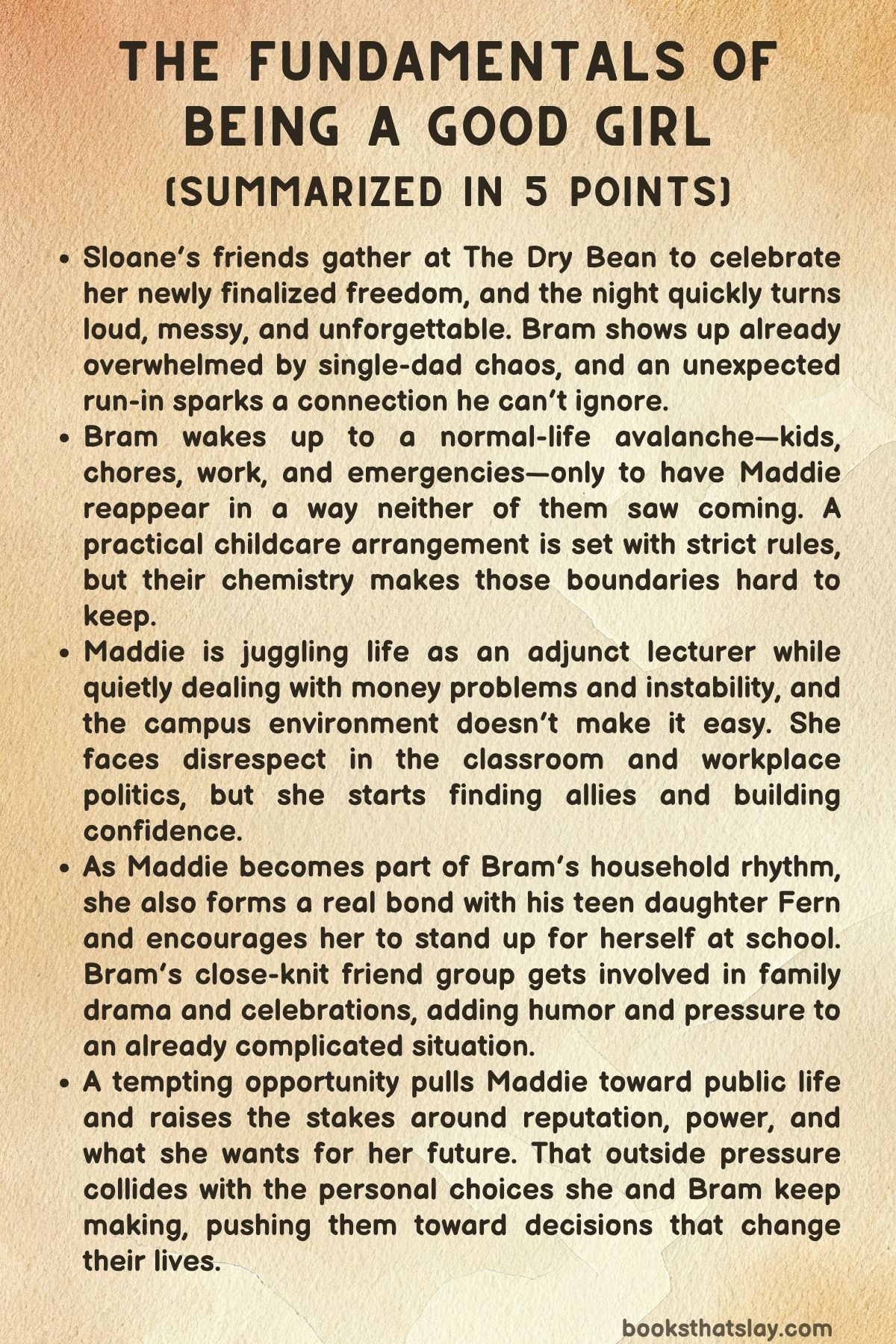
Summary
Bram Loe meets his friends at The Dry Bean to celebrate Sloane Saint James finally being legally free after a long marriage. Bram arrives already on edge, worn down by work deadlines, parenting three kids, and last-minute chaos at home.
His twins have accidentally made his ex-wife’s dog sick, and while he was trying to manage the fallout, a stranger stole his parking spot and flipped him off. The irritation clings to him when he walks into the bar—until the night takes a sharp turn.
A birthday celebration starts up, and the woman being called onto the stage for playful punishment is Maddie Kowalczk, the same stranger from the parking lot. Bram watches her with a focus that surprises him.
When their eyes meet, his anger switches tracks and becomes something hot and immediate. The group keeps drinking.
Joey sings karaoke, people arm-wrestle, and the bar grows loud and reckless. Bram and Maddie finally collide face-to-face, their argument turning into flirting, then into an agreement neither of them thinks through.
Before the night is over, they’re upstairs in the vacant apartments above the bar, having sex again and again until the line between revenge, attraction, and release disappears.
The next morning, Bram wakes hungover on his living-room floor, fully dressed, inside a cardboard fort his kids built around him. His teen daughter, Fern, is unimpressed.
The twins want pancakes, the house is a disaster, and the list of things Bram has to handle feels endless—cleaning, work, the dog at the vet, missing pets, car trouble, school logistics. He finds lipstick on his shirt and gets slammed with memories of Maddie’s body, Maddie’s mouth, Maddie’s voice.
He tells himself it was a one-time mistake and starts trying to pull himself into functioning-parent mode.
Then the doorbell rings.
Maddie is standing on his porch dressed like a professional, introducing herself as the childcare agency’s assigned sitter. Bram freezes.
Maddie freezes. They both realize what happened: he slept with the woman who is now supposed to help raise his kids for the next eight weeks.
The moment is made worse by chaos—one of the twins’ pets escapes and darts toward the street. Maddie reacts fast, saving the animal and winning the twins over instantly.
Bram, desperate because his ex-wife is leaving for a long research trip and the agency has no replacement, offers Maddie more money to stay. Maddie agrees, but lays down strict rules: no more sex, no being alone together inside the house, simplified expectations, and a credit card for kid-related expenses.
Bram accepts because he has no other choice. Maddie accepts because she needs the job more than she wants to admit.
On campus, Bram’s friend Leo spots Maddie and needles Bram about sleeping with the nanny. Bram insists the hookup happened before employment, but the truth is he can’t stop thinking about her.
Maddie’s first day teaching goes badly—students are bored, rude, and one of them pushes her to the edge. Bram watches from the doorway, and afterward Maddie confronts him for hovering.
She refuses to be treated like his employee in public. Bram backs off, but the fixation doesn’t fade.
Back at the house, Maddie proves she’s good with the kids. She turns ordinary moments into games, handles the twins’ chaos with calm confidence, and even starts connecting with Fern, who is old enough to see what the adults won’t say out loud.
Bram catches Maddie running through the sprinklers with the twins, her clothes soaked through, and he has to physically force himself not to stare. When he offers her dry clothes, she changes using items from her car.
Bram realizes, with a sick drop in his stomach, that she may be living out of it.
Maddie’s life is in free fall. She came to Mount Astra after a breakup with Gentry Wade, a man with political power and money.
The relationship ended in a way that left her financially stranded, and she’s been trying to survive on adjunct pay while sleeping in her car, washing up wherever she can, and pretending she’s fine. She befriends Junie at the library coffee bar and deals with a hostile older professor who treats her like she doesn’t belong.
When Maddie sees a campus “throwback” photo that makes Bram look like he’s still married, she assumes the worst—that she unknowingly slept with a married man. Furious and humiliated, she confronts him at home.
Bram explains he’s been divorced for years and his ex is engaged. The anger shifts into sexual tension so fast it scares them both, and they end up in Bram’s office doing exactly what they promised not to do.
They don’t get far before Fern bursts in crying. The interruption hits like a reality check.
Bram goes to his daughter, trying to be the parent she needs, while Maddie escapes to regain control of herself. What keeps happening is obvious: every time Bram and Maddie get close, they’re acting like it’s only physical, but their bodies keep telling the truth before their mouths will.
Maddie becomes part of the household rhythm. She makes school pickups smoother, earns the twins’ trust, and starts helping Fern through her own crisis.
Fern’s ex-boyfriend Simon cheated on her and is now trying to take credit for her work in student government. Maddie pushes Fern to run against him instead of shrinking.
Fern takes the dare. When Bram hears his daughter announce her campaign, pride flashes through him, and he supports her immediately.
Maddie and Bram share a look that says: we’re both changing things here, whether we meant to or not.
Bram’s friends get involved in Fern’s campaign in their own chaotic way, and the family begins to feel less like something Bram is barely holding together and more like something that’s alive. Maddie, meanwhile, keeps trying to hide just how unstable her life still is.
One day, everything collapses at once: she can’t shower because the campus locker rooms are closed, she spills coffee on herself in public, she walks in on coworkers hooking up, and then her car gets towed because she missed street-sweeping rules. With no car, no clean place to go, and no privacy, she drags herself through the day until she reaches Bram’s house.
There she finally eats, washes clothes, and takes a long shower, letting herself feel human again.
Bram comes home early in a panic, thinking the twins are missing. Maddie is exhausted past her limit and breaks down in tears.
Bram realizes the kids are safe and shifts instantly from fear to care, holding her until she can breathe. The comfort turns into desire.
This time, when they cross the line again, it’s not about a reckless night at a bar. It’s about relief.
It’s about wanting someone to see you and not look away.
Maddie finally admits the truth: she’s been homeless. Bram insists she move into the spare room immediately.
Maddie resists because pride is one of the only things she has left, but Bram refuses to let her keep punishing herself for someone else’s damage. She accepts the room, telling herself it’s temporary, telling herself it doesn’t mean anything.
As Maddie stabilizes, she gets stronger in the classroom. She pushes back against disrespect, gains confidence, and even starts to imagine a future again.
That’s when politics comes knocking. A consultant named Veronica Balentine approaches Maddie after noticing her and the attention she’s drawing.
Veronica offers her a path: money, support, and a real campaign if Maddie is willing to become a candidate. Maddie is tempted, not because she misses being someone’s accessory in political circles, but because she wants power on her own terms.
Bram is wary, warning her that Veronica’s help will come with control, but Maddie insists she knows the world Veronica is offering. She wants Bram to trust her ambition the way he trusts her with his kids.
The household grows closer even as Bram and Maddie try to keep their relationship boxed into “just sex.” Their friends suspect the truth. Fern’s campaign builds toward a school festival competition, and the group rallies behind her.
Fern wins, securing her goal of free menstrual products in school bathrooms. The victory is small in the grand scheme of the world, but huge in the way it teaches Fern she can fight and win.
Afterward, Sloane helps Fern and Maddie with makeovers, and Maddie cuts her hair back toward her natural look, feeling more like herself than she has in months.
On Halloween, Bram gets a call that Maddie is drunk outside a pub, alone and vulnerable. He finds her on the sidewalk singing and half-delirious, and his fear comes out as anger.
At home, he cleans her up and makes sure she’s safe, refusing to take advantage of her. During the night, Maddie learns Bram has his own past with politics and risk: he and his ex once did illegal environmental sabotage connected to a pipeline fight, then stopped when they realized the cost if they were caught.
Maddie, half-asleep and raw, asks if she belongs to him. Bram admits he wants her to.
The words land hard because they’re not part of a “just sex” arrangement.
Veronica pulls Maddie deeper into the political machine, introducing her to powerful people and treating her like a product that needs protecting. Maddie enjoys the thrill of being taken seriously, of being seen as someone with potential.
She comes home charged up and slides into Bram’s bed, letting herself imagine she can have both: love and power, intimacy and ambition.
Then Veronica catches Maddie being publicly affectionate with Bram and snaps. She threatens to destroy Maddie’s future if she doesn’t end it, listing scandals she could spin and leverage.
Cornered, Maddie lies and says Bram is only physical. Bram overhears.
When he confronts her, she doubles down, saying it can’t continue. The words gut him, because he knows she’s scared, but he also knows she chose to cut him with them.
Maddie stays long enough to keep stability for the kids, then moves into an apartment above The Dry Bean with help from Bram’s friends. Bram leaves her a cactus as a small, stubborn gift, along with care instructions like he’s trying to protect something living that he can’t hold directly.
At Thanksgiving, Maddie goes to Los Angeles and finally tells her family how bad things were, confessing she had been living in her car before Bram helped her. She admits she fell for him and ended it anyway.
At the airport, Maddie sees breaking news: a targeted leak exposes Gentry’s hypocrisy and sexual misconduct, tying him to an online handle and ruining his public image, especially given his policy positions. Maddie realizes Bram likely had a hand in it, even if he’ll never say so.
The relief is immediate, but so is the longing. Maddie calls Veronica and quits the candidate track, deciding she doesn’t want to be the polished face in front of donors.
She wants to be the person building better candidates and shaping power from behind the scenes.
Back in Kansas, Maddie returns ready to tell Bram the truth. With help from their friends, she meets him in a classroom and frames her confession like a lesson: she lied because she was scared, she called it only physical because she thought she had to choose, and she doesn’t want a future that costs her him.
Bram pushes back on her fear, forces honesty into the open, and then accepts her. They reconcile, this time without pretending it’s simple.
Maddie moves back, not into the guest room but into Bram’s life fully. She keeps teaching while preparing to work alongside Veronica in a new role, taking the parts of politics she wants and refusing the parts that require erasing herself.
A month later, Bram and Maddie plan a quiet courthouse wedding. Their friends crash it anyway, the twins cause chaos as flower girls, and the whole group spills onto the courthouse steps celebrating.
Bram and Maddie get married openly, with nothing hidden, choosing a life where love and ambition don’t have to be enemies.
Characters
Maddie Kowalczk
Maddie begins the story in a precarious, almost hidden survival mode: she is an adjunct lecturer trying to maintain authority in the classroom while secretly living out of her car, and that double life shapes nearly everything she does. Her sharpness—snapping at Junie, lashing back at a disrespectful student, keeping emotional distance—often reads like attitude, but it’s more accurately a shield built from exhaustion, humiliation, and the constant math of “how do I get through today.” The night at The Dry Bean exposes the other side of her: she can chase sensation, flirt with chaos, and choose pleasure with a kind of defiant hunger, which later complicates her attempt to set strict boundaries with Bram.
Maddie’s arc in Fundamentals of Being a Good Girl is fundamentally about agency: she’s been “adjacent to power” through Gentry and political circles, then dropped without a safety net, and she spends the book fighting to become the author of her own future rather than someone’s accessory. That ambition is real, not a vanity project—she’s energized by policy, messaging, and the thrill of being taken seriously—yet it also tempts her into compromises, especially when Veronica frames success as obedience, optics, and control.
By the end, Maddie’s decisive turn—rejecting the candidate track and choosing a behind-the-scenes path—shows a mature form of power: she refuses to be curated into a symbol and instead chooses work that lets her keep her values, her voice, and her love, openly, on terms she helped write.
Bram Loe
Bram is introduced as a man already at capacity: a single dad managing twins, a teen, an ex-wife leaving for weeks, a sick dog crisis, and professional deadlines, and his anger in the opening isn’t just about a parking spot—it’s the overflow of a life where everything depends on him. That “carrier of responsibility” identity is both his virtue and his trap; he’s competent, protective, and deeply attached to caregiving as proof of love, but he can slide into control when fear spikes, especially around his children’s safety.
His attraction to Maddie hits him like a disruptive force because it collides with his self-image as steady and contained, and the nanny arrangement turns that collision into a daily test of restraint, ethics, and desire. Bram’s past activism with Sara adds an important layer: he isn’t only a domestic caretaker, he’s someone who once risked everything for an ecosystem and a community, then stopped not because he stopped caring, but because the consequences would have fallen on his child—so his morality is intimate, parental, and intensely pragmatic.
With Maddie, that pragmatism becomes both tenderness and possessiveness: he offers stability in a way that is genuinely protective, yet it also fulfills his need to “fix” problems through action, which can make Maddie feel like a project or a rescue. His emotional climax arrives when he overhears Maddie describe their relationship as “just physical”; the devastation reveals how far past lust he has gone, and how much he fears being chosen only conditionally.
Bram’s resolution is not just winning Maddie back—it’s learning to trust her ambition, loosen his grip on outcomes, and accept a partnership where love isn’t another responsibility to manage, but a shared life to build.
Fern Loe
Fern functions as the story’s clearest mirror for both Maddie and Bram: she is old enough to see adult contradictions and young enough to still be wounded by them, and her presence forces their romance to confront real-world stakes rather than existing as a sealed-off fantasy. Her heartbreak over Simon’s cheating and credit-stealing is not treated as a small teenage problem; it becomes a formative injustice that shapes her confidence and sense of fairness, and it also echoes Maddie’s experience of being discarded and diminished by Gentry’s world.
Fern’s decision to run for student body president, and to anchor that campaign in something materially compassionate—free menstrual products—shows her as principled, practical, and more emotionally resilient than she initially feels. She also reveals Bram’s parenting instincts: he wants to charge in and solve, yet her arc pushes him toward support without domination, letting her build power with peers and community rather than through her father’s force.
With Maddie, Fern finds a rare kind of adult ally: someone close enough to care and honest enough to challenge, who validates her anger and channels it into action. By the end, Fern’s growth represents what healthy influence looks like in this book’s universe—guidance that increases a young person’s agency instead of replacing it.
Letty Loe
Letty, one of Bram’s twins, embodies the household’s playful chaos and also its emotional thermometer, reacting quickly to shifts in mood and stability. Her quick acceptance of Maddie—impressed by the frog rescue, delighted by games and sprinklers—shows how children measure adults less by history and more by presence: who shows up, who makes home feel safe, who can turn a hard day into laughter.
Letty’s role also heightens the ethical tension around Bram and Maddie; because she bonds so easily, the adults’ choices stop being private—they become part of the children’s sense of continuity. Letty helps reveal what Maddie is truly good at beyond lecturing and politics: improvising care, creating warmth without money, and making stressed adults remember joy.
Berry Loe
Berry, the other twin, complements Letty by reinforcing the sense that Bram’s home runs on constant motion, constant need, and constant love, which is exactly why Bram is so stretched thin at the start. Berry’s eagerness, routines, and small crises—pancakes, playdates, missing frog drama—create the everyday stakes that make Maddie’s presence so consequential: she isn’t just a romantic interest; she becomes part of the twins’ daily emotional architecture.
Berry also sharpens Maddie’s internal conflict: leaving Bram isn’t only leaving a man she loves, it’s risking disruption to two kids who have come to rely on her. Through Berry, the book keeps insisting that adult decisions echo outward, especially in blended, improvised families.
Sara Loe
Sara, Bram’s ex-wife, sits mostly offstage but remains a powerful gravitational force in the story because she represents Bram’s past ideals, shared history, and the kind of partnership that once centered activism and risk. Her glacier research trip establishes her as driven and independent, which helps explain the marriage’s long arc: two intense people who once burned in the same direction and then chose different forms of life.
Sara’s continued connection to Bram through co-parenting—and her engagement—clarifies that Bram’s romantic availability is real, and it also exposes how public narratives can lag behind private truth, as seen in the campus “throwback” caption that misleads Maddie. Importantly, Sara’s presence in Bram’s activism confession shows that Bram’s protectiveness is not new and not unique to Maddie; it is a core part of how he loves, and it can be beautiful or suffocating depending on whether the other person feels free inside it.
Joey Kemp
Joey is the catalyst energy of the opening: the friend who turns a celebration into an event, who believes in big nights, big gestures, and the kind of recklessness that makes good stories the next day. His desire to give Sloane the “Best Night Ever” positions him as loyal and sentimental beneath the rowdy exterior, and his obliviousness to the deeper consequences—like Bram disappearing upstairs with Maddie—highlights how the friend group can normalize chaos while missing the emotional landmines.
Joey’s own ending to that night—stumbling home and having sex with his wife, Riley—presents him as someone who channels intensity back into his marriage, suggesting that for him, excitement is a spice rather than an escape. He’s less central later, but his early role is crucial: he opens the gate to the story’s main collision and establishes the group’s culture of meddling affection.
Sloane Saint James
Sloane enters as newly, legally free after a long marriage, and that freedom gives her a particular authority in the group: she is living proof that reinvention is possible, even after years of constraint. She combines warmth with strategic boldness, stepping naturally into a “glam aunt” function for Fern while also playing organizer and fixer inside the friend network.
Sloane’s enthusiasm for Fern’s campaign shows how she expresses care through empowerment—makeovers, plotting, resources, confidence-building—while also flirting with rule-bending in a way that matches the group’s playful amorality when the cause feels justified. In the romance plot, she becomes a bridge between private longing and public decision, ultimately helping bring Bram and Maddie to the same room for a reckoning that is emotional but also practical: say what you mean, choose what you want, stop pretending it’s smaller than it is.
Leo Saint James
Leo is the story’s instigator and intelligence-gatherer, a friend who notices everything and enjoys pressing on sensitive spots—especially Bram’s denial about Maddie. His teasing is not purely cruelty; it’s a way of forcing truth into the open in a group that survives on honesty disguised as jokes.
Leo also carries a sharper edge through his history with Junie, which becomes significant when Maddie is drunk and vulnerable on Halloween: his proximity, her fear, and Junie’s reaction hint that Leo’s past actions weren’t harmless. Later, Leo’s role expands into the group’s “fixer” capacity when Bram asks him to dig into Maddie’s ex, and that request shows Bram’s darker protective streak—using social power to fight political power.
Leo operates at that intersection of friendship and manipulation, where loyalty can look like meddling and care can look like control.
Junie
Junie is Maddie’s first real foothold of kindness and normalcy on campus, a librarian who provides not just coffee but sanctuary, a place where Maddie can exhale. When Maddie snaps at her after the humiliating spill, Junie’s response—helpful, then later honest about why she stayed away on Halloween—marks her as emotionally steady, someone who sets boundaries without abandoning people.
Junie also functions as a moral contrast to the political operators in Maddie’s orbit: she doesn’t offer power, she offers care, and she proves that being seen doesn’t have to come with strings. Her complicated history with Leo adds realism to the friend web and reinforces one of the book’s recurring themes: charisma can hide harm, and community safety sometimes requires distance, even when the person involved is part of the group’s inner circle.
Dr. Miranda Salazar
Dr. Miranda Salazar represents institutional power used with rare decency: as department chair, she sees Maddie not as expendable adjunct labor but as someone with talent, history, and potential. By referencing Maddie’s political past in a way that affirms rather than gossips, Miranda reframes Maddie’s identity from “someone’s ex” to a person with her own trajectory, which is exactly the reframing Maddie needs to believe in herself again.
Miranda’s support also quietly critiques the academic hierarchy that leaves adjuncts vulnerable, underpaid, and disrespected, showing how one leader’s choices can either amplify that harm or soften it. She’s not a savior figure—she can’t fix the system—but she provides legitimacy at moments when Maddie’s confidence is under siege.
Dr. Wallace
Dr. Wallace is the story’s clearest depiction of everyday institutional disrespect: the entitled professor who treats space, time, and authority as his by default, interrupting Maddie’s classes and undermining her in front of students. His behavior is less about ideology than about hierarchy, and that’s why it stings—because it is normalized, petty, and effective at eroding someone’s sense of belonging.
Wallace’s function is to externalize the pressure Maddie feels as an adjunct: she is always one confrontation away from consequences, always one viral moment away from being disposable. When Maddie finally pushes back and gains respect, Wallace becomes the obstacle she learns to handle not with charm or apology, but with firm boundaries and the confidence that she has earned her space.
Riley Kemp
Riley appears briefly but meaningfully as Joey’s wife, anchoring him to a stable domestic reality that contrasts the night’s chaos. Her presence suggests that for all Joey’s exuberant disorder, he has a home base of mutual desire and partnership, and that intimacy can be celebratory rather than escapist.
Riley’s role is small, yet she subtly reinforces the book’s broader movement from secret, impulsive pleasure toward chosen, open commitment.
Gentry Wade
Gentry is the story’s shadow antagonist: he doesn’t need many scenes because the damage he caused is embedded in Maddie’s material conditions and emotional triggers. By dumping Maddie in a way that leaves her broke, stranded, and car-camping, he weaponizes proximity to power—the kind of power that can erase someone without consequence—then continues to represent a threat through optics, scandal, and the political machine around him.
The later revelation of his hypocrisy and exploitative behavior, tied to the “Footlicker95” leak and his public policy stance, exposes him as someone who uses morality as branding while indulging in secrecy, entitlement, and harm. Most importantly, Gentry’s function is to test Maddie’s definition of ambition: will she pursue power through the same ecosystem that protected him, or will she choose a path that doesn’t require surrendering her private life and dignity to donors’ demands.
Veronica Balentine
Veronica is a sophisticated embodiment of political power as control: she flatters Maddie’s potential, offers resources and access, then quickly reveals the price—obedience, image management, and the willingness to cut off anything that can be framed as scandal. Her low-profile mystique and donor-linked influence make her frightening not because she shouts, but because she can quietly decide who gets elevated and who gets erased.
Veronica’s ultimatum at the nursery crystallizes the central conflict between authentic life and curated ambition, forcing Maddie to confront whether politics, as Veronica practices it, is compatible with love, honesty, and self-respect. Even when Maddie ultimately chooses to work in the political world, she rejects Veronica’s terms by refusing the candidate mold and demanding a different kind of role—one where she can shape outcomes without being owned by the machine.
Anton
Anton, one of the adjuncts Maddie walks in on in the shared office, provides a moment of comic relief that still carries thematic weight: adjunct life is cramped, precarious, and intimate in ways that can be both supportive and humiliating. His casual friendliness—joking, normalizing Maddie’s bad morning, suggesting she cancel class—shows the informal solidarity of people who survive the same professional instability.
Anton’s presence also helps humanize Maddie’s workplace beyond conflict, reminding us that there are pockets of warmth even inside exploitative systems.
Martin
Martin, the other adjunct in that scene, reinforces the same dynamic as Anton: the adjunct community as a blend of exhaustion, gallows humor, and improvised camaraderie. His quick rapport with Maddie offers her a small reminder that she isn’t alone, even when she feels publicly exposed and privately desperate.
Like Anton, Martin’s role is brief but functional—he widens the world around Maddie and reflects the messy humanity that persists even when institutions don’t care.
Simon
Simon is Fern’s personal antagonist and a younger echo of the book’s adult power games: he cheats, then tries to control the narrative by taking credit for her work and positioning himself as the public face of ideas she helped build. His student body campaign becomes a lesson in how charisma and self-promotion can masquerade as leadership, especially in environments that reward confidence more than integrity.
Simon’s significance rises because Fern defeats him not by matching his tactics, but by clarifying her own values and mobilizing community support—an early version of the political lesson Maddie is learning at higher stakes.
Penelope Pike
Penelope Pike appears as a connector inside the political ecosystem surrounding Gentry, serving as a voice that translates scandal into consequences: families and machines protect themselves first, and retaliation is often less visible than the headline. Her confirmation that the Wade family will force Gentry to step down or escalate pressure underscores how politics, in this world, is managed like a business—assets preserved, liabilities cut.
Penelope’s presence sharpens Maddie’s understanding of what she’s up against and why Veronica’s threats are credible, making Maddie’s eventual choice to step away from the candidate track feel less like fear and more like clarity.
Gretchen Bailey
Representative Gretchen Bailey represents the public-facing peak of the political ladder Maddie is being invited to climb, and Maddie’s ability to charm and engage her shows that Maddie truly has the talent and instincts to belong in those rooms. Bailey’s dinner scene is less about Bailey as an individual and more about what she symbolizes: legitimacy, visibility, and the intoxicating feeling of being selected.
Through Bailey, the book demonstrates why Maddie is tempted—because the world of influence can feel like rescue, like destiny, like proof—and why it’s so dangerous when the gatekeepers demand pieces of your life as payment.
Nolan
Nolan, Maddie’s brother, is part of the family context that re-centers Maddie away from romance and ambition, back into origin and belonging. His presence in the Los Angeles Thanksgiving scene helps show what Maddie has been hiding: not just the relationship with Bram, but the depth of her instability and shame.
Nolan’s role supports Maddie’s emotional pivot, because confessing the truth to family is one of the ways she stops living as a curated version of herself for anyone else.
Bee
Bee’s pregnancy is the spark for the “emergency meeting” energy in Bram’s friend group and adds to the book’s emphasis on community life arriving loudly and inconveniently, in ways that force secrets into the open. Bee also matters in the political scandal thread connected to Gentry, because the leak’s collateral embarrassment ripples beyond Maddie and lands in the Wade-family orbit that Bee is near enough to feel.
Through Bee, the story highlights how public scandal is never cleanly contained: it spreads, touches bystanders, and becomes part of the negotiation of power and safety.
Themes
Desire, boundaries, and the cost of secrecy
The relationship between Bram and Maddie starts with a jolt of attraction that is made more combustible by timing, circumstance, and proximity. Their first night together is impulsive and mutual, but the moment she shows up as his childcare hire, the dynamic shifts into something that looks consensual on paper yet feels structurally uneven in practice.
Bram tries to convert desire into a controllable arrangement by leaning on “rules” and rationalizations—no sex, never alone, keep it practical—because he understands that the stakes are not only emotional but ethical. Maddie also insists on guardrails, but her bargaining position is shaped by survival: she needs income, stability, and the ability to keep showing up on campus without crumbling.
That imbalance makes secrecy feel like a solution, even when secrecy is what corrodes them. They hide the relationship from the children, from colleagues, and from friends, and that constant concealment turns intimacy into something tense and conditional.
Every domestic moment—sprinklers in the yard, dinner with the twins, a towel after a shower—becomes loaded because it could mean “family” while they are still pretending it means “nothing.” The book keeps returning to how boundaries aren’t only rules you declare; they are also the realities you can afford to enforce. Maddie’s homelessness and Bram’s fear of failing his kids both pressure them toward choices that blur lines, and the more they try to define it as “just physical,” the more that label exposes itself as a defense mechanism rather than truth.
When Veronica demands Maddie end it for political optics, the public consequences of private desire become undeniable. Maddie’s forced claim that it was only physical is devastating because it is strategically useful while emotionally dishonest, and it shows how secrecy trains people to speak against themselves.
The eventual reconciliation requires more than restarting the relationship; it requires rejecting the idea that intimacy must be hidden to be legitimate. By ending the performance—no more pretending it was casual, no more bending language to make risk disappear—the story argues that desire becomes healthier when it is named plainly and when boundaries are built to protect people, not to protect appearances.
Precarity, dignity, and what stability really means
Maddie’s car-camping is not treated as a quirky hardship; it is a daily grind that shapes her personality, choices, and sense of worth. The narrative makes the logistics humiliating in concrete ways—lack of shower access, the constant calculation of where to park, the fear of being noticed, and the exhaustion that makes her snap at the one friend who tries to help.
Even small disruptions, like spilled coffee or a closed locker room, become cascading failures because she has no cushion. Her authority in the classroom is undermined not just by rude students but by the fact that she is walking into a professional space while barely meeting her own basic needs.
The campus environment mirrors that precarity: adjunct offices, disrespect from an entitled professor, students who treat her as disposable, and administrative systems that can punish her for a single viral moment. Against that backdrop, Bram’s home represents warmth, towels, food, a spare room, and the chance to sleep without fear.
But the theme is not simply “rich person rescues struggling person.” Maddie resists help because she recognizes how quickly support can become a story someone else tells about you, turning need into a form of control. She is haunted by being seen as a “charity case,” especially after a breakup with a politically powerful partner who left her stranded, and she is determined not to replace one dependency with another.
Bram’s insistence that she take the room is framed as safety, but it also reveals his own instincts: when something scares him, he solves it by taking responsibility. That instinct is loving, yet it can also become possessive, which the book acknowledges when Bram feels unsettled by how perfectly Maddie fits into his family life.
The story uses money and resources as emotional leverage points—credit cards for job expenses, negotiations over duties, the threat of losing housing if she leaves, and the politics world offering “backing” that comes with strings. Maddie’s eventual move—choosing to step off the candidate track and pursue behind-the-scenes political work—reads as a bid for stability on her own terms.
She wants security that doesn’t require performing a version of herself that donors can brand. By giving Maddie a path that is not defined by Gentry, not dictated by Veronica, and not solely provided by Bram, the book frames dignity as the ability to accept help without surrendering authorship over your life.
Stability, in this sense, is not just a roof or a paycheck; it is the freedom to make choices that aren’t driven purely by fear.
Power, reputation, and the machinery of public life
Maddie’s world is saturated with politics even before she is recruited. She teaches government, she understands messaging, and she carries the afterimage of proximity to a powerful man who can shape her reputation without being physically present.
The story shows how political power works less like a noble calling and more like a system of incentives: viral moments become scouting opportunities, donors want candidates who photograph well, and “help” is offered with an invisible invoice. Veronica’s approach is especially revealing.
She does not ask Maddie what she wants to change; she asks what Maddie can be made into. The promise of housing help and campaign support is presented as benevolent, but the terms are clear once Maddie’s personal life becomes inconvenient.
When Veronica threatens to ruin Maddie unless she cuts ties with Bram, the theme sharpens into a critique of reputational control: morality is not the concern, manageability is. Maddie is pressured to treat a genuine relationship as a liability because the political machine requires a candidate whose story can be polished, simplified, and kept free of “complications.” Bram becomes a symbol of that complication not because he is unethical by nature, but because he comes with history, passion, and the possibility of scandal.
The narrative also complicates Bram’s own relationship to power through his activism past. He knows the thrill of “big wins,” and he also knows the bleakness of losing even after doing everything “right.” That experience makes him skeptical of softening language or compromising outcomes, which creates friction with Maddie’s growing awareness that politics often rewards ambiguity.
The Gentry scandal and the leak around “Footlicker95” reveal another layer: information is power, and the people who control it can enforce consequences quickly. Maddie’s reaction—vindication mixed with longing—captures how justice can feel inseparable from personal hurt when institutions fail to protect you.
Yet the book doesn’t settle for revenge as resolution. Maddie’s decision to quit the candidate track and aim for the strategist’s role reframes her relationship to the machine.
Instead of submitting to donor demands and living under constant threat, she chooses a position where she can influence outcomes while refusing to be consumed as a product. The theme suggests that reputation is a currency in politics, and that the hardest kind of agency is refusing to let that currency define your value.
Maddie’s pivot is not a retreat; it is an attempt to work inside power without surrendering her private life as collateral.
Family responsibility, chosen community, and learning to be held
Bram’s identity is built around caretaking, and the story makes that both admirable and exhausting. His life is a constant triage: sick pets, school pickups, work deadlines, twins who need pancakes, a teenager whose heartbreak is disguised as anger, and an ex-wife whose research trips create new logistical emergencies.
He performs competence because his children rely on him, but the cost is visible in his irritability, his rigidity, and the way he snaps at strangers when he is already overwhelmed. Maddie enters this environment first as chaos—an infuriating stranger at the bar—and then as a stabilizing presence who handles problems in ways Bram hasn’t considered.
She reorganizes school pickup traffic, builds rapport with the twins through play, and treats Fern like a full person rather than a fragile extension of Bram’s anxiety. That contrast matters: Bram’s love sometimes expresses itself as control, while Maddie’s care often expresses itself as trust.
Fern’s arc highlights this. Instead of making Fern’s crisis a parental rescue mission, Maddie encourages her to claim power publicly by running for student office, and Bram learns to support rather than commandeer.
Their household becomes a place where competence is shared instead of hoarded, and that is why Bram feels both comforted and threatened by how well Maddie fits. The friend group intensifies the theme by showing that family is not only blood or marriage; it is the people who show up when life is ridiculous, tender, or both.
The Andromeda Club is comedic, chaotic, and occasionally meddling, but it functions as a safety net that Bram didn’t realize he needed. They help Fern’s campaign, they create pressure for honesty, and they refuse to let Bram disappear into solitary responsibility.
Maddie also slowly rebuilds her own version of community through Junie and through repairing moments where stress made her harsh. What makes this theme land is that it asks both leads to learn a skill they are bad at.
Bram has to learn that being “the responsible one” does not mean carrying everything alone, and that love cannot be reduced to logistics. Maddie has to learn that letting people care for her does not automatically erase her independence.
Their relationship becomes sustainable only when it moves from secrecy and improvisation into a shared life that includes the kids, the friends, and the messiness of ordinary days. The courthouse wedding, crashed by the people who love them, works as proof of that shift: they stop trying to keep their happiness contained and instead allow their community to witness it.
In Fundamentals of Being a Good Girl, responsibility becomes something that can be distributed, and belonging becomes something you can choose, not just something you inherit.