The Friend of the Family Summary, Characters and Themes
The Friend of the Family by Dean Koontz is a historical thriller set in 1930s Southern California, told by a young woman raised as a sideshow “wonder” and treated as property. Known only as Alida, she has no surname, no legal protection, and no safe path out of the carnival world that exhibits her body for profit.
Her life changes when a wealthy couple refuses to accept her exploitation and pulls her into a home built on decency, privacy, and fierce loyalty. What follows is her hard-won transformation from spectacle to family member—while old threats, new predators, and unsettling gifts test the limits of safety and love.
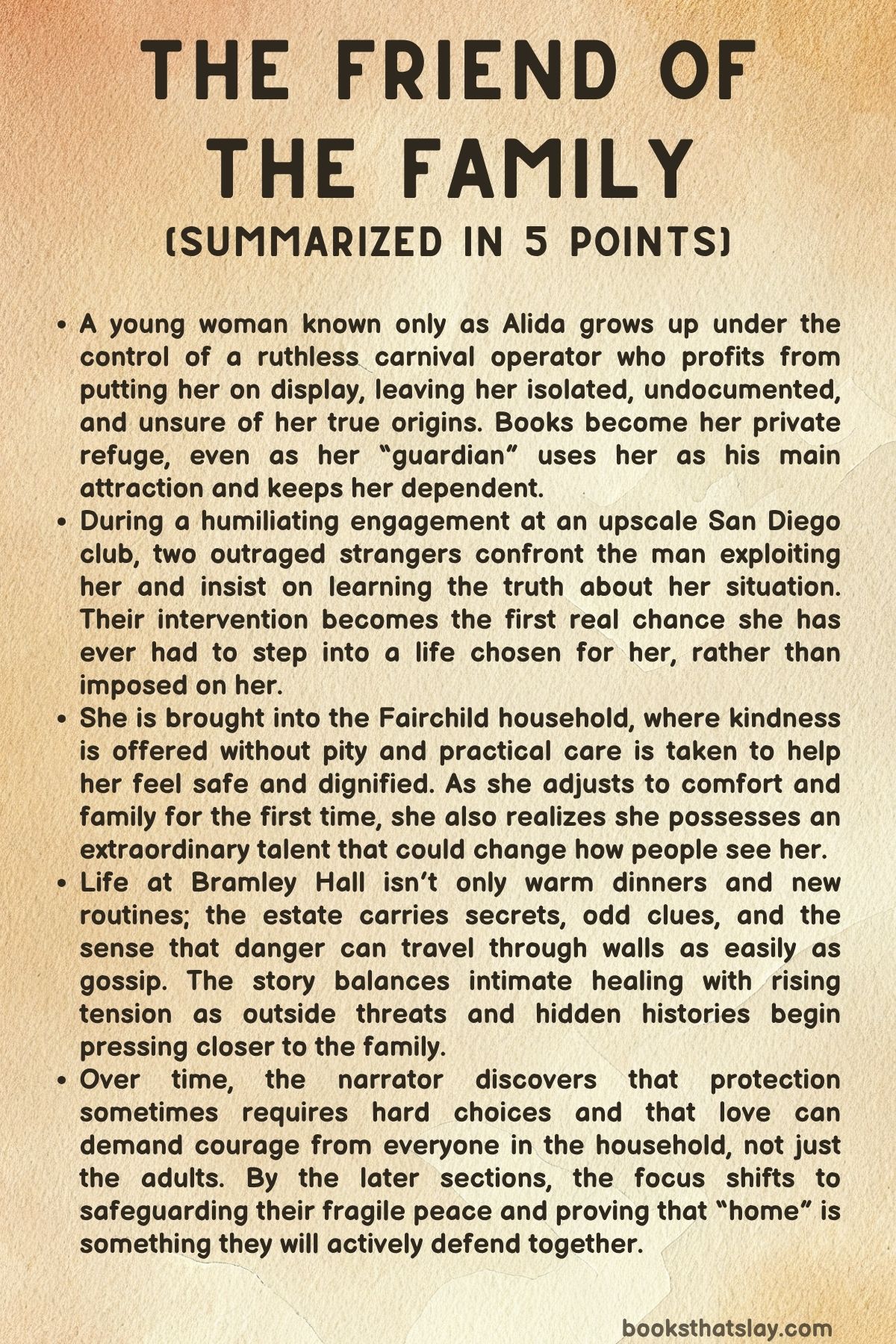
Summary
Alida has spent nearly her entire life without a last name and without any real sense of belonging. She lives under the control of a man called Captain, who claims to be her guardian but treats her as merchandise.
He runs a sideshow attraction with a traveling carnival, where “human wonders” are displayed for paying customers. The other performers have contracts, wages, and a community they can return to, but Alida has none of that.
She is the main draw, exhibited almost naked so the public can stare at her unusual body. Twice an hour she is forced to step onto a small stage and endure hands, whispers, and judgment.
She survives by shutting down emotionally and by clinging to one private refuge: books.
Captain insists he adopted her from his sister and waves official-looking documents when challenged. Alida suspects the papers are forged.
She also suspects Captain’s name is false. Even so, she feels trapped.
She has no money, no legal identity she can trust, and no certainty that running would lead anywhere safer. Captain does not beat her or pursue her sexually, but his control is total.
He keeps all earnings and decides every move. During the off-season he takes her to upscale speakeasies, hiding her body beneath heavy robes and a hood, inventing whatever story suits the moment.
He even steals books for her, feeding her hunger for stories while continuing to own her life.
In early September 1930, Captain leaves the carnival circuit mid-season and brings Alida to San Diego for a booking at the Blue Mood, a polished supper club with a floor show. Here, her humiliation is amplified.
Captain turns her appearance into a sensational “act,” presenting her in an ornate, coffin-like box and telling lurid lies about her origins. Audience members are invited onstage to touch her and inspect her.
The degradation becomes unbearable, especially when a crude comedian, Buddy Beamer, begins barging into her act. He pretends sympathy and then twists it into mocking jokes, and the crowd’s laughter lands on her like a physical assault.
Alida tries to prepare clever replies, but Buddy’s speed and the audience’s appetite for cruelty leave her exposed. After one especially brutal night, she sits alone at an hour when the city feels empty and considers ending her life.
On the second night, Buddy’s intrusion is worse—more vulgar, more organized, and supported by showgirls who turn the moment into a public taunt. Captain is delighted by the bigger reaction and starts imagining a longer engagement and future partnerships that would bind Alida even tighter to this life.
Alida’s hope collapses—until an unexpected knock interrupts their plans.
A well-dressed couple, Franklin and Loretta Fairchild, enter the dressing room with controlled fury. They have watched the show and cannot accept what they saw.
They confront Captain and demand to know who Alida is to him and what right he has to profit from her. Captain claims she is his daughter and insists she “chooses” this work.
Alida, pushed by the Fairchilds’ refusal to be intimidated, finally tells the truth: Captain bought her from her mother. She contradicts his claims about her health and upkeep, exposing his lies.
When Captain grows threatening, Franklin restrains him and makes it clear that this is kidnapping dressed up as show business.
The Fairchilds want to protect Alida without turning her into a public scandal. They propose a private resolution: they will take her away, and Captain will disappear.
Captain counters with threats—suggesting he can cross state lines, vanish, or kill her if cornered. The negotiation turns into a ransom.
Franklin offers money; Captain pushes for more. Loretta’s calm turns icy, and she makes it clear that if he refuses, consequences will follow.
They settle on forty thousand dollars in cash. Franklin drives to Los Angeles to retrieve it while Loretta stays behind with Alida, a pistol resting in her lap, keeping Captain contained.
Loretta tells Alida that if she comes with them, they will adopt her legally and give her a real family name.
When Franklin returns late with a valise of cash, Captain takes the money and leaves, offering a final warning that he could come looking—then implying he will stay away as long as he is paid and unchallenged. Alida rides north with the Fairchilds in their Cadillac, exhausted and unable to fully trust the sudden change.
They stop at the Beverly Hills Hotel and rent a bungalow. Alida experiences comfort that feels unreal: a private bath, soft bed linens, silence without threat.
Yet fear lingers in her dreams, where Captain invades the new home and harms the children she has not even met.
Over the next days, Loretta surrounds Alida with practical kindness rather than pity. A famous dressmaker, Marjorie Hollingsworth Merrimen, arrives to design clothing that will conceal and accommodate Alida’s body with dignity.
Alida expects shock, but Marjorie treats her like any other client—measuring, planning fabrics, proposing elegant robes, proper underthings, and gloves designed to be beautiful. A renowned shoemaker, Giovanni Leone, follows with custom fittings, equally tactful.
Loretta teaches Alida card games, sits with her through anxious silences, and gives her something she has been starved of: normal conversation.
They move to Bramley Hall, the Fairchilds’ grand estate. The house is staffed by a small army of professionals who welcome Alida with careful warmth: a formal majordomo, Julian Symington; his wife Victoria, who runs the household; maids including the reserved Anna May; a groundskeeper named Wilhelm Reinhardt; and a cook, Luigi Lattuada, whose intimidating first impression quickly gives way to sharp intelligence and unexpected gentleness.
The library astonishes Alida most—thousands of books, arranged and cared for like treasures. In her excitement she begins reciting openings of novels from memory and shocks Franklin and Loretta with the discovery that she can recall text word-for-word.
Alida panics, terrified that this gift will make her an object again. The Fairchilds reassure her: she is not a curiosity in their home, and they will keep her ability private if that makes her feel safe.
Alida meets the Fairchild children—Isadora, Gertrude, and Harry—who greet her with playful rhymes and blunt curiosity. Gertrude has a partially formed hand, and the detail clicks into place for Alida: these are people who understand difference without turning it into cruelty.
The family dog, a German shepherd named Rafael, studies Alida and then rolls over in easy trust, and that simple gesture hits her harder than any speech. For the first time, she feels she might truly belong.
As Alida settles into routines and small joys, the children pull her into a secret midnight club dedicated to investigating rumors about Bramley Hall. They lead her through hidden passages, a concealed stairway behind a cabinet, and into a basement where mysterious “evidence” has appeared over time: photos, clippings, and notes connected to a man convicted of manslaughter and to a name written beside the word “dead.” The children treat it as a puzzle; Alida senses it may be something darker.
Months pass into a warm first holiday season. Thanksgiving becomes a demanding scavenger hunt of envelopes and clues that the children believe will end with a visit from Laurel and Hardy.
They chase the final token with minutes to spare, only to learn the visit was a playful illusion. Still, the dinner is filled with laughter, and Alida realizes that disappointment hurts less when it happens inside love.
The next morning, danger arrives in a more practical form. Anna May breaks down and confesses that her criminal brother and a tabloid photographer have been pressuring her.
The photographer learned that the Fairchilds took a nearly naked performer from Blue Mood, and he believes he can turn Alida into a scandal that will pay him. The plan was to gain access to Bramley Hall, overpower Alida, and photograph her.
When poisoned meat is thrown over the wall—nearly killing Rafael—the threat becomes immediate. Franklin and Loretta refuse to involve the police because a trial would expose Alida to the same public hunger she barely escaped.
Instead, they neutralize the photographer through an elaborate deception using hired stuntmen posing as detectives, fabricating a case that terrifies him into backing off permanently.
Alida’s legal identity remains a mystery. A lawyer reports that no birth certificate can be found and that Captain appears to have stolen a dead man’s identity.
Still, adoption is possible. Alida chooses it without hesitation, signs the papers, and receives a new first name: Adiel—Addie for short—becoming a Fairchild in every way that matters.
Christmas follows with generosity, family rituals, and public outings that would have been unimaginable a year earlier. Yet beneath the celebration, Addie’s dreams begin to darken again, as if her past is refusing to stay buried.
Three years later, in early 1934, the household has found a steady rhythm despite the wider world’s hardship. The children grow older and the secret club fades.
Then Gertrude collapses with a sudden, violent illness. At the hospital the truth is grim: a staph infection has surged into her bloodstream and driven her into septic shock.
Desperate, Addie admits a secret she has carried since Rafael’s poisoning—she can pull sickness into herself. In a private moment at Gertrude’s bedside, with Franklin and Loretta present, Addie takes the fever and damage into her own body and briefly collapses.
When she wakes, Gertrude sits up, alert and healed. They agree no one else can ever know, and Addie senses that each rescue may shorten her life.
The danger Captain once represented returns in the worst way. Less than three hours after Captain leaves Bramley Hall during a later crisis, Pinkerton agents arrive to secure the house, installing locks and planning alarms while everyone waits for ransom instructions tied to a missing boy.
That night, Addie discovers signs of an intruder—refrigerators rummaged through, lights turned on, unease moving through the mansion like a living thing. Harry, now older, arms himself after hearing an angry man’s voice in Franklin’s office.
He quietly gathers Addie and Gertrude, and together they move through a hallway that suddenly goes dark when the power is sabotaged. They reach Franklin and Loretta’s suite and barricade themselves inside.
The phone line is dead.
Captain announces himself from behind the door, boasting that he has outsmarted them. He explains that his “special boy” found keys and let him into the house, then helped him locate and steal a hidden cache of $225,000.
Captain intends to leave with the money and abandon the boy behind as leverage, promising violence if anyone resists. In his smugness he reveals too much, and the boy realizes he has been betrayed.
The boy’s fury erupts. He attacks the door with unnatural strength, nearly tearing it apart.
As it begins to give, Harry fires through the panels. The hallway falls silent.
When they open the door, the boy lies collapsed, and Harry shoots again to ensure the threat is ended.
They find Captain dead as well—killed brutally by the boy in the moment of betrayal. A trusted local sheriff arrives quietly, confirms Harry acted in self-defense, and advises keeping the incident out of the press to protect both public calm and Addie’s privacy.
Together, the adults and the sheriff remove evidence, dispose of the bodies, and plan repairs—bullet holes, blood, a ruined carpet—so the house can return to its normal face by morning.
As dawn approaches, the family gathers in the kitchen, exhausted but intact. Coffee is poured, explanations are prepared for staff, and the household leans into the ordinary rituals that keep fear from becoming permanent.
Addie, once displayed as a spectacle, is now defended as fiercely as any Fairchild. The night proves what the name on her adoption papers has already made true: she is no longer property.
She is family.
Characters
Alida / Adiel “Addie”
Alida, the narrator, begins The Friend of the Family as someone denied the basic building blocks of identity: a last name, a stable home, bodily privacy, and even the right to consent to her own life. Years of forced display train her into a disciplined inner life—she learns to “leave” a room mentally, to forgive crowds because they are easy to hate, and to reserve her deepest anger for the person who made exploitation her daily reality.
What makes her compelling is the way her intelligence and tenderness survive in an environment designed to reduce her to spectacle; her devotion to reading is not a decorative trait but a lifeline that teaches her language for dignity and the patience to imagine a future she has never seen. Once rescued, she does not instantly become “healed” in a simple emotional arc; her fear remains embodied—nightmares, daymares, a reflex to anticipate harm—because captivity has trained her nervous system as much as her mind.
Her extraordinary memory and later her mysterious healing ability deepen the book’s central tension: she fears becoming “a freak twice over,” yet these gifts also become the means by which she contributes to the family rather than merely receiving their charity. Addie’s growth is marked by choice—accepting adoption, accepting a new name, accepting love without having to earn it through performance—while also recognizing the cost of her power, which seems to require that she absorb pain into herself, turning compassion into risk.
Forest Farnam
Captain Farnam is written as a predator whose most frightening weapon is not overt brutality but bureaucratic and psychological control. He keeps Alida in a cage without bars by manufacturing paperwork, controlling money, and convincing her the outside world is worse than he is; the absence of obvious sexual abuse or constant beating becomes part of his camouflage, allowing him to present himself as “guardian” rather than captor.
His cruelty is managerial—he monetizes humiliation with calm professionalism, uses stories and costumes to frame Alida as an object, and treats her body as inventory that must be displayed efficiently. He also understands the power of shame: if Alida is made to feel unworthy of ordinary life, she will police herself.
When confronted by the Fairchilds, he bargains like a kidnapper because that is what he is, and his willingness to threaten flight, violence, and lifelong pursuit shows the depth of his entitlement. His end is thematically fitting: the predator is finally consumed by the violent appetite he cultivated in others, and the narrative refuses him dignity in death, as if to underline that a life built on dehumanizing people forfeits the right to be mourned.
Buddy Beamer
Buddy Beamer embodies a different, socially acceptable form of cruelty: the kind that hides inside entertainment and gets rewarded with laughter. Unlike Captain, Buddy does not own Alida, but he participates in the machinery that turns her humiliation into group pleasure, and his “jokes” operate as permission slips for the audience to be worse.
His intrusions into her act show how mockery can escalate when there are no consequences; he reads the room instantly and pushes it toward louder degradation, then lets the crowd believe the whole thing is scripted so no one has to feel guilty. He is not given a complex redemption arc in the summary, and that matters—Buddy represents the casual collaborator, the person who may never think of himself as evil but reliably chooses the option that produces applause.
Here, he functions as a mirror for the audience: he is what public cruelty looks like when it wears a tuxedo and calls itself comedy.
Franklin Fairchild
Franklin Fairchild’s defining trait is controlled decisiveness. He sees the spectacle at Blue Mood and responds not with performative outrage but with immediate action—investigating the “relationship,” restraining Captain when necessary, and shifting the confrontation into a private solution that protects Alida from becoming a news item.
His love is practical: he offers money, organizes lawyers, anticipates threats, and later coordinates security, not because he believes money can buy morality, but because he recognizes it can buy time and safety in a world where the law might expose the victim as much as it punishes the abuser. At Bramley Hall, Franklin is also the hinge between warmth and severity; he indulges games and family rituals, yet he is willing to stage elaborate countermeasures against people like Maxwell because he prioritizes his daughter’s privacy over public vindication.
The story tests him hardest when Gertrude becomes gravely ill; his moment of despair reveals how deeply he is attached to the life they’ve built, and his agreement to keep Addie’s healing secret shows his willingness to live with ambiguity and moral burden if it keeps his family intact.
Loretta Fairchild
Loretta is the emotional and moral center that makes Franklin’s decisiveness feel humane rather than merely powerful. Her anger at Blue Mood is protective and clarifying—she names the exploitation plainly and refuses Captain’s narrative, and she keeps a pistol on her lap not as a symbol but as a boundary drawn in real time.
What distinguishes Loretta is her refusal to treat Addie with pity; she offers tenderness without turning Addie into a project, and she brings her into ordinary pleasures—games, conversation, clothing, breakfast—so that belonging becomes a daily practice rather than a single dramatic rescue. Loretta also has a talent for calibrated intimidation when the family is threatened; her role in neutralizing Maxwell shows she can weaponize theatricality in defense of privacy, creating consequences without inviting the public spectacle a trial would bring.
The later glimpse into Loretta’s own traumatic childhood reframes her strength as hard-won rather than innate, suggesting she recognizes in Addie not only suffering but the long afterlife of fear—and she chooses, repeatedly, to answer it with structure, warmth, and unwavering loyalty.
Marjorie Hollingsworth Merrimen
Marjorie’s importance lies in how she redefines “being seen.” Addie expects horror, pity, or revulsion when her robe comes off because the world has trained her to anticipate spectacle; Marjorie responds instead with professional attention and creative respect. By designing garments that conceal, accommodate, and beautify without pretending the body does not exist, Marjorie gives Addie a new relationship to clothing: it becomes agency rather than camouflage forced by captors.
Her brief surprise at Addie’s hands, followed by a deliberate gesture of acceptance and honor, is pivotal because it teaches Addie that kindness can coexist with honesty—someone can notice difference without turning it into disgust. Marjorie’s banter and brisk competence also normalize Addie’s presence in a social world; she treats her like a client, not a curiosity, and that shift is one of the earliest bricks in Addie’s new identity as a person rather than an exhibit.
Giovanni Leone
Giovanni appears briefly, but his function is profound: he participates in the restoration of bodily autonomy through craft. Having someone measure Addie’s feet with tact and care is the opposite of the invasive touching that defined her Blue Mood act; the same physical closeness becomes safe because it is purposeful, respectful, and consent-based.
Giovanni’s gentleness reinforces a recurring theme—that civilization is not only laws and wealth but also the everyday ethics of how people handle one another’s vulnerability. For Addie, custom shoes are not merely luxury; they are evidence that her comfort matters and that her body, however unusual, deserves things made for her rather than compromises that hurt.
Julian Symington
Julian Symington represents the formal architecture of Bramley Hall: the rituals, introductions, and quiet competence that turn a mansion into a functioning home. His welcoming manner matters because it signals that Addie’s adoption is not a private fantasy of the Fairchilds; it is being enacted socially, with staff included in the new reality.
Julian’s professionalism provides stability for a girl who has lived under arbitrary rules and sudden humiliations; at Bramley Hall, structure becomes safety rather than oppression. His presence also indicates that the Fairchilds’ world runs on discretion, which later becomes crucial when threats emerge and the household must act like a sealed, loyal unit.
Victoria Symington
Victoria adds softness to the mansion’s formality. As head housekeeper, she embodies a kind of domestic authority that can be intimidating to an outsider, yet she is described as cheerful and reassuring, which matters for Addie’s sense of acceptance.
Victoria helps translate Bramley Hall’s grandeur into livable spaces, showing Addie that the household is not a stage where she will be judged, but a community where routines can cradle her. Because Addie has been trained to read power dynamics for danger, Victoria’s friendliness functions as evidence that authority can be protective rather than predatory.
Wilhelm Reinhardt
Wilhelm’s welcome broadens Addie’s sense of belonging beyond the interior rooms and social niceties. As groundskeeper, he is linked to the estate’s boundaries—gates, land, perimeter—and his warmth subtly tells Addie that the outside of the house is also hers, not a hostile world waiting to reclaim her.
In a story where threats often come from beyond the walls, having a figure associated with the grounds treat her as family reinforces the idea that safety is being built deliberately, not imagined.
Lynette
Lynette’s emotional weight enters the narrative more strongly when she reveals the loss of her daughter during the 1918 flu, and that grief becomes a lens through which later scenes—especially the hospital crisis—are experienced. She is not merely a servant character; she is a reminder that trauma is not unique to Addie, and that Bramley Hall’s household is a gathering of survivors whose wounds take different forms.
Lynette’s presence during Gertrude’s illness adds generational depth: she understands how quickly a “cold” can become death, and her fear carries the lived memory of catastrophe. That history makes the family’s later secrecy and protectiveness feel less like melodrama and more like a community’s learned response to how fragile life can be.
Harmony
Harmony’s backstory—surviving the 1919 Boston molasses disaster and losing her future as a musician—positions her as someone who understands sudden devastation and the long, quiet aftermath of injury. Her advice to Addie to enjoy life but “stay alert” is not paranoia; it is the voice of experience, a survivor’s blend of gratitude and vigilance.
Harmony helps create the emotional tone of Bramley Hall as a place where happiness is allowed but never taken for granted, and her engagement later serves as a sign of life moving forward, counterbalancing the plot’s darker intrusions. In Addie’s world, Harmony models a way to live with scars without letting them define the horizon.
Anna May
Anna May is one of the story’s most psychologically realistic portraits of fear-driven compromise. Her reserve early on foreshadows a private crisis, and when it surfaces, it is not because she is malicious but because she is trapped between criminals and the consequences of exposing them—especially given her own history of abuse and deprivation.
What makes her arc meaningful is that she confesses before catastrophe fully unfolds, choosing moral risk over self-protection once she realizes real harm is imminent. Her apology to Addie is complicated: she is asking forgiveness not only for what she nearly enabled but for the version of herself that learned survival through silence.
The reconciliation, with Rafael physically inserting himself as a protective presence, underscores the theme that belonging is not perfection but repair; Anna May becomes part of the household’s moral circle because she tells the truth and accepts the cost of it.
Luigi Lattuada
Chef Lattuada is both charm and warning system. His initial “frightening” impression gives way to kindness, yet he remains a man who reads danger in people, speaking to Addie with blunt clarity about cruelty and urging her to come to him if she ever “smells” it.
He functions like a guardian who operates through intuition and attentiveness rather than weapons or wealth, and his late-night encounter with Addie becomes a quiet hinge into the house’s later unease when signs of intrusion appear. Luigi also contributes to the story’s sense of chosen family: feeding people is his love language, and the kitchen becomes the place where exhausted survivors gather after terror and try to make ordinary life restart.
His humor and competence keep the household human, preventing Bramley Hall from becoming merely a fortress.
Imogene Blackthorn
Imogene represents the Fairchilds’ commitment to nurturing their children’s minds, and by extension, their capacity for empathy and curiosity. Her role is understated but important because the children’s intelligence and ritual-making—clubs, investigations, games—come from an environment where learning is encouraged and imagination is structured.
This matters for Addie because her own education was self-made and secretive; at Bramley Hall, intellectual life is communal rather than solitary. Imogene’s presence also signals that the Fairchilds are intentional about shaping character, which explains why their children can meet Addie with curiosity instead of cruelty.
Isadora Fairchild
Isadora’s welcome rhymes and playful ceremony show how the Fairchild children transform novelty into inclusion rather than exclusion. As she matures into a serious pianist, she represents discipline and the refining of talent—an echo of Addie’s own intense relationship with books and memory, though expressed through music.
Isadora is also a bridge between childhood games and adult awareness; as the Clyde Tombaugh Club fades, she embodies the household’s transition from imaginative mysteries to real-world stakes. Her presence suggests that Bramley Hall’s safety is not about keeping children naïve; it is about allowing them to grow while staying rooted in family loyalty.
Gertrude “Gertie” Fairchild
Gertrude’s partially formed hand creates an immediate bond of recognition for Addie: it is the first time Addie sees physical difference inside a loving family context rather than a marketplace of gawking strangers. Gertrude’s later near-death illness becomes the moral crucible for Addie’s healing ability, forcing Addie to choose whether to risk herself for someone who has already given her belonging without conditions.
Gertrude’s recovery, and the family’s agreement to hide the truth, also ties her to the story’s theme of secrecy as protection rather than deceit. As she grows into a “modest teenage beauty,” the narrative complicates the idea of deformity as destiny, showing that difference can coexist with confidence and that identity is shaped by environment as much as by anatomy.
Harry Fairchild
Harry’s evolution from playful club member to the person who takes decisive action in the climactic break-in makes him one of the book’s clearest studies of courage under pressure. His choice to arm himself, organize Addie and Gertrude, and execute a quiet plan reflects a household where children are trusted with responsibility and taught to think rather than panic.
The shooting scene is ethically charged, but the narrative frames Harry’s action as protective necessity, not thrill; he fires because he believes his family will be killed if he hesitates. Harry also embodies the cost of living under threat—childhood ends when violence arrives at the bedroom door.
In The Friend of the Family, Harry becomes the proof that love is not only tenderness; it is also the willingness to do terrifying things to keep the vulnerable safe.
Morgan Waterford
Waterford’s function is to translate rescue into permanence. He brings the hard reality that Addie’s origins are untraceable and that Captain’s identity is fraudulent, which prevents the story from offering easy closure through paperwork.
Yet he also delivers the adoption documents that allow the Fairchilds to formalize what they have already chosen emotionally. In doing so, he helps shift Addie from a life defined by forged papers and false claims into one anchored by lawful belonging.
His presence underscores a central idea: identity can be stolen and fabricated, but it can also be deliberately rebuilt through commitment and community.
Willy Joe Maxwell
Maxwell is a predator adapted to respectability—his violence is not physical ownership like Captain’s but exposure, humiliation, and profit through scandal. He wants to turn Addie into a commodity again, not by displaying her on a stage but by capturing and selling an image, which shows how the story views publicity as another form of violation.
His plan’s ugliness—sneaking in, overpowering Addie, photographing her—reveals that exploitation can wear a professional mask and still be assault. Maxwell’s neutralization through staged “detective” intimidation is morally gray, but it fits the book’s logic: the Fairchilds choose a solution that protects Addie from a courtroom spectacle.
Maxwell remains important because he proves that even after rescue, the world’s hunger to consume Addie has not vanished; it has only changed costumes.
Connor
Connor operates as the coercive pressure that makes Anna May’s dilemma believable. He is not merely “a criminal,” but a lever that can move an entire household into danger because he understands how family ties can be used as hostage chains.
His role highlights how exploitation spreads: Captain exploited Addie directly, and later Connor and Maxwell attempt to exploit Anna May’s fear to reach Addie. Connor embodies the way predation recruits intermediaries, turning ordinary people into potential accomplices by threatening what they love or what they fear losing.
Leonard Sharpe and Enzo Valenti
These two illustrate the Fairchilds’ distinctive approach to protection: they weaponize illusion in defense of privacy. As stuntmen, they can perform authority convincingly, and that performance becomes a shield for Addie, allowing the family to stop Maxwell without inviting institutional attention that could expose her.
Their assumed identities—Shamash and Astarte—also reinforce the book’s interest in names and roles: Captain used false identity to harm, while the Fairchilds use staged identity to protect. The contrast sharpens a moral distinction between deception that steals autonomy and deception that preserves it.
Sheriff Emmett Oates
Oates represents the local face of law shaped by loyalty and pragmatism. He arrives quietly, assesses quickly, and understands that official justice could become public spectacle, which would endanger Addie by turning her into a headline.
His decision to treat Harry’s shooting as self-defense and his willingness to dispose of the bodies and evidence point to a troubling but consistent ethic in the story: sometimes the “right” outcome for the vulnerable cannot be achieved through transparent channels. Oates is not portrayed as corrupt in a petty way; he is portrayed as someone who believes that protecting a family from predators and the press is the greater good.
His affectionate farewell—hugging everyone—cements him as part of the protective circle around Bramley Hall.
“Midwest Jack”
Jack is the story’s most unsettling figure because he blurs the line between victim and threat. Recruited by Captain, used as a tool to gain access and terrorize, Jack’s physical power and ferocity make him a nightmare presence in the mansion, yet his outburst when Captain reveals betrayal suggests he was promised belonging or purpose and then discarded.
Jack’s rage, turning on Captain, reads like the inevitable outcome of a relationship built on manipulation: the exploited weapon finally realizes he is also disposable. His death at Harry’s hands is tragic in a complicated way—necessary for immediate survival, but also a reminder that predation produces secondary monsters, people shaped into danger by the very systems that first harmed them.
Themes
Exploitation, Consent, and the Market for Human Suffering
From the first scenes, Alida’s body is treated as a commodity with a price tag, a schedule, and a sales pitch. The Captain’s power does not rely on open violence; it relies on paperwork, isolation, and the careful management of what counts as “choice.” He supplies official-looking documents, controls where she sleeps, what she earns—nothing—and what she is allowed to imagine as possible.
That structure matters because it shows how exploitation often survives by appearing orderly and legitimate. The carnival corridor and the speakeasy stage are different venues, but the logic is identical: the audience purchases permission to stare, comment, and touch.
What changes at Blue Mood is not merely the setting’s elegance; it is the way refinement becomes a mask for cruelty. In a place of chandeliers and fine meals, the humiliation is packaged as sophisticated entertainment, which exposes how easily a crowd can outsource its conscience to context.
The comedian’s interruptions sharpen this theme because his jokes function like a social contract: laughter tells Alida that everyone present has agreed she is not fully a person in that moment. The audience’s certainty that it is “scripted” becomes another mechanism of harm—if it is entertainment, then no one has to feel responsible.
The rescue by the Fairchilds does not erase the economy of exploitation; it reveals another version of it. The Captain negotiates Alida’s freedom as though she were property, and the ransom amount puts a number on her life in the most literal way.
That transaction is morally sickening, yet the story refuses to pretend there is a clean option inside a corrupt system. The Fairchilds’ decision not to involve police later, when a scandal threatens, extends the theme into respectability and reputation: the public system that should protect her could also consume her again through exposure, headlines, and spectacle.
Even safety comes with conditions, strategy, and performance—stuntmen posing as detectives, theatrical intimidation, staged evidence. The theme insists that exploitation is not confined to obviously “bad” places; it can be fueled by curiosity, humor, law, and gossip, all of which can turn a vulnerable person into a public object while everyone involved claims innocence.
Identity, Naming, and the Right to Self-Definition
Alida begins life without a last name, which is not a minor detail but a sustained form of erasure. A surname usually signals lineage, belonging, and legal recognition; her lack of one makes her easier to control and easier to discard.
The Captain’s stories about her origins—sister’s child, adopted niece, convenient lies tailored to each audience—show identity as something imposed from above, shaped to fit whatever narrative produces profit and reduces questions. Even the hood and robe she wears in transit serve a double purpose: they hide her body from public view while also training her to experience herself as a secret that must be managed.
Books become her private territory because they offer identities that cannot be confiscated. Her reading is not simply escape; it is rehearsal for personhood.
If the world insists she is a display, literature gives her an inner life that cannot be put in a stall.
When Franklin and Loretta offer adoption, the story turns naming into a moral act. Being invited to become a Fairchild is not only a change in address; it is a declaration that she is claimable by love, not by ownership.
Yet the narrative is careful about how fragile that shift feels to Alida. She expects revulsion when Marjorie measures her, because she has been trained to expect that every unveiling leads to punishment or pity.
Marjorie’s professionalism, and especially her insistence on beauty without mockery, reframes Alida’s body as something that deserves care rather than commentary. That is a quiet revolution: identity starts to form through how others look at her, not with hunger or contempt, but with ordinary respect.
The moment her memory is revealed intensifies the theme. Alida worries about being “a freak twice over,” which shows how stigma spreads beyond the body into any trait that seems unusual.
Her fear is not irrational; it is a learned response to a world that labels difference and then monetizes it. The Fairchilds’ agreement to keep her ability private is complicated—protective, but also another form of concealment.
Still, it is concealment chosen for her safety rather than for someone else’s profit, and that distinction matters. The later renaming to Adiel, and her acceptance of it, presents identity as both gift and choice: they offer a name, but she signs the papers, she consents, she steps into a self that is not dictated by a captor.
Across The Friend of the Family, identity is shown as something that can be stolen through isolation and lies, and rebuilt through recognition, lawful belonging, and the daily experience of being addressed as fully human.
Home, Found Family, and the Ethics of Protection
Bramley Hall is more than a mansion; it functions as a counterargument to everything Alida has been taught about what she deserves. The story takes care to show that safety is not only the absence of harm; it is the presence of routine, privacy, and warmth without strings attached.
The library’s thousands of books matter because they symbolize permanence. In the Captain’s world, everything is temporary—tents, circuits, hotel rooms, invented stories.
At Bramley Hall, space is stable, doors can be closed, possessions can be kept, and meals happen at a table with people who want her there. The staff’s introductions also reinforce this: she is not treated as an exhibit being passed around, but as a person being welcomed.
Even Rafael’s response is thematically important because it bypasses social training. The dog’s trust offers Alida a form of acceptance that does not depend on explanation, apology, or performance.
The children bring another dimension to “home” by refusing to treat Alida as fragile porcelain. Their rhymes, curiosity, games, and invitations to the Clyde Tombaugh Club create belonging through inclusion rather than careful distance.
That inclusion is not always comfortable—secrets, investigations, hints of darkness in the house—but it is real. Alida is not placed on a pedestal; she is placed in a group.
The theme also recognizes that found family is built from many kinds of wounds. Harmony’s story of the molasses disaster, Lynette’s grief from the 1918 flu, Anna May’s abusive childhood, and Gertrude’s partial hand all create a household where pain is known, not theoretical.
This shared knowledge becomes an ethic: people who understand suffering can choose to respond with attention rather than spectacle.
Protection, however, is never presented as simple or purely lawful. The Fairchilds repeatedly choose secrecy to preserve Alida’s dignity.
They avoid police involvement when tabloids threaten, they neutralize Maxwell through staged intimidation, and later they cover up the deaths after Captain’s invasion. These choices are morally messy, and the narrative seems aware of that mess.
The theme asks what protection requires when public institutions could expose the vulnerable person they are meant to defend. The cover-up after the killings is especially revealing: the household closes ranks, replaces a door, disposes of evidence, and keeps the story out of the press.
It is not portrayed as virtue in the abstract; it is portrayed as a desperate extension of the same commitment that brought Alida home in the first place—keeping her from being turned into public property again. Here, home is not merely comfort; it is a collective decision to treat one person’s privacy as sacred, even when that decision demands risk, strategy, and a willingness to carry burdens together.
Power, Fear, and the Cost of Survival
Fear follows Alida even after her rescue because captivity leaves behind habits of anticipation. Her nightmares, “daymares,” and constant scanning for the Captain’s return show trauma as a form of time travel: the body and mind keep reliving threats long after the threat has changed shape.
The story emphasizes that fear is not weakness; it is evidence of how thoroughly someone has been trained to expect harm. Even luxury at the Beverly Hills Hotel feels unreal to her, not because she is ungrateful, but because her nervous system has learned that comfort is usually a trap before humiliation.
Safety requires re-learning, and that re-learning is not linear. Some nights she sleeps peacefully; other nights the Captain appears in dreams with blood on his hands.
The theme is clear that survival is not a clean victory. It is a continuing negotiation between hope and dread.
Power in the novel is shown as both institutional and intimate. The Captain has power through control of documents, money, movement, and narrative.
Later, Maxwell tries to gain power through photographs and public scandal, which would reduce Alida to an image consumed by strangers. Then the Captain returns with a new kind of power: infiltration, sabotage, hostage pressure, and the use of “the boy” as an instrument.
The house itself, supposedly secure with Pinkertons and locks, becomes vulnerable because power finds the smallest human errors—keys left behind, routines assumed, trust exploited. That shift demonstrates how fear can be rational: Alida’s anxiety about being found is not paranoia; it is pattern recognition.
The most striking expression of cost appears in Alida’s healing ability. When Gertrude is dying, Alida takes the illness into herself, and the act is framed as both miracle and sacrifice.
She senses that each rescue shortens her life, which turns compassion into an accounting problem: how many times can she save someone before she pays too much? This is not sentimental; it is sobering.
It asks whether the body of a person who has already been exploited is still expected to be spent for others, even in love. The difference is that this time the choice is hers, and the family agrees to protect her secret rather than profit from it.
Still, the cost remains real, and the secrecy hints at another burden: she must carry consequences alone so the household can remain safe from scrutiny.
The final confrontation at Bramley Hall intensifies the theme by forcing the family into violence and concealment. Harry’s gunfire, Jack’s rage, the discovery of stolen money, and the disposal of bodies show survival as something that can require actions a decent person would rather never take.
The household’s decision to keep it out of the press ties back to Alida’s core fear: public attention is danger. In this story, power is what others try to take from her body, her story, and her privacy; survival is what she and her chosen family build through vigilance, solidarity, and sometimes morally compromised choices made to prevent her from becoming an object again.