The First Time I Saw Him Summary, Characters and Themes
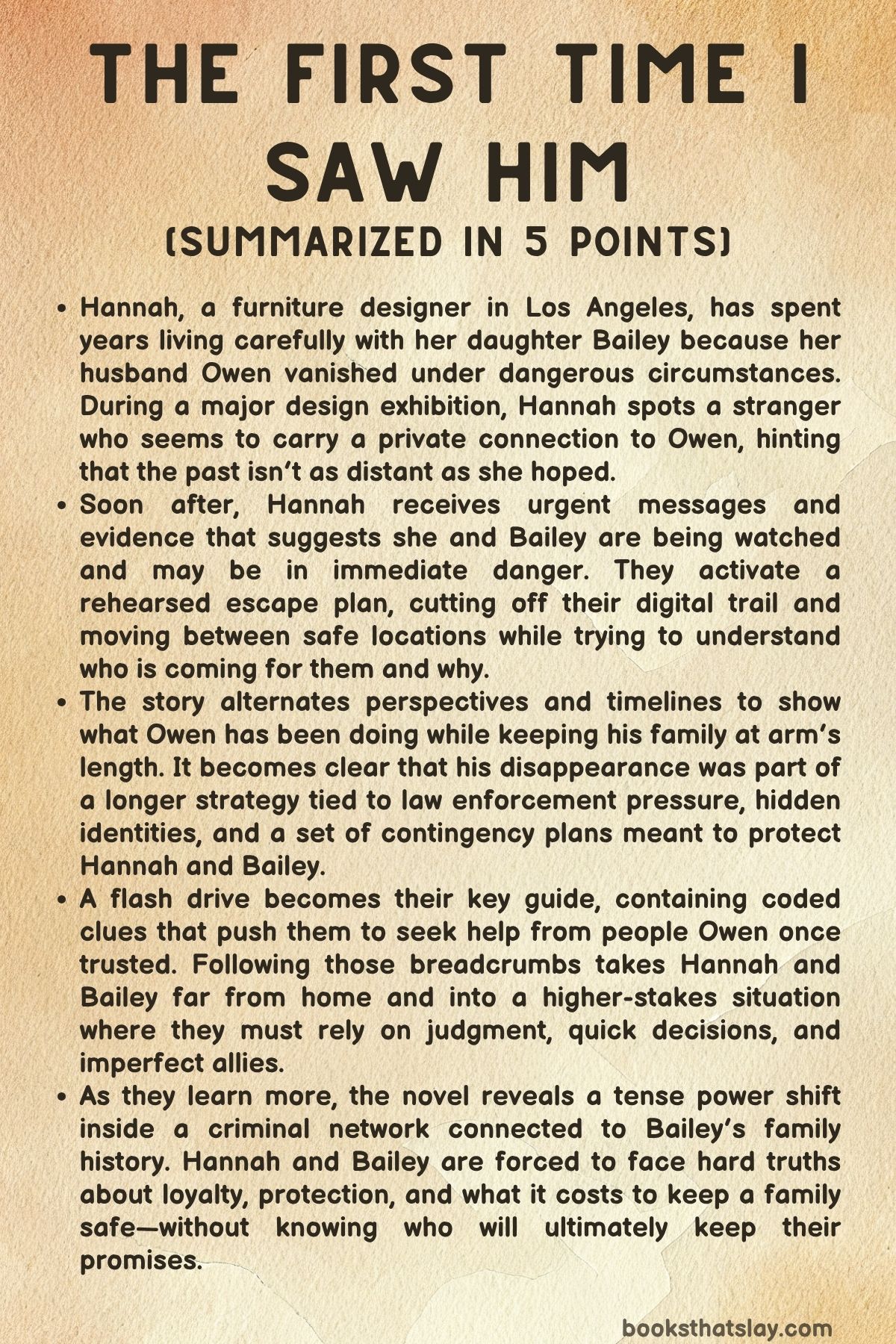
The First Time I Saw Him by Laura Dave, the sequel to The Last Thing He Told Me, is a tense, character-driven thriller about a woman who has built her whole life around a single fear: that her vanished husband might return—and that his return would mean danger for the family he left behind. Hannah is a furniture designer in Los Angeles raising her daughter, Bailey, under a set of quiet rules meant to keep them safe.
When Hannah spots a stranger wearing her husband’s wedding ring and speaking a phrase only he would know, the careful distance she has maintained collapses. What follows is a race across borders, guided by hidden messages, old bargains, and hard choices about love, loyalty, and survival.
Summary
Hannah is in Los Angeles, presenting her latest white oak furniture collection at a major design exhibition. The event is a business win but emotionally draining, and she’s looking forward to a normal evening with her daughter, Bailey, who is arriving with her new boyfriend.
Normal has always been the goal—yet Hannah has spent years living as if eyes are on her, because her husband Owen disappeared long ago under circumstances she never fully understood.
Near the end of the show, Hannah notices a man who doesn’t fit: buzz cut, tattoos, a damaged nose. Then she sees the detail that stops her cold—he is wearing Owen’s wedding ring, a ring Hannah made herself.
The man quietly helps her pick up the papers she drops, careful not to touch her, and as he leaves he murmurs a private phrase only Owen used. Hannah forces herself not to react, because reacting could be the spark that lights everything up.
Moments later, Bailey arrives, smiling and carefree, and Hannah has to perform calm while her world shifts under her feet.
The story cuts to Owen’s point of view. He has come close enough to see Bailey in person for the first time in years, after watching her from a distance through public social media while avoiding any digital trail.
He knows what his appearance will do to Hannah, and he knows he cannot stay. He moves like someone following a practiced plan: changing clothes, adjusting his look, staying alert to anyone who might approach.
Even when a woman at an airport bar tries to talk to him, Owen keeps distance, anchored by one thought—he is still Hannah’s husband, even if he has been absent.
Owen remembers the day everything broke. His friend Jules called with a warning: the FBI was coming, and “The Shop” was being raided.
Owen immediately activated a prebuilt escape route—cash from safe-deposit boxes, false documents, an encrypted phone, and notes prepared for Hannah and Bailey. He fled without going to the docks to see Hannah, because any final goodbye could have exposed her.
He drove overnight, abandoned his car, took a bus into Canada, and made sure money and a message reached Bailey through a school locker. From far away, he kept trying to protect them without being near them.
Later, when he called Bailey from New Zealand, he learned she knew about her biological mother, Kate, and Kate’s father, Nicholas Bell. That revelation changed the problem he was solving, and it set a longer plan in motion.
In the present, Owen arrives in Austin late at night under a New Zealand identity. He rents a car and goes to a downtown condo, instructing the doorman to announce him as “his son-in-law,” a phrase that connects him directly to Nicholas Bell’s world.
Back in Los Angeles, Hannah wakes early, replaying what she saw at the exhibition. She avoids calling Bailey because she can’t safely talk about Owen over normal lines.
Then her phone becomes a warning system. She receives a call from a number linked to Jules’s connections, but she declines it.
Immediately after, she gets a text from an unknown international number: “Check your pocket.” In her jacket, she finds a flash drive she didn’t put there. Another text arrives: “Get out of the house.
Now.” At her door is a man in a SoCalGas uniform claiming a neighborhood leak and insisting on entry. Hannah’s instincts scream that this is not a utility visit.
She grabs an emergency backpack, escapes through an attic window, climbs down a trellis, cuts through neighboring yards, and reaches a taxi stand. On the way toward Malibu, she removes her phone’s SIM card and tosses it out the window to reduce tracking.
Before the phone goes dark, she sends Bailey a prearranged emergency message: “Late drink?”
Bailey receives the alert while exhausted from her demanding job as a casting assistant and her stalled work on a musical. Her uncle Charlie calls, panicked, confirming something is wrong and urging her to leave immediately.
Bailey recognizes the danger code from Hannah and follows a plan they rehearsed: she disables her phone by dropping it in soapy water, uses a hidden route through her building, and reaches a backup car registered to Jules. She drives toward the Pacific Coast Highway to meet Hannah.
Hannah reaches a Malibu beach house owned by a client who keeps the property off obvious records, making it useful as a hiding place. There she calls Grady Bradford, a U.S. marshal Owen once trusted.
Before the conversation can settle, Hannah sees breaking news: Nicholas Bell has been pronounced dead at his Texas home. Grady confirms the report and explains what it means—Nicholas’s death changes the balance of power in the criminal organization tied to him.
The old deal that kept Hannah and Bailey safe is no longer being honored. With Nicholas gone, people want Owen, and Hannah and Bailey are the most visible path to him.
Grady also mentions something alarming: a doorman at Nicholas’s condo reported a visitor who identified himself as Nicholas’s son-in-law the night before. If that was Owen, then Owen may be connected in the eyes of the organization to Nicholas’s death, whether he caused it or not.
Bailey arrives at the Malibu house and sees the news for herself. Hannah focuses on movement and next steps rather than explanations that can wait.
They open Owen’s flash drive on a clean offline laptop. The home screen shows a marine compass and folders labeled like photo albums from their life—places, family moments, Bailey’s childhood, and Hannah’s work.
Hannah realizes the “photos” are messages, built to look harmless while carrying instructions. In the “Sausalito” folder she recognizes Owen’s friend Carl, Carl’s wife Patty, and especially Daniel, Carl’s brother.
Hannah calls Patty from a burner phone. Patty won’t involve Carl but confirms Daniel is the person who can help and gives Hannah a precise rendezvous: Napa County Airport at 10 a.m., straight to the tarmac, runway 19R/1L, tail number 82165.
She tells Hannah what name to use and warns her not to show ID.
As they drive north along Highway 1, Hannah checks her security cameras and sees men in SoCalGas uniforms searching her studio. She captures screenshots and alerts her neighbor to call police.
The danger is no longer theoretical. Hannah and Bailey talk through what they can: Owen has returned in disguise, Nicholas is “dead,” and someone is actively hunting them.
Bailey asks whether this means running forever, and Hannah answers with brutal clarity—they need to be anywhere but Los Angeles until they understand who is coming and why.
They stop briefly at a secluded estate in the Santa Cruz mountains belonging to a wealthy friend of Jules. The pool house is stocked and prepared, even with boat documents ready, but Hannah’s attention stays on Owen’s coded trail.
She contacts Jules from a safe landline and learns the organization’s leadership is shifting: Frank Campano Pointe is stepping back, and his daughter Quinn is gaining power. That shift explains the sudden aggression.
Rules that once prevented attacks on Hannah and Bailey are no longer reliable.
At Napa County Airport, Hannah and Bailey abandon their car and walk in with bags, avoiding cameras and toll systems. On the tarmac, Hannah persuades a security guard to drive them closer to their plane.
Daniel greets Hannah as “Ms. Roberts,” already aware of the cover story, and they board a private jet with a flight plan that appears to lead to Paris. During the flight, Hannah studies the flash drive and notices something that doesn’t fit: an image Owen included that points not to Paris but to the South of France.
The route changes unexpectedly for refueling in Miami, raising alarm, but Daniel seems uneasy too, suggesting outside pressure. Hannah insists nobody leaves the aircraft, and after a tense delay, they continue on.
In Paris, Hannah and Bailey move carefully through hotels and streets, trying to confirm whether they’re being followed. They make their way to La Réserve, the hotel tied to Hannah and Owen’s honeymoon, and go to the room they once shared, expecting Owen.
Instead, Nicholas appears—alive. The “death” was staged.
Nicholas explains the truth Hannah and Bailey were never allowed to know. For years, Owen and Nicholas have been working together to keep Hannah and Bailey protected from a powerful criminal organization Nicholas once served.
Frank Campano Pointe, the longtime leader, had promised safety as a personal guarantee, but Frank’s children—especially Quinn and Teddy—are positioned to take over, and they don’t intend to honor old promises. Nicholas and Owen staged Nicholas’s death to see who would move against them and to force the organization into revealing its next step while Nicholas was still able to manage the fallout.
The plan required Hannah and Bailey to believe Nicholas was truly dead so the performance would hold. But the organization reacted faster than Nicholas predicted, coming for Hannah and Bailey almost immediately.
Nicholas’s bodyguard Seth is revealed as the “follower” in Paris—he was protecting them, not hunting them. Nicholas says the final confrontation has to happen now.
Frank is in Èze for his eightieth birthday with all his children present. Nicholas intends to confront him directly and end this.
Hannah refuses to be sidelined and insists on going.
As they drive south, Hannah studies the organization’s family dynamics and learns why Quinn’s anger burns hottest: her husband Wesley is in prison, and Owen’s testimony helped put him there. That resentment has been waiting for a moment like this.
They split up in Antibes. Bailey goes to the Musée Picasso under cover of a public tour.
She sees a man watching her and panics, hiding long enough to confirm whether she is being tracked. When she returns to the gallery, she sits near a Picasso piece that Owen used earlier as a clue.
Owen arrives quietly and sits beside her. Father and daughter face each other after years of silence.
Bailey uses humor to break the tension, but the emotion is still raw. Owen looks changed—older and worn down—yet unmistakably himself.
They leave together, holding hands, moving toward a boat and the next phase of the plan.
Meanwhile, Hannah and Nicholas enter Frank’s private party in Èze. Security nearly confiscates Hannah’s tablet, but she talks her way through.
Frank sees Nicholas and reacts as if he’s seeing a ghost. Quinn and Teddy confront them, and Nicholas sets a deadline: if Hannah and Nicholas don’t leave safely within twenty minutes, incriminating documents will be sent to U.S. authorities, triggering arrests once the family returns to the United States.
Teddy becomes violent, striking Hannah, and a guard threatens her with a gun until Nicholas forces Frank to rein them in.
In a private back room, Nicholas frames the meeting as a “delivery.” Hannah reveals the tablet and gives Frank the password—a date tied to Kate’s death. Frank opens it to discover live surveillance feeds from his children’s homes.
The files contain organized evidence of crimes that cannot be hidden behind attorney-client privilege. Nicholas demands a deal: both families walk away safely—Hannah, Bailey, Charlie, Owen, and Frank’s children—and this ends.
Frank listens, then raises a gun and fires, wounding Nicholas.
Hannah presses cloth to Nicholas’s bleeding injury as he remains conscious, furious, and determined. Frank argues he needed to send a message, not kill him.
Nicholas, fighting through pain, repeats the boundary: the evidence stays sealed only if his family remains untouched. If anything happens—an “accident” on a plane, a boat, anywhere—another party will release everything.
Elsewhere, Owen watches the confrontation through a hidden feed only he can access, monitoring the ticking countdown and hovering over emergency calls to authorities. He is caught between intervention and restraint, remembering the plan he made with Nicholas: stay the course, especially when fear is loud.
He studies Hannah’s face on the screen, trying to read whether she needs him to act now—or hold steady for the outcome they built toward.
Characters
Hannah
In The First Time I Saw Him, Hannah is introduced as a disciplined, high-functioning professional whose outer life—design exhibitions, clients, and polished routines—has been built as camouflage for an inner life shaped by long-term threat assessment. She has spent years parenting Bailey with the steady, quiet vigilance of someone who believes danger is not a possibility but a schedule, and that choice shows up in how quickly she recognizes patterns: the “SoCalGas” ruse, the suspicious timing of messages, the need to cut the SIM, and the importance of moving before fear freezes her.
Her relationship to Owen is complicated by the way love and anger coexist without resolution. She has been keeping space for him to return while also preparing for the consequences of that return, so when she sees him wearing the ring she made, the moment does not read as reunion but as confirmation that the life she has been managing in the shadows is real again.
What makes Hannah particularly compelling is that she is not simply reactive. She becomes strategic, making adult choices under pressure—choosing safe houses, validating the flash drive on an offline laptop, calling the right people, and refusing to be sidelined when Nicholas tries to move alone—while still remaining emotionally tethered to the human stakes: Bailey’s fear, Owen’s absence, and the possibility that forgiveness might never get its chance.
Even in Europe, surrounded by the Campano Pointe family’s wealth and theatrics, Hannah’s focus remains practical and moral at once. She pushes conversations toward accountability, keeps returning to Kate’s death as the original fracture, and insists on an ending that is not just survival but a stopping of the pattern.
Bailey
Bailey’s character lives at the intersection of young adulthood and inherited danger, which makes her both ordinary and extraordinary in the same breath. She is trying to be a normal person in Los Angeles—working a demanding assistant job, dreaming about her musical, dating, and carrying the everyday anxieties of career and love—yet she has also been trained in emergency procedure like it is a second language.
When the signal comes, she performs competence with chilling calm: disabling her phone, using the building’s hidden routes, retrieving the backup car, and driving into uncertainty to find Hannah.
Her emotional center, though, is not toughness so much as attachment. Her grief for Nicholas, her hunger to understand her father, and her need to believe that the adults who shaped her life did so out of love rather than control all define her.
The memory of the New Yorker cartoon becomes a small but revealing window into her: she is observant, tender, and prone to guilt, interpreting Nicholas’s shortened call as possible disappointment because she is always scanning for signs that love might be conditional. When she finally meets Owen again, she does not collapse into a simple reunion narrative.
She recognizes change, measures the cost of what he has become, and still chooses contact—taking his hand—because her desire for her father is stronger than her fear of what his presence means. Across the story, Bailey grows from someone protected by plans into someone participating in them, and the biggest shift is not tactical but emotional: she starts demanding truth, pushing Hannah on anger and accountability, and claiming her right to be more than a piece on the board.
Owen
Owen is a man who has turned disappearance into a form of parenting, which is both the most protective and the most damaging thing about him. His defining trait is control under pressure: he changes appearances, uses public computers, rotates identities, carries encrypted tools, and moves like someone who learned long ago that being seen is a liability.
Yet his emotional life leaks through in small, restrained ways—refusing a woman’s conversation in the lounge because he is still “married,” keeping the wedding ring as a private tether, and speaking Hannah’s intimate phrase as if he cannot help reaching for their shared language even while he keeps distance.
Owen’s morality is built around choosing the lesser harm, and he has lived long enough inside that logic that he can make brutal decisions quickly: leaving without seeing Hannah at the docks, pulling Bailey into plans through indirect drops, and allowing Hannah and Bailey to believe Nicholas is dead because the illusion must hold. At the same time, he still carries the ache of what those choices cost.
The narrative also paints him as a collaborator rather than a lone wolf. His long coordination with Nicholas shows he can trust, plan, and commit to a shared strategy, but it also reveals how dire the stakes are that he would align with the very system that endangered his family in the first place.
Watching the confrontation in Èze through a hidden feed, hovering over emergency calls, Owen becomes the embodiment of the story’s core tension: he wants to intervene, but intervention could also be the thing that kills them. In The First Time I Saw Him, the love that motivates him is inseparable from the risk that follows him.
Nicholas Bell
Nicholas is the story’s moral paradox: a man who once stepped toward organized crime to preserve his public-interest identity and ended up paying for that compromise for decades. In the earlier timeline, he is exhausted, debt-burdened, and seduced not by greed but by the promise of freedom—the idea that he can continue doing good work if he makes a private bargain with evil.
That is what makes him tragic rather than cartoonish. His love for Bailey is the most consistent force in his life, and it is also the lever the organization uses to keep him compliant.
The favor he asks of Frank after prison—returning his granddaughter to him—becomes the emotional debt that structures everything that follows.
Nicholas’s staged death is not a cheap twist but an expression of how fully he understands the system he helped sustain. He knows that truth alone is not power; timing is power, perception is power, and the only way to force Quinn and Teddy to reveal their intentions is to create a vacuum.
He is also, crucially, not trying to save himself. His long planning with Owen carries an acceptance that the ending may require sacrifice, and his willingness to step into Frank’s birthday gathering is the act of someone who has decided that survival without resolution is just a slower kind of loss.
Even when shot, Nicholas remains lucid, furious, and sharply principled about the boundaries: his family must remain untouched, and the deterrent must remain credible, because credibility is the only language that holds in Frank’s world.
Frank Campano Pointe II
Frank is portrayed as the old-world patriarch of violence—charming, family-oriented in appearance, and terrifying precisely because his warmth and brutality live comfortably together. He recruits Nicholas not with overt threats but with psychological precision, offering a hand and a narrative of liberation while quietly demonstrating that he already knows enough to reshape Nicholas’s options.
His power is not only in what he can do but in how he frames what he does: protection becomes “not a favor,” coercion becomes “opportunity,” and moral injury becomes the price of membership in his orbit.
As he ages, Frank becomes the hinge between two eras of the organization, and that transition reveals another layer of menace. His children are not bound by the same informal codes, but he is the one who built the system that taught them to treat human lives as movable parts.
When confronted in Èze, his decision to shoot—more message than murder—shows how he communicates authority when words fail, and it also exposes that even he is now negotiating with forces he cannot fully contain, including his own family’s ambition. Frank’s complexity lies in his insistence that he never intended harm to Nicholas’s children, paired with his continued participation in the machine that made such harm inevitable.
The story uses him to show how self-justifying a patriarch can be while still producing real tenderness in small, disorienting flashes.
Quinn Campano Pointe
Quinn functions as the embodiment of succession-era ruthlessness, shaped by inheritance, grievance, and the conviction that nothing is ever truly settled. Her anger is not abstract; it is personal, sharpened by Wesley’s imprisonment, the failed parole vote, and the belief that Owen’s testimony destroyed her family’s stability.
That makes her feel entitled to retaliate even when the retaliation targets innocents. She is also the character most allergic to the idea of closure, warning Hannah that there is always a cost and implying that the family economy is built on paying in blood or fear, not on ending cycles.
Quinn’s most revealing moments are when her certainty falters. She calls Kate’s death an accident, but discomfort slips through, and her defensiveness suggests she knows the story is uglier than she wants to admit.
She tries to reframe the attempted capture of Hannah and Bailey as mere detainment, which exposes how normalized coercion is for her. She can sincerely believe she is being restrained while orchestrating acts that feel indistinguishable from terror to the people on the receiving end.
Quinn is dangerous not because she is chaotic but because she is institutional: she represents what happens when violence is raised like a language and then spoken fluently without needing permission from the old guard.
Teddy Campano Pointe
Teddy appears as the more openly aggressive sibling presence, the one who reaches for physical dominance when negotiation threatens to limit him. His attack on Hannah is not simply cruelty; it is an assertion that their family’s power must be felt in bodies, not just implied through wealth and security.
He also serves as a window into the family’s operational mindset: he objects that they “can’t control a plane,” revealing both how far he is willing to go and how he thinks in terms of leverage and plausible outcomes.
Compared to Quinn’s strategic anger, Teddy’s threat feels more immediate and less filtered, which makes him an effective instrument of intimidation inside the room while also suggesting he may be less equipped to navigate the subtler long game Nicholas and Owen are playing. In the structure of the confrontation, Teddy functions as the pressure point that tests whether Frank will rein in his heirs or let them burn down the remaining rules.
Kate
Kate is mostly absent from the present-tense action, yet she is the story’s central ghost—the event horizon around which every motive bends. As Nicholas’s daughter and Bailey’s biological mother, she represents the cost of proximity to the organization for people who did not choose it, and her death is portrayed less as a single tragedy than as the origin of the family’s moral fracture.
Her willingness to ask questions, to go to the U.S. attorney’s office, and to push for clarity suggests courage and a refusal to live inside half-truths. That refusal is precisely what makes her intolerable to a system that depends on silence.
Kate becomes the argument that Hannah keeps returning to when others try to negotiate terms. Without acknowledging what happened to Kate, the story implies, any deal is just another version of erasure.
Even in the way Frank talks about her—claiming he did not authorize harm while admitting the organization moved—Kate’s role is to expose the lie at the heart of every criminal family’s self-image: that violence can be controlled, targeted, and kept from spilling onto the people you claim to care about.
Jules
Jules is the quiet architect of logistics, the friend whose value is not in drama but in infrastructure: contacts, safe options, money pathways, and practical advice under pressure. Her presence suggests a history of contingency planning that predates the current crisis, and the fact that Bailey’s backup car is registered to Jules underscores how long this safety net has been woven.
When Hannah calls, Jules delivers information with clinical clarity—about Nicholas’s supposed heart attack, the lack of autopsy, and the leadership shift toward Quinn—showing she has access and understanding beyond what an outsider would reasonably have.
Jules also carries an emotional steadiness that Hannah leans on, not as comfort but as confirmation that her instincts are valid, and her caution signals that she knows how quickly a new window of help can close. She functions as a reminder that Hannah and Owen did not survive by courage alone; they survived by building a network, and Jules is one of its load-bearing pillars.
Charlie
Charlie operates as the alarm bell and the family tether, the person who breaks normalcy by refusing to explain until safety is secured. His panic is not performative; it reads as someone who understands the rules of threat—do not linger, do not talk on compromised lines, and do not wait for full context before moving.
By asking whether Hannah is with Bailey and whether Justin is outside, Charlie indicates his awareness that safety is layered and that even security can be a variable. This hints at a broader paranoia shaped by long exposure to this situation.
In a story filled with people playing chess, Charlie is the one who behaves like someone trying to get loved ones out of a burning building, and that urgency contributes to Bailey’s ability to act without hesitation. He also represents the collateral circle at risk, which matters because Nicholas’s demanded deal explicitly includes him, showing how deeply this danger has seeped into the family perimeter.
Shep
Shep appears briefly but plays an important symbolic role as the doorway to the life Bailey might have had if her family history were not weaponized. His introduction at dinner—Bailey arriving smiling, hand in hand—creates a sharp contrast with Hannah’s internal panic, and that contrast is the point.
The story shows how quickly ordinary milestones become staged performances when survival is on the line.
Because Shep is new and uninitiated, his presence highlights how much of Bailey’s identity has been compartmentalized. She can date and dream, but there is an entire emergency universe she cannot invite him into without endangering him.
Shep’s limited development in the summary still matters because he serves as a measuring stick for what normal looks like, and how fragile it becomes the moment Owen’s shadow re-enters the room.
Grady Bradford
Grady functions as institutional protection with boundaries, a U.S. marshal Owen once trusted who can confirm realities Hannah cannot safely investigate on her own. His role is to translate the shifting landscape into actionable stakes: Nicholas’s reported death ends the old deal, and without that deal Hannah and Bailey become leverage.
He also brings in the procedural consequences—security footage, identity connections, and the risk of tying Owen to Nicholas’s death—which forces Hannah to think not only about physical escape but narrative exposure.
Grady is significant because he embodies the idea that even legitimate systems are part of the chessboard. He can help, but he is constrained by what he can say, what he can prove, and how quickly events are moving.
His presence reinforces that Hannah’s survival strategy has always relied on selective trust, and Grady is one of the few figures who sits on that narrow bridge between law and the shadow world Nicholas and Owen have been navigating.
Patty
Patty is the gatekeeper of the next step, and her importance lies in her controlled refusal: she will not pull Carl in, but she will point Hannah toward Daniel, implying a family network with its own rules, loyalties, and red lines. Her statement that she has been expecting the call suggests prior coordination and the sense that this contingency was planned years ago, not improvised today.
Patty’s demeanor carries the strain of being adjacent to danger without wanting to be consumed by it, which makes her help feel both brave and reluctant. She also delivers the most operationally specific guidance—airport instructions, runway, tail number, code name, no ID—placing her in the category of characters who do not argue about feelings because feelings do not get people airborne.
In that sense, Patty represents the hidden community of people who have been quietly holding pieces of Owen’s plan without fully owning it.
Daniel
Daniel is portrayed as a capable operator caught inside someone else’s escalation, which makes him different from the more ideological or vengeful players. He has enough competence and familiarity to greet Hannah as “Ms. Roberts,” to accept that passports were already sent over, and to follow a flight plan that seems pre-arranged, indicating his role is not casual assistance but participation in a structured escape route.
Yet the Miami refueling detour exposes his limits. He looks uneasy, signals he is not fully in control, and becomes a person trying to keep the plane and its passengers safe while forces offstage tug at the route.
Daniel’s significance is that he embodies the uncomfortable middle ground between complicity and coercion. He is helpful, but he may also be pressured, monitored, or forced to comply with instructions that endanger Hannah and Bailey.
As a character, he amplifies the story’s atmosphere of uncertainty: even allies can become conduits for traps, and competence does not guarantee autonomy.
Seth
Seth operates as Nicholas’s shadow—protection that looks like threat until it is explained. His presence in Paris, initially read as stalking, becomes a reversal when he is revealed as Nicholas’s bodyguard whose job was to ensure Hannah and Bailey arrived safely.
This is important because it mirrors the broader theme of misread signals in a life shaped by surveillance. In this world, being followed can mean you are hunted, or it can mean you are being kept alive.
Seth’s loyalty appears personal rather than ideological. He is tied to Nicholas, and his mission is practical, not performative.
By tracking them through public spaces and staying close without revealing himself, Seth also demonstrates the story’s recurring tactic of layered cover—tour groups, taxis, hotel switches—where safety depends on blending in more than fighting back. He reinforces how Nicholas’s plan extends beyond paperwork and threats; it includes bodies on the ground.
Meredith
Meredith appears primarily in the past, but her presence helps define Nicholas’s earlier life as something real and human before it was consumed by bargaining and loss. Traveling with Nicholas to Miami and being present in the period when Frank recruits him positions her as part of the life Nicholas risks when he takes Frank’s hand.
Even without extensive detail, Meredith matters as a moral anchor in the origin story: Nicholas’s initial choice is not made in isolation, and the consequences do not land on him alone.
Her relative quietness in the summary underscores how the organization’s gravitational pull can reduce spouses and families to background details while it claims the center of a person’s decisions. Meredith’s function is to remind the reader that Nicholas once had an ordinary partnership to protect, which makes his later loneliness and fixation on Bailey feel like the remnants of a life that was steadily stripped away.
Carl
Carl is less visible on the page but important as a marker of Owen’s former anchored identity—friendship, stability, and a life that had continuity before flight became routine. The flash drive’s coded images featuring Carl and Patty signal that Carl is part of the hidden scaffolding of Owen’s plan, even if he is not meant to be activated directly.
Patty’s insistence on not involving Carl suggests he may be either too exposed, too vulnerable, or too unwilling to re-enter the danger, which makes him a symbol of the cost of Owen’s disappearance on his relationships.
Carl also frames Daniel’s inclusion. If Daniel is the operational contact, Carl is the emotional and historical link that makes the contact trustworthy.
In that sense, Carl represents the past life Owen can no longer live but still uses as infrastructure for protecting Hannah and Bailey.
Justin
Justin appears as a question rather than a presence, which is telling in itself. Charlie’s urgency about whether Justin is outside implies that security can be compromised, tracked, or used as a marker for location.
Justin’s role in the summary is to represent the ambiguity of outsourced protection: having a guard can be safety, but it can also be visibility, and visibility is a kind of risk.
Even without direct scenes, Justin shapes Bailey’s choices because he is part of the perimeter that Charlie is trying to assess before giving information. The character functions as an emblem of how Hannah and Bailey’s lives have been structured.
They do not simply have relationships and jobs; they have layers of precaution that may or may not hold when the rules change.
Jake
Jake’s presence is mostly contextual, but it adds a sharp emotional edge to Hannah’s situation by tying a safe house to personal history. The Malibu beach house belongs to a client married to Hannah’s former fiancé, which means Hannah’s refuge is also a reminder of an alternate life she might have had—one not defined by Owen’s disappearance and the ongoing fear that follows it.
That detail deepens Hannah’s character because it shows how much she has sacrificed and how her safety is dependent on awkward, imperfect options rather than clean solutions.
Jake also functions as a narrative contrast: a past relationship that ended versus a marriage that has been suspended rather than concluded. By placing Hannah in a house connected to Jake, the story underlines that her life is a collage of compromises, where even hiding carries emotional residue.
Themes
Surveillance, Exposure, and the Cost of Being Seen
In The First Time I Saw Him, Hannah’s daily life is shaped by a practiced awareness that visibility can be dangerous. She has built a routine that looks like ordinary parenting and professional hustle, yet it is guided by the assumption that someone could be tracking patterns, addresses, and relationships.
This is why the “First Look” exhibition is not only tiring but risky: the more public the setting, the more opportunities there are for a hostile party to confirm identities and locations. The theme becomes immediate when she notices the man wearing Owen’s wedding ring—the ring she made—because it collapses the distance between the protected life she constructed and the life that has been hunting them.
The moment is not written as a dramatic reunion; it is written as a breach. Owen’s brief phrase, recognizable only to Hannah, functions like a coded flare: it proves he can reach her, but it also proves that someone who wants to find him can reach her too.
Exposure operates in layers. Bailey’s social media presence is a tender point: Owen uses it to watch his daughter, but the same public traces could be used by the organization to triangulate them.
Even attempts at safety carry their own risks. Burner phones, public computers, ditching a SIM card, and rehearsed emergency texts are all methods of controlling exposure, but they also show how much labor it takes to stay unlocatable.
The gas-uniform visit underlines how surveillance turns into impersonation and access; danger is not just watching from a distance but manufacturing legitimacy to get through a door. Later, the flash drive’s photo folders demonstrate another version of exposure: family memories become containers for operational instructions, meaning the private archive of a marriage is repurposed into a survival tool.
By the time Hannah and Bailey move through airports, taxis, hotels, and boutiques, the story treats public space as a corridor of vulnerabilities. Safety depends on reading small cues—Daniel’s unease during the Miami stop, a possible tail in Paris, a guard’s curiosity at Napa—and responding before uncertainty becomes certainty.
Visibility becomes a currency everyone spends: Owen spends it to protect, the organization spends it to capture, and Hannah spends it to keep Bailey alive, even when it means leaving her own life behind in seconds.
Family as an Obligation That Outlasts Truth
The relationships in the story are defined less by what people know and more by what they are willing to carry for each other without being understood. Owen’s absence is not framed as simple abandonment; it is framed as a decision that preserves Hannah and Bailey at the cost of his right to be present.
He keeps watching Bailey grow up through what she posts publicly, and even that limited contact is handled like contraband—public computers, careful timing, no trace. This turns fatherhood into a distant practice of restraint, where love is expressed through refusal: refusal to approach, refusal to speak too long, refusal to give anyone a lead.
Hannah’s side of the same theme is a parent’s commitment to stability. She performs normalcy for Bailey at the design center minutes after seeing Owen because shock is dangerous and because she cannot put fear into her daughter’s hands without also putting a target on her back.
The emotional pressure comes from the way secrecy becomes a family language. Hannah and Bailey share rehearsed emergency protocols—the “Late drink?” signal, the phone disabling method, the hidden car—suggesting a household where “I love you” has also meant “here is what to do when the worst happens.” That kind of preparedness can build trust, but it can also distort intimacy.
You are close because you plan for disaster together, yet you are distant because the real reasons for the planning cannot be spoken. Bailey’s grief and guilt about Nicholas, especially her fixation on the last call and whether she hurt him, shows how family bonds invite self-blame when someone disappears or dies.
She searches for meaning in tone and timing because she wants love to be legible and dependable. The narrator’s response—that anger is a luxury when the person is not there to hear it—captures the way family obligation suppresses emotional closure.
You cannot resolve feelings in real time; you can only prioritize survival.
Nicholas’s role expands the theme beyond the nuclear family. His love for Bailey is not theoretical; it drives decades of compromise, including the bargain with Frank that effectively trades Nicholas’s autonomy for his granddaughter’s safety.
When Nicholas stages his own death, he does it partly as strategy, but also as proof that family protection sometimes requires being hated or mourned temporarily. He accepts that Hannah and Bailey must believe he is dead so the plan holds, meaning he chooses to injure their hearts to preserve their bodies.
The theme keeps returning to a hard idea: family is not just a source of comfort, it is a set of obligations that can demand lying, disappearing, and sacrificing the chance to be forgiven in the moment.
Power, Corruption, and the Illusion of Deals
Nicholas’s history shows how corruption rarely begins with a single dramatic moral collapse; it often begins with an offer that sounds like relief. As a public defender weighed down by debt and limited options, he is approached by Frank in a way that makes criminal work look like freedom rather than submission.
The pitch is not only money; it is control over his life and the ability to continue the kind of work that defines his self-image. This is how organized power recruits: it identifies the pressure points—financial strain, professional frustration, desire to protect a family—and reframes complicity as pragmatism.
Once Nicholas accepts, the relationship becomes a system of leverage. The organization does not simply employ him; it surrounds him with information, favors, and threats, until the boundary between his real life and his compromised life is impossible to cleanly separate.
The supposed arrangement that keeps Hannah and Bailey safe is central to the theme because it demonstrates how power structures promise stability while remaining fundamentally predatory. Frank’s protection is portrayed as a personal guarantee tied to his authority.
As long as he is in control, his word functions like law. The moment leadership begins to shift toward Quinn and Teddy, the guarantee loses its value because the promise was never institutional; it was personal and temporary.
That exposes the illusion: safety secured through a crime boss’s honor is still safety dependent on mood, succession, and family politics. The story also shows how corruption spreads through respectable surfaces.
Nicholas operates as an attorney, moves through legitimate systems, and uses professional privilege as both shield and weapon. His knowledge of how investigations work, how documents can be structured, and how pressure can be applied makes him unusually dangerous to the organization, but it also shows how crime and law can coexist in the same person for decades.
The tablet with surveillance feeds and organized evidence is a counterweight to the organization’s power because it converts secrecy into vulnerability. The threat is not moral outrage; it is exposure that triggers arrests and fractures the family empire.
Yet the standoff at Èze proves the limits of even well-designed leverage. Frank responds to mutually assured destruction with violence anyway—shooting Nicholas as a message—because power does not always behave rationally when challenged.
The agreement becomes less a contract and more a constantly renegotiated intimidation ritual. Quinn’s anger is not only personal; it is structural.
Her husband’s imprisonment ties her motives to revenge, and revenge becomes policy when she rises in influence. The story’s view of corruption is therefore not abstract: it is domestic and generational, sustained by inheritance, grievance, and the belief that consequences can always be paid off or redirected onto someone else.
Identity, Disguise, and the Losses Required to Survive
The story treats identity as something that can be peeled away under pressure, but never without cost. Owen’s physical transformation—buzz cut, tattoos, altered appearance, discarded clothing—signals more than evasion; it signals a life where the body becomes a tool and the self becomes a set of interchangeable parts.
He rents cars under a New Zealand identity, uses encrypted communication, and relies on false documents, showing how survival can require living as a collection of plausible stories rather than a stable person. What makes this theme emotionally sharp is that Owen is not disguising himself to commit harm; he is disguising himself to keep harm from reaching the people he loves.
That moral framing makes the transformation tragic rather than thrilling. Every new identity is also a burial of the old one: husband, father, colleague, neighbor.
Hannah’s identity shifts too, but in a different register. She is a furniture designer presenting white oak pieces at a major exhibition, yet she is also someone trained to escape through an attic window, carry an emergency backpack, and treat a utility worker’s uniform as a potential weapon.
Her competence in crisis reveals a hidden life built alongside her public one. Bailey’s identity is pulled apart by inheritance: she has a biological mother’s legacy, a grandfather whose love is real but whose history is compromised, and a father who exists in two forms—the family man she remembers and the hunted figure who cannot safely be the same person twice.
Even Nicholas performs identity management: attorney, grandfather, former organization asset, apparent dead man, negotiator at a birthday party surrounded by enemies. His staged death is an identity weapon, designed to draw out threats by making the world misread his status.
The flash drive organized as photo albums turns identity into code. Personal history becomes camouflage, and the meaning of an image depends on who knows how to read it.
Honeymoon photos are no longer only romance; they are navigation. A Picasso reference is not only art; it is a directional marker.
The theme reaches a peak in Paris when Hannah expects Owen and sees Nicholas instead, because it shows how expectations about who someone is keep failing under the weight of the larger plan. The story suggests that survival often demands not only hiding from enemies but also withholding your full self from the people who love you, because truth can become a trail.
The losses accumulate quietly: missed dinners, years of absence, grief performed in advance, anger postponed, and love expressed through distance. By the time Hannah insists on joining the confrontation, it reads as a refusal to keep surrendering identity to other people’s rules.
If she is going to be used as a path to Owen, she chooses to become an actor in the outcome rather than a symbol someone else moves around.