The Fifteen Minute Rule Summary, Characters and Themes
The Fifteen Minute Rule by Max Monroe is a friends-to-lovers romance that starts with a childhood pact and follows it into college, where feelings stop being easy to ignore. Julia and Ace have been inseparable since they were kids, anchored by one simple rule: they can’t stay mad at each other for more than fifteen minutes.
Years later, that same closeness becomes complicated when jealousy, dating, and secrets push them into unfamiliar territory. Funny, messy, and full of big group energy, the story tracks what happens when your safest person is also the one you might be falling for. It’s the 3rd book in the Dickson University series.
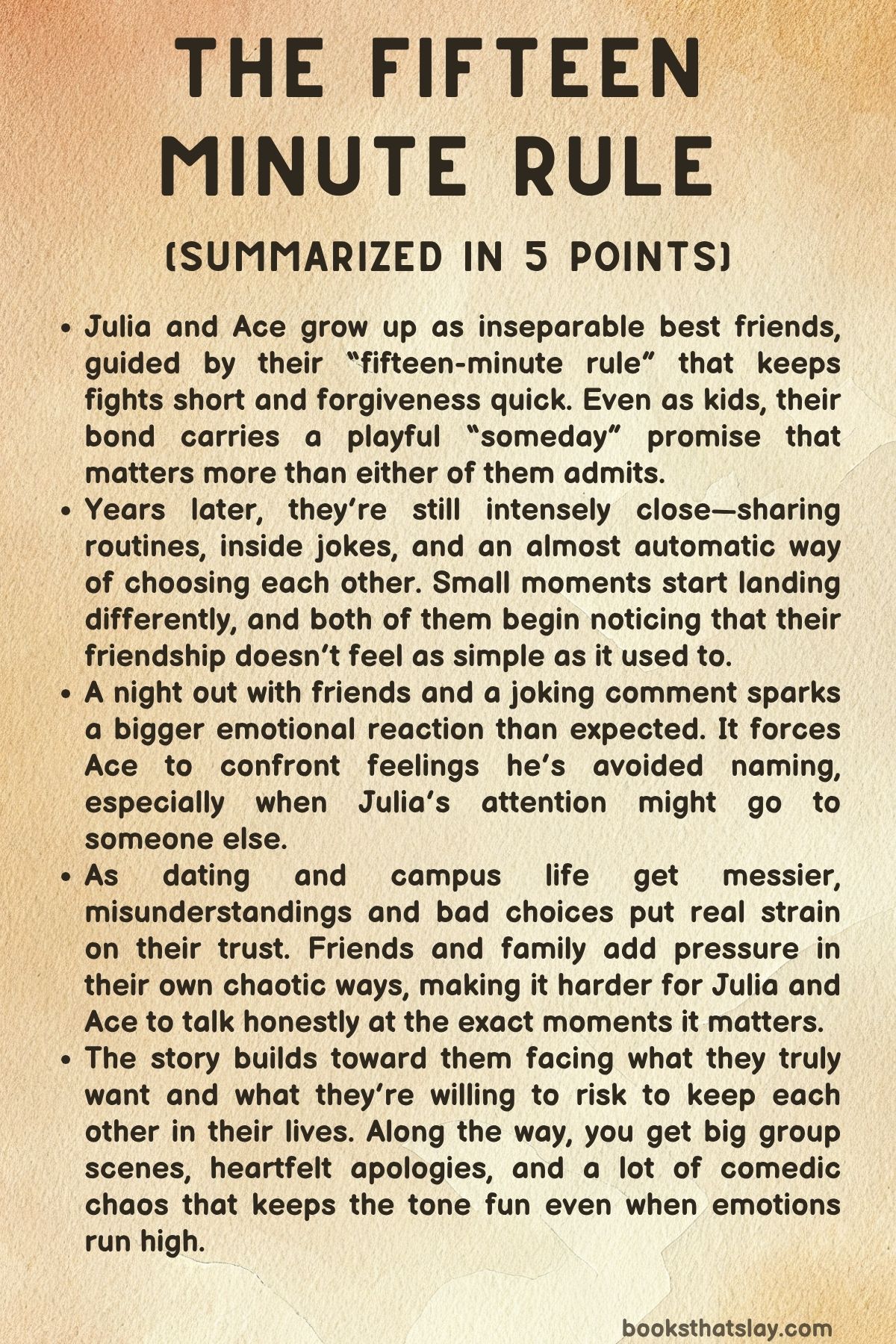
Summary
When Julia and Ace are seven, they argue in the way only best friends can: loud, dramatic, and over something that feels world-ending in the moment. Ace ruins Julia’s Barbie while playing with action figures, and Julia storms off in outrage.
But they have a standing agreement—their “fifteen-minute rule”—which means neither of them is allowed to stay angry for longer than fifteen minutes. Ace, who isn’t great at telling time, waits anxiously for Julia to declare the anger officially over.
Julia tries to hold her ground, but she caves early because Ace looks genuinely sorry, and their friendship snaps back into place.
That same day, Julia plays dress-up using Ace’s clothes and pretends she’s at a wedding. In her imagination, the groom looks a lot like Ace.
On impulse, she tells him they should get married someday. Ace thinks marriage sounds dumb and insists it’s for old people, but Julia pitches it like a perfect plan: if they decide now, they won’t have to marry anyone else later.
She’s especially determined to avoid marrying some random “stinky man,” based on her shaky understanding of dating and adult conversations. Ace pushes back, saying he doesn’t want to be anyone’s boyfriend or husband—he just wants to be Julia’s best friend.
Still, he eventually agrees to the idea, but only if they wait until they’re “really old.” Julia picks twenty-five.
To make it official, Julia writes a “decree” in her pink notebook: Ace and Julia will get married at twenty-five, no matter what. She signs it and tells Ace to sign too.
Their parents call them away before he can finish, but Julia makes him promise to keep the notebook safe. She leaves with a kiss on his cheek and the absolute certainty that her future is set.
Eleven years later, Julia returns home after a trip and discovers Ace has killed her houseplant while watching it for her. She’s furious, and he rushes over with an apology, pizza, and a replacement plant he picked after frantic internet research.
Julia refuses to forgive him right away, so Ace tries to revive their old “fifteen-minute rule,” arguing they should be required to get over it quickly. Julia insists the timer doesn’t start until he shows up in person.
Even while they bicker, their rhythm is familiar: teasing, arguing, forgiving, and automatically choosing each other’s company.
That night, Julia and Ace head out with their friends—Finn, Blake, and Scottie—to a club called Groove using fake IDs. Ace talks the bouncer into letting them in, and they settle into a VIP booth.
The group banter is easy until Julia jokes that she “can’t” drink and rubs her stomach, implying she might be pregnant. Scottie plays along, but Ace doesn’t.
He panics instantly, demanding to know whose baby it is and spiraling into protective rage. Julia bursts out laughing and admits it was a joke.
The prank ends, but Ace can’t shake what he felt in that moment—fear, anger, and something much deeper than friendly concern. Outside, Blake calls it for what it is: Ace is in love with Julia, and everyone seems to know it except him.
Ace goes home shaken, replaying years of memories with a new lens. Even his chaotic family life can’t fully distract him—his younger brother Gunnar shows up unexpectedly and disappears again in the middle of the night like it’s normal.
Ace’s longtime driver confirms Julia got home safely, and Ace lies awake with the realization that his feelings aren’t new. He’s just finally admitting them.
The next day, Julia’s life is equally chaotic: her sister Evie storms into the bathroom with a scandal involving their dad and a ridiculous online rumor. Their parents barge in to address it, turning Julia’s attempt at a normal morning into a family interrogation.
Ace arrives mid-commotion and gets swept into the chaos. Julia notices he’s acting slightly off, but she can’t pin down why.
Later, Julia and Ace spend the afternoon at an elite swim club in Manhattan. Ace tries to act like himself, but he’s suddenly hyper-aware of Julia: her body, her smile, her attention, and what it means when other people want it.
When two guys approach Julia and flirt, Ace can’t hide his possessiveness. He’s even more thrown when Julia casually mentions one of them—Drew—asked her out, and she said yes.
Ace scrambles to keep his reaction under control, then tries to redirect the day into their comfort zone by suggesting food and a spontaneous trip. Julia happily agrees, and for a while they fall back into their usual closeness—except now every touch hits Ace differently.
By the end of the day, he’s certain of two things: he loves her, and he hates that she’s going on a date with someone else.
Julia goes on the date, trying to stay present, but Ace bombards her with texts about random nonsense. She tells him to stop, and he agrees—until he sends a message claiming he needs help because Gunnar is out of control.
Gunnar has a history of dangerous stunts, so Julia panics and leaves the date early. Drew, surprisingly decent about it, insists on coming with her so she isn’t alone.
They head to Ace’s parents’ building.
The truth is uglier: Ace made up the emergency because he couldn’t tolerate Julia being with Drew. The lie spirals immediately.
In a desperate attempt to create a real crisis, Ace begs Gunnar to do something chaotic so Julia won’t realize she was manipulated. Gunnar, who treats chaos like a hobby, responds by throwing a massive party in the penthouse and inviting basically everyone he’s ever met—plus people who absolutely should not be there.
He shares building access details, orders alcohol, and sets off a chain reaction of strangers, deliveries, and outrageous guests flooding the apartment. Ace is trapped in the disaster he asked for.
Julia arrives with Drew and finds the penthouse in full rager mode, complete with bizarre entertainment and random adults who should never be around a fourteen-year-old’s party. To make it worse, Julia learns her own parents have been invited, and Ace’s parents are on their way back from a trip, apparently believing something dramatic happened.
When Ace’s parents arrive, they don’t shut it down the way Ace expects. They jump into the madness like it’s a sport.
Ace watches Julia laughing with Drew, and the night becomes a perfect example of a plan failing in real time.
The next morning, Ace is forced into cleanup while his parents joke, tease, and casually confirm what Ace is trying not to say out loud: he’s been in love with Julia for years. Ace decides he needs a real approach.
He starts researching what women want and drafts a personal strategy to win Julia over, treating it like a mission.
Julia keeps seeing Drew, and Ace keeps trying—sometimes sweetly, sometimes badly. He cooks her dinner in her apartment to set the stage for a confession, only to accidentally poison them both when the food contains peppers they’re allergic to.
They spend the night miserable, and the “romantic” evening turns into shared dehydration and regret. Still, Julia starts noticing that something has shifted in Ace.
He’s always been close, but lately he’s intense in a way she can’t ignore.
Ace’s life gets more complicated when he’s pulled into a secret society on campus, Computare Caterva, known as Double C. The initiation is dramatic and secretive, and Ace becomes its leader, bound to keep it quiet. When he finally returns late one night, drunk and half-dressed, a condom falls out of his pocket in front of Julia.
She doesn’t have the context, and the secrecy makes everything look worse. Ace tries to explain without breaking his oath, but it comes out as more lies and dodges.
Julia feels shut out and starts pulling away.
At a Double C event, Ace publicly reveals his new role, confirming that he kept a major part of his life hidden. Julia feels embarrassed and excluded, and in that vulnerable moment, she agrees to go out with Drew again.
The tension with Ace grows until it snaps. Ace finally admits what he’s been hiding emotionally too: he kisses Julia and confesses he loves her, along with the fact that he’s been doing extreme things just to keep her close.
Julia, overwhelmed and hurt, tells him it’s too late.
Soon after, Drew asks Julia to be his girlfriend in public, and she says yes, even though hesitation shows on her face. Ace is crushed and disappears from the party.
The silence between Julia and Ace stretches, and Julia tries to convince herself she’s made the right choice—until she breaks up with Drew and admits the truth to her friends: she loves Ace. Her friends push her to talk to him before they lose what they’ve always had.
Julia confesses the situation to her mom, and Ace’s mom overhears and immediately becomes determined to help. Julia later finds a letter from Ace: a direct, vulnerable apology.
He admits he handled everything badly, that he took her presence for granted because she felt permanent, and that he still loves her even if she doesn’t feel the same. He tells her he misses her and wants their friendship back.
The letter cracks Julia open in the best way—she feels hope again.
At the Gamma Pi Halloween party, Ace arrives miserable and ready to leave early, pushed along by friends and even his own father, who is prepared to intervene if Ace tries to run. Then Julia appears dressed like Sandy from Grease.
She walks up, delivers the iconic line, and kisses Ace in front of everyone. Julia tells Ace she’s in love with him.
Ace, stunned, checks if she’s still with Drew. She isn’t.
They apologize to each other, and Ace admits he’s loved her for most of his life. This time, they choose each other out loud.
They leave the party together and finally allow the relationship to become real. The first week is a rush of closeness: constant time together, shared routines, and a kind of happiness that feels obvious in hindsight.
Their friends and families celebrate like they’ve been waiting for this forever—because they have. At a family dinner, everyone throws them a surprise party with a giant “FINALLY!” banner.
Ace jokes about asking Julia’s father for permission to marry her someday and insists he still has the childhood contract.
As the months pass, their relationship settles into joy, teasing, and heat, while the group around them faces real life too—especially Scottie, who undergoes major surgery. When the doctor announces it’s a success, the entire friend group collapses into relief.
Later, milestones stack up: Julia’s birthday celebration, more Double C antics, and a holiday gathering where Scottie stands and takes steps, proving her recovery is real.
Eventually, Julia and Ace move in together near campus, blending their lives in a way that feels natural because they’ve always been a team. Even when Gunnar causes another public disaster, Ace and Julia handle it as partners.
By the next summer at the lake house, surrounded by friends and family, Ace watches Julia with the quiet gratitude of someone who almost missed his chance—and is determined never to take it for granted again.
Characters
Julia Winslow
Julia is the emotional center of The Fifteen Minute Rule, and her defining trait is how fiercely she loves—yet how hard she works to keep that love from making her feel foolish or vulnerable. As a child, she’s the one who insists on the “fifteen-minute rule,” which immediately establishes her as the steadying force in her friendship with Ace: she believes feelings matter, but she also believes repair matters more than punishment.
That instinct matures with her—she becomes someone who can be furious over Luna, over secrecy, over being made to feel manipulated, but she is also someone who consistently returns to the question of what’s true and what’s fair. Julia’s humor reads as both armor and intimacy; she teases, she provokes, she jokes about pregnancy, and she can turn a tense moment playful, but those same habits also reveal how much she relies on laughter to avoid naming what she wants out loud.
Her arc is less about “realizing” she loves Ace and more about permitting herself to accept the risk that comes with it: she doesn’t doubt the bond, she doubts the consequences of choosing it. When she dates Drew, it’s not because her connection with Ace is weak; it’s because Ace’s mixed signals and secrecy finally push her into needing clarity and dignity, something a straightforward, openly interested person can offer.
Julia’s eventual honesty—first with her friends, then with her mother, and finally with Ace—marks her growth: she stops interpreting her own longing as something that must be managed quietly and instead treats it as something worthy of being chosen publicly.
Ace Kelly
Ace is chaotic devotion in human form: impulsive, dramatic, funny, and intensely loyal, but often so afraid of losing Julia that he behaves in ways that nearly guarantee it. As a child, he’s the one who makes messes—ruining the chalk drawing, wrecking Barbie’s hair—and the “fifteen-minute rule” becomes both his accountability structure and his emotional lifeline, because it assures him that mistakes won’t equal abandonment.
That childhood fear doesn’t disappear when he grows up; it simply gains higher stakes and more sophisticated disguises. Ace’s humor is his reflexive coping mechanism, but beneath it is a deep possessiveness that isn’t rooted in entitlement so much as panic—he can’t tolerate the idea of Julia having a life that doesn’t orbit him, because he has built his sense of safety around her constant presence.
His turning point is the club scene where Julia’s pregnancy joke triggers a visceral reaction; it forces him to confront the truth that he hasn’t been “just” a best friend for a long time. From there, his arc is a study in badly managed love: jealousy he tries to hide, grand gestures he hopes will substitute for direct honesty, and manipulation he regrets the moment he sees the damage.
The manufactured Gunnar “emergency” is the clearest example of Ace at his worst—he chooses control over courage—yet it’s also what makes his later apology believable, because he finally names the ugliness of what he did instead of dressing it up as protectiveness. Ace’s strength is that he loves with his whole body—showing up, feeding people, planning, fussing, defending, celebrating—and once he learns that love is not proven by theatrics but by truth, he becomes the partner Julia can trust rather than the best friend she has to emotionally manage.
Finn
Finn functions as emotional ballast in the friend group, someone who can match Ace’s energy without competing with it and who offers steadiness when everything gets loud. He often appears in the social scenes—clubs, diners, parties—where his presence helps normalize the chaos, making the group feel like a real ecosystem rather than just a romance bubble.
Finn’s loyalty shows in the way he stays close through the escalating drama, and his emotional depth surfaces most clearly around Scottie’s surgery, where his fear and relief crack through the usual humor. That moment reframes him from “fun friend” into someone whose caring runs profound and quiet, suggesting that he isn’t just along for the ride; he is genuinely attached to these people as family.
In a story filled with big gestures, Finn’s role is to remind the narrative what grounded affection looks like: showing up, staying, and feeling things fully even if you don’t make a spectacle of them.
Scottie
Scottie is the group’s sharp-tongued truth-teller and, in many ways, its emotional leader—she reads situations quickly, cuts through tension with humor, and has the authority to call people out without being dismissed. Her wheelchair is present but never allowed to define her personality; instead, the story consistently frames her as someone who refuses pity and actively controls the tone of the room, using jokes to set expectations and keep others from getting weird or overly careful.
Scottie’s biggest narrative purpose is relational honesty: she’s one of the first to verbalize what others won’t, whether that’s challenging Julia’s “I can’t drink” moment or later pushing Julia to confront her feelings for Ace instead of hiding behind confusion. Her spinal surgery arc deepens her beyond the role of commentator, giving the friend group a shared vulnerability that’s not romantic but still intimate—waiting together, fearing together, celebrating together.
Scottie’s progress to walking again becomes a symbolic counterpoint to Ace and Julia’s romantic leap: both are about reclaiming possibility after a long stretch of uncertainty.
Blake Boden
Blake is the friend who sees too much and says the crucial thing at the crucial time. His most pivotal function is the moment he pulls Ace aside and flat-out states what everyone else already knows: Ace is in love with Julia.
That intervention matters because it comes from someone with social credibility in the group and because Blake delivers it as fact, not teasing, forcing Ace to stop treating his feelings like a temporary glitch. Blake also offers a contrast to Ace’s romantic flailing through his own storyline with Lexi: where Ace tries to strategize and perform, Blake’s relationship arc suggests a more direct emotional trajectory—messy, yes, but ultimately chosen openly.
He’s supportive without being sentimental, and that combination makes him an anchor for Ace in moments when Ace would rather spin out than sit still with a hard truth.
Lexi
Lexi is the story’s quiet architect—someone who influences outcomes from the background and then steps into the spotlight when it matters. Early on, she registers as uneasy in party spaces, which hints that she isn’t fully aligned with the group’s default chaos; she moves through it with purpose.
Her on-field grand romantic gesture with Blake reveals a willingness to claim what she wants publicly, even if it risks embarrassment, and it mirrors what Ace struggles to do with Julia. Lexi’s involvement with Double C expands her character beyond romance; she becomes a gatekeeper of tradition and power, someone trusted enough to orchestrate Ace’s initiation and serious enough to demand secrecy.
That secrecy becomes a narrative wedge between Ace and Julia, which is significant because Lexi isn’t villainous—she’s simply loyal to the society’s rules—yet her choices still have relational consequences. By straddling romance, friendship, and institutional power, Lexi embodies a key theme of the book: intimacy isn’t only threatened by other love interests; it’s also threatened by the secret selves people build when they’re afraid to be fully known.
Drew Bettencourt
Drew is the story’s clearest example of the “healthy alternative,” but he isn’t written as a disposable obstacle; he’s kind, patient, and consistent, which is exactly why he stings Ace so deeply. Drew’s most important quality is how straightforward he is—he asks Julia out, listens, keeps conversation going when she’s distracted, and even insists on accompanying her to what he believes is an emergency because he doesn’t want her unsafe.
In other words, Drew behaves like a considerate partner before he even has the title, which forces Julia to confront what she actually wants rather than what she’s merely used to. Narratively, Drew exposes the cost of Ace’s ambiguity: if Ace won’t claim Julia honestly, someone else will offer her clarity, and she is allowed to accept it.
Drew’s public girlfriend ask and kiss crystallize Ace’s worst fear, but they also give Julia a final piece of information—Ace’s silence has consequences—pushing the story toward its eventual reckoning. When Julia breaks up with Drew, it doesn’t invalidate him; it clarifies her truth: decency alone isn’t enough when the heart is already attached elsewhere.
Gregory Allister
Gregory plays a smaller but strategic role as part of the initial flirtation moment at the swim club, helping create a believable social pressure around Julia that Ace can’t ignore. He functions as proof that Julia is desired and visible outside of Ace’s protective bubble, which is essential because Ace’s jealousy only makes sense if Julia’s romantic options are real.
Gregory’s presence also underscores how Ace reacts to competition—not with calm communication, but with territorial flare—highlighting the emotional immaturity Ace must outgrow to be worthy of the relationship he wants.
Bruno
Bruno, the bouncer at Groove, is a brief but revealing character because he shows how Ace navigates the world: charm first, rules later, money if necessary. The interaction communicates Ace’s privilege and social confidence while also reinforcing his habit of controlling outcomes—getting the group inside, skipping the line, shaping the night.
It’s a small scene, but it fits the larger pattern: Ace solves problems through force of personality rather than patience, which becomes both his superpower and his recurring flaw.
Gary
Gary, the longtime driver, is one of the story’s understated stabilizers—an adult presence who has likely witnessed the Kelly family’s chaos for years and has learned to respond with calm competence. When Ace asks him to make sure Julia gets home safely, it reveals two things at once: Ace’s genuine protectiveness and his need for reassurance when his emotions get too big to hold alone.
Gary becomes a quiet confidant by proximity; Ace doesn’t bare his soul to him, but he relies on Gary as a steady point when everything else feels unsteady, which subtly emphasizes how isolated Ace feels inside his own wealth and family spectacle.
Gunnar Kelly
Gunnar is comedic escalation with teeth: he’s wild, unpredictable, and treated like a walking disaster, but his chaos is also a real source of fear for the people around him. His surprise return from the Bahamas, his casual late-night decisions, and his ability to summon a full penthouse rager in minutes all paint him as someone who experiences boundaries as optional suggestions.
Importantly, Gunnar’s chaos is not random in the story; it’s a mirror for Ace’s worst impulses. When Ace begs him to create a mess to cover a lie, Gunnar does it instantly and massively, showing Ace what manipulation looks like when taken to its logical extreme.
Gunnar also exposes the Kelly family’s permissive parenting dynamic—there are consequences, but they’re inconsistent, and spectacle often replaces structure. That environment helps explain Ace: he grew up in a world where dramatic behavior is rewarded with attention and laughter, so of course he tries drama when he’s terrified of losing Julia.
Thatcher “Thatch” Kelly
Thatch is larger-than-life parenting: abrasive, theatrical, oddly perceptive, and weirdly effective despite being emotionally chaotic. His most striking trait is that he can insult Ace one moment and show up in a gorilla suit the next, which encapsulates how the Kelly family expresses love—through absurdity, intimidation, and devotion all tangled together.
Thatch reads Ace’s feelings quickly and treats them like a problem to be solved through action and “proving” rather than quiet conversation, which pushes Ace toward performative wooing and strategy. Yet Thatch also serves as a comedic embodiment of unconditional support; he doesn’t shame Ace for loving Julia, he practically celebrates it.
The gorilla-suit moment, ridiculous as it is, becomes a sincere symbol: Thatch is the kind of father who will lurk in bushes to make sure his son doesn’t run away from happiness.
Cassie Kelly
Cassie is the glamorous chaos engine who turns private feelings into events and treats romance like a production worth staging. She’s not subtle, and that’s the point—she represents a world where big emotions deserve big theatrics, which both helps and complicates Ace and Julia’s story.
Cassie’s reaction to the penthouse party—more amused than angry, joining the mayhem—shows the permissive, celebratory atmosphere Ace was raised in, where consequences are often softened by humor. Her later involvement with Double C also reframes her as more than just a party mom; she’s connected, influential, and comfortable holding secret power.
When she overhears Julia confess she loves Ace and immediately starts plotting outfits and moments, it’s funny, but it’s also revealing: Cassie believes love should be claimed boldly, and she’s delighted to help push the story toward that public claiming.
Julia’s Father
Julia’s father is a grounding presence whose main narrative role is to embody the Winslow family’s comparatively normal framework—yes, they have their own chaos, including the dating app rumor and Evie’s panic, but their chaos feels like family conversation rather than wealth-fueled spectacle. His involvement in the rumor situation highlights the theme of misunderstanding and insecurity: rumors spiral, people panic, and truth needs to be spoken plainly.
Later, his interactions with Ace—especially Ace’s joking request for Julia’s hand in marriage—help frame the relationship as something that has always been visible to the adults around them, even when Ace and Julia were still pretending it was just friendship.
Julia’s Mother
Julia’s mother functions as emotional witness and safe harbor, the person Julia can confess to when the romantic confusion becomes too heavy to carry privately. Her presence in the Central Park conversation matters because it marks Julia’s shift from denial to ownership: telling her mother she’s in love with Ace is Julia choosing honesty over fear.
She also provides contrast to Cassie—where Cassie is flamboyant and plotty, Julia’s mother feels more steady and receptive—so Julia’s eventual decision lands as something supported by genuine care, not just spectacle.
Evie Winslow
Evie is anxious, dramatic, and intensely teenage, and her storyline injects family-specific comedy while also reinforcing the book’s recurring pattern: fear thrives in silence and assumptions. Her panic about the scandal website forces the family into conversation, revealing how quickly narratives form when people don’t have facts.
Evie’s energy also highlights Julia’s role in her family as the calmer older sister who can say, “This is probably fake,” and bring everyone down from the ceiling. In a romance about best friends who misread each other for years, Evie’s subplot becomes a smaller echo of the same theme—misinterpretation, spiraling, and the need for direct truth.
Philmore
Philmore, the family pig, is comedic symbolism more than a traditional character, but his timing and presence amplify the tone of The Fifteen Minute Rule: this is a world where love, wealth, chaos, and absurdity coexist without apology. The pig showing up as Ace’s parents arrive is a perfectly on-brand detail for the Kelly household, and it underscores how Ace’s life has always been a circus—one he’s learned to navigate with humor, but also one that has trained him to use spectacle instead of vulnerability.
Yoko
Yoko, Julia’s dog, quietly reflects Julia’s emotional state during the period when she’s distancing herself from Ace. When Julia takes Yoko for a walk to avoid conversation, it’s a physical enactment of her coping strategy: movement instead of confrontation, caretaking instead of asking for care.
Yoko becomes a small but meaningful marker of Julia’s need for safety and routine when trust feels shaken, and the dog’s presence emphasizes how deeply Julia values stability—even when she loves someone as chaotic as Ace.
Connor
Connor’s primary function is to give Double C legitimacy and structure, making it clear that the society isn’t just a silly club but a secretive institution with hierarchy, rituals, and real pressure. By helping orchestrate Ace’s initiation and emphasizing secrecy, Connor indirectly catalyzes the central conflict between Ace and Julia, because the secrecy gives Ace a convenient place to hide when he’s already emotionally hiding.
Connor isn’t framed as malicious; he represents the seductive pull of belonging and status, and how those systems can demand silence that damages intimate relationships.
Dr. Raines
Dr. Raines appears briefly but carries enormous emotional weight, acting as the bearer of relief and hope during Scottie’s surgery. In a story packed with romantic intensity and comedic chaos, the surgery outcome is a reminder that the friend group’s stakes aren’t only who ends up with whom—these people genuinely need each other to survive fear, pain, and uncertainty.
Dr. Raines becomes the voice that transforms dread into celebration, anchoring one of the book’s most tender communal moments.
Theo Damon
Theo is a cameo-style celebrity presence whose main purpose is tonal: he heightens the absurdity and glamour orbiting Cassie’s world, reinforcing how larger-than-life the Kelly-Winslow social ecosystem can be. His impatience while Cassie focuses on Julia’s romantic crisis is a funny reversal—celebrity becomes background noise while love becomes the main event—which matches the book’s values: fame and spectacle are secondary to the emotional lives of the characters.
Piper
Piper arrives late as a spark of future complications and new dynamics, functioning as a “next story” seed while also mirroring earlier romantic triangles. Her immediate effect is to make Julia and Ace exchange that knowing look—the one that suggests, “We recognize this mess; we’ve lived it”—which subtly confirms their growth.
Piper’s introduction also expands the social world beyond the central couple, implying that this friend group’s chaos-and-love ecosystem will continue, just with new people stepping into the spotlight.
Themes
The Fifteen-Minute Rule as Emotional Discipline and Repair
The fifteen-minute rule starts as a child’s agreement that turns conflict into something manageable rather than something that lingers. In The Fifteen Minute Rule, that small rule becomes a shared language for repair: it gives both Julia and Ace a boundary around anger, a structure that keeps them connected even when they mess up.
What makes it powerful is not the stopwatch aspect, but the idea that being right matters less than returning to each other. As kids, Julia uses the rule almost like a guide for compassion—she can see Ace feels bad, and she shortens the punishment because maintaining closeness feels more important than extending resentment.
Later, the same pattern repeats in a more adult form: even when the conflict is bigger than a ruined toy or a dead plant, they instinctively reach for routines that restore normalcy—food, familiar movies, shared jokes, a default assumption that they’ll be together after the storm.
At the same time, the rule also exposes a flaw that grows with them. It can make forgiveness feel automatic, which is comforting until it becomes a way to skip the hard part: telling the truth, setting boundaries, or admitting that something hurt more than usual.
Julia’s anger over the peace lily, for example, is not really about the plant alone; it’s about feeling like Ace hasn’t taken her priorities seriously. The rule offers an easy “reset,” but the emotional reality is that some injuries don’t shrink just because time passed.
Ace’s later jealousy moves this problem into sharper focus: he tries to force closeness by manufacturing urgency, turning “repair” into manipulation. That moment shows how repair rituals can be misused when one person is afraid of losing the relationship and chooses control over honesty.
The theme lands in the shift from quick forgiveness to earned repair—when Ace finally writes his letter and takes responsibility without demanding immediate comfort, the story presents a more mature version of the same idea: connection survives when accountability is real, not rushed.
Friendship as a Relationship with Its Own Commitments
Julia and Ace’s bond is treated as something serious long before romance is admitted, and that seriousness is the point. Their childhood “decree” is funny on the surface, but it also captures how they already think of each other as permanent.
They don’t describe their attachment as casual companionship; they build rules, promises, and imagined futures around it. As they grow up, that friendship functions like a primary relationship: they assume access, time, emotional priority, and an almost unquestioned right to be part of each other’s daily life.
Ace showing up with pizza to make things right, or Julia repeatedly texting until he responds, reflects a closeness that resembles a couple’s rhythm even when they still call it best friendship.
The tension comes from the mismatch between what friendship is “supposed” to allow and what their friendship actually demands. When other people enter the picture—especially Drew—Julia tries to behave like a normal person dating while keeping her best friend close, and Ace tries to behave like a normal best friend while feeling possessive.
Both roles start to crack because their friendship already includes emotional exclusivity, even if neither wants to name it. That’s why Ace’s reaction to the fake pregnancy joke is so extreme: it isn’t only shock, it’s the sudden confrontation with the idea that Julia’s life might be built around someone else.
Similarly, when Julia feels shut out by Ace’s secrecy about Double C, it doesn’t land like a small omission; it lands like betrayal, because the friendship has trained her to expect full access to him. The pain is amplified by their shared history: when you’ve been someone’s “always,” being treated like an “optional” feels humiliating.
This theme also highlights how hard it is to renegotiate closeness without destroying it. Their friendship doesn’t smoothly evolve; it breaks under stress, then has to be rebuilt with new terms.
The story shows that friendship can be deeply committed and still unstable when it becomes the place where people hide their romantic truth. In the end, their relationship doesn’t replace friendship; it formalizes what the friendship already was—devotion, loyalty, and a preference for each other that never really belonged in the “just friends” category.
Jealousy, Control, and the Cost of Avoiding Vulnerability
Ace’s jealousy isn’t presented as a single bad moment; it’s a pattern that escalates when he refuses vulnerability. Instead of saying “I’m scared of losing you,” he performs versions of protection, urgency, and dominance—demanding to know who the baby’s father is, confronting men who flirt with Julia, pushing plans to pull her away from Drew.
The manufactured emergency with Gunnar is the clearest example: Ace tries to control Julia’s choices by creating a situation where she “has” to pick him, because asking directly would require admitting he wants her. That choice becomes the turning point where jealousy stops being an internal feeling and becomes behavior that risks trust.
It’s also a moment of self-awareness: Ace realizes immediately that he crossed a line, which matters because the theme is not “jealousy is romantic,” but “jealousy becomes destructive when it’s used as a substitute for honesty.”
The consequences show up in Julia’s response. She doesn’t simply get mad; she becomes uncertain about what is real.
Secrecy plus a condom in his pocket plus vague explanations create a story Julia can’t verify, and when people can’t verify, they fill gaps with fear. Her decision to go back to Drew after the Double C reveal is not just revenge or confusion—it’s a protective move.
Drew represents clarity: he asks her out, shows up when she needs help, and behaves predictably. Ace represents intensity mixed with mystery, which makes her feel unsafe even though she loves him.
That’s the cost of avoiding vulnerability: you might keep your pride, but you lose the other person’s confidence in you.
What finally resolves this theme is not a grand gesture, but accountability without bargaining. Ace’s letter doesn’t ask Julia to fix his feelings or reassure him; it admits the manipulation, admits that he treated her like a certainty, and accepts the possibility of losing her.
That reversal is key: control collapses when he stops trying to manage the outcome and starts telling the truth. The story makes a clear argument that jealousy itself is not the worst problem—fear is.
Fear turns love into strategy, strategy turns into deception, and deception turns closeness into suspicion. When Ace risks rejection by naming his love openly, he removes the need for strategy, and the relationship finally has room to be mutual instead of managed.
Identity, Belonging, and the Pressure of Public Roles
A recurring undercurrent is how much Julia and Ace are shaped by the worlds they move through: money, status, social scenes, campus power structures, and family expectations. They aren’t only negotiating personal feelings; they’re also navigating roles other people recognize—Ace as the charismatic guy who can talk a bouncer into anything, Julia as the person others watch and approach, both of them surrounded by friends who comment, tease, and observe.
The Double C storyline takes this pressure and makes it explicit: Ace is pulled into a secret society with hierarchy, rituals, and performance. Leadership becomes a public identity he has to maintain, and secrecy becomes a rule he must follow even when it costs him intimacy.
That conflict reveals a central strain: when your life includes exclusive groups and image-based expectations, closeness can start competing with reputation. Ace’s inability to explain where he was, even when he wants to, creates a relationship crisis not because Julia is unreasonable, but because secrecy creates distance and distance creates doubt.
Family reinforces the same idea in a different tone. Ace’s parents are outrageous and affectionate, but they also normalize spectacle and escalation.
Their reaction to chaos is to turn it into entertainment, which teaches Ace that big emotions are handled with bigger performances. Julia’s family scenes show a different pressure: reputation matters, appearances matter, and even a rumor about her father’s dating life becomes an event that pulls everyone into discussion and damage control.
In that environment, Julia learns to manage embarrassment, keep things moving, and avoid feeding drama—skills that help her function but can also make her hesitate to confront what she wants.
The theme becomes clearest when romance finally turns public. Their kiss at the Halloween party is witnessed, celebrated, and instantly absorbed into the group narrative of “finally.” That moment is satisfying, but it also shows how much their relationship has been communal property in a way: friends have opinions, families have plans, and even strangers become part of the story when the setting is loud enough.
The book suggests that identity isn’t only internal; it’s also social. Julia and Ace have to decide who they are to each other in a world where everyone has already decided for them.
Real commitment, then, is not only confessing love—it’s choosing the private truth even when public roles, secret obligations, and other people’s expectations keep trying to write the script.