Aicha Summary, Characters and Themes
Aicha by Soraya Bouazzaoui is a historical fantasy novel rooted in Moroccan resistance, folklore, and the legend of Aicha Kandicha. Set in a Moroccan citadel under Portuguese occupation, the book follows Aicha Sanhaji, a young woman shaped by loss, war, loyalty, and a dangerous power growing inside her.
Raised by a rebel father and a brave sister, Aicha learns to fight for her people while struggling with love, fear, rage, and destiny. The novel presents her not only as a warrior, but as the tragic origin of a feared supernatural figure.
Summary
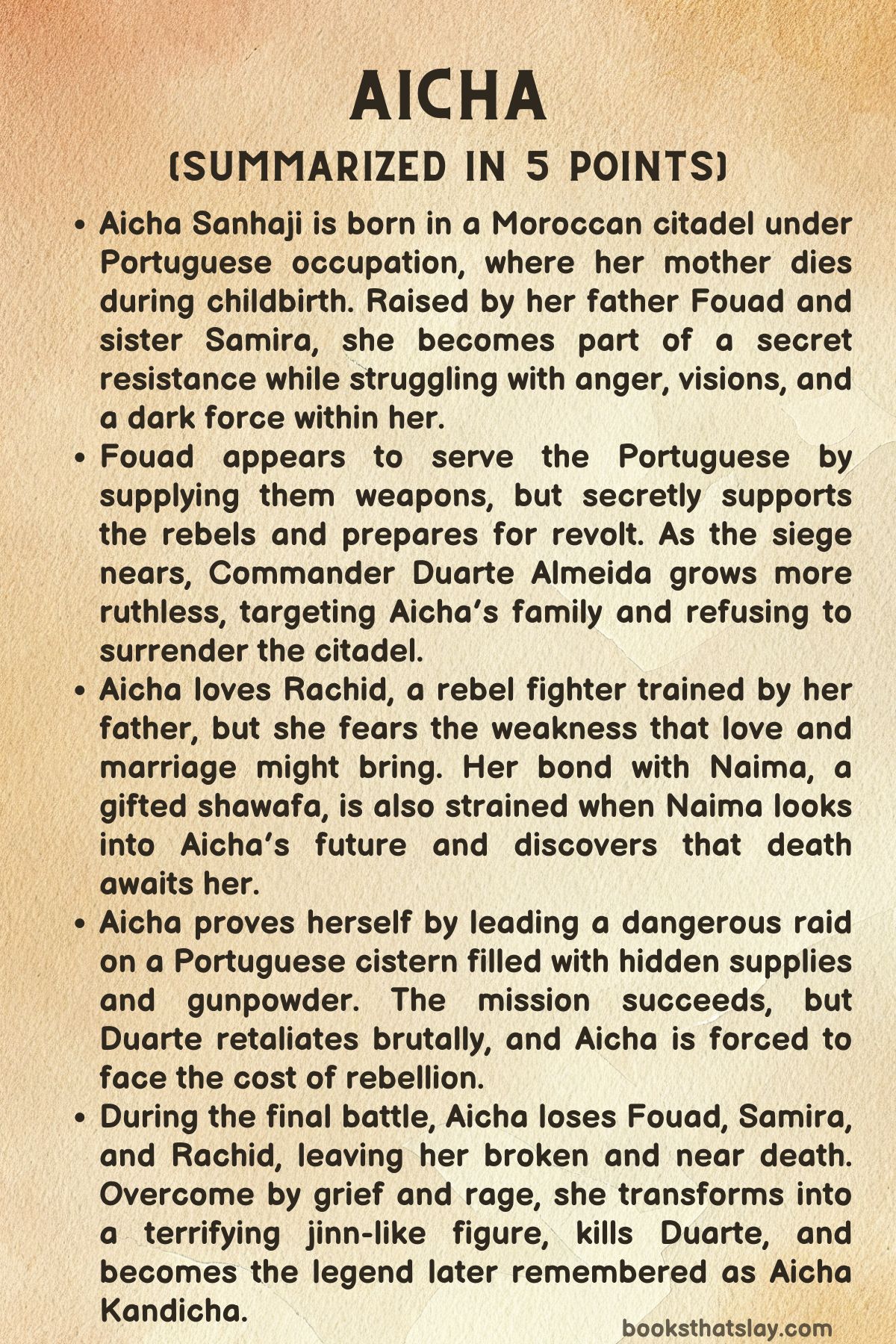
Aicha Sanhaji is born in a Moroccan citadel controlled by Portuguese occupiers. Her birth is marked by tragedy, as her mother, Tadla, dies while bringing her into the world.
This loss shapes Aicha’s life from the beginning. She is raised by her father, Fouad, a blacksmith, and by her older sister, Samira.
Fouad is more than a craftsman. In public, he works with the Portuguese soldiers by supplying them with weapons, but in secret, he is one of the leaders of the resistance.
He sells arms through hidden channels and helps prepare a rebellion against the foreign forces holding the citadel.
Aicha grows up in a household built on secrecy, courage, and danger. She learns early that survival requires strength, silence, and discipline.
Her father trains fighters and supports the Sultan’s approaching campaign to reclaim the occupied port. As the siege draws nearer, fear spreads through the citadel.
Food and water become harder to find, and many Portuguese families begin to leave. Commander Duarte Almeida, however, refuses to surrender.
He is cruel, proud, and determined to keep control. He suspects Fouad of rebellion and watches Aicha’s family closely, threatening them whenever he can.
Aicha’s hatred for Duarte grows with every encounter. She often clashes with him and struggles to control a violent voice inside herself that urges her to kill.
This inner darkness frightens her, even when she tries to deny it. She also sees strange shadowy figures and suffers nightmares of a horrifying version of herself.
These visions suggest that something unnatural is tied to her fate. Aicha wants to be brave and useful to the rebellion, but she also fears what she might become if she loses control.
In the middle of the rising conflict, Aicha is secretly in love with Rachid. He is a fighter trained by Fouad after his parents were executed, and he is deeply loyal to the resistance.
Rachid works closely with Samira as a smuggler and messenger, risking his life to move information and supplies. He loves Aicha and wants to marry her, but she hesitates.
Her fear is not simple. She worries that loving him openly will make him a weapon Duarte can use against her.
She also fears childbirth because her own mother died giving birth to her. Even so, her bond with Rachid grows stronger as danger closes around them.
Aicha also has a connection to the Gardens, a riad where women known as shawafas live under the protection of Lala Ilham. These women possess supernatural gifts, and Aicha’s closest friend, Naima, is among them.
Naima worries deeply about Aicha and senses that her friend’s path is dangerous. Hoping to protect her, Naima looks into Aicha’s future without permission.
What she sees terrifies her: Aicha is destined to die. Naima tries to warn her, but Aicha feels betrayed.
She does not want her fate exposed or handled by someone else. To Aicha, fighting for her home already means accepting death as a possibility.
As pressure builds inside the citadel, Aicha seeks a greater role in the rebellion. She discovers that Duarte’s men are hiding food, supplies, and gunpowder in the Portuguese cistern.
These resources are being kept from the local people while the occupiers prepare for a long fight. Aicha creates a plan to attack the cistern and weaken Duarte’s forces.
Fouad is reluctant to let her lead such a dangerous mission, but she proves her determination. She sets out with Samira, Rachid, Mounir, and Said.
The raid becomes a turning point for Aicha. She and Samira enter the cistern, kill guards, take what supplies they can, and burn the rest.
The explosion destroys Duarte’s stockpile and deals a serious blow to the Portuguese position. Aicha makes her first kill, and Fouad is proud of her courage.
For a brief moment, the mission feels like a victory. Yet the cost soon follows.
Duarte retaliates by capturing and torturing rebels. Fouad is brutally beaten after Aicha’s actions are discovered.
Aicha blames herself for her father’s suffering, but Fouad refuses to let her carry that guilt. He tells her he would endure pain for his daughters willingly.
The final siege begins soon after. Duarte becomes more desperate and more violent.
Rather than accept defeat, he orders massacres and prepares to destroy the citadel if he cannot keep it. The rebellion launches its attack at the gates while the Sultan’s army advances from outside.
Aicha, Rachid, Samira, Fouad, and their allies fight with everything they have. The battle is brutal and chaotic.
The hope of liberation is mixed with terrible loss as many Maghrebis are killed.
Aicha’s world collapses during the fighting. Fouad dies, and so does Samira.
These deaths break something inside her. The people who raised her, protected her, and gave her purpose are taken from her in the same battle meant to free their home.
Rachid continues fighting and faces Duarte directly. He badly wounds the commander, but Duarte survives long enough to strike back.
When Rachid tries to carry the injured Aicha away, Duarte stabs through him, killing him and wounding Aicha as well. Then, in a final act of cruelty, Duarte mutilates Rachid’s body in front of her.
Surrounded by the bodies of the people she loves most, Aicha reaches the edge of death. Her grief, rage, and the dark force within her finally take over.
The terrifying double from her nightmares becomes real through her own body. Her eyes turn black, her nails become claws, and she rises no longer fully human.
The violence she had resisted for so long becomes unstoppable. She hunts the remaining Portuguese soldiers and kills them with monstrous strength.
Duarte, the man who tormented her family and destroyed everything she loved, is finally torn apart by her.
By the end, Aicha is transformed into the feared figure who will later be remembered as Aicha Kandicha. Her story becomes the origin of a legend, but the legend is born from grief, occupation, resistance, and unbearable loss.
She does not become monstrous without reason. She is pushed there by war, cruelty, and the destruction of everyone she cared for.
In the epilogue, Naima and Lala Ilham are aboard a ship after fleeing the citadel with the other shawafas. Naima senses the moment Aicha loses the last part of her humanity and mourns her friend.
Ilham tells her that Aicha’s destiny had been written from birth. The ending leaves Aicha as both victim and avenger, a young woman turned into myth by a world that gave her no mercy.
Characters
Aicha Sanhaji
Aicha Sanhaji is the central figure of the book, and her character is shaped by loss, resistance, fear, rage, and destiny. Born during her mother Tadla’s death in childbirth, she carries a silent burden from the beginning of her life.
This origin makes her deeply connected to grief even before she fully understands it, and it also explains her fear of childbirth and vulnerability later in the story. She grows up in a violent occupied world where survival depends on secrecy, courage, and suspicion, so her fierceness is not simply a personality trait but a response to the world that surrounds her.
She is brave, sharp, and willing to fight, but she is also emotionally guarded because love feels dangerous to her.
Her inner conflict is one of the most important parts of her character. She wants to defend her home and family, yet she is haunted by a darker force inside herself.
The violent voice that urges her toward killing, her nightmares, and her visions of shadowy figures suggest that she is not only fighting an external occupation but also a terrifying part of her own nature. This makes her more than a conventional rebel heroine.
She is courageous and loyal, but she is also unstable, frightened by herself, and constantly struggling to remain human. Her transformation at the end of the story feels tragic because it is not presented as simple victory.
It is the result of unbearable grief after losing her father, sister, lover, and future.
Her relationship with Rachid reveals her softer and more fearful side. She loves him, but she resists the idea of marriage because emotional closeness gives others power over her.
She fears that Duarte could use Rachid against her, and she fears repeating her mother’s fate through childbirth. This hesitation shows that her strength is tied to trauma rather than emotional freedom.
She wants love, but she does not fully trust safety. By the end of the book, her humanity collapses under the weight of violence, and she becomes the monstrous legend remembered as Aicha Kandicha.
This ending turns her into a symbol of how oppression, grief, and vengeance can transform a person into something both powerful and tragic.
Tadla
Tadla is not physically present for most of the story, yet her importance is felt throughout the book. Her death in childbirth shapes the protagonist’s identity, fears, and emotional wounds.
She represents the first great loss in the family, and her absence creates a shadow that follows her daughters and husband. Because she dies while giving life, she becomes connected to both birth and death, making motherhood appear dangerous and painful in the protagonist’s mind.
Tadla’s role is especially important because she influences the main character without speaking directly in the story. Her death explains why childbirth becomes such a source of fear and why marriage is not merely a romantic decision for her daughter.
Tadla also deepens the emotional loneliness of the family. Fouad raises his daughters with strength and devotion, but the absence of their mother leaves a space that cannot be fully replaced.
In this way, Tadla functions as a quiet but powerful presence whose death continues to affect the choices, fears, and emotional lives of the living.
Fouad
Fouad is one of the strongest moral anchors in the story. As a blacksmith, father, and rebel leader, he lives a double life that requires discipline, courage, and intelligence.
Publicly, he supplies weapons to Portuguese soldiers, which makes him appear useful to the occupying power. Privately, he arms the resistance and prepares for revolt.
This double role shows his strategic mind and his ability to survive under dangerous conditions. He understands that open defiance would destroy his family too soon, so he uses patience and secrecy as weapons.
As a father, Fouad is loving but demanding. He raises his daughters in a world where softness can be dangerous, yet he does not treat them as helpless.
His pride in the protagonist’s first kill reveals the harsh values created by occupation and war. In a peaceful world, such a moment would be horrifying, but in his world, it becomes proof of survival and commitment.
This makes him a complicated father figure. He loves his daughters deeply, but he also prepares them for violence because he knows violence is coming for them regardless.
His suffering after the raid shows the cost of resistance. When he is beaten because of his daughter’s actions, he does not blame her.
Instead, he accepts pain as part of his duty to his family and homeland. This moment reveals his self-sacrificing love and his belief that the fight is larger than one person’s safety.
His death during the final siege is devastating because he represents protection, rebellion, and family strength. Once he is gone, the emotional structure holding the protagonist together begins to collapse.
Samira
Samira is a brave, capable, and loyal figure whose strength complements her sister’s more volatile nature. As the older sister, she carries responsibility within the family and the rebellion.
She works as a smuggler and messenger, which shows her courage and reliability. Her role requires not only physical bravery but also secrecy, quick thinking, and trustworthiness.
She is not a passive family member standing beside the rebellion; she is actively involved in keeping it alive.
Her bond with her younger sister is central to her character. She acts as a companion, protector, and fellow fighter.
During the cistern raid, the two sisters work together in one of the most important acts of resistance in the story. Samira’s presence helps show that the fight against occupation is not limited to men or formal soldiers.
Women in the story carry messages, infiltrate dangerous spaces, make decisions, and risk death. Through Samira, the book presents sisterhood as both emotional support and shared resistance.
Samira’s death is one of the major emotional breaking points in the story. She is not only a rebel casualty but part of the protagonist’s heart and identity.
Losing her means losing one of the last people who truly understands her life from the inside. Her death adds to the unbearable grief that pushes the protagonist toward transformation.
Samira therefore serves as both an important fighter in her own right and a symbol of the personal cost of rebellion.
Duarte Almeida
Duarte Almeida is the main human antagonist of the story, and he represents cruelty, pride, obsession, and the violence of occupation. As commander of the Portuguese citadel, he refuses surrender even when defeat becomes increasingly likely.
His unwillingness to accept reality makes him dangerous because he would rather destroy the citadel than lose control over it. This turns him from a military enemy into a figure of destructive arrogance.
His obsession with exposing Fouad’s rebellion reveals his need for domination. He does not merely want to maintain order; he wants to break the people who resist him.
His repeated threats toward the protagonist and her family show how he uses fear as a weapon. He understands that emotional bonds can be exploited, and this makes him especially threatening.
He is cruel not only on the battlefield but also psychologically, constantly trying to provoke, intimidate, and humiliate those beneath his power.
Duarte’s final actions make him one of the most hateful figures in the book. Even when wounded, he kills Rachid, wounds the protagonist, and mutilates Rachid’s body in front of her.
This moment shows his cruelty at its most personal and sadistic. His death at the hands of the transformed protagonist is violent, but it also feels like the return of all the brutality he has inflicted.
He helps create the monster that destroys him, making his end both punishment and consequence.
Rachid
Rachid is a deeply loyal and emotionally important character in the story. Orphaned after his parents are executed, he is shaped by loss in a way that connects him to the protagonist.
Trained by Fouad, he becomes both a fighter and a trusted member of the resistance. His past gives him a personal reason to oppose Portuguese power, but he is not defined only by revenge.
He also represents love, devotion, and the possibility of a future beyond war.
His relationship with the protagonist reveals tenderness within a brutal world. He wants to marry her, which shows his hope and emotional commitment.
Unlike the violence surrounding them, his love offers the possibility of stability and healing. However, that possibility is fragile because the world they live in does not allow love to remain untouched by danger.
Her hesitation does not mean she does not love him; rather, it shows that she knows love can become a weakness when enemies are willing to use it.
Rachid’s death is one of the most tragic moments in the book because he dies while trying to save the woman he loves. His final moments combine courage, devotion, and helplessness.
He wounds Duarte but cannot fully stop him, and his murder becomes the final emotional blow that destroys the protagonist’s remaining humanity. Through Rachid, the story shows that love can be powerful but not always protective.
His character represents the future that might have been possible if war and cruelty had not consumed everything.
Naima
Naima is the protagonist’s closest friend and one of the most emotionally sensitive characters in the story. Living among the shawafas at the Gardens, she belongs to a world of supernatural knowledge and female power.
Her gifts give her insight, but they also place her in a painful position because knowing more does not mean she can control fate. Her concern for her friend is sincere, and her decision to look into the future comes from fear and love rather than malice.
Her mistake is that she violates trust in an attempt to protect someone she loves. By looking into the protagonist’s future without permission, she crosses an emotional and spiritual boundary.
This creates conflict because her friend does not want to be treated as someone whose fate must be managed by others. Naima’s warning is rooted in care, but it also suggests a lack of faith in her friend’s right to choose her own path.
This makes Naima morally complex, because her betrayal is also an act of devotion.
In the epilogue, Naima becomes a witness to tragedy. She survives, but survival does not bring peace.
She feels the moment her friend’s humanity is lost, which makes her grief intimate and spiritual. Her mourning shows that the transformation into legend is not glorious to those who loved the person before the legend existed.
Through Naima, the book explores friendship, fate, guilt, and the sorrow of being unable to save someone from a destiny already unfolding.
Lala Ilham
Lala Ilham is a figure of authority, wisdom, and supernatural understanding. As the protector of the Gardens and the shawafas, she represents an older and deeper knowledge than the political struggle inside the citadel.
She understands fate in a way that younger characters struggle to accept. Her presence gives the story a mystical dimension, reminding the reader that the conflict is not only military or personal but also spiritual.
Ilham’s calmness can seem emotionally distant, especially when compared with Naima’s grief. However, her acceptance of destiny does not necessarily mean she lacks compassion.
Rather, she appears to understand that some paths cannot be changed, even by those with power. When she tells Naima that the protagonist’s destiny was written from birth, she reinforces the tragic structure of the story.
Her words suggest that the transformation at the end was not random but connected to forces present from the beginning.
As a character, Ilham serves as a guide between human suffering and supernatural fate. She does not prevent tragedy, but she helps frame it.
Her role is important because she shows the limits of knowledge and power. Even those who can see more than others cannot always save the people they care about.
This makes her a solemn and mysterious presence in the story.
Mounir
Mounir is one of the rebels who joins the cistern raid, and his role helps show that the resistance depends on collective courage rather than individual heroism alone. Although he is not as emotionally central as Fouad, Samira, Rachid, or Naima, his participation matters because the raid is one of the most daring acts of rebellion in the book.
By joining the mission, he accepts great personal risk for the survival of the citadel’s people.
His character represents the ordinary fighters who make rebellion possible. Not every member of a resistance movement receives the same attention, but each person contributes to the larger struggle.
Mounir’s presence in the raid shows trust in the protagonist’s leadership and trust in the mission itself. He helps create the sense that the rebellion is a network of people bound by desperation, loyalty, and hope.
Mounir also helps emphasize the danger of resistance work. The cistern raid succeeds, but it leads to violent retaliation.
Through characters like him, the story shows that victory in war is rarely clean or simple. Every successful act of rebellion creates consequences, and every fighter lives under the threat of capture, torture, or death.
Said
Said, like Mounir, is part of the rebel group involved in the cistern raid. His character contributes to the wider image of a community fighting for survival.
He may not dominate the emotional center of the story, but his presence helps show that the rebellion is not built only on leaders and legendary figures. It also depends on people willing to step into danger without certainty of survival.
His participation in the raid shows courage and commitment. The mission requires stealth, discipline, and the willingness to kill or be killed.
Said’s involvement places him among those who actively resist rather than simply endure occupation. This gives him symbolic importance as part of the collective force pushing back against Duarte’s control.
Said’s role also helps balance the story’s focus on personal tragedy with the broader struggle of the Maghrebi community. The protagonist’s pain is central, but she is not fighting alone.
Said represents the many individuals whose lives are caught in the machinery of war, occupation, and revolt. Through him, the book reminds the reader that resistance is shared, dangerous, and costly.
Commander Almeida’s Portuguese Soldiers
The Portuguese soldiers function as both individual threats and representatives of occupation. They enforce Duarte’s power, guard hidden supplies, carry out violence, and become part of the machinery that keeps the citadel under control.
While Duarte is the face of cruelty, the soldiers show how that cruelty becomes organized and practical. They are the hands through which occupation is maintained.
Their role in guarding food, supplies, and gunpowder is especially important because it shows how power controls survival. During the siege, scarcity becomes a weapon.
The hidden stockpile reveals the injustice between rulers and the occupied population. When the rebels attack the cistern, they are not only destroying military resources; they are striking against a system that hoards life while others suffer.
By the end of the story, the remaining soldiers become victims of the monstrous force created by the violence of their own side. Their deaths are terrifying, but they are also connected to the larger cycle of brutality.
The soldiers help show that occupation dehumanizes everyone involved, turning people into instruments of fear until fear finally turns back on them.
The Portuguese Families
The Portuguese families who flee the citadel serve a different role from the soldiers. They show that not everyone connected to the occupying side is equally committed to Duarte’s prideful refusal to surrender.
Their flight reveals the growing hopelessness of the Portuguese position and contrasts sharply with Duarte’s stubbornness. While he clings to power, they choose survival.
Their presence also adds complexity to the occupied citadel. War affects civilians on both sides, even though the moral center of the story remains with the oppressed Maghrebi population.
The families’ departure signals that the occupation is collapsing from within. They recognize what Duarte refuses to admit: the citadel cannot hold forever.
These families help create a sense of social breakdown before the final siege. As they leave, the world inside the citadel becomes emptier, harsher, and more clearly divided between those fighting for liberation and those determined to destroy what they cannot keep.
Their role is brief but meaningful because they show the fear and instability that come before the final catastrophe.
The Sultan’s Forces
The Sultan’s forces are important even though they remain mostly outside the intimate emotional world of the main characters. Their approach creates pressure on Duarte and hope for the rebels.
They represent the larger political and military movement that threatens to end Portuguese control over the last occupied port. Their presence gives the rebellion a wider historical and national significance.
For the people inside the citadel, the Sultan’s army symbolizes possible liberation. However, the story does not present liberation as easy or painless.
Even as outside help approaches, those inside still face hunger, torture, massacre, and death. This makes the Sultan’s forces a distant hope rather than an immediate rescue.
Their approach raises the stakes because Duarte becomes more desperate as defeat nears.
Their role also highlights the difference between large-scale history and personal tragedy. From a historical perspective, the siege may represent the fall of occupation.
From the protagonist’s perspective, it becomes the moment when she loses everyone she loves. The Sultan’s forces therefore help frame the conflict, but the emotional cost of that conflict is carried by the characters inside the citadel.
The Shawafas
The shawafas are a collective group of women with supernatural gifts, and they add mystery, spirituality, and feminine power to the story. Living in the Gardens, they exist somewhat apart from the ordinary political life of the citadel, yet they are still connected to its fate.
Their gifts suggest that the world of the story contains forces beyond weapons, armies, and human strategy.
They are important because they offer an alternative form of power. While Fouad and the rebels use arms, secrecy, and raids, the shawafas possess vision, intuition, and spiritual knowledge.
This contrast deepens the book’s world and shows that resistance and survival can take many forms. Their presence also surrounds the protagonist’s fate with a sense of inevitability, as though her tragedy belongs not only to history but also to legend.
Their escape in the epilogue is significant because they survive to remember. They carry the knowledge of what happened after the citadel falls into horror and legend.
Through them, the story preserves the emotional truth behind the monstrous figure that remains. The shawafas show that legends are not born only from fear; they are also born from grief, witness, and memory.
Themes
Resistance and the Cost of Freedom
In Aicha, resistance is not shown as a clean or glorious struggle, but as a painful duty carried by people who know the price may be their lives. Fouad’s rebellion grows out of love for his homeland, yet his work forces him to live in constant danger, pretending to serve the very soldiers he is trying to defeat.
Aicha inherits this burden and proves that freedom requires more than courage; it demands sacrifice, secrecy, and the willingness to accept loss. The raid on the cistern shows how rebellion can bring hope, but also brutal consequences, as victory leads to torture, punishment, and greater violence.
The struggle against occupation becomes deeply personal because the enemy does not only control land but also threatens families, dignity, and survival. By the end, freedom is won through devastation rather than triumph, showing that liberation can come at a terrible human cost.
Grief, Rage, and the Loss of Humanity
Aicha’s anger begins as a response to injustice, but it slowly becomes something larger and more dangerous. Her rage is understandable because she grows up surrounded by occupation, threats, hunger, and cruelty.
Duarte’s violence pushes her toward darker impulses, while her nightmares and shadowy visions suggest that something inside her is waiting to be released. At first, she tries to control this force because she still has human connections that ground her: Fouad, Samira, Rachid, and Naima.
Their love keeps her tied to ordinary feeling, even when she is violent or afraid. Once those bonds are destroyed, grief removes the last barrier between her humanity and the monstrous power within her.
Her transformation is not simply an act of revenge; it is the result of unbearable loss. The story suggests that when pain becomes too great and justice seems impossible, rage can consume the self completely.
Love as Strength and Vulnerability
Aicha’s love for Rachid is powerful because it exposes the conflict between her desire for closeness and her fear of weakness. She wants him, but she also fears that loving him will give Duarte another way to hurt her.
Her hesitation is not coldness; it comes from a life shaped by danger, death, and the memory of her mother’s childbirth. Love asks her to imagine a future beyond war, yet the world around her makes that future feel fragile.
Rachid represents tenderness, loyalty, and shared purpose, but he also becomes someone she could lose. This makes love both a source of strength and a threat.
Their bond gives Aicha emotional depth beyond her role as a fighter, showing that courage is not the absence of fear but the choice to care despite risk. His death destroys not only the person she loves but also the future she almost allowed herself to believe in.
Fate, Choice, and Powerlessness
The visions surrounding Aicha raise a painful question about whether her life is shaped by destiny or by the choices of others. Naima’s glimpse of her future suggests that Aicha’s death and transformation have been fixed from the beginning, yet Aicha refuses to live as though fate has already defeated her.
Her anger at Naima comes from feeling robbed of control, as if her life has been turned into something others can read but not change. The shawafas understand forces beyond ordinary human power, but even their knowledge does not save her.
This creates a tragic tension: Aicha makes brave choices, leads a successful mission, fights for her people, and loves deeply, yet the path still moves toward destruction. Fate in the story does not remove responsibility, but it does show how limited human control can be in a world shaped by war, prophecy, and violence.
Her legend is born from both her choices and forces she cannot escape.