The Monuments Men Summary and Analysis
The Monuments Men: Allied Heroes, Nazi Thieves, and the Greatest Treasure Hunt in History by Robert M. Edsel and Bret Witter is a nonfiction account of a little-known World War II mission: the Allied effort to protect Europe’s art, architecture, archives, and cultural history from Nazi theft and wartime destruction. The book follows museum curators, art historians, architects, artists, and conservators who served near the front lines with few resources but a vast responsibility.
Their work was not only about saving paintings and sculptures; it was about defending the memory of nations and families. Through their search for stolen treasures, the book shows how culture can become a target in war and why preserving it matters.
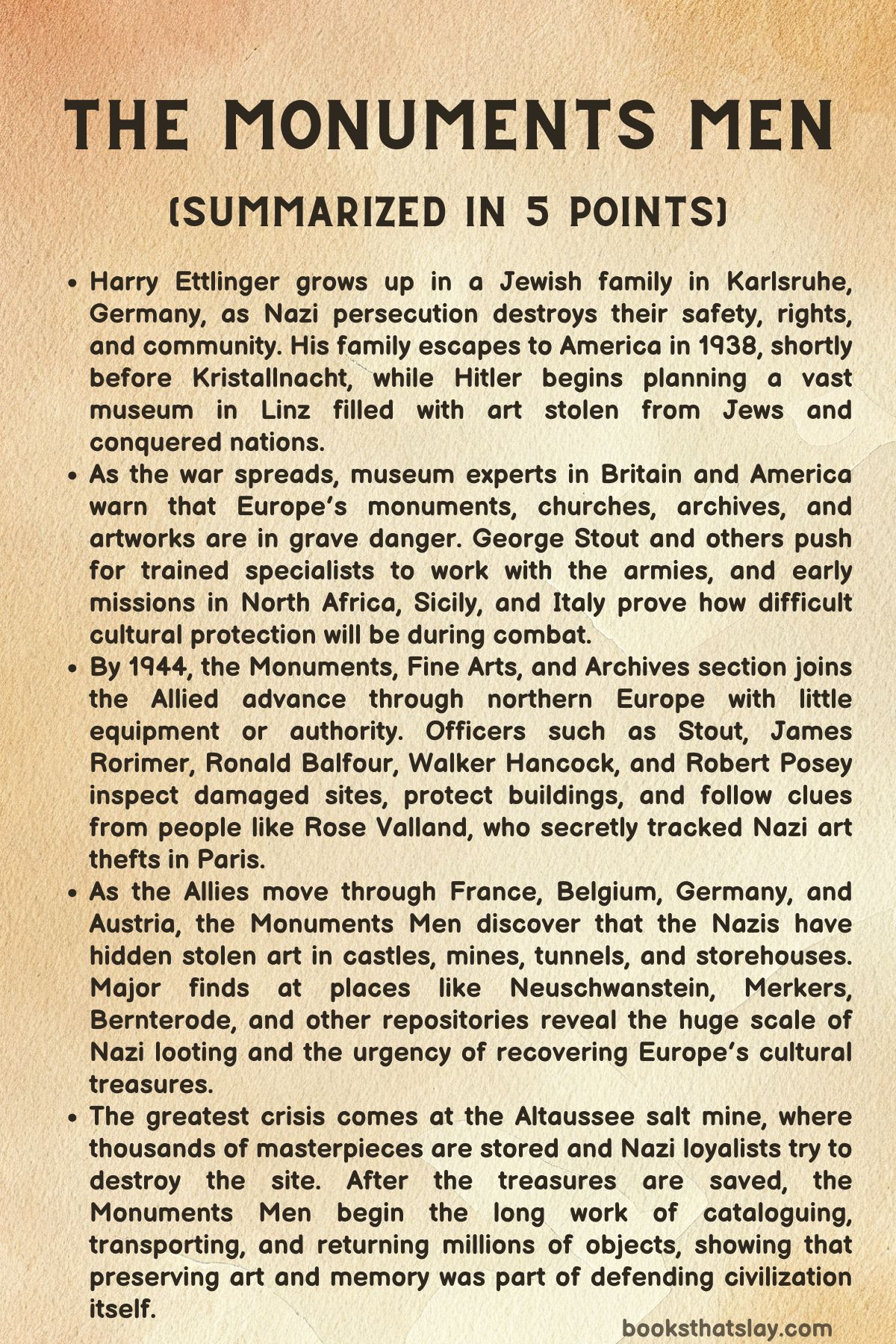
Summary
The Monuments Men begins with the story of Harry Ettlinger, a Jewish boy growing up in Karlsruhe, Germany. His family is respected, educated, and deeply connected to German civic life, but under Nazi rule, their position becomes dangerous.
Anti-Jewish laws and organized hatred gradually strip them of rights, safety, and belonging. Harry is denied access to parts of the culture around him, including works of art in his own city.
His family manages to escape to the United States in 1938, only weeks before Kristallnacht, when Jewish homes, businesses, and synagogues are attacked across Germany. In Karlsruhe, the synagogue Harry knew is burned, and Jewish men are sent to Dachau.
This personal story sets the moral frame for the book: Nazi violence was not only physical and political, but also cultural.
At the same time, Adolf Hitler is building a dream of artistic conquest. He wants to transform Linz, Austria, into the cultural capital of his empire and create a massive museum filled with Europe’s greatest artworks.
The planned Führermuseum becomes a symbol of Nazi ambition. Art is not treated as the property of individuals, museums, religious institutions, or nations, but as something to be seized and used to glorify Hitler’s rule.
Nazi officials steal from Jewish collectors, public museums, churches, private homes, and conquered countries. The looting is organized, bureaucratic, and enormous in scale.
As the war grows, some museum leaders and scholars in Britain and the United States begin to understand that Europe’s cultural heritage is in grave danger. George Stout, an American art conservator from Harvard’s Fogg Museum, becomes one of the strongest voices calling for action.
He argues that armies need trained specialists who can advise commanders, assess damage, and help protect important buildings, monuments, archives, and works of art. His view is practical as well as idealistic: once an army has destroyed or mishandled a historic site, the loss can never truly be repaired.
Early Allied efforts show how hard this mission will be. In North Africa, Sicily, and Italy, officers try to protect ancient ruins, churches, and museum collections while battles are still happening.
At Leptis Magna, British officers improvise ways to guard Roman ruins from military damage. In Sicily, Mason Hammond works with little help, trying to inspect historic sites and advise military authorities.
The destruction of Monte Cassino becomes one of the book’s most painful examples. The Allies bomb the famous abbey because they believe German forces are using it, only to discover that the Germans had not occupied it before the attack.
The episode shows the cost of poor information and the difficulty of balancing military urgency with cultural preservation.
By 1944, the Monuments, Fine Arts, and Archives section is created to support the Allied invasion of northern Europe. Its members come from museums, universities, architectural offices, and art studios.
George Stout, James Rorimer, Ronald Balfour, Walker Hancock, Robert Posey, and others enter the war not as ordinary combat officers, but as specialists assigned to save what they can. They receive lists, maps, and general orders, but they have almost no vehicles, staff, supplies, or formal power.
Often they must borrow transport, persuade commanders, and move through dangerous areas with little protection.
After D-Day, the Monuments officers enter Normandy and begin their work amid damaged towns, churches, archives, and cathedrals. They inspect buildings, post warnings, talk to local officials, and try to prevent further harm from Allied troops, civilians, weather, and neglect.
Their task is made harder by the speed of the advance and the chaos of war. They must decide what is urgent, what can be saved, and how to convince military leaders to care about cultural sites while lives are still being lost.
James Rorimer’s work in France becomes especially important. He travels through liberated areas, marks buildings as protected, and gathers information from local contacts.
In Paris, he meets Rose Valland, a quiet and brave employee at the Jeu de Paume museum. During the occupation, Valland secretly recorded Nazi shipments of stolen art, noting where collections were sent and which officials were involved.
Her records become one of the most important sources in the search for looted works. She had risked her life by listening, observing, and preserving evidence while surrounded by Nazi officials.
As Allied forces move through France, Belgium, and into Germany, the Monuments Men follow behind or near the front. They see ruined cities and damaged landmarks, including Bruges, Aachen, and Cologne.
Their work expands from protecting standing monuments to tracking stolen art. They investigate empty museums, abandoned buildings, castles, mines, tunnels, and hidden storehouses.
They also try to stop looting by soldiers and civilians. The danger is not only that the Nazis have stolen art, but that the confusion of liberation may scatter it again.
The trail leads to major repositories of stolen works. Neuschwanstein Castle becomes one of the great discoveries.
There, Allied officers find a huge collection of looted art and cultural objects taken largely from France. The site contains records, paintings, furniture, and personal possessions seized from Jewish families and collectors.
The Monuments Men begin the careful process of cataloguing and preparing the material for recovery. Their job requires patience and accuracy because returning art to its rightful owners depends on proper documentation.
In the last months of the war, the mission becomes more urgent. Germany is collapsing, and Nazi leaders hide art deeper inside the Reich and Austria.
Hitler and other officials issue destructive orders that threaten mines, bridges, factories, and possibly the treasures stored underground. The Monuments Men search locations connected to Hitler’s museum plans and to the private collections of Nazi leaders.
They depend on captured documents, informants, local witnesses, and their own instincts.
At Merkers, American troops discover a salt mine filled with gold, currency, and works of art. The find reveals the scale of Nazi theft and financial plunder.
At Bernterode, they discover coffins and royal treasures, another sign of how the Nazi regime treated history as something to be possessed and controlled. Harry Ettlinger, now serving as an American soldier, becomes part of this work because of his German language skills.
His journey carries deep personal meaning. The boy forced out of Germany by anti-Semitism returns in U.S. uniform and helps investigate the regime that tried to erase his family’s place in society.
In one powerful moment, he encounters a Rembrandt from Karlsruhe that he had once been forbidden to see because he was Jewish.
The greatest crisis centers on the Altaussee salt mine in Austria. Thousands of masterpieces are hidden there, including Michelangelo’s Bruges Madonna, Van Eyck’s Ghent Altarpiece, and Vermeer’s The Astronomer.
The mine is tied to Hitler’s dream of the Führermuseum and contains some of the most important works in Europe. As the Nazi regime falls apart, loyalists attempt to destroy the mine.
If they succeed, an enormous part of European cultural history will be lost. Local miners and officials play a vital role in preventing disaster by removing explosives and sealing entrances in a way that protects the art.
When Allied forces arrive, the Monuments Men enter the mine and confirm that the treasures have survived.
After Germany surrenders, the work is far from over. The Monuments Men must identify, catalogue, transport, and return millions of stolen objects.
Some pieces are restored to museums, churches, countries, and families. Others remain missing, misidentified, or disputed for decades.
The book makes clear that recovery is not simple. Ownership records have been destroyed, families have been murdered, borders have changed, and many stolen works have passed through multiple hands.
The men eventually return to civilian life. Many resume careers as museum directors, professors, architects, artists, conservators, and scholars.
Their wartime service does not make them famous at first, but their achievements are immense. They helped save paintings, sculptures, manuscripts, archives, churches, and public monuments that might otherwise have been destroyed, stolen permanently, or lost in confusion.
In the end, The Monuments Men presents the rescue of art as part of the larger fight against tyranny. The book argues that civilization is not protected only by winning battles.
It is also protected by saving memory, beauty, evidence, and identity. The Monuments Men understood that armies defend people, but they can also defend what people create, inherit, and pass on.
Their mission shows that culture is not a luxury in wartime; it is one of the things war is fought to preserve.
Key Figures
In The Monuments Men, the people and figures are shaped by war, cultural loss, moral responsibility, and the struggle to protect human memory from destruction.
Each one of them represents a different part of the larger conflict: victims of Nazi persecution, architects of cultural theft, soldiers trying to preserve civilization, and civilians who risk their lives to save art from being erased.
Harry Ettlinger
Harry Ettlinger is one of the most emotionally powerful figures in the book because his life connects personal loss with the larger historical tragedy of Nazi persecution. As a Jewish boy growing up in Karlsruhe, Germany, he experiences the gradual destruction of his family’s dignity, safety, and social position under Nazi rule.
His early life shows how anti-Semitic laws and violence did not destroy people all at once, but slowly stripped them of belonging, freedom, and hope. Harry’s escape to America gives him physical safety, but it does not erase the wound of being driven out of his homeland.
His later role as a U.S. soldier gives his character a strong sense of historical justice, especially when he helps investigate German art repositories. His encounter with the Karlsruhe Rembrandt, a painting he had once been forbidden to see because he was Jewish, becomes deeply symbolic.
It shows how the war’s cultural mission is also personal: the recovery of stolen art is connected to the recovery of dignity, identity, and memory.
Adolf Hitler
Adolf Hitler is presented as the central force behind both human destruction and cultural plunder. His obsession with art is not shown as a noble love of beauty, but as an extension of power, domination, and vanity.
His dream of transforming Linz into the artistic capital of his empire reveals his desire to rewrite European culture around himself and Nazi ideology. The planned Führermuseum represents more than a museum; it represents theft disguised as grandeur.
Hitler’s character shows how culture can be twisted into propaganda when separated from justice and humanity. He does not value art as shared human inheritance, but as a possession to be seized, controlled, and used to glorify tyranny.
His presence in the book gives the Monuments Men’s mission its urgency, because the danger is not only that paintings and monuments may be damaged, but that history itself may be stolen and reshaped by a brutal regime.
George Stout
George Stout is one of the most important and principled figures in the book. As an art conservator from Harvard’s Fogg Museum, he understands earlier than many others that war threatens not only soldiers and cities, but also the fragile cultural treasures that carry civilization’s memory.
His character is practical, disciplined, and deeply committed to preservation. He does not approach art as decoration or luxury; he sees it as something that belongs to humanity and must be protected even during military chaos.
Stout’s strength lies in his ability to combine intellectual expertise with field practicality. He works under difficult conditions, often without proper vehicles, staff, supplies, or authority, yet continues the mission with determination.
His character represents quiet heroism: not the dramatic heroism of battle, but the patient, skilled, exhausting work of saving what war is eager to destroy.
James Rorimer
James Rorimer is a determined and resourceful Monuments officer whose work in France becomes essential to the recovery of stolen art. His character is marked by persistence, intelligence, and an ability to build trust with local officials and witnesses.
As he moves through damaged towns, churches, museums, and archives, he shows how cultural protection requires both expertise and diplomacy. His relationship with Rose Valland is especially important because it demonstrates his willingness to listen, investigate, and rely on civilian courage.
Rorimer’s role in reaching Paris and following clues about Nazi shipments makes him central to the hunt for looted collections. He is not simply a soldier inspecting buildings; he becomes a detective of cultural theft.
His character shows that recovering art requires patience, human connection, and the ability to understand that every object has a history, an owner, and a moral claim attached to it.
Rose Valland
Rose Valland is one of the bravest and most remarkable figures in the story. Working at the Jeu de Paume, she secretly records Nazi art shipments while surrounded by danger.
Her courage is quiet, controlled, and incredibly risky because she must hide her knowledge while watching stolen French and Jewish-owned art pass through Nazi hands. Valland’s character is powerful because she resists not through weapons, but through memory, observation, and documentation.
She understands that information can become a weapon against theft and erasure. Her records later become crucial in tracing stolen works and locating major repositories, including Neuschwanstein.
Valland represents civilian resistance at its finest: disciplined, intelligent, and morally unshakable. Her role reminds readers that preserving culture during war does not depend only on armies; it also depends on individuals who refuse to let truth disappear.
Mason Hammond
Captain Mason Hammond represents the loneliness and difficulty of the early Monuments work before the mission becomes more organized. In Sicily, he struggles almost alone to inspect damaged cultural sites, showing how underprepared the Allied effort initially is.
His character reflects frustration, responsibility, and professional seriousness in the face of impossible conditions. Hammond’s work reveals that protecting monuments during war is not a simple matter of good intentions.
It requires transportation, authority, cooperation, and time, all of which are often missing. Through him, the book shows the gap between recognizing the value of cultural preservation and actually giving people the resources to do it.
Hammond’s importance lies in the fact that he helps expose the scale of the problem, making clear that the protection of art and architecture cannot be improvised forever.
Ronald Balfour
Ronald Balfour is portrayed as a thoughtful and scholarly figure whose commitment to European culture gives emotional depth to the mission. As one of the Monuments officers, he represents the intellectual and moral seriousness behind the effort to save monuments, archives, and works of art.
His character suggests that cultural preservation is not abstract; it is tied to memory, education, and the values that survive beyond war. Balfour’s presence among the officers shows the diversity of skills needed for the mission.
The task requires not only soldiers, but historians, scholars, architects, conservators, and people who understand why damaged churches, archives, and paintings matter. He stands as a reminder that civilization is protected by those who study it, value it, and are willing to risk themselves for it.
Walker Hancock
Walker Hancock is an important figure because he brings the perspective of an artist to the Monuments mission. As a sculptor, he understands the physical and emotional labor behind works of art, which gives his preservation work a personal intensity.
His character reflects patience, sensitivity, and respect for craftsmanship. In the ruined cities of Europe, Hancock’s role is not only to identify damage, but to understand what destruction means to artists, communities, and history.
He represents the creative spirit fighting against the destructive force of war. His work shows that the Monuments Men are not simply rescuing valuable objects; they are protecting the evidence of human imagination.
Hancock’s character adds artistic humanity to the military setting, making the mission feel less like administration and more like a defense of beauty itself.
Robert Posey
Robert Posey is a determined and practical Monuments officer who plays an important role in the search for hidden repositories. His character is shaped by persistence and field courage.
Unlike figures who enter the mission from museum or academic backgrounds, Posey’s strength lies in his ability to operate in dangerous, unstable conditions while following leads and investigating sites connected to Nazi theft. His work demonstrates that the recovery of art often depends on difficult detective work carried out amid military uncertainty.
Posey’s character also reflects the physical hardship of the mission. The search for hidden treasures in mines, tunnels, castles, and remote storehouses is exhausting and risky, but he continues because the stakes are enormous.
Through him, the book shows that cultural rescue is not gentle museum work during wartime; it can be dangerous, urgent, and physically demanding.
Bret Witter and Robert M. Edsel’s Monuments Officers as a Group
The Monuments Men as a group are central to the book’s meaning because they represent a rare wartime mission: saving rather than destroying. They are not given the power, supplies, or recognition that their task deserves, yet they continue across Normandy, France, Belgium, Germany, and Austria to inspect damage, prevent looting, trace stolen art, and protect endangered monuments.
Their character as a collective is defined by persistence under neglect. They must persuade military commanders, work with civilians, follow scattered clues, and improvise solutions in the middle of war.
What makes them compelling is that they understand the moral importance of their work even when others see it as secondary. They prove that civilization is not defended only by winning battles, but by protecting the art, archives, buildings, and sacred places that carry a people’s memory.
British Officers at Leptis Magna
The British officers at Leptis Magna show the improvisational beginnings of the cultural preservation effort. Their role is smaller than that of the later Monuments officers, but their actions are important because they reveal that the problem of protecting ancient sites existed before the mission was fully organized.
By trying to protect Roman ruins during military operations, they demonstrate practical awareness and respect for the past. Their character as a group reflects initiative rather than formal authority.
They do not have a perfect system, but they recognize that even in war, ancient monuments should not be treated as expendable. Their presence helps establish one of the book’s major ideas: cultural preservation often begins with individuals who decide that history matters, even before institutions are ready to support them.
Local Officials and Miners at Altaussee
The local officials and miners at Altaussee are among the most important civilian figures in the final stages of the story. Their actions help prevent one of the greatest cultural disasters of the war: the possible destruction of thousands of masterpieces hidden in the salt mine.
These people are courageous because they act at a moment when Nazi authority still poses real danger. By removing explosives and sealing entrances, they help save works such as Michelangelo’s Bruges Madonna, Van Eyck’s Ghent Altarpiece, and Vermeer’s The Astronomer.
Their character as a group is defined by moral courage and practical action. They show that resistance can come from ordinary workers and local figures who understand the value of what is at stake.
Their role proves that the survival of art sometimes depends not on famous leaders, but on people who make brave choices in dangerous places.
Nazi Officials and Loyalists
The Nazi officials and loyalists in the book represent greed, obedience, and ideological destruction. They hide stolen art in mines, castles, tunnels, and remote storehouses, treating Europe’s cultural inheritance as the property of a collapsing regime.
Their character is shaped by corruption and fear, especially in the final months of the war when destruction orders threaten not only military infrastructure but also stored treasures. These figures are important because they show how theft and destruction work together.
The Nazis do not merely steal art to possess it; they also risk destroying it rather than allowing it to be returned. Their behavior reveals a worldview in which culture has value only when it serves power.
Against them, the Monuments Men’s mission becomes a moral struggle to restore ownership, truth, and continuity.
Jewish Families and Victims of Nazi Theft
The Jewish families and victims of Nazi theft are essential to the moral heart of the book, even when they are not always presented as individual named characters. Their stolen collections, burned synagogues, lost homes, and shattered lives reveal the human meaning behind the art recovery mission.
The looted paintings and objects are not simply museum treasures; many are connected to families who were persecuted, displaced, or murdered. These victims give the mission its deepest ethical significance.
Without them, the recovery of art might seem like the rescue of beautiful objects alone. With them, it becomes an act of justice.
Their presence reminds readers that every stolen work carries a story of violence, loss, ownership, and memory. The book’s cultural mission is therefore also a human mission, because restoring art means acknowledging the people from whom it was taken.
American and British Museum Leaders
The American and British museum leaders are important because they recognize the danger to Europe’s monuments and collections before the military fully understands it. Their concern helps create the foundation for the Monuments, Fine Arts, and Archives section.
These figures represent institutional conscience and professional responsibility. They know that war can erase centuries of artistic and historical achievement if armies do not prepare to protect cultural sites.
Their character as a group is defined by foresight. They may not be on the front lines in the same way as Stout, Rorimer, or Posey, but their advocacy makes the mission possible.
Through them, the book shows that preservation begins with people who are willing to argue that culture matters, even when the world is focused almost entirely on military victory.
Allied Soldiers
The Allied soldiers in the book appear in different ways, sometimes as protectors, sometimes as accidental threats to the cultural objects around them. Many soldiers help discover repositories such as Merkers and Bernterode, and their advances make the recovery mission possible.
At the same time, the book shows that soldiers and civilians can also contribute to looting or damage when discipline fails. As a group, they represent the complicated reality of war.
They are fighting to defeat Nazi Germany, but they are not always trained to understand the cultural importance of the places they enter. Their character highlights why the Monuments officers are needed.
The army can liberate territory, but specialists are necessary to protect what remains inside that territory. The Allied soldiers therefore form the military background against which the preservation mission becomes urgent and distinct.
German Civilians
German civilians in the book occupy a complex position. Some are connected to the society that allowed Nazi power to grow, while others become witnesses, sources of information, or participants in saving cultural treasures.
Their character cannot be reduced to one simple moral category. In ruined German cities and hidden repositories, they are part of a defeated world facing the collapse of the regime that had claimed cultural superiority while stealing from others.
Some civilians help provide clues or protect objects; others are silent beneficiaries or bystanders within a system of plunder. Their presence adds complexity to the story because the recovery of art takes place not only in battlefields and mines, but among communities forced to confront what had been done in their name.
Through them, the book explores responsibility, fear, survival, and the difficult aftermath of war.
The Monuments Men’s Postwar Selves
The postwar lives of the Monuments Men add a reflective ending to their character arcs. After the fighting ends, they do not simply become heroes in a conventional sense; many return to civilian careers in museums, universities, architecture, art, and conservation.
This return shows that their wartime service was an extension of their peacetime values. They were people trained to preserve, study, create, and protect culture, and the war placed those values under extreme pressure.
Their postwar work also reminds readers that the mission did not end with Germany’s surrender. Identifying, cataloguing, transporting, and restituting stolen art remained a long and difficult process.
In The Monuments Men, their legacy lies not only in the masterpieces they recovered, but in the idea that protecting culture is part of protecting civilization itself.
Themes
Cultural Preservation as a Moral Duty
The Monuments Men presents cultural preservation as a duty that belongs not only to museums and scholars but also to soldiers, governments, and ordinary citizens. The protection of paintings, churches, archives, statues, and historic buildings becomes part of the larger fight against Nazi destruction.
The war threatens human life first, but the text shows that memory, identity, and civilization are also under attack. When officers such as George Stout argue for trained specialists, they challenge the idea that art is a luxury during wartime.
Their work proves that cultural objects carry the history of whole communities. A cathedral, a painting, or a local archive is not just valuable because it is old or beautiful; it holds evidence of belief, skill, suffering, pride, and continuity.
The mission is difficult because the officers lack vehicles, supplies, and authority, yet they keep working because saving culture is shown as saving what war tries to erase. The theme becomes especially powerful when hidden repositories are found, revealing how close Europe came to losing irreplaceable parts of its past.
The Destructive Greed of Totalitarian Power
Nazi looting is shown as more than theft; it is an expression of totalitarian control. Hitler’s dream of turning Linz into the artistic center of his empire reveals how power tries to own beauty, history, and achievement.
Art is stolen from Jewish families, museums, churches, and conquered nations because the regime wants to decide who deserves memory and who should be erased from it. The planned Führermuseum is not a celebration of culture but a monument to domination.
This theme is especially clear in the way Jewish owners are stripped of their property after first being stripped of rights, safety, and dignity. The theft of art becomes part of the same system that burns synagogues, drives families into exile, and sends men to concentration camps.
The Nazis treat masterpieces as trophies, proof that conquest can absorb the identity of others. By hiding art in mines and castles, they turn culture into plundered treasure.
The book shows that when political power has no moral limits, even beauty becomes a victim of violence.
Personal Loss, Memory, and Justice
Harry Ettlinger’s story gives the wider historical events a deeply personal meaning. His childhood in Karlsruhe begins in a respected Jewish family, but Nazi persecution gradually takes away his sense of home, belonging, and safety.
His family’s escape to America saves their lives, yet it does not erase the pain of being forced out of the country where they had lived with dignity. His later return to Germany as a U.S. soldier creates a powerful reversal.
He comes back not as a helpless Jewish boy excluded by Nazi hatred, but as someone helping investigate and recover what the regime tried to steal. His encounter with the Karlsruhe Rembrandt is especially meaningful because the painting represents both personal exclusion and historical justice.
As a child, he had been forbidden to see it because he was Jewish; as a soldier, he stands before it after helping defeat the system that rejected him. Through Harry, the recovery of art becomes more than a museum concern.
It becomes a way of restoring dignity, memory, and truth to people who were deliberately humiliated and displaced.
Courage Through Persistence and Small Acts
The courage shown in the narrative is often quiet, practical, and persistent rather than dramatic. The Monuments officers do not usually fight with weapons; they fight with lists, maps, signs, negotiations, inspections, and records.
Their bravery lies in continuing a mission that many military leaders see as secondary or inconvenient. They enter damaged cities, inspect unstable buildings, argue against unnecessary destruction, and try to prevent looting even when they have little authority.
Rose Valland’s courage is different but equally important. By secretly recording Nazi art shipments, she risks her life through patience, silence, and careful observation.
Local miners and officials near Altaussee also show courage by resisting destruction from within a collapsing regime. These acts prove that history is often saved by people who make difficult choices under pressure.
The theme suggests that heroism does not always look grand. It can mean preserving records, warning others, refusing to obey destructive orders, or protecting something fragile when it would be easier to look away.
Through such efforts, millions of cultural objects survive.