Twenties Girl Summary, Characters and Themes
Twenties Girl by Sophie Kinsella is a comic mystery about family, memory, and learning to trust yourself. At its center is Lara Lington, a young headhunter whose life is falling apart: her business is shaky, her partner has vanished, and she is still stuck on an ex who has moved on.
Then the ghost of her great-aunt Sadie appears at a funeral, demanding help finding a lost necklace. What begins as a bizarre interruption becomes a journey through old secrets, buried love, and Lara’s own need to stop chasing the wrong life.
Summary
Lara Lington is twenty-seven, anxious, and trying hard to look as if she has everything under control. She runs a small headhunting firm called L&N Executive Recruitment, but the “N” in the business, her partner Natalie, has disappeared to Goa and left Lara to handle everything alone.
The company is struggling, clients are uncertain, and Lara feels out of her depth. At the same time, she is heartbroken after being dumped by Josh.
She keeps calling him, thinking about him, and hoping the breakup can somehow be undone, even though everyone around her can see that he is not worth the pain.
Her parents are worried about her, but Lara insists she is fine. They take her to the funeral of her great-aunt Sadie Lancaster, who has died at the age of 105.
Sadie was not close to the family, and the funeral reflects that. It is bleak, quiet, and sparsely attended.
Lara’s immediate family is there, along with her famous and wealthy uncle Bill Lington, his wife Trudy, and their daughter Diamanté. Bill is celebrated in the family as a self-made coffee empire founder who supposedly began with only “two little coins.” Sadie, by contrast, is treated as a distant old relative nobody really understood.
During the service, Lara hears a young woman demanding a necklace. At first, she thinks she is imagining things, but then she sees Sadie’s ghost.
Sadie does not appear as the elderly woman who has just died. Instead, she appears as a glamorous, impatient, dramatic young woman of twenty-three, dressed and speaking like someone from the 1920s.
Sadie insists that she cannot rest until she finds her treasured dragonfly necklace. She is loud, demanding, and impossible to ignore.
When Sadie realizes her body is about to be cremated without the necklace, she pressures Lara to stop the funeral. Panicking, Lara blurts out that Sadie may have been murdered.
The accusation shocks everyone and forces the cremation to be delayed. Lara is taken seriously enough that the police become involved, and she has to invent a shaky story about suspicious behavior at Sadie’s nursing home.
She knows it sounds ridiculous, but she is trapped: Sadie will not leave her alone, and Lara has no way to explain the truth.
The delay gives Lara time to investigate. Sadie describes the missing dragonfly necklace, and Lara has a police artist create a sketch of it.
She visits Fairside Nursing Home, where Sadie had lived, and learns that the necklace was real. However, Sadie’s belongings have already been sorted and handled, and the necklace is gone.
The search begins to pull Lara into parts of Sadie’s life that the family never cared to ask about.
Sadie quickly becomes a constant presence in Lara’s world. She follows her, comments on everything, and uses her ghostly ability to shout into people’s minds.
Only Lara can see Sadie, but other people can hear Sadie’s commands in their heads when she chooses to project them. This causes chaos, but it also creates strange opportunities.
At work, Lara is dealing with a difficult situation at Macrosant, where a strong candidate refuses to take a job unless she can bring her dog. Sadie’s interference helps Lara push through the problem in an unusual way.
Sadie also pushes Lara toward Ed Harrison, an American businessman. Their first interactions are awkward and uncomfortable, partly because Lara behaves strangely under Sadie’s influence.
Lara is still fixed on Josh and does not see Ed as a real possibility at first. Sadie, who believes in bold romance and dramatic gestures, decides to help Lara win Josh back.
Using her ability to influence people, she helps manipulate Josh into returning to Lara.
For a while, Lara thinks this is what she wants. Having Josh back seems like proof that she has not failed.
But the renewed relationship feels empty. Josh’s feelings are weak, and Lara begins to see that she has been clinging to an idea rather than a real love.
Sadie’s interference gives Lara what she asked for, but it also helps her recognize that Josh is not the person she should be fighting for.
Meanwhile, Lara’s business problems continue. Natalie eventually returns from Goa and tries to reclaim authority, acting as if she can step back into the company and take control.
Lara has spent so much time feeling second-best to Natalie that she initially struggles to stand up for herself. But through the pressure of handling clients alone, and with Sadie’s disruptive encouragement, she begins to discover her own instincts.
At a business dinner, Sadie helps Lara appear almost psychic by feeding her information and prompting people in unexpected ways. The performance impresses others, and Lara gains confidence.
She also manages to find a strong candidate for an important client, proving that she has real talent. She starts to understand that she does not need Natalie’s approval to succeed.
Her way of working may be unusual, but it can be effective.
As Lara’s confidence grows, so does her connection with Ed. He becomes curious about her, even though her behavior often seems strange from the outside.
Their relationship develops gradually from confusion into trust and attraction. Ed sees more in Lara than she sees in herself, and Lara begins to value his steadiness and honesty.
Unlike Josh, Ed does not represent an old fantasy. He represents a possible future.
The search for the necklace leads Lara toward Uncle Bill. She discovers that Bill had visited Sadie before her death using the false name Charles Reece.
This raises questions about why he would hide his identity and why he was interested in Sadie. Lara starts digging into the family’s version of Bill’s success story and finds that it is not true.
The famous tale says Bill built his coffee empire from “two little coins,” making him a symbol of hard work and humble beginnings. In reality, Bill’s start came from Sadie.
Years earlier, he found a valuable portrait of young Sadie painted by the artist Cecil Malory. He sold it anonymously to the London Portrait Gallery for £500,000 and used the money to launch his business.
Rather than acknowledge Sadie’s role, he erased her from the story and allowed the family to think of her as an unimportant old woman.
Lara also uncovers the truth about Sadie’s lost love. Sadie had loved Stephen Nettleton, who later became known as Cecil Malory.
He painted her wearing the dragonfly necklace. Their families separated them after discovering the relationship, and Sadie believed Stephen had abandoned her.
The portrait proves otherwise. It shows that he loved her deeply and remembered her with care.
This knowledge changes Sadie’s understanding of her own past. A wound she carried for decades begins to heal.
The necklace itself eventually resurfaces in the world of Diamanté’s fashion show. It is briefly taken away to Paris by a model, which creates another frantic stage in the search.
Lara eventually recovers it and returns it to Sadie’s body. Once the necklace is back where Sadie wanted it, Sadie disappears.
Her business with the living world is finished, and she can finally rest.
But Lara does not let the truth about Sadie vanish. She exposes Uncle Bill’s lie and forces him to publicly recognize Sadie’s importance.
Bill has to admit that his success was built on money gained from her portrait. Sadie, who was ignored in death and dismissed in life, becomes known through the painting and the story behind it.
Lara then organizes the kind of memorial Sadie deserved from the beginning. Instead of a cold, empty funeral, she creates a grand 1920s-style celebration filled with flowers, music, cocktails, and admirers.
It honors Sadie not as a forgotten elderly relative, but as a vivid young woman who had loved, danced, hoped, and mattered. Bill is also made to donate ten million pounds to a foundation in Sadie’s name, giving her legacy public meaning.
By the end, Lara has changed. She leaves behind her dependence on Natalie and starts her own recruitment company, Magic Search.
She lets go of Josh and builds a real relationship with Ed. Most importantly, she learns to trust her own judgment.
Sadie’s arrival may have been chaotic, but it pushes Lara toward courage, honesty, and self-respect. The story closes with Lara moving forward, hoping that Sadie somehow saw the tribute and recognition she had always deserved.
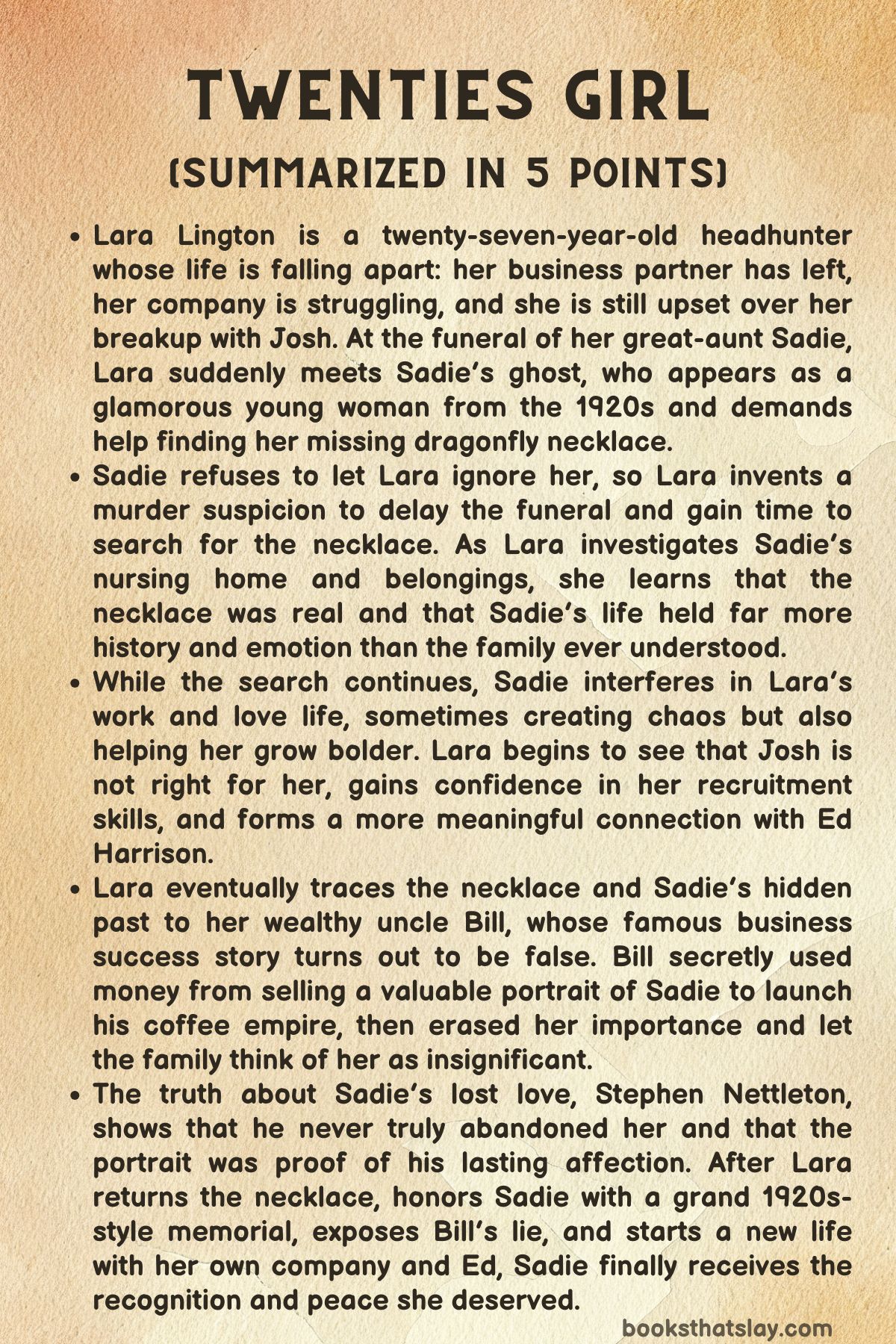
Characters
In Twenties Girl, the characters are shaped by memory, regret, ambition, love, and the need to be properly seen. The story uses Lara’s present-day struggles and Sadie’s unfinished past to show how easily people can be misunderstood, forgotten, or reduced to convenient family stories.
Lara Lington
Lara Lington is the emotional center of the book, and her journey is one of growth from insecurity to self-trust. At the beginning, she is twenty-seven, professionally anxious, romantically desperate, and still measuring herself against other people’s expectations.
Her recruitment business is failing, her partner Natalie has left, and her breakup with Josh has made her cling to an idea of love rather than the reality of the relationship. Lara often appears chaotic because she reacts quickly and emotionally, but beneath that chaos is a generous, loyal, and deeply feeling person.
Her connection with Sadie forces her into uncomfortable situations, yet it also gives her the courage to act when everyone else would rather ignore the past. As the story develops, Lara becomes more independent in both work and love.
She learns that she does not need Natalie to define her professional worth, Josh to validate her desirability, or her family’s approval to know what is right. Her final confidence comes from understanding Sadie’s value and, through that, understanding her own.
Sadie Lancaster
Sadie Lancaster is one of the most vivid and emotionally important figures in the book. Though she has died at the age of 105, she appears to Lara as a glamorous, demanding, lively young woman from the 1920s, which immediately shows the gap between how the family sees her and who she truly was.
To most of the family, Sadie is almost an inconvenience: an old relative whose life has become distant and irrelevant. But as her story unfolds, she becomes a symbol of hidden richness, lost love, and the tragedy of being forgotten while still having mattered deeply.
Sadie can be selfish, dramatic, bossy, and intrusive, especially when she interferes with Lara’s life, but these flaws make her feel alive rather than merely ghostly. Her obsession with the dragonfly necklace is not just about jewelry; it represents youth, love, identity, and the part of her life that was taken from her.
By the end, Sadie’s peace comes not only from recovering the necklace, but from finally being recognized as someone whose life had beauty, romance, and importance.
Ed Harrison
Ed Harrison serves as a contrast to Lara’s unhealthy attachment to Josh. At first, his connection with Lara begins awkwardly and under strange circumstances, largely because Sadie pushes Lara toward him.
However, Ed gradually becomes important because he sees Lara more clearly than Josh ever does. He is practical, intelligent, and somewhat reserved, but he is also open enough to become interested in Lara’s unusual energy and sincerity.
His role in the story is not simply that of a romantic replacement; he helps reveal Lara’s changing standards for love. With Josh, Lara is trying to revive something that no longer respects her.
With Ed, she begins to experience a relationship based on curiosity, honesty, and genuine attention. Ed’s presence shows Lara that love should not require humiliation or self-deception.
He becomes part of her future because he fits the stronger version of herself that she grows into.
Josh
Josh is important because he represents Lara’s emotional immaturity at the beginning of the story. Lara believes she still wants him, but her longing is less about Josh himself and more about rejection, habit, and fear of being alone.
Josh does not appear as deeply evil, but he is shallow in the way he treats Lara’s feelings. When Sadie helps manipulate him into coming back, the renewed relationship exposes what Lara could not see before: getting someone back does not mean getting love back.
Josh’s role is therefore necessary because he helps Lara recognize the difference between fantasy and reality. He is the person Lara thinks she needs, but his return becomes proof that she has outgrown him.
Through Josh, the book shows how romantic obsession can disguise itself as devotion when it is really wounded pride and insecurity.
Bill Lington
Uncle Bill Lington is one of the most morally revealing characters in the story. Publicly, he is rich, successful, charismatic, and admired for the family legend that he built his coffee empire from “two little coins.” Privately, he is exposed as someone whose success rests on concealment and exploitation.
His betrayal of Sadie is especially cruel because he does not merely benefit from her portrait; he erases her importance from the story of his own rise. Bill’s wrongdoing is not only financial but emotional and historical.
He allows Sadie to be remembered as insignificant while using the value connected to her image to build his fortune and reputation. His character shows how powerful people can shape public memory to protect themselves.
By forcing him to acknowledge Sadie and donate money in her name, Lara challenges not only his lie but the larger injustice of letting a woman’s life be used and then forgotten.
Natalie
Natalie is Lara’s absent business partner, and even when she is not physically present, her influence weighs heavily on Lara. Her decision to abandon L&N Executive Recruitment for Goa leaves Lara overwhelmed and exposed, but it also forces Lara to discover her own ability.
Natalie’s return and attempt to take charge again reveal the imbalance in their partnership. Lara has depended on Natalie’s confidence and authority for too long, which has made her underestimate herself.
Natalie is not simply a villain; rather, she represents the kind of dominant personality that can make another person feel smaller without necessarily intending to. Her role in the book is to push Lara toward professional independence.
By the time Lara begins trusting her own judgment and eventually creates Magic Search, Natalie no longer has the same power over her.
Stephen Nettleton / Cecil Malory
Stephen Nettleton, later known as Cecil Malory, is central to Sadie’s emotional past even though he belongs mostly to memory and art. He represents the love Sadie believed she had lost through abandonment, but the truth reveals something more painful and more tender: he loved her deeply, and circumstances separated them.
His portrait of Sadie becomes proof that she was seen with extraordinary care. As Cecil Malory, he gains artistic significance, but as Stephen, he is the young man who loved Sadie before family interference and misunderstanding changed the course of their lives.
His character adds tragedy to the story because he shows how easily love can be distorted by silence and separation. Through him, Sadie’s past is transformed from a forgotten old woman’s vague history into a deeply romantic and heartbreaking life.
Diamanté
Diamanté is a minor but memorable character because she reflects the shallow glamour of the modern family world around Bill. Her involvement in fashion and the necklace’s appearance in her show connect Sadie’s lost treasure to a world of display, image, and surface beauty.
Diamanté does not carry the moral weight that Bill does, but her presence helps show how Sadie’s personal and emotional object can be treated as an accessory by people who do not understand its meaning. She also represents a younger generation that has inherited wealth and status without understanding the hidden story behind it.
In this way, Diamanté’s role supports the book’s contrast between appearance and true value.
Trudy Lington
Trudy, Bill’s wife, belongs to the polished and privileged side of the family. Her role is smaller, but she helps complete the picture of Bill’s world: wealthy, socially confident, and detached from the emotional truth of Sadie’s life.
Trudy’s presence at the bleak funeral emphasizes how little genuine affection surrounds Sadie at the beginning. She is part of a family structure that attends out of obligation rather than love.
While she is not the central source of wrongdoing, her character contributes to the atmosphere of indifference that Lara eventually challenges. Through Trudy, the story shows how social respectability can exist alongside emotional emptiness.
Lara’s Parents
Lara’s parents are important because they show the ordinary family pressure surrounding Lara’s life. They worry about her, especially after her breakup with Josh, but their concern often makes Lara feel judged rather than comforted.
Lara pretends to be fine because she does not want to appear like a failure in front of them. Their presence highlights her insecurity and her need to perform stability even when she is struggling.
They also reflect the family’s broader ignorance about Sadie; like many others, they know little about the old woman whose funeral they attend. As Lara changes, her relationship with her parents becomes part of her larger movement away from pretending and toward acting with conviction.
Themes
Self-Discovery and Personal Confidence
Lara begins as someone who measures her worth through other people’s approval. Her failed relationship with Josh makes her feel rejected, and Natalie’s absence leaves her unsure whether she can manage the recruitment business alone.
She often hides her anxiety behind forced cheerfulness, especially around her parents, because she does not want to admit how lost she feels. Sadie’s arrival forces Lara into situations where she must act boldly, even when she feels ridiculous or frightened.
At first, Lara’s confidence depends on Sadie’s help, but gradually she starts trusting her own judgement. Her success with clients, her ability to handle Natalie’s return, and her decision to start Magic Search show that she has stopped seeing herself as the weaker partner in her own life.
By the end, Lara’s growth is not only professional but emotional. She no longer clings to Josh or waits for someone else to define her future.
Her confidence comes from choosing herself.
The Need to Remember and Value the Forgotten
In Twenties Girl, Sadie is first treated as an inconvenient old relative whose life no one has bothered to understand. Her funeral is empty, cold, and almost careless, which reflects how easily families and society can reduce elderly people to their final years while ignoring the richness of their past.
Sadie’s ghost appears young, lively, stylish, and demanding, immediately challenging the family’s narrow image of her. Through Lara’s search, Sadie becomes more than a forgotten great-aunt; she becomes a woman who loved deeply, suffered loss, inspired art, and unknowingly helped create Bill’s fortune.
The discovery of the portrait restores her identity and proves that her life had beauty and importance. The later memorial service corrects the emotional failure of the first funeral.
It gives Sadie the celebration she deserved and reminds the family that memory is a form of justice. Being remembered properly becomes Sadie’s true peace.
Truth, Greed, and Moral Responsibility
Bill’s public image depends on a charming story about success built from almost nothing, but that story hides selfishness and theft. His wealth is not founded on humble effort alone; it comes from selling Sadie’s portrait and erasing her connection to it.
His lie is especially cruel because it allows him to enjoy admiration while Sadie is dismissed as unimportant within her own family. The theme of truth becomes central as Lara moves from confusion to investigation.
She begins by telling a lie to stop the cremation, but that desperate act eventually leads to a much larger truth being uncovered. The contrast between Lara and Bill is important: Lara’s dishonesty is chaotic and temporary, while Bill’s dishonesty is deliberate and profitable.
When Lara exposes him, the issue is not simply money but accountability. Bill is forced to acknowledge Sadie publicly and contribute to a foundation in her name.
The story suggests that success without honesty leaves a moral debt behind.
Love, Illusion, and Emotional Maturity
Lara’s attachment to Josh is based less on real love than on fear of rejection and loneliness. She wants him back because his leaving has damaged her pride and made her doubt her own value.
When Sadie helps manipulate Josh into returning, Lara gets what she thought she wanted, but the relationship feels empty. This experience teaches her that being chosen by the wrong person cannot heal insecurity.
In contrast, her connection with Ed develops through awkwardness, honesty, and gradual trust. He sees Lara beyond her panic and strange behaviour, and she becomes more open with him as she becomes more honest with herself.
Sadie’s lost love for Stephen adds another layer to the theme. Her pain comes from believing she was abandoned, but the portrait reveals that love had existed even though circumstances separated them.
The story presents love as something that requires truth, respect, and courage. Lara’s maturity comes when she stops chasing an old fantasy and accepts a healthier future.