Turn Coat Summary, Characters and Themes | Jim Butcher
Turn Coat by Jim Butcher is an urban fantasy novel and the 11th book in the Dresden Files series, centered on Harry Dresden, Chicago’s professional wizard and reluctant trouble magnet. In this story, Harry is forced to protect one of his harshest enemies, Donald Morgan, after Morgan is accused of murdering a powerful White Council member.
What begins as a desperate attempt to hide a wounded fugitive becomes a dangerous investigation into betrayal, political fear, and hidden control inside the wizarding world. The book mixes mystery, supernatural action, dark humor, and moral tension as Harry tries to prove the truth before the Council executes the wrong man.
Summary
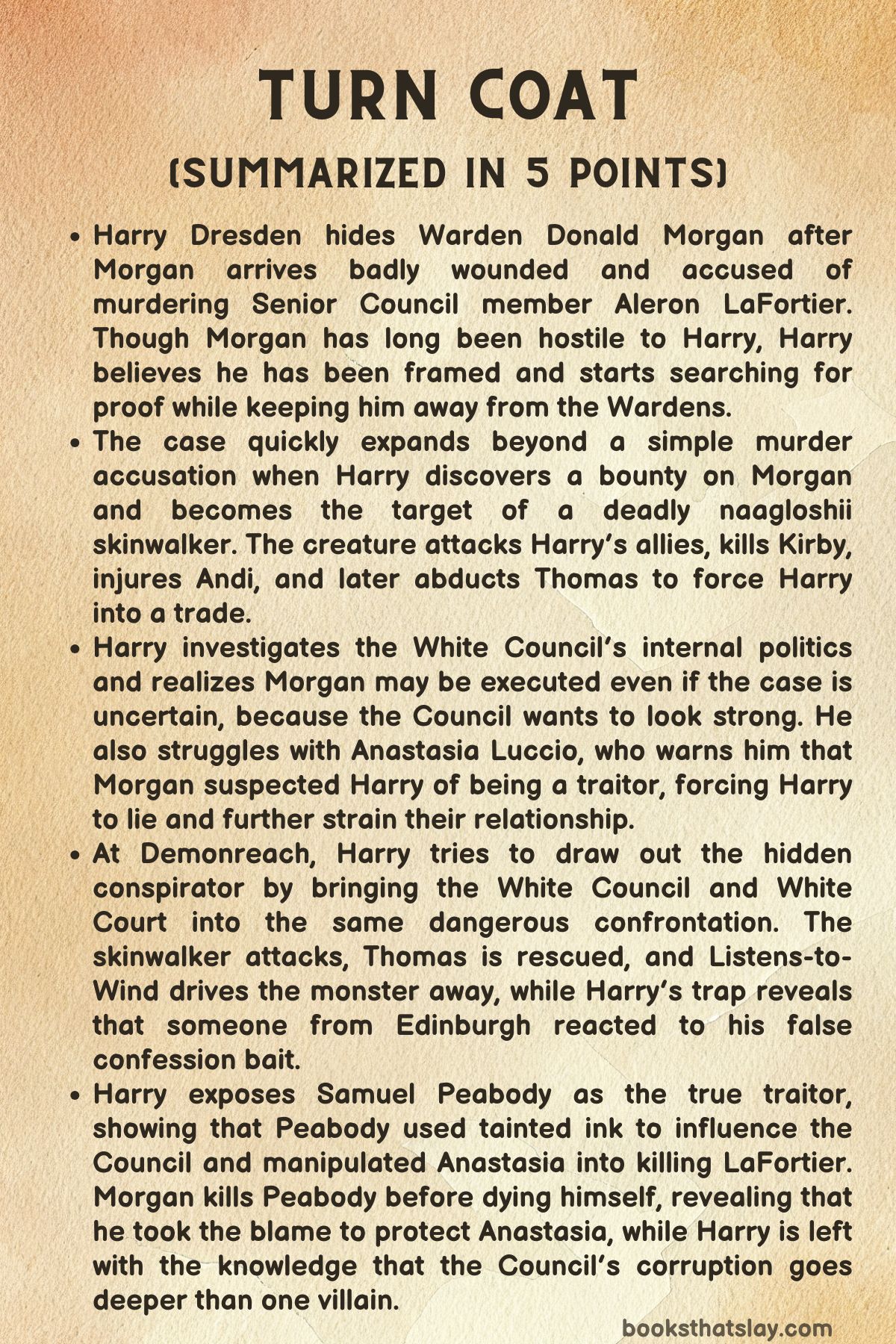
Harry Dresden’s ordinary day turns into chaos when Warden Donald Morgan appears at his apartment door, badly wounded, exhausted, and asking for help. Morgan is one of Harry’s oldest enemies within the White Council, a stern enforcer who has spent years watching Harry with suspicion and waiting for him to break the Laws of Magic.
Harry has every reason to turn him away, yet he cannot ignore a bleeding man begging for shelter. He takes Morgan inside and calls Waldo Butters, the medical examiner and Harry’s friend, to treat him in secret.
Morgan explains that he has been accused of murdering Aleron LaFortier, a member of the Senior Council. The evidence against him looks overwhelming.
He woke beside LaFortier’s body with the murder weapon in his hand, and further evidence links him to bribes and communication with the Red Court vampires. Morgan insists he has been framed, and Harry believes him, not because Morgan is kind or trustworthy, but because the setup feels too neat.
Morgan may be many things, but he is not a traitor.
Harry decides to hide Morgan while searching for the real killer. This decision puts him at odds with the Wardens, the White Council, and nearly everyone who expects him to obey authority.
He turns to his brother Thomas for information from the White Court vampire world. Through Thomas and Justine, Harry learns that an online bounty has been posted for Morgan.
The reward is enormous: five million dollars and other powerful favors. The bounty confirms that more than Council justice is at work.
Someone wants Morgan found quickly, and probably dead.
As Harry investigates, he notices that he is being followed by a monstrous shapeshifter. It is a naagloshii, also known as a skinwalker, an ancient and terrifying being with immense power.
When Harry accidentally looks upon its true nature with his wizard’s Sight, the experience nearly breaks him. The vision leaves him shaken, sickened, and afraid in a way few enemies have managed before.
He takes shelter with Billy and Georgia’s werewolf pack, hoping numbers and loyalty can buy him time.
The skinwalker attacks the werewolves, proving how dangerous it is. Kirby is killed, and Andi is badly injured.
The attack makes the conflict personal. Harry understands that this creature is not merely hunting Morgan; it is part of a larger pressure campaign meant to break him, isolate him, and force him into mistakes.
He moves Morgan to a prepared storage-unit safehouse with help from Molly Carpenter, his apprentice. Molly is young and powerful but still learning control, and her involvement raises the stakes even more.
Harry travels to the White Council’s headquarters in Edinburgh to examine the murder case from the inside. There he sees how political fear is shaping the situation.
Some Council members understand that the evidence against Morgan may be suspicious, but the Council is under pressure from war, internal distrust, and outside enemies. Executing Morgan would show strength and order.
Admitting uncertainty would make the Council look weak. Harry realizes that Morgan’s guilt may matter less to the Council than the appearance of control.
The case also threatens Harry’s relationship with Anastasia Luccio, captain of the Wardens and someone Harry cares about deeply. Luccio warns Harry that Morgan may be dangerous to him because Morgan had believed Harry might be the hidden traitor within the Council.
Harry lies to her to protect Morgan. The lie hurts the trust between them, but Harry sees no safe alternative.
Later, Luccio discovers Morgan hidden at Harry’s apartment. Molly attacks her to stop her from reporting him, but Mouse intervenes and prevents the confrontation from becoming deadly.
Harry is forced to move everyone again.
Harry’s search leads him toward Lara Raith, the powerful leader of the White Court vampires. He confronts her, believing that White Court money may have been used to frame Morgan.
Lara denies arranging the frame-up, and the situation soon turns violent when the skinwalker attacks her stronghold. Justine is injured, and Thomas is abducted.
The skinwalker later offers a trade: Thomas for Morgan. Harry refuses to let the enemy dictate the terms, but he also cannot abandon his brother.
To force the hidden players into the open, Harry arranges a dangerous meeting on Demonreach, the mysterious island with which he has a growing connection. He brings together members of the White Council and the White Court, hoping that pressure will expose the true manipulator.
The meeting almost collapses into accusations and arrests. The Wardens want Morgan.
The White Court has its own interests. Harry is walking a narrow line between factions that could easily decide he is the problem.
Then the skinwalker arrives. The battle is brutal.
Harry, Listens-to-Wind, and others fight to survive against a creature that outmatches nearly everyone present. Harry manages to rescue Thomas, though Thomas has been deeply damaged by captivity and torture.
Listens-to-Wind, one of the Senior Council’s most powerful wizards, faces the naagloshii directly and forces it to retreat. The victory is not clean, but it gives Harry a chance to continue the investigation.
Harry’s plan also produces a crucial result. He had falsely claimed that someone was ready to confess, and someone in Edinburgh reacted.
During Morgan’s trial, Harry presents his findings. He argues that the real traitor used the Ways to travel from Edinburgh and set events in motion.
The hidden enemy is Samuel Peabody, the quiet and efficient Council clerk who has long handled records, documents, and official proceedings.
Peabody’s position made him almost invisible, which allowed him to become extremely dangerous. He has been using magically tainted ink to subtly influence members of the Council for years.
His control was not obvious mind domination, but a steady pressure that shaped thoughts, emotions, and decisions. Through this method, he manipulated important wizards without their knowledge.
Most horribly, he used Anastasia Luccio to kill LaFortier while she was unaware of what she was doing. Morgan was then framed to take the blame.
When Peabody is exposed, he unleashes a deadly mistfiend infused with mordite inside the Council chamber. The attack causes panic and kills many wizards.
Peabody flees through the Ways, and Harry pursues him despite the danger and his own injuries. Peabody wounds Harry and comes close to escaping, but Morgan follows them.
Though badly injured and near death, Morgan shoots Peabody with Anastasia’s gun and kills him.
As Morgan dies, he reveals the truth behind his choices. He knew Anastasia had been used as the killer, and he accepted blame to protect her.
He came to Harry because Harry knew what it meant to be innocent, hunted, and condemned by the Wardens. This confession changes Harry’s understanding of Morgan.
The man who had judged him so harshly was also capable of sacrifice, loyalty, and painful honor.
After Morgan’s death, the White Council chooses a public version of events that protects its image. Morgan and Peabody are both allowed to carry blame, and the full truth is buried.
Harry is left with grief, anger, and the knowledge that the conspiracy did not end with Peabody. The traitor was only one part of a deeper corruption inside the Council.
Turn Coat ends with Harry more aware than ever that the institutions meant to protect the world can be manipulated from within, and that justice often depends on those willing to risk everything for the truth.
Characters
Harry Dresden
Harry Dresden is the central figure of Turn Coat, and his role in the book is built around loyalty, suspicion, justice, and emotional endurance. He begins in a difficult moral position when Donald Morgan, one of his harshest enemies in the White Council, arrives wounded and desperate.
Harry’s decision to protect Morgan shows that his sense of justice is stronger than his personal resentment. He does not forgive Morgan easily, but he refuses to let an innocent person be destroyed by political convenience.
Throughout the story, Harry acts as investigator, protector, and reluctant political player. He lies, hides evidence, risks his relationships, and challenges powerful institutions because he believes the truth matters more than appearances.
His fear after Seeing the skinwalker’s true form also reveals his vulnerability; he is not simply brave because he feels no terror, but because he keeps acting despite being deeply shaken. By the end of the book, Harry understands Morgan more fully, and Morgan’s death leaves him with grief, guilt, and a clearer awareness that the corruption inside the Council is far larger than one murder case.
Donald Morgan
Donald Morgan is one of the most tragic and morally complex figures in the book. For much of Harry’s life, Morgan has been an enemy, a relentless Warden who suspects Harry of being dangerous and corrupt.
Yet when Morgan is framed for LaFortier’s murder, the story reveals a more honorable and wounded side of him. Morgan is proud, rigid, and often cruel in his judgment, but he is not cowardly or selfish.
His decision to come to Harry is meaningful because Harry is one of the few people who truly understands what it means to be hunted by the Wardens while innocent. Morgan’s final revelation transforms the reader’s understanding of him.
He knew Anastasia had been manipulated and allowed himself to bear the blame in order to protect her. His death is not only the loss of a warrior, but also the collapse of the old image Harry had of him.
Morgan dies as a man of duty, loyalty, sacrifice, and hidden compassion.
Anastasia Luccio
Anastasia Luccio is a deeply important character because her tragedy is tied to both trust and violation. As Captain of the Wardens, she represents authority, discipline, and responsibility, but Peabody’s manipulation turns her into an unwilling weapon.
Her relationship with Harry is strained because Harry hides Morgan from her, and the emotional damage between them reflects how secrecy can poison even sincere bonds. Anastasia’s role in LaFortier’s murder is especially tragic because she is guilty in action but innocent in intention.
She is not portrayed as weak; rather, the book shows how even strong and disciplined people can be exploited when the enemy works slowly and subtly. Her manipulated involvement also explains Morgan’s sacrifice, making her one of the emotional centers of the story’s moral conflict.
Samuel Peabody
Samuel Peabody is the hidden traitor and one of the most dangerous villains in the story because his power comes from patience, invisibility, and trust. He is not frightening in the same obvious way as the skinwalker.
Instead, he is terrifying because he has spent years quietly influencing the White Council through tainted ink, shaping decisions and weakening minds without attracting attention. As a clerk, he occupies a position that seems ordinary and harmless, which makes his betrayal more effective.
Peabody’s meticulous nature allows him to manipulate events from behind the scenes, frame Morgan, control Anastasia, and destabilize the Council. His exposure shows that the greatest threat to the Council is not always an enemy outside its walls, but someone trusted inside its own system.
The Skinwalker
The skinwalker, or naagloshii, is one of the most frightening supernatural forces in the book. It represents ancient, predatory power, and its presence brings a level of terror that affects even Harry deeply.
Unlike Peabody, who works through secrecy and manipulation, the skinwalker uses violence, fear, and psychological domination. It attacks Harry’s allies, kills Kirby, wounds Andi, injures Justine, and abducts Thomas, making the threat painfully personal.
The creature’s ability to shake Harry after he Sees its true form makes it more than a physical enemy; it becomes a symbol of overwhelming evil that can scar the mind. Its bargain involving Thomas also shows its intelligence and cruelty.
It understands how to use emotional attachments as weapons.
Thomas Raith
Thomas Raith plays an important emotional and practical role in the story. As Harry’s brother and a member of the White Court, he stands between Harry’s personal world and the dangerous politics of the vampires.
Harry turns to Thomas for information, showing the trust between them, but Thomas’s abduction by the skinwalker turns him from helper into hostage. His suffering raises the stakes because Harry’s investigation is no longer only about Morgan’s innocence or Council politics; it becomes about saving family.
Thomas also reflects the cost of being connected to Harry. Those close to Harry are often pulled into danger, and Thomas’s ordeal shows how enemies can exploit Harry’s love and loyalty.
Lara Raith
Lara Raith is a powerful, intelligent, and politically dangerous character. She is never simply an ally, even when her interests temporarily overlap with Harry’s.
When Harry accuses the White Court of being connected to Morgan’s frame-up, Lara’s denial does not make her harmless; it only shows that the situation is more complicated than Harry first suspects. Lara represents controlled ambition and calculated authority.
The attack on her headquarters shows that even someone as prepared and ruthless as Lara can be struck by forces beyond ordinary political games. Her role also helps widen the scope of the plot, connecting Morgan’s case to tensions between the White Council and the White Court.
Justine
Justine is important because she provides a crucial clue while also becoming one of the skinwalker’s victims. Her discovery of the online bounty on Morgan helps Harry understand that the frame-up is part of a wider scheme designed to draw hunters, enemies, and political pressure toward Morgan.
Justine’s role shows that intelligence and observation can matter as much as magical power. Her injury during the attack on Lara’s headquarters also reinforces the story’s emotional cost.
She is not just a source of information; she is someone caught in the violence caused by hidden manipulation and supernatural brutality.
Molly Carpenter
Molly Carpenter’s role in the book reflects loyalty, inexperience, and the danger of acting from fear. She helps Harry move Morgan and participates in hiding him, showing her devotion to Harry and her willingness to take risks.
However, her attack on Anastasia reveals the immaturity and impulsiveness that still shape her choices. Molly wants to protect Harry and Morgan, but her judgment is not always controlled, and that makes her dangerous in tense situations.
Her presence also shows Harry’s responsibility as a mentor. He is not only solving a case; he is guiding someone whose power and emotions can have serious consequences.
Waldo Butters
Waldo Butters provides practical help at the beginning of the crisis by treating Morgan’s wounds. His role may be smaller than Harry’s or Morgan’s, but it is still meaningful because he represents ordinary courage in an extraordinary world.
Butters is not a wizard, a vampire, or a supernatural warrior, yet he steps into dangerous situations because people need him. His medical skill allows Morgan to survive long enough for the truth to be pursued.
In a story filled with political betrayal and monstrous violence, Butters brings human decency, intelligence, and practical compassion.
Mouse
Mouse acts as more than Harry’s loyal dog; he is a stabilizing and protective presence. His most important moment comes when he prevents Molly’s confrontation with Anastasia from turning deadly.
This shows that Mouse has both strength and judgment. He is not merely an animal companion but a guardian whose instincts often preserve lives and prevent emotional chaos from becoming irreversible tragedy.
In a book full of mistrust, Mouse represents loyalty that is steady, direct, and uncorrupted.
Listens-to-Wind
Listens-to-Wind is one of the strongest and wisest figures in the book. His battle with the naagloshii demonstrates his immense power, but his importance is not limited to combat.
He represents experience, discipline, and a deeper understanding of supernatural threats. When he confronts the skinwalker, the reader sees a kind of strength different from Harry’s: older, calmer, and more refined.
His presence also reminds us that the White Council, despite its corruption and political weakness, still contains people of courage and integrity. He becomes a powerful counterbalance to the fear and chaos caused by the skinwalker.
Aleron LaFortier
Aleron LaFortier is central to the plot because his murder sets the entire conflict in motion. Although he is dead when the major events unfold, his position as a Senior Council member makes his death politically explosive.
His murder is not only a crime but a weapon used to destabilize the White Council. LaFortier’s importance lies in what his death reveals: the Council is vulnerable, its politics are fragile, and its enemies understand how to turn internal fear into institutional panic.
He functions as the victim whose death exposes a much deeper conspiracy.
The Merlin
The Merlin represents the political authority of the White Council and the cold logic of institutional survival. He is not shown as simply foolish; rather, he understands that the situation may be more complicated than it appears, but he is still willing to let Morgan be sacrificed because the Council needs to appear strong.
This makes him morally troubling. He values order and public strength, but that priority risks destroying justice.
His role shows one of the book’s major tensions: institutions often protect themselves before they protect the truth.
Billy
Billy represents Harry’s connection to the werewolf pack and to a more personal community outside the White Council. When Harry takes shelter with Billy and Georgia’s group, Billy becomes part of the protective circle around Harry.
The skinwalker’s attack on the pack shows the danger Harry’s allies face simply by standing near him. Billy’s role is important because he reflects loyalty on a smaller, more intimate scale than the political loyalties of the Council.
He is part of the human and supernatural family Harry has built through trust rather than authority.
Georgia
Georgia, like Billy, represents friendship, loyalty, and the cost of sheltering Harry. Her presence with the werewolf pack helps create a sense of refuge before the skinwalker tears that safety apart.
Georgia’s role emphasizes that Harry’s world is not made only of formal alliances and magical institutions. It is also made of friends who take risks for him.
Through Georgia and the pack, the story shows how violence spreads outward from Harry’s conflicts and harms people who choose to stand with him.
Kirby
Kirby is one of the clearest examples of the personal cost of the skinwalker’s violence. His death during the attack on the werewolf pack gives the creature’s threat emotional weight.
Kirby is not just a casualty; he represents the loss suffered by Harry’s wider circle of allies. His death also deepens Harry’s guilt because Harry’s presence and the danger surrounding him help bring disaster to the people protecting him.
Through Kirby, the story shows that supernatural conflict leaves real grief behind.
Andi
Andi’s grave injury during the skinwalker’s attack reinforces the brutality of the creature and the vulnerability of Harry’s allies. Her suffering raises the emotional stakes of the story because it shows that survival does not mean escaping unharmed.
Andi’s role also strengthens the sense that Harry’s battle is not abstract. The people around him bleed, suffer, and lose friends because of the forces pursuing him.
Her injury becomes part of the emotional damage that pushes Harry forward.
Themes
Justice Versus Political Convenience
In Turn Coat, justice is shown as something fragile when institutions care more about survival than truth. Morgan’s accusation exposes how quickly the White Council is willing to accept a clean, public solution instead of facing a messy reality.
Harry’s investigation matters because it challenges the idea that authority automatically equals fairness. Morgan has spent years enforcing Council law harshly, yet when he becomes the accused, the same system gives him little mercy.
This reversal shows how dangerous a justice system becomes when reputation, fear, and politics guide its decisions. The Council’s leaders are not all fools; some understand that the evidence may be too convenient, but they still lean toward execution because they believe the organization must look strong.
Harry’s resistance becomes a defense of real justice: slow, difficult, unpopular, and based on evidence. The theme gains force because Morgan is not an easy victim to pity.
Harry helps someone who has hunted him, proving that justice cannot depend on personal liking.
Trust Built Under Pressure
Trust in the story is not presented as simple friendship or easy loyalty. It forms in dangerous circumstances, often between people who have strong reasons to doubt one another.
Harry’s decision to hide Morgan is risky because Morgan has never treated him kindly, yet Harry recognizes fear, innocence, and desperation in him. That choice creates a tense kind of trust based less on affection and more on shared experience.
Morgan trusts Harry because Harry knows what it means to be wrongly hunted, while Harry trusts Morgan because the accusation feels too perfect. Other relationships are also tested.
Harry lies to Anastasia to protect Morgan, and that lie harms their bond even though his motive is not selfish. Molly’s loyalty pushes her into dangerous action, showing how devotion can become reckless when guided by panic.
Thomas’s suffering also places emotional pressure on Harry, forcing him to balance loyalty to family against the larger investigation. Trust here is costly, uncertain, and often painful, but it is still necessary for truth to survive.
Corruption Hidden Inside Order
The White Council presents itself as a structure of law, discipline, and magical authority, yet the real danger comes from someone deeply embedded within that structure. Peabody’s role as a quiet clerk makes him especially threatening because he does not need open power to cause harm.
His use of tainted ink suggests that corruption can spread through ordinary routines, paperwork, habits, and unnoticed dependence. The Council fears enemies outside its walls, including vampires, warlocks, and monsters, but the greater weakness is internal complacency.
Peabody succeeds because people trust systems that appear stable. His influence over respected wizards reveals that intelligence and power do not make people immune to manipulation.
This theme also shows why Harry’s outsider status matters. Because he is often treated with suspicion, he is less willing to accept official conclusions without question.
The exposure of Peabody does not fully cleanse the Council either. The cover-up after Morgan’s death suggests that institutions often protect their image even after corruption is revealed.
Sacrifice, Guilt, and Moral Burden
Morgan’s death gives the story its strongest emotional weight because his sacrifice changes how both Harry and the reader understand him. For much of the narrative, Morgan seems stern, hostile, and almost impossible to forgive.
Yet his final confession reveals a man carrying guilt, loyalty, and love beneath his rigid sense of duty. He accepts blame not because he is weak, but because he wants to protect Anastasia from being destroyed by something done through her against her will.
This sacrifice complicates the idea of heroism. Morgan does not become noble by becoming gentle; he remains hard, wounded, and difficult, but his final actions show deep moral courage.
Harry is left with the burden of knowing the truth while watching the Council shape a cleaner public story. That burden reflects a recurring moral problem: doing the right thing does not guarantee recognition, healing, or fairness.
Sacrifice here is not romantic or triumphant. It is painful, private, and incomplete, leaving survivors to carry both grief and responsibility.