Heir of Twisted Lies Summary, Characters and Themes
Heir of Twisted Lies by LJ Andrews is a fantasy romance about power, identity, loyalty, and the cost of hidden truth. The story follows Lyra Bien, an orphaned melder whose rare abilities place her at the center of old prophecies and new wars.
After escaping Stonegate, Lyra must face betrayal, grief, and the discovery of her own bloodline while navigating her bond with Roark Ashwood, a prince with a divided soul and a dangerous past. Set across rival kingdoms shaped by craft, bloodlines, and ancient bones, Heir of Twisted Lies builds a world where love becomes protection, family is both wound and weapon, and survival demands sacrifice. It’s the 2nd book of the Stonegate series and the sequel to Broken Souls and Bones.
Summary
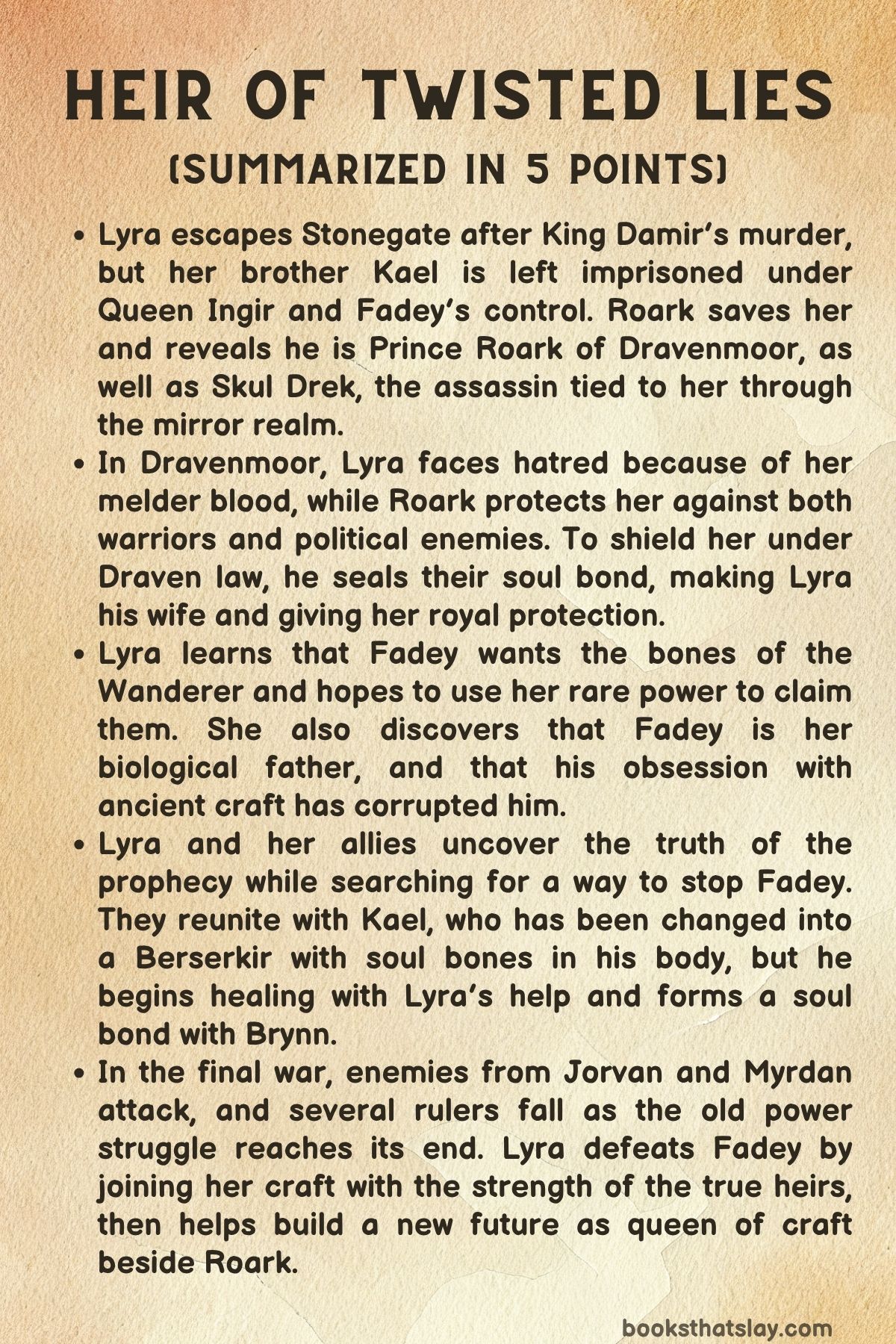
Heir of Twisted Lies begins after Lyra Bien has escaped Stonegate, but her freedom comes with a painful cost. King Damir has been murdered, Stonegate has fallen under the control of Queen Ingir and Fadey, and Lyra’s brother Kael remains imprisoned.
Lyra is not only grieving the chaos around her, she is furious at Roark Ashwood, the man who saved her. Roark was once known to her as the quiet Sentry of Stonegate, but he has revealed that he is Prince Roark of Dravenmoor.
Even more shocking, his divided soul is Skul Drek, the assassin who once haunted her through the mirror realm. Lyra feels betrayed by the truths Roark kept from her, and the fact that Kael was left behind makes that betrayal harder to forgive.
Roark, Lyra, and Emi are taken by Queen Elisabet of Dravenmoor. The journey to Dravenmoor shows Lyra how hated melders are among the Dravens.
Many of them blame melders for old wars, deaths, and suffering, and Lyra is treated as a threat before anyone truly knows her. Roark makes it clear that she is under his protection.
When Fillip attacks Lyra, Roark kills him, and he warns the Dark Watch that anyone who harms her will die. His actions do not erase Lyra’s anger, but they prove that his loyalty to her is not a performance.
Once they reach Dravenmoor, Lyra is separated from Roark and guarded by Gunter, Brynn, and Auki. At first, she expects hatred from them too, but they turn out to be loyal to Roark and willing to see Lyra as more than the fear surrounding her kind.
Meanwhile, Roark must answer to the úlfur council. Many on the council want Lyra killed because of what she is, but Queen Elisabet keeps her alive for questioning.
In Dravenmoor, Lyra and Roark begin to understand the larger danger facing every kingdom. Fadey wants the bones of the Wanderer, the first king of craft, and he believes Lyra’s rare power can help him claim them.
Roark decides that the only way to protect Lyra under Draven law is to complete their soul bond. Lyra agrees, though their relationship is still strained by secrets and pain.
By sealing the bond, Lyra becomes Roark’s wife and gains legal protection as Draven royalty. The bond changes her position, but it does not make her safe.
Enemies inside Dravenmoor still try to kill her, and Fadey begins reaching into her mind through a blood tether. The connection is disturbing and difficult to resist, and Lyra eventually learns why it exists.
Fadey is her biological father, though he does not know the truth.
This discovery forces Lyra to confront another part of her identity. She has always carried the loneliness of being orphaned, but now her bloodline connects her to the very man trying to use her.
Gammal later confirms more of Fadey’s past. He came from the Unfettered clans and was once sent to Jorvandal to uncover the truth about soul bones.
Instead of using that knowledge wisely, he was corrupted by greed and by the promise of the Wanderer’s power. Fadey’s hunger for power turned him into someone willing to destroy kingdoms, families, and his own blood.
Lyra, Roark, Emi, Gunter, Brynn, Auki, Thane, Yrsa, and the others begin to piece together the true meaning of the prophecy. Fadey believes the power of the Wanderer can be gathered by killing and using the firstborn heirs of the three kingdoms.
The truth is more complicated. The ancient veins of craft live within those heirs, but the power is not meant to be stolen through slaughter.
This changes the way Lyra understands both the threat and her own role in stopping it.
The group travels toward Unfettered territory, where Lyra is reunited with Kael. The reunion is painful because Kael has been changed.
He has been turned into a Berserkir, with soul bones melded into his body. He is dangerous, damaged, and difficult to reach, but he is still Kael.
Lyra refuses to give up on him. Brynn also discovers that she shares a soul bond with Kael, giving him another reason to hold on to himself.
Lyra begins removing the soul bones from Kael where she can, but some are too deeply embedded to take out safely. Kael’s recovery will not be simple, but he is no longer alone.
War soon reaches them. Forces from Jorvan and Myrdan arrive, led by Queen Ingir, King Hundur, and those allied with Fadey.
The conflict exposes further betrayal. Virki is revealed as a traitor who helped cause Nivek’s death and now serves Fadey.
The battle becomes a clash of kingdoms, crafts, old loyalties, and personal revenge. Kael uses bone craft against their enemies, showing both the horror of what was done to him and the strength he still commands.
Yrsa uses blood craft. Emi kills Hundur, ending one of the threats against them.
Jordis kills Ingir, bringing justice for the queen’s cruelty and the damage she caused. Amid the violence, Queen Elisabet dies and enters the mirror realm among the dead.
The final confrontation with Fadey takes place in the realm of souls. He attacks Lyra there, trying to use her and the craft carried by the heirs.
He believes power must be taken, controlled, and consumed, just as the Wanderer once did. Lyra realizes that she does not have to follow that path.
Her strength does not come from theft or domination. Instead, she joins her craft with the strengths of Thane, Yrsa, and Sindri.
Through that united power, she destroys Fadey and ends his attempt to claim the Wanderer’s legacy.
After the war, the kingdoms begin to rebuild. Power must be reorganized, and new roles are created to protect balance.
Sindri is named heir of Dravenmoor, while Roark rules as regent until Sindri is old enough to take his place. Lyra and Roark are named king and queen of craft, a higher authority meant to guard the balance between kingdoms and prevent one ruler from abusing ancient power again.
Kael joins the Dark Watch and continues healing, with Brynn beside him. His future is not free from pain, but he has a place, a purpose, and people who will fight for him.
Emi and Yrsa marry, giving their relationship a future after the losses and battles they survived. Lyra remains in Dravenmoor with Roark, no longer only an orphaned melder running from people who fear her.
She begins to reconcile the broken pieces of her past and claim a future shaped by choice rather than fear.
Lyra also forces Jarl Jakobson to apologize to Kael, giving her brother a measure of public justice. Near the end, she finds her blood uncle Brolin, gaining another link to the family history that had been hidden from her for so long.
The story closes with Lyra beside Roark, not untouched by grief, betrayal, or war, but stronger because she has faced them. Heir of Twisted Lies ends with a new order rising from the wreckage, and with Lyra stepping into a life built not from the lies that shaped her past, but from the truth she has finally claimed.
Characters
Lyra Bien
Lyra Bien is the emotional and moral center of Heir of Twisted Lies, and her journey is shaped by loss, fear, anger, love, and the burden of rare power. As an orphaned melder, she begins the story as someone hunted and hated for what she is, especially by people who blame melders for old wars and deaths.
Her escape from Stonegate does not feel like freedom because Kael remains imprisoned, and this leaves her torn between survival and guilt. Lyra’s anger toward Roark is deeply understandable because he saves her but leaves her brother behind, and his hidden identity makes her question whether she can trust the bond between them.
What makes Lyra compelling is that she does not simply accept protection from others; she grows into someone who understands her own power, her own bloodline, and her own right to decide how that power should be used. Her discovery that Fadey is her biological father adds a painful layer to her identity, but she refuses to let blood define her morality.
By the end of the book, Lyra becomes powerful not because she steals or dominates, but because she unites strengths, chooses balance, and rejects the corrupt path that destroyed Fadey.
Roark Ashwood / Prince Roark of Dravenmoor / Skul Drek
Roark is one of the most layered figures in the book because he exists under several identities, each revealing a different part of him. As Roark Ashwood, the silent Sentry of Stonegate, he appears guarded, controlled, and mysterious, but his true identity as Prince Roark of Dravenmoor reveals the political weight he has been carrying.
His split soul, Skul Drek, adds even more complexity because it connects him to fear, violence, and the assassin figure who once haunted Lyra in the mirror realm. Roark’s secrecy wounds Lyra, especially because she feels betrayed by the truths he kept from her, yet his actions repeatedly show his loyalty and devotion.
He protects her fiercely, even killing Fillip when Lyra is attacked and warning the Dark Watch that touching her means death. His proposal to seal their soul bond is both romantic and strategic, because it protects Lyra under Draven law while also confirming the depth of their connection.
Roark’s growth comes from moving beyond secrecy and survival into leadership, love, and responsibility.
Kael Bien
Kael is one of the most tragic and resilient characters in the story. As Lyra’s brother, he represents her deepest loyalty and one of the main reasons she cannot fully accept safety while he remains trapped.
His imprisonment under Queen Ingir and Fadey makes him a victim of political cruelty and magical corruption, and his transformation into a Berserkir with soul bones melded into his body shows the brutality of those who treat people as tools. Yet Kael is never reduced to only his suffering.
Even when he becomes dangerous and damaged, the story makes it clear that he is still himself beneath the violence forced into him. Lyra’s attempts to remove the soul bones from his body symbolize her refusal to abandon him, even when healing him is incomplete and difficult.
Kael’s bond with Brynn also gives him a path forward, suggesting that love, loyalty, and patience can exist even after terrible damage. His decision to join the Dark Watch after the war shows that he is still searching for purpose and control over the life that was stolen from him.
Fadey
Fadey is the central example of corrupted ambition in the book. As a supposedly dead melder who secretly manipulates events, he is dangerous not only because of his power but because of his obsession with the Wanderer’s bones and the authority he believes they can give him.
His past makes him more than a simple villain: he came from the Unfettered clans and was once sent to Jorvandal to learn the truth about soul bones, but greed changed the direction of his life. His connection to Lyra as her biological father makes his villainy more personal, especially because he uses a blood tether to invade her mind without even understanding the full truth of their relationship.
Fadey’s tragedy lies in the fact that he seeks power through taking, killing, and controlling, while Lyra ultimately defeats him by doing the opposite. He misunderstands the prophecy because he sees heirs as objects to be used rather than people who carry living veins of craft.
His destruction comes when Lyra rejects his method of stealing power and instead joins different strengths together.
Queen Ingir
Queen Ingir is a cruel and calculating ruler whose power depends on imprisonment, manipulation, and fear. Her role in keeping Kael captive immediately places her in opposition to Lyra’s deepest loyalty, and her alliance with Fadey shows that she is willing to work with dangerous forces to preserve or expand her control.
Ingir represents the kind of political authority that treats individuals as disposable pieces in a larger struggle for dominance. Her presence in the war confirms that she is not merely a distant threat but an active enemy whose choices have caused direct suffering.
Her death at Jordis’s hands feels like a moment of justice within the violent collapse of the old power structure. Ingir’s character helps show how kingdoms become corrupted when rulers value control more than truth, mercy, or balance.
Queen Elisabet
Queen Elisabet is a stern and politically complex figure. At first, she appears threatening because she captures Roark, Lyra, and Emi and brings them to Dravenmoor, placing Lyra in a kingdom where many people want her dead.
However, Elisabet is not driven by simple cruelty. She is a ruler shaped by law, duty, suspicion, and the need to protect her people from threats she does not fully understand.
Her decision to keep Lyra alive long enough to question her shows that she is cautious rather than blindly murderous. Elisabet’s relationship with Roark is also important because it places him between personal loyalty and royal responsibility.
Her death and movement into the mirror realm give her character a solemn ending, suggesting that even powerful rulers eventually become part of the larger spiritual and historical consequences of the world they helped shape.
Emi
Emi is a loyal, brave, and emotionally important character whose strength becomes increasingly visible as the story unfolds. She begins as someone close to Lyra and Roark during their capture and journey to Dravenmoor, but she becomes much more than a companion.
Emi’s loyalty gives Lyra emotional support in a hostile world, and her presence helps soften the harshness of Dravenmoor’s politics and prejudice. Her relationship with Yrsa adds tenderness and hope to a story filled with war, betrayal, and bloodline conflict.
Emi also proves herself in battle when she kills King Hundur, showing that she is capable of decisive violence when the people she loves and the future of the kingdoms are at stake. Her marriage to Yrsa after the war gives her arc a sense of healing and continuation, proving that love can survive even in the aftermath of destruction.
Gunter
Gunter first appears as one of Lyra’s guards in Dravenmoor, but he quickly becomes important because he challenges Lyra’s expectation that everyone around her will hate or harm her. His loyalty belongs to Roark, and because of that loyalty, he becomes a protector rather than an enemy.
Gunter represents the side of Dravenmoor that is disciplined, loyal, and honorable instead of blindly prejudiced. His presence helps Lyra understand that the kingdom is not made only of hostile warriors and suspicious rulers.
He also strengthens the group dynamic as the characters begin working together against Fadey. Gunter’s value lies in his steadiness, because in a story filled with betrayals and shifting identities, he becomes someone whose reliability matters.
Brynn
Brynn is one of the most emotionally significant supporting characters because her loyalty, courage, and compassion become especially important through her connection with Kael. Like Gunter and Auki, she begins as one of Lyra’s guards, but she proves that her duty is not rooted in hatred.
Brynn’s discovery of a soul bond with Kael adds a powerful emotional turn to the story because Kael is damaged, dangerous, and still healing from what was done to him. Rather than seeing him only as a threat, Brynn recognizes the person beneath the violence and corruption.
Her bond with Kael gives him hope and gives the story a gentler counterpoint to the darker uses of soul bones and blood ties. Brynn’s character shows that loyalty is not only about guarding someone physically; it is also about seeing who they truly are when others might only see what has been done to them.
Auki
Auki is another important figure among those assigned to guard Lyra, and her role helps reshape Lyra’s understanding of Dravenmoor. In a place where Lyra expects hatred because she is a melder, Auki becomes part of the small circle that proves loyalty to Roark can also mean fairness toward Lyra.
Auki’s presence contributes to the gradual formation of trust around Lyra, which is essential because Lyra arrives in Dravenmoor isolated and surrounded by enemies. Though Auki is not as central as Lyra, Roark, or Kael, she matters because she helps build the protective network that allows Lyra to survive long enough to understand the larger prophecy.
Her character reflects the importance of dependable allies in a world where public opinion and political fear can easily become deadly.
Thane
Thane is significant because he becomes part of the true understanding of the prophecy and the ancient veins of craft. His importance is not only political but magical, because Lyra eventually joins his strength with Yrsa’s, Sindri’s, and her own to defeat Fadey.
Thane represents one of the living sources of power that Fadey misunderstands. To Fadey, heirs and bloodlines are tools to be harvested, but through Thane and the others, the story shows that power is strongest when it is shared willingly and united with purpose.
Thane’s role helps shift the prophecy away from sacrifice and domination toward balance and cooperation. His character is therefore essential to the book’s larger message about inheritance, power, and responsibility.
Yrsa
Yrsa is a powerful and memorable character because she combines emotional depth with fierce magical strength. Her blood craft makes her a vital figure in battle, and her role in the final struggle proves that she is one of the people whose strength helps Lyra overcome Fadey.
Yrsa’s relationship with Emi also gives her character warmth and vulnerability, showing that she is not defined only by power or war. Her love for Emi becomes part of the healing that follows the violence of the story, and their marriage offers a hopeful future after so much loss.
Yrsa’s use of blood craft also contrasts with Fadey’s use of blood and soul power. Where Fadey uses blood ties to invade, control, and exploit, Yrsa’s strength becomes part of a united effort to protect and restore balance.
Sindri
Sindri becomes increasingly important because of his connection to Dravenmoor’s future and the true meaning of inherited craft. As one of the heirs whose power matters to the real prophecy, he is part of the living balance that Fadey tries to twist for his own purposes.
Sindri’s naming as heir of Dravenmoor after the war marks a major political transition, especially because Roark rules as regent until Sindri comes of age. This makes Sindri a symbol of renewal after the collapse of older conflicts and corrupt rulers.
His character carries the promise of a different kind of leadership, one shaped by the lessons of war and the protection of balance between kingdoms. Though young or still coming into his authority, Sindri’s future matters because the stability of Dravenmoor becomes tied to him.
Jordis
Jordis is a decisive figure in the battle because she kills Queen Ingir, bringing an end to one of the story’s cruelest political threats. Her action carries symbolic weight because Ingir represents imprisonment, manipulation, and the abuse of royal power.
Jordis’s role may not be as expansive as Lyra’s or Roark’s, but her courage at a critical moment changes the outcome of the conflict. She stands as one of the characters who acts when action is necessary, proving that the defeat of tyranny does not rest on one person alone.
Through Jordis, the story shows that justice often requires many hands, not only the central heroes.
Virki
Virki is a traitor whose exposure reveals the depth of Fadey’s influence and the danger of hidden enemies within trusted spaces. His involvement in Nivek’s death makes his betrayal personal and painful, because it shows that the damage caused by Fadey’s ambitions began before the open battle.
Virki represents the kind of person who enables evil from within, making him especially dangerous because he hides behind proximity and trust. His service to Fadey shows that corruption spreads through followers as much as through leaders.
As a character, Virki adds tension to the story by proving that the heroes are not only fighting armies and rulers but also betrayal among people who once seemed connected to their own side.
King Hundur
King Hundur is one of the hostile rulers whose presence in the war shows how widespread the conflict has become. As a leader of Myrdan forces and an ally within the larger attack against Lyra and her companions, he represents the political forces willing to support Fadey’s destructive vision.
His death at Emi’s hands is important because it gives Emi a major moment of agency and removes one of the powerful enemies from the battlefield. Hundur’s role is less emotionally intimate than Fadey’s or Ingir’s, but he matters because he shows that the war is not only personal; it is also a clash between kingdoms, rulers, and competing visions of power.
Gammal
Gammal functions as a keeper of truth and history. His confirmation of Fadey’s past helps Lyra and the others understand how Fadey became corrupted and why his obsession with the Wanderer’s power is so dangerous.
Gammal’s knowledge connects the present conflict to older histories involving the Unfettered clans, Jorvandal, soul bones, and the origins of craft. In a story where many characters are misled by false versions of prophecy, Gammal’s role is essential because he helps separate truth from manipulation.
He is not simply an information-giver; he represents the importance of memory, tradition, and honest understanding in resisting those who twist history for power.
Brolin
Brolin is important because he gives Lyra a living connection to her blood family that is not defined by Fadey’s corruption. After learning that Fadey is her biological father, Lyra could easily be left with a painful and poisoned understanding of her origins.
Finding her blood uncle Brolin helps repair that wound by showing that her family history contains more than betrayal, greed, and violence. Brolin’s appearance near the end gives Lyra a sense of belonging beyond survival and beyond the identities others have forced onto her.
His role is quiet but emotionally meaningful because he helps Lyra close one part of her past while beginning a new life with Roark.
Jarl Jakobson
Jarl Jakobson represents the prejudice and cruelty that Kael suffers even after the war’s larger battles have ended. Lyra forcing him to apologize to Kael is significant because it shows her growth into authority and her refusal to let old abuses go unchallenged.
Jakobson’s role may be smaller than the central villains’, but he reflects the everyday harm caused by arrogance and mistreatment. His apology matters because the story does not treat healing as something that happens only through defeating Fadey.
It also requires confronting smaller injustices, demanding accountability, and giving wounded characters like Kael the dignity they were denied.
Fillip
Fillip is a hostile figure whose attack on Lyra becomes an important turning point in how Roark publicly defends her. When Roark kills him, the act sends a clear message to the Draven warriors and the Dark Watch that Lyra is not to be touched.
Fillip’s character is not deeply developed, but his function in the story is important because he embodies the hatred directed at Lyra simply because she is a melder. Through him, the book shows how prejudice can become immediate physical danger.
His death also reveals the intensity of Roark’s protectiveness and the seriousness of his warning to those who might harm Lyra.
The Wanderer
The Wanderer is a historical and almost mythic presence whose legacy shapes the entire conflict. As the first king of craft, he represents the origin of a power that later characters either misunderstand, seek, fear, or try to control.
Fadey’s obsession with the Wanderer’s bones shows how legends can become dangerous when ambitious people treat ancient power as something to possess. The Wanderer’s method of gathering power through theft and domination becomes the path Lyra ultimately rejects.
Even though the Wanderer is not present like the living characters, his influence drives the prophecy, Fadey’s plans, and Lyra’s final realization. He functions as a warning about what happens when power is separated from balance and responsibility.
King Damir
King Damir’s murder is one of the key events in Heir of Twisted Lies that sets the story’s conflict in motion. Though he is not an active presence in the main events, his death creates the conditions for Lyra’s escape, Kael’s imprisonment, and the political instability surrounding Stonegate.
Damir’s importance lies in the consequences of his murder rather than in direct character development. His death leaves behind suspicion, danger, and a power struggle that other characters must survive.
In this way, he becomes part of the story’s foundation, reminding readers that the present conflict is built on earlier violence.
Nivek
Nivek matters because his death reveals the cost of betrayal and the damage caused by characters like Virki who secretly serve Fadey. Even if Nivek is not central in the same way as Lyra, Roark, or Kael, his death carries emotional and moral weight.
It shows that Fadey’s influence has already destroyed lives before the final battle begins. Nivek’s role strengthens the sense that the war is not abstract; it has personal victims, broken loyalties, and grief that remain with the survivors.
His death also helps expose Virki’s treachery, making him an important part of the truth that comes to light.
Themes
Trust After Betrayal
Trust becomes difficult because love, loyalty, and secrecy repeatedly collide. Lyra’s anger toward Roark is not only about Kael being left behind, but also about discovering that the person who protected her had hidden his royal identity, his divided soul, and his connection to the assassin who frightened her.
In Heir of Twisted Lies, trust is shown as something that cannot be repaired by affection alone; it must be rebuilt through action, honesty, and sacrifice. Roark protects Lyra in public and private, even when doing so turns his own people against him, but his protection does not erase the hurt caused by his silence.
Lyra’s journey shows that forgiveness is not instant. She must decide whether Roark’s choices came from manipulation or fear, and whether his present loyalty is strong enough to overcome past deception.
Their sealed bond becomes more than a romantic act because it forces both of them to accept vulnerability, consequence, and shared responsibility.
Power and Its Moral Limits
Power is constantly tested against the question of what a person is willing to destroy in order to gain control. Fadey represents the corrupt hunger for power because he treats bloodlines, bones, heirs, and even his own daughter as tools.
His desire for the Wanderer’s strength is built on theft, domination, and the belief that ancient force can be claimed through violence. Lyra’s final victory matters because she rejects that same logic.
She does not defeat him by becoming another version of him; instead, she uses unity, consent, and shared strength. This contrast makes power a moral choice rather than simply a magical ability.
The story suggests that true authority comes from protecting balance, not from owning every source of strength. Lyra and Roark’s later roles as rulers of craft reflect this idea, since their authority is meant to guard the kingdoms rather than exploit them.
Power becomes worthy only when it is guided by restraint, trust, and responsibility.
Identity Beyond Blood and Fear
Lyra’s identity is shaped by painful discoveries, but the story refuses to let blood define her completely. Learning that Fadey is her biological father could have trapped her in shame, fear, or the belief that corruption lives inside her by inheritance.
Instead, her choices prove that identity is built through action. She is a melder, an orphan, a sister, a wife, and eventually a ruler, but none of these roles alone explains who she is.
Kael’s transformation into a Berserkir also strengthens this theme. His body has been changed and weaponized, yet he remains himself beneath the damage.
Roark’s split soul creates a similar question, since he must accept both the prince and the feared assassin as parts of his existence. Through these characters, the story argues that identity is not erased by trauma, bloodline, magic, or reputation.
People can be harmed, altered, and misunderstood, but they still have the right to choose who they become.
Healing After War and Loss
The ending does not pretend that survival removes pain. Lyra, Kael, Roark, Emi, Yrsa, and the others must live with the consequences of imprisonment, betrayal, battle, death, and political collapse.
Healing appears as a slow process rather than a sudden reward. Kael joining the Dark Watch shows that he is not simply restored to who he was before; he must build a new life with the scars and powers forced into him.
Lyra’s reconciliation with her past also happens in stages, through protecting Kael, confronting old cruelty, accepting love, and finding blood family without losing the family she has chosen. Even after victory, the kingdoms need new leadership, new laws, and new trust.
This makes the aftermath as important as the battle itself. The story presents healing as rebuilding: relationships must be repaired, justice must be demanded, and survivors must decide what kind of future can grow from what was broken.