Heart of Mischief Summary, Characters and Themes
Heart of Mischief by Emma Noyes is a fantasy novel rooted in Norse mythology, danger, betrayal, and uneasy alliances. The story follows Charlie after her world has been shaken by Elias’s betrayal and the revelation that divine blood may run through her family.
As strange murders terrorize Silver Shores and Asgardian threats move closer, Charlie must train, investigate, and decide whom she can trust. The book blends teen drama with mythic stakes, building a story about power, loyalty, anger, and the cost of becoming something more than human. It’s the 2nd book of the Soul of Shadow series.
Summary
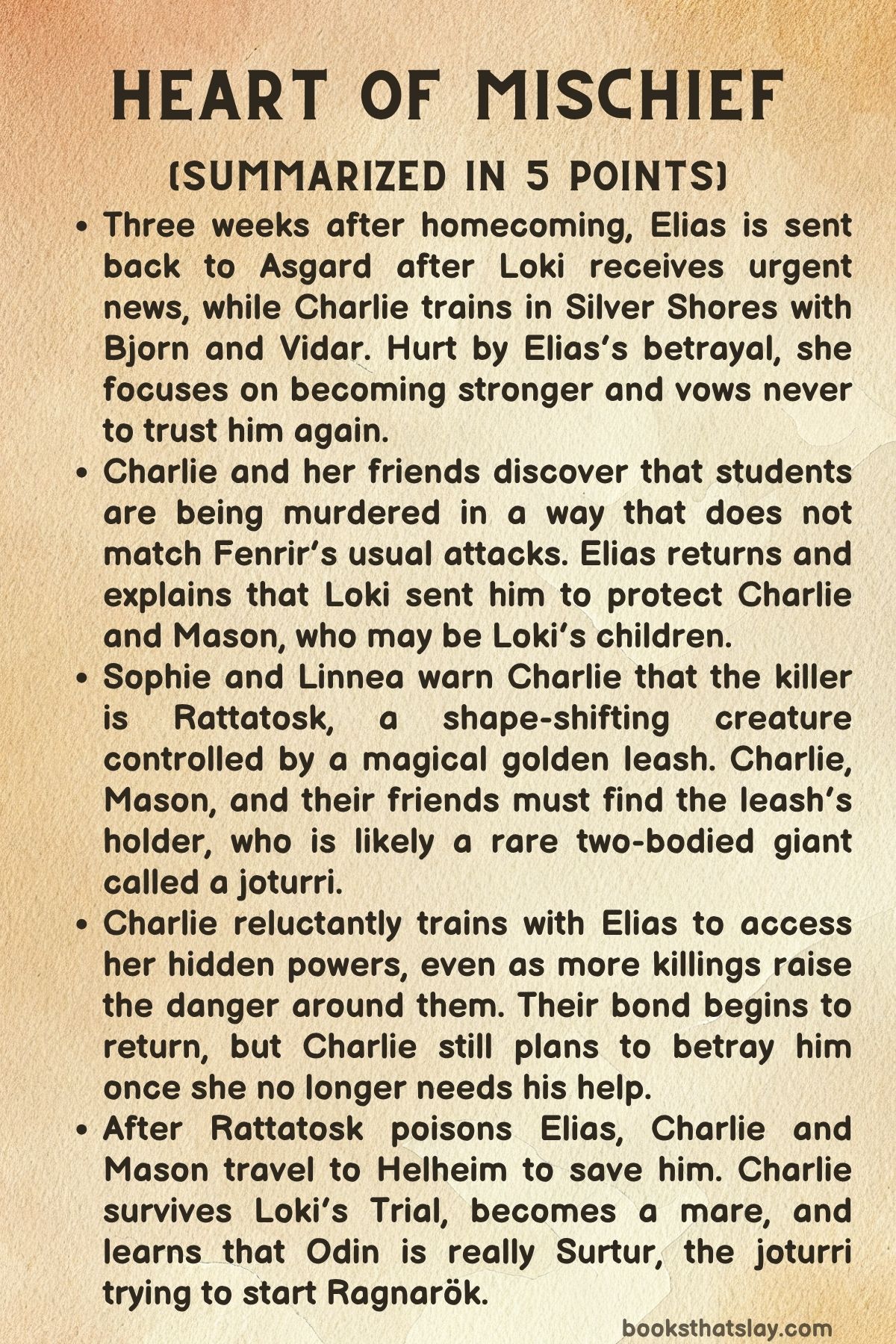
Three weeks after the events of homecoming, Elias is in Helheim with Loki and Hel. He expects his next task to take him to Alfheim, but Loki receives urgent news from Asgard and changes the plan.
Elias is told that he must return to Asgard because something important has come to light. His mission shifts, and the change sets him on a path back toward Charlie, Mason, and the danger growing in Silver Shores.
Charlie, meanwhile, is back home and trying to rebuild herself through training. Bjorn and Vidar are helping her and her friends prepare for the Asgardian threats that are beginning to leak into their town.
Charlie is still wounded by Elias’s betrayal. She repeats a hard promise to herself: she will become strong, kill Elias, and never trust him again.
Her anger is not simple pride. It is mixed with grief, fear, and the feeling that her whole life has been rearranged by secrets she never asked for.
Things are tense with Mason as well. He is barely speaking to her, and the distance between them adds to Charlie’s guilt and isolation.
Their bond has always mattered, but now both of them are carrying pain and confusion. Charlie keeps training because action feels safer than emotion.
If she can become stronger, she can protect herself from Elias, from the gods, and from whatever else is coming.
During a forest training exercise, Charlie and the others make a horrifying discovery. They find the bodies of Maddie and Milo Morris, two students whose fingers have been cut off.
The murders shock the town and spread fear through the school. At first, the deaths seem like another sign that the Fenrir threat has returned, but Charlie notices that the killings do not match the Fenrir’s usual pattern.
Something else is responsible, and whatever it is seems to be sending a message.
The atmosphere at school grows strained after the murders. Students are frightened, teachers are uneasy, and rumors move quickly.
Then Elias suddenly appears in the cafeteria, throwing Charlie’s already unstable world into fresh chaos. Mason attacks him immediately, but Elias uses mind control on the principal to avoid consequences.
His return forces Charlie to face the person she has sworn to destroy. Elias tells Charlie, Mason, Lou, and Abigail that Loki sent him back to protect Charlie and Mason.
He also calls them Loki’s children, a claim that only deepens the mystery around their family and their connection to the gods.
Not long afterward, Sophie crashes through the girls’ bathroom skylight with another Valkyrie named Linnea. Sophie brings news from Asgard.
Odin denies that Loki is Charlie and Mason’s father, but Sophie warns them that the murderer in Silver Shores is Rattatosk, a shape-shifting messenger squirrel whose claws carry deadly venom. Rattatosk is being controlled by a magical golden leash.
Whoever holds the leash commands him. Odin wants Charlie and Mason to find the person behind the killings.
Sophie gives them Valkyrie daggers before she leaves. The weapons are meant to help them survive, but they also show how serious the threat has become.
Charlie checks on Bjorn and Vidar and learns more about Rattatosk’s venomous claws. The danger is immediate, and anyone struck by them could die.
Charlie begins searching the forest for answers, trying to understand who might be using Rattatosk and why the killer is targeting students.
While in the forest, Charlie meets two älvor fairies. They tell her stories about Loki’s monstrous children, offering pieces of a larger mythic history that may explain what is happening to her and Mason.
Before Charlie can learn enough, Elias interrupts. His presence frustrates her, but he also reveals that his mare powers have grown stronger.
He can disappear into shadows, and he insists that he can help find whoever controls Rattatosk.
Elias explains that dwarven tools showed the magical leash appearing in two realms at once. That should be impossible unless the holder is a rare two-bodied giant known as a joturri.
This clue changes the investigation. Charlie and Elias visit Thrym at the Saugatuck dunes, hoping for answers.
Thrym tells them that Charlie may be able to use Loki’s magic to search for the leash, but she will need to learn how to access her powers first.
As more killings occur, the murderer leaves a message demanding that the “Children of Loki” come out. Charlie realizes that hiding will not save anyone.
Despite her anger toward Elias and her plan to betray him eventually, she agrees to train with him. Their lessons are uneasy at first.
Charlie does not want to depend on him, and Elias knows that she has not forgiven him. Still, he understands her magic in a way few others can.
Over the next several days, Charlie begins to change. She learns to levitate, conjure, and connect more deeply to the power inside her.
The training is difficult, but it gives her a sense of control she has been desperate to regain. At the same time, Abigail deciphers a new riddle pointing toward Helheim.
The clue suggests that the answers they need may lie in the realm of the dead.
Charlie’s feelings about Elias become harder to keep simple. She still believes he betrayed her, and she still plans to make him pay.
Yet training with him brings back the old pull between them. Their bond has not vanished just because trust has broken.
Elias seems determined to protect her, but Charlie cannot tell whether that makes him loyal, guilty, or dangerous. Mason, too, slowly begins reconnecting with Charlie.
Their relationship is not fully healed, but the silence between them starts to soften.
The crisis reaches a turning point during the Outdoor Education Trip. Charlie, Mason, Lou, Abigail, and Elias attend a student party in the woods.
The party offers a brief illusion of normal teenage life, but the danger stalking them is never far away. Charlie and Elias share a kiss, showing that their connection still has power over both of them.
The moment is cut short when Rattatosk finds them and attacks.
Elias fights Rattatosk and is poisoned by the creature’s claws. Henry transforms and kills Rattatosk, ending the immediate attack, but Elias is left dying from the venom.
Charlie realizes that ordinary help will not save him. Only a god’s blood can heal him.
Faced with losing Elias for real, Charlie’s anger is no longer enough to keep her away. She and Mason use the riddle Abigail solved and travel to Helheim.
In Helheim, Charlie bargains with Loki. To get what she needs, she enters a Trial connected to Gungnir, Odin’s spear.
The Trial subjects her to terrible pain and forces her through visions that reveal the truth behind the murders and the growing threat. Charlie learns that Loki was not the one controlling Rattatosk.
Odin was. Even worse, Odin is trying to start Ragnarök.
The visions also reveal that Odin is actually Surtur, a joturri, which explains how the leash could appear in two realms at once.
Charlie survives the Trial, but the cost is enormous. She passes it and becomes a mare, crossing a line that separates her from the fully human life she once knew.
After revealing the truth to Mason, she collapses. Her transformation is both a victory and a warning.
She has gained power, but that power ties her even more deeply to the dangerous world of gods, monsters, and prophecy.
In the epilogue, Elias watches over Charlie as she sleeps. He has helped heal her, and he understands that she is no longer entirely human.
The truth about Odin, Surtur, and Ragnarök has changed everything. The enemy is larger than they understood, the danger ahead is still growing, and Charlie’s new identity as a mare means her role in the coming conflict is only beginning.
Heart of Mischief ends with Charlie alive but transformed, Elias still bound to her by guilt, love, and loyalty, and the threat of Ragnarök moving closer. Silver Shores is no longer just a small town touched by strange violence.
It has become part of a mythic conflict where family, betrayal, and power may decide the fate of worlds.
Characters
Charlie
Charlie is the emotional and moral center of Heart of Mischief, and her character is shaped by betrayal, fear, grief, anger, and the painful need to become stronger. At the beginning of this part of the book, she is still deeply wounded by Elias’s earlier betrayal, and her repeated promise to become powerful enough to kill him shows how much that betrayal has damaged her ability to trust.
Yet Charlie is not simply vengeful. Her anger is mixed with fear, heartbreak, and a desperate desire to protect the people she loves.
She trains with determination because she understands that the dangers surrounding Silver Shores are no longer distant myths but immediate threats.
Charlie’s growth is especially important because she must learn to accept a part of herself that she does not fully understand. Her connection to Loki’s magic frightens her, but it also becomes the key to uncovering the truth.
Through her training with Elias, she begins to access abilities that make her more than human, and this transformation forces her to rethink who she is. Her power is not presented as easy or glamorous; it is tied to pain, sacrifice, and responsibility.
Charlie’s Trial in Helheim becomes the clearest expression of her courage because she endures suffering not for glory, but to save Elias and expose the truth about Odin.
Charlie is also emotionally complex because she tries to convince herself that she can use Elias and then betray him, but her feelings are stronger than her anger. Her renewed closeness with him does not erase what he did, but it shows that Charlie’s heart is still capable of love even after being hurt.
By the end of the book, Charlie has changed profoundly. She is no longer fully human, and her transformation into a mare marks both an ending and a beginning.
She becomes stronger, but that strength comes with danger, uncertainty, and a heavier destiny.
Elias
Elias is one of the most conflicted characters in the book. He returns from Helheim carrying secrets, new powers, and a mission from Loki, but his presence immediately reopens the wounds caused by his betrayal.
To Charlie and her friends, Elias is difficult to trust because he has already proven that he can deceive them. Still, his return also shows that he is not simply a villain or a traitor.
He is caught between loyalty, guilt, love, and survival, and much of his character depends on the tension between what he has done and what he is trying to repair.
His mare powers make him dangerous and mysterious, especially when he reveals abilities such as disappearing into shadows. These powers separate him from ordinary human life and place him closer to the supernatural conflicts driving the story.
However, Elias’s importance is not only magical. He becomes Charlie’s teacher and guide, helping her understand the nature of her own abilities.
This makes their relationship emotionally charged because Charlie needs his help even while she believes she should hate him. Elias becomes both a source of pain and a source of protection.
Elias’s poisoning by Rattatosk is a turning point because it reveals how deeply Charlie still cares for him. His near death strips away some of the emotional defenses between them and forces Charlie to act from love rather than resentment.
In the epilogue, Elias watching over Charlie gives him a quieter, more protective role. He understands that she has crossed into something dangerous and irreversible, and his concern for her suggests that his bond with Charlie remains one of the most powerful emotional threads in the story.
Mason
Mason is important because he represents both family loyalty and emotional distance. At the beginning, he is barely speaking to Charlie, which shows how strained their relationship has become after everything they have experienced.
His anger and silence are not meaningless; they come from fear, hurt, and confusion. Like Charlie, Mason has been pulled into a supernatural conflict that he did not ask for, and the revelation that he may be one of Loki’s children adds another layer to his identity crisis.
Mason’s reaction to Elias’s return is immediate and physical, which reveals his protective instincts. He does not trust Elias and is unwilling to calmly accept his explanation.
This makes Mason a contrast to Charlie, who is emotionally torn between anger and lingering love. Mason is more direct in his distrust, but he is also slowly forced to confront the larger truth that the threat is bigger than Elias.
His gradual reconnection with Charlie is meaningful because it shows that their bond can survive tension, fear, and silence.
Mason’s role becomes especially significant in Helheim. He travels with Charlie and helps her reach the truth, standing beside her during one of the most important moments in the book.
His presence reinforces the idea that Charlie does not carry her destiny alone. Though he may not undergo the same dramatic transformation that Charlie does, Mason’s journey is still one of acceptance.
He must accept the truth about his origins, the danger around him, and the fact that his sister is becoming something far beyond ordinary human understanding.
Loki
Loki is one of the most powerful and ambiguous figures in the story. He begins this section by changing Elias’s mission, sending him back to Asgard instead of Alfheim, which shows that Loki is always operating with knowledge that others do not have.
His actions are difficult to fully trust because he is associated with deception, manipulation, and hidden motives. However, the book complicates the usual expectation that Loki is the central villain.
Instead, he becomes a figure whose reputation may hide a more complicated truth.
As Charlie and Mason are called Loki’s children, Loki’s role becomes deeply personal rather than merely mythological. He is tied to their identity, their powers, and their destiny.
His presence in Helheim during Charlie’s bargain shows that he is both dangerous and necessary. Charlie cannot simply reject him, because his magic is part of who she is.
At the same time, accepting that connection means accepting a frightening inheritance.
Loki’s importance grows when Charlie discovers that Odin, not Loki, is behind Rattatosk’s violence. This revelation changes how the reader understands Loki’s role in the conflict.
He may still be unpredictable and morally uncertain, but he is not the source of every evil in the story. In this way, Loki becomes a character connected to misjudgment, inherited fear, and the danger of believing simple versions of mythic truth.
Hel
Hel’s role is quieter than Loki’s, but her presence strengthens the atmosphere of death, judgment, and otherworldly power. As the ruler associated with Helheim, she belongs to a realm that Charlie must enter when Elias is dying.
Hel’s world is not just a location; it represents the boundary between life and death, humanity and transformation. Her presence gives the book a darker mythological weight.
Hel also matters because Helheim becomes the place where truth is uncovered. Charlie does not only go there to save Elias; she goes there and discovers the reality behind the murders, Odin’s deception, and the coming danger of Ragnarök.
Hel’s realm therefore becomes a place of revelation. Even when Hel herself is not the emotional focus, her world shapes the consequences of the characters’ choices.
Odin / Surtur
Odin is the most deceptive and dangerous figure in the book because he hides behind authority, divine status, and reputation. At first, Odin appears to be the ruler whose denial of Loki’s connection to Charlie and Mason might carry weight.
Yet this authority is later exposed as false and corrupt. The discovery that Odin controlled Rattatosk completely changes the moral structure of the story, revealing that the violence in Silver Shores is not random and not caused by the person everyone might expect to blame.
The revelation that Odin is actually Surtur, a joturri, makes him even more threatening. He is not merely a ruler making cruel decisions; he is a hidden enemy trying to start Ragnarök.
His deception is especially chilling because he uses others as tools. Rattatosk becomes a weapon, the murders become messages, and fear becomes a strategy.
Odin’s villainy lies in his ability to manipulate truth itself, making others look guilty while he works from behind a mask of power.
As Surtur, Odin represents the danger of false appearances. He shows that evil in the story does not always look monstrous at first.
Sometimes it wears the face of order, leadership, and divine legitimacy. This makes him a strong antagonist because Charlie must not only fight danger physically; she must learn to see through lies that have been accepted as truth.
Rattatosk
Rattatosk is the immediate physical threat haunting Silver Shores. As a shape-shifting messenger squirrel controlled by a golden leash, he is both frightening and tragic.
His attacks are brutal, especially because his venomous claws can kill, and the murders of Maddie and Milo create fear throughout the school and town. His violence makes the supernatural danger feel personal and unavoidable.
At the same time, Rattatosk is not the true mastermind. He is controlled by whoever holds the leash, which makes him a weapon rather than the ultimate villain.
This detail gives his character a disturbing kind of helplessness. He commits horrific acts, but he is also bound by another’s command.
His role reflects one of the book’s major concerns: power can be used to control bodies, choices, and truth.
Rattatosk’s attack during the Outdoor Education Trip raises the stakes dramatically because it nearly kills Elias. His death at Henry’s hands ends the immediate threat, but it does not solve the larger mystery.
In fact, his defeat only pushes Charlie closer to the truth behind the violence. Rattatosk is therefore both a monster and a clue, a creature whose actions expose a much greater evil.
Sophie
Sophie serves as a messenger, protector, and link to the larger Asgardian conflict. Her dramatic arrival through the bathroom skylight immediately gives her a strong presence, and she brings important information that changes the direction of the story.
She warns Charlie and Mason about Rattatosk, explains the golden leash, and gives them Valkyrie daggers. Through Sophie, the danger becomes clearer and more urgent.
Her role also shows that Charlie and Mason are not completely abandoned. Even though the gods are divided and truth is uncertain, Sophie offers practical help.
She does not solve the problem for them, but she gives them knowledge and weapons. This makes her a character associated with preparation and warning.
She belongs to the world of warriors and divine conflict, but she still reaches into the human world to help the characters survive.
Linnea
Linnea appears alongside Sophie and helps establish the presence of the Valkyries as serious and active figures in the story. Though she does not receive as much attention as Sophie, her arrival reinforces the idea that the danger surrounding Charlie and Mason is important enough to draw supernatural warriors into Silver Shores.
Linnea’s presence expands the world and reminds the reader that the conflict is not isolated to one town.
As another Valkyrie, Linnea also strengthens the atmosphere of urgency. She represents discipline, danger, and the larger systems of Asgardian power.
Her role may be smaller, but she contributes to the sense that Charlie and her friends are caught in a conflict watched by beings far beyond ordinary human life.
Bjorn
Bjorn is one of Charlie’s trainers and functions as a guide in the practical side of survival. His importance lies in helping Charlie and her friends prepare for threats that they cannot defeat through ordinary means.
Training with Bjorn shows that courage alone is not enough; the characters need skill, endurance, and knowledge if they are going to survive.
Bjorn also helps ground the supernatural conflict in physical discipline. While much of the story involves magic, gods, and hidden identities, Bjorn’s training reminds Charlie that strength must be built through effort.
His role is protective, but not soft. He helps prepare the characters for a world where hesitation can be fatal.
Vidar
Vidar works alongside Bjorn as another figure of training and protection. He helps Charlie and the others understand that Asgardian danger requires more than emotional determination.
Like Bjorn, he represents discipline and readiness. His presence gives Charlie’s development a structured foundation before her magical abilities fully emerge.
Vidar also contributes to the sense that the human and divine worlds are merging. Training is no longer just preparation for a possible future threat; it is a response to dangers already entering Silver Shores.
Through Vidar, the book shows that survival depends on accepting the reality of the supernatural instead of pretending life can return to normal.
Lou
Lou is part of Charlie’s close circle and represents friendship under pressure. Although Charlie’s magical identity and family connection to Loki place her at the center of the conflict, Lou’s presence reminds the reader that Charlie is still surrounded by people who matter to her.
Lou is pulled into danger because of loyalty, and that loyalty makes her important.
Her role also helps balance the emotional weight of the story. Charlie’s life is filled with betrayal, fear, and supernatural revelations, but her friendships keep her connected to ordinary human feeling.
Lou’s presence at school, during the trip, and within the group shows that friendship can survive even when the world becomes frightening and strange.
Abigail
Abigail is one of the most intellectually useful characters in the group. Her ability to decipher riddles makes her essential to the plot, especially when the clues point toward Helheim.
Abigail’s strength is not primarily physical or magical, but her intelligence directly affects the group’s survival. She helps turn confusion into direction.
Abigail also represents the importance of knowledge in a story filled with deception. Since Odin hides the truth and Rattatosk’s controller is difficult to identify, solving riddles and interpreting clues become acts of resistance.
Abigail’s role proves that bravery is not only found in battle. It can also appear in careful thinking, patience, and the ability to recognize meaning where others might see only mystery.
Henry
Henry becomes crucial during Rattatosk’s attack because he transforms and kills the creature. This moment reveals that Henry is far more than an ordinary student or background figure.
His transformation adds another supernatural layer to the group’s world and shows that hidden powers may exist closer than expected.
His killing of Rattatosk saves the others from immediate danger, but it also comes too late to prevent Elias from being poisoned. This makes Henry’s role both heroic and limited.
He can stop the creature, but he cannot undo all the damage. His character shows how survival in the story often depends on sudden, frightening power, but also how even victory can leave devastating consequences.
Thrym
Thrym acts as a source of mythological knowledge and guidance. When Charlie and Elias visit him at the Saugatuck dunes, he helps explain how Charlie might use Loki’s magic to dredge for the leash.
His role is important because he gives Charlie a possible method for finding the hidden controller behind Rattatosk. Without this guidance, Charlie’s power would remain more mysterious and less directed.
Thrym also represents the broader world of giants and old mythic beings. Through him, the story expands beyond Asgard, Helheim, and Silver Shores into a wider network of supernatural knowledge.
He does not take over Charlie’s journey, but he gives her information that helps her understand what she might be capable of becoming.
Maddie and Milo Morris
Maddie and Milo Morris are victims whose deaths mark a major shift in the book’s danger. Their bodies are discovered with their fingers cut off, and the brutality of their murders shocks the students and unsettles the school.
Even though they do not function as active characters for long, their deaths matter because they prove that the threat is no longer hidden or distant.
Their murders also help Charlie realize that the killings do not match the Fenrir’s pattern. In that sense, Maddie and Milo become part of the mystery’s turning point.
Their deaths are tragic, but they are also clues that push Charlie toward the truth. They show how innocent people suffer when gods and monsters use the human world as a battlefield.
The Älvor Fairies
The älvor fairies serve as mysterious sources of old knowledge. When Charlie encounters them in the forest, they tell stories about Loki’s monstrous children, connecting her present danger to a deeper mythological past.
Their presence gives the story an eerie, folkloric quality and suggests that the truth Charlie seeks exists in fragments scattered across different beings and realms.
The fairies also increase Charlie’s uncertainty. They begin to reveal information, but Elias interrupts before she can learn more.
This makes their scene important because it shows how knowledge in the book is often incomplete, interrupted, or difficult to trust. The älvor fairies are not central allies, but they help deepen the mystery surrounding Loki, his children, and Charlie’s own identity.
Themes
Betrayal and the Difficulty of Trust
Charlie’s emotional state is shaped by the pain of Elias’s betrayal, and this makes trust feel almost impossible for her. She tries to protect herself by turning hurt into anger, repeating the idea that she will become strong enough to kill him and never trust him again.
This reaction shows how betrayal does not simply damage one relationship; it changes how a person sees every future choice. Elias’s return forces Charlie to face a painful conflict between what she feels and what she believes she should feel.
His actions suggest that he may still care for her, but his past deception makes every gesture suspicious. The tension between suspicion and lingering affection gives this theme emotional depth.
Trust is shown not as something easily restored through apologies, but as something tested through danger, sacrifice, and repeated choices. In Heart of Mischief, trust becomes a risk Charlie must decide whether to take, even when her fear tells her not to.
Power, Identity, and Transformation
Charlie’s journey is strongly connected to her growing understanding of who she is and what kind of power lives inside her. At first, her strength comes mainly from determination, anger, and physical training, but the danger around her pushes her toward a deeper form of self-discovery.
Learning to levitate, conjure, and connect with magic changes her sense of identity because she can no longer think of herself as ordinary. Her connection to Loki also raises difficult questions about inheritance, destiny, and whether bloodline defines character.
Charlie does not simply gain power; she must decide how to use it, especially when that power comes from a source others fear or distrust. Her Trial in Helheim becomes the clearest sign of transformation, as pain, vision, and truth combine to push her beyond her former human limits.
By becoming a mare, she crosses a boundary that cannot be undone. Her identity becomes both stronger and more uncertain.
Family, Bloodline, and Chosen Loyalty
The question of family carries both comfort and danger throughout the story. Charlie and Mason’s possible connection to Loki turns their bloodline into a source of fear, attention, and manipulation.
Being called Loki’s children places them at the center of a conflict they do not fully understand, and it makes them targets for forces far older and more powerful than themselves. Yet family is not shown only through blood.
Charlie’s bond with Mason is strained after Elias’s betrayal, but their slow reconnection shows that loyalty can survive anger and silence. Her friendships with Lou and Abigail also matter because they offer support when divine parentage and supernatural danger make her life unstable.
The story contrasts inherited identity with chosen loyalty, showing that who stands beside Charlie matters as much as who her father may be. Family becomes a complicated force: it can expose someone to danger, but it can also give them the courage to keep fighting.
Truth, Deception, and Hidden Evil
The mystery surrounding Rattatosk’s controller shows how dangerous false appearances can be. At first, the violence seems connected to obvious enemies, and Loki appears to be the most suspicious figure because of his reputation and his link to Charlie and Mason.
However, the deeper truth reveals that the real threat comes from a place of supposed authority. Odin’s deception is especially powerful because he hides behind order, leadership, and divine status while secretly using violence to push the world toward Ragnarök.
This theme challenges the idea that evil is always easy to recognize. The story suggests that reputation can mislead, and that trusted power can become more dangerous than open chaos.
Charlie’s Trial forces hidden truth into the open, but that truth comes through suffering rather than simple discovery. By revealing Odin as Surtur and the true force behind the attacks, the plot shows that survival depends not only on strength, but also on questioning what everyone has been taught to believe.