Hell’s Heart Summary, Characters and Themes
Hell’s Heart by Alexis Hall is a science-fiction reimagining of the great sea-hunt narrative, moved from Earth’s oceans to the storming skies of Jupiter. It follows a nameless, shape-shifting narrator who joins the Leviathan-hunting ship Pequod in search of money, escape, and something like belonging.
Instead, she is drawn into the orbit of Captain A, a brilliant and damaged commander whose obsession with the legendary white Leviathan, the Möbius Beast, drives the crew toward ruin. The book mixes cosmic horror, queer desire, dark comedy, and fatal ambition in a story about survival, myth, and the cost of chasing revenge.
Summary
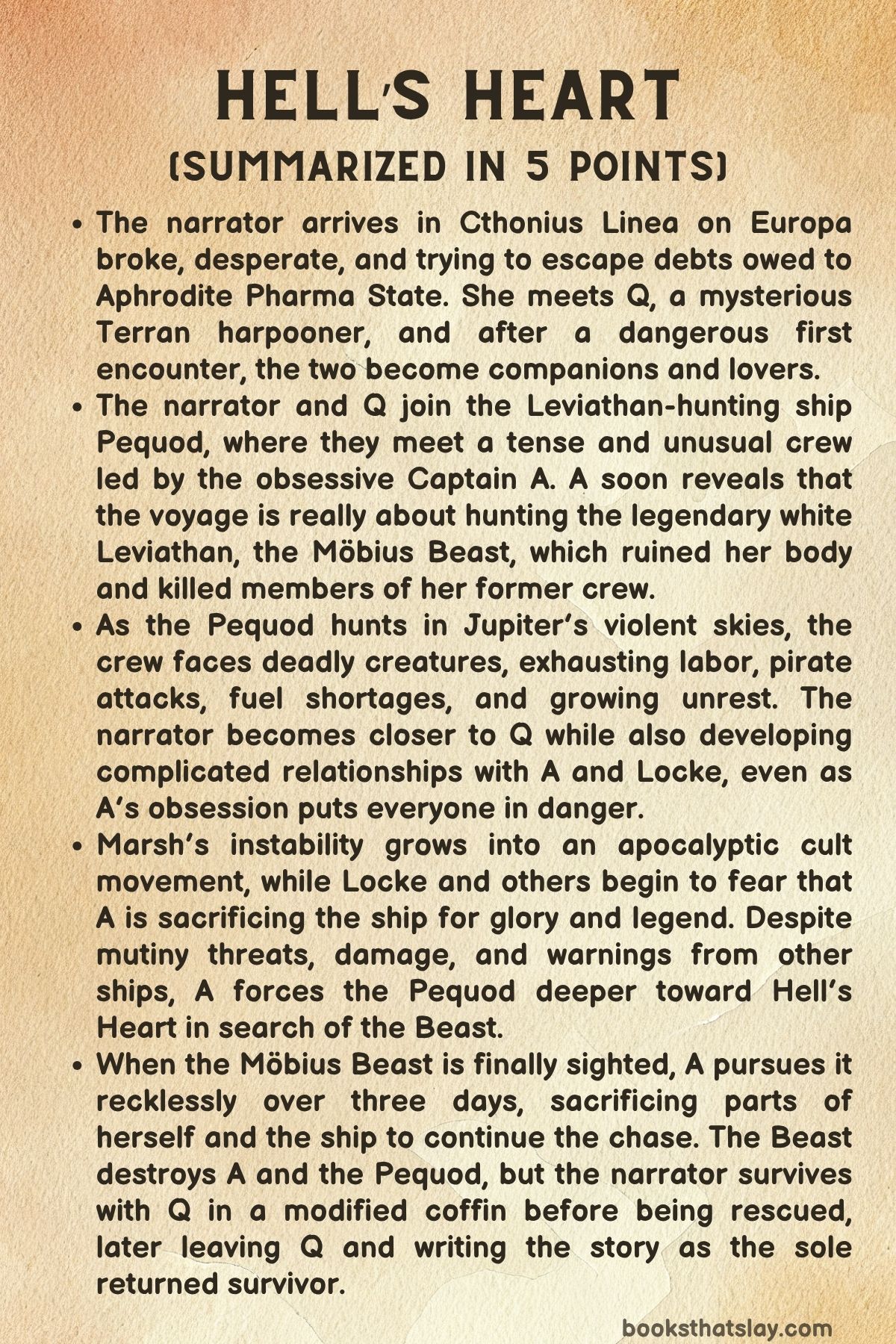
Hell’s Heart begins with a narrator who has no fixed name, no stable home, and very little money. She arrives in Cthonius Linea, a rough dock city on Europa, with debts behind her and danger not far away.
Aphrodite Pharma State has a claim on her, and she knows that if she stays too long, that claim may catch up with her. She needs work, money, and a way off Europa.
In a place built around the deadly trade of Leviathan hunting, the most practical answer is to sign on with a ship heading into Jupiter’s skies.
She takes a room at the Coffin Inn, a cheap and uneasy place filled with travelers, hunters, religious fanatics, and people who have nowhere better to go. There she meets Q, a quiet Terran harpooner with a dangerous air and a past she does not explain.
Their first real encounter is almost fatal: Q enters their shared room and wakes the narrator with a knife at her throat, mistaking her for a threat. Once the fear and confusion pass, the two begin to trust each other.
Their partnership grows quickly into desire, and then into love, or at least into the closest thing either of them can safely name.
Together they search for a ship and find the Pequod, a strange hunter-barque marked by Leviathan bone and a reputation that feels half practical and half cursed. The narrator signs on as an ordinary hand, while Q is taken aboard as a harpooner.
As the ship prepares to launch, the narrator begins to learn the shape of the crew. Locke, the first mate, is stern, controlled, and watchful.
Truelove serves as an officer and is connected to the Church of Starry Wisdom. Marsh, another harpooner, carries a nervous intensity that will later become something more dangerous.
Others, including Bulkington, Dawlish, Flint, and many working hands, complete the strange little society of the ship.
At first, the captain is absent. She is spoken of more than seen, and this absence makes her feel larger than ordinary command.
When Captain A finally appears, the true purpose of the voyage becomes clear. The Pequod is not merely hunting Leviathans for profit.
A is searching for the Möbius Beast, the legendary white Leviathan that once maimed her, took her leg, and destroyed members of her former crew. She offers her entire share of the voyage to whoever first sights the creature.
Her speech fills the crew with dread, excitement, greed, and loyalty. From that moment, the voyage is no longer a commercial hunt.
It is a mission shaped by one woman’s need for revenge and lasting fame.
The Pequod descends into Jupiter’s vast and violent atmosphere, where hunting is both labor and war. The crew watches for spouts, launches boats, drives harpoons into enormous living bodies, and drags the dead back to be cut apart.
The work is filthy, exhausting, and dangerous. Leviathans are not the only threats.
Krakens and other creatures move through the Jovian storms, and the environment itself seems ready to tear human machines and human bodies apart. The narrator learns the rhythms of shipboard life: obedience, fear, boredom, hunger, injury, and the strange closeness that comes from shared danger.
During the voyage, her private life becomes as complicated as the public one. She remains bound to Q, whose steadiness and mystery continue to draw her in.
At the same time, she is increasingly fascinated by A, whose force of will is almost impossible to resist. A is cruel, commanding, damaged, and magnetic.
The narrator is also drawn into an intimate connection with Locke, whose discipline hides a deep concern for the fate of the ship. These relationships are not simple comforts.
They place the narrator between loyalty, desire, fear, and the knowledge that everyone around A may eventually be spent in service of her obsession.
Q is badly injured during one of the hunts, and the narrator is shaken by the possibility of losing her. In response, she builds a coffin-like survival casket, meant to preserve Q if the worst happens.
Q survives, and the object later becomes something more useful than either of them first understands. What begins as a desperate act of care slowly becomes the means by which survival may still be possible when nearly every other hope fails.
As the Pequod continues, Captain A’s fixation grows stronger. The ship encounters others in Jupiter’s hunting grounds, and each meeting seems to reflect some warning or alternative future.
The Jeroboam carries a religious figure called the Archangel, who gives ominous warnings about the Möbius Beast. The Rachel is searching for lost crew, asking for help that A is unwilling to give in any meaningful way.
These meetings show how far A has separated herself from ordinary human duty. Other captains still think in terms of rescue, profit, or caution.
A thinks only of the white Leviathan.
The danger inside the ship grows as much as the danger outside it. Pirates attack the Pequod, and their leader, Wolfram, is captured.
While imprisoned, Wolfram becomes another source of unrest. Marsh, already shaken after a horrifying experience inside a Leviathan carcass, begins to change.
His fear and trauma turn toward prophecy. Under the influence of the Church of Starry Wisdom and the ship’s growing sense of doom, he becomes a prophet-like figure.
His words attract followers, and an apocalyptic mood spreads among parts of the crew. The Pequod becomes not only a working ship but a pressure chamber of fear, belief, hunger, desire, and resentment.
Practical problems make everything worse. Fuel runs low.
Storms intensify. Damage builds.
The ship is pushed farther into places where it should not go. Locke sees more clearly than most that A may be leading everyone to death in order to turn herself into legend.
The first mate confronts her, even threatening her with a pistol, but A remains calm and in control. Her authority depends on more than rank.
She knows how to command the imagination of the crew. She promises glory, meaning, revenge, and a place in a story larger than survival.
Again and again, when mutiny threatens, she pulls the crew back under her power.
After an explosion damages the Pequod’s fuel reserves, turning back would be the sane choice. A refuses.
The crew is forced to strip a dead Behemoth for fuel and reinforce the ship with Leviathan bone. The Pequod becomes less a vessel than a wounded creature armored in the remains of other creatures.
It pushes onward toward Hell’s Heart, the deadly region where the Möbius Beast is believed to live. Each step forward feels less like pursuit and more like surrender to the captain’s will.
At last, Marsh sights the Möbius Beast. The hunt lasts three days.
The white Leviathan proves to be as strange and terrifying as its legend promised. A pursues it with reckless focus, giving up more of herself and more of the ship with each attempt.
She loses another mechanical leg and sacrifices Fidelity, the ship’s intelligence, in order to continue the chase. Every boundary that might have protected the Pequod is crossed.
Crew, machine, fuel, safety, and reason are all offered to the hunt.
On the final day, A goes out alone in a boat with the special harpoon. Her confrontation with the Beast is the end point of everything she has chosen.
She faces it directly, but the creature destroys her. Her death does not end the danger.
The Möbius Beast turns on the Pequod, wrapping itself around the ship and tearing into its hull. The vessel that has carried the crew through storms, hunts, madness, and hunger is broken open.
People die throughout the ship as the Beast dismantles it piece by piece.
The destruction reaches the spermaceti stores and engine systems, causing a catastrophic explosion. The Pequod is destroyed.
The narrator survives only because Q leads her into the modified coffin. The object once built out of fear and love now saves them both.
With life support, foils, and a beacon, it carries them through the disaster until the Rachel finds and rescues them.
Afterward, the narrator and Q travel to Earth. Q shows her trees, open sky, and a world that seems free from the systems of ownership and debt that have shaped the narrator’s life.
For a time, it offers the possibility of peace. But the narrator cannot remain there.
Whatever she has survived, she is still restless, still unable to settle fully into the life Q offers. She leaves Q behind and later writes the account of the Pequod as the only returned survivor.
Her story becomes a record of love, fear, obsession, and ruin, shaped by the knowledge that survival does not always bring rest, and escape does not always mean freedom.
Characters
The Narrator
The narrator of Hell’s Heart is a restless, unstable, and deeply searching figure whose many possible names suggest a fractured sense of identity. She arrives in Cthonius Linea broke, desperate, and eager to escape the control of Aphrodite Pharma State, which immediately presents her as someone trapped between survival and flight.
She is not a heroic adventurer at the beginning of the book; she is someone pushed forward by fear, debt, hunger, curiosity, and the hope that a dangerous voyage might offer a way out. Her willingness to join a Leviathan-hunting ship shows both desperation and courage, because she chooses a brutal life not because she fully understands it, but because ordinary life has already failed her.
As the voyage progresses, the narrator becomes the emotional center through which the reader experiences the strangeness, danger, and moral confusion of the Pequod. She is observant, vulnerable, and often conflicted.
Her relationships with Q, A, and Locke reveal different sides of her personality. With Q, she discovers tenderness, intimacy, and the possibility of being protected without being owned.
With A, she is drawn toward charisma, obsession, and destructive grandeur. With Locke, she encounters discipline, restraint, and a more grounded form of human connection.
These attachments show that she is not simply moving through events; she is being reshaped by them.
The narrator’s deepest conflict is between belonging and escape. She wants freedom, yet she repeatedly attaches herself to people and causes that endanger her.
She is fascinated by A’s mythic pursuit even when she senses its madness, and she becomes part of the ship’s world even though that world is clearly consuming itself. Her survival at the end does not feel like triumph.
Instead, it leaves her burdened with memory, guilt, and loneliness. When she reaches Earth with Q, she sees a life beyond ownership, debt, and pursuit, but she cannot remain there.
Her final act of writing the account makes her both survivor and witness, someone who escaped the wreck physically but remains emotionally tied to everything the voyage destroyed.
Q
Q is one of the most mysterious and emotionally powerful figures in the book. Introduced as a Terran harpooner who first appears threateningly with a knife at the narrator’s throat, she immediately carries an air of danger, secrecy, and self-protection.
Yet this first impression gradually gives way to a much more complex character. Q is fierce, skilled, and physically brave, but she is also capable of tenderness and loyalty.
Her bond with the narrator becomes one of the most important emotional relationships in the story because it offers warmth and intimacy within a world dominated by violence, debt, and obsession.
Q’s identity as a harpooner connects her to the harsh practical work of the hunt. She is not merely a romantic figure or a mysterious outsider; she is someone who understands risk through the body.
Her courage is practical rather than theatrical. She faces danger because it is part of the work, not because she needs to turn herself into legend.
This separates her from A, whose courage becomes inseparable from obsession. Q’s injury during the voyage exposes her vulnerability and reveals the narrator’s fear of loss.
The coffin-like survival casket built for her becomes a powerful symbol of love, mortality, and protection. It begins as an object associated with death, but through Q’s survival and later adaptation of it, it becomes an instrument of life.
Q also represents a form of freedom that the narrator cannot fully accept. Her connection to Earth, trees, open sky, and a world without ownership makes her almost the opposite of the industrial, predatory systems that shape the narrator’s life.
She offers the narrator not just love, but another way of living. However, the narrator’s inability to stay with her shows that love alone cannot repair every wound.
Q survives the destruction of the Pequod and helps save the narrator, but she cannot save her from restlessness, trauma, or the need to turn experience into story. Her role is therefore both intimate and symbolic: she is lover, protector, survivor, and the image of a peace the narrator recognizes but cannot inhabit.
A
A is the most commanding and destructive presence in Hell’s Heart. As captain of the Pequod, she appears almost larger than life, marked by injury, loss, charisma, and a consuming desire for revenge against the Möbius Beast.
Her missing leg and past trauma make her pursuit personal from the beginning. She is not simply hunting for profit; she is trying to defeat the creature that wounded her body and shattered her former crew.
This gives her a tragic intensity, but it also makes her dangerous because her private wound becomes the governing purpose of an entire ship.
A’s power lies in her ability to transform obsession into collective destiny. She convinces the crew that the hunt is not merely a reckless personal vendetta but a path toward glory, legend, and meaning.
Her offer of her entire lay to whoever first sights the Beast shows how easily she can turn greed, ambition, and awe into tools of command. Even when the voyage becomes increasingly irrational, she retains control through presence, language, fear, and magnetism.
The crew may doubt her, resent her, or fear her, but she understands how to dominate their imaginations.
Her relationship with the narrator adds emotional complexity to her character. The narrator is drawn to A not simply because A is powerful, but because A represents intensity without compromise.
A lives as though ordinary limits do not apply to her. This makes her fascinating, but also monstrous.
She repeatedly chooses the hunt over safety, the legend over the crew, and revenge over life. Her willingness to sacrifice Fidelity and continue the chase after catastrophic damage proves that her obsession has consumed whatever remained of responsible leadership.
In the end, A becomes inseparable from the thing she hunts. Her final lonely confrontation with the Beast is grand, terrifying, and empty, because it fulfills her desire for myth while destroying nearly everyone who followed her.
Locke
Locke is the severe first mate of the Pequod and one of the clearest voices of discipline, order, and uneasy conscience in the story. They are strict, controlled, and often difficult, but their severity comes from an understanding of what survival aboard such a ship requires.
Unlike A, Locke does not seem intoxicated by legend. They understand hierarchy, labor, danger, and command in practical terms.
This makes them an important counterweight to A’s increasingly mythic and reckless leadership.
Locke’s tension with A reveals the moral structure of the voyage. They are loyal to the ship and its chain of command, but they are not blind.
As A pushes the crew deeper into danger, Locke begins to recognize that the captain may be sacrificing everyone not for necessity, but for immortality through story. This makes Locke one of the few characters capable of naming the danger clearly.
Their confrontation with A, especially when they threaten her with a pistol, shows how far the situation has deteriorated. Yet A’s ability to calmly disarm them also reveals Locke’s limitation: they may see the truth, but they cannot finally overcome the captain’s force of will.
The narrator’s involvement with Locke shows another side of them. Beneath the severity, Locke is not merely a symbol of authority; they are a person capable of desire, attachment, and vulnerability.
Their relationship with the narrator is different from her relationship with Q or A. Locke offers neither Q’s gentleness nor A’s consuming grandeur. Instead, they represent control under pressure, a kind of damaged steadiness in a collapsing world.
Their tragedy lies in being rational enough to understand the danger but not powerful enough to stop it.
Marsh
Marsh is one of the most disturbing and tragic figures in the book. At first, he appears as an uneasy harpooner, someone already marked by instability and fear.
His discomfort sets him apart from the more practiced or hardened members of the crew, and as the voyage continues, his mind becomes increasingly vulnerable to terror, religious extremity, and apocalyptic meaning. The horrifying incident inside a Leviathan carcass becomes a turning point for him, pushing him from fear into prophetic madness.
Marsh’s transformation into a prophet-like figure for the Starry Wisdom followers shows how trauma can become ideology. Unable to process what he has experienced in ordinary human terms, he turns horror into revelation.
His growing cult gives shape to the crew’s fear and despair, especially as the ship descends deeper into danger. In this way, Marsh becomes a mirror of A. Both are consumed by visions larger than ordinary life, but where A turns trauma into revenge and legend, Marsh turns it into religious apocalypse.
His connection with Wolfram intensifies this transformation. Wolfram spreads unrest while imprisoned, and Marsh’s cult absorbs that instability into its own growing extremism.
Marsh is dangerous not because he begins as a villain, but because he becomes a vessel for the fears already present aboard the Pequod. His character shows how quickly a ship under pressure can become spiritually infected.
As order breaks down, Marsh gives chaos a voice, and that voice becomes increasingly difficult to ignore.
Truelove
Truelove is an officer associated with the Church of Starry Wisdom, and their presence aboard the Pequod brings a strong religious and ideological dimension to the voyage. Unlike characters whose roles are mainly practical, Truelove represents belief, ritual, and the search for cosmic meaning.
Their connection to the Church suggests that the hunt is never only economic or physical; it also unfolds in a universe where people interpret terror through faith, prophecy, and systems of hidden knowledge.
Truelove’s importance lies in the way they help establish the atmosphere of spiritual unease aboard the ship. The Church of Starry Wisdom is not merely background decoration.
Through figures like Truelove, the voyage becomes surrounded by a sense of fatalism and cosmic dread. The Leviathans, the Möbius Beast, Jupiter’s storms, and the crew’s suffering all seem to invite religious interpretation.
Truelove’s presence makes it easier for Marsh’s later transformation to take root, because the language of revelation and doom already exists on the ship.
As a character, Truelove stands at the intersection of duty and belief. They are part of the ship’s command structure, but they also belong to a spiritual world that looks beyond ordinary survival.
This dual role makes them quietly unsettling. They help show that the Pequod is not only threatened by external monsters or A’s obsession, but also by ideas that can turn fear into worship.
Truelove’s significance is therefore atmospheric and thematic: they help make the ship feel like a place where work, faith, madness, and death are dangerously intertwined.
Bulkington
Bulkington is an experienced member of the crew whose presence gives the ship a sense of practical endurance. In a world filled with obsession, prophecy, and fear, Bulkington represents the seasoned worker who understands the rhythms and dangers of Leviathan hunting.
His experience matters because the hunt is not abstract; it is physical, exhausting, and technically demanding. Characters like Bulkington make the Pequod feel like a functioning vessel before it becomes a doomed symbol.
Bulkington’s role also emphasizes the cost of A’s command. Experienced crew members are valuable because they carry knowledge that cannot easily be replaced.
They know how to survive storms, hunts, and shipboard labor. When such people are drawn into A’s pursuit of the Möbius Beast, the waste becomes even more tragic.
The voyage does not merely endanger reckless dreamers or fanatics; it consumes competent workers whose skills should have been used for survival rather than obsession.
Although Bulkington may not dominate the emotional center of the story, he contributes to the collective life of the ship. He helps establish the Pequod as a community of labor, not simply a stage for A’s revenge.
His presence reminds the reader that the crew is made of individuals with histories, abilities, and instincts. Through him, the book shows that disaster is not only the fall of great figures, but also the destruction of ordinary competence and hard-earned experience.
Dawlish
Dawlish is one of the crew members who helps create the lived reality of the Pequod. While not as central as the narrator, Q, A, Locke, or Marsh, Dawlish belongs to the working body of the ship, and that makes the character important to the atmosphere of the book.
The Pequod is not just defined by its captain or its legendary target; it is also defined by the many people who keep it moving, hunting, repairing, butchering, and surviving from day to day.
Dawlish represents the ordinary sailor caught inside extraordinary circumstances. The danger of the voyage depends partly on the fact that characters like Dawlish are not necessarily driven by A’s private obsession.
They are part of the ship’s labor system, and once the voyage turns toward madness, they become trapped in consequences they did not create. This gives the character a quiet tragic function.
Dawlish helps show how leadership failure spreads downward, endangering everyone regardless of how deeply they believe in the captain’s mission.
The presence of Dawlish also strengthens the social texture of the ship. A doomed voyage needs more than a few major personalities; it needs a crew whose collective fear, fatigue, loyalty, and resentment can be felt.
Dawlish contributes to that larger human field. Through such characters, the story makes the Pequod feel populated and alive before it is torn apart.
Flint
Flint, like Dawlish, is part of the crew whose importance lies in helping form the shipboard community. The character belongs to the world of labor, danger, and obedience that makes the hunt possible.
The Pequod’s voyage depends on many such figures, and Flint helps represent the ordinary human cost of a mission that gradually becomes less about survival and more about A’s hunger for confrontation with the Möbius Beast.
Flint’s role reminds the reader that not every character needs to be psychologically foregrounded in order to matter. In a ship narrative, the crew functions as both a community and a moral measure.
As conditions worsen, every crew member placed at risk becomes evidence of A’s failure as captain. Flint is part of that endangered collective.
The character’s value lies in being one of the people whose life is bound to decisions made by those with greater authority.
Through Flint, the book continues to emphasize the difference between myth and lived reality. A may imagine the voyage in terms of destiny, revenge, and legend, but crew members like Flint experience it through hunger, fear, storms, damaged systems, and the threat of death.
Flint therefore helps ground the story’s grander themes in the practical world of bodies and labor.
Wolfram
Wolfram is the captured pirate leader whose arrival aboard the Pequod introduces a new source of disorder. As a pirate, Wolfram already stands outside lawful or stable systems, but his most important role comes after his capture.
Imprisoned on the ship, he becomes a corrosive presence, spreading unrest and helping intensify the tensions already building among the crew. He does not create the Pequod’s instability by himself; rather, he exploits and accelerates what is already there.
Wolfram’s conversion into Marsh’s growing apocalyptic cult is especially important. It shows his adaptability and his instinct for power within chaos.
Whether his conversion is sincere, strategic, or some mixture of both, it allows him to remain influential even while physically confined. His character demonstrates that danger aboard the Pequod does not only come from outside attacks or monstrous creatures.
Words, beliefs, and resentment can be just as destructive as weapons.
As a figure of unrest, Wolfram helps reveal the fragility of shipboard order. A vessel depends on discipline and shared purpose, but by the time Wolfram begins spreading his influence, the crew is already strained by fear, damage, fuel shortages, and A’s refusal to turn back.
Wolfram becomes a spark in an atmosphere full of fumes. His character is dangerous because he understands that a doomed community can be manipulated through anger, prophecy, and despair.
Fidelity
Fidelity, the ship’s intelligence, is one of the most unusual and symbolically important characters in the book. Although not human in the ordinary sense, Fidelity is part of the Pequod’s life and survival.
The name itself suggests loyalty, trust, and faithful service, which makes A’s later sacrifice of Fidelity especially meaningful. The ship’s intelligence is not merely equipment; it represents the rational systems and supportive structures that keep the vessel alive.
A’s decision to sacrifice Fidelity in order to continue chasing the Möbius Beast marks one of the clearest signs that her obsession has passed beyond all responsible limits. To destroy or expend something named Fidelity is symbolically to destroy loyalty itself.
It shows that A is willing to consume not only fuel, bodies, and morale, but also the very systems that make shared survival possible. In this sense, Fidelity’s fate reveals the moral bankruptcy of A’s command.
Fidelity also deepens the emotional and technological world of the story. The Pequod is not simply an old hunting ship; it exists in a future where intelligence, machinery, bone, flesh, and myth combine.
Fidelity’s presence makes the ship feel alive in a broader sense, and the sacrifice of that intelligence contributes to the feeling that the Pequod is being stripped of its soul before its physical destruction. Fidelity’s character therefore stands for service, trust, and the terrible cost of a captain who values pursuit more than preservation.
The Archangel
The Archangel aboard the Jeroboam is a warning figure, someone whose role is to speak doom before the final catastrophe fully arrives. Their warning about the Möbius Beast contributes to the growing sense that A’s pursuit is not simply dangerous but forbidden, cursed, or cosmically wrong.
In a voyage already filled with religious anxiety and prophetic language, the Archangel intensifies the atmosphere of fatal inevitability.
The Archangel’s importance lies less in personal development and more in narrative function. They are a messenger, a voice from another ship that reflects what the Pequod might become or what it refuses to understand.
Warnings in the story are repeatedly available, but A does not truly accept them. This makes the Archangel part of the moral pattern of the book: disaster is not caused by ignorance alone, because signs of danger appear before the end.
The tragedy comes from the refusal to heed them.
As a character, the Archangel also strengthens the connection between the hunt and religious terror. The name suggests divine announcement, but the message is not comforting.
It is a declaration of danger. By placing such a figure in the Pequod’s path, the story shows that the crew is moving through a world where madness, prophecy, and experience all point toward the same conclusion: the Beast should not be pursued.
A’s refusal to listen makes her obsession appear even more absolute.
The Captain of the Rachel
The captain of the Rachel serves as an important contrast to A. While A is consumed by the pursuit of the Möbius Beast, the captain of the Rachel is searching for lost crew. This difference reveals two very different models of command.
A turns her crew into instruments of revenge and legend, while the Rachel’s captain is defined by responsibility, grief, and the desire to recover the missing. The contrast quietly exposes how far A has fallen from the ethical duties of leadership.
The Rachel’s captain also plays a crucial role in the narrator’s survival. After the destruction of the Pequod, the Rachel rescues the narrator and Q, making the ship a vessel of recovery rather than conquest.
This rescue gives the captain a redemptive function in the story. In a world where so many leaders exploit, abandon, or endanger others, the Rachel’s captain represents the possibility that command can still mean care.
The character also helps shape the ending’s emotional tone. The narrator survives not because A’s quest succeeds, but because another ship, governed by a different set of values, finds her.
The Rachel’s captain therefore stands for the human responsibility that A rejected. Their presence suggests that survival depends not on glory, but on the willingness to search for the lost.
The Representatives of the Ship’s Owners
The representatives of the Pequod’s owners are minor but important figures because they connect the voyage to systems of commerce, profit, and institutional distance. They help sign on the narrator and Q, assigning them places within the ship’s hierarchy and economy.
Their role shows that the hunt is not only an adventure or a personal vendetta; it is also part of a larger structure of ownership, labor, and exploitation.
These representatives are significant because they stand at the threshold between dockside desperation and shipboard danger. The narrator comes to them needing work, and they help convert that need into service aboard the Pequod.
This makes them part of the machinery that turns vulnerable people into crew members on lethal voyages. They may not share A’s obsession, but they belong to the economic world that makes such voyages possible.
Their limited presence also says something about power. The owners and their agents can arrange the terms of labor, but they do not suffer the full consequences of the voyage.
Once the ship launches, the crew bears the risk. The representatives therefore help the book criticize systems in which danger is experienced by workers while profit and authority remain partly removed from the site of suffering.
Members of the Church of Starry Wisdom
The members of the Church of Starry Wisdom form a collective presence rather than a single fully individualized character, but they are still important to the book’s atmosphere and conflict. They bring religious intensity, cosmic fear, and the language of revelation into the story.
Their presence helps make the Pequod feel spiritually unstable long before the final disaster occurs.
As the voyage becomes more dangerous, the Church’s influence becomes more threatening. The crew’s fear needs a form, and the Church provides one.
Through figures connected to it, especially Truelove and later Marsh’s followers, terror is transformed into belief. This matters because belief can hold people together, but it can also drive them further into madness.
The Church becomes a channel through which the unknown horrors of Jupiter and the Leviathans are interpreted as signs of apocalypse or cosmic truth.
The Church also deepens the story’s sense of scale. The Pequod is not merely traveling through physical space; it is entering a realm where human systems of meaning begin to collapse.
Science, labor, religion, and myth all struggle to explain what the crew encounters. The Church of Starry Wisdom represents the temptation to surrender reason to awe and dread, and its growing influence shows how fear can become devotion.
Aphrodite Pharma State
Aphrodite Pharma State functions less as a traditional character and more as a powerful offstage force shaping the narrator’s life. The narrator’s debt to it is one of the reasons she is desperate to leave Europa, and this makes it an important presence from the beginning.
It represents ownership, financial pressure, and the way institutions can pursue people even before the central voyage begins.
Its importance lies in how it frames the narrator’s lack of freedom. She does not join the Pequod from a position of comfort or pure curiosity.
She is running from a system that has power over her future. Aphrodite Pharma State therefore helps explain why the narrator is willing to accept dangerous work.
The Leviathan hunt may be deadly, but debt has already made ordinary life feel like a trap.
As a force in the story, Aphrodite Pharma State also connects personal desperation to larger structures of control. The narrator’s journey is not only about monsters, ships, and storms; it begins with economic vulnerability.
This makes the later themes of ownership and freedom more meaningful, especially when Q shows the narrator a world without ownership. Aphrodite Pharma State stands as one of the systems the narrator wants to escape, even though escape proves far more complicated than simply leaving Europa.
The Möbius Beast
The Möbius Beast is the central monstrous presence of the book and the object of A’s consuming obsession. It is not a character in the ordinary human sense, but it functions as an antagonist, symbol, and force of destiny.
As the legendary white Leviathan that took A’s leg and killed members of her previous crew, it carries the weight of trauma before it fully appears. For much of the voyage, its power comes from absence.
It exists as rumor, memory, warning, and desire.
The Beast means different things to different characters. To A, it is the enemy that must be confronted so that her suffering can become meaningful.
To the crew, it becomes a promise of reward, a source of fear, and eventually a sign of doom. To prophetic and religious figures, it appears almost cosmic, a creature whose significance exceeds ordinary hunting.
This multiplicity makes the Beast more than an animal. It becomes a mirror for human obsession, greed, terror, and the hunger for legend.
When the Beast finally attacks, it destroys the fantasy that it can be mastered. A imagines herself as its destined opponent, but the Beast proves indifferent to her myth.
It destroys her, then tears through the Pequod and triggers the final explosion. Its violence is overwhelming and impersonal.
In the end, the Möbius Beast represents the limit of human ambition. It is the thing A tries to turn into meaning, but it answers only with destruction.
Themes
Obsession and Self-Destruction
A’s pursuit of the Möbius Beast turns revenge into a force that consumes judgment, loyalty, safety, and finally life itself. In Hell’s Heart, the hunt begins as a mission that seems heroic because it promises meaning, glory, and justice for past loss.
Yet A’s need to face the Beast becomes larger than the crew, the ship, and even survival. She refuses chances to turn back, ignores damage, risks fuel, sacrifices Fidelity, and treats danger as proof that the voyage matters.
Her obsession also infects others because she makes destruction sound noble. The crew’s fear is repeatedly overcome by her confidence and the dream of being remembered.
This theme shows how obsession can disguise itself as courage when it is really a refusal to accept limits. A does not simply chase a monster; she chases the version of herself that can defeat it.
By the end, her need for victory leaves no room for wisdom, love, or responsibility.
Survival, Debt, and the Search for Freedom
The narrator’s journey begins with the pressure of debt and the desperate wish to escape ownership by Aphrodite Pharma State. Her decision to join the Pequod is not born from adventure alone but from the limited choices available to someone trapped by economic power.
Europa is presented as a place where movement, work, and even the body are shaped by systems of control. The narrator wants freedom, but every path toward it demands risk: dangerous labor, unstable alliances, and service aboard a ship ruled by someone else’s purpose.
This theme becomes sharper after the destruction of the Pequod, when survival does not automatically bring peace. Earth offers openness, trees, and a life without ownership, yet the narrator cannot remain there.
Her leaving Q suggests that freedom is not only a physical condition but also a mental and emotional struggle. She survives the system, the voyage, and the Beast, but she remains restless, unable to fully belong anywhere.
Love, Desire, and Emotional Uncertainty
The narrator’s relationships with Q, A, and Locke reveal love as unstable, intense, and often shaped by fear. With Q, intimacy begins through danger and misunderstanding, then grows into companionship, trust, and physical tenderness.
Q becomes the person most connected to the narrator’s survival, especially through the coffin that later saves them both. Yet the narrator’s desire is not simple or fixed.
Her attraction to A is tied to power, mystery, and charisma, while her involvement with Locke reflects a different kind of closeness, built around tension and shared awareness of the ship’s collapse. These relationships show that love does not always create clarity.
It can comfort, confuse, expose weakness, and sharpen guilt. The narrator often wants connection but resists permanence.
Her final separation from Q is painful because Q represents safety and possibility, but also a life the narrator cannot accept. Love survives disaster, but it does not cure restlessness.
Faith, Madness, and the Need for Meaning
The rise of Marsh and the Starry Wisdom followers shows how fear can become belief when people are trapped in extreme conditions. The voyage exposes the crew to violence, death, bodily horror, storms, hunger, and the constant threat of the unknown.
In that pressure, ordinary reason weakens, and apocalyptic faith begins to offer structure. Marsh’s transformation into a prophet-like figure is disturbing because it grows from trauma and because others start to accept his visions as truth.
Wolfram’s influence deepens this unrest, turning imprisonment and fear into a shared religious fever. This theme does not present belief only as foolishness; it shows why people may need meaning when reality becomes unbearable.
The Möbius Beast becomes more than an animal. It becomes a sign, a judgment, a destiny, or a godlike force depending on who is looking at it.
As the ship nears ruin, faith and madness become difficult to separate.