Tempt Me at Twilight Summary, Characters and Themes
Tempt Me at Twilight by Lisa Kleypas is a Victorian historical romance built around a woman who longs for a calm, respectable life and a hotel owner who has learned to survive by control, secrecy, and willpower. The story follows Poppy Hathaway, a clever member of the unconventional Hathaway family, after a chance encounter with Harry Rutledge changes her future.
What begins with scandal and resentment gradually becomes a marriage tested by pride, fear, loneliness, and desire. The novel uses society rules, family loyalty, and emotional risk to show how love can grow between two people who begin almost as opponents. It’s the 3rd book of the Hathaways series.
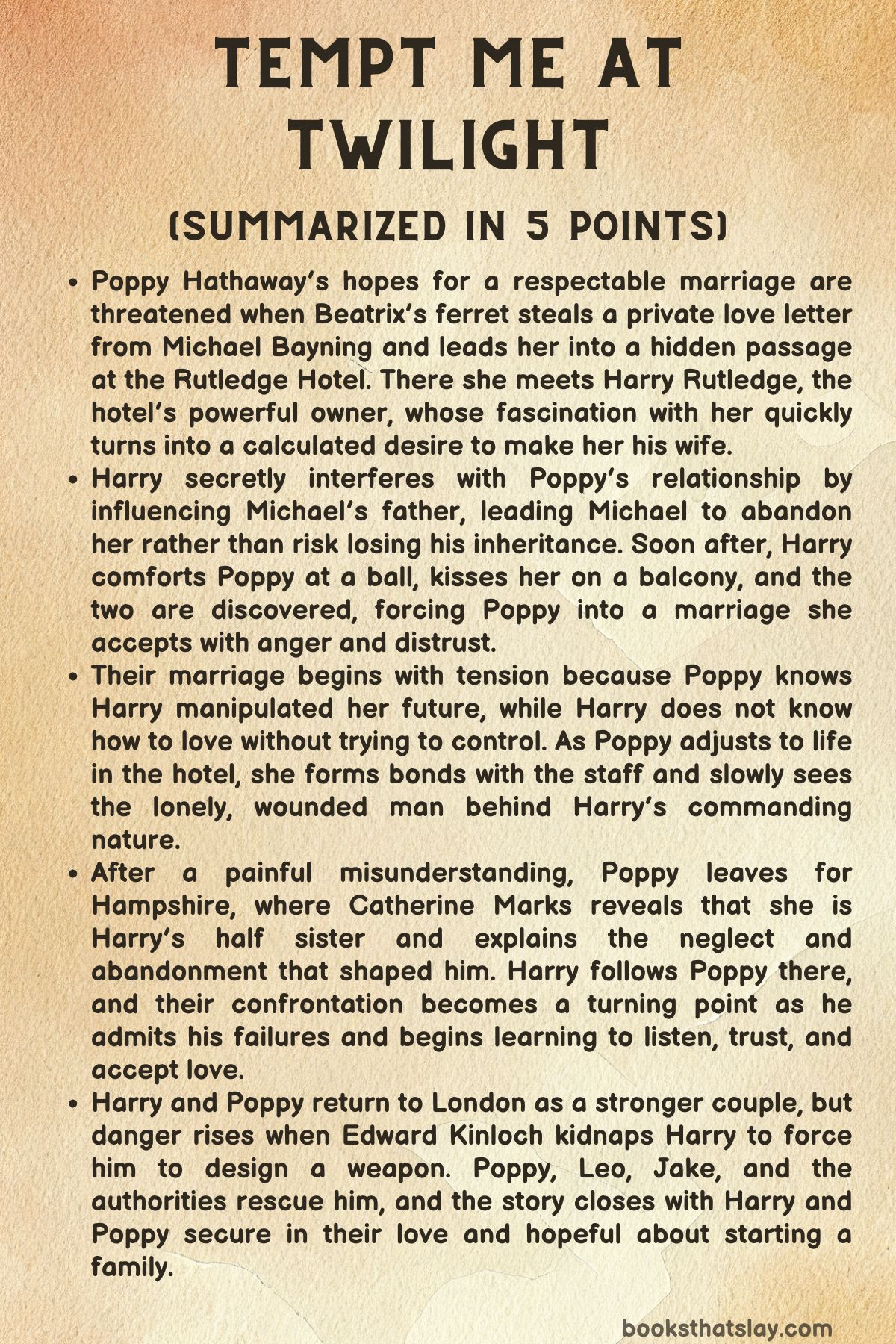
Summary
Poppy Hathaway wants a quiet, respectable future, and for a time she believes Michael Bayning will give it to her. Their romance is secret, but she hopes it will soon become an accepted courtship.
That hope is shaken when her sister Beatrix’s ferret, Dodger, steals a private love letter from Michael and runs through the Rutledge Hotel. Poppy chases him because the letter could damage her reputation if anyone finds it.
In the confusion, she discovers a hidden passage behind a fireplace. Instead of escaping unseen, she meets Harry Rutledge, the mysterious and powerful hotel owner.
Harry is immediately struck by Poppy. She is intelligent, curious, and far livelier than the society women he usually encounters.
He brings her into his private room of curiosities, where she responds to rare objects, books, inventions, and history with genuine interest. Their conversation reveals her quick mind and open nature.
Harry unsettles her with his forceful presence, then kisses her before letting her go. Poppy is shaken and does not yet understand how much the encounter has changed Harry’s intentions.
After she leaves, Harry finds and reads Michael’s stolen letter. It proves that Michael loves Poppy and intends to seek his father’s approval.
Harry sees the attachment as an obstacle, not a boundary. Through his loyal assistant Jake Valentine, he arranges a secret meeting with Michael’s father, Viscount Andover.
His goal is clear: he wants to remove Michael from Poppy’s life and place himself in her future.
Poppy continues to believe Michael may soon speak publicly. Her family is concerned because his courtship remains hidden, but she hopes a social outing will force clarity.
When Michael finally meets her, he is pale and miserable. He tells her his father has forbidden the match and threatened to disinherit him.
Poppy offers patience, and her family would even support an elopement, but Michael cannot give up wealth, position, and family approval. He returns her letters and ends their relationship, leaving her devastated by lost love and public humiliation.
To protect her reputation, the Hathaways insist that she attend a ball and show society she has not been destroyed by rejection. Poppy tries to remain composed, but the gossip is cruel, and seeing Michael with another woman hurts her further.
Harry appears and draws her away to a balcony. There, he comforts her with unexpected gentleness.
Their conversation turns into a passionate kiss, and they are discovered by witnesses. The scandal leaves Poppy compromised, and marriage to Harry becomes the practical solution.
Poppy does not accept him blindly. In the rose garden, she asks Harry direct questions about his character, ambition, honesty, danger, and fidelity.
Harry admits he is not morally gentle and that he has shaped his life through power and manipulation, but he insists he will not lie to her and will keep his wedding vows. Poppy does not love him, but refusing him would deepen the scandal and threaten her family’s standing.
She agrees to marry him, asking only for a simple betrothal ring.
On the wedding day, Michael returns and tells Poppy the truth: Harry influenced Lord Andover in order to destroy their match. Michael begs her to run away with him, claiming he no longer cares about inheritance or scandal.
Harry arrives, nearly loses control, and confirms the emotional truth of the accusation. Poppy understands that Michael’s rebellion has come too late.
He once chose safety over her, and she doubts he could live happily outside the world he values. She marries Harry, but warns him that she may never forgive him and may never love him.
The early days of the marriage are tense. Harry has prepared luxurious private apartments for Poppy, but she feels trapped and angry.
He is intensely attracted to her, yet he does not want her merely as an unwilling wife. Their wedding night is sensual and combative, and Harry stops before fully claiming the marriage.
As Poppy tours the hotel, she feels warmth toward the employees and takes interest in their lives. Harry treats the hotel as a business machine and tries to keep emotional distance between his wife and the staff.
Poppy’s presence alters the hotel. The staff respond to her kindness, humor, and curiosity, while Harry grows both jealous and fascinated by her influence.
He tries to give her jewels, carriages, gowns, and comfort, but Poppy resists the idea that gifts can replace trust or affection. At a diplomatic supper, she proves herself socially skilled and intellectually capable.
Harry is proud of her, but their marriage remains strained because he wants closeness while still trying to control the terms of it.
Their bond deepens when Poppy injures her ankle and Harry panics with genuine concern. His care is excessive but tender, and Poppy begins to see the frightened man behind his commanding manner.
Still, their conflicts continue. Harry wants obedience and predictability; Poppy wants freedom, purpose, and emotional respect.
When she objects to his possible involvement in designing a more effective weapon, he is shaken by her moral clarity. During the argument that follows, their marriage is finally consummated, but Poppy experiences pain, and Harry is horrified by the thought that he has hurt her.
He leaves, and she misreads his withdrawal as rejection.
Confused and wounded, Poppy goes to Hampshire with Leo. There, Catherine Marks reveals that she is Harry’s half sister and explains the cruelty of his childhood.
Harry grew up neglected in his father’s hotel, emotionally starved and abandoned by his mother. Poppy begins to understand why he fears abandonment and why love is so foreign to him.
She realizes sympathy alone will not heal him, but forgiveness may allow them to begin honestly.
Harry follows her to Hampshire in anger and fear. Cam delays him and fights him, testing whether he can master himself.
When Harry finally reaches Poppy, their confrontation becomes a turning point. He cannot honestly regret separating her from Michael because he wants her too much, but he can admit he has failed to be the husband she needed.
He promises to listen. Poppy meets him with desire and forgiveness, and their marriage becomes truly mutual for the first time.
In Hampshire, Harry experiences family life as he never has before. The Hathaways’ warmth, teasing, loyalty, and practical care open a new world to him.
He helps Leo and Merripen solve estate problems and begins repairing his bond with Catherine. Poppy and Harry grow playful and trusting together, and Harry learns that home is not a building he controls but the place where he is loved.
Trouble returns when Michael, drunk and unstable, comes to the hotel with a revolver and fires during a struggle. Poppy is angry because he endangers Harry and innocent people, not because she still wants him.
Harry mistakes her fear for lingering attachment, but she makes clear that her concern is for him. Later, she gives Harry an engraved pocket watch, and his jealousy gives way to a confession of love.
Poppy tells him she loves him too.
Soon after, Harry disappears. Poppy knows something is wrong and works with Jake, Leo, and Bow Street to find him.
Suspicion falls on Edward Kinloch, an arms manufacturer angered by Harry’s refusal to design a weapon. Leo’s architectural eye helps identify a hidden room in Kinloch’s house, where Harry has been imprisoned and pressured to create the gun design.
Poppy and the others rescue him, and Harry returns to the hotel with a changed understanding of belonging. By the end, Poppy may be pregnant, and Harry’s joy shows how completely love has transformed his expectations.
Once certain he would always be alone, he now wants family, trust, and a future with Poppy.
Characters
Poppy Hathaway
In Tempt Me at Twilight, Poppy Hathaway is defined by the tension between her wish for ordinary safety and the extraordinary world around her. She is the Hathaway sibling most attached to the idea of a respectable, peaceful life.
Her love for Michael Bayning represents that dream at first, because he seems to offer social acceptance, familiar courtship, and a place in the world without chaos. Yet Poppy is not dull or timid.
Her curiosity, intelligence, and humor make her stand out immediately, especially when she meets Harry in the hidden passage and matches his interest in rare objects, politics, history, and inventions. Her emotional growth comes from learning that security without courage is fragile.
She begins the novel wanting a life that will not embarrass or unsettle her, but she ends it understanding that love may require risk, confrontation, and forgiveness. Poppy’s strength lies in her refusal to be purchased, managed, or reduced to a prize.
She wants affection freely given, moral accountability, and a marriage in which her inner life matters. Her forgiveness of Harry is not weakness; it is a decision made after she sees both his wrongdoing and his pain.
Harry Rutledge
Harry is the character who gives Tempt Me at Twilight much of its moral tension. He is brilliant, disciplined, wealthy, and accustomed to controlling every part of his environment.
The Rutledge Hotel is not only his business but also an extension of his mind: hidden passages, private rooms, strict systems, and constant management all reflect his need to command the world before it can wound him. His pursuit of Poppy is ethically troubling because he manipulates Michael’s father and uses scandal to force a marriage.
Yet the book does not present him as a simple villain. Harry’s childhood neglect, abandonment, and emotional starvation explain why possession seems safer to him than love.
He has never been taught how to ask, trust, or wait. Poppy unsettles him because she cannot be mastered by gifts, strategy, or desire.
His transformation is gradual and uneven. He does not become gentle all at once, but he learns to listen, apologize, and accept emotional risk.
His love becomes real when he stops treating Poppy as something to win and begins treating her as someone whose freedom is necessary to his happiness.
Michael Bayning
Michael Bayning functions as both Poppy’s lost first love and a measure of the difference between romantic feeling and moral courage. He genuinely loves Poppy, but his love fails when it demands sacrifice.
Faced with his father’s threat of disinheritance, he chooses status, family approval, and social comfort over the woman he claims to want. His later attempt to reclaim Poppy at her wedding is dramatic but unconvincing because it comes only after the damage has been done.
Michael is not without feeling; his decline into drinking, gambling, desperation, and violence shows that losing Poppy affects him deeply. However, the book uses him to show that emotion alone does not make a person worthy.
He lacks the steadiness needed to stand beside Poppy when the cost is high. His drunken visit to the hotel with a revolver marks the collapse of his self-image.
By then, he is less a romantic alternative than a warning about weakness disguised as sensitivity. He loses Poppy not only because Harry interferes, but because he cannot act with the strength love requires.
Catherine Marks
Catherine’s role in Tempt Me at Twilight is layered with secrecy, caution, and guarded compassion. As the Hathaway sisters’ companion, she presents herself as strict, proper, and practical, helping the family survive society’s rules despite their eccentric reputation.
Her dislike of Harry is immediate and personal, long before the full reason is known. When she is revealed as his half sister, her behavior gains new meaning.
She has seen enough of Harry’s darkness to fear what he may do, and she tries to protect Poppy from becoming another person damaged by his will. Catherine also carries her own wounds.
Her nightmares, hidden past, and tense interactions with Leo suggest a woman who has survived by controlling what others can know about her. She is not merely an obstacle to Harry and Poppy’s romance; she is a witness to the emotional cost of family abandonment.
Her gradual softening toward Harry matters because it signals that his change is visible beyond marriage. Catherine’s guarded hope that Poppy is bringing out a better version of him prepares the way for her own story while also deepening the family drama.
Leo Hathaway
Leo Hathaway brings wit, skepticism, and protective force to the novel. As Poppy’s brother, he often masks concern with sarcasm, but his loyalty is never in doubt.
He mistrusts Harry for good reason and is quick to defend Poppy when scandal threatens her. His conversations with Catherine reveal his sharp instincts; he notices inconsistencies in her knowledge of Harry and senses that she is hiding more than she says.
Leo’s role grows especially important when Poppy flees to him after the painful confusion of her marriage. His advice is unexpectedly practical and emotionally honest.
He does not reduce her problems to sentiment, nor does he excuse Harry, but he helps her ask whether forgiveness is possible. Leo also proves his intelligence during Harry’s rescue by identifying the hidden room in Kinloch’s house through architectural asymmetry.
This moment shows that his charm is backed by real competence. His unresolved attraction to Catherine adds a secondary romantic current, and his return to Hampshire at the end signals that his own emotional defenses are beginning to fail.
Amelia Hathaway
Amelia is the family’s emotional anchor and one of Poppy’s clearest sources of comfort. She understands the damage society can do to a woman’s reputation, but she is never cold or calculating in her response to Poppy’s pain.
When Michael abandons Poppy, Amelia offers sympathy without making Poppy feel weak. She is also practical enough to suggest elopement and family financial support, showing that her loyalty to her sister matters more than rigid social convention.
Later, in Hampshire, Amelia becomes the person Poppy can speak to about the confusion of marriage, desire, hurt, and forgiveness. Her advice is earthy, direct, and loving.
She encourages Poppy not to wait passively for Harry to become emotionally fluent, but to meet him with courage and claim the marriage she wants. Amelia’s importance lies in her balance of warmth and decisiveness.
She represents the Hathaway habit of turning crisis into action. Her marriage to Cam also provides a contrast to Poppy’s troubled beginning, showing that love can include passion, stability, and respect when both partners learn how to make room for each other.
Cam Rohan
Cam Rohan is calm, perceptive, and quietly formidable. As Amelia’s husband, he stands slightly outside the Hathaway bloodline, but he is fully part of the family’s protective circle.
His confrontation with Harry after the balcony scandal shows that he is not intimidated by wealth or power. Cam has investigated Harry and understands both his reputation and his vulnerabilities, which allows him to speak to him as an equal rather than as a frightened relative.
Later, in Hampshire, Cam delays Harry and provokes a fight, not out of simple hostility but as a test of Harry’s control and seriousness. Cam’s advice also influences Harry’s growth.
He explains that Hathaway women need freedom and visible affection, not confinement or silent provision. This guidance is crucial because Harry has assumed that luxury and protection should be enough.
Cam’s own steadiness makes him an example of masculine strength that does not depend on domination. He can fight, warn, and challenge, but he can also listen, interpret emotion, and support the family without needing to control every outcome.
Beatrix Hathaway
Beatrix is the catalyst for much of the story’s beginning, because her ferret Dodger steals Michael’s letter and accidentally sends Poppy into Harry’s hidden world. She is eccentric, animal-loving, fearless, and more delighted by oddity than frightened by it.
Where Poppy wants respectability, Beatrix finds adventure almost irresistible. Her comments about Harry watching Poppy like a predator show that she has strong instincts beneath her playful manner.
She often sees truths others try to soften. Her handling of the escaped macaque also proves her intelligence and composure.
While others panic, Beatrix understands animal behavior and helps solve the problem without cruelty. She is important because she reflects the Hathaway family’s refusal to fit neatly into society’s expectations.
Her presence reminds Poppy that a life too carefully planned may not be as safe as it appears. Beatrix’s approval of Harry, though unusual enough to make others uneasy, suggests that she recognizes something alive and interesting in him.
She adds humor, disruption, and insight, often moving events forward without intending to.
Jake Valentine
Jake Valentine is Harry’s loyal assistant and one of the few people who understands the demands of Harry’s world from the inside. His background as an illegitimate child and former blacksmith gives him toughness, discretion, and a deep appreciation for the opportunity Harry has given him.
Jake respects Harry’s intelligence and fairness, but he is not blind to his employer’s ruthlessness. He notices the effect Poppy has on Harry and becomes a quiet observer of the marriage’s transformation.
His loyalty is practical rather than sentimental; he follows instructions, protects the hotel, and acts quickly when Harry disappears. Yet he also helps Poppy leave for Hampshire when she is distressed, which shows that he recognizes her emotional need even when it complicates Harry’s wishes.
Jake’s position between servant, confidant, and operative makes him essential to the hotel’s inner life. He represents competence without social power, and his steady presence helps reveal that Harry inspires devotion not only through fear or wages but through a hard-won trust among those who work closest to him.
Kev Merripen
Merripen is a quieter but forceful member of the Hathaway family, defined by protectiveness, physical strength, and deep loyalty. He is not as verbally sharp as Leo or as socially smooth as Cam, but his presence carries weight.
When Harry arrives in Hampshire and the confrontation with Cam escalates, Merripen is ready to step in, making clear that the family’s defense of Poppy is not symbolic. His advice to Harry after Poppy becomes angry about Michael’s armed visit is also revealing.
Merripen understands that logic alone cannot answer a wife’s fear, especially when that fear comes from love. His blunt guidance helps Harry see that Poppy’s anger is not proof of attachment to Michael but evidence of concern for Harry’s safety.
Merripen’s role in the timber-moving discussions also shows the practical nature of the estate and the family’s shared investment in making life better for tenants. He contributes steadiness, watchfulness, and a grounded kind of wisdom.
His marriage to Win, along with her pregnancy, adds another sign of family continuity.
Win Hathaway
Win Hathaway brings softness, grace, and emotional clarity to the family scenes in Hampshire. Her welcome of Poppy when Poppy arrives distressed shows her instinctive kindness.
She does not demand explanations before offering shelter. Win’s own marriage to Merripen gives her a quiet authority on love that has survived hardship, and her presence helps make Ramsay House feel like a place of recovery.
Her pregnancy announcement interrupts the confrontation between Harry, Cam, Merripen, and the family, shifting the emotional atmosphere from violence to astonished joy. This moment is important because it reminds everyone, including Harry, that family life is not only conflict and defense but also renewal.
Win is not central to the main romance, but she helps create the environment that teaches Harry what he has lacked. Through her, the household feels nurturing rather than merely chaotic.
Her gentleness does not make her weak; it gives the family a sense of peace that contrasts sharply with the emotional barrenness of Harry’s childhood.
Mrs. Pennywhistle
Mrs. Pennywhistle is one of the hotel figures who helps reveal what Poppy brings into Harry’s world. She understands the staff, the rhythms of the hotel, and the emotional climate of the Rutledge marriage more clearly than Harry might expect.
Her observations about Poppy needing affection, companionship, and purpose are accurate and generous. She can see that luxury alone will not satisfy a woman who wants meaningful human connection.
Mrs. Pennywhistle’s warmth toward Poppy helps the young bride feel that the hotel might become a home rather than a gilded cage. At the same time, her willingness to discuss Harry’s happiness with the staff shows how invested the workers are in their employer’s private life.
She is a maternal, practical presence within the hotel community. Her role is not dramatic, but it is important because she recognizes the emotional truth of the marriage before Harry can name it.
Through her, the hotel becomes a living community rather than just a setting of wealth and service.
Monsieur Broussard and Chef Rupert
Monsieur Broussard and Chef Rupert represent the lively domestic heart of the Rutledge Hotel. Their kitchen scenes give Poppy a space where she can taste, laugh, observe, and feel useful.
The experimental apple pudding is more than a comic detail; it shows the creativity and human warmth of the staff. For Poppy, the kitchen offers what Harry’s private apartments do not at first: companionship without pressure.
These characters also help show why Harry’s insistence on emotional distance from employees is unrealistic. The hotel runs on human relationships, not just rules and schedules.
Monsieur Broussard and Chef Rupert respond to Poppy because she treats them as people with skill and personality. Their presence widens the novel beyond the central couple, making the hotel feel active and socially layered.
They also contribute to the staff’s quiet hope that Poppy will change Harry. In their scenes, the contrast between Harry’s controlled world and Poppy’s relational nature becomes clear without needing open argument.
Dodger
Dodger, Beatrix’s ferret, is small but structurally vital to the plot. By stealing Michael’s letter, he causes the accident that brings Poppy into the hidden passage and places her directly in Harry’s path.
Dodger is an agent of disorder, and in this novel disorder often exposes truths that polite society tries to hide. Without him, Poppy’s secret romance might have continued quietly, Harry might never have become fascinated by her, and the central marriage might never have occurred.
Dodger also reflects Beatrix’s influence on the family. The Hathaways live with animals, accidents, and odd interruptions as part of ordinary life, while Harry’s hotel is built on discipline and control.
The ferret’s chaos therefore becomes a challenge to Harry’s sealed world. His theft of the letter is comic, but the consequences are serious.
Dodger shows how chance, embarrassment, and family eccentricity can redirect lives more powerfully than careful planning.
Lord Andover
Lord Andover is the social force that breaks Michael’s promise to Poppy. As Michael Bayning’s father, he embodies aristocratic control, inheritance pressure, and the fear of marrying beneath expectation.
His threat to disinherit Michael exposes the fragility of Michael’s love. Lord Andover does not need much direct presence to affect the story because his authority works through money and obedience.
Harry’s manipulation of him also reveals how power can be used indirectly. By influencing Andover, Harry does not simply compete with Michael; he attacks the social foundation on which Michael depends.
Lord Andover’s role is important because he represents the old system Poppy initially hopes to enter through marriage. That system demands conformity and punishes romantic independence.
In choosing not to run away with Michael later, Poppy recognizes that Michael remains tied to his father’s world, even when he claims otherwise. Lord Andover therefore becomes a symbol of the life Poppy thought she wanted and the limitations she eventually outgrows.
Lord and Lady Norbury
Lord and Lady Norbury are central to the public scandal that changes Poppy’s future. Their ball is meant to help her appear composed after Michael’s rejection, but it becomes the setting where her reputation is compromised beyond easy repair.
Lady Norbury’s willingness to vouch for Harry gives him social access, while her later discovery of Poppy and Harry on the balcony turns a private emotional moment into public consequence. The Norburys represent the watchful eyes of society, where appearances can become fate within seconds.
They are not villains, but their presence shows how little privacy a young woman has once gossip begins. Poppy’s life is altered because respected witnesses see enough to draw the expected conclusion.
Through them, the novel shows how reputation is created collectively, often without full knowledge of motive or truth. Their role is brief but decisive, because they provide the public confirmation that makes marriage to Harry seem unavoidable.
Edward Kinloch
Edward Kinloch is the external villain of the later plot, and his importance lies in the way he converts moral disagreement into violence. As an arms manufacturer, he wants Harry’s mind for destructive purposes.
Harry’s refusal to design a more effective weapon shows the influence Poppy has had on him and the growth of his moral awareness. Kinloch’s kidnapping of Harry proves that the world Harry operates in is genuinely dangerous; his enemies are not imaginary, and his power has consequences.
Kinloch also gives Poppy the chance to act decisively for Harry. By helping identify him as a suspect and taking part in the rescue, Poppy is no longer merely the woman Harry pursued or wronged.
She becomes his defender. Kinloch’s hidden room also gives Leo an opportunity to prove his practical intelligence.
As an antagonist, Kinloch sharpens the final movement of the story by threatening Harry’s body and freedom just after his emotional defenses have begun to fall.
Special Constable Hembrey
Special Constable Hembrey represents lawful investigation and public order during Harry’s disappearance. His report about the stable boy’s sighting gives Poppy, Leo, and Jake a concrete path toward Kinloch.
He is not as emotionally central as the family or hotel staff, but he helps move the rescue from panic to action. In a story where Harry often relies on private systems, hidden passages, and personal networks, Hembrey’s presence is a reminder that official structures still matter.
His role also shows that Poppy’s fear is taken seriously once evidence emerges. The search for Harry is not treated as a private marital crisis alone; it becomes a public crime requiring organized response.
Hembrey’s practical contribution allows the rescuers to narrow the search and reach the place where Leo’s architectural insight becomes useful. As a minor figure, he adds credibility to the rescue sequence and helps place Harry’s danger within the wider city.
Mr. Brimbley
Mr. Brimbley is the hotel steward whose office contains the hidden passage Poppy discovers while chasing Dodger. His importance is mostly structural, but it is meaningful because his workspace becomes the gateway between the respectable surface of the hotel and its secret interior.
Through his office, Poppy crosses from guest territory into Harry’s hidden domain. Mr. Brimbley also represents the complex machinery of the Rutledge Hotel, where servants, managers, offices, corridors, and private systems all operate beneath the polished luxury seen by guests.
Although he does not shape the romance directly, his office allows the story’s first major accident to happen. The fact that such a secret entrance exists in an employee’s space also reflects Harry’s layered control of the hotel.
Mr. Brimbley’s role reminds readers that great houses and hotels depend on unseen workers and unseen rooms, and that the most important turns in a life can begin in places society overlooks.
Mr. Lufton
Mr. Lufton is one of the hotel employees endangered by Michael Bayning’s drunken visit with a revolver. His fright matters because it shifts the event from a private romantic breakdown to a public act of danger.
Michael does not simply embarrass himself or threaten Harry; he terrifies an innocent worker and disrupts the safety of the hotel. Through Mr. Lufton, the consequences of aristocratic male despair become visible to people with less power.
This helps Poppy see Michael more clearly. Her anger after reading about the incident is not jealousy or lingering love.
It is moral outrage that he risked others because he could not bear his loss with dignity. Mr. Lufton’s role also reinforces the staff’s vulnerability.
They serve in an environment shaped by wealthy guests, powerful owners, and external threats, yet they are the ones who may suffer when those forces collide. His fear gives the incident emotional weight beyond gossip.
Lord Pencarrow
Lord Pencarrow appears through the comic report of an elderly guest’s accident involving a banister. His role is minor, but it contributes to the hotel’s sense of constant motion and human unpredictability.
The Rutledge Hotel may be designed for elegance and order, yet guests bring frailty, vanity, mishaps, and absurdity into it every day. Lord Pencarrow’s incident gives the letter from Jake a touch of humor before the darker news about Michael and the revolver.
This contrast matters because the novel often balances danger with domestic comedy. Lord Pencarrow is not central to Poppy and Harry’s emotional journey, but his situation reminds readers that the hotel is filled with many lives at once.
For Harry, such problems are usually matters of management. For Poppy, they are signs of people needing care.
The comic discomfort surrounding Lord Pencarrow helps preserve the lively, social texture of the hotel world.
Meredith Clifton
Meredith Clifton appears in Leo’s London life just before Poppy arrives seeking help. Her interrupted attempted seduction of Leo serves two purposes.
First, it shows that Leo is still restless and not fully settled in his emotional life. Second, it highlights the strength of his loyalty to Poppy.
The moment his sister arrives in distress, Meredith becomes irrelevant, and Leo shifts immediately into protective brotherhood. Meredith is less important as an individual than as a glimpse of the life Leo might use to distract himself from deeper feeling, particularly his unresolved attraction to Catherine.
Her presence also adds a light social edge to the scene, showing the contrast between flirtation and family crisis. Through her, the novel briefly displays Leo’s charm and availability, then undercuts it by showing where his true priorities lie.
She helps mark the transition from Leo as a witty secondary figure to Leo as a brother capable of seriousness and care.
The Nagarajan Diplomats
The Nagarajan diplomats are tied to the escaped blue macaque, an incident that reveals several central character traits. Their concern over the animal’s safety and diplomatic significance raises the stakes beyond hotel inconvenience.
The macaque is intended as an important gift, so Harry’s anger is partly about reputation and partly about the danger of a public incident. The diplomats’ alarm when violence is considered helps expose the limits of Harry’s practical ruthlessness.
Poppy and Beatrix respond differently, seeking a humane solution, and Beatrix’s knowledge of animals saves the situation. The diplomats therefore help create a scene where cultural protocol, hotel management, animal behavior, and Hathaway eccentricity meet.
Their role also gives Poppy and Harry a chance to interact under pressure. Harry sees Poppy’s courage and compassion, while Poppy sees both his protectiveness and his capacity for harsh decisions.
The diplomats remain secondary, but the situation around them reveals much about the central figures.
Themes
Love as a Choice Made After Disillusionment
Poppy’s romantic journey does not move from innocence to an easy reward. It begins with a love that seems safe and socially acceptable, then breaks when Michael cannot choose her over inheritance and approval.
That disappointment strips away her belief that respectable courtship automatically means dependable devotion. Harry, by contrast, begins as the wrong man in nearly every practical and moral sense: dangerous, manipulative, secretive, and too accustomed to possession.
Yet the emotional force of Tempt Me at Twilight comes from watching love become a choice made with open eyes rather than a dream protected from reality. Poppy does not forgive Harry because his actions were harmless.
She forgives him after understanding the damage he caused, the wounds that shaped him, and the effort he begins to make. Harry’s love also changes from acquisition to commitment.
At first, he wants Poppy because she fascinates him and because he refuses to lose. Later, he wants her happiness even when it requires listening, restraint, apology, and trust.
The theme suggests that lasting love is not proven by intensity alone. It is proven when both people accept truth, cost, and responsibility.
Control, Fear, and the Need for Emotional Safety
Harry’s need for control is one of the central forces shaping the story. The hotel’s hidden passages, strict routines, private rooms, and disciplined staff mirror the way he has built his life: nothing should surprise him, abandon him, or expose need.
His childhood taught him that dependence leads to pain, so he turns power into protection. This makes him impressive but also emotionally dangerous.
He tries to secure Poppy through strategy, scandal, gifts, and rules because those are tools he understands. Poppy’s resistance exposes the failure of control as a substitute for safety.
She does not feel cherished when Harry arranges her life without asking, and she does not feel loved when he offers jewels in place of vulnerability. Her idea of safety is relational rather than material.
She wants to be heard, trusted, and allowed to care about others. The marriage begins to heal only when Harry understands that keeping Poppy close physically is not the same as making her feel secure.
Emotional safety requires freedom from coercion, room for anger, and the confidence that love will not be withdrawn when truth is spoken.
Family as a Cure for Isolation
The Hathaway family is noisy, strange, loyal, and socially imperfect, but it offers the one thing Harry has never known: a place where belonging does not have to be earned through usefulness or power. Poppy’s family protects her fiercely, but they also challenge one another, tease one another, and make room for disorder.
Their love is active. Amelia comforts and advises, Leo protects and questions, Cam tests and interprets, Beatrix disrupts and perceives, while Win and Merripen create a sense of steadiness in Hampshire.
When Harry enters this world, he is forced to experience family not as obligation or inheritance but as daily participation. He helps with estate problems, sees Leo’s competence, speaks with Catherine as a brother, and watches affection operate without calculation.
This changes him because it gives him a model he cannot build alone. The theme is not that family is perfect or always gentle.
The Hathaways can be blunt, chaotic, and suspicious. Yet their loyalty creates an environment where damaged people can begin again.
For Poppy, family gives her the courage to forgive without losing herself. For Harry, it offers a first lesson in being loved without having to command the room.
Reputation, Gender, and Public Consequence
Poppy’s fate is repeatedly shaped by the rules governing female reputation. A stolen letter, an unchaperoned moment, a kiss on a balcony, and the presence of witnesses all carry consequences far beyond private intention.
The society around her gives men more room to make mistakes, recover, and redefine themselves, while a woman’s future can be altered by appearance alone. Michael can retreat from their courtship and still remain socially eligible, but Poppy must attend a ball to prove she is not broken by rejection.
When she and Harry are discovered together, marriage becomes the accepted solution not because anyone fully understands what happened, but because public interpretation has already hardened. This theme gives the romance its pressure.
Harry exploits society’s rules to secure Poppy, which makes his pursuit morally troubling. At the same time, those rules existed before him and would punish Poppy regardless of her intentions.
The book uses reputation to show how social order can become a cage, especially for women who must appear calm while others judge them. Poppy’s eventual happiness does not erase the injustice of that system, but it allows her to build a freer private life within its limits.