The Book Witch Summary, Characters and Themes
The Book Witch by Meg Shaffer is a fantasy novel about the power of stories, the people who protect them, and the strange border between fiction and reality. At its center is Rainy March, a Book Witch who can enter novels to repair damage caused by enemies who want to erase books they consider unworthy.
What begins as a magical rescue mission grows into a mystery about love, family, authorship, and identity. The novel treats books as living worlds, showing how fictional characters can change real lives and how readers, writers, and stories depend on one another.
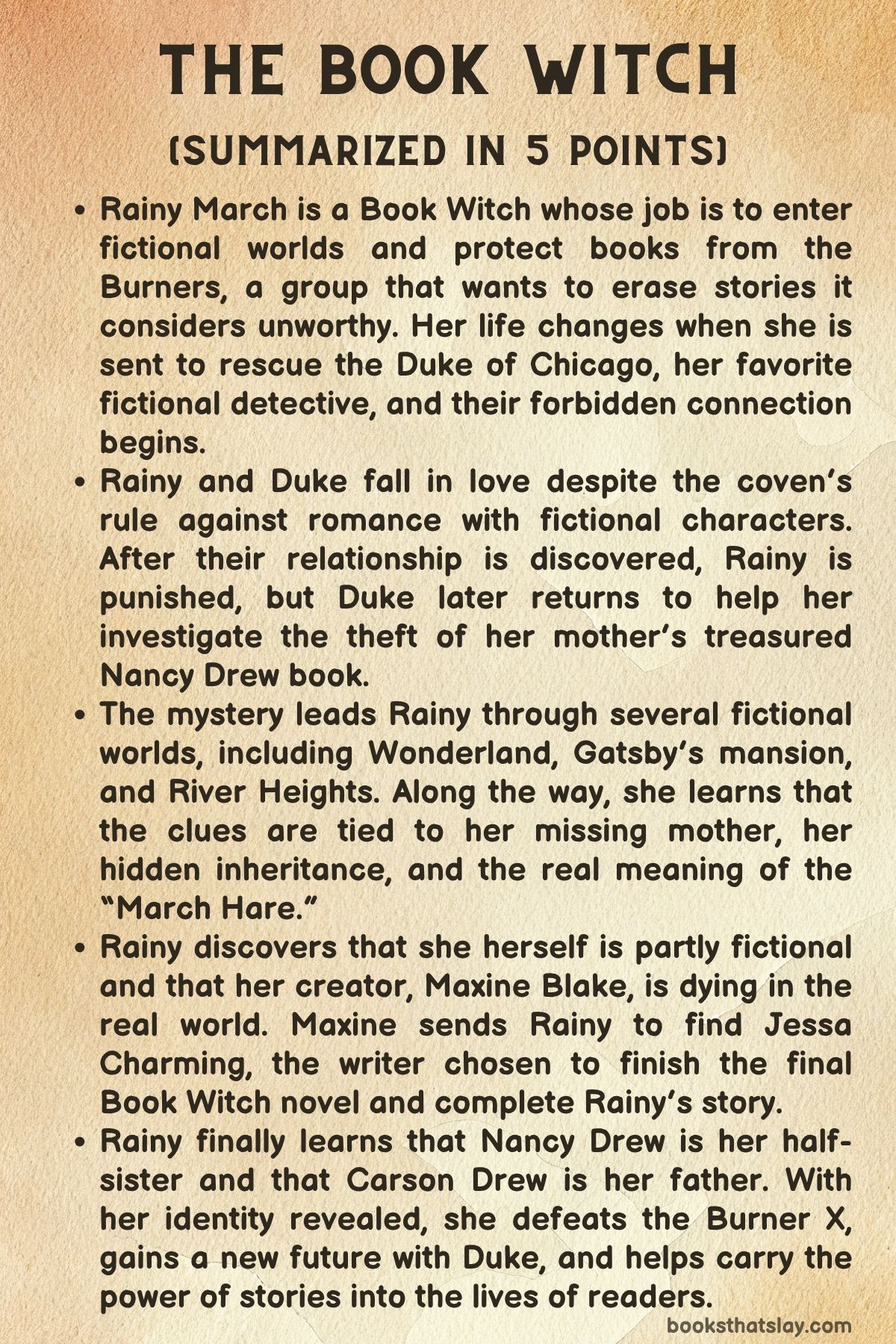
Summary
Rainy March is a young Book Witch from the Ink and Paper Coven, a magical order that protects fiction from a destructive rival group known as the Burners. The Burners enter books and damage them from within, erasing plot, characters, and meaning until stories disappear from both memory and existence.
Book Witches travel into novels with the help of black umbrellas, restore balance, and defend the right of all stories to live, not only the so-called classics approved by narrow-minded guardians of literature.
Rainy lives with her grandfather, Sullivan “Pops” March, and her cat familiar, Koshka. Her life changes when the coven leader, Dr. Regina Fanshawe, sends a case involving Rainy’s favorite fictional detective, the Duke of Chicago.
Duke is the hero of a noir mystery series that helped Rainy survive her grief after her mother’s death. Pops considers the assignment too dangerous because Rainy is emotionally attached to Duke, but Rainy insists that her deep knowledge of his world makes her the best choice.
After reciting the coven’s strict rules, including the ban against falling in love with fictional characters, Rainy enters Duke’s book.
Inside 1930s Chicago, Rainy finds Duke tied up in a hidden room in a speakeasy. He quickly sees through her disguise and begins charming her, even while danger surrounds them.
Rainy learns that his captor is X, a Burner she has faced before. X plans to burn the story from the inside and reveals to Duke that he is fictional.
Rainy is forced to confirm the truth. Duke’s new awareness shakes the book world, and when the building starts collapsing, he suddenly gains the power to alter his own narrative.
He saves Rainy and takes them to his detective office.
As Rainy and Duke spend time together, their attraction grows. He struggles with the knowledge that his past, including the deaths of his brothers, was written rather than lived in the ordinary human sense.
Rainy helps him see that his story still matters because fiction can guide, comfort, and change real readers. Duke gives Rainy his mother’s mourning ring, which contains a forget-me-not flower, and she leaves without erasing his memory, breaking protocol because she cannot bear to make him forget her.
Back in her world, Rainy misses Duke intensely. Eight days later, her longing somehow pulls him out of his book and into reality.
Their relationship becomes secret and forbidden. For nearly a year they find ways to be together, but eventually the coven discovers the romance.
Rainy is punished and placed on probation, while Fanshawe confiscates her Duke of Chicago books. A year after their forced separation, Rainy is still miserable, working at Pilcrow House and restoring old Gothic romances as penance.
A new assignment sends Rainy after Elizabeth Bennet, who has gone missing from Pride and Prejudice. Rainy finds Elizabeth at an Oregon beach, fascinated by the ocean and modern freedom.
Elizabeth is tempted by a world where women can study and choose more freely, but Rainy convinces her that her role in her own story matters to generations of readers. Rainy lets her watch the sunset before returning her to the novel, but because she is slightly late, Fanshawe punishes her by taking her umbrella.
Rainy returns home to find that her mother Ellery’s treasured copy of The Secret of the Old Clock has been stolen from the wall safe. Soon after, Duke appears at her door, violently displaced into the real world.
Rainy realizes that magical dust from a Little Free Library, combined with her own longing and a Duke book she received from Penny Nichols, accidentally summoned him. Mrs. Turner, the housekeeper, encourages Duke to investigate the theft, and he suspects that Pops’s unexplained absence may be connected.
Rainy and Duke search Pops’s desk and find clues about Ellery’s Nancy Drew book. A hidden message suggests that Ellery left Rainy an inheritance that changes everything about stories and may allow Rainy and Duke to be together.
Pops briefly calls from an unknown place and tells Rainy to find the March Hare. Rainy and Duke first assume this points to Alice’s Adventures in Wonderland, but the book is magically locked because it is too important to enter directly.
To bypass the lock, they enter The Great Gatsby and use Gatsby’s library to reach a copy of Alice’s story inside the fictional world.
In Wonderland, they find the Mad Tea Party abandoned and a place setting waiting for Rainy. A clue tells them they have the wrong March Hare and that the answer is staring them in the face.
Their investigation sends them back to Rainy’s world, where Duke continues to help her and their feelings rise again. They consult Medda Baker, a mystery writer and bookstore owner, who helps them view the case as if it were a mystery plot.
Medda reveals that the copy of The Secret of the Old Clock Duke bought from her shop is actually the stolen book, hidden where Rainy could find it.
The clue eventually leads Rainy to an old amusement park with Alice-themed exhibits, but the March Hare there turns out to be a false lead. A security guard catches Rainy and Duke, and Duke improvises a romantic proposal to explain their presence.
Rainy then sees how Duke’s fictional stories once helped the guard through a dark time, giving him courage to change his life. This moment reminds Duke that fictional characters can have real effects on living people.
Rainy later realizes that the March Hare may connect not only to Wonderland but also to Through the Looking-Glass. Before she can act on this insight, she falls through a mirror into a strange hallway where she meets Maxine Blake.
Maxine reveals that she is Rainy’s author. Rainy herself is fictional, the heroine of a successful series about Book Witches.
Maxine has written Rainy’s life, including her grief and longing, and Rainy is shaken by the discovery. Maxine explains that she is dying and cannot finish her final book, The March Hare Mystery.
She sends Rainy into the real world to find Jessa Charming, the writer chosen to complete the story. The phrase March Hare is a pun: Rainy must find the March heir.
Rainy enters the real world through a mirror and lands in the Santa Barbara Public Library during Maxine’s funeral. There she learns how beloved the Book Witch series is and how much it has shaped readers, writers, and librarians.
She meets Anthony, Maxine’s husband, and delivers Maxine’s final message to him. Anthony recognizes who Rainy is and helps her understand Maxine’s life.
Maxine had loved Nancy Drew as a child and once risked herself to read to another orphan who was dying. Rainy says goodbye to her creator at the cemetery, then finds Jessa Charming nearby.
Jessa is afraid to finish Maxine’s book, believing herself unworthy. Rainy insists that Maxine chose her for a reason and promises to believe in Jessa if Jessa believes in her.
Jessa finally agrees to write, allowing Rainy to return to her own story. Once back at Pilcrow House, Rainy finally understands the real March Hare clue.
Penny Nichols, the cheerful apprentice with rabbit ears and a mysterious background, is actually Nancy Drew in disguise.
Rainy enters Nancy’s book and arrives in River Heights. Nancy confirms that she is Penny and guides Rainy toward the truth.
Rainy discovers that her mother, Ellery, once became trapped in River Heights, lost her memory after breaking a coven rule, and fell in love with Carson Drew. Ellery married Carson and became pregnant with Rainy before eventually recovering her memory and leaving.
Fanshawe later concealed the truth and charmed Carson to forget Ellery. Rainy realizes that Carson Drew is her father and Nancy is her half-sister.
Because Rainy is half-human and half-fictional, many coven rules do not apply to her in the same way.
Pops appears and explains that he had discovered the same truth but became trapped while investigating. Nancy and Pops had shaped the mystery so Rainy could uncover her identity herself.
Rainy chooses not to break Fanshawe’s spell on Carson yet, not wanting to cause him the pain of remembering Ellery before she is ready. She still gets to meet him, and Nancy introduces Duke as Rainy’s fiancé, giving Rainy a small but meaningful connection between her father and the man she loves.
The victory is interrupted when X arrives and tries to kill Rainy after learning she is fictional. Rainy embraces her new power as a person of both worlds.
She takes control of the scene, turns his gun into a harmless object, blocks his lighter, and finally banishes him into Dante’s Inferno as punishment for his attacks on literature.
Six months later, Rainy’s life has changed. She visits Carson in River Heights, Nancy spends time in Rainy’s world as Penny, and Pops replaces Fanshawe as coven leader.
The rules soften, including the rule against loving fictional characters. Rainy then arranges for Medda Baker to complete Duke’s unfinished final novel and write both Rainy and Mrs. Turner into it.
In that new story, Duke meets Rainy as his secretary and falls in love with her again.
The novel closes with Frankie, a fan of the Book Witch series who once helped Rainy in the real world. Reading the completed The March Hare Mystery inspires Frankie to pursue her dream of opening a bookstore.
When she hesitates, Rainy appears at her door, thanks her for fixing her umbrella, and tells her she must open the store. Rainy then vanishes, proving that stories continue to reach outward, changing readers long after the final line.
Characters
Rainy March
Rainy March is the emotional and moral center of The Book Witch, a heroine defined by love for stories, grief for her mother, and a stubborn belief that fiction matters. At the beginning, she is a talented Book Witch who tries to obey the coven’s laws, but her private attachments make obedience difficult.
Her love for the Duke of Chicago begins as admiration for a fictional comfort figure, then becomes a real relationship that challenges everything she has been taught. Rainy’s greatest conflict is not simply choosing between duty and romance; it is learning that identity, love, and reality are more complicated than the coven allows.
Her longing for Duke, her need to know the truth about Ellery, and her anger at Fanshawe’s secrecy all push her toward self-knowledge. When she discovers that she is partly fictional, the revelation could destroy her sense of self, but instead it gives her language for what she has always felt: she belongs to stories and to the real emotions they create.
Rainy’s final power comes from accepting every part of herself rather than trying to fit one fixed category. She is a protector, daughter, sister, lover, reader, and character at once.
The Duke of Chicago
The Duke of Chicago is both a noir detective and a romantic hero, but the book gives him more depth than the charming archetype he first appears to be. He begins as the idealized figure Rainy has loved through books: handsome, clever, flirtatious, brave, and wounded by loss.
Once he learns that he is fictional, his confidence is shaken, and his usual detective control cannot fully protect him from the pain of being written by someone else. His journey is about dignity.
He has to decide whether a life shaped by an author can still be meaningful, and Rainy helps him understand that meaning does not depend on being ordinary flesh-and-blood. Duke’s effect on Adam, the security guard whose life changed after reading his stories, gives Duke the proof he needs that his courage has mattered beyond his own world.
In romance, Duke is bold and persistent, but he is not only a fantasy of escape. He wants a future with Rainy and repeatedly challenges rules that treat fictional people as lesser beings.
His love is connected to recognition: Rainy makes him feel real, and he makes Rainy feel seen beyond her duties and grief.
Koshka
Koshka, Rainy’s feline familiar, is a quiet but important presence in the story. She often acts before the human characters fully understand what is happening, leading Rainy toward clues, locating people, and serving as an instinctive guide through dangerous or confusing spaces.
As a familiar, Koshka is not merely a pet; she represents Rainy’s connection to magic, intuition, and home. Her presence softens scenes of tension because she carries a sense of companionship that does not require explanation.
She also helps show Rainy’s nature. Rainy’s care for Koshka reveals her tenderness and her habit of forming deep bonds, even while she tries to act disciplined and professional.
In book worlds, Koshka becomes a practical ally, but emotionally she is also a witness to Rainy’s growth. She remains close through missions, heartbreak, investigation, and discovery, giving Rainy a steady point of loyalty while every boundary around her changes.
Sullivan “Pops” March
Pops is Rainy’s grandfather, guardian, mentor, and emotional anchor. His protectiveness sometimes appears strict, especially when he tries to stop Rainy from taking the Duke case, but his caution comes from experience and love rather than simple control.
He understands the dangers of storycraft and knows that emotional attachment can make a Book Witch vulnerable. His secrecy around Ellery’s past and his own investigation complicates him, because he is not completely open with Rainy even when his intentions are protective.
Pops represents an older form of duty, one built on rules, responsibility, and the preservation of knowledge. Yet he is also capable of change.
By the end, when he becomes coven leader, he does not simply preserve the old system; he reforms it. His decision to make Nancy a Book Witch and loosen the rule against loving fictional characters shows that he has learned from Rainy’s life.
Pops’s strength lies in his willingness to protect tradition without worshipping it.
Dr. Regina Fanshawe
Dr. Regina Fanshawe functions as an authority figure whose commitment to order becomes harmful. As coven leader, she presents herself as the guardian of rules and discipline, but her behavior reveals fear, pride, and a need for control.
She punishes Rainy harshly, confiscates her umbrella, and compares her unfavorably to Ellery, using Rainy’s grief as a weapon. Her greatest wrongdoing is concealing the truth about Rainy’s parentage and charming Carson Drew to forget Ellery.
Fanshawe believes she is preserving boundaries between worlds, but her actions deny people the truth about their own lives. She is not a Burner, yet she shares with them a dangerous certainty that some forms of control are justified for a supposed greater good.
In the book, Fanshawe shows how institutions meant to protect stories can become oppressive when rules matter more than compassion. Her demotion is fitting because the story does not merely punish her; it replaces her kind of leadership with a more humane one.
Penny Nichols / Nancy Drew
Penny Nichols is one of the cleverest disguises in the novel because she hides in plain sight as a cheerful apprentice while secretly being Nancy Drew. Her apparent playfulness, including the rabbit ears and bright manner, masks a precise detective mind.
As Nancy, she is both an iconic fictional sleuth and Rainy’s half-sister, which gives her role emotional power beyond the mystery. Nancy cannot simply tell Rainy the truth because the rules of fictional identity require discovery rather than explanation.
Instead, she builds a case that forces Rainy to notice patterns, question assumptions, and reach the answer herself. This makes Nancy both guide and sister: she protects Rainy by giving her the tools to understand her own life.
Her decision to operate inside the coven as Penny also shows adaptability. Nancy belongs to a fictional world, but she refuses to stay limited by it.
Her intelligence is active, generous, and strategic, and her bond with Rainy gives the story a family connection rooted not only in blood but in shared curiosity and courage.
Ellery March / Ellery Drew
Ellery is absent for most of the story, but her presence shapes Rainy’s deepest wounds and desires. Rainy grows up with very little knowledge of her mother, which turns Ellery into an almost mythic figure: perfect, gifted, mysterious, and unreachable.
Fanshawe’s constant praise of Ellery worsens this image, making Rainy feel like she can never live up to a woman she barely knew. The truth makes Ellery more human and more moving.
She was not a flawless legend who chose secrecy for grand reasons; she was a woman who became trapped, lost her memory, fell in love, married Carson Drew, and tried to return to her family while carrying Rainy. Her story is marked by accident, love, and loss rather than simple heroism.
Ellery’s absence cannot be repaired completely, and the book respects that. Even after Rainy finds Nancy and Carson, she still grieves because answers do not replace a mother.
Ellery matters because she turns Rainy’s identity from a mystery of lack into a history of love.
Carson Drew
Carson Drew is central to Rainy’s hidden inheritance, even though he does not fully understand his own connection to her. As Nancy Drew’s father and Ellery’s husband, he stands at the meeting point between Rainy’s human and fictional origins.
Fanshawe’s spell robs him of his memory of Ellery, making him a victim of control as much as Rainy is. His tragedy is quiet because he does not know what he has lost.
Rainy’s choice not to restore his memory immediately is one of her most mature decisions. She wants to be known by him, but she refuses to satisfy her own longing by causing him sudden pain.
Carson’s importance lies in what he offers Rainy even without full recognition: proof that she was born from love, not secrecy or shame. His warm treatment of her as a daughter, even under the spell, suggests that emotional truth can survive beneath erased memory.
He gives Rainy a family link that is imperfect but deeply meaningful.
Maxine Blake / Medda Baker
Maxine Blake is the author-creator figure in The Book Witch, and her appearance changes the entire meaning of Rainy’s world. As Medda Baker, she enters the story as a mystery writer who helps Rainy think structurally about the case.
As Maxine, she reveals herself as the person who created Rainy and the Book Witch series. She is loving, manipulative, brilliant, vulnerable, and morally complicated.
Her defense of Rainy’s tragic backstory shows the uneasy power authors hold over characters: she has given Rainy purpose, but she has also given her pain. Maxine’s own childhood explains her devotion to books.
Nancy Drew gave her courage, and book burning taught her that stories need defenders. By creating Rainy, she transforms personal suffering into a heroine who protects literature.
Yet Maxine is not all-powerful by the end. Her illness prevents her from finishing the final book, so she must trust Jessa and Rainy.
Her final act is not control but surrender: she sends her creation beyond the boundaries of the written world and accepts that stories must outlive their authors.
Jessa Charming
Jessa Charming represents inheritance, artistic fear, and the burden of continuing another writer’s work. She loves Maxine’s books so deeply that she built part of her own identity around them, even choosing a pen name that reflects Rainy March.
This makes her both the right successor and the person most frightened by the role. Her hesitation does not come from indifference but from reverence.
She worries that she cannot honor Maxine’s creation properly, and that fear nearly stops her from accepting the task. Rainy’s appeal to Jessa is powerful because it reverses the reader-character relationship.
Jessa has believed in Rainy for years; now Rainy asks Jessa to believe in herself. Jessa’s agreement to finish the final book shows that literary legacy requires courage from those who come after.
She is not replacing Maxine but carrying the story forward, proving that authorship can be shared across time, influence, and love.
Anthony Blake
Anthony Blake is Maxine’s husband and one of the novel’s gentlest figures. His love for Maxine gives the reader a view of her beyond fame and authorship.
Through Anthony, Maxine becomes not only a literary icon but a wounded, brave, beloved person with a private history. His eulogy reveals the childhood act that shaped her life: reading Nancy Drew to a dying orphan at great personal cost.
Anthony’s grief is restrained but deep, and Rainy’s message that he was Maxine’s favorite story gives him a final gift from the woman he loved. He also helps Rainy navigate the real world after Maxine’s death, treating her not as an impossibility but as someone deserving care and respect.
Anthony stands for the human relationships behind books: the spouses, friends, and witnesses who know the author not only through published work but through daily love.
X
X is the clearest villain in The Book Witch, but he is more than a simple destroyer. As a Burner, he believes in a narrow hierarchy of literature, where only certain approved classics deserve survival and other stories can be erased.
His violence comes from contempt: he does not merely dislike books; he wants to control what counts as worthy imagination. His attacks expose the danger of treating taste as moral law.
X’s decision to reveal Duke’s fictional nature is especially cruel because he uses truth as a weapon, hoping knowledge will break Duke’s sense of self. When he later tries to kill Rainy after learning that she is fictional, his hatred becomes even more direct.
He fears characters who know what they are and readers who love too widely. Rainy’s defeat of him is playful but just, turning his tools of harm into useless objects before sending him into a punishment suited to his crimes against stories.
He embodies censorship, arrogance, and the fear of living literature.
Mrs. Turner
Mrs. Turner begins as a practical housekeeper at Pilcrow House, but her history gives her a quiet sadness. She is revealed to be a character who escaped from the Sherlock Holmes stories and gradually lost her memory of her original identity.
Her existence shows the cost of leaving one’s fictional world without a stable place in another. She is not unhappy in a simple way, but she carries a sense of dislocation she cannot fully name.
Rainy uses Mrs. Turner’s condition to show Duke what might happen if he stays permanently in the real world: a fictional person may gain freedom but lose the structure that made them whole. Yet Mrs. Turner is not merely a warning.
She is loyal, observant, and active in the household, and she supports Duke’s investigation by “hiring” him to find the stolen book. Her later inclusion in Duke’s completed story suggests repair, giving her a chance to belong again inside a narrative that can hold her.
Elizabeth Bennet
Elizabeth Bennet’s brief appearance is one of the book’s clearest examples of how fictional characters can desire more than their original circumstances. When Rainy finds her at the beach, Elizabeth is not running from responsibility out of selfishness.
She is responding to the shock of modern possibility: education, independence, and a world larger than the social limits of her own setting. Her fascination with the ocean mirrors her hunger for freedom.
Rainy’s task is difficult because she respects Elizabeth’s intelligence and understands why modern life tempts her. The scene avoids treating Elizabeth as a prop; she becomes a person facing the painful choice between individual curiosity and the meaning her story holds for readers.
Her return to Pride and Prejudice reinforces one of the novel’s central ideas: a character’s written role can matter without making that character’s desires meaningless.
Adam
Adam, the amusement park security guard, appears briefly but plays a key emotional role in Duke’s development. At first, he is an obstacle, catching Rainy and Duke where they should not be.
Duke’s improvised proposal turns the scene comic, but the moment becomes serious when Adam recognizes something in Duke. Rainy’s magic reveals that Adam read Duke’s books during the isolation of the COVID-19 lockdown and found the courage to leave an unfulfilling job and pursue teaching.
Adam proves to Duke that fictional courage can create real courage. He is not important because of his authority at the park; he is important because he is a reader whose life was altered by a story.
Through him, the book gives concrete evidence that characters matter outside their plots. Adam becomes a living answer to Duke’s fear that being fictional makes him lesser.
Frankie
Frankie begins as a fan who helps Rainy in the real world by fixing her damaged umbrella, but she becomes part of the novel’s final statement about readers. She attends Maxine’s funeral as someone shaped by the Book Witch series, and later she reads the completed book that includes the very encounter she partly remembers.
Her dream of opening a bookstore shows how reading can become action. Like many readers, Frankie hesitates because dreams are risky, expensive, and uncertain.
Rainy’s final visit gives her the push she needs, turning inspiration into decision. Frankie’s role closes the circle between author, character, and reader.
Maxine created Rainy, Rainy influenced Jessa, Jessa helped finish the story, and that story reaches Frankie. Through Frankie, the novel suggests that the real ending of a book may happen in the life of someone who reads it.
Themes
The Power of Stories to Change Real Lives
Stories in The Book Witch are not treated as decoration or escape from life; they are active forces that alter choices, identities, and futures. The clearest proof comes through characters like Adam and Frankie.
Adam reads the Duke of Chicago books during a lonely period and finds the courage to leave a job that is draining him. Frankie reads the completed Book Witch novel and finally moves toward her dream of opening a bookstore.
These moments show that fiction does not need to be literally real to produce real consequences. Rainy’s entire vocation is built on this belief.
She protects books because every story may be the one that reaches a reader at the exact moment they need courage, comfort, or a new way to understand themselves. The Burners’ crime is not only destroying paper or plot; it is cutting off future transformations that no one can predict.
The novel argues that stories matter because they continue their work quietly inside readers. A book may be invented, but the hope, bravery, grief, or decision it awakens can become part of actual life.
Love Across Boundaries
Rainy and Duke’s romance challenges every boundary the coven tries to enforce. The rule against loving fictional characters assumes that the division between real and fictional is clear, fixed, and morally necessary.
Rainy’s life proves otherwise. Her love for Duke begins in reading, becomes a relationship, and finally becomes part of her own identity as someone who is herself partly fictional.
Their romance asks whether love is invalid if one person comes from a written world. The answer the story gives is no, but it does not make the relationship simple.
Duke could lose his place in his own books, Rainy could lose her standing in the coven, and both of them must face the pain caused by different forms of existence. Their love matters because it forces a larger ethical change.
Pops eventually relaxes the rules, suggesting that institutions must adapt when love reveals truths the law refuses to recognize. The romance is not only about desire; it is about personhood.
Rainy and Duke love each other because each sees the other as fully real, even when the world around them denies that possibility.
Identity, Authorship, and Self-Discovery
Rainy’s search for the March Hare begins as a mystery about a stolen book and a hidden family history, but it becomes a deeper search for selfhood. She believes she is a human Book Witch with a dead mother and an unknown father.
Then she learns that Maxine Blake created her, that she is a fictional heroine, and later that Carson Drew is her father and Nancy Drew is her half-sister. Each revelation changes her understanding of herself, yet none of them erases who she has already been.
The novel treats identity as layered rather than singular. Rainy is written by an author, born from Ellery and Carson, raised by Pops, shaped by grief, and changed by love.
She is not less real because she has origins in fiction. In fact, her power grows when she stops trying to separate these parts.
The mystery structure reinforces this theme because Rainy cannot simply be told who she is; she must solve herself. Discovery gives her ownership.
By the time she defeats X, she is no longer waiting for an author, leader, or rulebook to define her.
Censorship, Literary Value, and Who Gets to Decide
The Burners believe they are defending literature by destroying books they consider lesser, but the novel exposes this as arrogance disguised as taste. Their devotion to “the classics” is not true love of literature; it is a desire to control what others are allowed to read, value, and remember.
X’s violence shows the endpoint of this thinking. Once a person believes only certain stories deserve survival, readers become less important than a rigid idea of cultural purity.
The Book Witches stand against that logic by protecting romance, mystery, fantasy, children’s books, detective stories, and every kind of fiction that may speak to someone. The novel does not reject classics; it rejects using classics as weapons against other books.
Rainy’s work at the Little Free Library captures the healthier vision of reading. She fills it with books that local readers need, not books chosen by one authority as universally superior.
Literary value becomes personal, communal, and unpredictable. A story’s worth may appear years later in a reader’s changed life, which means no censor can know what should be erased.