The Shoemaker’s Holiday Summary, Characters and Themes
The Shoemaker’s Holiday is a lively Elizabethan city comedy by Thomas Dekker, first performed near the end of the sixteenth century. The work celebrates London’s tradespeople, especially shoemakers, while also exploring love, class, marriage, loyalty, and civic pride.
At its center are two love stories: Rowland Lacy and Rose, whose families oppose their match, and Ralph and Jane, a married working-class couple separated by war. Around them stands Simon Eyre, the loud, generous shoemaker whose rise from tradesman to Lord Mayor gives the play its comic energy and its warm faith in ordinary London life.
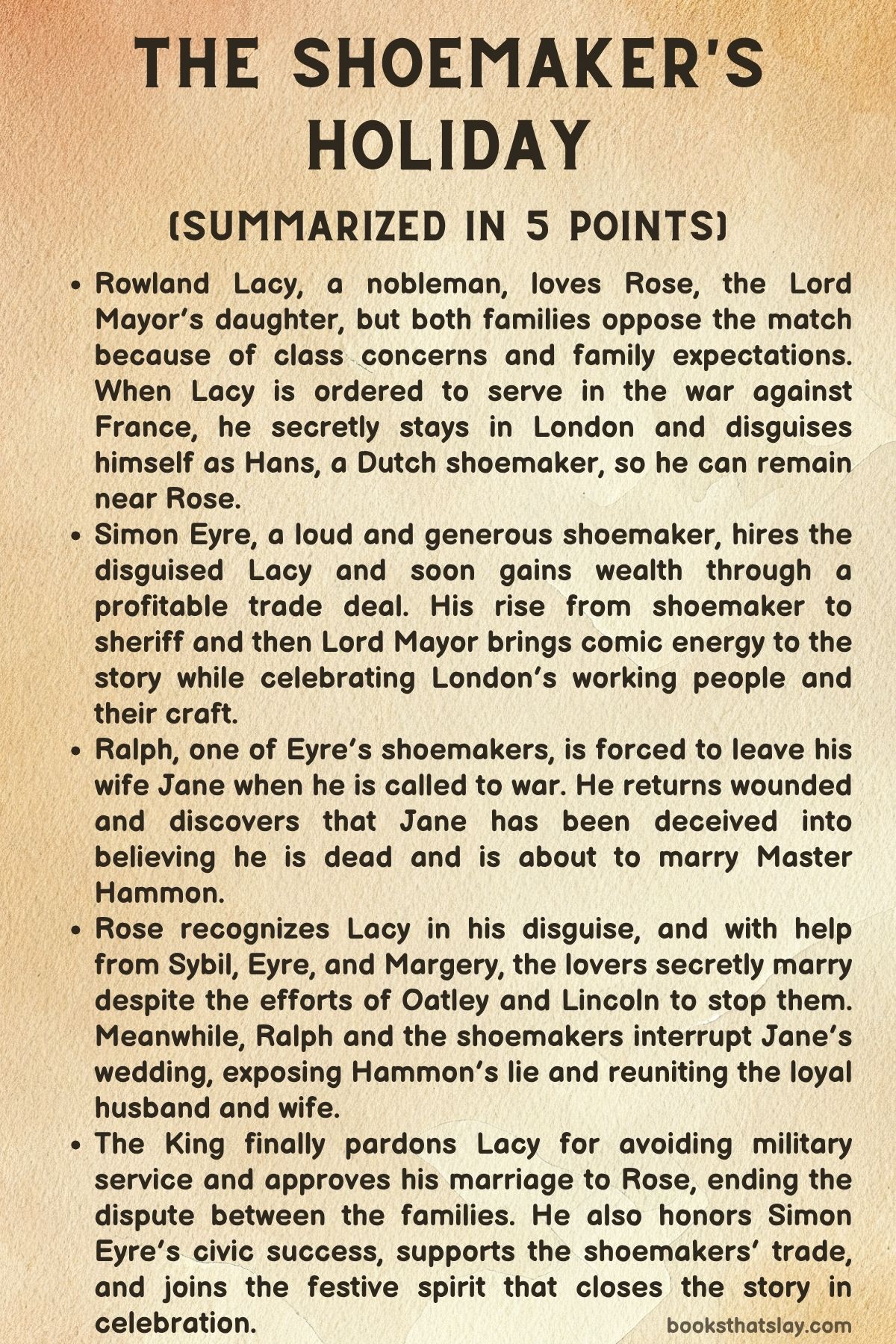
Summary
The Shoemaker’s Holiday begins with a modest appeal to the audience, asking them to receive the play kindly. The opening mood is anxious but playful, as the actors depend on public favor.
From there, the story moves quickly into the social and romantic tensions that shape the action.
The Earl of Lincoln and the Lord Mayor of London, Oatley, discuss a problem that troubles them both. Lincoln’s nephew, Rowland Lacy, loves Oatley’s daughter, Rose.
Neither older man approves of the match. Oatley believes Rose is below Lacy in rank and worries that marriage into the nobility would damage her fortune and happiness.
Lincoln also opposes the relationship, partly because he thinks Lacy is irresponsible and partly because he wants his nephew to obey family expectations. Lacy has already shown a habit of spending freely and avoiding duty, and Lincoln fears that love for Rose will distract him further.
A military campaign against France gives both men a way to separate the lovers. Lacy has been given command in the army and is ordered to leave England.
Lincoln expects him to go, and Oatley is glad to see him removed from Rose’s reach. Lacy promises honor to his family, but once he is alone with his cousin Askew, he reveals that love matters more to him than military command.
He plans to delay his departure and find a way to stay near Rose.
The play then introduces Simon Eyre, a loud, energetic shoemaker of Tower Hill, along with his wife Margery and his workers Firk and Hodge. Ralph, one of Eyre’s young shoemakers, has been called to serve as a soldier under Lacy’s command.
Ralph’s wife, Jane, is devastated by the separation. The shoemakers plead for Ralph to be released, but Lacy refuses.
Ralph accepts his duty with dignity, gives Jane a pair of shoes he has made for her, and asks her to remember him while he is away. His departure brings a serious note into the comedy, showing the cost of war for ordinary households.
Rose, meanwhile, is kept away from London by her father. She longs for Lacy and feels trapped by family control.
Her maid Sybil brings news from the city, but Rose cares only for word of her lover. She sends Sybil back to discover what has happened to him and whether he has truly left for France.
Lacy has not gone to war. Instead, he disguises himself as Hans, a Dutch shoemaker, and seeks work in Simon Eyre’s shop.
By taking on the identity of a foreign craftsman, he hides his noble status and enters the world of trade. Eyre is hesitant at first, but Hodge and Margery persuade him to hire the newcomer because he appears to be skilled.
Firk mocks his accent, and the shop welcomes him with drink, humor, and work. Lacy’s disguise allows him to stay in London while searching for Rose.
At the same time, another suitor appears. Master Hammon, a gentleman, encounters Rose while hunting near her father’s property.
He flirts with her, and Oatley sees him as a suitable husband for his daughter. Rose, however, has no interest in him.
Oatley later tries to encourage the match, but Rose rejects Hammon’s compliments and declares that she would rather remain unmarried than accept a man she does not love. Hammon privately realizes that he is drawn more strongly to another woman.
That woman is Jane. While Ralph is away at war, Jane works as a seamstress.
Hammon pursues her, although she remains loyal to her absent husband. He tells her he wants to marry her, but she insists that she is already married.
Hammon then uses a cruel deception: he shows her a list that supposedly names soldiers killed in France, and Ralph’s name appears on it. Jane believes the report and breaks down in grief.
Even then, she resists moving on quickly, but Hammon pressures her until she says that, if she ever does remarry, it will be him. His conduct reveals selfishness hidden under polite manners.
The shoemaker plot rises alongside the love plots. Lacy, still disguised as Hans, helps Eyre discover a chance to buy valuable goods from a foreign skipper at a low price.
The deal makes Eyre wealthy. His new fortune transforms his social position.
He moves from successful tradesman to sheriff and then toward the office of Lord Mayor. Margery enjoys the new status and worries about the clothing and manners expected of her as a woman of rank.
Eyre, however, remains proudly himself. He enjoys wealth and office, but he does not abandon the language, humor, or fellowship of the shoemakers.
When Eyre visits Oatley with his shoemakers, they perform a dance. Rose recognizes Lacy beneath his disguise.
Lacy also sees Rose but continues pretending to be Hans. Their brief exchange confirms that their love has survived separation and secrecy.
Sybil helps arrange a meeting between them. Soon Rose and Lacy plan to elope.
Lacy hopes Eyre will use his growing authority to protect them, and Eyre agrees. Because Hans has helped him become rich, Eyre feels bound to return the kindness.
The older generation grows suspicious. Lincoln learns that Lacy was not in France and that Askew led the troops in his place.
He realizes that his nephew must still be in England because of Rose. Oatley also tries to keep Rose away from Lacy, but his efforts fail.
When Sybil reports that Rose has eloped with Hans, Oatley is furious, not yet fully understanding that Hans is Lacy. Lincoln suspects the truth.
Firk then misleads both men by telling them that the wedding will take place at St. Faith’s. In fact, Rose and Lacy are being married elsewhere, at the Savoy, with help from Eyre and Margery.
The false information sends Lincoln and Oatley into the middle of another crisis. Ralph has returned from war wounded and limping.
He comes back to Eyre’s shop looking for Jane, but no one knows exactly where she is. Soon a servant brings a shoe to the shop as a pattern for wedding shoes needed by a bride who is to marry Hammon.
Ralph instantly recognizes the shoe as the one he made for Jane before leaving for war. He understands that Jane is the intended bride.
With the support of the shoemakers, he prepares to stop the wedding.
At St. Faith’s, Jane arrives with Hammon and the wedding party. Ralph and the shoemakers block the marriage.
Jane sees that her husband is alive and runs to him. She rejects Hammon at once, horrified that he led her to believe Ralph was dead.
Hammon first tries to treat Jane as something that can be bargained for, offering Ralph money to give her up. Ralph refuses, and the shoemakers angrily defend him.
Jane chooses her true husband, regardless of his poverty and injuries. Hammon finally recognizes his wrongdoing and gives money as a gift rather than a bribe before leaving.
Lincoln and Oatley arrive at the church, expecting to find Rose and Lacy. Instead, they find Ralph and Jane reunited.
Firk mocks their confusion, and Dodger brings word that Rose and Lacy are already married. The older men decide to appeal to the King, hoping royal authority will undo the marriage.
The final movement of the play brings the King, the new Lord Mayor, the lovers, and the shoemakers together. Eyre has arranged a great feast for the apprentices and shoemakers, celebrating the craft and honoring St. Hugh, the patron saint of shoemakers.
Lacy asks Eyre to seek the King’s pardon for his desertion from military duty and to defend his marriage to Rose. Eyre agrees and approaches the King in his bold, comic fashion.
The King pardons Lacy, recognizing that his fault came from love rather than cowardice. Lincoln and Oatley object to the marriage, especially because of rank, but the King resolves the matter by approving the union.
He raises Lacy’s status, making him Sir Rowland, which also raises Rose’s position. The marriage is secured.
Eyre receives royal favor as well. The King approves the naming of Leadenhall and grants Eyre’s request that leather markets be held there twice a week.
This decision honors the shoemaking trade and links Eyre’s personal rise to the prosperity of London’s craftsmen. Eyre then invites the King to join a banquet for the apprentices, fulfilling a promise he made when he was poor.
The play closes with celebration, social reconciliation, and public festivity. Love survives family resistance, marriage is protected from deception, and the laboring world of London receives comic honor through Eyre’s generosity and confidence.
Characters
Simon Eyre
Simon Eyre is the comic center and civic hero of The Shoemaker’s Holiday. He begins as a noisy shoemaker of Tower Hill, full of jokes, boasts, insults, and sudden bursts of generosity.
His language is excessive and theatrical, but his heart is rooted in fellowship. He treats his workers not merely as laborers but as members of a shared craft, and his pride in shoemaking gives the play much of its social warmth.
Eyre’s rise from tradesman to sheriff and then Lord Mayor might have made him cold or self-important, but he refuses to abandon the habits of his old life. He wears office with delight, yet he remains loyal to apprentices, workers, food, drink, and public celebration.
His greatness lies not in refinement but in abundance. He gives, shouts, laughs, feeds, protects, and rewards.
By helping Lacy and Rose, honoring Ralph and Jane’s world, and asking the King to support leather markets, he turns personal success into communal benefit. Eyre represents the possibility that civic authority can grow out of work, humor, and generosity rather than bloodline alone.
Margery Eyre
Margery Eyre is Simon Eyre’s wife, and she brings a practical, sharp, often comic counterforce to her husband’s wild energy. She is concerned with order, clothing, rank, and respectability, especially once Eyre’s fortunes begin to change.
Her reactions to wealth show both vanity and uncertainty. She enjoys being treated as a lady, but she is also anxious about how to act in a higher social position.
This makes her funny, but it also makes her human. Unlike Eyre, who seems able to carry his old self into every new office without embarrassment, Margery feels the pressure of status more strongly.
Her quarrels with Jane and her concern over appearances show her limitations, yet she is not cruel at heart. She supports Eyre, participates in the household’s new fortunes, and helps Lacy and Rose when their marriage needs protection.
In the play, Margery shows how social mobility affects domestic life, especially for a woman expected to perform new forms of gentility.
Rowland Lacy / Hans
Rowland Lacy is a nobleman whose love for Rose leads him to reject military duty and social expectation. His decision to disguise himself as Hans, a Dutch shoemaker, is morally complicated.
On one hand, he deserts a command entrusted to him and places his personal desire above public responsibility. On the other hand, his love is sincere, and his disguise allows him to cross the class barriers that others use to control marriage.
As Hans, he enters Eyre’s shop and becomes part of the shoemaking world, though only temporarily. This disguise softens the difference between nobility and craft labor, but it does not erase it completely.
Lacy can put on the life of a worker because he has the privilege to remove it later. Still, his time in the shop matters.
He helps Eyre gain wealth, earns trust, and proves that love can make rank unstable. In The Shoemaker’s Holiday, Lacy is not a perfect hero; he is romantic, clever, evasive, and dependent on others.
His final pardon shows that the play treats his fault seriously but allows love and royal mercy to repair it.
Rose Oatley
Rose Oatley is the Lord Mayor’s daughter and the beloved of Rowland Lacy. She is placed under strong parental control, but she is never passive.
Her father tries to manage her future through isolation and arranged marriage, yet Rose remains emotionally clear and verbally strong. She rejects Hammon’s courtship with wit and firmness, making it plain that wealth and suitability mean nothing without affection.
Her loyalty to Lacy is steady, but she also shows courage in acting on that love. Once she recognizes him in disguise, she works with Sybil and Lacy to make their marriage possible.
Rose’s position in the play is shaped by class anxiety: she is considered too low for Lacy by noble standards, yet her father sees a gentleman like Hammon as an acceptable match. Through Rose, the story questions the idea that marriage should be controlled by rank, money, or family strategy.
She insists, through action rather than speeches alone, that her own choice matters.
Ralph
Ralph is one of the most sympathetic figures in the play. He is a shoemaker, a husband, and a soldier forced away from his new wife.
His departure for war brings emotional weight to a comic story because it shows how political and military decisions affect ordinary people. Ralph does not resist his duty in a loud or rebellious way.
Instead, he accepts it with dignity, gives Jane the shoes he has made, and leaves behind a token of love and memory. When he returns wounded, scarred, and limping, he carries the physical cost of service.
His first concern is not his injuries but Jane. Ralph’s recognition of the shoe he once gave her is one of the play’s most meaningful moments, because craft becomes proof of love.
The object he made with his hands allows him to reclaim his marriage. Ralph’s refusal to sell Jane to Hammon shows his moral strength.
He is poor and damaged by war, but he possesses a loyalty that cannot be bought.
Jane
Jane is Ralph’s wife, and her story tests the meaning of marital faith under pressure, grief, and deception. At the beginning, she is devastated by Ralph’s departure, and the shoes he gives her become a sign of their bond.
Later, when Hammon tells her that Ralph has died, her grief is immediate and sincere. She does not eagerly replace Ralph; she mourns him and resists Hammon’s advances.
Her eventual conditional agreement to marry Hammon comes from emotional manipulation, not true desire. When Ralph appears alive, Jane’s response is instant and decisive.
She returns to him without hesitation, even though he is wounded and poor. Her choice rejects Hammon’s wealth and exposes the emptiness of a marriage built on falsehood.
Jane’s character gives the story its clearest defense of faithful love among working people. She is vulnerable, but she is not shallow.
Her loyalty survives absence, misinformation, and social pressure.
Firk
Firk is one of the chief comic voices in the play. He is quick with jokes, teasing, wordplay, and mischief, and he often turns serious situations into scenes of disorder and laughter.
Yet beneath his clowning there is loyalty. He mocks Lacy’s Dutch disguise, jokes about Eyre’s rise, and plays with the confusion of Lincoln and Oatley, but he consistently supports the shoemakers and protects those connected to the craft.
His most important act is misleading the older men about Rose and Lacy’s wedding location. This trick helps the lovers while also setting up the comic collision at Jane’s intended wedding to Hammon.
Firk’s humor can be rude and chaotic, but it serves a purpose. He punctures the dignity of powerful men who believe they can control everyone else.
In the story, he represents the unruly intelligence of the workshop, where wit becomes a weapon against authority.
Hodge
Hodge is a steadier figure than Firk and often acts as the practical intelligence of Eyre’s shop. He recognizes the value of the deal with the skipper and understands that it could transform Eyre’s fortunes.
He also helps maintain the work culture of the shoemakers, urging labor when needed and supporting fellowship when the group must act together. Hodge’s loyalty to Ralph is especially important.
When Ralph returns from war searching for Jane, Hodge responds with concern and practical help. He is less flamboyant than Eyre and less mischievous than Firk, but he helps keep the workshop world believable.
Through Hodge, the play gives dignity to skilled labor, business sense, and male friendship within the craft community. He shows that the shoemakers’ world is not only comic noise; it is also built on cooperation, memory, and shared responsibility.
Lord Mayor Oatley
Lord Mayor Oatley is Rose’s father and one of the main representatives of social control in the story. Although he is a civic leader rather than a nobleman, he is deeply invested in hierarchy.
He does not want Rose to marry Lacy because he fears the instability of a match across social lines. His reasoning is partly protective and partly self-interested.
He worries that a noble husband might waste Rose’s fortune, but he also wants to manage her marriage as a matter of status and advantage. His preference for Hammon shows his desire for a controlled, respectable match.
Oatley’s treatment of Rose reveals the limits placed on daughters in marriage arrangements. He cares about her future, but he does not truly listen to her will.
His confusion at the end, when Firk tricks him and Rose has already married Lacy, reduces his authority to comic frustration. The story does not make him evil, but it shows how parental power becomes foolish when it ignores love and choice.
Earl of Lincoln
The Earl of Lincoln is Lacy’s uncle and the strongest voice of aristocratic pride in the play. He expects obedience from Lacy because family honor, inheritance, and noble discipline matter deeply to him.
His objection to Rose is based on rank, and his anger over Lacy’s desertion is sharpened by the sense that private love has embarrassed public duty. Lincoln is more severe than Oatley because he speaks from the confidence of hereditary power.
To him, marriage is not simply personal; it is a matter of bloodline and social order. Yet his authority is repeatedly defeated by disguise, craft loyalty, and royal judgment.
Lincoln can command, threaten, and investigate, but he cannot stop the emotional and comic energies around him. In the end, the King’s approval overrules him.
His role in the play is to show the rigidity of noble status when faced with a city world that is more flexible, lively, and socially mobile.
Master Hammon
Master Hammon begins as a gentleman suitor who appears respectable, but his conduct toward Jane exposes a serious moral weakness. His interest shifts from Rose to Jane, and once he wants Jane, he uses deception to pursue her.
By falsely leading her to believe that Ralph has died, he turns her grief into an opportunity. This makes him one of the more troubling characters in the story, because his manners hide manipulation.
His offer to marry Jane may seem socially generous because she is below him in rank, but the offer is built on a lie and on disregard for her existing marriage. At the church, when Ralph returns, Hammon’s first instinct is still possessive.
His offer of money for Jane treats her like property. However, he does experience a limited moral correction.
When he gives money as a gift and leaves, he acknowledges that he cannot rightfully claim her. Hammon is not a villain without conscience, but he is a warning against desire dressed up as courtesy.
Sybil
Sybil is Rose’s maid and an important helper in the love plot. She carries messages, gathers news, observes events, and assists Rose in maintaining contact with Lacy.
Her presence gives Rose more freedom than her father intends. Sybil is not merely a servant who follows orders; she has opinions, wit, and practical value.
At first, she is skeptical of Lacy and notices arrogance in him, which suggests that she sees more clearly than Rose in some respects. Still, she remains loyal to her mistress and helps arrange the meetings that lead to the secret marriage.
In the play, Sybil belongs to the comic world of clever servants who understand movement, secrecy, and timing better than their social superiors. She helps love succeed not through grand speeches but through practical action.
The King
The King enters late in the story, but his judgment resolves the conflicts that family and city authorities cannot settle. He is amused by Simon Eyre’s personality and seems willing to value plain speech when it is joined with loyalty.
His pardon of Lacy is important because it acknowledges wrongdoing while choosing mercy. He understands that Lacy failed in military duty, yet he treats love as a human motive rather than a sign of treason.
His approval of Lacy and Rose’s marriage also softens the harshness of class boundaries. By knighting Lacy and accepting Rose, he creates a legal and social solution that satisfies honor without destroying love.
His approval of Eyre’s leather markets links royal authority to the welfare of trade. In The Shoemaker’s Holiday, the King functions as the final source of order, but he is not distant or cold.
He joins the festive spirit and allows public joy to become part of political settlement.
Askew
Askew is Lacy’s cousin and a quieter figure, but he matters because he shows loyalty under difficult circumstances. When Lacy delays his departure for France, Askew warns him that Lincoln and others are watching closely.
Even so, he does not betray him. He takes command in Lacy’s place and later becomes associated with the English victory abroad.
Askew’s actions highlight Lacy’s irresponsibility by contrast. While Lacy stays in London for love, Askew carries the burden of military duty.
The play does not give him the same comic or romantic attention as Lacy, but his presence reminds the audience that Lacy’s choices have consequences beyond himself. Askew is dutiful, observant, and loyal, and he helps preserve Lacy’s honor more than Lacy himself does.
Captain Lovell
Captain Lovell represents military authority and the demands of national service. He arrives to confirm the King’s command that Lacy must sail for France, and his function is to bring the pressure of war into the domestic and romantic world of the play.
He is not developed as a deeply personal character, but his presence is necessary because he makes Lacy’s choice serious. Without Lovell’s announcement, Lacy’s disguise might seem like a simple romantic trick.
With the military order in place, Lacy’s decision becomes an act of desertion. Lovell therefore helps create the moral tension that must later be resolved by royal pardon.
Dodger
Dodger is Lincoln’s attendant, and his role is tied to surveillance, news, and pursuit. He brings information from France that reveals Lacy’s absence from the battlefield, and this news triggers Lincoln’s effort to find his nephew.
Dodger also moves between powerful men as a messenger, carrying suspicions and updates that advance the plot. He is not as comic as Firk or as central as the lovers, but he helps expose hidden action.
His name suits his function in a world of evasion and pursuit, where people are constantly hiding, searching, disguising themselves, or being misled.
Master Warner
Master Warner appears as Hammon’s cousin and hunting companion. His role is minor, but he helps establish the social world in which Hammon moves.
During the hunting scene, Warner participates in the atmosphere of leisure, courtship, and gentlemanly pursuit. His flirtation with Sybil mirrors Hammon’s flirtation with Rose, though on a smaller comic scale.
Warner’s presence helps widen the contrast between the gentlemen hunters and the women they encounter. He is part of the world of male privilege, recreation, and casual pursuit that the play later tests through Hammon’s more serious misconduct.
Master Scott
Master Scott is Oatley’s nephew and a supporting civic figure. Oatley turns to him while discussing the intended marriage between Rose and Hammon, which places Scott within the network of family approval and public respectability.
He does not drive the action, but he helps show how marriage decisions are treated as family business rather than private choice. His presence reinforces the social machinery surrounding Rose: fathers, nephews, gentlemen, and officials all speak as if her future can be arranged through consultation among men.
Scott’s minor role therefore supports one of the play’s central conflicts between personal desire and managed marriage.
The Skipper
The skipper is the foreign shipman whose business opportunity changes Simon Eyre’s fortunes. He offers luxury goods at a low price, and this bargain becomes the practical source of Eyre’s rise.
Though he appears only briefly, his role is important because he connects London trade to wider commercial routes. Through him, the shoemaker’s shop is not isolated from the larger world; it is part of a city shaped by ships, imported goods, risk, and sudden profit.
The skipper’s deal also gives Lacy, in his Hans disguise, a chance to benefit Eyre. This act creates the debt of gratitude that later leads Eyre to help Lacy and Rose.
Themes
Love Against Social Control
Love in The Shoemaker’s Holiday repeatedly runs into systems designed to control it: fathers, uncles, class rules, military duty, and public reputation. Rose and Lacy are separated because their families treat marriage as a social arrangement rather than a personal bond.
Oatley worries about money and suitability, while Lincoln worries about noble blood and obedience. Their opposition turns love into a form of resistance.
Lacy’s disguise as Hans is not only a romantic trick; it is a way of escaping the identity that others use to control him. Rose’s refusal of Hammon is equally important because it shows that she has a will of her own, even when her father tries to direct her future.
Ralph and Jane’s marriage offers a working-class version of the same theme. Their love is threatened not by rank but by war, poverty, injury, and Hammon’s deception.
In both relationships, true affection survives pressure from people who believe they have the right to decide for others. The play finally rewards chosen love, but it does not pretend that such love is easy.
It needs courage, loyalty, help from friends, and public recognition before it can become secure.
Class, Work, and Social Mobility
The play treats class as powerful but not fixed. Nobles and civic leaders try to protect social boundaries, yet the action keeps showing how unstable those boundaries can be.
Lacy becomes Hans and enters a shoemaker’s shop. Eyre rises from craftsman to civic leader.
Rose moves upward through royal approval after marriage. These changes create comedy, but they also question the belief that worth belongs only to birth.
Simon Eyre’s success is especially important because it comes through trade, risk, energy, and collective labor. He becomes wealthy through commerce, but the play does not present him as someone who must abandon his old identity to deserve office.
Instead, his value as Lord Mayor comes from the same qualities that made him a memorable shoemaker: generosity, confidence, loyalty, and public spirit. The shoemakers’ craft becomes a source of pride, not embarrassment.
Leather, shoes, markets, apprentices, and workshop jokes all become part of London’s civic identity. The play does not destroy hierarchy entirely; the King still has final authority, and Lacy’s noble rank still matters.
Even so, it gives unusual honor to working people and imagines a city where labor can stand close to power.
Marriage, Loyalty, and Moral Choice
Marriage in the play is not only a romantic goal; it is a test of truth, consent, and moral responsibility. Rose and Lacy’s marriage challenges family authority, but it is based on mutual choice.
Ralph and Jane’s marriage is tested more painfully. Their bond begins in tenderness, symbolized by the shoes Ralph gives Jane before leaving for war.
When Hammon deceives Jane with false news of Ralph’s death, he attacks the foundation of that bond by turning grief into vulnerability. Jane’s near-remarriage is not presented as betrayal because she believes Ralph is dead and is pressured while mourning.
Her immediate return to Ralph proves the depth of her loyalty. Ralph’s conduct is equally revealing.
He refuses Hammon’s money because Jane is not an object to be purchased. That refusal gives the working-class marriage a dignity that Hammon’s gentlemanly status cannot match.
The play contrasts marriages arranged for advantage, pursued through deception, or defended through love. It suggests that a true marriage depends not on wealth or rank but on consent, constancy, and mutual recognition.
The public stopping of Jane’s wedding also shows that community has a duty to defend a rightful bond when private manipulation threatens it.
Festivity, Community, and Civic Harmony
Celebration is not decoration in the play; it is one of the main ways the story imagines a better social order. Songs, dances, drinking, feasts, and holiday customs gather people together across divisions of work, rank, and authority.
Simon Eyre understands festivity as a civic duty. When he becomes powerful, he does not withdraw into private luxury.
He feeds apprentices, honors shoemakers, welcomes the King, and turns his rise into a shared public event. This matters because many conflicts in the play begin with separation: lovers are kept apart, Ralph is sent to war, Jane is isolated by false grief, and class groups distrust one another.
Festivity reverses that movement. It brings bodies into the same space and makes reconciliation visible.
The final banquet does not erase every inequality, but it allows the King, civic officers, lovers, and tradespeople to share a mood of approval and release. Eyre’s request for leather markets also joins celebration to practical benefit.
Community is not only laughter and food; it is also work, trade, and public provision. By ending in holiday rather than punishment, the play imagines London as a place where disorder can be turned into fellowship through generosity, forgiveness, and shared joy.