The Coral Island Summary, Characters and Themes
The Coral Island by R. M. Ballantyne is a classic adventure novel about three boys who are shipwrecked on a Pacific island and must learn to survive with courage, intelligence, and faith. Told through Ralph Rover’s voice, the book follows Ralph, Jack Martin, and Peterkin Gay as they build shelter, find food, explore the island, confront pirates, and become involved in conflicts among nearby island communities.
Published in the nineteenth century, The Coral Island reflects its era’s ideas about empire, Christianity, boyhood, and adventure while presenting a fast-moving story of survival, friendship, danger, and moral testing.
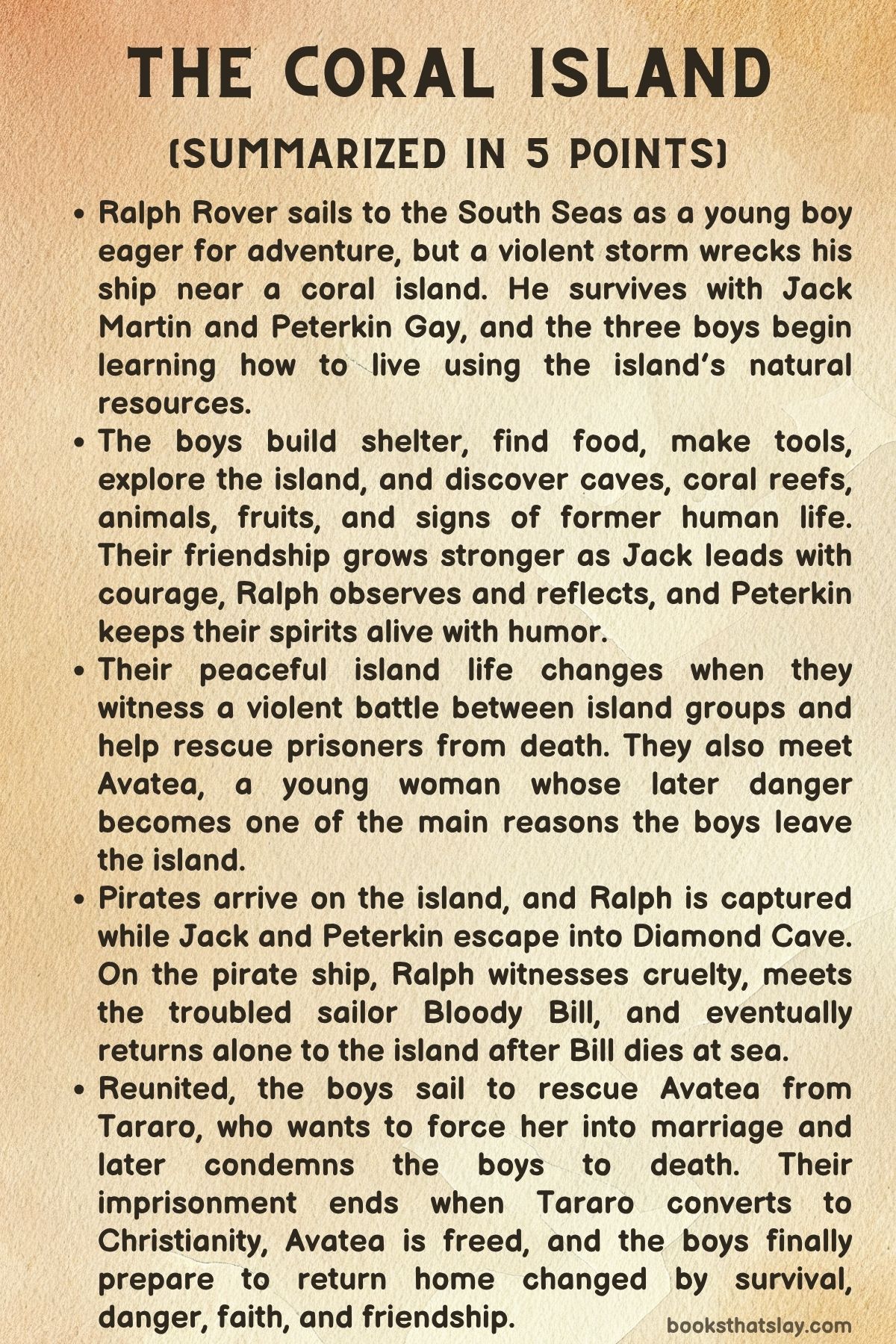
Summary
Ralph Rover grows up with the sea almost written into his life. Born during a storm on the Atlantic Ocean, he inherits a strong desire for travel from his father, a sea captain, and from the wider maritime world around him.
Even as a child, Ralph is drawn to stories of distant islands, especially the coral islands of the South Seas. These places seem to him beautiful, fertile, mysterious, and full of adventure.
When he is fifteen, he persuades his parents to let him go to sea. His mother, anxious but loving, gives him a Bible and asks him to read it and pray.
Ralph joins a merchant ship named the Arrow and begins the voyage that will shape his life.
On board, Ralph becomes close friends with two other boys. Jack Martin is older, stronger, practical, brave, and intelligent.
Peterkin Gay is younger, lively, funny, impulsive, and quick with jokes. The three form a loyal friendship during the voyage.
After the ship rounds Cape Horn, a violent storm hits among the coral islands. The Arrow loses control and is driven toward a reef.
When the ship breaks apart, the three boys cling to a large oar and are thrown into the sea. Ralph loses consciousness and wakes on the shore of a tropical island, with Peterkin beside him and Jack having helped bring them safely to land.
At first, Ralph is afraid that they may starve, be attacked, or die alone. Jack refuses to give in to despair and urges the others to assess their situation.
The boys examine their possessions and discover that they have only a few small items, including a broken knife, cord, a needle, a damaged telescope, tinder, and clothing. Their most important find is an axe lodged in the oar that brought them ashore.
This gives them the means to cut wood, build shelter, make tools, and survive. Jack’s knowledge from travel books becomes extremely useful.
He identifies coconuts, breadfruit, candle-nut trees, edible roots, and other island resources. The boys build a leafy shelter, start a fire, gather food, and begin to treat the island as both a home and a place of discovery.
Their early life on the island is full of exploration. They swim in the lagoon, dive among brilliant coral formations, collect oysters, study marine life, and climb the island’s hills.
From the highest point, Ralph sees that the island is roughly circular, surrounded by a reef, with mountains, valleys, streams, and several openings through the coral barrier. They discover signs that someone lived there before, including old cut marks, timber, a decayed pole, and later a ruined hut.
Inside the hut they find the skeletons of a man and a dog. The sight frightens them and reminds them that their own adventure could end tragically if they become careless or hopeless.
As time passes, the boys grow more capable. Jack makes a knife from iron, they learn to fish, and they build weapons such as a bow, spear, and sling.
They discover a safe diving area called the Water Garden and later find a hidden underwater passage leading into a shining cave, which they name Diamond Cave. They hunt pigs and birds, gather roots and fruit, and explore the island’s strange natural features, including spouting rocks where sea water erupts through channels in the stone.
Peterkin often turns serious situations into comedy, but he also proves brave and useful. Ralph observes and reflects, often thinking about God, nature, and the moral meaning of their experiences.
Jack becomes the leader, guiding the others through practical problems and dangers.
The boys eventually build a small boat using wood, cordage, pitch, and improvised tools. This expands their world beyond the shore.
They sail across the lagoon, visit the reef, study how coral islands form, and make plans to visit a nearby island where penguins live. Their trip to Penguin Island is exciting but dangerous.
On the way back, a storm drives them onto a tiny coral rock where they must shelter for several days. This experience shows how fragile their safety remains, even after months of successful survival.
Still, they return home and continue their island life with confidence.
Their peaceful routine ends when two groups of islanders arrive in canoes. One group is fleeing, and the other is attacking.
The boys watch a violent battle from hiding. When the attackers begin preparing to kill and eat prisoners, Jack decides they must act.
He rushes into the fight, and Ralph and Peterkin help release the captives. The freed men join the battle and defeat the attackers.
Jack also saves a young woman named Avatea and rescues an infant thrown into the sea. Afterward, the boys try to prevent further violence and help bury the dead.
The defeated chief, Tararo, eventually makes peace with them, and his people leave the island after repairing their canoe. Avatea’s sadness as she departs leaves a strong impression on the boys.
Not long after, a schooner appears. At first, the boys hope it means rescue, but they realize it is a pirate ship when it raises a black flag and fires on the island.
The pirates come ashore, raid their shelter, and threaten them. Jack leads Ralph and Peterkin to Diamond Cave, where they escape through the underwater entrance.
Ralph later swims out to scout and is captured by the pirate captain, who had only pretended to leave. Ralph refuses to reveal where Jack and Peterkin are hiding.
He is taken aboard the schooner, separated from his friends, and forced into the company of pirates.
On the pirate ship, Ralph meets Bloody Bill, a rough sailor with a troubled conscience. Bill is kinder than the other pirates and warns Ralph about the captain’s true nature.
Ralph witnesses the crew’s cruelty, including their attack on islanders and their willingness to murder for profit. The captain pretends to respect missionaries, but only because Christianized islands are easier for him to exploit in trade.
Ralph is horrified by the violence around him and begins to fear that constant exposure to cruelty may harden his own heart.
The pirates sail to an island ruled by Chief Romata, where they trade for sandalwood. Ralph also meets Tararo again and learns that Avatea is alive but in danger.
She has refused to marry the chief chosen for her because she loves a Christian chief from another island. Tararo threatens to have her killed if she continues to resist.
Ralph wants to help her, but he is trapped among the pirates. The captain later plans a night attack to steal sandalwood.
Bloody Bill tries to warn the islanders by setting a trap and then firing his own weapon. The raid fails, the pirates are killed, and Bill escapes with Ralph in the schooner, but he has been fatally wounded by the captain.
At sea, Bill fears divine judgment. Ralph comforts him with the Bible verses he remembers, and Bill dies after a storm.
Ralph buries him at sea and sails alone.
After two difficult weeks, Ralph reaches the coral island again. He fires the schooner’s cannon, frightening Peterkin and Jack before revealing himself.
The reunion is joyful. Ralph tells them everything that happened, and Jack and Peterkin explain how they survived after Ralph was taken.
They found the gunpowder barrel Ralph had thrown overboard and had searched the island for him before losing hope. Once Ralph tells them about Avatea’s danger, Jack insists they must rescue her.
The three prepare the schooner, say goodbye to the island that has been their home, and sail away.
They reach Mango, Tararo’s island, and make contact with a Christian missionary teacher living among a small converted community. The teacher tells them that Avatea is alive but imprisoned, that she wants to join the Christians, and that she loves a Christian chief.
He also explains the struggle between older customs and the influence of Christianity on the island. Ralph, Jack, and Peterkin visit the Christian village and see a striking contrast between that settlement and the violent practices they have witnessed elsewhere.
They later observe a battle and then see terrible rituals connected with the dead and with sacrifice. These scenes convince them that Avatea’s danger is real and immediate.
Jack asks Tararo to release Avatea, but Tararo refuses. When Avatea is placed on a ceremonial heap as if she is about to be sacrificed, Jack rushes forward, pulls her away, and challenges the assembled warriors.
The teacher prevents immediate bloodshed, and Tararo postpones Avatea’s fate for three days while detaining the boys’ schooner. The teacher proposes a risky escape: the boys must abandon their vessel and paddle Avatea to a Christian island fifty miles away.
They attempt the rescue by night, but a war canoe pursues and captures them. Brought back to Mango, Jack openly defies Tararo and says he would try to save Avatea again.
Tararo sentences the three boys to death.
They are imprisoned in a dark cave for a month. Fear slowly turns into despair, and even Peterkin loses his humor.
Then, unexpectedly, their guard cuts their bonds and releases them. Outside, the teacher explains that another missionary has arrived and that Tararo has converted to Christianity.
Tararo frees the boys, offers them provisions, and prepares to burn the island’s idols. Avatea is also safe, and her beloved chief has arrived to marry her.
The boys witness the destruction of the idols and the beginning of major change on Mango.
After Avatea’s wedding, the boys prepare to return home. They take volunteers to help sail the schooner to Tahiti, where they hope to find a full crew for England.
The missionary explains that a storm brought him to Mango at the right time, leading to Tararo’s conversion and the boys’ rescue. As the schooner leaves the lagoon, the islanders cheer from the shore.
Ralph, Jack, and Peterkin sail away under the stars, filled with joy at going home but also sadness at leaving behind the islands, dangers, friendships, and lessons that have changed them forever.
Characters
Ralph Rover
Ralph Rover is the narrator and emotional center of the book. He begins as a boy eager for travel, inspired by stories of the sea and the coral islands, but his adventure quickly becomes more serious than anything he imagined.
Ralph is observant, thoughtful, and often more inward-looking than Jack or Peterkin. He notices the beauty of the island, the details of sea life, the habits of animals, and the moral meaning of what happens around him.
His voice gives the story its reflective quality because he does not only describe action; he also thinks about fear, faith, violence, friendship, and growth. In The Coral Island, Ralph’s development is shaped by separation, danger, and responsibility.
When he is captured by pirates, he is forced to face evil without the support of his friends. This part of the book matures him because he sees cruelty at close range and has to protect his own conscience.
His care for Bloody Bill also shows that Ralph is capable of compassion even toward a morally damaged man. By the end, Ralph is no longer only a boy seeking adventure.
He has become someone who understands that adventure can carry suffering, moral duty, and lasting responsibility.
Jack Martin
Jack Martin is the natural leader of the three boys. Older, stronger, and more capable than Ralph and Peterkin, he provides courage and practical intelligence in nearly every crisis.
Jack’s strength is not only physical. He remembers useful information from books, applies it quickly, and turns limited materials into tools, weapons, shelter, fire, and even a boat.
His leadership is calm and active; he does not allow fear to control the group for long, and he often responds to danger by doing the next necessary thing. Jack can be bold to the point of recklessness, especially when he rushes into battle or challenges Tararo’s people to save Avatea.
Still, his bravery is closely tied to his sense of justice. He cannot stand by when the weak are being harmed.
In the book, Jack represents decisive moral action. He is not deeply reflective like Ralph, but his instinct is usually to protect, rescue, build, and confront wrongdoing.
His limitations are also clear. His confidence can lead him into danger, and his view of the world is shaped by the assumptions of his time.
Even so, his loyalty to his friends and his willingness to risk his life make him one of the story’s strongest figures.
Peterkin Gay
Peterkin Gay brings humor, energy, and emotional warmth to the story. As the youngest of the three boys, he often reacts with jokes, exaggeration, and mischief, which helps soften fear and loneliness on the island.
His comic nature does not mean he is useless or shallow. Peterkin helps hunt, build, fight, cook, and explore, even when his efforts sometimes fail or create laughter at his expense.
He often speaks without thinking, but his cheerfulness plays an important role in keeping the group’s spirits alive. In the book, Peterkin’s growth is seen most clearly when he loses some of his easy humor after witnessing violence and later during imprisonment.
The suffering around him changes him, showing that his lightness is not ignorance but a fragile defense against fear. His panic during the underwater escape to Diamond Cave also makes him feel human and believable.
He is brave in many moments, but he is not fearless. Peterkin’s value lies in his loyalty, adaptability, and ability to bring life to a difficult situation.
He helps the story avoid becoming only a tale of survival and danger by reminding readers that friendship also needs laughter.
Bloody Bill
Bloody Bill is one of the most morally conflicted figures in the story. He belongs to the pirate crew and has clearly lived a violent life, yet he shows kindness toward Ralph and gradually reveals a troubled conscience.
His name suggests brutality, but his actions near the end complicate that first impression. Bill understands the pirate captain’s cruelty and tries to warn Ralph about the danger he faces.
He also risks his life to alert the islanders before the planned attack, an act that separates him morally from the rest of the crew. Bill’s final scenes are important because they show guilt, fear, and the longing for forgiveness.
Wounded and dying, he is no longer the rough sailor who can hide behind violence. He becomes a man afraid of judgment and unsure whether grace can reach him.
Ralph’s attempt to comfort him with remembered Bible verses gives the scene a serious religious dimension. Bill does not become innocent, and the book does not erase his past, but it presents him as someone capable of repentance.
His death at sea is lonely and sad, yet it also gives Ralph one of his deepest lessons about mercy and human weakness.
Tararo
Tararo is first introduced as a chief whose people are rescued with the boys’ help, but he later becomes an obstacle to Avatea’s freedom. This makes him a character marked by contradiction.
He can accept help, make peace, and show gratitude, yet he also claims authority over Avatea’s life and future. His decision to force her into marriage and threaten her death reveals the harshness of his power.
Tararo’s role in the story is closely connected to the book’s religious and colonial worldview. He represents a society that the narrative portrays as violent and in need of Christian transformation.
His eventual conversion changes the direction of the ending. By freeing the boys, sparing Avatea, and burning the idols, he moves from antagonist to symbol of religious change.
From a modern perspective, this portrayal is shaped by nineteenth-century missionary attitudes and should be read with awareness of its biases. Within the story itself, Tararo’s change allows the conflict to resolve without the boys winning by force.
His authority, once threatening, becomes the means through which the island is transformed and the main characters are released.
Avatea
Avatea is central to the later conflict even though she is given less direct speech and agency than the boys. She is introduced as a young woman saved during the battle on the coral island, and her sadness when leaving suggests a strong emotional bond with the boys, especially Jack.
Later, Ralph learns that she has refused the marriage arranged by Tararo because she loves a Christian chief from another island and wishes to join the Christian community. Her refusal is a powerful act within the limits placed around her.
She resists being treated as property and chooses love, faith, and personal loyalty over obedience to Tararo’s command. The boys’ rescue mission is built around her danger, but Avatea is not merely a passive figure.
Her decision creates the moral crisis that drives the final part of the story. In the book, she represents innocence under threat, but also spiritual and personal choice.
Her eventual marriage to the man she loves gives her story a happy resolution, though the narrative still filters her largely through the boys’ perceptions and through the religious values of the author’s time.
The Missionary Teacher
The missionary teacher is a key guide in the later part of the story. He speaks English, explains the situation on Mango, and helps Ralph, Jack, and Peterkin understand the conflict surrounding Avatea.
He is calm, courageous, and deeply committed to his faith. His willingness to remain behind while helping the boys escape shows that he accepts real danger for the sake of others.
He does not simply advise from safety; he acts at personal risk. In the story, he represents Christian discipline, education, and moral conviction.
He also challenges the boys when their own religious commitment appears shallow or inconsistent, reminding them that faith is not only a comfort but a responsibility. His presence shifts the adventure from survival and combat toward spiritual conflict.
He becomes a bridge between the boys and the island community, serving as interpreter, planner, and moral instructor. At the same time, his portrayal is closely tied to the missionary message of The Coral Island, where Christianity is shown as the main force capable of ending violence and changing social customs.
The Pirate Captain
The pirate captain is one of the clearest human villains in the book. He is cruel, manipulative, and practical in his evil.
When he captures Ralph, he threatens violence to force information from him, then pretends to be something less dangerous than he is. His claim that the crew only plays at piracy reveals his willingness to deceive a young captive.
He mixes trade and violence, using fear, weapons, and fraud to gain profit. His attitude toward missionaries is especially revealing.
He does not respect them for moral reasons; he values them because their work makes island communities easier for him to exploit. This makes him not only violent but also cynical.
He understands goodness only in terms of usefulness. The captain’s planned raid for sandalwood shows his greed and disregard for human life, and his shooting of Bloody Bill exposes his complete intolerance of conscience among his crew.
His death during the failed attack is a form of narrative justice. He stands as a warning against power without morality, courage without compassion, and intelligence used only for selfish gain.
Romata
Romata appears as a chief involved in the sandalwood trade with the pirates. His role is smaller than Tararo’s, but he adds to the book’s picture of disorder, violence, and corruption.
He has been cheated before by the pirate captain, which shows that he is part of a world where trade is built on suspicion and exploitation. His drunken rage after receiving brandy from the captain is one of the book’s sharper examples of destructive contact between European sailors and island societies.
The scene in which he injures a man while intoxicated presents him as dangerous, but it also suggests that the pirates worsen existing brutality by introducing alcohol and manipulating local leaders. Romata is not developed as a deeply private character, yet he serves an important purpose.
He shows how greed, trade, intoxication, and violence reinforce one another. Through him, the story criticizes the pirate captain’s influence while still presenting island society through the prejudiced lens of its time.
Romata’s presence makes the world beyond the coral island feel unstable and morally hazardous.
The Missionary
The English missionary who arrives near the end acts as the agent of final rescue and transformation. His arrival is explained as providential, caused by a storm that brings him to Mango at the right moment.
Through him, Tararo converts, the boys are freed, Avatea is saved, and the idols are burned. He is less personally developed than the missionary teacher, but his function is central to the ending.
He represents organized Christian mission work and the book’s belief that religious conversion can reshape entire communities. His warmth toward the boys and his explanation of recent events give the ending a sense of order after long uncertainty.
He also confirms the story’s moral structure: danger and imprisonment are answered not by revenge but by conversion, forgiveness, and release. From a modern viewpoint, his role reflects the strong missionary assumptions of the period in which the novel was written.
Within the book, however, he is presented as a figure of hope, rescue, and spiritual authority.
Mahine
Mahine is a minor but memorable character because his actions reveal the tensions that remain even after battle has ended. When Jack stops him from cutting flesh from a dead enemy, Mahine becomes resentful.
This moment shows Jack’s attempt to impose his own moral code immediately after violence, but it also shows that not everyone accepts his authority or values. Mahine’s anger suggests that customs, revenge, and personal pride do not disappear simply because the boys intervene.
He functions as a reminder that peace after conflict is fragile. Although he does not dominate the plot, his reaction helps show how difficult moral change can be in the world of the story.
He also exposes Jack’s complicated position. Jack may act bravely and compassionately, but he is still an outsider interfering with practices he condemns.
Mahine’s bitterness gives the scene a harder edge and prevents the aftermath of the battle from feeling simple.
Ralph’s Mother
Ralph’s mother appears briefly, but her influence remains important. Before Ralph leaves England, she gives him a Bible and asks him to read it and pray.
This gesture becomes one of the story’s moral foundations. Ralph loses the physical Bible in the shipwreck, yet its memory stays with him.
Later, when he tries to comfort Bloody Bill, he can recall only a small number of verses, but even those become meaningful. Ralph’s mother represents home, faith, conscience, and the moral education Ralph carries into danger.
She cannot protect him from storms, pirates, violence, or loneliness, but her parting gift continues to shape his inner life. Her role also deepens Ralph’s character by showing that his adventure is not a clean break from home.
Even in the Pacific, his mother’s instruction remains present in his thoughts. Through her, the book connects childhood obedience, religious memory, and the question of how a young person holds on to belief when separated from family and civilization.
Ralph’s Father
Ralph’s father gives Ralph his connection to the sea. As a former sea captain, he belongs to the maritime tradition that inspires Ralph’s dreams of travel.
His decision to arrange Ralph’s place aboard the Arrow is important because it turns Ralph’s longing into action. He is cautious but not entirely resistant, and his approval allows Ralph to enter the adult world of ships, labor, and danger.
Although he does not remain active in the plot, his influence helps explain Ralph’s courage and attraction to exploration. He represents inheritance, experience, and the older generation’s role in opening the world to the young.
Ralph’s father also gives the story a sense that adventure is not random. Ralph comes from a family shaped by sea travel, and his journey continues that pattern.
His brief presence at the beginning makes Ralph’s later isolation more meaningful because the boy who once had parental guidance must learn to judge, act, and endure without it.
Themes
Survival, Ingenuity, and Practical Intelligence
Survival in The Coral Island depends less on brute strength than on observation, discipline, and the ability to turn small resources into lasting advantages. The boys arrive with almost nothing, yet their situation changes once they begin to think carefully about what the island can provide.
The axe becomes a foundation for shelter, tools, boatbuilding, and defense. Coconuts, breadfruit, roots, fish, birds, pigs, candle-nuts, pitch, coral pools, and timber all become part of their new life because Jack, Ralph, and Peterkin learn to read their surroundings.
Jack’s book knowledge is especially important, but the story also values experiment. The boys make mistakes, adjust, and try again.
Their boat, weapons, fire-making, food storage, and exploration all show practical intelligence growing through use. This theme also gives the adventure its sense of boyhood competence.
The island is dangerous, but it is not treated only as a threat. It becomes a place where curiosity and skill can produce order.
The boys’ success suggests that courage must be paired with patience, memory, cooperation, and steady labor. Their survival is a shared achievement, built from both leadership and friendship.
Friendship, Loyalty, and Shared Courage
The bond among Ralph, Jack, and Peterkin gives the story its emotional structure. Each boy has a different temperament, and the friendship works because those differences balance one another.
Jack leads and acts, Ralph observes and reflects, and Peterkin brings humor and quick energy. Their unity matters most when fear threatens to separate them emotionally or physically.
During the shipwreck, shark attack, storms, pirate arrival, and later rescue mission for Avatea, they survive because they trust one another. Jack often takes command, but the group is not held together by authority alone.
It is held together by affection, loyalty, and the belief that no one should be abandoned. Ralph’s capture by pirates is painful because it breaks the trio apart, and the reunion later feels powerful because their friendship has survived uncertainty and grief.
Peterkin’s panic during the underwater escape and his despair in prison also show that courage is not constant. Friends carry one another when bravery fails.
The book treats friendship as a form of moral training. The boys learn to sacrifice comfort, safety, and even hope for one another and for those they feel responsible to protect.
Faith, Conscience, and Moral Testing
Faith in the story is not only a set of beliefs spoken in quiet moments; it becomes a test of how characters respond to fear, guilt, violence, and mercy. Ralph’s mother gives him a Bible before he leaves home, and although the book itself is lost, its influence remains in his memory.
Ralph prays, reflects on providence, and later tries to comfort Bloody Bill with the little scripture he can remember. This moment is especially important because faith becomes practical rather than decorative.
Bill has lived violently, yet near death he longs for forgiveness and fears judgment. Ralph cannot solve his guilt, but he can offer hope.
The boys themselves are also tested. They must decide whether to hide from cruelty or resist it, whether to rescue Avatea despite danger, and whether to trust divine protection when human plans fail.
The missionary teacher strengthens this theme by challenging shallow religious confidence and linking belief to action. Faith is shown as comfort, warning, discipline, and courage.
At the same time, the religious vision reflects the nineteenth-century assumptions of the author, especially in its treatment of conversion and cultural change.
Violence, Civilization, and the Limits of Adventure
The story begins with the excitement of travel, but it steadily complicates the idea of adventure by exposing the boys to violence, exploitation, and death. The island first seems like a place of freedom, beauty, and self-reliance.
Later, battles, cannibalism, piracy, forced marriage, murder, imprisonment, and sacrifice reveal a harsher world beyond the boys’ early fantasies. The pirate captain is especially important because he challenges any simple division between European civilization and island violence.
He is educated enough to deceive, trade, command a ship, and use weapons, yet he is cruel, greedy, and morally empty. His actions show that brutality is not confined to the people the boys call uncivilized.
The book often presents Christianity as the answer to violence, especially through the transformation of Mango, but it also shows how easily power can become abusive when detached from conscience. Adventure, therefore, becomes a moral education.
Ralph, Jack, and Peterkin do not simply collect exciting experiences; they are forced to witness suffering and choose what kind of men they want to become. The final sadness of leaving the Pacific comes partly from knowing that wonder and danger have changed them permanently.