Coyote Lost and Found Summary, Characters and Themes
Coyote Lost and Found by Dan Gemeinhart is a middle grade realistic fiction novel about grief, family, friendship, and learning how to live after loss. The book follows Coyote Sunrise, a girl who has spent years on the road with her father after the death of her mother and sisters.
When she discovers her mother’s ashes hidden on their old school bus, she is pushed into a new journey that forces her to face old pain, new relationships, and the fear of letting go. Written with warmth, humor, and emotional honesty, the novel captures a young girl’s search for courage, connection, and peace. It’s the 2nd book of the Coyote Sunrise series.
Summary
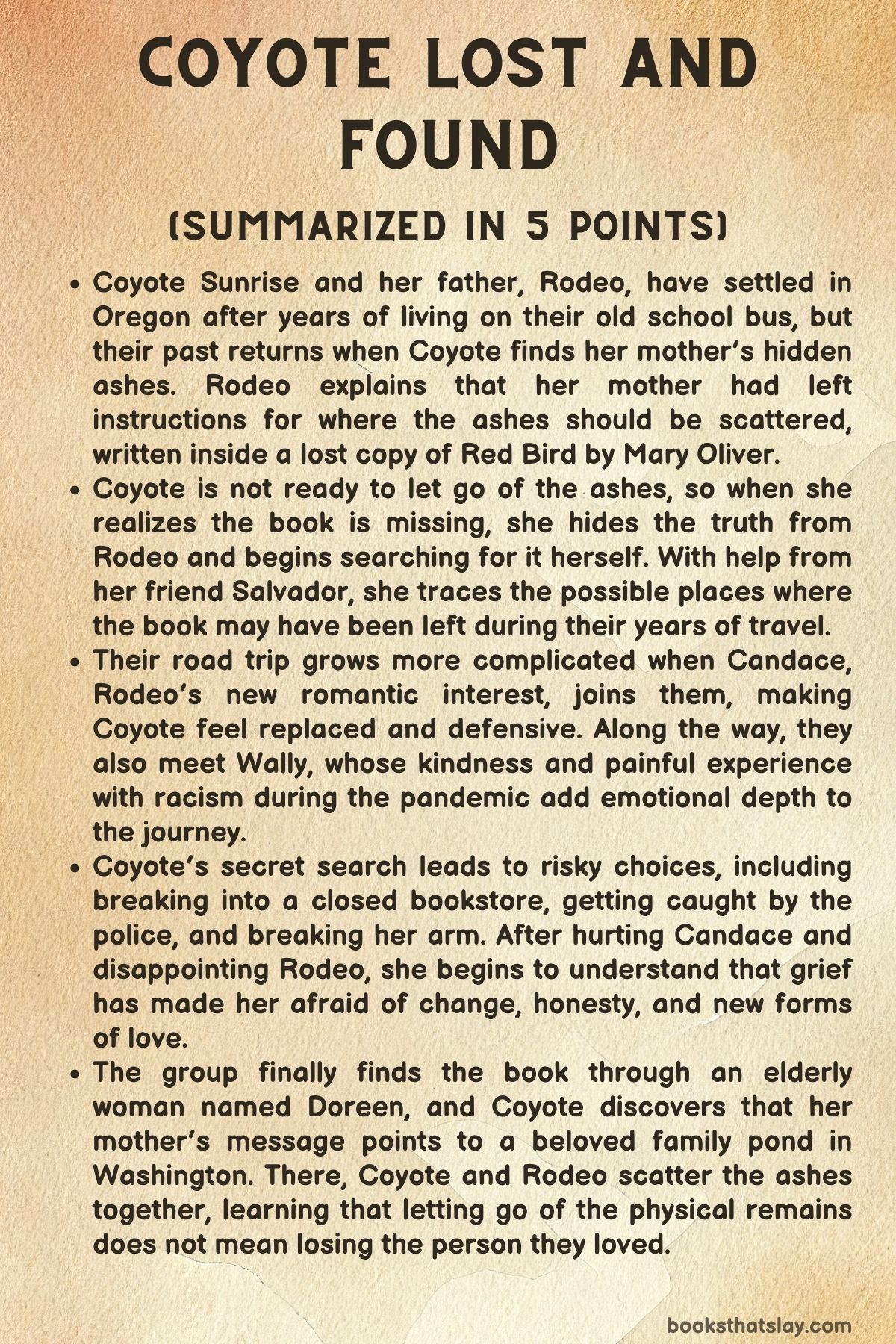
Coyote Sunrise and her father, Rodeo, are no longer wandering the country in their old school bus, Yager. After five years of living on the road, they have settled in a small Oregon town and are trying to build a more stable life.
Yet the bus still holds pieces of their past, and one day Coyote finds an old box hidden behind a bookshelf inside it. Her cat, Ivan, pays little attention, but Coyote knows the box matters.
When she opens it, she discovers her mother’s ashes. Her mother and two sisters, Ava and Rose, died years earlier in a car accident, and that loss sent Coyote and Rodeo into years of motion, as if staying on the road could keep grief from catching up with them.
When Rodeo comes home and sees the box, he understands at once what Coyote has found. He admits that he hid the ashes because he could neither part with them nor face what they represented.
He has begun to deal with his grief through counseling and with Coyote’s help, and he decides that it may be time to honor his wife’s wish. He says she left the location where she wanted her ashes scattered written in a book that should still be on the bus.
Coyote is not ready to lose the one physical part of her mother she has just found, but Rodeo gives her some time to prepare.
Coyote’s life at school is lonely. Other students tease her for her name, her clothes, and the way she behaves.
Rodeo calls her a “lone lobster,” a person who does not quite belong with the crowd. Coyote does spend time in the library with Audrey, a blunt, socially awkward girl who draws dragons, but Coyote does not yet fully see Audrey as a friend.
When Coyote tells Audrey about the ashes, Audrey gives a direct answer: Coyote should do what her mother wanted. That advice stays with her, though accepting it is much harder than hearing it.
When Coyote searches the bus for the book, she realizes it is gone. During their years of travel, she and Rodeo often exchanged books in towns they visited, taking some and leaving others behind.
The book must have been given away by accident. Coyote panics, but instead of telling Rodeo the truth, she lets him believe she is only making excuses to delay the trip.
She calls her old friend Salvador, who warns her that hiding the truth from Rodeo is dangerous, but he also gives her hope by saying the book is not gone forever. It is lost, and lost things can sometimes be found.
Coyote makes a list of seven possible towns where the book may have been left. She calls used bookstores and thrift shops, gradually narrowing the search.
The book is Red Bird by Mary Oliver, and Coyote needs that exact copy because her mother wrote the location inside it. Then school is canceled for several weeks because of COVID-19.
Coyote sees this as a chance to begin the search sooner, even though Rodeo is more worried about the pandemic than excited about travel. Salvador gets permission from his mother to join them, which gives Coyote comfort.
Her excitement is shaken when Rodeo announces that Candace, a neighbor he has been spending time with, will also come along with her chihuahua.
Coyote dislikes Candace from the start. She sees her as an outsider invading a journey that should belong to Coyote, Rodeo, and the memory of her mother.
When the group sets out, Coyote sits with the ashes in her lap and Ivan by her side. They pick up Salvador, and Coyote is relieved to see him.
She also feels embarrassed that he has a social life and she does not. Still, Salvador gives her the kind of quiet support she needs.
She shows him the ashes, and he sits with her while she cries.
The search takes them through several states. In Wyoming, Coyote and Salvador visit a thrift store, pretending to look for another book while secretly hunting for Red Bird.
A local boy named Rawley helps them, but they do not find it. In Colorado, Candace suggests stopping for famous tater tots.
Coyote resents Candace’s habit of planning things, but the food turns out to be wonderful. The stop leads them to Wally, a kind, adventurous man sitting outside in the rain.
Rodeo invites him aboard, continuing his old habit of picking up strangers during their travels. Candace worries this is unsafe, but Coyote sees it as part of who Rodeo is.
In Kansas, the next bookstore is disappointing. The owner is unfriendly, and the book is not there.
Outside, Rodeo is shaken after seeing a book Coyote’s mother once loved. He admits that he has carried guilt for years, feeling responsible for the deaths of his wife and daughters.
He hopes that scattering the ashes will help him lay that guilt down. Coyote comforts him with a playful story, as the two often do for each other, but inside she becomes more frightened.
If she cannot find the book, Rodeo may not get the peace he needs.
As they continue, Coyote remembers moments with her mother, including a beautiful day in an apple orchard when rain and falling blossoms made the world feel magical. These memories strengthen her determination.
At the same time, she struggles with change. She sees signs that Rodeo and Candace are romantically close, and it unsettles her.
Salvador notices and tries to talk with her, but when he defends Candace and then admits that he has a girlfriend, Coyote feels even more replaced. She lashes out, then slowly realizes that Salvador has put more effort into their friendship than she has.
This realization forces her to examine her own behavior.
The journey also brings them face to face with cruelty. At a convenience store in Indiana, a man at the counter targets Wally with racist abuse connected to fear and prejudice during the pandemic.
Coyote and Salvador freeze, unsure what to do. Rodeo confronts the man, but Wally is deeply hurt.
Coyote feels ashamed that she did not act with more courage. She can only sit beside Wally and say she is sorry.
Later, she tries to comfort him by getting him his favorite Reuben sandwich. Wally eventually laughs and shares it, reminding everyone that kindness can still survive a terrible moment.
Coyote’s hopes drop when the bookstore in Maine says it does not have the book. The final possible place is Pittsburgh, but when they arrive, the store has closed permanently because of the pandemic.
Seeing books still inside, Coyote decides to break in. She uses Candace’s tiredness as an excuse to arrange a motel stay, then sneaks out with Salvador at night.
At the store, Coyote climbs through a window but falls and breaks her arm. An alarm sounds, and the police and store owner arrive.
Coyote explains her situation, and even though she has broken into the store, they help her search. The book is not there.
Rodeo arrives angry and disappointed, and Coyote’s injury makes everything worse.
At the hospital and afterward, Coyote’s anger grows. She thinks about Rodeo hiding the ashes, Salvador having other friends, her mother and sisters leaving her through death, and the life she cannot control.
She directs that anger at Candace, accusing her of intruding on a trip meant for Coyote’s mother. Candace, hurt, leaves at a train station.
Coyote soon feels guilty, especially when she sees Rodeo looking defeated. Salvador helps her face the damage she has caused.
Together on the roof of the bus, he tells her that growing into herself is a lifelong process. Their friendship gives Coyote the courage to try to repair things.
Coyote calls Candace, apologizes, and tells her the truth about the lost book. Candace understands and agrees to return.
Coyote then finally tells Rodeo everything. Instead of being furious, he blames himself for waiting so long to handle the ashes.
When he sees a photo of the book on Coyote’s phone, Salvador realizes it came from a bookstore in Ohio. Since they are already nearby, they go there.
The store owner no longer has the book, but he remembers giving it to an elderly woman named Doreen. Coyote meets Doreen in a park and learns that she has recently lost her sister to COVID-19.
Doreen understands Coyote’s pain and urges her to read what is inside the book before making any decision.
Coyote finally holds her mother’s copy of Red Bird. Inside, she finds a taped page with the poem “Mornings at Blackwater,” a poem that speaks about embracing life and the present moment.
She hears it in her mother’s voice and cries. When she and Rodeo read the inscription, they discover that it does not directly name a location.
Instead, Coyote’s mother wrote “I love you” four times, one for each member of the family she left behind. At first this seems disappointing, but it gives both Coyote and Rodeo exactly the message they needed.
Then Coyote notices five underlined words in the poem and realizes they point to a pond in Washington, a place her family loved before the accident.
Wally chooses to continue with them, and Coyote invites Doreen too. On the way, Coyote and Rodeo read more notes in the book, including a joke Rodeo once wrote for his wife.
He says that if he had died first, he would only have wanted her to laugh and feel better. During a “blow out,” when they open all the bus windows, Coyote accidentally lets the box of ashes fly open.
The ashes scatter everywhere. For a moment everyone is stunned, and then Coyote begins to laugh.
Soon they all laugh. Rodeo realizes that the part of his wife that matters is not contained in the ashes.
Coyote is still less certain, but the accident helps her loosen her fear.
Doreen later talks with Coyote about gratitude. She explains that even painful life is still life, and that being alive means having the chance to feel, remember, love, and continue.
Coyote begins to see how much she still has: Rodeo, Salvador, Wally, Candace, Ivan, memories of her mother and sisters, and even Audrey back at school. She calls Audrey and openly names their friendship, and Audrey happily accepts.
At last, the bus reaches the pond in Washington. The sunset colors the water and trees, and Coyote wonders again if she is ready.
Wally reminds her that releasing the ashes does not mean releasing her mother. Doreen brings her sister’s ashes but chooses not to scatter them yet.
Coyote and Rodeo step forward together and take turns placing Coyote’s mother’s ashes into the water, remembering the woman they loved. The journey ends not with every pain solved, but with Coyote understanding more clearly that grief, love, loss, laughter, and gratitude can all exist together.
On the bus, surrounded by the people who have become part of her life, she feels lucky, loved, and more ready to keep living.
Characters
Coyote Sunrise
Coyote Sunrise is the emotional center of Coyote Lost and Found, and her character is shaped by the tension between holding on and moving forward. She is imaginative, stubborn, funny, lonely, and deeply wounded by the loss of her mother and sisters.
Her discovery of the ashes forces her to confront grief she has spent years carrying without fully naming. Coyote’s decision to search for the lost book shows both love and fear: she wants to honor her mother, but she also wants to delay the final act of scattering the ashes.
Her lies to Rodeo are not born from cruelty; they come from panic and the desperate need to control something in a life where death has already taken too much. She often reacts defensively, especially toward Candace and Salvador, because change feels like betrayal to her.
Yet the book also shows her capacity for growth. She learns to apologize, to recognize friendship, to face her mistakes, and to understand that letting go of an object is not the same as losing love.
By the end, Coyote becomes more honest, more grateful, and more open to the people around her.
Rodeo Sunrise
Rodeo is a loving father whose unusual behavior comes from both personality and pain. In Coyote Lost and Found, he is shown as generous, eccentric, and emotionally fragile beneath his cheerful surface.
His habit of picking up strangers reflects his openness to people and his belief in the goodness of the road, but it also connects to the years he spent avoiding the stillness of grief. Hiding the ashes reveals the depth of his struggle.
He could not release them, but he also could not bear to face them, so he placed them out of sight and tried to keep moving. His guilt over the deaths of his wife and daughters has shaped his life with Coyote, sometimes making him protective and sometimes making him avoidant.
His relationship with Candace shows that he is beginning to imagine a future, but he has difficulty helping Coyote accept that change. Rodeo’s greatest strength is his love for his daughter.
Even when he is angry after her break-in, he remains emotionally connected to her. His journey is one of learning that honoring the dead does not require refusing happiness among the living.
Salvador
Salvador is Coyote’s closest friend and one of the strongest voices of truth in the story. He is loyal, gentle, practical, and emotionally mature, often seeing what Coyote is trying not to see.
His return to the bus gives Coyote comfort because he understands her unusual life in a way most people cannot. At the same time, Salvador is not simply there to support her without limits.
He challenges her when she lies to Rodeo, calls attention to her jealousy, and tells her honestly that friendship requires effort from both sides. His own life has continued while Coyote has been distant, and his girlfriend becomes a painful reminder that Coyote cannot expect people to remain frozen in place for her.
Salvador’s importance lies in the way he balances tenderness with honesty. He helps Coyote break into the store, but he also worries about the consequences.
He comforts her on the roof of the bus and helps her see herself as someone still becoming. He represents the kind of friendship that does not excuse every mistake but stays present while a person learns.
Candace
Candace is first seen through Coyote’s suspicious and resentful eyes, which makes her seem like an intruder. In Coyote Lost and Found, however, her role becomes much richer as the story progresses.
She is not trying to replace Coyote’s mother or take Rodeo away from his daughter. She is a woman who cares about Rodeo and is trying to understand a family shaped by loss, road life, and habits that are unfamiliar to her.
Her preference for planning, her concern about picking up strangers, and her tiredness during the trip make her different from the bus family, but those differences do not make her unkind. Coyote’s anger toward her reveals more about Coyote’s fear than about Candace’s character.
When Coyote lashes out and accuses her of invading the trip, Candace is hurt enough to leave, yet she later accepts Coyote’s apology with grace. Her willingness to return shows patience and emotional generosity.
Candace represents the difficult but necessary truth that new love does not erase old love, and that families can grow without betraying the people they have lost.
Wally
Wally enters the book as a stranger in the rain, but he quickly becomes an important part of the traveling group. He is friendly, adventurous, and open to wherever the road might take him.
His willingness to join the bus reflects a spirit of trust and curiosity, and he fits naturally into Rodeo’s tradition of gathering people along the way. Wally’s character also brings the pandemic’s social tensions into the story in a direct and painful way.
The racist attack he experiences at the convenience store reveals the cruelty and fear that many Asian Americans faced during that period. His reaction is not dramatic; he apologizes and leaves, which makes the moment even more painful because it suggests he has had to endure such treatment before.
Coyote’s attempt to comfort him with his favorite sandwich shows how small acts of care can matter when words are not enough. Wally becomes a guide for Coyote near the end, helping her understand that scattering the ashes will not erase her mother.
His kindness, humor, and quiet wisdom make him a healing presence in the book.
Doreen
Doreen is an elderly woman who appears late in the story but carries great emotional weight. She has recently lost her sister to COVID-19, which gives her an immediate bond with Coyote.
Unlike some adults who might rush to advise a grieving child, Doreen listens carefully and responds with patience. She understands that Coyote’s hesitation is not childishness but love mixed with fear.
By giving Coyote the book and encouraging her to read what is inside before deciding what to do, Doreen helps move the story from frantic searching toward reflection. Her own urn, holding her sister’s ashes, shows that grief has no single timeline.
She comes with Coyote to the pond but chooses not to scatter her sister’s ashes yet, proving that readiness is personal. Her conversation with Coyote about gratitude gives the book one of its clearest emotional lessons.
Doreen does not deny pain; instead, she teaches that life remains valuable even when it contains suffering. Her presence helps Coyote see grief as part of being alive, not as the opposite of living.
Audrey
Audrey is a quiet but meaningful character because she represents the friendship Coyote fails to recognize at first. At school, Coyote thinks of herself as isolated and mocked, and in many ways she is.
Yet Audrey sits with her in the library, spends time near her, and shares space with her in a way that matters. Audrey’s bluntness can make her seem unpleasant, but her direct nature also allows her to say what others might avoid.
When Coyote tells her about the ashes, Audrey’s advice is simple: do what her mother wanted. This response lacks softness, but it has moral clarity.
Audrey does not become part of the road trip, yet her role grows in meaning when Coyote later realizes that friendship can exist in forms she had not fully appreciated. Calling Audrey and naming her as a friend is a sign of Coyote’s growth.
It shows that Coyote is beginning to look beyond her own loneliness and notice the people who have been quietly present. Audrey represents the possibility of belonging in ordinary life, not only on the road.
Coyote’s Mother
Coyote’s mother is absent in the present action, but her influence shapes nearly every choice in the story. She is remembered as imaginative, loving, and able to make ordinary moments feel magical, such as the rainy day in the apple orchard.
Her copy of Red Bird becomes more than a lost object; it becomes a bridge between past and present. Coyote wants the book because it might contain instructions, but what she finds inside is something more emotionally important: love, memory, and a message about living.
The four written declarations of love show that Coyote’s mother thought of each family member, while the underlined words in the poem reveal her connection to the pond and to a life of shared memories. She is not idealized only as a symbol of loss; she is also remembered as playful, tender, and deeply connected to her family.
Through her, the book shows how a person can continue to guide the living even after death, not as a ghostly presence, but through memories, words, places, and the love they left behind.
Ava and Rose
Ava and Rose, Coyote’s sisters, do not appear directly in the present timeline, but their absence is central to Coyote’s grief. They represent the part of Coyote’s childhood that was violently cut short by the accident.
Losing a mother is devastating, but losing siblings also means losing companions, shared memories, and the everyday sense of growing up beside others. Coyote’s anger that they “left” her reflects the irrational but very real emotional logic of grief.
She knows they did not choose to leave, yet the pain still feels like abandonment. Their presence in the memory box reminds Coyote of the family’s old values, especially kindness.
That memory helps her recognize the harm she has done to Candace and pushes her toward apology. Ava and Rose matter because they are not treated merely as background tragedy.
They remain part of the family’s emotional life. Coyote’s love for them continues to influence how she understands herself, how she measures kindness, and how she learns to live with the missing spaces they left behind.
Ivan
Ivan, Coyote’s cat, is a small but steady presence in the book. He does not drive the action in the way the human characters do, but he adds comfort, familiarity, and a sense of home.
For a girl whose life has involved movement, loss, and emotional upheaval, Ivan represents continuity. He is there when Coyote discovers the ashes, and he travels with the group on the bus.
His indifference to human drama creates gentle humor, but his presence also matters because animals often provide comfort without requiring explanation. Coyote does not have to justify her feelings to Ivan.
He simply exists beside her, part of the strange, beloved world of Yager. In a story about family made from blood, friendship, memory, and chance encounters, Ivan belongs to the emotional household of the bus.
He helps make Yager feel less like a vehicle and more like a living space filled with history, habits, and affection.
Ms. Jordan
Ms. Jordan, the school librarian, has a modest role, but she helps define Coyote’s school life. The library is one of the few places where Coyote can exist without facing the full pressure of judgment from other students.
Ms. Jordan’s presence suggests adult stability and quiet acceptance. She is part of the environment that allows Coyote and Audrey to spend time together, and the library becomes a refuge for children who do not easily fit in elsewhere.
Although Ms. Jordan does not take part in the road journey, her role points to an important contrast in Coyote’s life. On the bus, Coyote is surrounded by movement and intense emotional history; at school, she faces the challenge of ordinary belonging.
Ms. Jordan’s library offers a bridge between those worlds, a place where difference is less exposed and where Coyote can begin, even if slowly, to form a connection with Audrey.
Rawley
Rawley is a brief but useful supporting character who appears during the search in Wyoming. He helps Coyote and Salvador look through the books at the thrift store, and his role shows how the road often brings temporary helpers into Coyote’s life.
He does not know the full emotional weight of the search, yet he becomes part of it for a short time. Characters like Rawley remind readers that not every meaningful interaction has to last long.
Sometimes a person enters a story for a moment, offers assistance, and then disappears from the main action, leaving behind a small mark. His presence also adds realism to the search itself.
Coyote’s mission is not completed through one grand discovery but through many attempts, wrong turns, and brief encounters. Rawley belongs to that pattern of ordinary human help that supports the larger emotional journey.
Themes
Grief, Memory, and the Work of Letting Go
Grief in Coyote Lost and Found is not presented as something a person simply overcomes. It changes shape, hides in objects, appears in anger, and returns through memory.
The ashes are the clearest symbol of this struggle. For Rodeo, they represent guilt and unfinished mourning; for Coyote, they represent one of the last physical connections to her mother.
Both characters want to honor the woman they loved, but both are afraid of what honoring her might require. The search for the lost book turns grief into action, giving Coyote a task that feels easier than acceptance.
Yet the task slowly teaches her that memory does not live only in objects. Her mother remains present in the apple orchard memory, the poem, the inscription, the pond, and Coyote’s own capacity for love.
The accidental scattering of ashes inside the bus is important because it breaks the illusion of perfect control. The ashes are not sacred because of their physical form; they matter because of what they represent.
By the time Coyote and Rodeo reach the pond, letting go becomes not an erasure, but an act of trust.
Honesty and the Cost of Avoidance
Coyote and Rodeo both hide painful truths, and the story shows how avoidance often begins as self-protection but grows into harm. Rodeo hides the ashes because he cannot face them, and Coyote hides the loss of the book because she fears disappointing him and losing her chance to control the situation.
Neither lie is cruel in intention, yet both create distance between father and daughter. Coyote’s secrecy leads to increasingly risky choices, ending in the break-in, her broken arm, and Rodeo’s deep hurt.
Her mistake is not simply that she searches for the book; it is that she tries to carry the burden alone. Rodeo’s avoidance is older and heavier.
By delaying the decision about the ashes, he leaves Coyote to discover them unexpectedly, without preparation. The book does not punish them for being afraid.
Instead, it shows that fear becomes more damaging when it is hidden. When Coyote finally tells the truth, Rodeo does not explode as she expects.
The truth hurts, but it also allows them to work together. Honesty becomes the first real step toward healing because it replaces isolation with shared responsibility.
Friendship, Belonging, and Emotional Courage
Coyote sees herself as someone who does not fit anywhere, but the story gradually challenges that belief. At school, she feels mocked and alone, yet Audrey has been beside her in the library.
On the road, Salvador remains her closest friend, but Coyote must learn that friendship cannot survive on need alone. Salvador’s honesty is important because he loves Coyote enough to tell her when she is being unfair.
His girlfriend and his life away from her make Coyote feel replaced, but they also force her to understand that other people do not exist only in relation to her pain. Belonging requires attention, effort, and humility.
Coyote’s call to Audrey near the end shows real growth because she stops defining herself only by rejection and begins to notice connection. The bus group also expands her idea of family.
Candace, Wally, and Doreen are not replacements for the people she lost; they are additions to a life that is still growing. Emotional courage means more than dramatic bravery.
It means apologizing, admitting jealousy, accepting change, and letting people care for her even when she feels unworthy or afraid.
Kindness in a Fearful World
The pandemic setting brings fear into the story, but the book is equally interested in how people respond to fear. The racist attack on Wally is one of the clearest examples of fear turning into cruelty.
The store clerk treats Wally as a threat because of prejudice, and the scene exposes how public fear can become personal violence. Coyote’s frozen reaction also matters.
She wants to be brave, but in the moment she does not know how to act. Her shame afterward is part of her moral growth.
The story does not suggest that a sandwich can fix racism or erase humiliation, but Coyote’s effort to comfort Wally shows that kindness still has value when larger wrongs feel overwhelming. Rodeo’s habit of welcoming strangers also reflects this theme.
His openness can be risky, but it creates the conditions for Wally and Doreen to become part of the journey. Candace’s return after Coyote’s apology is another act of kindness, one rooted in patience rather than pride.
Throughout the story, kindness is not treated as simple politeness. It is a choice to remain open, generous, and human when fear encourages suspicion.