The Museum of Innocence Summary, Characters and Themes
The Museum of Innocence by Orhan Pamuk is a novel about love, memory, class, desire, and the strange power that ordinary objects can gain when they become linked to longing. Set mainly in Istanbul from the 1970s onward, it follows Kemal Basmacı, a wealthy young businessman whose affair with his distant relative Füsun changes the entire direction of his life.
What begins as desire becomes an obsession that reshapes his relationships, his sense of time, and his identity. The novel is also a meditation on Turkish society, especially its tensions between modernity, tradition, reputation, and personal freedom.
Summary
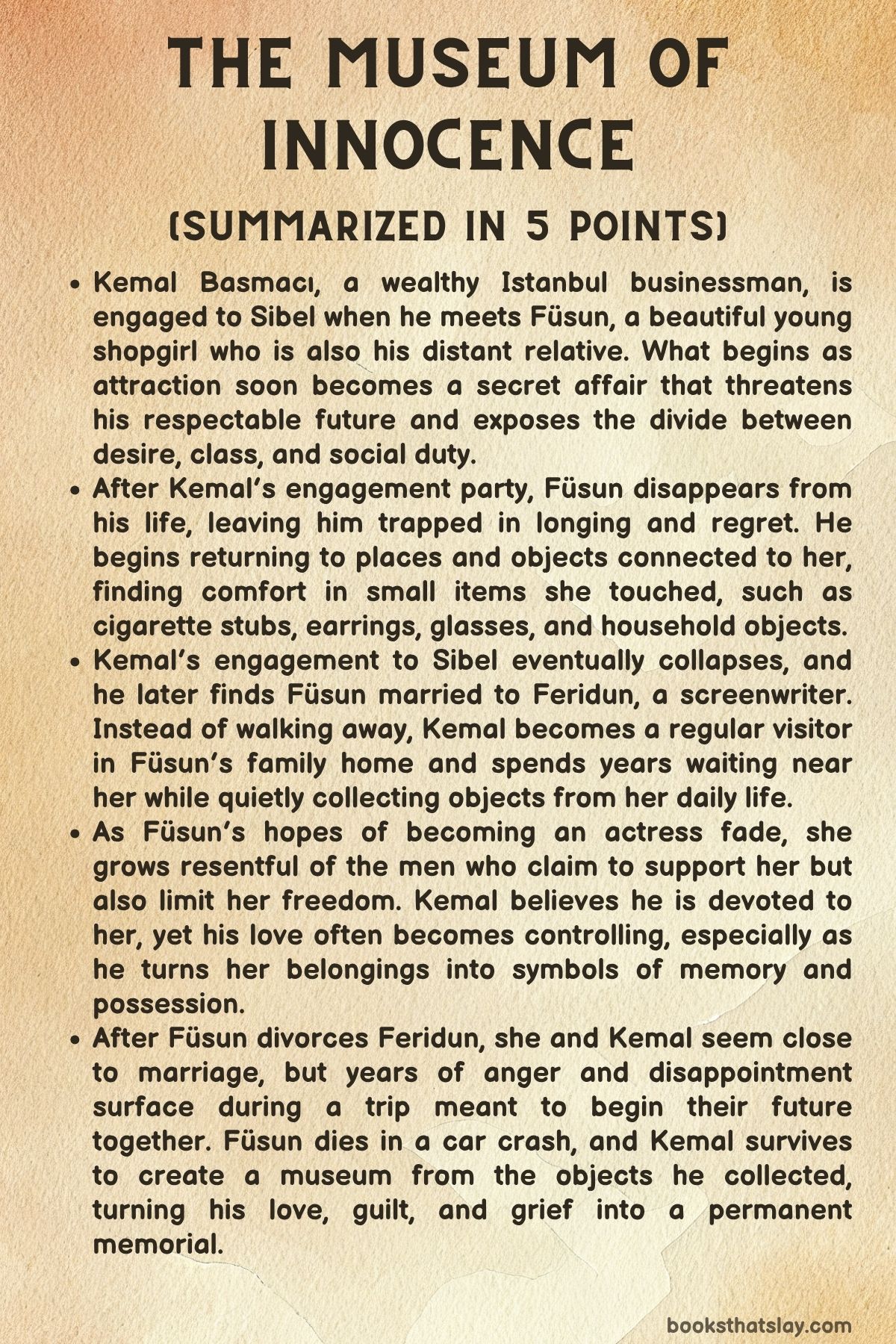
Kemal Basmacı is a wealthy young man from Istanbul’s upper class, engaged to Sibel, a refined woman from a similar social background. Their match seems socially perfect: both families approve, their friends expect marriage, and Kemal appears to be moving toward a secure, respectable future.
Yet this stable life begins to shift when he enters a boutique to buy Sibel a handbag and meets Füsun Keskin, a beautiful shopgirl who is also a distant relative. Füsun is younger, less wealthy, and preparing for her university entrance exams.
Kemal is immediately struck by her beauty, and although he tries to dismiss his attraction as harmless, he soon begins thinking about her with growing intensity.
A false designer handbag becomes the first excuse for further contact. When Sibel points out that the bag is fake, Kemal returns to the shop for a refund and finds himself moved by Füsun’s tears.
He invites her to bring the refund money to a family-owned apartment, where he later waits for her with a mixture of guilt, desire, and anticipation. Füsun eventually comes, and their meetings turn into an affair.
Kemal offers to help her study, but the lessons quickly become secondary to their physical relationship. Füsun, who dreams of becoming an actress, appears both young and self-possessed, aware of her beauty and of the danger that male attention brings.
Kemal convinces himself that he can keep his affair separate from his engagement. He continues to prepare for marriage with Sibel while meeting Füsun in secret.
Yet the affair becomes more emotionally serious. Füsun tells him she loves him, and Kemal says the same, though he still does not break off his engagement.
Their happiest moment occurs shortly before his engagement party, when Füsun loses one of her earrings during an intimate encounter. Kemal keeps the memory of that moment, and the lost earring becomes one of the first objects that later carries the emotional weight of his obsession.
The engagement party takes place among Istanbul’s wealthy social elite. Kemal attends as Sibel’s future husband but spends the evening watching Füsun, who arrives with her parents.
He is jealous when she dances with other men and engineers situations to be near her. Füsun, however, understands more than Kemal admits.
She sees the public reality of his engagement and the private promises he has made to her. After the party, she disappears.
She does not come to the apartment, quits her job, and eventually leaves her old home with her family. Kemal begins to suffer intensely from her absence.
His longing becomes physical and mental torment. He searches for Füsun in the streets, sees her in strangers, and returns obsessively to the apartment where they once met.
Objects she touched begin to console him: cigarette stubs, mirrors, glasses, small personal items. They seem to preserve her presence when her body is absent.
His engagement to Sibel deteriorates under the pressure of this obsession. Sibel first tries to understand and rescue him, interpreting his distress as a passing crisis, but Kemal finally confesses that he had an affair with Füsun.
Although he lies about some details, the damage is done. Their engagement collapses, and Sibel leaves his life.
Kemal’s father dies around this time, deepening his grief. His father had once warned him not to take love for granted, revealing that he too had loved another woman and had lived with regret.
After the funeral, Kemal receives a letter from Füsun inviting him to dinner at her family’s new home. He goes with the intention of asking her to marry him, only to discover that she has married Feridun, a young screenwriter.
Kemal is humiliated but hides it. He soon realizes that Füsun and her family may want him to finance Feridun’s film project, which would also serve Füsun’s dream of becoming an actress.
Rather than leave, Kemal accepts this new role. He begins visiting the Keskin household regularly, first through discussions about cinema and then as an almost nightly guest.
For years, he sits with Füsun, her mother Nesibe, her father Tarık, and Feridun, sharing meals, watching television, playing games, and taking part in their domestic routines. He tells himself that being near Füsun is enough.
Time changes for him inside their home; instead of measuring years, he remembers individual evenings, gestures, looks, and objects. His old upper-class social life fades, and his identity shifts toward patient waiting.
During these years, Kemal becomes involved in the Turkish film world. He creates a production company to support Feridun’s projects and to keep Füsun close to him.
Yet his support is conflicted. He wants Füsun to achieve her dream, but he also fears the sexual exploitation and gossip surrounding the film industry.
As a result, he often helps delay or limit her chances. Füsun senses this and grows bitter.
Feridun, meanwhile, becomes involved with Papatya, an actress and singer whose career rises through a commercial film that Kemal produces. Feridun eventually leaves the Keskin household, and his marriage to Füsun collapses.
Throughout these years, Kemal quietly steals objects from Füsun’s home: cigarette stubs, utensils, ornaments, personal belongings, and anything that has absorbed her presence. He knows the behavior is shameful, but the objects soothe him.
They allow him to possess something of Füsun when he cannot possess her life or love. His collection grows into a private world of memory.
He sees each object not as junk but as evidence of moments, moods, and lost possibilities.
After Tarık dies, Füsun and Feridun divorce. Kemal and Füsun finally begin to move toward marriage.
Their mothers meet, old tensions soften, and Kemal imagines that the years of waiting are about to be rewarded. Füsun admits that she has feelings for him, but she also carries anger.
She feels that both Kemal and Feridun limited her future, especially her chance to become an actress. She asks for a driving trip to Europe before marriage, and Kemal agrees.
The trip seems like a final passage into the life he has desired for so long.
Kemal, Füsun, Nesibe, and the driver Çetin set out together and stop at a hotel. Kemal reveals engagement rings and treats the evening as a private engagement celebration.
There is tension between him and Füsun, but later that night she comes to his room, and they have sex for the first time in years. For Kemal, this seems like the return of their old intimacy.
For Füsun, however, the night brings unresolved anger to the surface. She confronts him about the objects he has stolen and about the way he failed to support her ambitions.
She also accuses him of taking her virginity long ago without accepting the responsibility that society placed on such an act.
Füsun insists on driving the car. Kemal is frightened by her reckless speed, but she continues, wearing the long-lost earring from their happiest moment.
The car crashes, and Füsun dies. Kemal survives.
Her death turns his obsession into permanent mourning. He returns to the objects he has collected and decides to create a museum in her memory.
He buys the Keskin house, moves into its attic, travels through Europe studying museums, and imagines a space where every object will tell the story of his love, shame, desire, and loss.
In the end, Kemal asks the writer Orhan Pamuk to turn his story into a novel that will serve as a catalogue for the museum. The book becomes both a love story and an exhibit of memory.
Kemal dies years later, but not before insisting that despite everything, he lived a happy life. His claim is both moving and unsettling, because his happiness is inseparable from obsession, loss, and the belief that objects can preserve what time destroys.
Characters
Kemal Basmacı
In The Museum of Innocence, Kemal Basmacı is a wealthy Istanbul businessman whose life is overtaken by his love for Füsun. At the beginning of the book, he seems to possess everything his social world values: family status, education, money, a respectable fiancée, and a clear path toward marriage.
Yet his affair with Füsun reveals a deep instability beneath that polished life. Kemal is capable of tenderness, but his tenderness is often mixed with selfishness.
He wants Füsun, but for a long time he refuses to sacrifice the safety of his engagement to Sibel. His tragedy lies in the gap between what he feels and what he is willing to do.
Over time, love becomes less a relationship than a private system of worship. He transforms Füsun’s belongings into sacred objects and builds his identity around memory.
Kemal is not simply a romantic victim; he is also controlling, evasive, class-protected, and often blind to the damage he causes. Still, the book makes him human by showing his shame, longing, and need to give meaning to pain.
Füsun Keskin
Füsun is the emotional center of The Museum of Innocence, even though much of what readers know about her comes through Kemal’s possessive gaze. She is beautiful, intelligent, proud, and aware from a young age of how men look at her.
Her dream of becoming an actress is not shallow vanity; it is her attempt to claim visibility, independence, and a life beyond the limits imposed on her by class and gender. Füsun’s relationship with Kemal is marked by desire, hope, injury, and resentment.
She loves him, but she also understands that he fails her when he chooses public respectability over her dignity. Her marriage to Feridun can be read as an act of survival, a way to protect her reputation after being abandoned emotionally and socially.
In later years, her bitterness grows because Kemal stays close while also limiting her freedom. Her final recklessness is not random; it expresses years of frustration, lost ambition, and anger at being turned into an object of longing rather than being allowed a full life of her own.
Sibel
Sibel is one of the most dignified and wronged figures in the book. She begins as Kemal’s fiancée, a modern, educated woman who is nevertheless bound by the expectations of upper-class Turkish society.
Her relationship with Kemal is built on companionship, shared background, and mutual social approval, but it is damaged by his inability to be honest. Sibel is not naive.
She senses his emotional absence long before he confesses anything, and she tries to save him from what she sees as an obsession. Her pain is sharpened by the double standard surrounding sex and reputation.
She has been intimate with Kemal, yet society would judge her harshly if the engagement ended, while Kemal’s position remains more secure. Her eventual decision to return the ring is an act of self-respect.
Sibel’s later life suggests that she survives, but the book never treats her suffering as minor. She represents the person left behind when romantic obsession is excused as destiny.
Füsun Keskin
Füsun is one of the central figures in The Museum of Innocence, and her character is defined by the tension between how Kemal sees her and what she wants for herself. To Kemal, she becomes beauty, memory, desire, and loss.
To herself, she is a young woman who wants movement, work, recognition, and control over her life. Her childhood experiences with unwanted male attention make her alert to power, and she learns how vulnerable a woman can be in a society that judges her body before her character.
She can be affectionate, playful, cold, proud, and angry, and these shifts show that she is not the passive beloved Kemal tries to preserve in memory. Her accusations near the end of the book reveal how deeply she understands the cost of his love.
She knows that he collected her traces while failing to protect her future. Her death turns her into a permanent symbol for Kemal, but the story also makes clear that this symbolic role is part of the injustice done to her.
Nesibe Keskin
Nesibe, Füsun’s mother, is warm, practical, socially cautious, and emotionally perceptive. As a seamstress connected to wealthier households, she understands class hierarchy from below and knows how fragile reputation can be for a family like hers.
She welcomes Kemal into the Keskin home with courtesy, food, and repeated invitations, but her kindness is never simple ignorance. She senses Kemal’s devotion and also recognizes that his presence may one day help Füsun.
Nesibe wants security for her daughter, yet she is also complicit in arrangements that limit Füsun’s freedom, including the marriage to Feridun. Her grief after Füsun’s death is quiet and devastating, and her later acceptance of Kemal’s museum shows her need to preserve her daughter in whatever way remains possible.
Nesibe is one of the book’s most important domestic presences because she turns the Keskin home into the space where Kemal waits, hopes, steals, suffers, and creates the emotional material for his museum.
Tarık Keskin
Tarık Bey is Füsun’s father, a man shaped by pride, caution, and the social vulnerability of his family. He is not as emotionally open as Nesibe, but his presence matters because he represents the protective authority surrounding Füsun.
His concerns about the film industry are rooted in fear that public exposure will damage his daughter’s reputation. At times, these fears seem conservative and restrictive, but the book also shows that his anxieties are not baseless in a world where actresses can be exploited and judged.
Tarık helps arrange Füsun’s marriage to Feridun as a way to restore order after her disappointment and social risk. He does not always understand Füsun’s inner life, but he recognizes Kemal’s attachment to her.
His death removes one of the barriers between Kemal and Füsun, yet it also marks another stage in the atmosphere of loss that surrounds the final movement of the story.
Feridun
Feridun is Füsun’s husband and a screenwriter whose ambitions connect the domestic world of the Keskins with the film culture of Istanbul. He is not presented as a villain, though Kemal naturally sees him as an obstacle.
Feridun’s marriage to Füsun is practical, protective, and emotionally weak. He wants to make serious films and initially appears idealistic about cinema, but his work gradually bends toward commercial success.
His relationship with Papatya exposes his vanity and his hunger for artistic recognition. Feridun’s greatest narrative function is to keep Kemal in a state of prolonged waiting.
Because he is present but often absent, married to Füsun but emotionally elsewhere, he creates a painful opening that Kemal occupies for years. He also reflects the compromises of the film world, where artistic dreams, money, desire, and reputation constantly collide.
Vecihe Basmacı
Vecihe, Kemal’s mother, is a representative of upper-class judgment, family loyalty, and social control. She is affectionate toward Kemal, but her affection is inseparable from anxiety about status.
Her view of Füsun’s family is shaped by class prejudice and moral suspicion, especially after Füsun’s beauty contest involvement. Vecihe wants Kemal to marry properly and fears that Füsun will pull him into disgrace or unhappiness.
At times, her warnings are cruel, but they are not always foolish. She sees things about Kemal’s situation that he refuses to admit, including Füsun’s anger and his own humiliation.
Her refusal to attend Tarık’s funeral shows the limits of her acceptance, while her earlier concern for Sibel reveals that she understands the social consequences of broken engagements. Vecihe is not merely a snob; she is a mother who measures love through survival, reputation, and family continuity.
Mümtaz Basmacı
Mümtaz, Kemal’s father, is a quieter but deeply influential figure. His confession about his own past affair gives Kemal a mirror in which to see the dangers of taking a woman’s devotion for granted.
Mümtaz’s regret is one of the book’s clearest warnings, but Kemal does not fully learn from it in time. The pearl earrings Mümtaz gives him carry the weight of failed apology, transferred from one generation’s romantic mistake to another.
After Mümtaz dies, Kemal treats his father’s objects with the same need for consolation that he later directs toward Füsun’s belongings. This connection helps explain why objects matter so much in the story.
Mümtaz teaches Kemal, indirectly, that love can become regret when action comes too late. His death also loosens Kemal’s ties to ordinary family duty and pushes him further into mourning and obsession.
Osman Basmacı
Osman, Kemal’s brother, stands for business discipline, family responsibility, and the practical world that Kemal increasingly abandons. He notices Kemal’s distraction and becomes frustrated when personal jealousy interferes with professional matters.
Unlike Kemal, Osman remains grounded in company interests and social stability. His arguments with Kemal show how far Kemal has drifted from the expectations of his class and family.
Osman is not emotionally central to the love story, but he is important as a measure of Kemal’s decline. Through Osman, the book shows that obsession does not remain private; it affects work, family trust, money, and reputation.
Çetin
Çetin, the family driver, is a loyal witness to many of Kemal’s most private moments. He drives Kemal through Istanbul during searches, visits, and emotional crises, often understanding more than he says.
His role is modest but steady, and he provides a link between Kemal’s upper-class comfort and the practical movement of the city. During the military inspection, Çetin protects Kemal from embarrassment when a stolen object is discovered in the car.
His loyalty is quiet, but it allows Kemal’s strange life to continue with fewer consequences than it might otherwise have faced. Çetin also accompanies the final trip, making him part of the journey that seems to promise union but ends in disaster.
Zaim
Zaim is one of Kemal’s old society friends, associated with wealth, pleasure, business promotion, and social gossip. His fruit soda venture places him within the modernizing commercial class of Istanbul, yet his attitudes remain marked by class arrogance.
He often acts as a messenger from Kemal’s former social circle, reporting what others think and urging Kemal to behave sensibly. His remarks about women from lower social backgrounds reveal the casual cruelty of the elite world Kemal comes from.
Zaim’s later relationship with Sibel also sharpens Kemal’s sense of exclusion. He is important because he shows that Kemal’s old world does not simply disappear; it judges him, replaces him, and continues without him.
Mehmet
Mehmet begins as one of Kemal and Sibel’s friends and is involved in the social matchmaking around Nurcihan. His awkward early interactions with her reveal the performative nature of upper-class romance, where couples are formed under the eyes of friends.
Later, his marriage to Nurcihan becomes another example of social respectability failing to guarantee emotional fulfillment. When he reconnects with Kemal after Füsun’s death, he brings news from the circle Kemal left behind.
Mehmet’s presence helps measure the passage of time: while Kemal has been fixed in longing, others have married, had children, grown bored, and continued with ordinary disappointments.
Nurcihan
Nurcihan is Sibel’s close friend and part of the social world that expects marriage to follow class logic and public approval. Her early attraction to Zaim and eventual relationship with Mehmet show the uncertainties beneath polite matchmaking.
She also becomes one of the people who recognizes Sibel’s suffering, making her a witness to the emotional cost of Kemal’s behavior. Nurcihan matters because she belongs to the life Kemal was supposed to lead.
Her later falling out with Sibel suggests that even the respectable world contains rivalry, resentment, and fracture. Through Nurcihan, the story avoids idealizing the social circle Kemal loses.
Ceyda
Ceyda is Füsun’s friend and one of the few people Kemal can approach when Füsun disappears. She acts as a partial messenger, giving Kemal hope while also warning him that finding Füsun may not bring happiness.
Her cryptic responses increase his longing and send him deeper into the city in search of Füsun. Ceyda’s role is brief but significant because she controls access to information at moments when Kemal is desperate.
She also represents the world of young women around Füsun, a world that Kemal does not fully understand but tries to use for his own emotional purposes.
Kenan
Kenan is a Satsat employee and later a business figure connected with Osman and Turgay. For Kemal, Kenan becomes a focus of jealousy because he dances with Füsun at the engagement party.
This jealousy shows how quickly Kemal turns ordinary social contact into threat. Kenan is also part of the professional world that Kemal neglects.
When Kemal resents him in business matters, the resentment is not purely commercial; it is contaminated by romantic suspicion. Kenan’s character therefore helps expose Kemal’s inability to separate private obsession from public responsibility.
Turgay
Turgay is connected to both business and Füsun’s past. Füsun describes him as one of the men who desired her before Kemal, and Kemal’s jealousy turns him into an enemy.
Turgay’s anger over being excluded from the engagement party affects business dealings, which shows how social insult, masculine pride, and commerce overlap in Kemal’s world. Kemal’s confrontation with him is less about business than about possessiveness.
Turgay may not occupy much space in the story, but he reveals the insecurity beneath Kemal’s love. Kemal wants to believe his feeling is pure, yet he repeatedly measures it against other men’s desire.
Belkıs
Belkıs is a dead woman whose story reflects the harsh treatment of sexually independent women in Istanbul society. Her past relationships, reputation, and lonely death create a social warning around female sexuality.
Men desire women like Belkıs, but they do not necessarily marry or protect them. Women judge them, but often from within the same oppressive moral system.
Kemal’s discussion of Belkıs shows his awareness of these double standards, even though he fails to act honorably toward Füsun when it matters. Belkıs’s death near the time of Kemal and Füsun’s happiest moment also casts a shadow over their love, linking desire with danger and social punishment.
Papatya
Papatya is an actress and singer whose rise in the film world contrasts sharply with Füsun’s frustrated ambitions. She succeeds where Füsun is blocked, partly because she knows how to use publicity, desire, and scandal to her advantage.
Her relationship with Feridun intensifies Füsun’s disappointment and helps break the already weak marriage. Papatya is not treated only as a rival; she is also a figure of ambition and survival in a male-dominated industry.
Her success exposes the painful truth that talent alone is not enough. A woman must also navigate gossip, exploitation, timing, and public appetite.
For Füsun, Papatya becomes both an object of admiration and a reminder of what she has been denied.
Orhan Pamuk
Pamuk’s appearance inside the book turns the story into a reflection on authorship, memory, and the transformation of life into art. He is not only the real author’s fictional presence but also the person Kemal chooses to shape his museum catalogue into narrative form.
His role raises questions about who owns a story: the person who lived it, the person who tells it, or the objects that remain. Kemal worries that Pamuk may not understand his obsession, but Pamuk earns his trust by recalling his own brief encounter with Füsun.
This late shift in narration reminds readers that every account is shaped, arranged, and interpreted. Pamuk’s character makes the book self-aware without removing its emotional seriousness.
White Carnation
White Carnation, the gossip columnist, represents the public appetite for scandal. His presence at the engagement party is comic at first, but his later column about Kemal and Füsun causes real damage.
He turns private pain into society entertainment, mixing truth and error in a way that wounds reputations. Through him, the book shows how gossip functions as social punishment.
It does not need to be fully accurate to be powerful. For Kemal, the column is humiliating because it exposes him to his old world.
For Füsun, it confirms that her life and hopes can be publicly reduced to scandal.
Fatma
Fatma, Vecihe’s maid, plays a small but crucial role by returning Füsun’s missing earring to Kemal. Her discovery reveals that the object had been hidden within Kemal’s own household, misread by Vecihe as evidence of Mümtaz’s possible affair.
Fatma’s action restores a missing piece of Kemal and Füsun’s past, but it comes too late to repair the damage. She belongs to the domestic background of the Basmacı home, yet her intervention changes the course of Kemal’s search.
In a book where objects carry emotional force, Fatma becomes important because she returns one of the most charged objects of all.
Sühendan Yıldız
Sühendan Yıldız is an actress who helps Kemal understand the dangers of the film industry. Through her, he learns which producers are exploitative and which situations might threaten Füsun.
Her guidance complicates Kemal’s motives. On one level, he genuinely wants to protect Füsun.
On another, this protection becomes a way to restrict her opportunities. Sühendan therefore helps reveal the moral ambiguity of Kemal’s role as producer and guardian.
She also brings texture to the film world, showing that actresses survive through knowledge, warning networks, and practical caution.
Salih Sarılı
Salih Sarılı introduces Kemal to the hidden realities of the Turkish film industry, including the fact that many performers work in disreputable productions to survive. His character widens Kemal’s understanding of the world Füsun wants to enter.
Salih is not central emotionally, but he gives the film setting a harder social edge. Through him, cinema is shown not as pure glamour but as a workplace shaped by money, compromise, and vulnerability.
His presence helps explain why Kemal becomes fearful for Füsun, even as that fear becomes part of the force that limits her.
Hayal Hayati
Hayal Hayati is a state censor and filmmaker who exposes the arbitrary power surrounding film production. His interest in casting Füsun is unsettling because he can manipulate rules for his own advantage.
He represents institutional control over art and women’s bodies, showing how censorship is not only political but also personal and sexual. Through him, the book presents the film world as a place where official authority and private desire can merge dangerously.
Kemal’s concern about Hayati is justified, but it also strengthens his habit of controlling Füsun’s access to cinema.
Daktilo Demir
Daktilo Demir, the script doctor, represents delay, bureaucracy, and compromise in the creative process. His revisions slow the film project and frustrate Füsun, who is already anxious about losing time.
He is part of the machinery that turns dreams into paperwork, negotiation, and waiting. His role may seem technical, but it matters because every delay increases Füsun’s resentment and strengthens Kemal’s position as the man who can either move her career forward or hold it back.
Daktilo Demir shows how ambition can be weakened not only by enemies but also by systems that exhaust hope.
Themes
Obsession, Love, and Possession
Kemal’s love for Füsun begins as desire, grows into emotional dependence, and eventually becomes a lifelong structure of meaning. The disturbing force of the story comes from the fact that his love is both sincere and possessive.
He suffers deeply when Füsun disappears, but his suffering does not make him innocent. He wants to be near her, yet he often fails to consider what she wants beyond him.
His collection of objects shows this contradiction clearly. A cigarette stub or earring may help him remember her, but collecting these things also lets him possess pieces of her life without her consent.
The book refuses to present obsession as pure romance. Kemal’s longing produces beauty, patience, and a museum, but it also produces theft, delay, self-deception, and harm.
The Museum of Innocence treats love as a force that can preserve memory while also distorting the beloved person. Füsun becomes most available to Kemal when she is absent, silent, or dead, and that fact makes his devotion both moving and morally troubling.
Memory, Objects, and Time
Objects in the story are not passive belongings; they are containers of time. Kemal believes that things touched by Füsun preserve her presence more faithfully than ordinary memory can.
This belief gives emotional power to cigarette stubs, earrings, glasses, ornaments, and household items that would otherwise seem worthless. His museum is built on the idea that personal history can be arranged through material evidence.
The objects let him return to certain moments and resist the forward movement of life. This is why the Keskin household becomes so important to him.
Inside it, time feels suspended, and each evening with Füsun becomes a separate present moment he can later preserve. Yet the theme is not only nostalgic.
The book also questions whether memory heals or traps. Kemal’s objects console him, but they also prevent him from accepting change.
His collection protects him from emptiness while keeping him loyal to pain. The museum becomes both a tribute and a prison, a place where love survives because life itself has been stopped and arranged behind glass.
Class, Gender, and Reputation
The relationship between Kemal and Füsun is shaped from the beginning by unequal social power. Kemal belongs to Istanbul’s wealthy elite, while Füsun comes from a poorer branch of the extended family.
This difference affects how their actions are judged. Kemal can risk scandal and still retain much of his social protection, but Füsun’s reputation is far more fragile.
The question of virginity, marriage, and female honor runs through the book with painful force. Women are expected to carry the burden of sexual morality, while men are allowed more freedom and later regret.
Sibel and Füsun suffer differently under the same system. Sibel is modern and upper-class, yet the broken engagement threatens her dignity.
Füsun is poorer and more exposed, so her affair with Kemal endangers her future more severely. The book shows that modern manners do not erase older codes of judgment.
Behind parties, restaurants, boutiques, and cinema halls, social rank and gendered shame continue to decide whose pain is visible, whose freedom is limited, and whose mistakes can be forgiven.
Art, Storytelling, and Self-Deception
The book is filled with acts of storytelling: Kemal narrates his love, the film industry manufactures dramatic lives, gossip columns distort private events, and the museum turns objects into exhibits. These forms of storytelling are powerful, but they are never neutral.
Kemal’s account tries to give order and dignity to his obsession, yet readers can see the gaps between his interpretation and the harm he causes. The film industry offers another version of this problem.
Füsun wants cinema because it promises recognition and transformation, but the industry is full of men who reshape women’s dreams for profit, desire, or control. Even the final involvement of Pamuk raises questions about how life becomes literature.
A story can preserve someone, but it can also edit, arrange, and possess them. Kemal wants his museum and narrative to prove that his life was happy and meaningful.
The book allows that claim to stand, but it also leaves readers aware of its cost. Art can honor lost experience, yet it can also turn suffering into something beautiful enough to hide the truth.