Martin Chuzzlewit Summary, Characters and Themes
Martin Chuzzlewit is Charles Dickens’s comic and satirical novel about greed, hypocrisy, selfishness, and moral reform. Set between England and the United States, the story follows members of the Chuzzlewit family as they chase money, influence, and inheritance, often at the cost of decency.
At its center are two Martins: a suspicious old patriarch and his proud grandson, both of whom must confront their own faults. Around them, Dickens builds a lively world of frauds, flatterers, comic servants, devoted friends, and damaged families. The result is a sharp social novel about character, conscience, and the moral price of selfishness.
Summary
The story begins with the Chuzzlewit family, an old and wealthy English family whose members are respectable in appearance but often driven by greed, rivalry, and pride. Old Martin, the rich patriarch, is suspicious of nearly everyone around him because he believes his relatives only want his money.
His closest companion is Mary Graham, an orphaned young woman whom he employs as his nurse and attendant. Because Mary is paid for her service and has no claim on his fortune, Old Martin trusts her more than his own family.
His bitterness, however, makes him harsh and controlling, especially toward his grandson, young Martin, who has fallen in love with Mary.
Young Martin has grown up expecting to inherit wealth, and this expectation has made him proud and self-centered. When Old Martin discovers his attachment to Mary, he assumes the romance is another attempt to gain control of his fortune.
He disinherits his grandson and sends him away. Young Martin, angry and humiliated, becomes an apprentice to Seth Pecksniff, a relative who presents himself as a man of spotless morality.
Pecksniff runs an architectural school, but he is a fraud who takes fees from pupils, uses their work as his own, and hides selfish motives behind speeches about virtue. His daughters, Mercy and Charity, are shaped by his vanity and social ambition, though they respond to life in very different ways.
At Pecksniff’s house, young Martin meets Tom Pinch, Pecksniff’s loyal assistant. Tom is gentle, trusting, and deeply grateful to Pecksniff, whom he wrongly believes to be a noble benefactor.
Tom admires Martin and tries to help him, though Martin often treats him with condescension. Martin confides that he loves Mary and has been cast off by his grandfather.
Tom, who has quietly admired Mary himself, gives up his own hope out of loyalty to Martin. This shows Tom’s goodness, but it also shows how blind he remains to Pecksniff’s cruelty.
Pecksniff travels to London with his daughters and manages to win Old Martin’s confidence. Old Martin, still angry with his grandson, asks Pecksniff to dismiss young Martin from his house.
Pecksniff obeys eagerly, pretending moral outrage while acting entirely from self-interest. Martin is thrown out and decides to go to America, believing he can make a fortune there and return worthy of marrying Mary.
Before leaving, he receives help from Tom, who gives him nearly all the money he has. Martin also meets Mark Tapley, a cheerful servant from the Blue Dragon inn.
Mark wants to test whether his good humor can survive real hardship, so he joins Martin as his companion and servant.
Before leaving England, Martin secretly meets Mary. She worries about his plans but remains faithful to him.
She gives him a ring to sell if he needs money, and he promises to write. Martin and Mark then travel to America.
At first Martin is struck by the loud confidence, aggressive journalism, political boasting, and commercial energy he finds there. He meets newspaper editors, public men, and self-important citizens who praise freedom while ignoring corruption, exploitation, and slavery.
Through Bevan, a more thoughtful American acquaintance, Martin sees that the country contains both kindness and hypocrisy.
Martin is persuaded to buy land in a settlement called Eden, which has been advertised as a place of opportunity. In reality, Eden is a miserable swamp where earlier settlers have been ruined by disease, poverty, and fraud.
Martin and Mark arrive to find sickness, hunger, and despair. Martin falls seriously ill, and Mark nurses him with patience and cheerfulness.
Later Mark also becomes ill, and Martin has to care for him. This shared suffering changes Martin.
He begins to see how selfish, proud, and ungrateful he has been. Mark’s loyalty and Tom’s earlier generosity force him to judge himself honestly.
With Bevan’s help, Martin and Mark escape Eden and return to England, poorer but morally changed.
Meanwhile, other parts of the Chuzzlewit family move toward disaster. Anthony Chuzzlewit, Old Martin’s brother, has raised his son Jonas to be hard, greedy, and calculating.
Jonas openly wishes for his father’s death because he wants the inheritance. Anthony takes grim pride in the selfishness he has encouraged, but his household is loveless and poisoned by suspicion.
After Anthony dies, Jonas becomes more confident and seeks a profitable marriage. He first appears to court Charity Pecksniff, but he chooses Mercy instead.
Mercy, once playful and vain, enters marriage lightly and soon discovers Jonas’s brutality. He bullies and abuses her, and her spirit is crushed.
Jonas becomes involved with Montague Tigg, formerly a shabby adventurer and now the polished head of a fraudulent insurance company. Tigg has reinvented himself as Tigg Montague and uses style, false respectability, and business jargon to attract investors.
Jonas is drawn into the scheme, but Tigg learns dangerous secrets about him through Nadgett, a quiet private investigator. Jonas fears that Tigg knows he tried to poison his father.
In truth, Jonas had obtained poison from Lewsome, a weak former medical man, intending to kill Anthony. Anthony discovered the plan but died naturally before Jonas could carry it out.
Still, Jonas believes himself exposed and becomes vulnerable to blackmail.
Tom Pinch’s faith in Pecksniff finally collapses when Mary tells him that Pecksniff has made unwanted advances toward her and has threatened Martin. Pecksniff overhears enough to turn the situation against Tom.
He accuses Tom of ingratitude and misconduct, then dismisses him in front of Old Martin. Tom is heartbroken, not merely because he loses his position, but because the moral image he had built around Pecksniff is destroyed.
He goes to London, reunites with his sister Ruth, and rescues her from a cruel household where she has been mistreated as a governess. With help from John Westlock, Tom finds lodging and later receives mysterious employment cataloguing books.
The mystery employer is eventually revealed to be Old Martin himself. Old Martin has not truly been under Pecksniff’s control; he has been testing him.
Having realized his own selfishness, Old Martin has watched Pecksniff closely to see whether any real goodness lies beneath his moral speeches. Pecksniff fails every test.
He rejects young Martin, mistreats Tom, pursues Mary, and seeks advantage at every turn. Old Martin quietly helps Tom and prepares to expose Pecksniff.
Jonas’s crimes come to a head when Tigg pressures him further. During a journey, Jonas begins to think of murder.
Later he follows Tigg into a dark wood and kills him. He returns home trying to appear calm, but fear consumes him.
Nadgett has tracked the chain of events, and Lewsome’s confession has reached John Westlock and Martin. Chuffey, Anthony’s old clerk, also reveals the truth about Anthony’s final days: Anthony knew Jonas had intended to poison him, but he forgave his son and chose not to expose him.
Jonas is arrested for Tigg’s murder. Cornered and disgraced, he poisons himself and dies.
Old Martin then gathers the central figures and reveals the truth. He condemns Pecksniff as a hypocrite who has exploited trust, family, and religion for personal gain.
He reconciles with young Martin, admitting that his own suspicion and selfishness helped create the conflict between them. Martin, now humbled by suffering, apologizes and accepts a better path.
Mary and Martin are united with Old Martin’s blessing. Mark proposes to Mrs. Lupin, hoping to turn the Blue Dragon into a happier home.
John Westlock and Ruth Pinch also confess their love and become engaged. Tom, whose goodness has quietly supported everyone, finds joy in the happiness of those he loves.
Pecksniff leaves exposed and defeated, still trying to speak like a virtuous man even after his false character has been revealed.
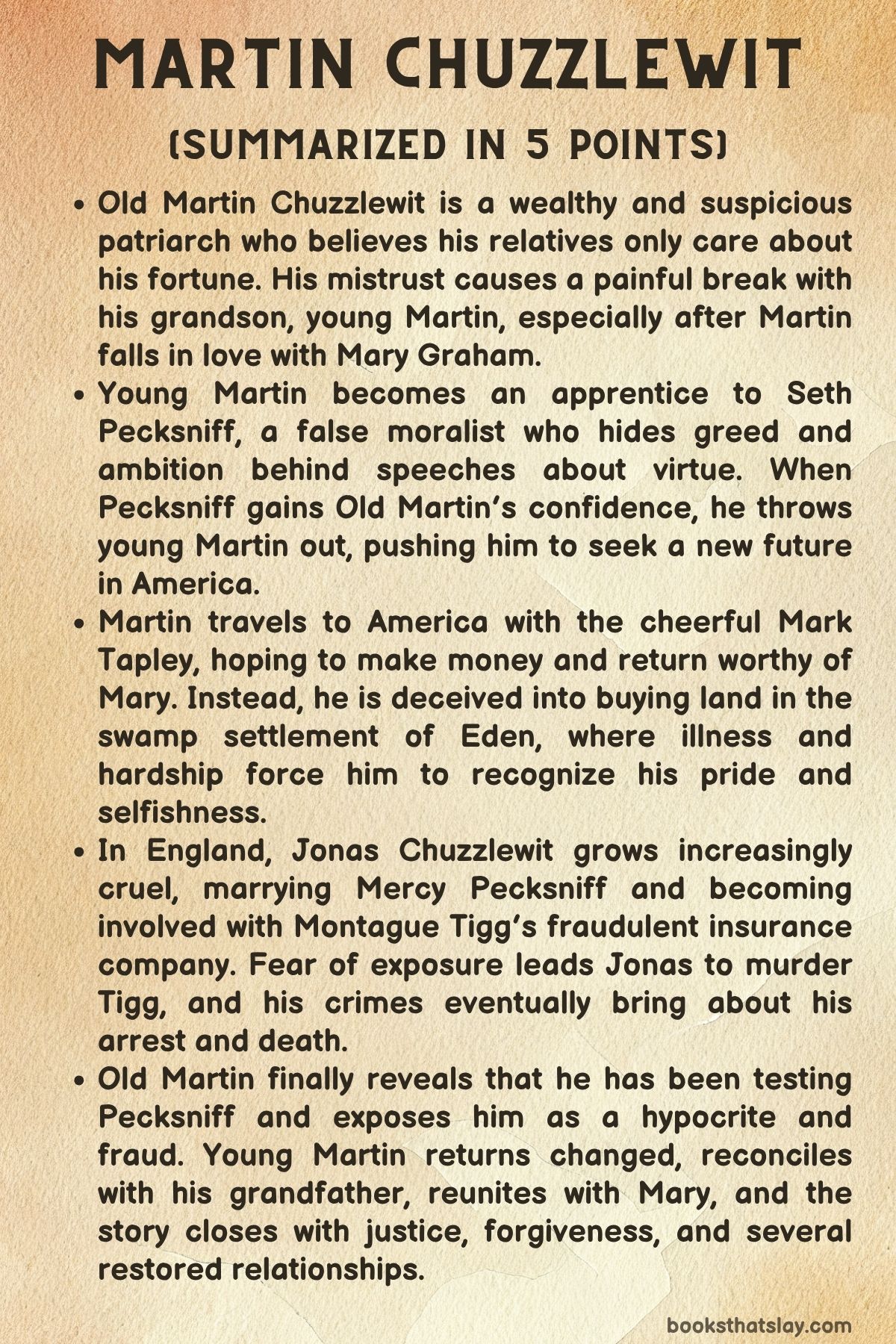
Characters
Young Martin
Young Martin Chuzzlewit begins the book as proud, entitled, and emotionally immature. He believes that his future should naturally include wealth, social standing, and marriage to Mary, and although his love for her is sincere, his early behavior is shaped by self-importance.
His friendship with Tom Pinch is uneven because he accepts Tom’s devotion without fully respecting him. Martin’s journey to America becomes the turning point in his character.
Eden strips away his illusions about easy fortune and forces him into dependence, illness, and shame. Through Mark Tapley’s care and loyalty, Martin begins to understand the selfishness that has damaged his relationships.
By the time he returns to England, he is no longer chasing wealth as proof of worth. He wants honest work, forgiveness, and a life grounded in responsibility.
His reform is meaningful because it is painful; he changes not through speeches, but through suffering, gratitude, and self-knowledge.
Old Martin
Old Martin is the wealthy patriarch whose suspicion drives much of the conflict in Martin Chuzzlewit. He understands that his relatives covet his fortune, but his awareness hardens into mistrust so severe that he wounds the people who care for him most.
His treatment of Mary is complicated because he depends on her loyalty but also controls her life. His quarrel with his grandson comes from fear that love itself may be another form of financial strategy.
Yet Old Martin is not fixed in cruelty. Pecksniff’s false moral advice first unsettles him, and later the goodness of Mary, Tom, and others helps him recognize his own faults.
His secret testing of Pecksniff is morally questionable because it manipulates people, but it also reveals his desire to correct past wrongs. By the end of the novel, he becomes a figure of judgment and reconciliation, exposing hypocrisy while accepting responsibility for the selfishness he helped spread.
Seth Pecksniff
Seth Pecksniff is one of the central hypocrites in Martin Chuzzlewit, a man whose public language of morality hides greed, vanity, and predatory self-interest. He speaks constantly of virtue, charity, humility, and duty, but his actions reveal the opposite.
As an architectural teacher, he exploits pupils by taking their money and claiming their work. As a father, he treats his daughters as instruments in social and financial advancement.
As a relative, he flatters Old Martin in hopes of gaining influence over his fortune. Pecksniff’s most dangerous quality is not simple greed but the way he uses moral language as a weapon.
He can injure others while presenting himself as injured, and he can turn truth into accusation when it threatens him. His pursuit of Mary shows the ugliness beneath his polished surface.
Even when exposed, he tries to preserve the role of the wronged virtuous man, proving that his hypocrisy is not a mask he can easily remove but the core of his identity.
Tom Pinch
Tom Pinch is the moral center of the book because his goodness is patient, humble, and active. At first, his greatest weakness is misplaced devotion.
He believes Pecksniff to be noble and cannot accept John Westlock’s warnings. This innocence makes him vulnerable, but it does not make him foolish in the deeper moral sense.
Tom is generous with money, affection, time, and trust. He helps Martin even when Martin treats him as inferior, and he sacrifices his own quiet love for Mary because he believes loyalty matters more than desire.
When he finally sees Pecksniff clearly, the discovery wounds him deeply because it destroys an ideal he has lived by. Yet Tom does not become bitter.
In London, he protects Ruth, accepts honest work, and continues to act with kindness. His reward is not romantic fulfillment with Mary but the restoration of truth, friendship, and family.
Tom’s greatness lies in his ability to suffer disappointment without losing his moral balance.
Mary Graham
Mary Graham is calm, principled, and emotionally strong. As Old Martin’s companion, she occupies a difficult position because others suspect her of scheming for his fortune, while Old Martin trusts her partly because she has no inheritance claim.
She loves young Martin, but she does not encourage selfish rebellion or resentment. Her loyalty is steady, yet she repeatedly urges forgiveness and patience.
Mary also shows quiet courage in resisting Pecksniff. She sees through his moral performance and refuses to soften her judgment when he harasses and threatens her.
Her strength is not dramatic but firm; she survives dependence, suspicion, and pressure without surrendering her dignity. In the story, Mary often serves as a measure of other characters’ moral quality.
Those who trust and respect her tend toward growth, while those who objectify or manipulate her expose their own corruption. Her final union with Martin confirms not only romantic loyalty but also the value of constancy under pressure.
Mark Tapley
Mark Tapley is comic, loyal, and surprisingly wise. He begins with the unusual wish to find a miserable situation in which his cheerfulness will actually count for something.
This idea sounds absurd, but his conduct in Eden proves that his good humor is not shallow. When Martin becomes sick and frightened, Mark works, nurses, jokes, and endures without complaint.
He never claims moral superiority, yet his example teaches Martin more than any sermon could. Mark’s cheerfulness is valuable because it is tied to service.
He wants hardship not for drama but as a test of character, and when hardship arrives, he meets it with courage. His love for Mrs. Lupin also shows his desire for settled happiness after proving himself.
By the end of the book, Mark represents practical goodness: the kind that cooks, carries, nurses, comforts, and keeps hope alive when fine words are useless.
Jonas Chuzzlewit
Jonas Chuzzlewit is a study in moral decay shaped by upbringing, greed, and fear. He has been raised by Anthony to value money over affection, and he openly resents his father for living too long.
His cruelty is not hidden behind refined manners; he is coarse, violent, and calculating. His marriage to Mercy reveals the domestic horror of his character, as he breaks down her lively spirit through intimidation and abuse.
Jonas is also cowardly. He wants the profit of crime without the burden of guilt or danger.
His attempt to poison Anthony shows intention without courage, while his murder of Tigg shows what happens when fear corners him. Even after learning that Anthony died naturally and had forgiven him, Jonas is not redeemed.
He is frightened, trapped, and self-pitying rather than repentant in any full moral sense. His death is the final result of a life built on selfishness without love, conscience, or trust.
Mercy Pecksniff
Mercy, often called Merry, begins as playful, flirtatious, and somewhat shallow, but her arc becomes one of the saddest in the novel. In her father’s house, she treats courtship and marriage lightly, enjoying attention without understanding the danger of Jonas’s character.
Old Martin warns her, but she does not take the threat seriously. Once married, she discovers that Jonas’s cruelty is not a game.
Her brightness fades under abuse, and the change in her shocks those who knew her before. Yet Mercy is not presented only as a victim.
Her suffering gives her a clearer moral perception, and her kindness toward Chuffey shows that she retains compassion despite her own pain. Her movement from careless girlhood to wounded endurance exposes the cost of treating marriage as a financial or social arrangement.
Through Mercy, the story shows how selfish men and ambitious families can destroy a young woman’s security and joy.
Charity Pecksniff
Charity, often called Cherry, is proud, jealous, and deeply shaped by her father’s values. She expects to be chosen by Jonas and is humiliated when he proposes to Mercy instead.
Her pain is real, but it often turns into bitterness rather than self-knowledge. She blames others, especially her sister, and carries her resentment into later scenes.
Her relationship with Augustus Moddle is comic but also revealing. She does not love him in a generous way; she sees him partly as a means of restoring her wounded pride.
Charity’s character shows another result of Pecksniff’s household. While Mercy suffers through marriage, Charity becomes hardened by disappointment and rivalry.
She has moments of vulnerability, but she rarely rises above vanity and grievance. Her name is ironic because she often lacks charity in the moral sense, especially toward the sister whose suffering should have moved her to sympathy.
John Westlock
John Westlock is clear-sighted, loyal, and independent. As a former pupil of Pecksniff, he understands the fraud and hypocrisy of the man long before Tom can accept it.
John’s frustration with Tom comes from affection rather than arrogance; he wants his friend to be free from deception. Once Tom arrives in London, John responds with warmth and practical help, offering shelter, guidance, and respect.
His love for Ruth develops with gentleness and sincerity. Unlike many relationships in the book, theirs is not based on money or manipulation but mutual admiration.
John also plays an important role in uncovering the truth about Jonas because he listens to Lewsome and helps organize the effort to expose hidden crimes. He represents honest professional ambition and social decency.
As an architect, friend, and future husband, John offers a healthier alternative to Pecksniff’s false respectability.
Ruth Pinch
Ruth Pinch is gentle, capable, and quietly resilient. As a governess, she suffers under employers who degrade her position and then blame her for not being respected.
Her situation shows the vulnerability of working women who depend on households that may treat them as inferior. Tom’s rescue of Ruth is one of his finest moments, but Ruth is not merely someone to be rescued.
Once she and Tom set up their home, she becomes a source of order, warmth, and emotional strength. Her domestic skill is presented not as limitation but as intelligence, care, and dignity.
Ruth also understands Tom’s feelings with tenderness, especially his love for Mary and his sadness over it. Her relationship with John Westlock brings her the affection and respect she deserves.
Ruth’s character adds emotional balance to the novel because her goodness is practical, observant, and steady.
Montague Tigg
Montague Tigg, later styling himself as Tigg Montague, is an opportunist who rises from shabby dependency to polished fraud. In his early appearances, he is comic in his shameless borrowing and social parasitism.
Later, his transformation into the head of the Anglo-Bengalee company shows a more dangerous form of the same character. He learns that appearance can create trust, and he uses offices, titles, dinners, and confident language to attract investors.
Tigg is not physically brutal like Jonas, but he is morally reckless. He builds a business on deception and feeds on the weaknesses of greedy men.
His blackmail of Jonas is meant to secure profit, yet it also places him in danger. Tigg’s murder shows the risk of dealing with people as corrupt as himself.
He is a fraud who thinks he can control other frauds, but he misjudges the violence fear can produce.
Sarah Gamp
Sarah Gamp is one of the great comic grotesques in the novel. She works as a nurse and caretaker, yet she is careless, self-indulgent, and often more interested in drink, food, and personal comfort than in her patients.
Her repeated references to Mrs. Harris, who may not exist at all, create a comic shield through which she praises and excuses herself. Beneath the humor, however, Mrs. Gamp is also part of Dickens’s criticism of neglected care work and corrupt professional habits.
She is not evil in the way Jonas or Pecksniff is, but she is irresponsible in a role that requires compassion and discipline. Her handling of the sick and vulnerable is often harsh, and her moral sense is clouded by appetite and habit.
Still, she becomes useful in the exposure of Jonas, partly because her vanity and grievances make her willing to talk. She is funny, disturbing, and socially revealing at the same time.
Anthony Chuzzlewit
Anthony Chuzzlewit is cold, miserly, and emotionally damaged, but he is not without tragic awareness. He has trained Jonas to be selfish and hard, taking pride in the very qualities that later turn against him.
His relationship with his son is a grim exchange of suspicion, inheritance, and resentment. Anthony’s late discovery of Jonas’s intention to poison him forces him to confront what his own values have produced.
His decision not to expose Jonas and his wish to forgive him show a final movement toward tenderness, though it comes too late to repair the damage. Anthony’s natural death complicates the moral situation because Jonas is guilty in intention even if not in the actual death.
Through Anthony, the story suggests that selfishness is inherited not only through money but through habits of feeling, speech, and expectation.
Chuffey
Chuffey is Anthony’s old clerk and companion, a figure of loyalty, grief, and buried truth. At first he appears mentally confused and socially insignificant, but his attachment to Anthony gives him moral importance.
He has witnessed the misery of Anthony and Jonas’s household and carries the secret of Anthony’s final wishes. His grief after Anthony’s death is dismissed by others, especially those who find him inconvenient, but it is one of the few genuine emotional responses in that household.
Chuffey’s later testimony changes the understanding of Anthony’s death and reveals the depth of Anthony’s last-minute remorse. His devotion to Mercy after her marriage also shows his instinctive sympathy for the vulnerable.
Chuffey may seem broken, but he preserves truths that stronger and louder characters try to hide.
Mrs. Lupin
Mrs. Lupin, the landlady of the Blue Dragon, represents warmth, hospitality, and practical judgment. She is kind to travelers, loyal to Tom, and emotionally perceptive about the people around her.
Her inn becomes a place of refuge and reconnection, especially for Mark and Martin when they return from America. Mrs. Lupin also brings out Mark Tapley’s softer hopes.
His wish to marry her and rename the inn reflects a desire to turn cheerfulness into a settled domestic life. She is not naïve; she sees through nonsense, including some of Mark’s comic ideas about testing his good humor.
Her importance lies in the stability she offers. In a novel full of schemes, false homes, and predatory households, Mrs. Lupin’s inn stands for honest welcome and community.
Nadgett
Nadgett is quiet, watchful, and unsettlingly effective. As Tigg’s spy, he gathers information without attracting attention, moving through barbershops, streets, homes, and public places with patient secrecy.
Though he works for a corrupt man, his observations eventually help expose Jonas’s crimes. Nadgett is not a warm moral figure like Tom or Mark; he belongs to the darker machinery of surveillance and suspicion.
Yet in a world where criminals hide behind business, family, and respectability, his methods become useful. His role also reflects one of the book’s recurring concerns: hidden actions eventually leave traces.
Jonas believes secrecy protects him, but Nadgett’s persistence proves otherwise. He is less a developed emotional character than an instrument of consequence, bringing buried guilt into public view.
Chevy Slyme
Chevy Slyme begins as one of the grasping Chuzzlewit relatives who hopes to benefit from Old Martin’s wealth. His early association with Tigg places him among the needy, scheming figures who gather around money without dignity.
Later, however, he reappears in a very different role as a police officer involved in Jonas’s arrest. This shift gives him a curious place in the story.
He is not transformed into a major moral hero, but his new position allows him to take part in the enforcement of justice against a worse relative. His willingness to give Jonas a brief chance to be alone shows a morally ambiguous mixture of pity, weakness, and grim understanding.
Slyme’s path suggests that even minor and compromised characters can be pulled into the larger movement from family greed toward public judgment.
Lewsome
Lewsome is weak, guilty, and essential to the exposure of Jonas. As a former medical man, he gives Jonas access to poison and then suffers under the burden of what he believes he helped cause.
His illness reflects both physical collapse and moral torment. He lacks the strength to confess immediately, but his desire to tell the truth shows that conscience still works in him.
Lewsome is not innocent; he accepts Jonas’s request and benefits from the cancellation of debts. Yet his later confession helps separate legal fact from moral intention.
Anthony was not murdered by Jonas’s poison, but Jonas still intended murder, and Lewsome’s evidence reveals that intention. His character shows how wrongdoing spreads through weakness as much as through active malice.
Mrs. Todgers
Mrs. Todgers runs a London boarding house that gathers many comic and socially ambitious figures under one roof. She is practical, sentimental, and alert to the small dramas of courtship, lodging, and reputation.
Her house is crowded, confusing, and often ridiculous, but it also serves as an important social crossroads. Through her, the reader sees the Pecksniff daughters in London, the boarders’ shallow flirtations, and later the altered condition of Mercy.
Mrs. Todgers is not a major moral force, yet she has human feeling, especially when she notices suffering in others. Her world is one of cramped rooms, gossip, meals, and social performance, making her boarding house a smaller comic version of the society the novel criticizes.
Augustus Moddle
Augustus Moddle is comic in his gloom, romantic despair, and emotional excess. He first attaches himself to Mercy and then transfers his attention to Charity because she reminds him of her sister.
His sadness often appears exaggerated, yet it reveals the absurd side of romantic self-pity. Moddle wants to suffer beautifully, and his courtship of Charity is filled with tears, hesitation, and melodrama.
He is not cruel, but he is weak and self-absorbed. His relationship with Charity mirrors the novel’s wider interest in mismatched motives: people often seek marriage not from clear love but from vanity, loneliness, resentment, or fantasy.
Moddle’s comic misery provides relief from darker plots while still reflecting the dangers of emotional immaturity.
Themes
Selfishness and Moral Reform
Selfishness appears as an inherited habit, a social disease, and a personal failing that can still be corrected when a character becomes honest with himself. Young Martin’s early pride is not the same as Jonas’s cruelty or Pecksniff’s hypocrisy, but it belongs to the same moral field: he thinks first of his own disappointment, his own future, and his own claim to happiness.
Old Martin’s suspicion is also a form of selfishness because it turns love into a financial test and makes trust almost impossible. The book does not treat all selfish people as equally lost.
Jonas moves from greed to violence because he refuses self-knowledge, while Pecksniff grows worse because he has trained himself to disguise selfishness as virtue. Young Martin and Old Martin, however, change because suffering and observation force them to see what they have become.
In Martin Chuzzlewit, reform begins when self-deception breaks. The hopeful ending depends not on wealth being redistributed alone, but on pride being confessed, forgiveness being asked for, and relationships being rebuilt on better moral terms.
Hypocrisy and False Respectability
Respectability in the novel often functions as a costume. Pecksniff is the clearest example because he speaks in the language of morality while exploiting pupils, manipulating family members, and harassing Mary.
His danger lies in the gap between speech and action. He does not merely lie; he uses virtue itself as a performance that protects him from criticism.
Tigg’s insurance company offers a business version of the same problem. Offices, titles, formal dinners, and impressive language create the appearance of stability, though the whole enterprise is fraudulent.
Even family respectability is suspect when relatives gather around Old Martin with polite concern that barely conceals hunger for inheritance. Dickens shows that society often rewards the look of goodness before testing the reality of conduct.
True morality appears in quieter forms: Tom giving away his money, Mark nursing Martin, Ruth keeping house with care, and Mary resisting pressure without public display. The contrast makes the theme sharp.
Goodness does not need constant advertisement, while false respectability depends on being loudly announced.
Family, Inheritance, and Corruption
The Chuzzlewit family is bound less by affection than by expectation of money. Inheritance turns kinship into competition, and Old Martin’s fortune becomes a magnet for flattery, suspicion, resentment, and strategy.
Relatives who should offer care instead calculate advantage. Jonas’s relationship with Anthony shows the most brutal form of this corruption.
A son waits for his father’s death as a financial opportunity, while the father has helped create that attitude by raising him without tenderness. Pecksniff treats his daughters’ marriages as transactions, and the damage falls most heavily on Mercy, whose marriage to Jonas becomes a prison.
The novel repeatedly asks what family means when money becomes its central language. Blood relation alone is not enough to create loyalty or love.
Some of the strongest bonds are chosen rather than inherited: Tom and John’s friendship, Tom and Ruth’s sibling devotion, Mark’s loyalty to Martin, and Mary’s care for Old Martin. By the end, the healthier family circle is built through repentance, affection, and trust rather than through legal claims or shared surnames.
Suffering, Loyalty, and the Testing of Character
Hardship reveals character more clearly than comfort. Mark Tapley’s comic wish to find a situation bad enough to prove his cheerfulness becomes serious in Eden, where disease, disappointment, and fear test both him and Martin.
Mark’s loyalty is practical rather than sentimental. He works, nurses, encourages, and remains steady when Martin has no money, no strength, and no plan.
This loyalty becomes the force that helps Martin change. Tom Pinch is tested differently.
His suffering comes through disillusionment, lost employment, and impossible love, yet he refuses bitterness. Mary is tested through dependence and unwanted pressure, while Mercy is tested through a cruel marriage that exposes how little protection social arrangements can offer.
The novel values endurance, but not passive endurance alone. The best characters suffer and still act generously.
They protect others, tell the truth, offer help, and remain capable of joy. Suffering does not automatically ennoble anyone; Jonas becomes worse under fear, and Pecksniff learns nothing from exposure.
The difference lies in whether pain leads to self-knowledge or deeper selfishness.