Agnes of God Summary, Characters and Themes
Agnes of God by John Pielmeier is a dramatic play about faith, trauma, guilt, and the limits of human understanding. Set around the investigation of a newborn’s death in a convent, it follows court-appointed psychiatrist Dr. Martha Livingstone as she tries to determine whether Sister Agnes, a young nun, is mentally fit to stand trial.
What begins as a legal and medical inquiry becomes a deeper conflict between science and religion, memory and denial, innocence and responsibility. The play is powerful because it refuses easy answers, leaving its characters and audience caught between evidence, belief, pain, and mystery.
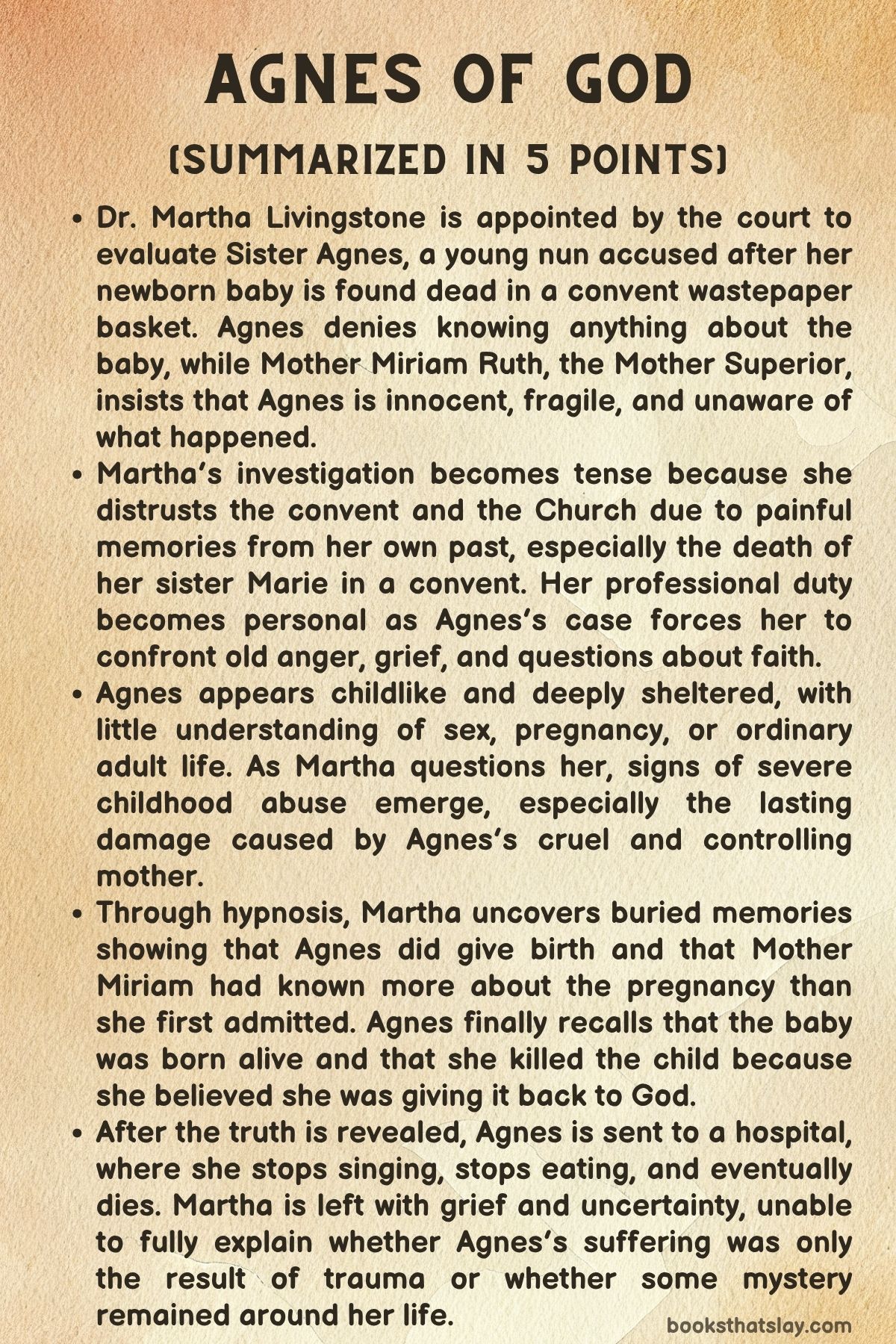
Summary
The play begins with Dr. Martha Livingstone speaking alone, recalling how, as a child, she repeatedly watched the film Camille and hoped each viewing might end differently. Even though she knew the heroine would die, she imagined that somewhere there might be another version of the story where the ending changed.
This memory introduces one of Martha’s deepest longings: the desire to believe that terrible stories might still have happy endings. From there, she turns to the case that has brought her into contact with Sister Agnes, a young nun accused after a dead infant is found in a wastepaper basket in her convent room.
The baby’s umbilical cord had been tied around its neck, and Agnes had been discovered unconscious nearby, weakened by severe blood loss. Martha has been appointed by the court to evaluate Agnes’s mental condition and decide whether she is legally sane.
Martha first meets Mother Miriam Ruth, the Mother Superior of the convent. Mother Miriam wants to protect Agnes and is wary of Martha’s psychiatric approach.
She insists that Agnes is fragile, innocent, and unable to answer the questions Martha wants to ask. According to Mother Miriam, no one in the convent knew Agnes was pregnant.
Agnes lived a sheltered and private life, and the usual medical examinations had not taken place during the pregnancy. Mother Miriam explains that she discovered Agnes unconscious and later found the dead infant hidden in the wastebasket.
Another nun contacted the authorities. Martha wants to know who fathered the child, but Mother Miriam resists the question, arguing that the father’s identity is less important than Agnes’s state of mind.
She even suggests that Agnes may not have received the child in any ordinary way.
Martha’s attitude toward the convent is shaped by painful memories of her own life. She remembers her younger sister, Marie, who entered a convent at fifteen and later died of untreated appendicitis because the convent did not send her to a hospital.
This event permanently damaged Martha’s relationship with religion and the Church. She sees religious institutions as capable of dangerous blindness, especially when obedience replaces common sense.
Hearing Agnes sing, however, unsettles her. Agnes’s voice seems extraordinary, almost disconnected from the simple and frightened young woman Martha is about to meet.
When Martha interviews Agnes, Agnes appears childlike, evasive, and deeply confused. She speaks easily of God and love but denies ever seeing a baby.
She insists that the police invented the child and says she remembers only feeling sick, going to her room, suffering pain, and falling asleep. When Martha asks questions about childbirth and sex, Agnes becomes distressed and defensive.
Her understanding of pregnancy is shaped by religious fantasy rather than ordinary knowledge. She speaks of angels, a mysterious Lady who sings through her, and disturbing memories of her mother.
She also mentions hearing the name Marie, which unsettles Martha because of her dead sister.
Mother Miriam insists that Agnes is neither lying nor insane. She believes Agnes has no real knowledge of sex or childbirth because she was raised in extreme isolation by her mother before entering the convent.
Martha is not convinced. She sees signs of psychological damage and begins to suspect that Agnes’s innocence may be connected to severe repression.
Mother Miriam tells Martha about a time when Agnes stopped eating because she believed God wanted her to become small and pure. Agnes thought God hated fat people and that she needed to become childlike to be acceptable to Him.
She also believed her dead mother was still watching and punishing her. Around this time, Agnes developed a wound through her palm, which Mother Miriam saw as possibly miraculous, while Martha interpreted it as a psychological symptom.
Martha’s own history continues to surface. She remembers arguing with her mother about religion, rejecting God, losing faith after Marie’s death, and never forgiving the Church.
She also recalls a failed relationship with Maurice, a Frenchman she loved partly because her mother disapproved of him. When Martha became pregnant, she chose not to continue the pregnancy, and the relationship ended.
These memories make her involvement in Agnes’s case deeply personal. Although Martha tries to remain objective, the case reopens old wounds about motherhood, belief, guilt, and bodily autonomy.
As Martha questions Agnes further, Agnes reveals more about her childhood. She says she fears babies because they are fragile and because growing up itself seems frightening.
She believes she was dropped as a child and that this explains her difficulties understanding the world. She describes her mother as isolated, controlling, and capable of predicting the future through messages from angels.
Martha presses her about motherhood, pregnancy, and the father of the child, but Agnes becomes overwhelmed and lashes out, accusing Martha of trying to take God away from her.
The conflict between Martha and Mother Miriam intensifies. Martha believes Agnes has been dangerously sheltered and deprived of knowledge about life, sex, and independence.
Mother Miriam argues that Agnes is not a symbol of the Church but a vulnerable person who will be destroyed by prison or a psychiatric hospital. She also reveals that she was once married and had children before entering religious life.
Her own children have rejected her, and she admits that her attempts to protect them failed. Martha proposes that Agnes may be acquitted through legal innocence, but to do that she needs the truth.
Mother Miriam remembers an incident involving Agnes’s missing sheets. Agnes had burned them because they were stained with blood, though she did not understand why.
At first she thought the bleeding was menstrual, then insisted it was different and frightening. Mother Miriam now realizes that this may have marked the moment of conception or the beginning of the pregnancy.
Martha becomes increasingly convinced that there is a hidden third presence in the story, someone or something beyond Agnes and the dead child.
Martha eventually uncovers the severity of Agnes’s abuse. Agnes reveals that her mother humiliated her, shamed her body, warned her about pregnancy in cruel ways, and even burned her genitals with a cigarette.
Agnes continues to fear her mother after death, believing she is still watching and judging her. Martha tries to help Agnes reject her mother’s accusations and accept that she is not ugly, stupid, or a mistake.
Agnes begins to respond, but the effort is painful. Martha asks permission to use hypnosis to recover buried memories, and Agnes agrees after Martha reassures her.
Mother Miriam then reveals that she is Agnes’s aunt. She knew Agnes’s mother was troubled and addicted to alcohol, but claims she did not know the full extent of the abuse.
Martha accuses her of withholding crucial information. Their argument becomes a debate about responsibility, faith, and whether religious protection can become neglect.
Mother Miriam also admits her own crisis of faith and says Agnes’s singing restored something in her. Despite her fears, she allows hypnosis to continue.
Under hypnosis, Agnes admits that she did have a baby. She says she knew she was pregnant and feared she was unworthy of being a mother.
She believed she was being punished. She also says another nun guessed the truth, though she refuses to name her.
Martha guides her back to the night of the birth. Agnes remembers eating dinner, attending prayers, feeling ill, and returning to her room.
She notices a wastepaper basket there, even though one was not normally present. As she relives the experience, she describes terrible pain, hallucinations, and the sense that someone was there to take the baby.
Mother Miriam tries to stop the session, but Martha brings Agnes back safely. Afterward, Agnes embraces Martha but later says she will not see her again.
She identifies her mother as the figure she believed was present.
Martha becomes more emotionally involved. She has a disturbing dream in which she is a midwife in a remote white hospital, performing a birth that seems to pull her inside the mother’s body.
When she wakes, she finds blood on her sheets despite not having menstruated for years. This strange event shakes her confidence in pure rationality.
She obtains a court order placing Agnes under her care, convinced that she is doing the right thing, but she also recognizes that she has lost professional distance.
Martha then confronts Mother Miriam, who finally admits she knew Agnes was pregnant before the birth. She says she realized it too late and told Agnes not to tell anyone.
She also admits that she entered Agnes’s room during labor, but claims she panicked and left to get help. Martha suspects Mother Miriam may have been involved in the baby’s death, but Mother Miriam denies it.
During another hypnosis session, Agnes returns to the night she became pregnant and describes a strange experience of light, blood, flowers, and a divine presence. Martha tries to direct her toward the possibility of a human attacker, but Agnes identifies the figure as God and says she now hates Him.
At last, Agnes remembers the birth. She says Mother Miriam was present during the delivery and then left her alone with the newborn.
The baby was alive. Agnes tied the umbilical cord around the baby’s neck because she believed she was giving the child back to God.
She then placed the body in the wastebasket. The truth devastates everyone.
Agnes withdraws into singing and fragmented visions, unable to fully return to ordinary reality.
After the case ends, Martha withdraws. Mother Miriam submits Agnes to the court, and Agnes is sent to a hospital.
There, she stops singing, stops eating, and eventually dies. Martha is left with unanswered questions.
She cannot fully explain why Agnes was abused, why the baby died, or why Agnes’s mind was destroyed. She remains uncertain whether Agnes’s experience was only trauma or whether some form of mystery still surrounded her.
In the end, Martha misses Agnes and wants to believe that some part of her remains. For Martha, even the possibility that Agnes was blessed becomes a small form of miracle.
Characters
Dr. Martha Livingstone
Dr. Martha Livingstone is the intellectual and emotional center of the investigation. As the court-appointed psychiatrist in Agnes of God, she enters the convent with a professional duty: to determine whether Agnes is legally sane.
Yet her role quickly becomes more complicated because the case touches the deepest wounds of her own life. Martha is rational, skeptical, sharp, and often impatient with religious explanations, but her skepticism is not abstract.
It comes from personal loss, especially the death of her sister Marie in a convent and her painful relationship with her religious mother. She sees the mind as the place where meaning is made, and she distrusts any institution that asks people to surrender judgment to faith.
At the same time, Martha is not emotionally cold. Her need to save Agnes becomes intense because Agnes represents more than a patient.
She becomes a living challenge to Martha’s beliefs about truth, healing, motherhood, and responsibility. Martha wants facts, but she also wants redemption.
Her tragedy is that uncovering truth does not save Agnes. By the end, Martha is forced to accept that knowledge can expose pain without repairing it.
Sister Agnes
Sister Agnes is the most fragile and mysterious figure in the play. The emotional power of Agnes of God comes largely from the gap between what Agnes appears to be and what has happened around her.
She is young, sheltered, musically gifted, and almost childlike in her understanding of the world. Her language is filled with angels, divine voices, purity, punishment, and fear.
At first, she denies the existence of the baby, not as a calculated lie but as a defense against unbearable memory. Agnes’s innocence is real in one sense, because she has been denied knowledge of sex, pregnancy, and ordinary adult life.
Yet this innocence has been created through isolation, abuse, and repression, not through peace. Her childhood with her mother has left her terrified of her body and convinced that pain is tied to moral failure.
Her singing represents both beauty and escape; it connects her to something beyond ordinary speech, but it also shields her from facing reality. Agnes’s final confession shows a mind trying to give spiritual meaning to trauma.
She kills the baby not out of cruelty but out of a distorted belief that returning the child to God is an act of purity. Her death after the trial confirms how completely her identity depended on the fragile world that had already broken her.
Mother Miriam Ruth
Mother Miriam Ruth is one of the most morally complicated figures in Agnes of God. She is protective, intelligent, forceful, and deeply attached to Agnes, but her protection is also mixed with secrecy, denial, and fear of scandal.
As Mother Superior, she represents the convent’s authority, yet she is not simply a cold institutional figure. She has lived in the outside world, been married, raised children, failed as a mother in her own eyes, and entered religious life carrying regret.
Her desire to protect Agnes comes partly from love and partly from her need to believe that Agnes is special, perhaps even touched by God. This belief helps Mother Miriam preserve meaning in a world that has disappointed her.
However, her actions also cause harm. She withholds information, minimizes danger, and admits too late that she knew Agnes was pregnant.
Her faith allows her to see wonder where Martha sees damage, but it also tempts her to avoid practical responsibility. Mother Miriam is tragic because she genuinely loves Agnes while also helping create the silence that destroys her.
She wants a miracle, but her need for one makes her less able to face the human facts in front of her.
Agnes’s Mother
Agnes’s mother is physically absent from the main action, but her presence controls much of the story. She survives in Agnes’s mind as a voice of punishment, shame, and fear.
Through Agnes’s memories, she emerges as abusive, unstable, isolated, and cruelly obsessed with the body as a source of sin and disgust. She teaches Agnes to fear womanhood, sexuality, pregnancy, and even physical growth.
Her violence is not only physical but psychological. By humiliating Agnes and making her believe that her body is ugly or mistaken, she damages Agnes’s ability to understand herself as a whole person.
Even after death, Agnes believes her mother is watching her, which shows how deeply the abuse has entered her inner life. Agnes’s mother also distorts religious language, turning God, angels, punishment, and purity into tools of control.
She helps explain why Agnes cannot separate divine love from terror. In the play, she functions as the unseen origin of Agnes’s broken relationship with her body, her faith, and her memory.
Marie
Marie, Martha’s younger sister, is a small but crucial figure because she explains much of Martha’s anger toward the Church. Marie entered a convent as a teenager and disappeared from Martha’s ordinary family life.
Her later death from untreated appendicitis becomes, for Martha, proof that religious obedience can become deadly when it replaces medical care and practical judgment. Marie’s fate haunts Martha’s view of Agnes.
Martha does not approach the convent as a neutral space; she carries the memory of a sister who trusted such a place and died there. Marie also creates an emotional link between Martha and Agnes.
When Agnes mentions the name Marie without understanding its meaning, Martha is shaken because it suggests that the case is touching something private and unresolved inside her. Marie represents lost sisterhood, failed protection, and the personal grief behind Martha’s professional certainty.
Through her, the play shows that Martha’s rationalism is not only a philosophy. It is also a scar.
Father Marshall
Father Marshall is a minor figure, but his presence matters because he represents the unanswered question of male involvement. Agnes speaks of him as someone whose love she can see in his eyes, and she meets him regularly in confession.
Mother Miriam dismisses him as shy and unlikely to be involved, but the very mention of him introduces suspicion because Agnes has had so little contact with men. He remains largely undefined, which makes him more symbolic than fully developed.
He stands for the male religious authority that surrounds Agnes but remains strangely distant from accountability. Whether or not he has any direct connection to Agnes’s pregnancy is not confirmed through the material, but his place in Agnes’s imagination is important.
She understands love through religious structures rather than ordinary relationships, and Father Marshall becomes part of that confused emotional world. His absence from the central confrontation also matters.
The women struggle over truth, guilt, and interpretation, while the possible male source of sexual violence remains uncertain and shadowed.
Maurice
Maurice appears through Martha’s memories rather than the main investigation, but he reveals important parts of her character. He was Martha’s former fiancé, a Frenchman disliked by her mother.
Martha admits that her mother’s opposition strengthened her attachment to him, which suggests how much her early life was shaped by resistance. The relationship ended after Martha became pregnant and chose not to continue the pregnancy.
Maurice’s different view of the situation caused the separation. Through him, the story shows that Martha’s relationship to motherhood is emotionally complex.
Her questioning of Agnes is not detached from her own reproductive history. Maurice also reflects the conflict between personal freedom and inherited expectations.
Martha did not want to become her mother or live out a role imposed on her by family, religion, or romance. His memory places Martha’s later obsession with Agnes’s child in a sharper light.
She is investigating a dead infant while carrying her own unresolved history of pregnancy, choice, and loss.
Sister Margaret
Sister Margaret has a limited role, but she is important as a witness to the aftermath of the birth. She is present when Mother Miriam discovers the scene in Agnes’s room and contacts the authorities.
Her action brings the outside world into the convent, breaking the closed circle of silence that surrounds Agnes. Although the material does not give her much psychological detail, Sister Margaret represents ordinary institutional responsibility at a moment when others are confused, frightened, or secretive.
She does what the situation requires by alerting legal authorities. In that sense, she contrasts with Mother Miriam, whose instinct is to protect the convent and Agnes from exposure.
Sister Margaret’s importance lies not in personal development but in function. She is the person whose response prevents the baby’s death from remaining hidden entirely.
Her presence reminds readers that institutions are made of individuals who can either preserve secrecy or interrupt it.
Sister Paul
Sister Paul is connected to the timeline of Agnes’s pregnancy and appears mainly through the memories uncovered later in the story. The night associated with Sister Paul’s death becomes important because Martha and Mother Miriam believe it may be linked to the moment Agnes became pregnant.
Sister Paul herself is not developed as a major personality, but her death creates an atmosphere of spiritual fear, grief, and confusion around Agnes’s experience. In Agnes’s mind, events do not remain neatly separated.
Death, blood, divine vision, punishment, and bodily violation become fused together. Sister Paul therefore functions as part of the emotional and religious environment that surrounds Agnes’s trauma.
Her role shows how convent life, with its rituals, losses, silences, and beliefs, shapes the way Agnes interprets what happens to her. Even when a character appears only briefly or indirectly, the play uses that presence to deepen the sense that Agnes’s memories are formed from fragments of fear, faith, and pain.
God and the Imagined Divine Presence
God is not a conventional character, yet the imagined divine presence is central to the story because Agnes experiences God as both comfort and terror. For Agnes, God is not an abstract doctrine.
God speaks, watches, judges, punishes, loves, and demands. This presence is shaped by the teachings of the convent, the abuse inflicted by her mother, and Agnes’s own need to make sense of suffering.
When Agnes describes the conception of the child, she identifies the figure as God, which makes the event spiritually meaningful to her even as Martha reads it as evidence of trauma or assault. The divine presence in the play is therefore unstable.
To Mother Miriam, it may signal mystery or miracle. To Martha, it may be a psychological construction formed by abuse.
To Agnes, it is real enough to command her actions. This imagined God becomes one of the most frightening forces in the story because Agnes cannot separate divine love from violence.
Her decision to return the baby to God shows how completely her damaged religious imagination governs her understanding of life and death.
Themes
Faith, Doubt, and the Search for Meaning
Faith in Agnes of God is never presented as simple comfort, and doubt is never treated as simple wisdom. The story places Martha’s rational skepticism beside Mother Miriam’s religious belief and refuses to let either position explain everything.
Martha wants evidence, cause, motive, and diagnosis. She believes that what people call divine mystery can often be understood through psychology, trauma, and memory.
Mother Miriam, by contrast, wants to preserve the possibility that Agnes is touched by something sacred. She is not blind to pain, but she fears that reducing Agnes to symptoms will destroy the last source of wonder in her life.
Agnes herself stands between these positions. Her faith gives her language for beauty, music, purity, and love, but it also traps her in fear, punishment, and distorted obedience.
The play’s most unsettling question is not whether God exists but whether human beings can bear a world where suffering has no clear meaning. Martha begins as someone who rejects religious answers, yet she ends wanting to believe that Agnes was blessed.
This change does not erase her skepticism. It shows how grief can make even the most rational person long for mystery.
Trauma, Repression, and the Body as Evidence
Agnes’s body carries truths that her conscious mind cannot face. The pregnancy, blood loss, wounds, refusal to eat, and imagined stigmata all reveal pain that has been buried beneath denial and religious language.
Her body remembers what her mind has blocked. This makes the investigation especially painful because Martha cannot reach the truth through ordinary questioning alone.
Agnes does not simply choose silence; she has survived by separating herself from knowledge that would destroy her fragile sense of purity. Her childhood abuse explains why bodily experience is terrifying to her.
Her mother taught her that her body was shameful, dangerous, and punishable, so Agnes interprets menstruation, pregnancy, sex, and childbirth through fear rather than understanding. The baby’s birth becomes not only a physical event but a collapse of every defense Agnes has built.
Hypnosis forces these buried memories to return, but recovery of memory does not bring healing. Instead, it exposes how much damage has already been done.
The theme is especially painful because the body becomes the most reliable witness, while the person living in that body remains unable to survive the truth it reveals.
Innocence, Responsibility, and Moral Judgment
Agnes’s guilt cannot be understood through ordinary moral categories. She kills the baby, yet the story makes it impossible to see her as simply evil or fully responsible in the usual sense.
Her innocence is not the innocence of someone untouched by darkness. It is the innocence of someone denied knowledge, language, agency, and protection.
She does not understand pregnancy in a realistic way, does not understand motherhood as an ordinary human role, and cannot separate God’s will from the voices of fear and punishment inside her mind. The legal system wants an answer: sane or insane, guilty or innocent, responsible or not responsible.
The emotional reality is far more difficult. Martha’s task is to translate Agnes’s shattered inner life into terms the court can use, but the play shows how limited those terms are.
Mother Miriam’s responsibility is also morally complex. She does not kill the child, but her secrecy and fear help create the conditions in which disaster occurs.
Martha, too, causes harm while trying to help. The story suggests that judgment becomes dangerous when it ignores the hidden histories behind an act.
Institutional Power, Protection, and Silence
The convent is meant to be a place of safety, but the story shows how protection can become another form of control when it depends on secrecy. Mother Miriam wants to shield Agnes from the outside world, the courts, psychiatric hospitals, and public shame.
Her instinct is understandable because Agnes is vulnerable, and the outside world is not gentle. Yet the same protective instinct keeps crucial facts hidden.
Agnes’s pregnancy is concealed, her ignorance is preserved, and her suffering is treated as something that can be contained within religious walls. The institution’s silence does not create Agnes’s original trauma, but it allows that trauma to remain unnamed until it becomes fatal.
Martha’s outside authority challenges the convent, but her power is also imperfect. Psychiatry, law, and medicine can expose secrets, classify mental states, and issue orders, but they cannot guarantee mercy or healing.
Agnes is caught between institutions that all claim to know what is best for her. The convent wants to preserve her soul, the court wants a verdict, and Martha wants psychological truth.
None of them can finally save her, which makes the theme of institutional power deeply tragic.