When He Was Wicked Summary, Characters and Themes
When He Was Wicked by Julia Quinn is a Regency romance centered on grief, desire, loyalty, and second chances. It follows Francesca Bridgerton, a young widow who once had a peaceful and loving marriage, and Michael Stirling, the charming cousin of her late husband who has secretly loved her for years.
The book explores what happens when friendship shifts into attraction, when guilt blocks happiness, and when two people must decide whether loving again dishonors the past or gives it new meaning. It is a story about mourning, patience, longing, and the courage to accept a different kind of love. It’s the 6th book of the Bridgertons series.
Summary
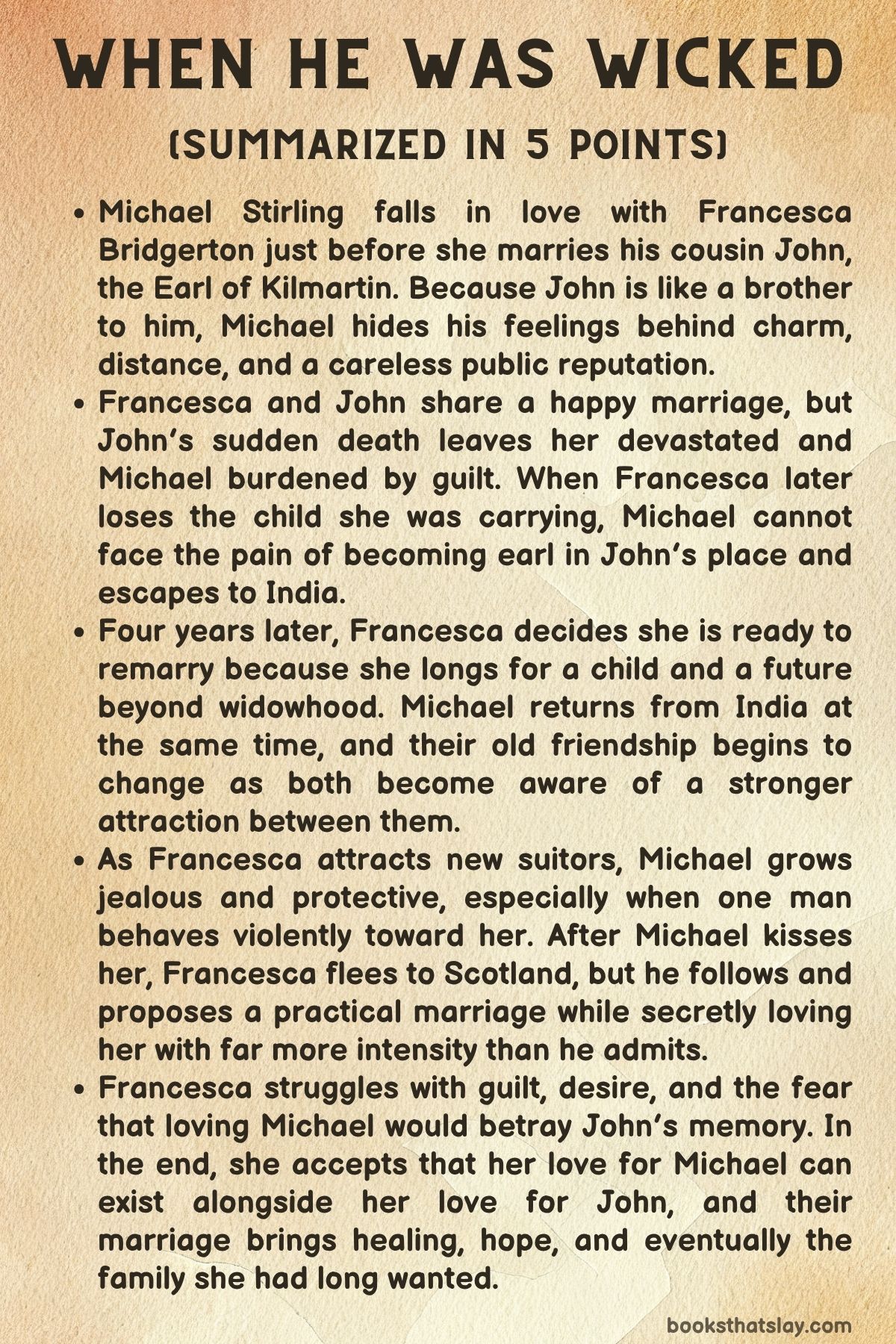
When He Was Wicked begins with Michael Stirling experiencing an immediate and life-changing attraction to Francesca Bridgerton at a supper held before her wedding to his cousin, John Stirling, the Earl of Kilmartin. Michael and John have been raised almost like brothers, and Michael loves him deeply, which makes his feelings for Francesca feel shameful from the first moment.
Francesca, however, is unaware of his inner conflict. She marries John and settles into a happy, gentle marriage built on compatibility, ease, and trust.
Michael becomes a close part of their lives, visiting them often and sharing a warm friendship with Francesca while silently hiding the depth of his love.
Two years into Francesca and John’s marriage, Michael still lives with the pain of wanting what he believes he can never have. He has earned a reputation as a carefree rake, but this public image hides a man burdened by self-reproach.
Francesca sees him as a dear friend and confidant, someone who belongs naturally beside both her and John. She even teases him about marriage, trying to imagine a future for him with another woman.
Michael deflects these suggestions because the only woman he wants is already married to the man he loves most like family.
Everything changes when John suffers a severe headache and lies down before a scheduled meeting. Francesca and Michael go for a walk, and when they return, John’s valet reports that he cannot wake him.
Francesca rushes upstairs and discovers that John has died. Her grief is immediate and overwhelming.
Michael holds her as she breaks down, but he is also struck by horror, guilt, and dread. John’s death does not simply make Michael an heir; it makes him the possible next Earl of Kilmartin, a position he never wanted and one that feels stolen from the cousin he adored.
The question of succession becomes even more complicated when Francesca announces that she is pregnant. If she gives birth to a son, the child will inherit John’s title.
If not, Michael will become earl. Officials become involved, treating Francesca’s pregnancy as a matter of inheritance rather than private sorrow.
Michael is enraged by their coldness, but he cannot escape the terrible possibility that John’s death may bring him the title, estate, and social role that should have belonged to John’s child. Francesca, meanwhile, tries to manage her grief with dignity, supported by John’s mother, Janet, and Michael’s mother, Helen.
Francesca later loses the baby, deepening the loss she has already suffered. Michael receives word of the miscarriage but cannot bring himself to comfort her properly.
His guilt has become unbearable. He is now the Earl of Kilmartin, and the life that once belonged to John has passed to him.
Francesca seeks him out and tells him how much she misses his friendship. She also tells him that the child would have needed him, too, because he was the only person who knew John as she did.
Michael reacts badly, feeling trapped by the idea that he might be asked to replace John. He insists that he cannot be John, frightening Francesca and damaging the closeness between them.
Soon afterward, he leaves for India, running from the title, the estate, Francesca, and himself.
Four years later, Francesca is twenty-six and decides she is ready to leave full mourning behind. She wants a child, and since John is gone, she knows she must remarry if she is to have one.
She travels to London for the social season with practical intentions: she will reenter society, update her wardrobe, and search for a suitable husband. During Michael’s absence, she has managed the Kilmartin estate with skill and authority, because he left her in charge before going abroad.
At the same time, Michael returns from India after several years of work in Madras. Neither expects to find the other in London so soon.
Their reunion occurs late at night in the library of Kilmartin House. Francesca, dressed informally, finds Michael warming himself by the fire.
The moment is awkward, intimate, and charged with everything unsaid between them. Michael notices that Francesca is no longer simply his cousin’s widow in the same way she once was; she is now a woman who may remarry, and that knowledge unsettles him.
Francesca is also affected by his presence in a new way, though she does not yet understand what has shifted.
To avoid scandal, Francesca moves temporarily to her mother Violet’s house. Michael visits, and their old rhythm begins to return, though it is altered by tension.
Francesca tells him plainly that she intends to find a husband because she wants a baby. This confession disturbs Michael.
The thought of watching her be courted by other men is painful, but he still considers himself unworthy of pursuing her. His old guilt remains strong, and he continues to believe that loving Francesca betrays John’s memory.
Michael soon falls ill with a recurrence of malaria contracted abroad. Francesca discovers him feverish and stays by his side through the night, terrified at the thought of losing him too.
His illness exposes how deeply she still cares for him. She agrees to keep his condition private, but the incident intensifies the emotional bond between them.
Around this time, Violet begins to suspect that Francesca and Michael’s relationship may be more complicated than either admits. Francesca denies any affair, yet she cannot ignore the fact that she has begun to notice Michael’s physical presence in a way she never did while John was alive.
As Francesca enters society again, suitors begin to pursue her. Flowers, poems, and invitations arrive, and her family helps signal that she is open to remarriage.
Michael attends balls and social events, often surrounded by admiring women, but his attention remains fixed on Francesca. She criticizes him for his rakish reputation, not realizing that this reputation has long been partly a shield against his impossible love for her.
Michael’s jealousy grows as men show interest in her, especially when he learns that some are attracted not only by Francesca herself but also by the dowry attached to her remarriage.
His protectiveness becomes fierce when Sir Geoffrey Fowler forces himself on Francesca in a garden. Michael finds them, pulls Sir Geoffrey away, and threatens him with violence if he ever approaches her again.
Francesca is shaken, but Michael’s reaction reveals the intensity of his feelings. Later, when she confronts him about his anger and about whether he resents her wish to remarry, the truth between them begins to surface.
Michael kisses her, and Francesca responds. The kiss frightens her because it proves that her feelings for Michael are no longer simple friendship.
She pulls away and soon flees to Scotland, telling herself that she needs distance.
Michael follows after encouragement from Colin Bridgerton, who bluntly suggests that Michael should marry Francesca himself. Michael decides to propose, but rather than confessing his love, he frames the marriage as a practical arrangement.
Francesca would remain countess, keep her home, and have a chance at children with a man she already trusts. Francesca refuses because the idea feels emotionally dangerous and morally confusing.
Michael then begins actively courting and seducing her, believing that if she admits her desire, she may also accept marriage.
In Scotland, Francesca struggles with desire, guilt, and loyalty to John’s memory. She and Michael begin a physical relationship, but she refuses to give him a clear answer about marriage.
She tells herself that she will marry him only if she becomes pregnant, turning the question into a practical matter rather than an emotional choice. Michael, however, wants more than duty.
He has loved her for six years, and the more time they spend together, the less he can hide the depth of that love. Their intimacy is mixed with argument, tenderness, frustration, and fear.
When Francesca realizes she is not pregnant, her disappointment forces her to confront her own motives. She breaks down, believing she has fallen from her own standards and betrayed John by desiring Michael so intensely.
Michael finally confesses that he has loved her for years. This truth shocks her, but it also clarifies the emotional reality she has been avoiding.
After time alone at a gazebo John built for her, Francesca returns to Michael and agrees to marry him.
They marry quickly in Scotland. Francesca asks Michael to promise fidelity, and he reveals that his past affairs were attempts to forget her.
After the wedding, Michael tells her that he loves her. Francesca cannot immediately say the same.
She believes marrying him was right, but she has not yet fully understood that her love for him is not a betrayal of John. Their marriage begins with passion and closeness, but also with Francesca’s emotional hesitation.
When Michael later falls ill again, Francesca fears that she may lose a second husband. The fear breaks through her resistance.
She realizes that she loves Michael not as a replacement for John, but as the man he is. She goes to John’s grave with peonies, speaks honestly to her late husband, and tells him that she has fallen in love with Michael.
She believes John would have wanted them to be happy. Michael hears her confession, and Francesca tells him directly that she loves him.
This moment releases both of them from much of the guilt that has shaped their relationship.
The story closes by showing that love after loss is not a denial of the past. Janet later gives her blessing to Francesca and Michael’s marriage, acknowledging John’s lasting place in her heart while accepting their happiness.
Years later, Francesca still struggles with infertility, and the pain of childlessness remains real for both her and Michael. At Aubrey Hall, surrounded by family, Francesca grieves privately when others announce pregnancies, but she also begins to accept comfort and hope.
Eventually, she becomes pregnant and gives birth to a son named John, followed by a daughter named Janet Helen. Her new family honors the people they have loved and lost, while proving that life can continue in a form that is different, but still deeply meaningful.
Characters
Francesca Bridgerton
Francesca Bridgerton is one of the most quietly complex heroines in the book because her emotional life is shaped by restraint, loyalty, and longing rather than dramatic outward rebellion. At the beginning of When He Was Wicked, she is happily married to John Stirling, and her marriage is defined by peace, friendship, and deep compatibility.
She is not unhappy, restless, or secretly searching for something else. This matters because her later love for Michael does not grow out of dissatisfaction with John, but from a second emotional awakening after genuine loss.
Francesca’s grief is sincere, and so is her desire to rebuild her life. Her wish to remarry is tied strongly to motherhood, which gives her decisions a practical urgency.
She wants a child not as a social accessory, but as an answer to loneliness, loss, and the future she imagined before John’s death.
Francesca’s greatest inner conflict comes from the fear that loving Michael means betraying John. She can understand remarriage in theory, but desire unsettles her because it makes the new relationship feel too alive, too real, and too different from the controlled image of widowhood she has carried.
Her guilt is intensified by the fact that Michael is not a stranger; he is John’s cousin and was once part of her marriage’s inner circle. Francesca is also stubborn in the way she tries to manage emotion through logic.
She tells herself she will marry Michael only if pregnancy requires it, using motherhood as a condition that lets her avoid naming love. Yet her actions reveal the truth before her words do.
She worries over Michael when he is ill, seeks him out, responds to his presence, and is devastated by the thought of losing him. By the end of the novel, Francesca’s growth lies in accepting that love is not limited to one form or one lifetime.
She learns that honoring John does not require refusing happiness with Michael, and that her heart can hold memory and new devotion at once.
Michael Stirling
Michael Stirling is driven by a conflict between desire and conscience. Publicly, he is known as charming, flirtatious, and unserious, but this identity hides years of emotional discipline and self-condemnation.
From the moment he falls in love with Francesca, he believes that his feelings are morally wrong because she belongs to John, the cousin he loves like a brother. This guilt becomes the central force of his life.
He does not act on his love while John is alive, but he cannot escape it either. His reputation as a rake becomes a way to distract others from the truth and perhaps to distract himself as well.
The irony is that his apparent carelessness masks a man who feels everything too intensely.
John’s death wounds Michael in several ways at once. He loses his closest male bond, inherits a title he never sought, and becomes tied more closely to the woman he believes he has no right to want.
His decision to leave for India is not simply an escape from responsibility; it is an escape from emotional temptation and from the feeling that he has taken John’s place. When he returns, he is changed but not cured.
His jealousy over Francesca’s suitors shows that absence has not weakened his love. His protectiveness, anger, and eventual proposal all reveal a man who has spent too long denying himself.
In When He Was Wicked, Michael’s growth depends on releasing the belief that happiness with Francesca must be stolen from John. He must learn that love for the dead and love for the living are not enemies.
His confession that he has loved Francesca for six years is a turning point because it replaces strategy with truth. By the end, Michael becomes not a substitute for John, but Francesca’s chosen husband in his own right.
John Stirling
John Stirling’s presence in the book is brief in direct action, but his influence lasts across the entire story. He represents a kind of love that is steady, gentle, and deeply secure.
His marriage to Francesca is not portrayed as flawed or incomplete. They are well matched, affectionate, and comfortable together.
This makes his death more than a plot event; it becomes the emotional foundation against which everything else must be measured. John’s goodness also explains the guilt felt by both Francesca and Michael.
If John had been cruel or distant, Francesca’s later love might have felt simpler. Instead, because John was loved and worthy of love, moving forward becomes morally painful.
John also functions as the bond between Francesca and Michael before he becomes the barrier in their minds. Michael’s love for John makes his attraction to Francesca feel unforgivable, and Francesca’s loyalty to John makes her later passion for Michael feel like a violation of memory.
Yet John is not an oppressive figure. The story gradually suggests that the guilt belongs more to the living than to him.
The gazebo he built for Francesca becomes a place of reflection, and his grave becomes the place where Francesca finally speaks honestly about her new love. John’s role is therefore not to prevent Francesca’s future, but to show that the past remains part of it.
His memory is honored most fully when Francesca and Michael stop treating love as a competition between him and their marriage.
Violet Bridgerton
Violet Bridgerton serves as a model of grief, endurance, and maternal understanding. As Francesca’s mother, she recognizes emotional tension even when Francesca tries to hide it.
Violet has also known the pain of losing a beloved husband, which gives her insight that other characters may lack. Her conversation with Francesca about why she never remarried is important because it does not turn widowhood into a rule.
Violet explains her own choice without making it a standard Francesca must follow. She had children, financial security, and no desire to seek another marriage, but she understands that Francesca’s life and needs are different.
Violet’s wisdom lies in her refusal to simplify love. She does not tell Francesca to replace John, nor does she tell her to remain frozen in mourning.
Instead, she encourages her daughter to judge future suitors on their own merits. This advice allows Francesca to imagine that a second marriage need not imitate the first.
Violet also acts as a gentle social guardian, noticing when Francesca’s relationship with Michael may attract gossip, but her concern is protective rather than punitive. Later, her comfort during Francesca’s infertility grief shows another side of her strength.
She cannot solve her daughter’s pain, but she can hold it with her. Violet’s role in the novel is quiet but essential because she creates emotional space for Francesca to grieve, desire, doubt, and eventually choose.
Janet Stirling
Janet Stirling, John’s mother, carries one of the most delicate emotional positions in the story. She has lost her son, yet she remains connected to Francesca and Michael, two people whose eventual marriage could easily feel painful to her.
Her early hope for Francesca’s pregnancy reflects her longing for a living continuation of John. When the baby is lost, Janet’s grief is layered with Francesca’s, and both women are left with absence rather than renewal.
Janet’s presence in the household after John’s death helps show how grief becomes communal. It is not Francesca’s burden alone, nor Michael’s, nor Janet’s; each person is mourning a different version of the same man.
What makes Janet especially moving is her eventual generosity. In her later letter, she admits that Michael and Francesca’s marriage surprised her, but she comes to see that they belong together.
Her blessing matters because she is the person who might most understandably object. Instead, she thanks Michael for allowing John to love Francesca first.
That statement reframes the entire emotional conflict of When He Was Wicked. Janet does not erase John, but she does not use his memory to punish the living.
Her acceptance gives moral and emotional permission to a marriage that has been shadowed by guilt. Through Janet, the story suggests that love can remain loyal to the dead while still making room for the living.
Helen Stirling
Helen Stirling, Michael’s mother, is a stabilizing figure who understands more than she openly controls. She witnesses Michael’s distress after John’s death and Francesca’s miscarriage, and she becomes one of the few people positioned close enough to see the damage grief has done to both of them.
Her role is less forceful than Violet’s, but she represents family continuity on Michael’s side. She is present during moments when the Kilmartin household must adjust to loss, inheritance, illness, and social change.
Helen’s importance lies in her quiet acceptance of complicated realities. She sees Michael avoid Francesca, flee responsibility, return altered, and then struggle with the emotional consequences of his long absence.
She does not dominate his choices, but her presence reminds the reader that Michael’s life is not only defined by passion for Francesca. He is also a son, an heir, and a man carrying the expectations of a family.
Helen’s support helps create the domestic setting in which Michael and Francesca can eventually face each other honestly. Her character adds softness to the Stirling family’s grief and helps keep the story from narrowing entirely to romantic conflict.
Colin Bridgerton
Colin Bridgerton acts as the truth-teller who sees what Michael refuses to admit. His conversations with Michael are direct, practical, and slightly provocative.
Colin does not share Michael’s belief that marrying Francesca would be forbidden or dishonorable. From his outside position, he can see that the obstacles are emotional rather than legal or moral.
By telling Michael that he should consider marrying Francesca himself, Colin gives shape to the possibility Michael has been trying not to name.
Colin’s value in the book comes from his ability to cut through self-deception. He recognizes that Michael does not want Francesca to marry another man, and he also understands that inaction could lead to unhappiness for everyone involved.
His own engagement to Penelope adds another layer, because he is moving toward love while Michael remains trapped by guilt. Colin does not solve the problem for Michael, but he pushes him toward action.
Without Colin’s bluntness, Michael might continue watching Francesca from a distance, suffering nobly while making no real choice. Colin’s role is therefore brief but decisive.
Lady Danbury
Lady Danbury brings sharp social intelligence and comic force to the story. She appears as an older woman who says what others avoid, and her presence at social events adds energy to scenes shaped by courtship, gossip, and reputation.
She is not central to the emotional conflict between Francesca and Michael, but she belongs to the wider social world that pressures both of them. Balls, matchmaking mothers, public appearances, and rumors all matter in this society, and Lady Danbury understands that world better than almost anyone.
Her bluntness also contrasts with Francesca and Michael’s secrecy. While they hide from their own feelings, Lady Danbury moves through society with confidence and little patience for pretense.
She reminds the reader that the romance unfolds in a public culture where private emotion is constantly watched, interpreted, and discussed. Her role is small but memorable because she adds wit and social sharpness to a story otherwise marked by grief, restraint, and longing.
Themes
Love After Loss
Love after loss is treated as a difficult emotional reality rather than a simple second chance. Francesca’s first marriage to John is real, loving, and worthy of respect, which means her later feelings for Michael cannot be dismissed as the discovery of a better man or a correction of a failed past.
The novel gives weight to the idea that a person can love deeply, lose that love, and still be capable of loving again without making the first love false. Francesca’s struggle comes from believing that passion for Michael may somehow reduce what she shared with John.
Her guilt is not only social; it is deeply personal. She fears that her own body and heart are betraying her memory of her husband.
Michael carries a related burden because he loved Francesca while John was alive and then inherited John’s title after his death. Their romance can only become whole when both accept that love is not a single space that one person occupies forever to the exclusion of all others.
John remains beloved, but his memory does not have to become a prison. The graveyard scene makes this clear: Francesca does not move on by forgetting John, but by speaking to him honestly and allowing her new love to exist beside her old one.
Guilt and Self-Forgiveness
Guilt shapes nearly every major choice Michael and Francesca make. Michael’s guilt begins before any wrongdoing occurs.
He loves Francesca while she is married to John, and though he never acts on that love, he judges himself harshly for feeling it. After John dies, that guilt becomes heavier because Michael inherits the earldom and eventually desires the widow of the man he adored.
He reads fate almost as an accusation, as if receiving John’s title means he has somehow taken John’s life. Francesca’s guilt has a different source.
She does not love Michael while John is alive, but after John’s death she feels ashamed of wanting another man, especially one so closely connected to her late husband. Both characters confuse feeling with betrayal.
They punish themselves for emotions that are human, complicated, and not fully under their control. When He Was Wicked shows that self-forgiveness is not achieved through denial.
Michael cannot heal by pretending he never loved Francesca, and Francesca cannot heal by pretending she feels only practical affection for Michael. They must name their desires, examine their fears, and finally accept that guilt is not the same as moral truth.
Their peace comes when they stop treating happiness as something they must atone for.
Desire, Respect, and Emotional Honesty
Desire in the story is powerful because it forces Francesca and Michael to confront truths they would rather manage politely. Their friendship once depended on ease, teasing, and trust, but after Michael returns from India, physical awareness changes the nature of their bond.
Francesca is unsettled because desire makes her feel less in control of her identity as John’s widow. Michael, meanwhile, has lived with desire for years but has hidden it behind charm and avoidance.
When their attraction becomes mutual, it creates both intimacy and conflict. The important point is that desire alone does not solve the emotional problem.
In fact, it often exposes how much remains unresolved. Francesca can be physically drawn to Michael and still be afraid to marry him.
Michael can seduce Francesca and still need to offer her truth rather than strategy. Their physical relationship becomes meaningful only when it is joined with emotional honesty.
The story also repeatedly links passion with consent, trust, and recognition. Francesca is not merely pursued; she must choose, question, refuse, return, and finally speak.
The movement from hidden longing to open love shows that desire becomes lasting only when both people stop using it as a substitute for confession.
Motherhood, Infertility, and the Need for a Future
Francesca’s longing for a child gives the novel much of its emotional urgency. Her desire to remarry is not presented as shallow social ambition; it comes from a deep need to build a future after death has taken both her husband and her first pregnancy.
The miscarriage leaves her grief tied not only to John’s loss but also to the loss of an imagined life. Years later, when she decides to seek a new husband, motherhood is at the center of her reasoning.
This desire complicates her relationship with Michael because she tries to turn marriage into a practical solution rather than admit her love. Later, her continued infertility after marrying him shows that happiness does not erase every wound.
Even in a loving marriage, Francesca still suffers when others around her become pregnant. Her pain is private, recurring, and difficult to share fully, which makes Violet’s comfort and Michael’s quiet understanding important.
The eventual birth of her children brings joy, but the story does not treat the earlier sorrow as meaningless. Instead, it shows how the desire for a child is tied to memory, identity, hope, and fear.
Francesca wants motherhood because she wants life to continue, and when it finally does, it carries the names and love of those who came before.