All That Life Can Afford Summary, Characters and Themes
All That Life Can Afford by Emily Everett is a contemporary coming-of-age novel about Anna, an American graduate student trying to build a life in London while carrying grief, debt, and shame from her past. The story follows her uneasy movement between working-class reality and a wealthy social circle that seems to offer glamour, romance, and escape.
As Anna becomes close to the Wilder family and their friends, she begins hiding parts of herself to fit in. The novel explores class, ambition, friendship, love, and the painful cost of pretending to be someone else.
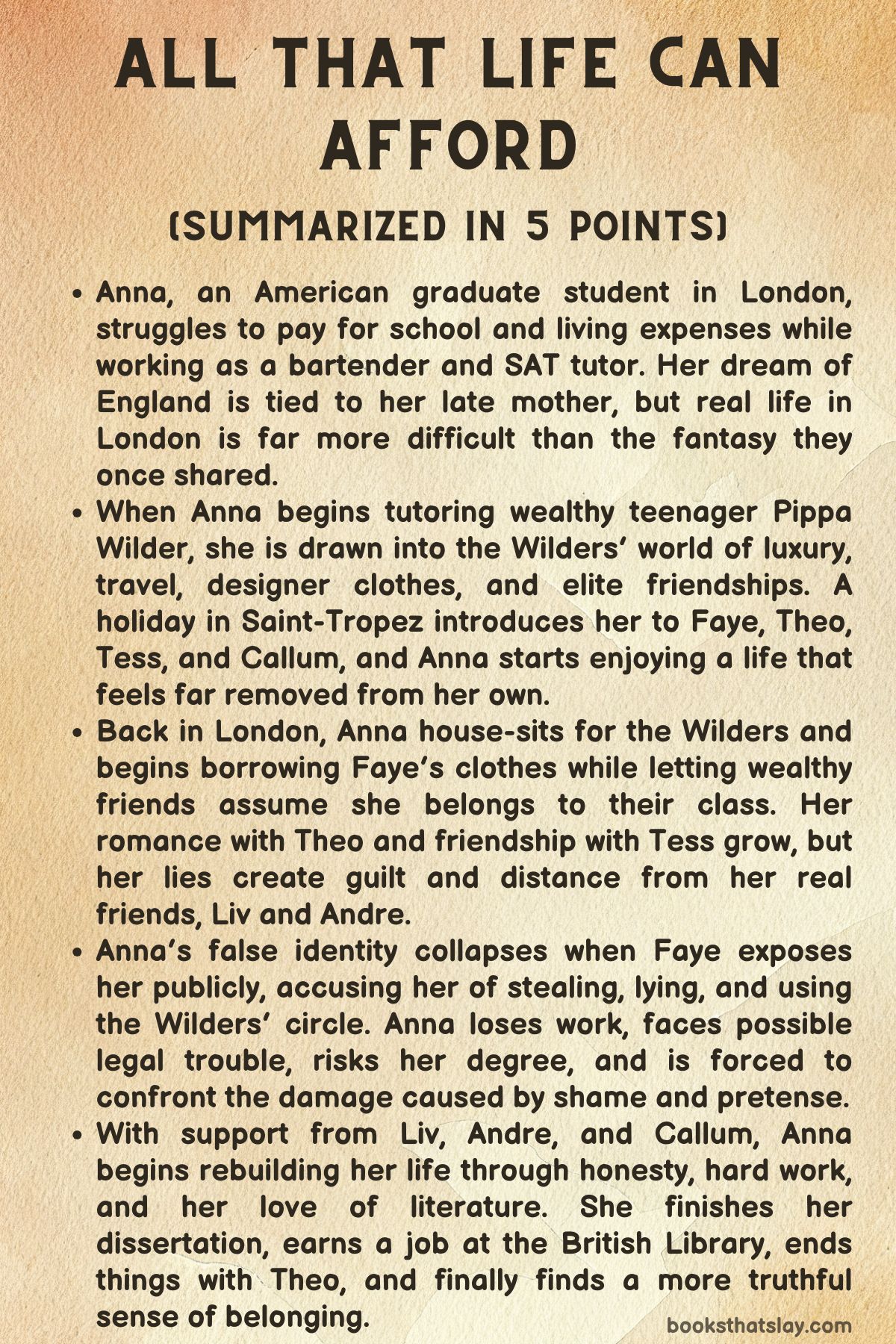
Summary
Anna arrives in London hoping the city will become the dream she and her mother once imagined together. She is studying British literature at Queen Mary University while trying to survive on limited money.
Her life is far from easy. She works as a bartender at Garage and takes SAT-prep tutoring jobs through Kramer Test Prep, traveling long distances to teach students in wealthy homes.
Even the train fare to reach some sessions can be hard to afford, and one day she has to talk her way out of paying for a ticket. The moment leaves her ashamed and frightened by how fragile her new life feels.
Her financial stress is tied to deeper grief. Anna’s mother died the previous year after years of diabetes and unaffordable medical care.
When Anna was a child, she and her mother spent time in libraries reading about England. To Anna, England became a symbol of beauty, intelligence, and possibility.
Now that she is finally there, she feels proud but also disappointed. London is not a fairy tale when rent, food, tuition, and transportation are constant worries.
Anna often feels out of place. In her classes, she is surrounded by students who seem more confident and better suited to the academic world.
She has felt this sort of distance before, even at Smith College, where she discovered her love of literature and publishing but still struggled to belong. Her closest London friends, Andre and Liv, understand her background better than most people.
They spend time together in simple, comforting ways, such as sitting on Parliament Hill and eating baklava. When Anna admits her money problems, they suggest asking her father for help, but Anna’s relationship with him is strained.
After her mother’s death, she fled to England instead of facing life at home with him.
Anna’s circumstances change when Kramer asks her to take on a new student, Pippa Wilder. Pippa is sixteen, wealthy, candid, and anxious about the SAT.
Anna meets her at the Savoy and is immediately drawn into a world of luxury. Pippa’s mother is pleased with Anna’s work and asks her to continue tutoring Pippa privately during the holidays at the family’s house in Saint-Tropez.
Anna knows this might violate Kramer’s expectations, but the offer is too tempting to refuse.
In France, Anna is stunned by the Wilders’ wealth. Their home, their food, their clothes, and their social circle all seem to belong to another world.
She meets Pippa’s older sister, Faye, who is elegant and hard to read. Anna also meets Callum, a charming law student connected to Faye’s friends.
Callum is attractive, intelligent, and surprisingly interested in Anna’s literary ambitions. Their conversations feel easy, but there is tension between them from the beginning.
As Anna spends more time with the Wilders and their friends, she enjoys the borrowed glamour. Faye lends her clothes, Anna attends parties, and she begins to feel like she can become a different version of herself.
She grows close to Theo, a handsome friend of the group, and they kiss on New Year’s Eve. Theo’s attention makes Anna feel desired and included.
Yet beneath the excitement, memories of home keep returning. On Christmas, she thinks about calling her father but hesitates.
She remembers the painful period before her mother’s death, including a car accident caused by her mother’s low blood sugar and a bitter argument with her father. Anna still carries guilt, anger, and longing, especially for the mother who believed she would someday reach England.
After the holidays, Anna returns to London, where the Wilders ask her to house sit their Highgate home. This gives her access to a beautiful house, Faye’s wardrobe, and Theo, who lives nearby.
Anna begins borrowing Faye’s clothes without asking, at first telling herself it is harmless. Theo introduces her to his friends as one of Faye’s friends, and Anna does not correct the misunderstanding.
She also becomes close to Tess, a wealthy young woman who loves literature. Tess assumes Anna shares her class background, and Anna again stays silent.
Each small lie makes the next one easier.
Anna’s new life starts to affect her old one. She sees less of Andre and Liv, and she becomes more invested in impressing Theo’s circle.
She also tries to use her connection to wealthy schools to build independent tutoring work. After one school dismisses her, she changes her presentation, wears Faye’s expensive clothes, and secures an SAT course at another school.
For a moment, she feels as if appearance and confidence can change everything.
Callum sees through her performance. After his dog muddies Faye’s pants that Anna is wearing, he confronts her.
He knows she is borrowing Faye’s clothes and allowing his friends to believe she is someone she is not. Anna resents his judgment, especially because he has money and privilege, but his words unsettle her.
Callum seems frustrated by his own wealthy social world, yet he also refuses to excuse Anna’s dishonesty.
Anna’s connection with Callum deepens during a birthday trip to Lisbon arranged by Tess. Theo surprises Anna by joining the group, but Anna finds herself increasingly aware of Callum.
When she gets lost in the rain and breaks down, Callum finds her and takes her to his relatives’ home. There, Anna sees a warmer, humbler side of him.
He explains that his family’s money is newer than she assumed and that his grandparents once owned a restaurant. Anna opens up about her own family and admits she has enjoyed pretending to be someone else.
Callum urges her to tell the truth, especially to Tess. They kiss, but Callum immediately pulls away, saying it was a mistake because he does not want to hurt his friends.
Soon after, Anna’s lies and financial mistakes catch up with her. Andre calls in distress because Anna failed to handle council tax arrangements for their old flat, leaving him in danger of eviction.
Anna uses loan money to repay him, making her own tuition crisis worse. Back in London, she tries to focus on tutoring and her dissertation, but her double life collapses at a party on Billionaires Row.
Faye sees Anna wearing one of her dresses and exposes her in front of everyone. She reveals that Anna works for the Wilders, accuses her of stealing, and claims she used the family and their friends.
Callum helps Anna leave, but the damage is done.
Anna returns to the Highgate house humiliated. Theo arrives and acts as if the scandal can be smoothed over, but Anna discovers that he and Faye have been involved.
She realizes Theo has treated her as a secret amusement rather than a serious partner. Then the Wilders’ lawyer appears and orders her to leave, warning that the family may press charges.
Anna moves in with Liv and tries to repair her friendships. Andre is hurt and angry, but he eventually begins to forgive her.
Pippa calls to say she is not angry, though Faye is pushing her parents toward legal action. Meanwhile, rumors about Anna spread online.
She loses tutoring clients, Kramer fires her, and one school refuses to pay her for completed work. Her tuition bill threatens her place at Queen Mary and her chance at a post-study work visa.
Desperate, she contacts Callum for legal advice.
Callum agrees to help her pursue the unpaid tutoring money. During their meeting, they talk honestly about what happened.
He admits he was disappointed in her lies but also curious about how long she could maintain the act. He tells her Tess still asks about her.
At the Hardy Tree, among old gravestones, Anna speaks more openly about loneliness, ambition, and her hope of applying for a job at the British Library. Callum encourages her to present her real self.
He offers her a loan, but Anna refuses because she does not want to become the person Faye accused her of being.
Anna finishes her dissertation after a visit to Jane Austen’s house gives her the clarity she needs. She interviews for a British Library apprenticeship and chooses honesty, sharing her personal history and proposing educational programs inspired by her own love of books.
Afterward, while looking at herself in her bartending shirt, she recognizes that she no longer wants to hide who she is.
Her efforts begin to pay off. She passes her dissertation, celebrates with Liv and Andre, and receives a call from the British Library.
She does not get the apprenticeship; instead, she is offered a full-time position. The payment from the school that owed her money finally arrives, thanks to Callum’s help.
When Theo tries to restart their relationship in secret, Anna refuses. She wants a life built on truth, not secrecy.
On her first day at the British Library, Anna feels she belongs. Callum meets her afterward and tells her he convinced the Wilders to drop the charges.
He confesses his feelings, and they kiss. Later, Anna moves into a new flat with Liv and Andre.
Callum joins them for dinner, and the group spends time together in a simpler, happier way. Anna understands that the life she wanted was never only about wealth, beauty, or belonging to someone else’s world.
By accepting herself, repairing her friendships, and finding work connected to her love of books, she finally has a future that feels truly her own.
Characters
Anna
Anna is the central character of All That Life Can Afford, and her story is shaped by hunger: hunger for security, beauty, recognition, education, love, and escape. She arrives in London carrying both ambition and grief, trying to turn the dream she shared with her mother into a real life.
Her love of British literature is sincere, and her intellectual passion gives her a strong inner identity even when her outer life feels unstable. At the same time, Anna is painfully aware of money in every situation.
Train fares, tuition bills, rent, clothing, meals, and unpaid work all become pressures that affect how she thinks and behaves. Her attraction to the Wilders’ world is not simply greed; it comes from exhaustion, loneliness, and the desire to stop feeling like an outsider.
Anna’s deepest flaw is her willingness to hide parts of herself when honesty feels too costly. She does not set out to hurt people, but she allows misunderstandings to grow because they give her temporary relief from shame.
Borrowing Faye’s clothes, letting Tess assume she has money, and accepting Theo’s version of her identity all become part of a performance. Yet Anna is not shallow.
She is conflicted throughout, and her guilt shows that she understands the emotional danger of what she is doing. Her growth comes when she stops seeing her background as something to cover up.
By the end, Anna’s success at the British Library matters because it comes from her real self: her intelligence, her love of books, her work ethic, and her lived experience. She learns that belonging built on pretense can collapse quickly, but belonging built on truth can last.
Callum
Callum begins as a charming but guarded figure who seems to belong easily among wealthy young people. He is attractive, educated, socially skilled, and comfortable in elite spaces, but he is not fully at peace with that world.
His coldness toward Anna after their early connection comes from a mix of attraction, suspicion, and disappointment. He sees that she is pretending, and because he understands class performance more than she realizes, he recognizes both the cleverness and the danger in her behavior.
His judgment can seem harsh, especially because he still benefits from privilege, but he is also one of the few people willing to confront Anna directly instead of treating her as entertainment.
What makes Callum more complex is that his background is not as simple as Anna assumes. He has money now, but his family’s wealth is newer, and his relatives in Lisbon reveal a warmer, more grounded side of him.
He knows what it means to move between classes, even if his life has become far more secure than Anna’s. His work offering legal advice to immigrants also suggests that he wants his education to serve a purpose beyond status.
Callum’s feelings for Anna develop through honesty rather than fantasy. He is drawn to her intelligence and resilience, but he cannot accept the way she hurts others through deception.
His final actions show care without control: he helps her recover unpaid wages, convinces the Wilders to drop the charges, and supports her without forcing her to depend on him.
Theo
Theo represents the seductive ease of privilege at its most careless. He is handsome, confident, socially connected, and appealing to Anna partly because he seems to offer instant entry into a life she has only watched from the outside.
His attention makes her feel chosen, and their romance gives her a sense of glamour and validation. Yet Theo’s affection is shallow.
He enjoys Anna, but he does not truly try to know her. When he introduces her as one of Faye’s friends, he helps maintain the false image rather than asking who she really is.
Theo’s weakness is not open cruelty but moral laziness. He avoids discomfort, treats relationships casually, and assumes problems can be smoothed over because that is how his world works.
After Anna is exposed, he does not grasp the seriousness of her humiliation or the legal threat she faces. His suggestion that they continue seeing each other in secret reveals how little he respects her need for dignity.
He wants pleasure without responsibility and intimacy without consequences. In contrast to Callum, Theo does not challenge Anna to become more honest or more herself.
He encourages the fantasy because it benefits him. Anna’s decision to end things with him marks a clear step in her growth.
Faye Wilder
Faye is proud, polished, and socially powerful. From Anna’s first encounter with her, Faye feels difficult to read, and that uncertainty creates tension.
She is not simply jealous or cruel; she is someone who has been raised inside wealth and is used to controlling access to her world. Her clothes, friendships, family name, and social reputation all function as extensions of her identity.
When Anna borrows her dresses and enters her circle under false assumptions, Faye experiences it as a violation of boundaries, status, and personal property.
Faye’s reaction is severe and public, exposing Anna in the most humiliating way possible. Her anger is understandable in part, because Anna has taken things without permission and misrepresented herself.
However, Faye’s cruelty lies in how she frames Anna not as a flawed person but as a fraud, thief, and social threat. She weaponizes class shame, turning Anna’s economic insecurity into proof of bad character.
Her relationship with Theo also complicates the situation. Faye’s exposure of Anna may be driven by betrayal, possessiveness, and the fear of losing control.
She functions as the character who enforces the rules of the elite circle, reminding Anna that borrowed beauty and borrowed status can be revoked at any moment.
Pippa Wilder
Pippa is one of the gentler members of the Wilder family. As Anna’s student, she is anxious, open, and more direct than the adults around her.
Her worry about the SAT makes her seem younger and more vulnerable than the glamorous world surrounding her. Unlike Faye, Pippa does not treat Anna primarily as an intruder.
She values Anna’s help and appears to form a sincere attachment to her. Their tutoring sessions create one of the few relationships in the Wilder world based on actual work and trust rather than social performance.
Pippa’s role is important because she shows that privilege does not erase insecurity. She has wealth, travel, and access, but she still fears failure and wants reassurance.
Her dream of moving to New York mirrors Anna’s dream of England, though Pippa’s path is far easier because money protects her. After Anna’s fall, Pippa’s call matters because it offers compassion from inside the family that has rejected Anna.
She warns Anna about the possible charges but makes clear that she herself is not angry. Pippa’s loyalty is limited by her age and dependence on her family, yet her kindness gives Anna proof that not every connection from that world was false.
Mrs. Wilder
Mrs. Wilder is courteous, generous, and quietly powerful. She recognizes Anna’s usefulness quickly and brings her deeper into the family’s life, first as Pippa’s tutor and then as a house sitter.
Her invitations appear warm, and they offer Anna opportunities she could never afford on her own. Yet Mrs. Wilder’s generosity exists within clear class boundaries.
Anna is welcomed because she performs a service. She can be included in beautiful homes and holidays, but her position remains conditional.
Her character shows how wealth can make kindness complicated. Mrs. Wilder may genuinely appreciate Anna and trust her with Pippa, but when Anna becomes a reputational problem, the family responds through legal force.
The shift from hospitality to threat reveals the limits of their acceptance. Mrs. Wilder’s world can absorb Anna as a tutor, guest, or temporary helper, but not as someone who blurs the line between employee and equal.
She is less openly hostile than Faye, but she still participates in a system where protection of family status matters more than understanding Anna’s motives.
Andre
Andre is one of Anna’s real anchors. He shares a more modest background and understands the pressure of trying to survive in London without financial cushioning.
His friendship with Anna is built on ordinary routines, humor, shared television, and honest conversation rather than glamour. He is part of the life Anna temporarily neglects when the Wilder world begins to consume her attention.
Because of this, his anger over the council tax problem carries emotional weight. He is not simply upset about money; he is hurt because Anna’s avoidance puts him in danger.
Andre’s eventual forgiveness shows the strength of chosen friendship, but it does not erase Anna’s mistake. He expects accountability from her, and that expectation is healthier than the indulgence she receives from Theo.
Andre helps represent the life Anna nearly loses while chasing acceptance elsewhere. His presence reminds readers that genuine belonging may look less dazzling but is far more dependable.
By the end, when he, Liv, Anna, and Callum spend time together in their new shared life, Andre’s continued friendship signals that Anna has repaired something meaningful.
Liv
Liv is practical, loyal, and encouraging. She understands Anna’s ambition and often pushes her toward opportunities, including the holiday tutoring arrangement in France.
Like Andre, she comes from a background closer to Anna’s and provides emotional steadiness. Liv does not judge Anna for wanting more from life, and she recognizes that the Wilders’ offer could help Anna financially and socially.
Her support comes from care, not envy.
At the same time, Liv is part of the world Anna sidelines as she becomes absorbed in wealthier circles. Anna’s distance from Liv reveals how aspiration can strain old friendships when someone starts measuring their worth through new social approval.
Liv’s importance grows after Anna’s public disgrace. She gives Anna a place to stay and becomes part of the difficult but necessary process of repair.
Liv represents friendship that can survive disappointment because it is rooted in honesty. She does not exist only to comfort Anna; she also reflects the life Anna must return to if she wants to become whole again.
Tess
Tess is one of the most sympathetic people in the wealthy circle because she is genuinely interested in Anna’s mind. Their friendship begins through literature, and Tess’s love of books gives Anna a sense of recognition that is not based only on clothes or parties.
Tess assumes Anna is from a similar class background, and Anna’s decision not to correct her becomes one of the more painful lies because Tess seems capable of real friendship.
Tess also complicates Anna’s assumptions about wealth. She has money, but she has felt out of place in academic settings and carries her own insecurities.
Her loneliness is different from Anna’s, yet it is still real. This makes Anna’s deception more damaging because Tess might have understood more than Anna expected.
Callum later reveals that Tess still asks about Anna and has even pursued graduate school after Anna’s encouragement, suggesting that their connection had lasting meaning. Tess represents the friendship Anna could have had if she had trusted the truth sooner.
Her character shows that class difference creates barriers, but fear and shame can make those barriers even higher.
Anna’s Mother
Anna’s mother is absent in the present but central to Anna’s emotional life. She gave Anna her love of England and books, turning literature into a shared refuge from financial stress and illness.
Her belief that Anna would someday reach England becomes one of the forces that drives Anna forward. Anna’s dream is not only personal ambition; it is also a way of staying connected to her mother.
Her illness and death expose the brutal consequences of poverty. Because insulin and medical care are expensive, her health is constantly endangered.
The car accident caused by low blood sugar becomes one of Anna’s defining memories, filled with fear, helplessness, and anger. Anna’s grief is complicated by guilt: she left, she stayed, she sacrificed, she resented, and still she could not save her mother.
Throughout All That Life Can Afford, Anna often wonders what her mother would think of her choices. By the end, her mother’s memory becomes less of a wound and more of a quiet source of strength.
Anna’s work at the British Library honors the world of books they loved together.
Anna’s Father
Anna’s father is a strained and painful figure in Anna’s life. His relationship with her breaks down around her mother’s illness and death, when fear and grief turn into blame.
He disapproves of Anna’s academic path, likely seeing literature as impractical in a life where money has always mattered. From Anna’s perspective, he represents limitation, conflict, and the home she needed to escape.
Still, his character should not be read only as an antagonist. The family’s financial hardship and his wife’s illness have also shaped him.
His inability to support Anna emotionally does not necessarily mean he lacks love; it means he cannot bridge the damage between them. Anna’s urge to call home during lonely moments shows that the bond is not fully dead, even if she cannot reach him.
He represents the unresolved part of Anna’s past. Unlike her friendships and career, this relationship is not neatly healed, which makes it feel realistic.
Some wounds remain open while Anna moves forward.
Mrs. Wilder’s Lawyer
The Wilders’ lawyer appears briefly but serves an important function. He turns social rejection into formal threat.
Until his arrival, Anna’s punishment has been humiliation, gossip, and exclusion. His presence makes clear that wealthy families have institutional power behind them.
They can use legal pressure to protect themselves and frighten someone with far fewer resources.
He is not developed as an emotional character, but he represents the machinery of class protection. Anna’s fear after his warning is not exaggerated; legal action could destroy her education, visa prospects, finances, and reputation.
Through him, the story shows that elite anger has consequences beyond social embarrassment. For someone like Anna, being disliked by the wrong family can become materially dangerous.
Themes
Class Performance and the Cost of Passing
Anna’s movement through wealthy spaces shows how class is not only about money but also about clothing, speech, confidence, taste, leisure, and assumptions. She learns quickly that the right dress, the right address, and the right silence can change how people treat her.
When she wears Faye’s clothes or stays in the Highgate house, others read her as someone who belongs. This gives her access to friendship, romance, and respect that she has rarely received so easily.
The tragedy is that Anna’s performance works just well enough to tempt her into continuing it.
The cost of passing is emotional and moral. Anna does not merely hide poverty; she begins hiding relationships, history, grief, and responsibility.
Her silence with Tess is especially important because Tess might have accepted her truth, yet Anna cannot risk finding out. The wealthy circle also reveals its own dependence on performance.
Theo performs charm, Faye performs superiority, and even Callum performs detachment. In All That Life Can Afford, class identity becomes a social script, and Anna’s mistake is believing she can borrow that script without losing part of herself.
Her recovery begins when she stops treating her real background as a defect.
Grief, Escape, and the Search for a New Self
Anna’s journey to London is powered by grief as much as ambition. England was the dream she shared with her mother, so reaching it feels like fulfilling a promise.
Yet the city cannot remove the pain she carries. Her mother’s death follows her into classrooms, trains, libraries, parties, and romantic relationships.
Anna’s desire to become someone else is partly a desire to become someone untouched by loss. The Wilder world offers a version of life where beauty seems to cover pain: expensive clothes, sea views, elegant meals, and easy travel.
For a while, Anna lets that world distract her from the harder work of mourning.
Her grief is also tied to guilt. She wonders whether she abandoned her father, whether she failed her mother, whether her sacrifices mattered, and whether her dream of England was selfish.
These questions make her vulnerable to any environment that promises reinvention. But escape cannot replace healing.
Anna only becomes stronger when she faces the truth of where she comes from and admits that her mother’s memory does not require her to become glamorous or untouchable. Her mother loved books, imagination, and possibility; Anna honors her not by pretending to belong to the rich, but by building a life around literature, work, and honest connection.
Money, Security, and Moral Pressure
Money in the novel is never just background detail. It shapes Anna’s choices from the beginning: whether she can take the train, pay tuition, keep housing, continue her degree, or remain in the country after graduation.
Her financial instability creates a constant state of emergency. This pressure does not excuse her dishonesty, but it explains why certain temptations become so powerful.
When a person is always calculating costs, the chance to live briefly without calculation can feel like freedom.
The contrast between Anna and the wealthy characters shows how differently mistakes are priced. Theo can be careless without much consequence.
Faye can shame Anna publicly and then rely on family power. Tess can offer a birthday trip without understanding the embarrassment such generosity may cause.
Anna, by contrast, can be ruined by late fees, unpaid wages, lost tutoring clients, or a legal threat. Even her education is conditional on payment.
The unpaid Muswell money becomes a symbol of how easily institutions exploit people who lack leverage. Callum’s legal help matters because it gives Anna some power in a situation where she has almost none.
The story presents money as protection, opportunity, and pressure, showing how morality becomes harder to maintain when survival is uncertain.
Authentic Belonging Versus Social Acceptance
Anna spends much of the story confusing social acceptance with belonging. When Theo’s friends include her, when Tess likes her, when Faye’s clothes fit her, and when the Wilders trust her with their home, she feels close to the life she wanted.
Yet this acceptance depends on a false image, which means it can disappear the moment the truth appears. Anna’s public exposure is devastating because it proves that she was never secure in that world.
She was being tolerated under conditions she did not fully understand.
Real belonging appears in quieter places. It exists in Liv’s flat after Anna has lost status, in Andre’s reluctant but meaningful forgiveness, in the British Library where Anna’s knowledge and ideas matter, and in Callum’s eventual love for her real self rather than her performance.
The difference is honesty. Social acceptance asks Anna to maintain an image; belonging allows her to be known.
Her final life is less glamorous than the Wilder fantasy, but it is more stable because it is built on mutual recognition. The ending suggests that Anna does not need to reject ambition or beauty, but she does need to stop seeking them at the cost of self-respect.