What Katy Did Summary, Characters and Themes
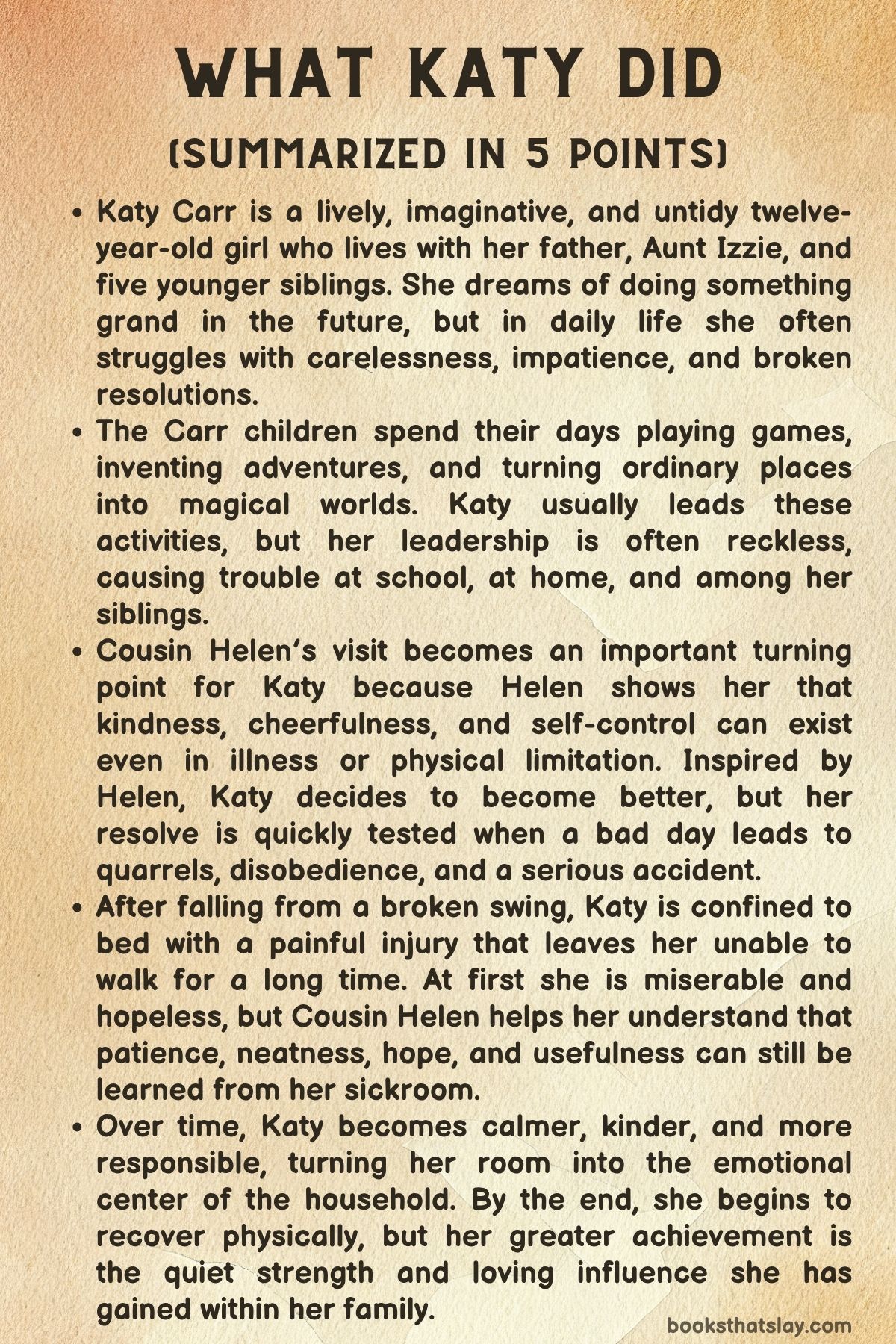
What Katy Did is a classic children’s novel by Susan Coolidge about Katy Carr, a bright, restless, messy, loving girl who dreams of doing something grand. At first, Katy’s life is full of games, quarrels, broken promises, and wild plans, but a serious accident changes the course of her childhood.
Confined to her room, she slowly learns patience, kindness, self-control, and responsibility. The book follows her growth from impulsive girlhood into a steadier, more thoughtful form of leadership within her family, making it a story about character, home, suffering, and quiet moral strength. It’s the 1st book of the Carr Family series.
Summary
What Katy Did begins with a playful question about what Katy “did,” then answers it through the life of Katy Carr, a 12-year-old girl in the town of Burnet. Katy lives with her father, Dr. Carr, and her younger siblings Clover, Elsie, Dorry, Johnnie, and Phil.
Their mother has died, and Aunt Izzie, Dr. Carr’s sister, keeps house for the family. Aunt Izzie values order and discipline, while Dr. Carr is gentler and more tolerant of the children’s noise, bruises, and games.
Katy, the eldest, is tall, untidy, affectionate, and full of grand hopes. She dreams of becoming beautiful, famous, heroic, or useful in some extraordinary way, but she often fails at ordinary duties.
The Carr children live in a world of play and imagination. They climb, run, invent games, and turn nearby places into private kingdoms.
Their favorite outdoor retreat is Paradise, a green, marshy spot where they gather flowers, eat treats, and talk about the futures they want. Clover is devoted to Katy and shares her imaginative energy.
Elsie longs to be included but is often left out by the older girls. Dorry, Johnnie, and Phil bring comic confusion and innocence to the household.
Katy leads them all with confidence, but her leadership is not yet wise. She can make life exciting, yet she can also be careless, impatient, and forgetful.
Katy’s small mistakes often grow into larger troubles. At school, she begins one day badly because she has neglected a broken bonnet string.
She is late, cross, and unprepared. When her bonnet blows into the rival schoolyard, she climbs the fence to retrieve it and wins the admiration of her classmates.
Excited by this success, she invents a wild indoor game that leaves the schoolroom in disorder. When the teacher asks who is responsible, Katy honestly confesses.
That evening, Dr. Carr helps her understand that many disasters begin with small acts of neglect.
The same weakness appears at home. Aunt Izzie once leaves Katy in charge of the younger children, asking her to get everyone safely to bed.
Instead, Katy joins them in a forbidden game in the dark. The evening ends in noise, deception, and shame.
Dr. Carr then reminds Katy that her mother had hoped she would become a loving guide to the younger children. This rebuke hurts Katy deeply because it touches the gap between the person she wants to be and the person she is in daily life.
Katy also has a habit of forming intense friendships with people she barely understands. Her new admiration for Imogen Clark is tested when Imogen visits the Carr home.
Imogen arrives overdressed, rejects the children’s simple pleasures, insists on parlor manners, and tells exaggerated stories. Dr. Carr gently warns Katy that real friendship needs sincerity and judgment, not glamour or performance.
Katy does not fully accept the lesson at once, but it prepares her for later maturity.
The most important influence on Katy is Cousin Helen. The children expect Helen, who has a disability, to be sad or solemn.
Instead, she is cheerful, graceful, attractively dressed, and kind. Katy is amazed that someone who lives with physical limitation can still bring so much brightness to others.
Helen teaches her that illness does not excuse a person from trying to be pleasant, neat, and considerate. Katy also learns that Helen once gave up the man she loved after her accident so he could be free.
Deeply moved, Katy decides she will become like Helen, though she delays the effort until the next day.
That “tomorrow” begins badly. Katy wakes in an angry mood, breaks the vase Helen gave her, quarrels with Elsie, and pushes her during a struggle over a slate.
Then she disobeys Aunt Izzie’s order not to use the new swing. Aunt Izzie has not explained that the swing is unsafe, but Katy knows she has been forbidden to use it.
She swings higher and higher until the damaged fastening gives way. The swing twists, throws her to the ground, and leaves her unconscious.
When Katy wakes, she is in severe pain and cannot stand. Dr. Carr is away at first, and another doctor examines her.
When her father returns, the seriousness of the injury becomes clear. Katy’s back has been badly hurt, her legs remain numb, and she must stay in bed for months, perhaps longer.
At first, she is overcome by misery. She closes her blinds, refuses comfort, loses interest in study or play, and grieves for the active future she believes she has lost.
Cousin Helen returns and gives Katy a new way to think about her suffering. She describes the sickroom as a school where Katy can learn patience, cheerfulness, hope, neatness, and the art of making the best of things.
Helen does not pretend the lessons are easy. She admits that after her own accident she once gave in to despair before learning to live differently.
Her honesty helps Katy trust her advice. Helen encourages her to open the blinds, keep the room pleasant, study a little each day, welcome the children, and make her bed a center of family life rather than a place of bitterness.
Katy begins to change through small efforts. Her room becomes brighter, cleaner, and more welcoming.
She still suffers and sometimes struggles with disappointment, but she starts thinking about others again. At Christmas, she plans gifts for the family.
Though she briefly feels forgotten, the children surprise her with a decorated miniature tree, presents, and treats. Dr. Carr gives her a reclining chair so she can sit by the window, and this restores a sense of connection with the outside world.
Later, Katy organizes a Valentine celebration in her room, proving that she can create happiness even while confined.
Another trial comes when Aunt Izzie falls ill with typhoid fever and dies. The children are filled with regret, remembering how much they had complained about her.
After the funeral, Katy asks Dr. Carr to let her manage the household from her chair rather than bring in a housekeeper. He agrees to a trial.
At first she makes mistakes with menus and household rules, but gradually she learns to guide the servants, help Clover, and care for the family’s needs. Aunt Izzie’s old routines help her understand the value of order and responsibility.
Two years after the accident, Katy has become the quiet center of the home. The younger children bring her their questions and troubles.
Dorry’s failed clock repair, Phil’s mistaken attempt to wash baby chicks, and unexpected visitors all show how patiently Katy now responds to daily problems. When Imogen Clark reappears, Katy can see her false airs clearly.
When an old friend of Aunt Izzie’s visits at an inconvenient time, Katy treats her with courtesy, showing respect for Aunt Izzie’s memory.
At last, Katy begins to recover. She stands by herself, then gradually learns to stand longer, walk with support, and move beyond her room.
She chooses her mother’s birthday for her first trip downstairs. Her family prepares a celebration, and the parlor has been arranged for her comfort.
The greatest surprise is Cousin Helen, waiting to greet her. During Helen’s visit, she sees how much the children depend on Katy’s gentleness and wisdom.
Katy has not achieved the fame or heroic life she imagined as a child. Instead, she has done something quieter and better: she has learned to turn pain, regret, and limitation into love, patience, and service.
Characters
Katy Carr
Katy Carr is the central figure of What Katy Did, and her development gives the book its emotional and moral direction. At the beginning, she is loving, imaginative, and generous, but also careless, untidy, quick-tempered, and unreliable.
She dreams of greatness, yet she does not understand that greatness begins in small duties: keeping promises, showing patience, admitting fault, and caring for others consistently. Her accident forces her into a life she would never have chosen, and at first she responds with bitterness and despair.
What makes Katy compelling is that her change is gradual rather than instant. She must practice patience, learn to control her moods, and accept help before she can help others.
Her eventual strength is not passive obedience but active moral leadership. By the end, Katy becomes the emotional center of the household because she has learned to use tenderness, judgment, and self-command where she once used excitement and impulse.
Clover Carr
Clover is Katy’s closest companion and one of the warmest presences in the book. She is sweet-natured, loyal, clever in play, and deeply attached to her older sister.
Early in the story, Clover often follows Katy’s lead, sharing her games, jokes, and imaginative plans. Yet she also has a softer steadiness that balances Katy’s more explosive nature.
After Katy’s accident, Clover grows in maturity because the family’s needs require it. She becomes Katy’s helper, messenger, and partner in managing the household.
Her love is practical: she brings news, assists with tasks, supports surprises, and helps maintain the flow of family life around Katy’s room. Clover’s remark that she almost dreads Katy getting well shows both her affection and her human selfishness; she loves the gentler Katy so much that she fears losing the atmosphere created by her sister’s illness.
This makes Clover more believable, because her devotion contains both kindness and ordinary human weakness.
Elsie Carr
Elsie is a sensitive child whose loneliness reveals one of Katy’s early failures. She often feels excluded by Katy, Clover, and Cecy, and her longing to be accepted makes her vulnerable to hurt.
Before Katy’s accident, Elsie’s place in the family shows how careless affection can still wound others. Katy loves her, but she does not always notice her need for attention and respect.
The moment when Katy pushes Elsie during their quarrel is important because it brings Katy’s impatience into sharp focus. After the accident, Elsie’s response is not revenge but tenderness.
She comes quietly to fan Katy and offers her treasures as gifts, showing a forgiving nature that helps awaken Katy’s remorse. In the later part of the story, Elsie benefits from Katy’s transformation.
She becomes one of the children who can bring thoughts and worries to Katy, and her earlier exclusion is answered by a warmer family order. Elsie’s role reminds readers that small acts of neglect can be deeply painful to a child.
Dr. Carr
Dr. Carr is a loving father whose gentleness is balanced by moral seriousness. As a physician, he is often away from home, yet his emotional influence over the children is strong.
He allows them freedom, encourages play, and understands their energy better than Aunt Izzie does. However, he is not careless about discipline.
When Katy’s conduct goes wrong, he does not merely scold; he teaches. His explanation after the schoolroom disaster helps Katy connect small habits with larger consequences, and his reminder of her mother’s hopes gives her a clearer sense of responsibility.
After Katy’s accident, Dr. Carr’s role becomes more painful. He must tell his daughter difficult truths while also protecting her hope.
His tenderness never becomes indulgence, especially when she begins to recover and he warns her against rushing. Dr. Carr represents wise parental love: affectionate, patient, honest, and committed to forming character rather than simply correcting behavior.
Aunt Izzie
Aunt Izzie is often seen by the children as fussy, strict, and difficult, but What Katy Did gradually shows that her role deserves more sympathy. She manages a busy household of motherless children, and her standards of order are constantly challenged by noise, torn clothes, broken rules, and muddy adventures.
She does not always understand the children’s imagination, and her sharpness can make her seem cold. Yet her death reveals the hidden value of her work.
After she is gone, the children remember how much they troubled her, and Katy discovers that the household runs partly because of the systems Aunt Izzie established. Aunt Izzie’s importance lies in the ordinary labor that children often fail to appreciate.
She is not as emotionally graceful as Cousin Helen, but she has given the family structure, discipline, and continuity. Her presence also helps Katy understand that responsibility can be tiring, thankless, and still necessary.
Cousin Helen
Cousin Helen is the book’s clearest model of spiritual discipline, but she is not presented as distant or lifeless. Her influence comes from cheerfulness, beauty of manner, honesty, and self-control.
The children expect her disability to make her sad or severe, but she arrives with warmth, humor, and elegance. She teaches Katy that suffering does not excuse carelessness toward oneself or others.
Her account of her own despair after her accident makes her guidance credible, because she has earned her serenity through struggle. She also teaches through practical details: open the blinds, make the room pleasant, study, welcome visitors, and turn limitation into usefulness.
In What Katy Did, Cousin Helen’s power lies in showing Katy that goodness can be cultivated through daily choices. She does not erase pain or pretend that loss is easy.
Instead, she shows how a person can live generously within changed circumstances and become a source of peace to others.
Dorry Carr
Dorry brings humor, appetite, and boyish energy into the story. As a younger brother, he often appears through comic details, such as his food-centered journal or his ambitious attempt to repair Katy’s clock.
Dorry is not a deeply troubled character, but he is important because he represents the ordinary life of the household that continues around Katy. His mistakes are not malicious; they come from curiosity, confidence, and inexperience.
Katy’s treatment of Dorry after her transformation shows how much she has grown. Rather than mocking his failure with the clock, she protects his dignity and encourages him to learn properly.
Through Dorry, the book shows that leadership in a family often means responding well to small moments. A child’s awkward attempt, if met with scorn, can become shame; if met with kindness, it can become growth.
Dorry helps reveal Katy’s new patience in action.
Johnnie Carr
Johnnie is lively, impulsive, and comic, often involved in small domestic incidents that show the cheerful disorder of the Carr household. Her personality contrasts with Dorry’s while still matching his energy, and the two younger children help create the busy family atmosphere that overwhelms Aunt Izzie.
Johnnie’s actions, such as dosing a toy chair with medicine or rushing in with news, belong to the world of childhood curiosity. She is not presented as a moral problem to be solved but as a child who needs guidance, warmth, and space to grow.
Katy’s later relationship with Johnnie is marked by greater attentiveness. Instead of dismissing younger children as interruptions, Katy learns to listen to their confidences and respond with patience.
Johnnie therefore helps measure the change in Katy’s character. The same household that once tempted Katy into irresponsibility becomes the place where she practices care.
Phil Carr
Phil is the youngest Carr child, and his innocence often brings both comedy and tenderness to the book. At four years old in the early part of the story, he participates in the older children’s games without fully understanding them.
He is easily frightened, easily comforted, and often guided by literal childish logic, as when he tries to wash baby chicks because he thinks their yellow down is something that should come off. Phil’s role is important because he draws out nurturing behavior from others.
Before the accident, Katy’s leadership of the younger children is exciting but not always safe or wise. Later, when she corrects Phil gently and helps him understand the harm he has caused, her growth becomes visible.
Phil’s dependence gives Katy chances to practice the motherly role her father once described. Through him, the story shows that care for the very young requires patience, imagination, and gentleness.
Cecy Hall
Cecy Hall is the Carr children’s neighbor and a regular participant in their games, plans, and performances. She often represents the more proper outside world that brushes up against the Carrs’ disorderly home life.
Cecy can be prim, romantic, and eager to join in imaginative play, and she shares in many of Katy and Clover’s childhood pleasures. Her presence expands the story beyond the Carr family while still keeping the focus close to home.
Cecy’s friendship also highlights Katy’s social nature. Katy likes admiration, companionship, and shared invention, and Cecy helps feed that side of her.
Yet Cecy is not merely a follower; she observes the changes in Katy and recognizes her sweetness later in the book. Her comments help confirm that Katy’s transformation is visible not only to family members but also to someone just outside the family circle.
Cecy’s role is modest but useful, giving the story another witness to Katy’s growth.
Imogen Clark
Imogen Clark functions as a test of Katy’s judgment. Katy is drawn to her because Imogen seems unusual, dramatic, and interesting, but the visit exposes her vanity and falsehood.
She arrives in showy, unsuitable clothing, rejects the children’s simple pleasures, insists on parlor behavior, and tells stories that are clearly invented. Through Imogen, the book examines Katy’s tendency to romanticize people before understanding them.
Katy wants life to be grand and exciting, so she is tempted by performance and exaggeration. Dr. Carr’s warning after Imogen’s visit is gentle but important: friendship should be based on sincerity, not glamour.
When Imogen returns later and Katy can see her more clearly, it marks a quiet advance in Katy’s maturity. She has not become cruel or superior, but she no longer mistakes artificial behavior for depth.
Imogen’s character helps show the difference between childish fascination and wiser discernment.
Themes
Growth Through Daily Self-Discipline
Katy’s growth is built through repeated acts of self-control rather than one sudden change. At first, she imagines goodness as something large, beautiful, and future-oriented.
She wants to do something remarkable, yet she overlooks the small habits that would make her reliable in the present. What Katy Did uses ordinary failures—lost items, broken rules, quarrels, messy rooms, and careless words—to show that character is formed in daily conduct.
After the accident, this lesson becomes unavoidable. Katy cannot run away into games or dreams; she must face herself in stillness.
Cousin Helen’s guidance turns the sickroom into a place of practice, where patience, cheerfulness, order, and kindness become daily lessons. The theme is not that suffering automatically improves a person.
Katy changes because she accepts correction, makes efforts, fails at times, and tries again. Her final position in the family is earned through ordinary discipline: speaking gently when irritated, welcoming others when tired, organizing household matters, and thinking before acting.
The book values the quiet moral labor that no one may notice immediately but that gradually changes the atmosphere of a home. It also treats discipline as something hopeful, because every small choice gives Katy another chance to become less ruled by impulse and more guided by love.
The Moral Power of Home
Home is treated as a place where character is tested, revealed, and shaped. The Carr household is noisy, disorderly, affectionate, and imperfect.
It contains grief from the mother’s death, tension between freedom and discipline, and the daily strain of caring for many children. Yet the home is also the place where Katy’s most meaningful work occurs.
Her childhood dreams aim outward toward fame, heroism, or public admiration, but her real calling develops inside the family. The sickroom becomes a new domestic center, not because Katy controls everyone, but because she learns to receive them with attention and kindness.
The children bring her questions, troubles, gifts, and news, and she becomes useful by responding well. Aunt Izzie’s death deepens this theme by showing that home depends on hidden labor.
Meals, schedules, order, and hospitality require thought and effort. When Katy takes up household management, she begins to understand service as practical responsibility.
The story honors the family not as a perfect institution but as a living school of patience, duty, forgiveness, and love. It suggests that the household, with all its interruptions and frustrations, can train a person more fully than public praise ever could.
Suffering, Usefulness, and Hope
Katy’s accident changes the meaning of usefulness in the story. Before it, she connects usefulness with action, adventure, and visible achievement.
Once confined to bed, she believes her life has been reduced to helplessness. Her despair comes partly from pain, but also from the feeling that she can no longer become the person she imagined.
Cousin Helen’s teaching challenges this belief. She does not deny the severity of loss; instead, she shows that usefulness can survive within limitation.
Katy can still choose how her room feels, how she speaks, whether she studies, whether she welcomes her siblings, and whether she lets sorrow make her selfish. Hope in the book is therefore active, not passive.
It is not mere confidence that circumstances will improve, though Katy eventually does recover. It is the decision to live meaningfully even before recovery is promised.
This makes her later healing feel less like a reward and more like the continuation of a change already underway. Katy becomes useful first while still confined, which gives her growth deeper weight.
The theme respects pain without treating it as the end of identity, because Katy’s mind, conscience, and capacity for love remain alive.
Kindness as Leadership
Leadership in the story gradually shifts from command to care. Early Katy leads because she is imaginative, bold, and older than the others.
The children follow her into games, performances, secret places, and mischief, but her leadership often lacks judgment. She can inspire, but she can also endanger or exclude.
After her accident, she learns a different form of influence. Because she cannot physically lead the children outdoors or into adventures, she must guide them through attention, sympathy, and wise speech.
This change is clearest in her treatment of the younger children. She listens to Elsie more tenderly, protects Dorry from humiliation, corrects Phil without harshness, and helps Clover share responsibility.
Kindness becomes an active force that organizes the household and makes people feel safe. The story does not present kindness as weakness.
Katy’s gentleness requires discipline, memory, and moral effort. She must restrain irritation, think about others’ feelings, and choose generosity when inconvenience would make selfishness easier.
By the end, her authority comes from trust. The family turns toward her because she has become dependable, not because she demands obedience.
This form of leadership is quiet, but it changes the emotional climate of the entire home.