The Other Side of Change Summary and Analysis
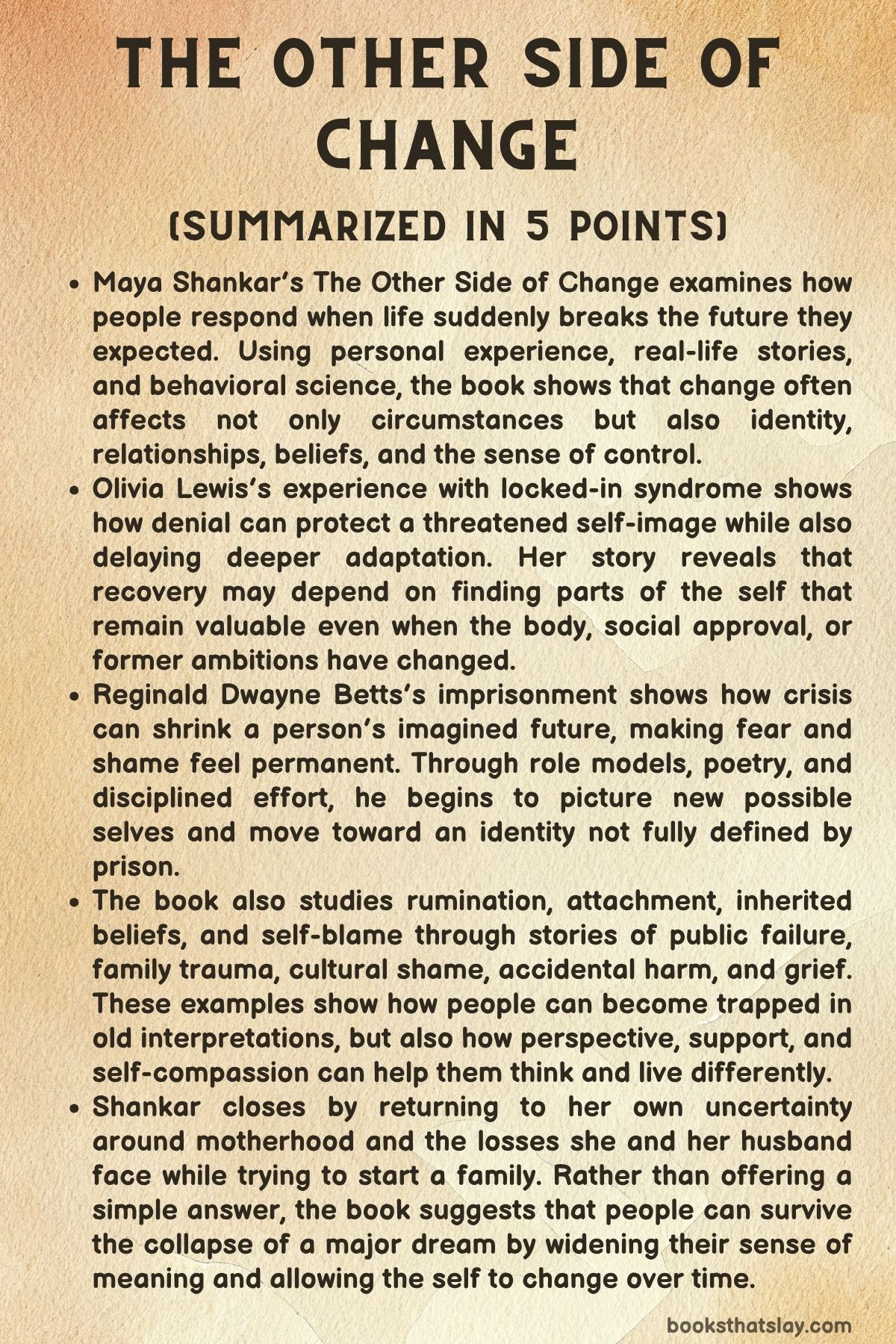
The Other Side of Change: Who We Become When Life Makes Other Plans by Maya Shankar is a popular psychology book about what happens when life breaks the future a person had imagined. Drawing on Shankar’s work as a cognitive scientist and interviewer, the book studies people who face sudden illness, imprisonment, panic, bereavement, family trauma, shame, guilt, and uncertain parenthood.
It does not treat change as simple inspiration or easy growth. Instead, it looks closely at the fear, denial, self-blame, and confusion that follow disruption, while showing how identity can be rebuilt through new perspectives, relationships, self-compassion, and meaning.
Summary
The Other Side of Change begins with a question that is both personal and psychological: what happens to a person when life refuses to follow the plan they had built their identity around? Shankar frames the book through her own experience of unwanted change, especially her shifting relationship to motherhood and the collapse of an imagined future.
She describes the strange division that major disruption creates, where life suddenly feels separated into a before and an after. The external world may continue as usual, but the person experiencing the disruption feels inwardly altered, uncertain, and separated from the version of life they thought they understood.
The book argues that one of the hardest parts of change is not only the loss itself, but the collapse of control. People often assume that planning, effort, intelligence, and caution can protect them from certain kinds of pain.
When a sudden event proves otherwise, the illusion of control weakens. Shankar does not dismiss advice about positivity or resilience, but she treats such advice as incomplete.
Her concern is not to tell readers to recover quickly, but to understand how people actually adapt when identity, belief, relationships, and future plans have been shaken.
The first major story centers on Olivia Lewis, a college senior whose life is transformed after a devastating stroke leaves her with locked-in syndrome. Before the stroke, Olivia sees herself through achievement, appearance, romance, and social approval.
She is conscious after the stroke, but unable to move and able to communicate only through blinking. Although she accepts that the stroke happened, she resists what it may mean for her future.
Shankar uses Olivia’s experience to explain a form of denial in which a person acknowledges the facts but refuses their larger implications. Olivia fixates on stories of unusually successful recovery and ignores less hopeful possibilities.
This denial protects her for a time, but it also keeps her tied to an old identity that can no longer fully support her.
Olivia’s growth begins when she is treated with dignity by therapists who do not reduce her to tragedy. Their steady respect helps her recognize parts of herself that remain alive despite physical loss.
Shankar uses this to discuss self-affirmation, the practice of identifying values and qualities that survive even when circumstances change. Olivia’s story shows that recovery is not always a return to a former self.
It may require building a new identity that is less dependent on one body, one role, one achievement, or one set of judgments from others.
The book then turns to Reginald Dwayne Betts, who enters adult prison as a teenager after a carjacking conviction. Before prison, Dwayne imagines himself as bright, ambitious, and capable of escaping the violence and poverty around him.
Prison threatens not only his freedom but his possible future selves. He fears becoming violent, numb, addicted, or permanently defined by incarceration.
Shankar introduces the idea of possible selves: the hopeful, feared, and expected identities people imagine for themselves. In crisis, a person’s imagined future can shrink drastically, making one terrible path seem inevitable.
Dwayne’s view expands through two important influences. Bilal, an older inmate, offers a living model of dignity under brutal conditions.
The poetry of Etheridge Knight gives Dwayne a vision of writing as something available to him, not only to people outside prison. These examples do not remove his circumstances, but they make another identity imaginable.
Shankar also discusses people such as Nora McInerny and Christine Hà to show how new possible selves can emerge after loss, disability, or unwanted labels. The book stresses that adaptation begins when a person can picture a future self worth moving toward, then take small practical steps in that direction.
Another section examines rumination through the story of Matt Gutman, a journalist who makes a serious mistake during a live report on Kobe Bryant’s fatal helicopter crash. In a moment of panic, he incorrectly states that Bryant’s daughters were on board.
Afterward, Matt becomes trapped in repeated thoughts about the error, replaying criticism and fearing that his mind is damaged. Shankar defines rumination as repetitive thinking that feels like problem-solving but increases distress.
Matt’s panic is linked not to physical danger, but to social threat: the fear of public failure, shame, and judgment.
Through Matt’s work with evolutionary psychiatrist Randolph Nesse, he learns to see panic as an adaptive system that can misfire rather than as proof of personal defect. This is an example of cognitive reappraisal, a change in interpretation that can reduce emotional force.
Shankar expands this idea through Kylie Yorke’s eco-anxiety and Florence Williams’s obsessive search for answers after her husband leaves her. Each person begins to loosen rumination by gaining distance from the thought loop, whether through time perspective, social perspective, or a wider view of human suffering.
The book makes clear that spiraling thoughts can feel productive, but healing often begins when a person learns to step back from them.
Shankar then considers how disruption reshapes relationships through Tara Sharp’s life. Tara grows up loving her father, Felix, who is generous and affectionate but also volatile because of trauma from the Vietnam War.
When he dies by suicide during her first days of college, Tara responds by working hard, withdrawing emotionally, and treating deep love as dangerous. Shankar uses Tara’s experience to explain attachment: the way people seek safety, closeness, and protection in relationships.
Tara develops an avoidant pattern, keeping emotional distance to protect herself from unbearable loss.
This pattern affects her marriage to Ben, who is also emotionally closed off. When their daughter Ellie is expected to be born with a rare heart defect, both parents respond with self-protection.
Ben turns toward control and rigidity, while Tara tries not to attach too deeply to the baby. Yet Tara eventually realizes that withholding love will not save her from pain; it will only limit her life with Ellie.
By allowing herself to love despite uncertainty, she opens the door to therapy, friendship, family honesty, and deeper support. The book presents attachment not as fixed destiny, but as something that can become more secure through repeated experiences of trust and care.
The story of Ingrid Rojas Contreras explores how disruption can expose inherited beliefs. Ingrid grows up in a Colombian family with a strong curandero tradition, but she learns to hide these spiritual stories because they may invite ridicule or danger.
After moving through American spaces that pressure her to assimilate, she feels split between the family history she values and the identity she feels expected to perform. A serious bicycling accident causes retrograde amnesia, temporarily removing access to many of her memories.
At first, the blankness frightens her, but it also frees her from some of the shame attached to her past.
As Ingrid’s memories return, she realizes that she can remember the shame without feeling it in the same way. This allows her to question the story she had built about her family’s traditions.
What she once interpreted as evidence that her heritage was embarrassing may have been caution rooted in love and protection. Shankar uses Ingrid’s story to discuss narrative identity, the internal story people build to explain who they are.
She also includes Brad Snyder, who loses his sight while serving in the military and later recognizes that his heroic self-image has kept him from a more honest relationship with his sister. These stories show that identity can be revised when old assumptions are examined rather than automatically obeyed.
Maryann Gray’s story addresses guilt, self-blame, and self-compassion. Maryann accidentally strikes and kills an eight-year-old boy named Brian in a car accident that witnesses and police agree was not her fault.
Despite this, she is consumed by grief and shame. She begins to believe that because harm came through her, she must be dangerous or morally stained.
Shankar connects this response to the just world hypothesis, the belief that people get what they deserve. When tragedy has no clear moral explanation, the mind may create one through self-blame.
This can feel like control, because if one person is at fault, then the event seems less random.
Maryann begins to heal when she sees another accidental driver publicly condemned and writes with compassion for both victims and the person who caused harm. The response to her essay helps her imagine offering herself similar mercy.
She later finds meaning in the biblical idea of cities of refuge, places where those who caused accidental death could live under protection rather than revenge. Eventually, she creates a support organization for people who have unintentionally harmed others.
Shankar uses this story to show that self-compassion is not the rejection of responsibility. It is a way to move from endless punishment toward service, repair, and shared humanity.
The book closes by returning to Shankar’s own struggle with motherhood. She describes falling in love with Jimmy and imagining a future family, while also carrying a deep fear that having children would bring unbearable suffering.
Over time, the idea of motherhood shifts from comfort to threat. Therapy, perspective, and a walk through a cemetery with her father help her understand that thoughts and feelings are not always accurate predictions of reality.
Later, she and Jimmy pursue parenthood through surrogacy with Haylee, but two pregnancy losses leave them exhausted and grief-stricken.
A moment of gratitude after the second loss helps Shankar and Jimmy see that their whole identity has narrowed around one dream. They begin to recognize other sources of meaning: love, work, friendship, health, family, creativity, and everyday rituals.
The ending does not offer a fixed answer about whether they will become parents. Instead, it leaves them in a more flexible relationship with uncertainty.
The book’s final idea is that people often underestimate how much they will change. Even when a central dream collapses, the self may not be finished.
It may be altered, expanded, and remade in ways that cannot yet be imagined.
Key Figures
Maya Shankar
Maya Shankar is the guiding presence of The Other Side of Change, both as author and as a person trying to understand her own experience of unwanted transformation. Her role in the book is not distant or purely analytical; she uses her training as a cognitive scientist to interpret the stories of others, but she also admits that intellectual knowledge does not protect a person from fear, grief, or uncertainty.
Her own struggle with motherhood gives the book its emotional center. She is drawn to the subject of change because she has lived through the pain of losing a future she had imagined for herself.
What makes her compelling is the tension between her scientific curiosity and her personal vulnerability. She wants patterns, explanations, and frameworks, but she also knows that human pain does not obey neat formulas.
By the end, she becomes a figure of acceptance rather than certainty. She does not present healing as a clean solution; she presents it as a more flexible way of living with what remains unknown.
Olivia Lewis
Olivia Lewis is one of the book’s clearest examples of identity being shattered by a sudden physical event. Before her stroke, Olivia’s sense of self is closely tied to being seen, admired, loved, and successful.
She wants her life to look as if it is finally coming together, and much of her confidence depends on how others respond to her. Locked-in syndrome takes away many of the outward tools through which she has built that identity.
She can think and feel, but she cannot move freely or speak in the way she once did. Her denial is therefore not simple refusal; it is an attempt to protect the person she still believes she must be.
Her fixation on rare recovery stories shows how hope can become narrow when the old self feels too precious to release. Olivia’s deeper growth comes when she begins to recognize that dignity, value, and identity do not depend only on appearance, performance, or approval.
In The Other Side of Change, her journey shows how a person can begin again without fully recovering what was lost.
Reginald Dwayne Betts
Reginald Dwayne Betts represents the danger of a future becoming too small in a person’s imagination. As a teenager sentenced to adult prison, he does not only fear confinement; he fears the identity prison might force upon him.
His past ambition and intelligence do not disappear, but they are threatened by an environment that seems designed to narrow his choices. Dwayne’s story is powerful because it shows that the future is partly psychological before it becomes practical.
If a person cannot imagine becoming anything beyond a feared identity, then even survival can feel like surrender. Bilal’s dignity and Etheridge Knight’s poetry give Dwayne something essential: proof that another self can exist under harsh conditions.
Writing becomes a way for him to preserve thought, moral seriousness, and possibility. Yet his character is not presented as someone who simply overcomes hardship through willpower.
The book also recognizes the lasting stigma and structural barriers he faces. Dwayne’s role shows how imagination, models, and discipline can keep a person from being fully defined by the worst label attached to them.
Bilal
Bilal is important because he offers Dwayne a living example of dignity inside a place where dignity is constantly threatened. He is not described as someone who changes Dwayne’s circumstances in a practical sense; he cannot erase the sentence, the danger, or the fear.
His influence lies in the way he carries himself. To a young person surrounded by violence and dehumanization, Bilal represents a possible adult self that is neither broken nor brutal.
He protects younger inmates and shows that moral beauty can survive in a harsh environment. His presence creates moral elevation in Dwayne, helping him see that courage and decency are still available to him.
Bilal’s character matters because he proves that a model does not need to give advice directly in order to transform someone. Sometimes another person’s way of being is enough to widen the future.
Etheridge Knight
Etheridge Knight functions as an artistic and symbolic influence in Dwayne’s life. His prison poetry gives Dwayne permission to see writing as a path that belongs to him.
Knight’s importance is not only literary; he becomes evidence that confinement does not have to end the life of the mind. Through his work, Dwayne sees that language can hold pain, memory, anger, and aspiration without reducing the writer to his sentence.
Knight’s role in the book shows the power of encountering someone who has made art from circumstances that seem designed to silence people. He helps Dwayne recognize that a person can be marked by prison without being fully owned by it.
As a character within the larger book, Knight expands the idea of possible selves by showing how art can carry identity beyond physical and social limits.
Nora McInerny
Nora McInerny appears as an example of someone resisting a single identity after loss. Her connection to widowhood is important because the label can easily become totalizing, as if one event or relationship status explains the whole person.
In the book’s larger discussion of possible selves, Nora represents the difficulty of living after a role has been forced upon someone by tragedy. Her value lies in showing that a painful identity may be real without being complete.
She does not need to deny loss in order to resist being reduced to it. Her character helps broaden the book’s argument that adaptation often depends on finding language and action that allow a person to remain more than the event that changed them.
Christine Hà
Christine Hà is included as a figure who reimagines identity after blindness. Her story challenges the assumption that a lost ability must permanently close the door on a meaningful ambition.
As a chef who is blind, she represents the creation of a possible self that might appear impossible from the outside. Her role is not merely inspirational; it helps demonstrate how adaptation involves practical revision.
A person may need new methods, new forms of support, and new confidence in senses or skills that were once secondary. Christine’s presence in the book shows that identity can survive major alteration when a person finds new ways to inhabit a passion.
She helps expand the meaning of capability beyond the standard assumptions attached to the body.
Matt Gutman
Matt Gutman’s character is shaped by panic, public error, and the mental aftermath of shame. As a journalist, his identity depends heavily on accuracy, composure, and credibility.
When he makes a serious mistake during a live report, the error attacks not only his professional reputation but his trust in his own mind. His rumination shows how a single moment can grow into a much larger internal threat.
He watches himself fail again and again through memory, video, and public criticism, until he begins to believe that something is fundamentally wrong with him. Matt’s growth comes from learning to interpret panic differently.
Rather than seeing it as proof of damage, he begins to understand it as a protective system that has misfired. His role in the book shows how changing the meaning of an experience can reduce its power.
He is not freed by pretending the mistake did not matter; he is helped by seeing that the mistake does not define the whole of his mind or self.
Randolph Nesse
Randolph Nesse serves as a clarifying figure in Matt Gutman’s story. As an evolutionary psychiatrist, he offers a way to understand panic not as a moral weakness or personal defect, but as part of an adaptive system.
His importance lies in giving Matt a new framework. He does not erase the consequences of the mistake, but he changes the interpretation of Matt’s reaction to it.
In the book, Randolph represents the value of explanation when shame has turned suffering into self-condemnation. His perspective helps transform panic from a frightening mystery into something understandable.
This matters because people often fear symptoms more when they believe those symptoms prove permanent damage. Randolph’s role shows how knowledge, when delivered with care, can become a form of emotional relief.
Kylie Yorke
Kylie Yorke represents the kind of rumination that grows from large-scale crisis rather than a single personal mistake. Her eco-anxiety intensifies after wildfires destroy communities she once knew, and her distress reflects the emotional weight of living amid climate uncertainty.
Kylie’s character shows how rumination can be tied to responsibility, fear, and helplessness all at once. She is not merely worrying about herself; she is caught in a loop about the future of the world and humanity’s role in damaging it.
Her shift comes through a wider historical perspective. By placing current fears within a larger human timeline, she gains enough distance to think more clearly.
Kylie’s role shows that psychological distance is not the same as indifference. It can help a person remain engaged without being consumed by panic.
Florence Williams
Florence Williams appears as a figure caught in the painful search for answers after abandonment. When her husband leaves her, she becomes trapped in repeated analysis, trying to understand why the relationship ended and what it means about her.
Her rumination is deeply human because heartbreak often creates unanswered questions that feel impossible to put down. Florence’s visit to the Museum of Broken Relationships gives her social perspective.
She sees that unresolved pain is not uniquely hers, and that many people carry objects, memories, and questions from love that did not last. Her role in the book shows how isolation can intensify suffering, while contact with shared human experience can soften it.
She does not receive every answer she wants, but she gains a wider view of heartbreak that helps reduce the private intensity of her thoughts.
Tara Sharp
Tara Sharp is one of the most emotionally guarded figures in the book. Her childhood love for her father is mixed with fear of his trauma-related volatility, and his suicide teaches her that closeness can lead to unbearable pain.
Tara’s avoidant attachment style is not presented as coldness; it is a protective response formed by loss. She learns to work hard, stay controlled, and keep emotional distance because dependency feels dangerous.
Her marriage to Ben reflects this pattern, since emotional distance feels safer than vulnerability. The expected birth of Ellie, who has a rare heart defect, forces Tara to face the limits of self-protection.
Trying not to love her daughter cannot prevent grief; it can only prevent connection. Tara’s eventual willingness to love Ellie despite uncertainty marks a major shift.
In The Other Side of Change, she shows that security can be rebuilt through risk, openness, and repeated experiences of care.
Felix Sharp
Felix Sharp is a deeply influential figure in Tara’s life because he embodies both love and fear. He is remembered as generous and loving, but his trauma from military service creates volatility that shapes the emotional atmosphere of Tara’s childhood.
Felix is not presented as a simple source of harm. Tara admires him, loves him, and fears him, which makes his impact complex.
His suicide becomes a defining wound for Tara, teaching her to associate deep attachment with danger. Felix’s role in the book shows how unresolved trauma can echo through family relationships, even when love is present.
His character matters because Tara’s later avoidant patterns cannot be understood without him. He leaves behind grief, confusion, admiration, and fear, all of which shape the way Tara relates to intimacy as an adult.
Ben
Ben, Tara’s husband, mirrors and intensifies Tara’s emotional distance. Because he is also withdrawn, their relationship initially feels safe to Tara.
There is less demand for vulnerability, less risk of emotional exposure, and less pressure to confront the fears she has carried since her father’s death. Yet this safety has limits.
When Ellie’s heart defect becomes known, Ben responds through control, rigidity, and withdrawal. His coping style makes it harder for the couple to support each other at the moment they most need connection.
Ben’s character demonstrates how two people can share emotional defenses that protect them individually but weaken them relationally. He is not simply an obstacle; he is another person trying to manage terror in the only way he knows.
Through him, the book shows that crisis affects relationships as systems, not just individuals.
Ellie
Ellie is central to Tara’s transformation even before she is born. Her rare heart defect creates the possibility of loss, and that possibility activates Tara’s oldest fears about love and pain.
Ellie’s character is less about spoken action and more about emotional consequence. She forces Tara to confront a painful truth: avoiding attachment cannot guarantee safety.
By trying not to love Ellie, Tara is trying to bargain with grief, but the effort becomes impossible to sustain. Ellie represents vulnerability in its purest form.
She is fragile, loved, feared for, and beyond anyone’s full control. Her presence in the book helps reveal that love is always uncertain, but that uncertainty does not make love a mistake.
Through Ellie, Tara begins moving toward openness and a more secure way of relating to others.
Ingrid Rojas Contreras
Ingrid Rojas Contreras is a character shaped by memory, heritage, shame, and self-revision. She grows up with a rich Colombian family tradition connected to curandero practices, yet she learns to hide parts of that inheritance because they may be judged or misunderstood.
This creates a split identity. One part of her values her family’s stories, while another part fears how those stories will be received in American social and academic spaces.
Her bicycle accident and retrograde amnesia create a strange opening. Without full access to memory, she experiences a temporary freedom from the emotional weight attached to her past.
When memories return, she can examine them differently. Ingrid’s importance lies in her ability to reinterpret inherited beliefs.
She realizes that shame may have come from childhood misunderstanding, social pressure, and protective family warnings rather than from anything wrong with her heritage. Her story shows how identity can become more chosen when old narratives are questioned.
Brad Snyder
Brad Snyder’s story centers on blindness, military service, and the revision of a heroic self-image. After losing his sight in an IED explosion, he must adjust to a changed body and a changed relationship to independence.
Yet his deeper challenge involves the identity he has built around being strong, heroic, and self-sufficient. This image affects his relationship with his sister because it keeps him performing a role rather than relating honestly.
Brad’s character shows that not all limiting beliefs look like shame or weakness. Some appear as admirable ideals that quietly prevent intimacy.
His journey suggests that growth may require releasing even positive self-images when they become too rigid. In the book, he helps show that identity change is not only about overcoming loss; it can also mean becoming more truthful with oneself and others.
Maryann Gray
Maryann Gray is one of the book’s most intense studies of guilt and moral injury. After accidentally killing Brian in a car accident that authorities determine was not her fault, she cannot accept the randomness of what happened.
Her mind turns tragedy into evidence against herself. She begins to believe that causing harm, even without fault, means she is dangerous or deserving of punishment.
Maryann’s self-blame shows how the desire for a just world can become cruel when reality offers no fair explanation. Her compassion for another accidental driver becomes a turning point because it reveals a mercy she has denied herself.
By finding meaning in the idea of cities of refuge and later supporting others through Accidental Impacts and The Hyacinth Fellowship, Maryann transforms private shame into service. Her character shows that self-compassion is not escape from responsibility; it can be the condition that makes meaningful responsibility possible.
Brian
Brian, the eight-year-old boy killed in Maryann’s accident, is a brief but deeply significant presence. He represents the irreversible reality at the center of Maryann’s grief.
Because he is a child, his death carries a particular emotional force, and Maryann’s inability to explain or undo it becomes the source of her prolonged self-punishment. Brian is not developed as a full character in the same way as others, but his importance is undeniable.
His death raises the book’s hardest questions about accident, innocence, blame, and meaning. Through him, the story refuses to make healing simple.
Maryann’s recovery cannot depend on minimizing the loss. It must depend on learning how to live responsibly and compassionately in the presence of an event that will always remain tragic.
Scott
Scott appears as another example of how people can blame themselves when suffering violates their expectations of fairness. His cancer diagnosis challenges the belief that healthy living should protect a person from serious illness.
Because he has lived carefully, the illness feels not only frightening but morally confusing. Scott’s role in the book reinforces the idea that an internal sense of control can become harmful when it turns every bad outcome into personal failure.
He shows how easily people search for causes inside themselves, even when chance, biology, and complexity are involved. His character helps broaden Maryann’s story beyond accidental harm and shows that self-blame can arise in many forms of suffering.
Jimmy
Jimmy is central to Maya Shankar’s personal story because he shares the dream of family and the losses that follow. His relationship with Shankar begins with excitement about their future, but their attempts at parenthood place pressure on their marriage and daily life.
Jimmy is not simply a supporting partner; he is part of the shared identity that forms around the hope of having a child. After the pregnancy losses, he and Shankar are both pulled into grief, disappointment, and exhaustion.
Their gratitude practice becomes important because it allows them to see that their lives contain meaning beyond one dream. Jimmy’s role shows how change can narrow a couple’s emotional world, but also how shared reflection can widen it again.
Through him, the book presents partnership as a place where grief can either consume identity or help rebuild it.
Haylee
Haylee, the surrogate in Shankar and Jimmy’s parenthood journey, represents hope, generosity, and the painful uncertainty of assisted reproduction. Her role carries emotional weight because the pregnancies she carries become attached to Shankar and Jimmy’s imagined future.
When the embryo transfers end in loss, Haylee is part of a shared experience of grief, even though the book’s focus remains on Shankar and Jimmy. Haylee’s presence also shows that major life change often involves more than the person at the center of the story.
Dreams, losses, and medical processes can connect multiple people in emotionally complicated ways. She helps reveal the fragility of plans that depend on bodies, timing, chance, and care.
Shankar’s Father
Shankar’s father plays a quiet but meaningful role in helping her gain perspective on fear. During their walk through a cemetery, he becomes part of a moment that allows her to place suffering on a timeline.
This does not erase her fear of motherhood or her anxiety about pain, but it helps make the fear feel finite rather than endless. His role is important because he offers presence more than instruction.
The scene shows how perspective can sometimes come through ordinary companionship, not dramatic advice. As a character in the book, he represents grounding, familial connection, and the gentle widening of a mind trapped inside imagined future suffering.
Themes
Identity After Disruption
Identity in The Other Side of Change is treated as something both deeply personal and surprisingly vulnerable. The people in the book do not suffer only because something painful happens to them; they suffer because the event threatens the person they believed they were becoming.
Olivia’s stroke attacks her self-image as socially accepted, attractive, and successful. Dwayne’s imprisonment threatens to replace his ambitions with the identity of inmate.
Tara’s father’s death teaches her to see emotional closeness as dangerous. Shankar’s struggle with motherhood challenges a future self she had long assumed would matter to her.
In each case, disruption does not merely change circumstances; it changes the story a person tells about who they are. The book suggests that identity becomes fragile when it depends too heavily on a single role, outcome, body, relationship, or dream.
Yet it also suggests that identity can become more resilient when people recognize values and capacities that remain even after loss. Change may remove a version of the self, but it can also reveal that the self was never limited to one imagined future.
The Mind’s Search for Control
A repeated pattern across the book is the mind’s need to make painful events feel understandable. When life becomes random, people often reach for explanations, even explanations that hurt them.
Olivia’s denial gives her a sense of control because it lets her believe in one preferred recovery story. Matt’s rumination feels like problem-solving, even though it traps him in shame.
Maryann’s self-blame gives moral shape to an accident that had no fair explanation. Scott’s response to cancer shows the same pattern: if a person believes good choices should guarantee good outcomes, illness can start to feel like personal failure.
The book shows that control is psychologically comforting, but it can become dangerous when it turns uncertainty into self-punishment. Accepting limits does not mean giving up agency.
Instead, it allows a person to separate what can be influenced from what cannot. This distinction is essential to recovery because it prevents people from wasting their strength on impossible revisions of the past.
Real control often begins with releasing false control.
Relationships, Attachment, and the Risk of Love
The book presents love as one of the areas most affected by major change. Disruption can make people cling harder, withdraw completely, or question whether closeness is worth the risk.
Tara’s story shows this most clearly. Her father’s love is real, but his volatility and death make attachment feel unsafe.
As an adult, she chooses emotional distance because it appears to protect her from devastation. Yet her daughter Ellie’s medical uncertainty forces her to face the cost of that defense.
To avoid love in order to avoid grief is also to avoid connection, tenderness, and support. Ben’s reaction shows that relationships are shaped by more than one person’s coping style; when both partners retreat into control or distance, the relationship itself becomes less able to hold pain.
The book’s treatment of attachment is hopeful without being simplistic. It suggests that relational patterns are powerful, but they can shift through therapy, honesty, friendship, reliability, and repeated experiences of care.
Love remains risky, but the book argues that a life organized around avoiding loss can become its own form of loss.
Meaning, Self-Compassion, and Rebuilding
Meaning in the book does not arrive as a simple lesson hidden inside suffering. It is something people slowly build after they stop treating pain as proof of personal failure.
Maryann’s story is the clearest example: she cannot change the accident that killed Brian, and the book does not ask readers to soften the reality of that loss. Her transformation begins when she moves from endless shame toward compassion, first for another accidental driver and then for herself.
This shift allows her to create support for others who have unintentionally caused harm. Ingrid’s story also shows meaning being rebuilt through reinterpretation.
She learns that inherited shame around her family’s traditions may have come from fear and protection rather than actual disgrace. Shankar and Jimmy’s gratitude practice offers another version of rebuilding, as they recognize that one dream has narrowed their sense of life’s worth.
Across these stories, self-compassion is not presented as self-excuse. It is the emotional ground that allows responsibility, clarity, service, and a more honest future to become possible.