Falling Upward Summary and Analysis
Falling Upward: A Spirituality for the Two Halves of Life by Richard Rohr is a spiritual reflection on how human life changes as people move from building identity to seeking deeper meaning. Rohr, a Franciscan priest, argues that the first half of life is usually concerned with success, belonging, safety, rules, and achievement, while the second half asks for wisdom, surrender, compassion, and a more honest relationship with God.
Rather than treating failure as a detour, the book presents loss, humility, and imperfection as necessary teachers. It is a work of Christian spirituality, but it also draws on myth, psychology, poetry, and other faith traditions.
Summary
Falling Upward presents Richard Rohr’s vision of human life as a spiritual journey shaped by two major movements. The first half of life is spent building a strong sense of identity, learning rules, finding security, forming relationships, and creating a place in society.
The second half of life begins when a person realizes that achievement, image, and control are not enough. Rohr argues that many people remain trapped in the first stage because modern culture rewards success, status, certainty, and self-protection.
His central claim is that true spiritual growth often begins through failure, loss, suffering, or some event that breaks the ego’s illusion of control.
Rohr begins by explaining that human beings are not meant simply to survive or climb social ladders. The first task of life is necessary, because people need boundaries, identity, discipline, and a practical foundation.
A person must build a “container” before they can fill it with meaning. Yet the problem comes when the container becomes the whole point.
People may become obsessed with appearing successful, defending their image, gaining approval, or protecting the identity they have built. Rohr sees this as a sign of immaturity, not only in individuals but also in societies and institutions.
A major idea in the book is that spiritual maturity cannot be learned only through reading, ideas, or religious membership. It must be lived.
Rohr uses the hero’s journey as a way to describe this process. The hero leaves the familiar world, faces trials, experiences hurt or loss, discovers a deeper truth, and then returns with wisdom that can serve others.
This pattern appears in myths, scripture, and human lives. Rohr believes that every person must leave some form of “home,” whether that means family expectations, social status, religious certainty, or the false comfort of a fixed identity.
The first half of life, in Rohr’s view, is concerned with law, order, structure, and belonging. These things are not bad.
Children need rules, love, limits, and standards in order to feel secure and develop character. Cultures also need shared values and moral frameworks.
However, rules and boundaries are temporary tools, not final destinations. A mature person eventually learns that the same structures that once helped them can later restrict their spiritual growth.
Rohr compares this to dismissing a “loyal soldier,” an inner voice that once protected a person but later prevents deeper freedom.
The book repeatedly returns to paradox. Rohr believes that many truths of spiritual life cannot be reduced to neat formulas.
People must build an ego before they can surrender it. They must lose life in order to find it.
They must face imperfection in order to become more whole. They must accept suffering without allowing suffering to make them bitter.
This kind of thinking resists the modern desire for clean answers and upward progress. Rohr argues that life is not a straight path of improvement but a pattern of falling, learning, surrendering, and rising in a new way.
Suffering plays a central role in Rohr’s argument. He does not present suffering as pleasant or romantic, but as unavoidable and spiritually useful when faced honestly.
Everyone eventually meets a situation they cannot control, fix, explain, or escape. Such moments expose the weakness of the false self and push people beyond the ego’s defenses.
Rohr connects this to Christian teaching, especially the crucifixion of Jesus, which he sees as a sign that transformation often comes through surrender rather than power. He challenges religious interpretations that try to make suffering too tidy or mechanical, arguing instead that suffering opens people to reality, compassion, and God.
Rohr also explores the idea of home. He believes that human beings carry a deep spiritual homesickness, a longing for union with God and the true self.
Myths such as the journey of Odysseus express this longing through the image of returning home after struggle and wandering. For Rohr, home is not merely a place but a condition of the soul.
People often forget who they are, become distracted by ambition or comfort, and avoid the inner journey. Yet the longing remains, calling them toward depth, presence, and belonging in God.
Another important part of the book is Rohr’s discussion of the false self and the true self. The false self is the identity built from roles, achievements, fears, social expectations, and ego needs.
It is not entirely evil, because people need some form of identity in order to function. But it becomes dangerous when mistaken for the whole person.
The true self is deeper, more childlike, freer, and already connected to God. Spiritual growth is the process of remembering this true self after years of forgetting it.
Rohr also discusses the persona and the shadow. The persona is the public face people show to others, such as the role of parent, worker, leader, minister, or successful person.
The shadow consists of the traits, fears, resentments, and weaknesses people do not want to recognize in themselves. Rohr argues that avoiding sin is not enough if people refuse to examine the shadow that produces harmful behavior.
Shadow work requires humility, self-knowledge, and the willingness to notice criticism, overreactions, and patterns of blame. People who face their shadow become less judgmental because they recognize imperfection in themselves.
As the book moves further into the second half of life, Rohr describes a mature spiritual person as someone who becomes less defensive, less tribal, and more compassionate. Such a person no longer needs constant approval or rigid identity markers.
Their world becomes wider, even if their social circle becomes smaller and more intimate. They become more comfortable with mystery, less attached to certainty, and more able to hold sadness and joy together.
Rohr calls this condition “bright sadness,” a mature awareness of life’s pain that does not destroy gratitude, hope, or peace.
Rohr criticizes institutions, including religious institutions, when they remain stuck in first-half-of-life thinking. Churches, political systems, and cultures often become obsessed with membership, rules, boundaries, and superiority.
They may protect their own image instead of serving love, justice, and transformation. Rohr is especially critical of forms of religion that make people passive, fearful, judgmental, or overly attached to certainty.
Still, he does not reject Christianity or the church. As a Franciscan priest, he writes as someone who has been shaped by Catholicism while also challenging it from within.
The book also draws from many figures beyond traditional Christian theology. Rohr uses psychology, mythology, poetry, and examples from other religious traditions to show that spiritual maturity is a universal human concern.
He refers to Carl Jung’s idea of the two halves of life, Maslow’s hierarchy of needs, Odysseus’s journey, Francis of Assisi’s transformation, Thomas Merton’s poetry, Buddhist self-reflection, Sufi and Hindu wisdom, and the lives of people such as Helen Keller. These references broaden the book’s argument and show Rohr’s belief that truth can be recognized across cultures and traditions.
Service becomes one of the clearest signs of mature transformation. Rohr argues that people in the second half of life are happier when they give themselves away.
Their lives become less about proving their worth and more about helping others discover theirs. Relationships are especially important because people need others to mirror their goodness, wounds, confusion, and potential.
No one can fully know themselves alone. Friends, mentors, spiritual teachers, and even difficult people can reveal parts of the self that would otherwise remain hidden.
In the later reflections, Rohr clarifies that the movement into the second half of life may happen through one dramatic event or through many small awakenings. He also revisits the idea of sin, presenting it less as an individual offense against God and more as a collective illusion that allows people to ignore harm.
Racism, militarism, consumerism, and status-driven culture can become accepted forms of blindness when society validates them. For Rohr, the answer is not performative goodness but transformed being.
A person must change inwardly before their service can become genuine.
The book closes with a sense of invitation rather than instruction. Rohr does not offer a simple method for spiritual maturity.
Instead, he asks readers to pay attention to life, accept necessary suffering, release false identities, face their shadow, become comfortable with mystery, and return to the true self rooted in God. The title’s paradox captures the whole movement: people grow not by avoiding failure, but by allowing their falls to become the path toward wisdom, love, and freedom.
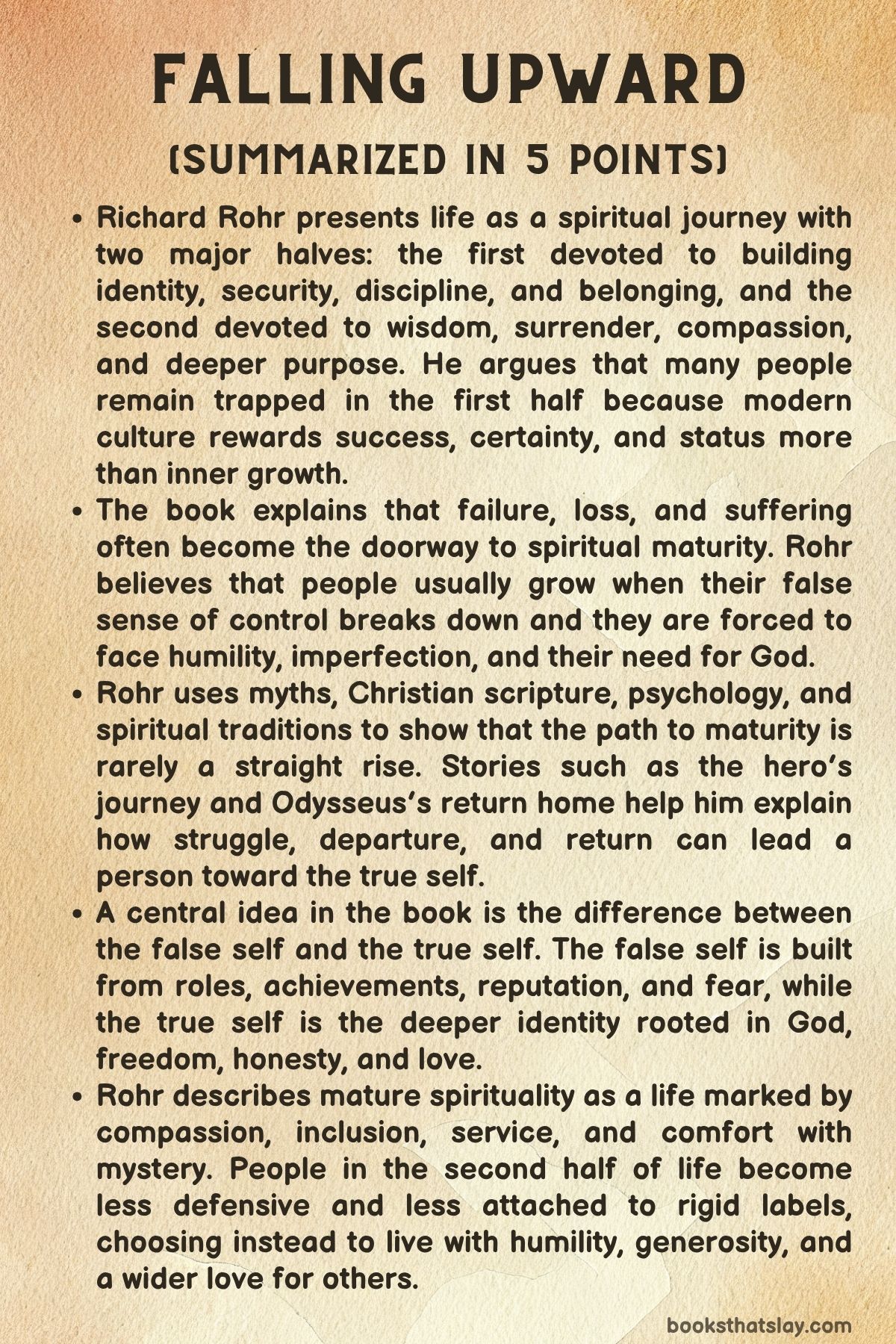
Key Figures
Richard Rohr
Richard Rohr is the guiding voice of the book and functions less as a distant author than as a spiritual mentor speaking from long experience. He appears as a priest, teacher, critic, and seeker who has spent decades reflecting on Christian spirituality, human growth, institutional religion, and the difficult movement from ego to wisdom.
In Falling Upward, Rohr’s personality comes through as bold, reflective, impatient with shallow religion, and deeply committed to transformation. He does not write as someone who rejects the church from outside it; he writes as someone formed by Catholicism who also believes that religious institutions often fail to bring people into real spiritual maturity.
His willingness to criticize the church, question common interpretations of sin, and challenge rigid certainty gives him the role of an internal reformer. At the same time, he is not simply rebellious.
He values structure, tradition, scripture, ritual, and moral formation, but he insists that these things must lead people toward humility, compassion, and freedom rather than fear or superiority. Rohr’s character is marked by paradox: he is loyal yet critical, Christian yet open to other traditions, intellectually confident yet willing to admit mystery.
His voice holds the book together because the argument depends not only on doctrine but also on the credibility of a person who has lived with faith, doubt, discipline, and change.
The Reader or Spiritual Seeker
The reader is treated as an active presence in the book, not as a passive audience. Rohr writes to someone who may have built a respectable life but still senses that something deeper is missing.
This imagined seeker may be successful, religious, responsible, educated, or morally serious, yet still stuck in the anxieties of the first half of life. The book assumes that the reader carries wounds, defenses, ambitions, fears, and a longing for home that cannot be satisfied by achievement.
Rohr’s treatment of the reader is both respectful and demanding. He dignifies the reader by comparing ordinary life to the hero’s journey, suggesting that every person is called into a larger spiritual adventure.
But he also refuses to flatter the reader’s ego. He repeatedly warns that comfort, certainty, status, and the desire to look good can prevent growth.
The reader, as a character in the book’s spiritual drama, must learn to stop avoiding suffering and start listening to what life is teaching. This makes the seeker a figure of possibility: incomplete, wounded, resistant, but also capable of becoming wiser, freer, and more loving.
The First-Half Self
The first-half self represents the part of a person that needs identity, order, security, belonging, and achievement. In the book, this self is not treated as evil or useless.
Rohr makes clear that people must pass through this stage because they need a strong foundation before they can move beyond it. The first-half self wants to know who it is, where it belongs, what rules to follow, what role to play, and how to succeed.
It builds careers, families, reputations, beliefs, and social identities. Its strengths are discipline, ambition, structure, loyalty, and survival.
Its weakness is that it mistakes these necessary beginnings for the whole meaning of life. When the first-half self remains dominant for too long, it becomes defensive, judgmental, status-conscious, tribal, and afraid of change.
It can cling to religion, politics, family, nationality, or career not as paths toward love but as shields against uncertainty. In Falling Upward, the first-half self is important because it shows why growth must begin with structure but cannot end there.
Rohr’s analysis makes this self recognizable rather than ridiculous, which allows readers to see their own immaturity without being crushed by shame.
The Second-Half Self
The second-half self is the mature person who has passed through enough loss, failure, and self-questioning to live with greater freedom. This figure does not need constant approval, rigid labels, or the illusion of complete control.
Rohr presents the second-half self as more inclusive, calmer, wiser, and more capable of compassion. Such a person can hold complexity without rushing to simplify it.
They can live with sadness without becoming bitter and with joy without becoming shallow. The second-half self is not necessarily old in years, because spiritual maturity does not follow a strict biological timeline.
It is a condition reached when a person stops living mainly for image, success, and self-protection. This character’s strength is the ability to give, forgive, include, and serve.
The second-half self has learned that life is not about winning every argument or defending every boundary. It is about becoming whole enough to create wholeness around oneself.
Rohr’s portrayal makes this figure the goal of the book’s movement: not a flawless saint, but a person who has been softened and enlarged by reality.
The False Self
The false self is one of the most important inner figures in the book. It is the constructed identity made from roles, accomplishments, reputation, fear, family expectations, cultural approval, and ego needs.
Rohr does not describe the false self as completely bad, because some constructed identity is needed in early life. A person must learn how to function, belong, work, relate, and make choices.
The danger begins when the false self is treated as the real self. It then becomes a prison, demanding constant defense and validation.
The false self wants to appear right, competent, admired, moral, secure, and separate from weakness. It fears humiliation because humiliation exposes how fragile it is.
In the book, suffering often works by cracking this false self open. A failure, loss, conflict, or uncontrollable situation shows the person that their public identity cannot save them.
Rohr’s treatment of the false self is spiritually sharp because he shows that it can hide behind respectable forms: religion, success, morality, leadership, or family duty. The false self can look good to the world while keeping a person far from humility and love.
The True Self
The true self is the deeper identity that Rohr believes is rooted in God. Unlike the false self, it is not manufactured through achievement or social approval.
It is discovered, remembered, and received. The true self is childlike but not childish, simple but not ignorant, humble but not weak.
It is the part of the person that can live in union with God, others, and reality without needing constant defense. Rohr connects the true self to spiritual homecoming.
People spend much of life forgetting who they are, but the second half of life invites them to return to this deeper identity. The true self can accept imperfection because it does not depend on perfection for worth.
It can serve others because it is not obsessed with proving itself. It can face suffering because suffering does not destroy its foundation.
In Falling Upward, the true self gives the book its hopeful center. Rohr’s argument would be harsh if it only exposed illusion, but the true self shows that beyond the collapse of ego there is not emptiness but freedom, belonging, and a more generous way of living.
The Loyal Soldier
The loyal soldier is Rohr’s image for the inner protector that helps a person survive the first half of life. This figure represents discipline, boundaries, duty, identity, and defense.
In childhood and early adulthood, the loyal soldier is useful because it helps a person become responsible, stable, and capable of navigating the world. It tells people how to stay safe, obey rules, meet expectations, and protect what they have built.
The problem is that the loyal soldier does not know when its work is done. It may continue giving commands even when the person needs freedom rather than defense.
Rohr uses this figure to explain why people struggle to move into the second half of life. They feel guilty leaving old roles, beliefs, or loyalties because the loyal soldier mistakes change for betrayal.
Its voice can even sound like the voice of God, especially when someone has been trained to equate obedience with spiritual maturity. The loyal soldier is therefore both necessary and limiting.
It must be honored for its service but eventually released so the person can become more open, compassionate, and whole.
The Shadow Self
The shadow self represents the hidden parts of a person that they refuse or fail to see. It contains resentment, vanity, fear, anger, selfishness, sadness, prejudice, and other disowned traits.
Rohr treats the shadow not as a simple synonym for sin but as the unseen source from which harmful actions often arise. This distinction is important because someone may try hard to avoid obvious wrongdoing while still refusing to understand the inner patterns that lead to it.
The shadow self often appears through overreactions, blame, denial, irritation, and the traits people most criticize in others. In the book, shadow work becomes a central part of maturity.
A person must listen to criticism, notice emotional triggers, and become honest about the impulses they would rather hide. Rohr argues that people who face their shadow become more forgiving because they understand their own divided nature.
They are less likely to reduce others to their worst qualities. The shadow self is uncomfortable to confront, but it becomes a teacher.
By revealing what has been denied, it helps the person move toward humility and compassion.
The Persona
The persona is the public mask a person wears in society. It may take the form of a job title, religious role, family role, social reputation, or admired identity.
Rohr does not condemn the persona outright, because social life requires people to play certain roles. A parent, teacher, priest, leader, or worker must have some public identity in order to serve others responsibly.
Yet the persona becomes dangerous when it is mistaken for the whole person. A rigid persona can hide the shadow self and prevent honest growth.
Someone may appear moral, successful, spiritual, or respectable while remaining deeply afraid of being exposed. The persona wants applause and protection; it does not want humility.
In the book, Rohr’s analysis of persona helps explain why people can do harm without recognizing it. They become loyal to the image they are defending rather than to truth.
The mature person learns to wear the persona lightly, without letting it replace the soul. This release brings relief because the person no longer has to live under constant fear of judgment.
Jesus
Jesus appears as the book’s central spiritual model, though Rohr often presents him in ways that challenge conventional religious comfort. In Rohr’s reading, Jesus is not mainly a defender of order, respectability, or religious certainty.
He is a figure who calls people beyond security, family expectations, social boundaries, and ego-driven identity. Jesus welcomes sinners, breaks rules when love requires it, speaks in paradox, and shows that transformation often comes through surrender.
Rohr uses Jesus’s teachings about losing life to find it, leaving family to follow him, becoming like a child, and loving enemies to support the idea that spiritual maturity demands a break from first-half-of-life thinking. The crucifixion becomes especially important because it shows that the path of God is not based on domination or easy success.
Jesus’s suffering reveals the mystery of transformation through loss. In the book, Jesus is not made safe or sentimental.
He is presented as a demanding teacher whose message unsettles people who want religion to confirm their existing identities.
Odysseus
Odysseus serves as a mythic example of the journey toward home. Rohr uses his story to show that ancient myths often understand the human soul with remarkable depth.
Odysseus must endure danger, loss, wandering, temptation, and descent before he can return to Ithaca. Rohr interprets this return not only as a physical homecoming but as a symbol of the soul’s return to its true center.
Odysseus becomes important because he shows that the journey downward can become the path toward wisdom. His struggles are not interruptions of the journey; they are the journey.
The movement through darkness, vulnerability, and sacrifice helps him leave immaturity behind. In the book, Odysseus also helps Rohr connect Christian spirituality with broader human patterns.
The hero’s journey is not limited to one culture or one religion. It expresses a recurring truth about human growth: people often have to leave home, lose certainty, and confront their limits before they can understand what home really means.
Francis of Assisi
Francis of Assisi appears as a powerful example of transformation through the encounter with what one fears or rejects. Rohr refers to the story of Francis kissing a person with leprosy, an act that marks a decisive break from his old self.
Francis had to face revulsion, fear, and social distance, but that very encounter opened him to love. In the book, Francis represents the kind of spiritual change that cannot happen through ideas alone.
He does not simply adopt a new belief; he becomes a new person through a concrete act of humility and compassion. His example supports Rohr’s claim that the stumbling stone, the thing one resists most, may become the doorway into grace.
Francis also reflects the Franciscan values that shape Rohr’s own outlook: simplicity, solidarity with the excluded, love of creation, and freedom from status. He stands as a model of what happens when a person allows suffering and discomfort to break the false self rather than harden it.
Thomas Merton
Thomas Merton appears near the end of the book as a spiritual elder whose poetry expresses the freedom Rohr associates with the second half of life. Merton, a monk and contemplative writer, represents a person moving beyond ego, status, money, approval, and narrow identity into a more surrendered union with God.
Rohr treats him as a guide who understands the inner journey not merely as moral improvement but as release into presence. Merton’s poem becomes a final artistic expression of the book’s message: the person who has passed through surrender can live with serenity, simplicity, and spiritual freedom.
As a character in the book’s world of references, Merton embodies contemplative maturity. He shows that wisdom is not loud or self-advertising.
It is quiet, spacious, and rooted in being. Rohr’s use of Merton also reinforces the book’s respect for poetry as a form of spiritual knowledge, capable of saying what abstract explanation cannot fully contain.
Helen Keller and Anne Sullivan
Helen Keller and Anne Sullivan appear as an example of transformation through relationship and mirroring. Keller’s life shows that limitation does not prevent a person from serving others or living with meaning.
Sullivan’s role is equally important because she helps Keller discover and express capacities that might otherwise remain hidden. Rohr uses their relationship to explain how people come to know themselves through others.
No one can fully mirror themselves. A trusted person can reflect goodness, strength, confusion, pain, and possibility in a way that helps the self become visible.
Keller and Sullivan therefore represent the relational side of spiritual growth. The journey is personal, but it is not isolated.
Mentors, friends, teachers, and companions help people recognize who they are and who they can become. Their example also supports Rohr’s claim that service and happiness are connected.
Keller’s life becomes meaningful not because suffering disappears, but because suffering is transformed into purpose and connection.
Themes
Growth Through Loss and Failure
Loss is treated not as an unfortunate interruption to spiritual growth but as one of its most reliable beginnings. Rohr challenges the cultural habit of equating progress with steady upward movement, achievement, success, and control.
In his view, many people do not begin the deeper journey until something disrupts the identity they have carefully built. This disruption may come through personal failure, grief, humiliation, aging, disappointment, or a situation that cannot be fixed by intelligence or effort.
Such experiences are painful because they expose the limits of the ego. The false self wants to remain admired, competent, and secure, but suffering reveals that this identity is too small to carry the full weight of life.
Rohr does not glorify pain for its own sake. Instead, he argues that pain becomes spiritually useful when people stop resisting reality and begin asking what it can teach them.
The movement downward breaks open the person’s defenses and makes room for compassion, humility, and dependence on God. In Falling Upward, this pattern gives the title its meaning: the fall becomes upward when it leads to wisdom rather than bitterness.
The Movement From Ego to Soul
The first half of life is shaped by the need to build a workable identity, but the second half asks a person to stop treating that identity as ultimate. Rohr’s distinction between ego and soul is central to his understanding of maturity.
The ego wants definition, approval, success, certainty, and separation. It asks, “Who am I?” in terms of roles, achievements, beliefs, possessions, and reputation.
This is necessary for a time, because people need structure before they can live freely. Yet the soul asks a deeper question: what remains when the roles and achievements are no longer enough?
Rohr suggests that many people become trapped because they keep defending the early self long after it has served its purpose. The soul grows when a person can release the need to appear perfect, right, or important.
This movement does not destroy identity; it purifies it. A mature person still has a personality, history, and commitments, but these no longer function as walls.
The soul is more spacious than the ego. It can include others, forgive weakness, accept mystery, and serve without needing constant recognition.
The Need for Paradox and Mystery
Rohr repeatedly argues that spiritual maturity requires comfort with paradox. Life cannot be understood only through clear categories, strict cause and effect, or simple moral formulas.
People can be wounded and blessed at the same time. They can love someone and still feel frustration.
They can be imperfect and still loved by God. They can lose what they thought mattered and discover a deeper form of life.
This kind of thinking is difficult for people who want certainty, especially in religion. Rohr criticizes forms of faith that reduce mystery to rigid answers and turn spirituality into rule-keeping or group loyalty.
For him, Jesus’s teachings often work through paradox: losing life to find it, becoming like a child to enter the kingdom, loving enemies, and finding God among the rejected. Mystery is not confusion or laziness; it is a more honest response to reality than premature certainty.
Mature faith does not need to explain everything in order to trust. It can wait, listen, and live with unanswered questions.
This theme gives the book much of its intellectual and spiritual depth because Rohr asks readers to exchange control for wisdom.
Compassion, Inclusion, and the Second Half of Life
Maturity is measured by the widening of love. Rohr presents the second half of life as a movement away from tribal identity and toward compassion that includes more people, not fewer.
In early life, belonging to a family, religion, nation, profession, or group can provide safety and identity. Yet these same forms of belonging can become spiritually limiting when they produce superiority, exclusion, or fear of outsiders.
Rohr sees Jesus as radically inclusive because he moves toward sinners, outsiders, and people on the margins rather than protecting a narrow circle of respectability. A mature person becomes less interested in proving who belongs and more interested in creating healing.
This does not mean losing all boundaries or moral seriousness. It means that love becomes larger than the ego’s need to rank, reject, and defend.
Compassion also grows through shadow work, because people who recognize their own weakness become less eager to condemn others. The second half of life is therefore not private enlightenment alone.
It is a changed way of being in the world, marked by service, forgiveness, humility, and a deeper sense of shared humanity.