A Stage Set for Villains Summary, Characters and Themes
A Stage Set for Villains by Shannon J. Spann is a dark fantasy about survival, performance, power, and the cost of becoming what others fear. The story follows Riven Hesper, a young woman cursed as a child by the blood of an immortal Player from the magical Playhouse.
Years later, with her body failing and her future stolen, Riven enters the Playhouse hoping to find a cure. Instead, she is forced into a deadly contest where actors manipulate reality, memories, and lives. The novel mixes theatrical danger with rebellion, romance, and questions about freedom, identity, and who gets to control the story.
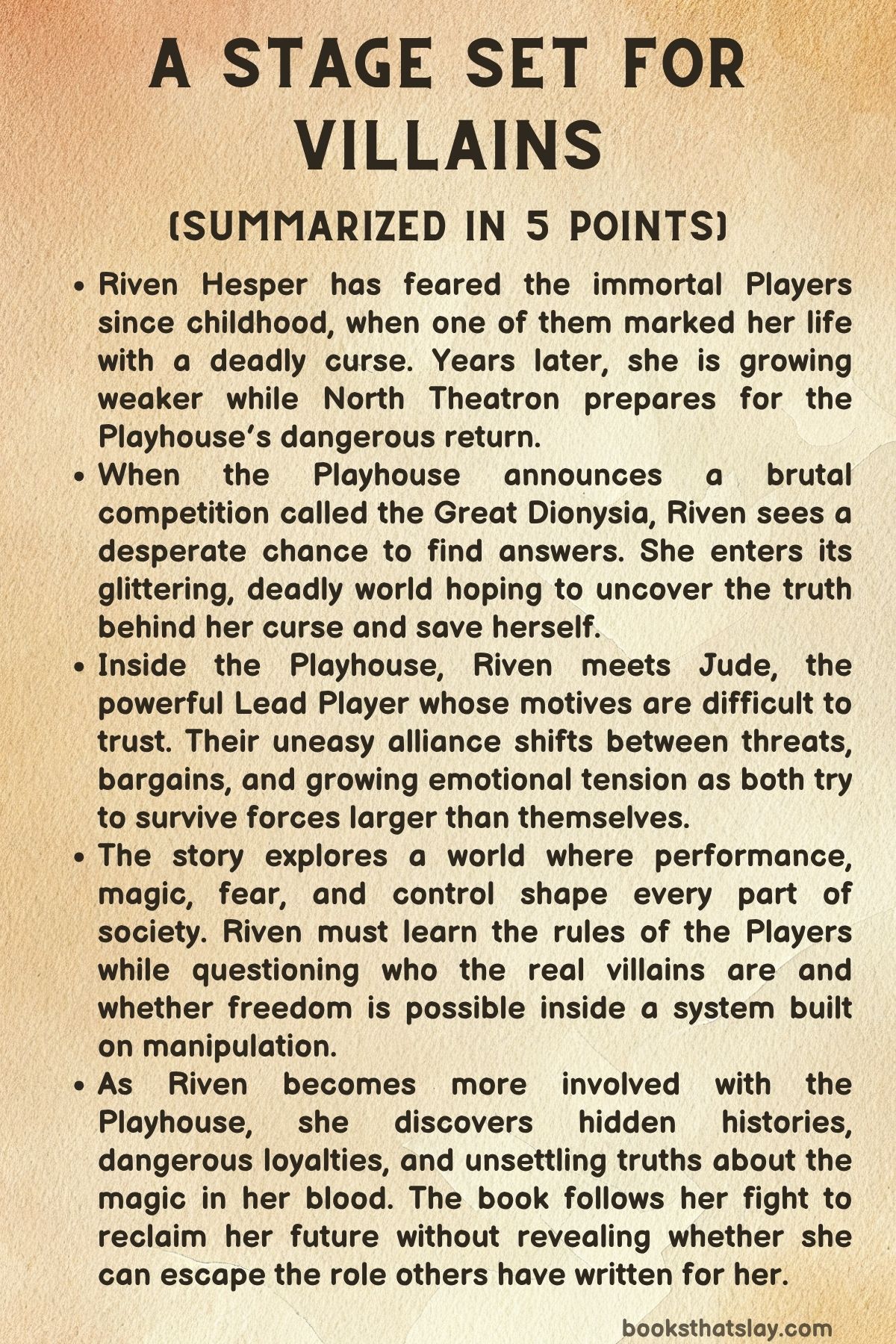
Summary
Riven Hesper grows up in North Theatron afraid of the Players, immortal performers from the Playhouse who can control mortals through their strange theatrical power. As a child, she goes to the courthouse with her older brother Galen to receive an Eleutheraen gold mark, a protective sign that shields people from Player influence and prevents them from lying.
Galen teaches her the rules every mortal must know: never meet a Player’s eyes, offer three compliments, and remember that Eleutheraen gold is the only thing that can kill them.
Before Riven can be marked, a Player escapes inside the courthouse. The world freezes around them, leaving only Riven able to move.
The Player hurts Galen to force Riven to look at her, destroys Riven’s marking papers, and tries to compel her to come along. Riven resists by using Galen’s Eleutheraen gold knife to stab the Player’s hand.
The Player’s golden blood spills onto Riven and sinks into her skin. Guards drag the Player away, but not before she warns Riven that she will suffer if she refuses to come with her.
Ten years later, Riven is wasting away because of the Player’s blood. She is cold, weak, bruised, and treated like someone cursed.
Her hope is to attend Orkestrian Academy and become a healer, but even that dream is fragile. At the same time, the Playhouse returns to the District of Dionysus after years of absence, just as an old treaty limiting the Players’ movements nears its end.
Fear spreads through the District. People smash mirrors because Players can use reflections, while Revelers, who worship the Playhouse, prepare offerings.
Riven learns that her condition may kill her soon. Her acceptance to the academy is revoked after Galen raises concerns about her worsening health, leaving her furious and desperate.
That night, she follows Galen into the District but is drawn instead toward the Playhouse. Revelers discover her hidden mark and attack her, but a mysterious song makes them kill themselves.
Silenus Darstellar, director of the Playhouse, appears and mistakes Riven for a late auditionee. Riven realizes the Script, Silenus’s powerful book, might be able to undo what was done to her, so she enters the Playhouse.
Inside, Riven is surrounded by beauty, music, and danger. She searches for Silenus’s room, hoping to steal the Script, but crosses paths with Jude, the Lead Player.
At first, Jude mistakes her fear for stage fright and treats her with unexpected gentleness, even giving her a ring she can steal for food. Later, he discovers she is marked and cannot be compelled.
When Silenus almost finds them, Jude hides her and gives her the false identity Alistaire Hunt, claiming she is his chosen contender for the Great Dionysia.
Jude explains that he needs Riven because her mark makes her ineligible to become a Player. If she survives the contest and then reveals the mark, the competition will collapse, allowing Jude to keep his role without a final duel.
Riven refuses to trust him, but he promises he may be able to help with the curse if she helps him. Before she can decide, he sends her into the arena.
The Great Dionysia is a brutal festival where mortals compete for the chance to become a Player by killing one. Riven meets the other contenders, who already have borrowed Craft from their mentors.
She has none. The Players demonstrate their arts: Compulsion, Reality Suspension, and Mimicry.
Riven quickly understands that the Playhouse is not a place of healing but a system built on performance, control, and death. Still, Jude’s stolen medicine briefly eases the icy pain inside her, convincing her he might truly know how to help.
Riven tries to escape and looks for Eleutheraen gold weapons inside the Playhouse. She contacts Haris, an obsessive Reveler she once encountered, and asks for help.
She also discovers more about the Playhouse’s politics, including the threat of war between North and South Theatron once the treaty expires. Jude keeps insisting that she must destroy or cut her mark to use Craft, but Riven refuses because the mark is one of the few protections she has left.
As the competition grows more dangerous, Riven’s connection to Jude deepens in strange ways. Gene Hunt, a supposedly dead former Player, appears through mirrors and attacks Jude.
Riven ends up carrying Jude’s memories inside her mind and using his face through Mimicry. When Jude is incapacitated, Silenus forces Riven to perform as him.
She proves alarmingly skilled, so skilled that the other Players begin to suspect there is more to her than anyone understands.
During one performance, Riven sneaks into the prop room to steal Eleutheraen gold. There she is confronted by Marigold, the Prop Master, and Gene appears again with Riven’s lost knife.
In the struggle, Riven kills Marigold with an Eleutheraen arrowhead. Nyxene, the terrifying Stage Manager, destroys Gene, but his final words point Riven back toward the Script.
Riven later finds that Jude’s Craft has entered her body and that her own body is changing. She is stronger, her mark is healing, and she now has power beneath her skin.
Determined to stop the Great Dionysia, Riven forces Jude out of the Playhouse with her. She chains him with Eleutheraen gold, weakens him, and tries to take him to Syrene to trade him to the North.
Her plan falters when she sees that handing him over would likely mean torture or execution. Jude escapes, but Riven is soon captured by Dorian, a Player-hunter who sees her as a political threat because she may be the first Northern Player.
Dorian prepares to poison her, but Jude returns disguised as him, having killed the real Dorian. Jude rescues Riven brutally, using Compulsion to punish the hunters in ways that horrify her.
Riven and Jude argue as they flee through the snow. She sees him as monstrous; he sees her as someone who lets others hurt her rather than fighting back.
Their anger exposes deeper feelings, and Jude admits he cares for her. They kiss, but their situation worsens.
Jude is wanted for leaving the Playhouse, and something golden begins spreading through his body. He starts coughing gold and forgetting things, even Riven’s name.
Riven realizes he is being damaged by forces tied to the Playhouse and agrees they must return.
The final contest places Riven in the arena against Jude. Silenus expects one of them to die.
Riven arms herself, including one Eleutheraen gold-tipped arrow. The arena fills with spectators arriving through mirror portals.
Jude uses illusions from Riven’s trauma to force her to fight, while hiding their private words from the audience. Riven refuses to follow Silenus’s design.
She counters with visions from Jude’s memories and tries to reach the person beneath his role.
Jude keeps pushing her toward violence, hoping to awaken the Player inside her. Riven resists.
When she finally has the chance to shoot him, she asks him to tell her the truth he has been avoiding. Jude admits he has loved her in every life.
Instead of killing him, Riven shoots the gold-tipped arrow into the heart of the Playhouse.
The Playhouse begins to break apart. Riven uses Compulsion to order the audience to escape.
She had secretly convinced the other Players to flee with her to Eleutherae, their ruined homeland, where they might finally be free. Jude helps them escape but stays behind to hold off Silenus, revealing that past attempts failed because someone always had to remain.
Riven refuses to leave him and returns before the gates close.
Inside the collapsing theatre, Silenus reveals that he controls the Players through the Script and that Riven’s freedom has been broken. Nyxene comes to kill her, but Jude signals that he is still himself.
He attacks Silenus and draws the remaining Craft of the Playhouse into his own body, tearing himself apart to buy Riven time. Riven understands that she must not destroy the Script but rewrite it.
She pours Eleutheraen gold over it and tells Jude to find her as the Playhouse erupts.
The Playhouse burns to ash, freeing the Players. Eleutherae’s lost magic returns to the world, bringing color, music, stories, and warmth back to Theatron.
Mortal marks vanish, Revelers wake from their obsession, and theatre becomes human-made again rather than ruled by Compulsion and death. Years later, Riven and the others attend a modern play about the Playhouse.
Jude has been missing for years, but after the performance a familiar man with his ring and copper hair appears. When he says he never cared for tragedies, Riven realizes Jude has finally found her.
Characters
Riven Hesper
Riven Hesper is the emotional and moral center of A stage set for villains. She begins as a frightened child in North Theatron, raised to fear the Players and obey the rules that protect mortals from them.
Her childhood encounter with the unnamed Player marks her life permanently, not only because the Player’s blood enters her body, but because that moment teaches Riven that survival often depends on refusing to submit. Ten years later, she has become physically fragile, socially isolated, and furious at the future stolen from her.
Her curse makes her appear almost dead, but her inner life is intensely alive: she is angry, observant, stubborn, and desperate to claim control over a body and destiny that have been controlled by others.
Riven’s greatest strength in the book is her refusal to be defined by fear. She is afraid of the Players, the Playhouse, death, and her own changing nature, but she repeatedly acts despite that fear.
Her decision to enter the Playhouse is reckless, yet it also shows her determination to save herself when the world around her has already decided she is doomed. She does not want power for glory; she wants a cure, a future, and the chance to live as more than a cursed girl people pity or avoid.
This makes her ambition sympathetic, even when her choices become dangerous.
As the story develops, Riven becomes increasingly complicated because she is no longer only a victim of Player violence. Jude’s Craft enters her, her mark begins to change, and she discovers that she may be something the North has never seen before: a mortal with Player-like power.
This transformation forces her to confront the line between self-defense and cruelty. She can manipulate, deceive, wound, and compel, but she repeatedly resists becoming the kind of monster she fears.
Her refusal to kill Jude in the arena, even when given the chance, proves that her strength lies not only in surviving violence but in choosing not to let violence become her identity.
Riven’s relationship with Jude reveals her deepest conflict. She hates what he represents, yet she recognizes his pain, captivity, and humanity beneath the role of Lead Player.
Their bond is volatile because both of them are wounded, manipulative, and frightened of dependency. Riven does not simply soften Jude; she challenges the entire system that has shaped him.
By the end of the story, she becomes a liberator rather than a contender. Her final act is not to win the Great Dionysia by killing, but to rewrite the rules that made killing necessary.
Riven’s arc is therefore a movement from cursed survivor to active author of her own fate.
Jude
Jude is one of the most tragic and morally complex figures in the book. As Lead Player, he is introduced as charming, dangerous, theatrical, and capable of terrible cruelty.
He understands performance so deeply that it has become almost impossible to separate his real self from the role he plays. At first, he appears to be another beautiful monster of the Playhouse, someone who can tease, manipulate, and threaten with effortless confidence.
Yet his actions toward Riven quickly reveal contradictions. He traps her in the competition, but he also protects her.
He uses her, but he also sees her fear and tries to steady her. He is both captor and captive.
Jude’s cruelty is real, and the story does not erase it. His violence toward Dorian’s companions shows how terrifying he can be when he believes Riven has been harmed.
He is capable of punishment that feels excessive, theatrical, and monstrous. However, the book also shows that Jude’s brutality has been shaped by centuries of confinement, performance, and survival under Silenus’s control.
He is not innocent, but he is not free either. His role as Lead Player forces him to keep winning, keep performing, and keep existing inside a system that consumes identity, memory, and humanity.
His love for Riven is powerful because it is tied to recognition. Jude sees in her someone who refuses to accept the Playhouse’s script, while Riven sees in him someone who has forgotten how to imagine life outside it.
Their romance is not simple comfort; it is conflict, accusation, temptation, and hope. Jude often tries to pull Riven into his world because he believes the Playhouse is the only place where people like them can survive.
Riven, however, forces him to confront the possibility that survival without freedom is only another form of death.
By the finale, Jude’s character becomes deeply sacrificial. He appears to embrace monstrosity, but his wink to Riven proves that some part of him remains himself.
His final decision to draw the Playhouse’s Craft into his own body shows that beneath all his manipulation and violence, he is capable of love that acts without possession. He does not merely say he loves Riven; he gives her the chance to rewrite the Script and free the others.
His return in the encore makes his arc feel like a release from tragedy. Jude survives not as the Lead Player trapped in a role, but as someone finally able to step back into a life beyond the stage.
Galen Hesper
Galen Hesper is Riven’s older brother and one of the strongest symbols of protection in the story. As a child, he teaches Riven the rules for surviving Players, and his presence at the courthouse gives her a sense of safety before everything goes wrong.
When the Player wounds him to force Riven’s obedience, Galen becomes part of the trauma that shapes Riven’s life. He represents the family bond Riven nearly loses at the beginning and continues trying to protect throughout the novel.
As an adult, Galen’s protectiveness becomes more complicated. He loves Riven, but his fear for her leads him to interfere with her future at the Orkestrian Academy.
From his perspective, he is trying to save a sister whose body is visibly failing. From Riven’s perspective, he becomes another person making decisions for her because of her condition.
This tension gives Galen depth: he is not cruel, but his care can become controlling. His actions show how love can wound when it is guided more by fear than trust.
Galen’s decision to seek help from Dorian also shows the danger of acting out of desperation. He wants to rescue Riven from the Playhouse, but the information he provides is used against her.
This makes him an important example of human limitation in the story. Unlike Riven or Jude, Galen does not fully understand the scale of the forces around them.
He is brave and devoted, but he is also vulnerable to manipulation because he believes protection can be achieved through the familiar systems of the North. His role in the book is emotionally important because he reminds Riven of home, family, and the life she is trying to reclaim.
Silenus Darstellar
Silenus Darstellar is the director of the Playhouse and the central architect of its cruelty. He presents himself with elegance, authority, and theatrical grandeur, but beneath that polished surface is a figure who thrives on control.
Silenus understands spectacle as power. He does not merely manage performances; he manages people, histories, contracts, identities, and deaths.
His announcements about negotiation, the casting call, and the Great Dionysia are framed as entertainment, but they are really mechanisms of domination.
What makes Silenus especially dangerous is that he rarely appears chaotic. His evil is organized, ritualized, and institutional.
He uses the language of theatre to disguise exploitation. Contenders become performers, death becomes art, captivity becomes tradition, and obedience becomes part of the show.
His possession and use of the Script reveal the full extent of his control. He is not simply a villain who enjoys violence; he is a director who believes reality itself should obey his staging.
Silenus’s relationship with Jude shows how deeply he depends on roles. Jude is valuable to him as Lead Player, not as a person.
Riven becomes valuable when she disrupts the expected drama and creates a more exciting performance. Silenus appreciates talent only when it can be absorbed into his system.
His greatest fear is not death, but improvisation beyond his control. When Riven refuses to follow his script, she attacks the foundation of his authority.
By the end of the story, Silenus represents the old order of the Playhouse: beautiful, powerful, and rotten. His downfall is not achieved through a conventional duel but through rewriting.
That matters because his power has always depended on authorship. He controls the story until Riven seizes the power to change it.
Silenus is therefore the embodiment of artistic tyranny, a figure who turns creativity into imprisonment.
Haris
Haris is a disturbing and sorrowful example of what Player worship can do to a mortal mind. As an unmarked Reveler, he is vulnerable to obsession, manipulation, and spiritual hunger.
His devotion to the Players is not presented as harmless admiration; it is desperate, bodily, and frightening. When Riven tries to protect him with Eleutheraen gold, his violent reaction shows how deeply he has surrendered himself to the Playhouse’s influence.
Haris also functions as a dark mirror to Riven. Both are marked by the Players, but in opposite ways.
Riven has been poisoned against her will and fights to reclaim herself, while Haris longs to be taken and transformed by the very beings who have harmed her. His desire to reach the Players exposes the seductive side of the Playhouse.
It does not only terrify mortals; it attracts them by promising beauty, power, belonging, and transcendence.
His later contact with Riven through a mirror shows that even dangerous people can become useful in desperate circumstances. However, Haris never becomes a simple ally.
His obsession remains unsettling because it is rooted in self-erasure. He helps illuminate one of the book’s major concerns: the danger of confusing worship with freedom.
Haris wants to be chosen, but the story makes it clear that being chosen by a cruel power can mean losing oneself.
Cassia
Cassia is Riven’s aunt and one of the few adult figures connected to knowledge rather than performance. Her work at the Dionysian Records places her near history, documentation, and evidence.
In a world full of illusion, compulsion, and staged reality, Cassia’s role matters because she searches through records and images to make sense of what happened to Riven. She is practical, concerned, and grounded.
Cassia’s importance lies in the way she treats Riven’s condition as something that deserves investigation rather than gossip. While others call Riven cursed or look at her with disgust, Cassia tries to identify the Player responsible.
Her suspicion of Iris shows that she is actively looking for answers, even if the truth is more complicated than the records reveal. She represents familial care expressed through research and persistence.
Although Cassia is not at the center of the Playhouse conflict, she helps establish the human cost of its return. Her presence reminds the reader that the Players’ violence does not only affect those who enter the theatre.
Families, archivists, officials, and ordinary citizens are all pulled into its influence. Cassia gives Riven a connection to the mortal world’s memory, making her an important stabilizing figure in the story.
Sebastian
Sebastian is a minor but revealing character because he reflects the everyday cruelty Riven faces before she enters the Playhouse. His bookstore should be associated with learning, preparation, and possibility, yet his interaction with Riven is marked by insult and bluntness.
He reminds her that healers believe she may not survive much longer, turning her private fear into public humiliation.
Sebastian’s function in the book is to show how Riven’s society has already begun treating her as half-dead. He is not a grand villain like Silenus, but his casual harshness matters because it contributes to Riven’s isolation.
His words sharpen her anger and intensify her need to find answers for herself. Through Sebastian, the story shows that cruelty does not always need magic or theatrical power; sometimes it appears as ordinary dismissal.
He also helps explain why the Playhouse becomes tempting despite its danger. Riven’s mortal world has no cure for her and little compassion.
When she later steps into the Playhouse, the choice is reckless, but the earlier scenes with people like Sebastian make it understandable. He represents a society that protects itself from Players while failing to protect one of its own wounded children.
Iris
Iris is important even though she remains more distant than many other Players. Cassia considers whether Iris could be the Player who poisoned Riven, but Riven rejects that possibility because the attacker is not among the known cast.
This makes Iris part of the atmosphere of suspicion surrounding the Players. Her image stands in for the difficulty of identifying truth in a world built on masks, roles, and immortal performers.
Iris’s significance is therefore partly symbolic. She represents the known face of Player danger, while Riven’s actual attacker remains unknown and outside easy classification.
This distinction matters because it shows that records, portraits, and official knowledge cannot fully contain the history of the Playhouse. Iris helps deepen the mystery around Riven’s curse and the larger hidden workings of Player power.
Titus
Titus is one of the Players who most openly embodies menace. He is aggressive, suspicious, and quick to threaten Riven.
His presence at the rooftop cast party makes clear that the Playhouse is not merely glamorous and strange; it is full of beings who enjoy intimidation. Titus treats danger as performance, and his behavior reinforces Riven’s belief that Players cannot be trusted.
His demonstration with Parrish during the stage combat assessment is especially important. By slitting Parrish’s throat in a controlled performance of Reality Suspension, Titus reveals how completely the Players have transformed violence into art.
For him, death and injury are not moral boundaries but theatrical techniques. This makes him frightening because he does not appear to distinguish between performance and cruelty in the way mortals do.
Titus also helps define the culture Jude comes from. Around Players like Titus, brutality is normalized and even admired.
His role in the story is not primarily emotional but atmospheric and thematic. He shows what centuries inside the Playhouse can make of a person: sharp, theatrical, powerful, and disturbingly casual about pain.
Mattia
Mattia is a perceptive Player whose suspicion gives him a quieter but important role. When Riven performs as Jude, Mattia notices that her Mimicry is too perfect for an ordinary auditionee.
This makes him stand out as someone who watches carefully and understands the technical demands of performance. He is not merely decorative within the cast; he can sense when the script of events is wrong.
Mattia’s alertness increases the danger around Riven. In the Playhouse, survival often depends on deception, and Mattia’s ability to notice inconsistencies threatens her cover.
His suspicion also shows that the Players are not easily fooled, even when they appear distracted by drama or cruelty. They are performers trained to read bodies, voices, gestures, and roles.
At the same time, Mattia is part of the trapped cast Riven ultimately tries to free. His suspicion does not make him a simple enemy.
Like the other Players, he exists within Silenus’s system and has been shaped by it. His role helps show that the Playhouse cast is made up of dangerous people who are also prisoners of the institution that made them dangerous.
Arius
Arius is most visible through his connection to healing supplies and practical support within the Playhouse. Jude uses supplies stolen from Arius to treat Riven’s injuries, and the salve briefly eases the icy curse in her lungs.
Because of this, Arius becomes indirectly associated with the possibility of relief. He is part of the Player world, but the materials connected to him help Riven believe that Jude may genuinely be able to help her.
Arius’s role also complicates the idea that everything within the Playhouse is purely destructive. The same world that trains people to kill onstage also contains knowledge, remedies, and forms of care.
Arius does not need to occupy the emotional center of the story to matter; his presence expands the texture of Player society. He suggests that the cast members have functions and skills beyond their public performances.
By belonging to the group of Players Riven later urges to flee, Arius also becomes part of the possibility of collective escape. He is not developed as deeply as Jude or Parrish, but he helps show that the Players are a community, not merely a set of villains.
That distinction is central to A stage set for villains, because the story asks the reader to see the difference between people who do harm and the system that scripts them into doing it.
Parrish
Parrish is one of the most vivid supporting Players because she combines theatrical beauty with grotesque violence. Her arrival with bloody teeth taken from a supposed imposter immediately marks her as unsettling.
She appears comfortable with horror, and her behavior reinforces the sense that the Playhouse has its own moral logic, one far removed from ordinary human restraint.
Yet Parrish is not only monstrous. Her later warning to Riven before the finale shows that she can also be clear-eyed, practical, and protective in her own way.
She tells Riven not to trust the arena’s illusions, offering advice that may help her survive. This moment suggests that Parrish understands the dangers of performance from the inside.
She may participate in the Playhouse’s violence, but she is not blind to how its tricks work.
Parrish’s apparent death during Titus’s demonstration is also important because it reveals the terrifying nature of Reality Suspension. Through her, the reader sees how Players can make death part of performance without treating it as final in the mortal sense.
She embodies the uncanny quality of the cast: glamorous, frightening, wounded, and difficult to judge by ordinary standards.
Gene Hunt
Gene Hunt is a haunting figure whose presence exposes the buried failures of the Playhouse. Although believed to be gone, he appears through mirrors and attacks Jude, proving that the past has not been safely contained.
Gene’s connection to Jude’s old role, his dressing room, and the name Alistaire Hunt makes him a ghostly reminder that identities in the Playhouse are inherited, performed, and often violently replaced.
Gene’s attacks are frightening, but they are also revealing. He wants Jude dead and seems connected to the hidden truth of the Script.
His fragmented words to Riven before Nyxene destroys him point her toward the object that ultimately matters most. Even in a damaged and dangerous form, Gene becomes a messenger of buried knowledge.
His character deepens the tragedy of the Players because he shows what happens to those who are consumed by the Playhouse and its roles. Gene is not simply a villainous apparition.
He is evidence of a system that leaves remnants, echoes, and unfinished suffering behind. Through him, the story suggests that the Playhouse does not truly let anyone go cleanly.
Marigold
Marigold, the Prop Master, is a sharp and dangerous figure whose brief role has major consequences for Riven. She guards the world of objects that make performance possible: weapons, chains, props, and tools.
In a theatre where props can become instruments of survival or death, Marigold’s position gives her real power. Riven seeks her out because the prop room may contain what she needs to escape.
Marigold’s ability to detect inconsistencies when Riven pretends to be Jude shows that she is observant and disciplined. She is not easily deceived by appearance alone.
This makes her confrontation with Riven tense because it pits Riven’s borrowed performance against someone trained to notice the details behind performance. Marigold’s suspicion helps reinforce the idea that identity in the Playhouse is always being watched and tested.
Her accidental death at Riven’s hands is a turning point. It forces Riven deeper into guilt and danger, showing that her attempt to survive can still cause irreversible harm.
Marigold’s death is not presented as a triumphant victory. It is messy, desperate, and morally troubling, which fits the book’s larger refusal to make survival clean.
Nyxene
Nyxene, the Stage Manager, is one of the most terrifying figures in the story because she feels less human than the other Players. While Silenus controls through direction and the Script, Nyxene enforces through destruction.
Her arrival after Marigold’s death creates immediate dread, and her ability to destroy Gene shows that she exists as a guardian of the Playhouse’s order.
Nyxene’s role is especially important because she protects Silenus above all else. She is not merely another performer with personal motives; she functions like the Playhouse’s immune system, attacking threats to its control.
This makes her frighteningly impersonal. Unlike Jude, she does not seem torn by affection.
Unlike Silenus, she does not need theatrical speeches. Her power is direct, brutal, and absolute.
In the climax, Jude understands Nyxene’s loyalty and uses it against the system. By attacking Silenus, he draws Nyxene away and gives Riven time.
This moment reveals that Nyxene’s strength is also a limitation: she follows the logic of protection so completely that she can be manipulated by someone who understands the rules. She represents the deadly machinery of the Playhouse, powerful but bound to its function.
Thyone
Thyone is one of the contenders in the Great Dionysia and part of the group that shows Riven what she is up against. Along with her twin Phileas, she has already received Craft bindings from a mentor, making her better prepared for the competition than Riven.
This contrast emphasizes Riven’s vulnerability. Riven enters the contest with no proper training, a damaged body, and a hidden mark, while contenders like Thyone have accepted the structure of the competition more fully.
Thyone’s role is also important because she represents the mortal desire to become something more than mortal. The contenders are not simply victims dragged into the Playhouse.
Some of them are ambitious, devoted, or willing to risk death for transformation. Through Thyone, the book shows that the Great Dionysia feeds on longing as much as fear.
The dream of becoming a Player is powerful enough to make mortals enter a deadly arena willingly.
Phileas
Phileas, Thyone’s twin, helps build the sense that the Great Dionysia is a ritualized competition rather than a random act of violence. Like Thyone, he has Craft bindings and is better positioned than Riven at the beginning of the contest.
His presence makes Riven’s isolation clearer. She is not part of the Reveler culture, does not worship the Players, and does not understand the competition’s expectations in the way the other contenders do.
As part of a twin pair, Phileas also adds to the theatricality of the contender group. The Playhouse values striking identities, memorable roles, and dramatic contrasts.
Phileas and Thyone fit that world more naturally than Riven does at first. His role highlights the fact that the competition is not only about power but about casting.
Every contender is being shaped into a possible performer, and Phileas is one of the mortals willing to be shaped.
Tig
Tig is another contender whose importance lies in what he reveals about the Great Dionysia. He belongs to the group of mortals competing for the chance to become a Player, and his presence helps show that Riven’s situation is unusual.
Unlike Riven, the other contenders have more direct connections to the competition’s structure and have received power through their mentors. Tig therefore helps establish the imbalance Riven faces.
Even without occupying the center of the plot, Tig contributes to the atmosphere of danger and ambition. The contenders are rivals, but they are also evidence of the Playhouse’s seductive reach.
Each one represents a mortal willing to step close to death for the promise of transformation. Tig’s role helps make the competition feel populated, competitive, and morally uneasy rather than focused only on Riven and Jude.
Linos
Linos is one of the contenders and, like Thyone, Phileas, and Tig, helps define the mortal side of the Great Dionysia. His presence reinforces the idea that the Playhouse does not need to rely only on force.
It can attract people into its rituals by offering the possibility of power, immortality, and belonging. Linos is part of that dangerous promise.
For Riven, contenders like Linos sharpen the pressure of the competition. They are not merely background figures; they are possible future Players and immediate obstacles.
Their Craft bindings remind Riven that she is underprepared and that Jude’s plan places her in real danger. Linos helps show that the Playhouse’s cruelty is structured as opportunity, which makes it more disturbing.
Dorian
Dorian, the Playhouse Bounty Hunter, is a severe and politically charged antagonist. He is feared as someone who hunts Players, but his treatment of Riven reveals that his cause is not simply heroic.
When he learns that her mark is damaged and Craft is in her blood, he views her not primarily as a wounded person but as a political danger. To him, she represents the possibility of a Northern Player, a threat to the balance between North and South Theatron.
Dorian’s willingness to poison Riven with the Poison of Echidna shows how easily anti-Player violence can become cruel in its own right. He opposes the Playhouse, but he is still willing to sacrifice an individual for a political objective.
This makes him an important counterweight to Silenus. The book does not suggest that everyone against the Players is automatically good.
Dorian proves that fear of monsters can produce monstrous behavior.
His death at Jude’s hands is brutal and meaningful. Jude disguises himself as Dorian, turning the hunter’s identity into another performance.
This reversal exposes the fragility of Dorian’s power. He believes he is hunting the dangerous beings of the Playhouse, but he is ultimately outplayed by one of them.
Dorian’s role complicates the moral landscape by showing that Riven is endangered by both Player control and mortal politics.
Basel
Basel is one of Dorian’s companions and part of the hunter group that corners Riven. His role helps give Dorian’s operation weight.
Dorian is not acting alone; he belongs to a network of people willing to use violence, captivity, and intimidation in the name of resisting the Playhouse. Basel’s presence makes the threat to Riven feel organized rather than accidental.
Although Basel is less individually developed than Dorian or Eleni, he contributes to the moral tension of the hunter scene. The group claims to oppose Player danger, yet they become dangerous to Riven themselves.
Through characters like Basel, the story shows how political fear can turn people into instruments of harm. He is part of the human world’s answer to the Players, and that answer is shown to be deeply flawed.
Eleni
Eleni is one of Dorian’s companions and becomes especially memorable because of Jude’s punishment. When Jude compels her to kneel to Riven, the moment is horrifying not because Eleni is innocent of threatening Riven, but because Jude’s response reveals the terrifying intimacy of Compulsion.
Eleni’s body and will are turned into a performance of submission.
Her role exposes the ugliness of power on both sides of the conflict. With Dorian, she participates in cornering and threatening Riven.
Under Jude’s Compulsion, she becomes a victim of Player violence. This double position makes her part of the book’s moral complexity.
People can be both harmful and harmed, both agents and instruments, depending on who holds power in the scene.
Cora
Cora matters primarily as an identity Jude uses through Mimicry. When Jude appears disguised as Cora in the costume wing, the moment demonstrates how fluid and unsettling identity becomes inside the Playhouse.
Faces can be borrowed, bodies can be imitated, and trust becomes almost impossible. Cora’s presence, even through disguise, shows that the Playhouse is a place where appearance cannot be treated as truth.
The use of Cora’s form also reveals Jude’s skill. He does not merely change how he looks; he uses disguise as strategy, surveillance, and pressure.
Through Cora, Riven experiences the Playhouse’s power to make even ordinary interactions unstable. The character’s importance lies less in individual development and more in what the borrowed identity reveals about the world of performance.
Alistaire Hunt
Alistaire Hunt is not simply a person in the usual sense, but an invented role that becomes crucial to Riven’s survival and transformation. Jude creates the alias to hide Riven from Silenus, claiming her as his chosen contender.
The name gives Riven a place inside the Playhouse, but it also traps her inside another identity. As Alistaire, she can move through the competition, but she must also perform a self that was built by Jude’s lie.
The alias becomes more than a disguise because the Playhouse responds to roles as if they have power. Once Riven is named Alistaire Hunt, she is drawn deeper into the theatrical machinery of the Great Dionysia.
The invented identity allows her to survive, deceive, and eventually astonish the audience with her Mimicry. Yet it also threatens to erase the difference between who she is and who the Playhouse wants her to become.
Alistaire Hunt’s connection to Gene Hunt gives the name a haunted quality. It is not a blank mask; it carries echoes of past Players, old roles, and unfinished violence.
Through this identity, A stage set for villains explores how names and roles can protect a person while also endangering their sense of self. Riven’s eventual rejection of Silenus’s script depends partly on her ability to use the role without being consumed by it.
Themes
Power, Control, and the Right to Choose
Power in A Stage Set for Villains is never shown as simple strength; it is shown through control over bodies, choices, memories, and truth. The Players can freeze reality, command mortals, reshape appearances, and turn performance into a weapon.
This makes ordinary people live with fear, rules, and protective marks, while the Playhouse turns obedience into spectacle. Riven’s journey is driven by her refusal to be controlled, first by the curse in her blood, then by Jude’s bargain, Dorian’s political fear, and finally Sil’s Script.
Her resistance matters because almost every force around her tries to decide what she is: cursed girl, illegal contender, dangerous Northern Player, useful pawn, or future monster. By the end, her greatest act is not killing Jude or winning the competition, but rejecting the role written for her.
Rewriting the Script becomes a symbolic recovery of free will, proving that true power lies not in controlling others, but in breaking systems that depend on control.
Performance, Identity, and the Masks People Wear
Performance shapes nearly every part of the story, but it is not limited to the stage. Characters survive by acting, hiding, pretending, and taking on roles they may not believe in.
Riven enters the Playhouse under a false name, is forced to wear Jude’s face, and gradually learns that identity can be both protection and prison. Jude’s role as Lead Player also hides pain, fear, loyalty, and desperation beneath charm and cruelty.
The Great Dionysia turns violence into entertainment, making death, trauma, and fear appear meaningful only when watched by an audience. This creates a disturbing question: who is a person when everyone is performing for survival?
Riven’s growth comes from learning to use performance without losing herself to it. She can mimic, deceive, and command attention, but she refuses to let the Playhouse define her as only a Player.
The ending restores theatre to human hands, suggesting that performance should express life, not consume it.
Trauma, Survival, and the Cost of Memory
Riven’s body carries the past long before she understands it. The Player’s blood does not simply injure her; it turns memory into something physical, visible, and inescapable.
Her coldness, weakness, bruising, and fear all show how trauma can continue long after the original violence has ended. The story also connects trauma to memory through Craft, since Player power costs memories and humanity.
This makes survival complicated: power can protect, but it can also erase the self. Jude’s fading memory and golden wounds show the terrible price of living too long under a system built on sacrifice.
Riven’s trauma is repeatedly used against her, especially in the arena, where childhood fear becomes part of a public performance. Yet she survives by refusing to let pain become her whole identity.
She remembers what was done to her, but she also chooses what those memories will mean. Healing begins when she stops seeking only a cure and starts fighting the source of the harm.
Freedom, Sacrifice, and Breaking Inherited Systems
Freedom in A Stage Set for Villains requires more than escape. Many characters try to run, bargain, hide, or survive within the Playhouse, but the system always pulls them back because its power is written into contracts, laws, worship, fear, and story itself.
Riven first wants freedom only for herself: a cure, a future, and a life beyond the curse. Over time, her goal expands as she sees that the Players are also trapped, even when they appear powerful.
Jude’s tragedy lies in knowing the system is cruel while still believing there may be no life outside it. Riven’s choice to shoot the heart of the Playhouse instead of Jude changes the meaning of victory.
She refuses to replace one violent role with another and instead attacks the structure forcing people into those roles. Jude’s final sacrifice gives her the chance to rewrite the Script, but Riven’s courage makes liberation possible.
The restored world suggests that freedom is not given by power; it is created when people refuse to keep obeying inherited cruelty.