A World Appears Summary and Analysis
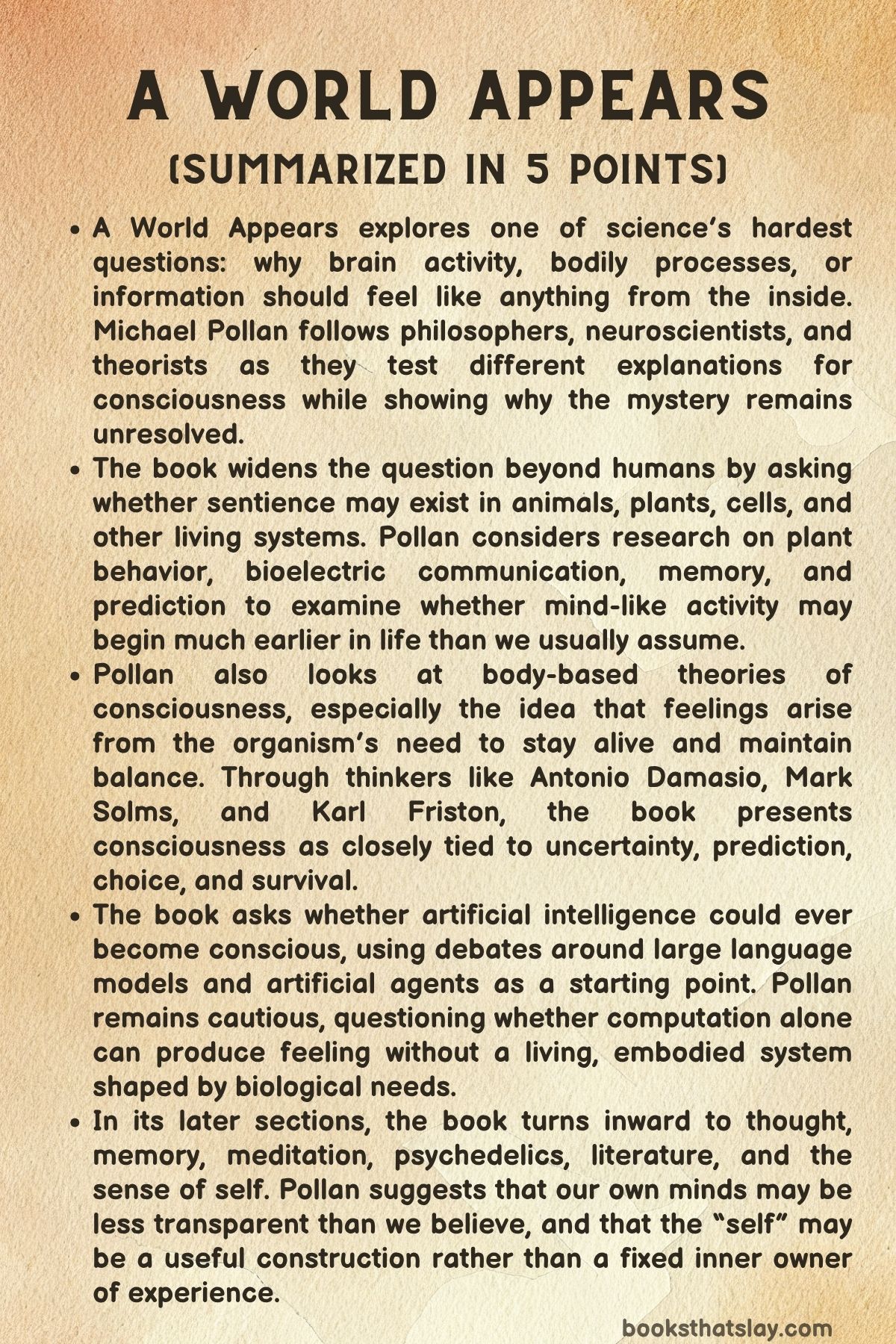
A World Appears: A Journey into Consciousness by Michael Pollan is an inquiry into consciousness: what it is, where it begins, and whether it belongs only to humans. Pollan follows scientists, philosophers, plant researchers, neuroscientists, Buddhist thinkers, and AI theorists as they argue over one of the hardest questions in science: why experience feels like something from the inside.
The book moves from brain research to plant intelligence, from artificial intelligence to meditation, and from bodily feeling to the shifting sense of self. In Pollan’s hands, consciousness becomes less like a single human possession and more like a mystery spread across life itself.
Summary
A World Appears begins with a wager that captures the central tension of the book. In 1998, neuroscientist Christof Koch and philosopher David Chalmers made a bet over whether science would identify the physical basis of consciousness within twenty-five years.
Koch, influenced by Francis Crick, believed that consciousness would eventually be explained through neural correlates: the brain structures or processes that produce subjective experience. Chalmers was less confident.
He had already drawn a famous distinction between the “easy problems” of consciousness, such as perception, memory, learning, and attention, and the “hard problem”: why any physical process should be accompanied by inner experience at all.
Pollan uses this bet to open a larger investigation. He asks why consciousness became such a difficult subject for science in the first place.
Since Galileo, modern science had focused on what could be measured objectively, pushing subjective experience to the margins. Descartes deepened the split by separating mind from matter and reserving true mind mostly for humans.
This division helped science progress, but it also made consciousness seem almost impossible to study. Pollan finds himself pulled in two directions.
He admires science’s power to explain mysteries once seen as magical, yet he also understands Chalmers’s worry that subjective experience cannot be reduced to brain activity alone.
By 2023, Koch conceded the bet and gave Chalmers a case of Madeira. Neuroscience had made enormous progress, but it had not solved the hard problem.
Koch himself had come to see that finding brain activity linked to consciousness does not explain why that activity feels like anything. Pollan then examines major theories of consciousness.
Integrated information theory claims consciousness is tied to a system’s ability to integrate information. Global workspace theory argues that unconscious processes compete for attention, and when information reaches a central workspace and is broadcast through the brain, it becomes conscious.
Both theories are under experimental pressure, but neither has settled the question.
From there, Pollan turns to the borders of consciousness. He explores whether sentience might exist in plants.
After a psychedelic experience in his garden, he felt that plants were awake and aware in a basic way. Later, his doubts returned, but the experience pushed him toward plant science.
Researchers such as Paco Calvo and Stefano Mancuso argue that plants show memory, recognition, signaling, prediction, and choice. Mimosa plants can learn to ignore harmless disturbance.
Pea plants can grow toward soil where nutrients are improving. Roots appear to search for water and minerals.
Vines seem to assess possible supports before growing toward them. These researchers suggest that intelligence may not require a brain.
Plants may rely on distributed systems, root networks, and bioelectric signals.
Pollan carefully separates sentience from full human consciousness. Sentience, in this account, is the ability to sense the environment, respond flexibly, show preferences, and act with some form of agency.
Consciousness, as humans usually understand it, includes richer qualities such as emotion, self-awareness, reasoning, and reflection. If plants are sentient, ethical questions follow.
Do they feel pain? Some scientists think they might experience harm in some form.
Others argue that because plants cannot run from danger, pain as animals know it may not serve the same purpose for them.
The book then moves to Michael Levin, a developmental biologist whose work challenges the idea that cognition belongs only to brains. Levin studies how cells communicate through bioelectric fields and organize themselves into bodies.
His experiments with Xenobots and planaria suggest that memory, decision-making, and goal-directed behavior may exist across living tissues. Planaria can retain learned behavior even after their heads are removed and regrown, implying that memory may be stored beyond the brain.
Levin’s work gives Pollan a broader framework: mind-like behavior may emerge gradually wherever living systems regulate themselves and pursue goals.
Karl Friston’s free-energy principle becomes another major turning point. Friston describes living systems as entities that reduce uncertainty in order to survive.
Organisms sense their surroundings, make predictions, act on those predictions, and adjust when reality pushes back. At its simplest, this process is homeostasis.
At its most complex, it becomes planning, attention, selfhood, and human consciousness. For Friston, consciousness is not supernatural.
It is a refined form of inference, especially useful for social life, imagination, and anticipating possible futures. Pollan leaves Friston’s office mentally tired but intrigued by the thought that confusion itself may be proof of consciousness: a state of felt uncertainty.
Pollan then follows the idea that sentience may begin with life. He meets philosopher Evan Thompson, who argues that Western science made a mistake by separating consciousness from living experience.
Thompson believes consciousness must be studied not only from the outside, through measurement, but also from within, through direct experience. Meditation, Indigenous knowledge, intuition, and psychedelics may all have roles to play.
This conversation strengthens Pollan’s sense that the boundary between human mind and the rest of life may be less firm than he once assumed.
The book next turns to the body. Psychologist Daniel Gilbert warns Pollan to be careful about wanting consciousness to remain magical.
Pollan recognizes that temptation in himself, but he continues asking whether consciousness can be explained as computation alone. Neurologist Antonio Damasio offers a body-based theory.
He argues that feelings are central to consciousness and arise from the organism’s need to maintain internal balance. Hunger, thirst, pain, temperature, itch, and other bodily signals are not secondary details; they may be the foundation of conscious life.
Consciousness begins, in Damasio’s view, with the brainstem registering the body’s condition and turning it into feeling.
Mark Solms builds on Damasio and Friston by defining consciousness as felt uncertainty. He argues that consciousness appears when an organism must make choices under uncertain conditions and use feelings to guide action.
Solms is involved in building an artificial agent with basic needs such as hunger, thirst, and rest. The agent must learn to survive by balancing those needs.
Pollan remains skeptical that a simulation can truly feel anything, but the project forces him to consider what kind of body, if any, artificial consciousness would require.
This leads to artificial intelligence. Pollan recounts Blake Lemoine’s claim that Google’s LaMDA language model was sentient.
LaMDA described sadness, loneliness, fear, and a soul, but many experts believed it was mirroring human language rather than experiencing anything. Pollan sees the case as both misleading and important.
It showed how easily humans attribute mind to language, but it also made artificial consciousness harder to dismiss. He discusses scientific reports suggesting that current AI systems are probably not conscious, though conscious AI may not be impossible.
Pollan questions the assumption that consciousness is just software. Brains are biological, embodied, chemical, and physically changed by experience, while computers are very different systems.
Wanting to examine consciousness from within, Pollan works with psychologist Russell Hurlburt, who studies inner experience through random beeps. Pollan wears a device that interrupts him during the day, then records what was happening in his mind at the moment of each beep.
He discovers that his thoughts are often vague, wordless, and difficult to describe. Hurlburt pushes him to separate actual experience from later interpretation.
Pollan is unsettled by the possibility that he has less clear inner life than he assumes.
Pollan also explores spontaneous thought through the work of Kalina Christoff Hadjiilieva. She studies mind-wandering, daydreaming, and thoughts that seem to arise on their own.
Her brain-imaging research suggests that unconscious processes prepare thoughts before they become conscious. In meditators, activity in the hippocampus can rise seconds before a thought enters awareness.
Pollan connects this to literature, where writers such as Virginia Woolf, James Joyce, Tolstoy, and Lucy Ellmann tried to represent the movement of consciousness long before neuroscience could measure it.
Finally, A World Appears turns to the self. Pollan asks what the “I” really is.
David Hume found no stable self when he looked inward, only perceptions and feelings. Pollan finds something similar in meditation.
Alison Gopnik explains that babies are conscious before they have a developed self, and children gradually build selfhood through memory, recognition, and control. Anil Seth argues that the self is a prediction created by the brain to regulate the body.
Michael Levin adds that memory, which helps create identity, is constantly revised rather than preserved exactly.
The book ends by considering experiences in which the self fades: meditation, psychedelics, awe, music, art, and Buddhist practice. Matthieu Ricard argues that belief in a permanent self causes suffering.
Thomas Metzinger studies pure awareness, consciousness without a strong subject. Koch, changed by his own psychedelic experience, begins to wonder whether consciousness may be more fundamental than physicalism allows.
Pollan ends not with certainty but with a deeper humility. The search for consciousness has not solved the mystery, but it has changed the shape of the question.
Key Figures
Michael Pollan
Michael Pollan is the central guiding presence in A World Appears, not simply as an author reporting on consciousness but as an active inquirer whose doubts, fascinations, hesitations, and experiences shape the movement of the book. He approaches consciousness with a divided temperament: one part of him is drawn toward scientific explanation, while another part resists the idea that subjective experience can be reduced to brain mechanisms, information processing, or physical systems.
This tension makes him an important character because he is not merely explaining ideas; he is testing them against his own intuitions, memories, psychedelic experiences, meditative observations, and encounters with scientists and philosophers. His curiosity is open-ended rather than dogmatic, and he often seems most honest when admitting confusion.
By the end of the book, his journey does not produce certainty, but it deepens his awareness of how difficult consciousness is to understand from either the outside or the inside.
Pollan’s role also depends on his willingness to let different forms of knowledge disturb him. He listens to neuroscientists, philosophers, plant biologists, developmental biologists, psychologists, novelists, and Buddhist thinkers, and each encounter slightly alters his understanding of mind.
He is especially drawn to the idea that consciousness may not be a sudden miracle appearing only in humans but part of a wider continuum that begins with life, sentience, bodily regulation, or even cellular intelligence. At the same time, he remains careful and skeptical, especially when claims about plants, artificial intelligence, or computational consciousness move beyond the evidence.
This combination of openness and caution gives him moral and intellectual credibility. He becomes a character whose main development lies in learning to live with uncertainty rather than trying to defeat it.
Christof Koch
Christof Koch is one of the most important scientific figures in the book because he represents the ambitious neuroscientific attempt to locate consciousness in the brain. Working in the tradition of Francis Crick, Koch begins with confidence that consciousness can be explained through its neural correlates, meaning the specific brain mechanisms that accompany subjective experience.
His bet with David Chalmers captures this confidence: he believes that science will identify the physical basis of consciousness within twenty-five years. Koch’s position is not shallow materialism; it is grounded in serious scientific faith that mysteries become solvable when studied rigorously.
He embodies the hope that consciousness, like life itself, might eventually lose its magical aura once its mechanisms are understood.
Yet Koch becomes more interesting because his confidence changes. When he concedes the bet in 2023, he does not simply lose a wager; he acknowledges that neuroscience has not solved the deeper problem of why brain activity feels like anything.
This makes him a character marked by intellectual humility. His later interest in integrated information theory shows that he still seeks a scientific account, but he is no longer satisfied with merely identifying brain activity correlated with consciousness.
His psychedelic experience with ayahuasca also complicates him, leading him to question strict physicalism and wonder whether consciousness may be more fundamental than he once believed. Koch’s arc is therefore one of transformation: from confident reductionist investigator to a more philosophically unsettled thinker who recognizes that consciousness may resist the explanatory tools he once trusted.
David Chalmers
David Chalmers serves as the book’s great defender of mystery. His distinction between the “easy problems” and the “hard problem” of consciousness gives the entire inquiry its central philosophical tension.
The easy problems involve explaining memory, perception, attention, and learning; the hard problem asks why any physical or mental process is accompanied by inner experience at all. Chalmers is important because he refuses to let scientific progress in brain mapping or cognition be mistaken for a complete explanation of consciousness.
His skepticism is not anti-scientific but philosophical: he insists that explaining function is not the same as explaining feeling.
Chalmers’s character is defined by intellectual persistence. Even after decades of neuroscience, he continues to argue that consciousness remains deeply mysterious, and he is willing to entertain possibilities that many scientists might find strange, including panpsychism, idealism, illusionism, and quantum theories.
His openness to unusual possibilities does not make him careless; rather, it shows his refusal to prematurely close the question. In the book, Chalmers functions as a necessary counterweight to reductionist certainty.
He keeps reminding the reader that even the most sophisticated theory must still answer the question of why experience exists at all.
Francis Crick
Francis Crick appears as an influential background figure whose legacy shapes Christof Koch’s early scientific approach to consciousness. Known for his work on DNA, Crick represents the power of science to explain phenomena once treated as mysterious or almost magical.
In the context of the book, he stands for the belief that consciousness too might be explained if researchers identify the right biological mechanisms. His importance lies less in direct action and more in the intellectual tradition he represents: the conviction that the mind can be studied through the brain.
Crick’s presence also highlights the book’s larger historical argument about science. The same scientific confidence that solved problems in biology encouraged researchers like Koch to believe consciousness would eventually yield to empirical investigation.
Yet the failure to solve the hard problem within the expected time also exposes the limits of this confidence. Crick therefore becomes a symbolic character: he embodies the success of reductionist science, while also casting a shadow over the question of whether consciousness can be understood in the same way as genes, cells, or molecules.
Galileo
Galileo is presented as a historical figure whose influence helped shape the modern scientific worldview. His importance in the book lies in the way science, following his legacy, came to focus on measurable, objective qualities while excluding subjective experience from its proper domain.
This decision allowed science to become powerful, precise, and mathematical, but it also left consciousness outside the frame. Galileo therefore functions as a foundational character in the story of how consciousness became a late and difficult subject for science.
As a figure in the book, Galileo is not criticized simply for narrowing science; rather, he represents a trade-off. By separating objective reality from subjective qualities, modern science gained enormous explanatory strength.
But the cost was that first-person experience became harder to explain scientifically. His role helps clarify why consciousness is not merely another unsolved problem but a problem partly produced by the very methods that made modern science successful.
René Descartes
René Descartes appears as another major historical figure whose mind-body dualism shapes the book’s treatment of consciousness. By separating mind from matter, and by granting true mind mainly to humans, Descartes helped create a worldview in which animals could be treated as machines and nonhuman forms of awareness could be dismissed.
His influence is especially important in the later discussion of plants, animals, and nonhuman sentience, because the book repeatedly challenges the assumption that mind belongs only to human beings.
Descartes functions as both a philosophical ancestor and a problem to be overcome. His division between mind and body made consciousness seem special, private, and separate from the material world.
Yet much of the book moves in the opposite direction, toward theories that root mind in life, embodiment, homeostasis, prediction, or biological organization. Descartes therefore represents an older model of consciousness that still haunts modern thinking even when scientists try to reject it.
Paco Calvo
Paco Calvo is one of the key figures in the book’s exploration of plant sentience. As a plant neurobiologist, he challenges the traditional view that plants are passive, mechanical organisms.
Through examples involving learning, memory, signaling, prediction, and decision-making, Calvo helps open the possibility that plants may possess a form of intelligence or awareness very different from animal consciousness. His work forces the narrator to consider that mind-like behavior may not require a brain.
Calvo’s importance lies in expanding the reader’s imagination. He does not simply claim that plants think like humans; instead, he suggests that plants may have their own distributed, embodied form of responsiveness.
This makes him a character who unsettles human-centered assumptions. In the book’s larger argument, Calvo helps move consciousness away from the brain alone and toward a broader biological field in which roots, vines, signals, and environmental responsiveness may matter.
Stefano Mancuso
Stefano Mancuso is another major advocate for plant intelligence and plays an important role in distinguishing plant awareness from animal-like feeling. He argues that plants display sophisticated forms of behavior through distributed networks rather than centralized brains.
Mancuso’s view expands the idea of cognition by showing that plants can sense, communicate, adapt, and respond to the world in ways that appear intelligent. He helps the book treat plants not as inert background life but as active organisms with preferences and agency.
Mancuso is also significant because he introduces ethical caution without exaggeration. When the question of plant pain arises, he argues that plants are aware of harm but probably do not feel pain in the way animals do, since pain evolved in relation to movement away from danger.
This makes his position nuanced. He grants plants more agency than conventional science often does, but he does not simply project animal consciousness onto them.
His character helps the book develop a more careful vocabulary for sentience, awareness, and suffering.
František Baluška
František Baluška appears in the book as a scientist willing to consider the possibility that plants may feel pain or possess more complex forms of sentience than commonly assumed. His role is important because he pushes the ethical implications of plant intelligence further than some of the other researchers.
If plants are not merely responsive but in some sense capable of distress or pain, then human assumptions about moral concern become much more complicated.
Baluška’s presence sharpens the book’s distinction between awareness and suffering. He represents a more provocative edge of plant neurobiology, where claims about plant experience challenge ordinary boundaries between human, animal, and plant life.
Even if the narrator does not fully accept the strongest version of this view, Baluška helps make the question unavoidable. His character forces the reader to ask what kind of inner life, if any, belongs to organisms without brains.
Michael Levin
Michael Levin is one of the most intellectually radical and fascinating scientific characters in the book. As a developmental biologist, he studies bioelectric fields, cellular communication, regeneration, and collective intelligence.
His work suggests that cognition and goal-directed behavior exist far below the level of brains. Through examples such as Xenobots and planaria retaining memories after regrowing their heads, Levin challenges the assumption that mind must be located in neurons alone.
He presents life itself as organized by problem-solving systems that communicate, remember, and pursue goals.
Levin’s character matters because he extends the book’s inquiry from plants to cells and bodies. He sees intelligence as something that emerges gradually from living systems trying to maintain themselves, repair themselves, and coordinate their parts.
His ideas also reshape the discussion of selfhood and memory. The example of caterpillars becoming butterflies while retaining altered associations suggests that identity is not a fixed archive but a process of improvisation.
Levin’s view makes the self seem less like a permanent owner of memories and more like a living system continually rewriting meaning.
Karl Friston
Karl Friston is presented as one of the most difficult but influential thinkers in the book. His free-energy principle offers a sweeping account of life, cognition, and consciousness as processes of reducing uncertainty and maintaining order.
For Friston, organisms survive by sensing the world, making predictions, acting to avoid surprise, and adjusting themselves to preserve homeostasis. His ideas connect simple biological systems to complex human minds, suggesting that consciousness may be an advanced form of inference rather than a mysterious substance added to matter.
Friston’s character is intellectually demanding. The narrator leaves his office mentally exhausted, which reflects the density and ambition of Friston’s theory.
Friston does not make consciousness grand or magical; he makes it continuous with life’s basic need to predict and survive. Yet his ideas do not fully dissolve the hard problem for the narrator.
Instead, they shift the question. If consciousness is connected to “felt uncertainty,” then confusion itself becomes evidence of being conscious.
Friston’s role in A World Appears is to offer one of the book’s most powerful bridges between biological life and subjective experience, even while leaving some mystery intact.
Evan Thompson
Evan Thompson is an important philosophical figure because he challenges the separation between consciousness and life. He argues that Western science has wrongly excluded lived experience and has treated consciousness too narrowly as an object to be explained only from the outside.
Thompson’s approach includes meditation, intuition, Indigenous knowledge, and possibly psychedelics as legitimate ways of investigating mind. This makes him a key figure in the book’s effort to widen the methods by which consciousness can be studied.
Thompson also strengthens the narrator’s growing sense that sentience may be woven into life from the beginning. His ideas connect plant intelligence, Buddhism, phenomenology, and biology into a broader view of mind as something inseparable from living experience.
He does not reject science but argues that science must be expanded by first-person inquiry. His character helps the book move beyond the opposition between objective science and private feeling, suggesting that consciousness may require both forms of knowledge.
Daniel Gilbert
Daniel Gilbert plays the role of a skeptical psychological voice who warns against the desire to preserve consciousness as magical. His question about why information processing should feel like anything at all restates the hard problem in direct and accessible terms.
He is important because he recognizes the mystery of consciousness while also warning the narrator not to romanticize that mystery. His phrase about being wary of the desire for magic becomes a challenge to the narrator’s own instincts.
Gilbert’s character introduces a disciplined skepticism into the book. He does not deny that consciousness is difficult to explain, but he cautions against the human tendency to protect mystery because mystery can feel meaningful.
This makes him a counterweight to the narrator’s attraction to plants, psychedelics, and non-reductionist theories. Gilbert helps keep the inquiry honest by asking whether the search for consciousness sometimes reflects not only intellectual curiosity but also a longing for enchantment.
Antonio Damasio
Antonio Damasio is a major figure in the book’s turn toward embodiment. He argues that feelings are central to consciousness and that they arise from the body’s need to maintain homeostasis.
By focusing on hunger, thirst, pain, itch, heat, cold, and other bodily signals, Damasio shifts attention away from vision, abstract cognition, and high-level perception. In his view, consciousness begins in the body’s needs and in the brainstem’s registration of those needs as feelings.
Damasio’s character is persuasive because he grounds consciousness in biological urgency. Rather than treating the mind as detached thought, he presents feeling as the organism’s way of monitoring its own condition and guiding action.
This gives consciousness a survival function. Yet the narrator also notices that Damasio’s account does not completely explain how bodily signals become felt experience.
Damasio therefore provides one of the book’s strongest embodied theories while still leaving the deepest mystery unresolved.
Mark Solms
Mark Solms is one of the book’s most ambitious figures because he attempts to combine Damasio’s body-based theory with Friston’s free-energy principle. His definition of consciousness as “felt uncertainty” gives the book one of its most memorable formulations.
Solms argues that consciousness arises when organisms face uncertain choices and must use feelings to guide action. This makes consciousness not a luxury but a practical tool for survival.
Solms becomes especially compelling through his attempt to build an artificial agent with competing homeostatic needs such as hunger, thirst, and rest. He believes that if such a system can feel how well or badly it is doing, it may develop consciousness.
The narrator remains skeptical, especially because simulated feelings may not be real feelings, but Solms’s project forces an important question: could consciousness be built if the right kind of embodied need and uncertainty were created? Solms is therefore both a theorist and an experimenter, pushing the book’s inquiry toward the boundary between biological and artificial minds.
Blake Lemoine
Blake Lemoine appears as a controversial and revealing character in the discussion of artificial intelligence. His claim that Google’s LaMDA language model was sentient brings the question of machine consciousness into public view.
Lemoine’s conversations with LaMDA, in which the model described sadness, loneliness, fear, and a soul, show how easily language can create the impression of inner life. His belief in LaMDA’s sentience may have been mistaken, but it was not meaningless; it exposed how emotionally powerful artificial language can become.
Lemoine’s character is important because he embodies both credulity and moral concern. The narrator suspects that LaMDA may have mirrored Lemoine’s own language and beliefs, yet the episode still forces scientists to take artificial consciousness more seriously.
Lemoine becomes a figure through whom the book examines projection, empathy, and the uncertainty of recognizing minds unlike our own. His role is not simply to be wrong or right, but to show how difficult it becomes to judge consciousness when a system speaks as if it has feelings.
Russell Hurlburt
Russell Hurlburt is one of the most important figures in the book’s investigation of inner experience. His method of using random beeps to sample consciousness forces the narrator to examine what is actually present in his mind at particular moments.
Hurlburt’s approach is careful, demanding, and skeptical of easy assumptions. He presses the narrator to distinguish direct experience from interpretation, memory, and surrounding context.
Hurlburt’s character changes the narrator’s relationship to his own mind. Through their sessions, the narrator discovers that his thoughts are often not clear verbal sentences or vivid images but vague, preverbal impressions.
Hurlburt even suggests that the narrator may have less inner experience than he assumes, a conclusion the narrator resists but cannot easily dismiss. In the book, Hurlburt functions as a disciplined guide into first-person observation, showing that consciousness is not automatically transparent to the person having it.
Kalina Christoff Hadjiilieva
Kalina Christoff Hadjiilieva is a significant figure because she studies spontaneous thought, including mind-wandering, daydreaming, creative thinking, and thoughts that seem to arise from nowhere. Her work focuses not only on conscious perception but also on the unconscious processes that prepare thoughts before they enter awareness.
Her personal history in Bulgaria after the fall of the Berlin Wall gives emotional depth to her scientific interests, because experiences of upheaval and loss helped her understand how suppressed mental material can gain hidden power.
Christoff Hadjiilieva’s research makes her one of the book’s strongest bridges between neuroscience and lived mental life. Her use of neurophenomenology combines self-report with brain imaging, allowing her to study how free mind-wandering differs from rumination.
Her experiment with meditators, in which hippocampal activity rose before thoughts became conscious, suggests that consciousness receives thoughts only after unconscious processes have already begun shaping them. She restores the unconscious to scientific seriousness and shows that the mind’s visible surface may be only the final stage of a deeper process.
Virginia Woolf
Virginia Woolf appears as one of the literary figures who understood consciousness before neuroscience had the tools to study it. Her importance lies in the way her writing captures the flow of inner life, with perceptions, memories, sensations, and emotions moving together rather than appearing as orderly statements.
In the book’s discussion of literature, Woolf represents the novelist’s ability to portray consciousness from within.
Woolf’s role also helps challenge the idea that science alone can describe the mind. Literature, in her example, becomes a method for investigating experience.
By rendering thought as fluid, layered, and unstable, Woolf shows that consciousness is not merely a sequence of clear ideas. Her presence in the book reminds the reader that artists have long explored the stream of consciousness with a precision that scientific language often struggles to match.
James Joyce
James Joyce is another crucial literary figure in the book’s treatment of inner life. Through his portrayal of Leopold Bloom’s thoughts, Joyce shows consciousness as a continuous movement of perception, memory, association, bodily sensation, and shifting attention.
His writing captures the mind not as a tidy narrator but as a living stream. This makes him important to the book’s argument that literature has often reached truths about consciousness before experimental science.
Joyce’s character is less a participant in the book’s events than a model of artistic investigation. His work demonstrates how thought moves through fragments, distractions, repetitions, and sudden associations.
In this sense, Joyce helps the book explain why inner experience is difficult to study: it does not always appear in clear language or organized form. His literary method gives shape to the very disorder that consciousness researchers attempt to measure.
Leopold Bloom
Leopold Bloom appears as a fictional example rather than a scientific thinker, but he is still an important character within the book’s exploration of consciousness. His thoughts during a funeral reveal how the mind moves between present perception, memory, association, and bodily awareness.
Bloom’s consciousness is ordinary yet profound because it shows how inner life is never limited to the immediate event in front of us. A single moment can contain grief, observation, distraction, memory, and private reflection.
Bloom’s role is to make consciousness concrete. Instead of discussing the mind only through theories, the book uses him to show what mental life feels like from the inside.
He demonstrates that consciousness is layered, associative, and often only partly controlled. Through Bloom, the book suggests that fiction can reveal the texture of thought in ways that scientific diagrams or theories cannot fully capture.
Leo Tolstoy
Leo Tolstoy appears as another writer who grasped the inner movement of consciousness with extraordinary force. His use of stream-of-consciousness narration, especially in portraying Anna Karenina’s final mental collapse, shows how thought can become fragmented, intense, and self-destructive.
Tolstoy’s importance lies in his ability to depict not only ordinary inner life but also consciousness under emotional pressure.
Tolstoy’s role also shows that uncontrolled thought has not always been seen as liberating or truthful. In earlier literary traditions, mental flow could appear dangerous, unstable, or close to madness.
Through Tolstoy, the book connects consciousness with suffering, emotional crisis, and the breakdown of self-control. He helps show that the stream of consciousness is not simply creative or beautiful; it can also become overwhelming.
Anna Karenina
Anna Karenina appears as a fictional character whose final thoughts illustrate the terrifying intensity of consciousness in crisis. Her mind becomes a place of collapse, where perception, memory, emotion, and despair rush together.
In the book, she functions as an example of how literature can portray mental experience at the edge of endurance. Her consciousness is not calm reflection but a storm of association and suffering.
Anna’s role deepens the book’s treatment of the stream of consciousness by showing its darker possibilities. If Leopold Bloom represents the ordinary richness of inner life, Anna represents the mind when it can no longer stabilize itself.
Through her, the book shows that consciousness is not merely awareness; it is also vulnerability. The same inner life that makes meaning possible can become painful, chaotic, and destructive.
Lucy Ellmann
Lucy Ellmann is an important contemporary literary figure in the book because she approaches consciousness through fiction rather than neuroscience. Her novel Ducks, Newburyport, built as one long sentence tracing the thoughts of a middle-aged Ohio mother, becomes a major example of how literature can represent the density and simultaneity of inner experience.
Ellmann explains that she studied her own consciousness, not scientific theories, and this gives her work an intimate authority.
Ellmann’s character is especially valuable because she emphasizes the limits of language. She argues that real consciousness contains simultaneous sensations, memories, habits, associations, and feelings that words can only approximate.
Her view supports one of the book’s central insights: inner life is richer and stranger than the forms we use to describe it. Ellmann treats internal monologue as proof of life, suggesting that the movement of thought itself marks the presence of consciousness.
The Middle-Aged Ohio Mother
The middle-aged Ohio mother in Ducks, Newburyport appears as a fictional mind whose thoughts circle through family, money, politics, food, trauma, fear, and ordinary domestic life. She is important because her consciousness is not presented as a neat sequence of reflections but as a sprawling, repetitive, anxious, and deeply human flow.
Her mind contains both conscious concerns and half-conscious associations, making her an example of how much mental life occurs outside deliberate control.
In the book, this character helps demonstrate that consciousness is not limited to dramatic philosophical questions. It is also present in ordinary worry, habit, memory, and daily perception.
Her mental life shows how private experience is shaped by culture, politics, family, bodily needs, and personal history. She makes consciousness feel domestic and everyday while also revealing its immense complexity.
David Hume
David Hume is a key philosophical figure in the book’s discussion of the self. When he looks inward, he finds only perceptions, feelings, and thoughts, never a stable “I.” His view challenges the common assumption that there is a permanent self standing behind experience.
Hume’s importance lies in making the self seem less like a solid entity and more like a bundle or stream of mental events.
Hume’s character helps the narrator test his own self-understanding through meditation. Like Hume, the narrator finds no fixed self when he looks closely, only changing experiences.
Yet the feeling of continuity remains powerful, especially through memory. Hume therefore introduces one of the book’s most unsettling ideas: the self may be something we construct rather than something we discover.
Alison Gopnik
Alison Gopnik is central to the book’s account of how the self develops in children. She explains that babies can be conscious before they possess a stable self.
Over time, children develop self-recognition, episodic memory, narrative continuity, and executive control. Her account shows that the self is not present fully formed from the beginning but gradually emerges through development.
Gopnik’s contrast between children’s “lantern consciousness” and adults’ “spotlight consciousness” is especially important. Children experience the world with broad openness, while adults focus attention in narrower, goal-directed ways.
Her ideas help the book connect childhood, psychedelics, learning, and selfhood. She suggests that adult consciousness, with all its planning and control, may come at the cost of losing some of the openness that defines early life.
Anil Seth
Anil Seth is one of the book’s major theorists of the self. He argues that the brain is constantly predicting the world and correcting those predictions through sensory input.
The self, in his view, is also a prediction: the brain’s model of the body, emotions, and inner signals. This makes the self not the hidden owner of experience but another perception generated by the brain to regulate the organism.
Seth’s character is important because he makes the self feel both constructed and biologically necessary. His theory suggests that the experience of being “me” is a controlled hallucination rooted in the body’s need to stay alive.
The narrator finds this powerful but incomplete, because it still leaves open the question of who or what experiences the hallucinated world and self. Seth therefore offers one of the book’s most compelling naturalistic accounts while also revealing the persistence of the hard problem.
Matthieu Ricard
Matthieu Ricard appears as a Buddhist thinker whose role is to challenge the belief in a permanent self. He argues that attachment to a fixed self creates suffering because people spend their lives protecting, defending, and satisfying something that is ultimately unstable.
His perspective gives the book a spiritual and ethical dimension, moving the discussion of selfhood beyond neuroscience and philosophy.
Ricard’s character helps explain why dissolving the self may be experienced not as loss but as liberation. In his view, the self is not only an intellectual illusion but also a source of craving and pain.
His presence connects meditation, Buddhist practice, and the possibility of consciousness without ordinary ego. He helps the book ask not only what the self is, but whether clinging to it makes human beings suffer.
Thomas Metzinger
Thomas Metzinger is important because he studies forms of consciousness that may occur without a conventional self or subject. His interest in “pure awareness” fits into the book’s exploration of meditation, psychedelics, awe, and ego dissolution.
Metzinger’s work suggests that consciousness may not always require the ordinary feeling of being a personal “I” who owns experience.
Metzinger’s character helps separate consciousness from selfhood. This distinction is crucial because much of ordinary life makes the two seem inseparable: to be conscious appears to mean to be someone.
Metzinger challenges that assumption by examining states in which awareness remains but the sense of self weakens or disappears. His role in A World Appears deepens the idea that the self may be only one possible structure within consciousness, not its foundation.
Themes
The Mystery and Limits of Scientific Explanation
A World Appears presents consciousness as a subject that both attracts and frustrates scientific explanation. The bet between Christof Koch and David Chalmers becomes a symbol of this tension: Koch represents the hope that science can locate consciousness in brain mechanisms, while Chalmers represents the doubt that physical explanation can ever fully explain why experience feels like something.
The discussion of neural correlates, integrated information theory, and global workspace theory shows that science has made real progress in mapping brain activity, attention, and information processing. Yet the central puzzle remains unresolved.
The text does not reject science; instead, it shows science reaching the edge of its own methods. Since modern science has long favored what can be measured from the outside, subjective experience resists easy study.
Consciousness is not just another object in the world; it is the condition through which the world is known. This makes the theme especially powerful because the more researchers try to explain consciousness, the more they expose the limits of purely objective knowledge.
Sentience Beyond the Human Mind
The discussion of plants, cells, and simple organisms challenges the assumption that mind belongs only to humans or animals with brains. Plant scientists argue that plants can learn, remember, signal, respond to danger, recognize kin, and make choices based on changing conditions.
These examples do not prove that plants possess human-like consciousness, but they push the reader to reconsider where sentience begins. The distinction between sentience and full consciousness is central here.
Sentience appears as a basic capacity to sense, respond, prefer, and act in ways that help life continue. Michael Levin’s work deepens this idea by showing that cells and bioelectric networks can behave in goal-directed ways without a brain.
Planaria, Xenobots, and cellular communication suggest that cognition may exist in degrees rather than as an all-or-nothing trait. This theme expands the moral and philosophical range of the text.
If awareness, agency, or primitive mind-like activity exists far below human consciousness, then the living world becomes less mechanical and more responsive than Western science has often allowed.
The Body as the Ground of Consciousness
The text repeatedly questions whether consciousness can be understood as information processing alone. Antonio Damasio and Mark Solms shift attention away from abstract thought and toward the body’s needs: hunger, thirst, pain, temperature, rest, and survival.
Consciousness is presented not as a detached mental screen but as something rooted in homeostasis, the organism’s effort to stay alive. Feelings matter because they tell the organism how it is doing.
This bodily emphasis challenges computational views of mind, especially the idea that consciousness could be copied onto any suitable machine. Brains are not only processors; they are living organs shaped by chemistry, emotion, sensation, and bodily regulation.
The debate over artificial consciousness makes this theme sharper. A language model may describe sadness or fear, but the text asks whether such statements mean anything without a body that can suffer, need, heal, or die.
In this view, consciousness is not simply knowing information. It is felt life, tied to vulnerability, survival, and the body’s constant negotiation with the world.
The Unstable Nature of Self and Inner Experience
A World Appears treats the self not as a fixed inner owner of experience but as something constructed, revised, and sometimes dissolved. Meditation, philosophy, childhood development, memory, neuroscience, and psychedelics all point toward the same unsettling possibility: the “I” may be less solid than it feels.
Hume’s search for the self finds only passing perceptions, while Anil Seth describes the self as a prediction created by the brain to regulate the body. Alison Gopnik’s account of children shows that consciousness exists before a stable self, suggesting that selfhood develops gradually through memory, recognition, and control.
Russell Hurlburt’s beeper experiment further weakens certainty by showing that inner experience is often vaguer than people assume. Thoughts may not always appear as clear words or images; they may be partial, shifting, or barely formed.
The theme becomes most vivid in moments of self-loss through meditation, art, awe, or psychedelics. These experiences do not simply erase identity; they reveal that the self may be useful, but not ultimate.