The Rain God Summary, Characters and Themes
The Rain God by Arturo Islas is a family-centered novel about memory, exile, illness, silence, sexuality, grief, and inherited shame. Islas presents the Angel family through Miguel Chico, a man living far from the desert border world that shaped him.
As he looks back after a life-threatening operation, the family’s hidden wounds begin to surface: forbidden love, religious fear, racial prejudice, violent loss, mental collapse, and the burden of loyalty. The book is not only about one family’s past, but also about how stories are edited, protected, distorted, and finally faced. It’s the 1st book of the Angel Family series.
Summary
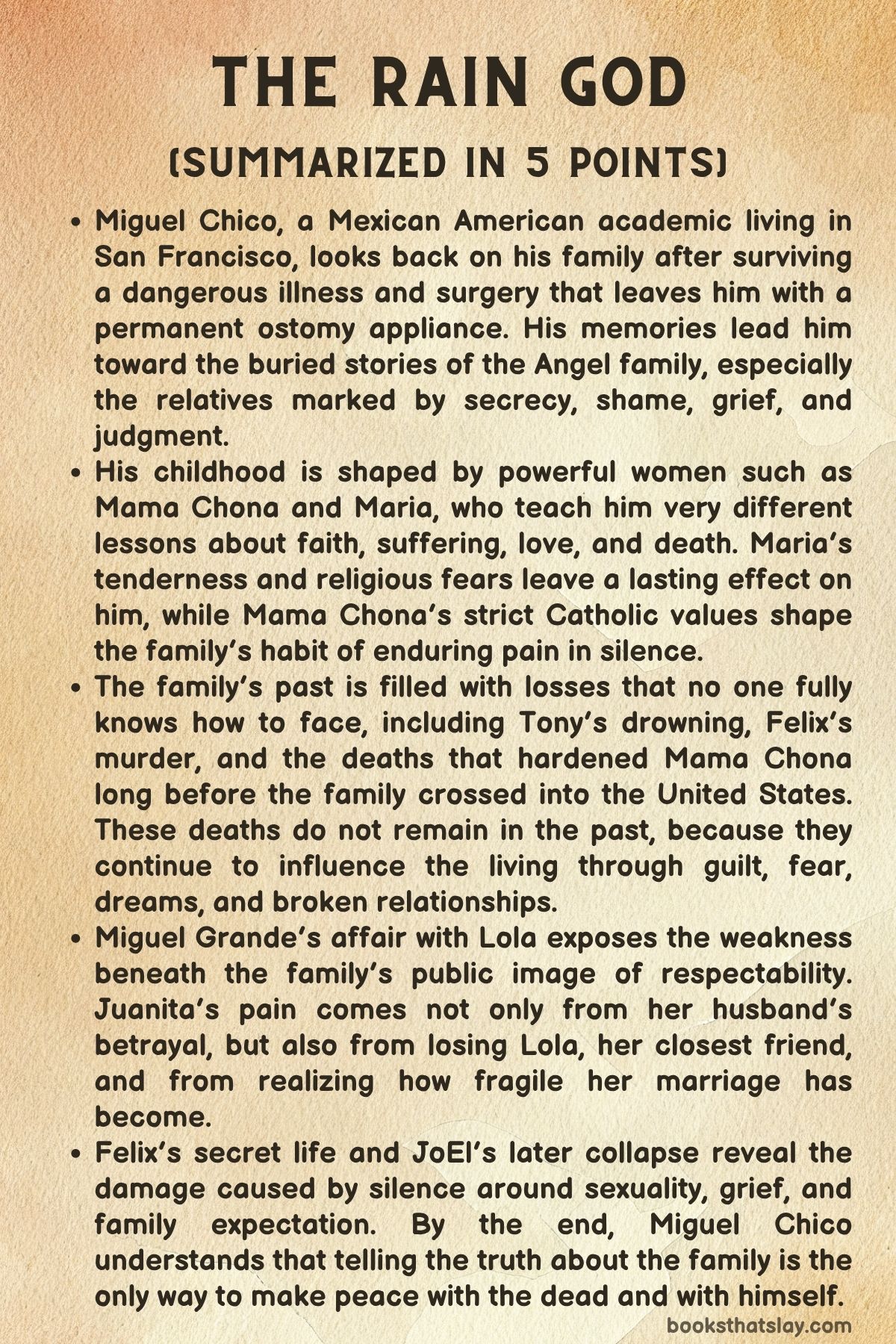
The Rain God follows Miguel Chico, a second-generation Mexican American man living in San Francisco, as he remembers the Angel family and the desert border world he left behind. His reflections begin in the shadow of illness.
After medication for a bladder infection worsens a dormant intestinal condition, he is taken into surgery near death. Doctors tell him he will need to live with a permanent ostomy appliance.
At first, he wants to ask them to let him die, but he survives. His recovery forces him to confront the body, shame, loneliness, and the family history that has always shaped him.
Miguel Chico has long been an outsider within his own family. His relatives call him Mickie to separate him from his father, Miguel Grande.
He is the first of his generation to attend a prestigious university and earn a doctorate, but his education does not fully protect him from family judgment. Because he remains unmarried, lives far from home, and rarely visits, some relatives quietly suspect he belongs among the family’s “sinners.” These sinners include relatives who violated family expectations through sexuality, rebellion, scandal, or social shame.
Miguel Chico’s illness makes him think about them differently. He begins to see that their stories are not isolated failures, but pieces of a larger family pattern built on silence, pride, religion, and fear.
One of the earliest influences on Miguel Chico is Mama Chona, his paternal grandmother. She is stern, proud, and deeply Catholic, a woman who insists on being called by a dignified title rather than a softer grandmotherly name.
She teaches the family to endure suffering and to treat pain as a spiritual discipline. Miguel Chico remembers a childhood photograph in which he walks hand in hand with her.
The image stays with him as both comfort and burden. Mama Chona represents family order, but also the emotional discipline that teaches children to hide fear and desire.
Miguel Chico’s childhood is also marked by death. As a small boy, he visits the cemetery with his family for years before truly understanding what it means.
The dead first seem abstract to him, until his young friend Leonardo hangs himself. At the mortuary, Miguel Chico touches Leonardo’s cold face and begins to understand that death is physical and final.
His nursemaid Maria tells him he will see Leonardo again on Judgment Day. This answer does not calm him.
Instead, it teaches him to fear the future, the next day, and the unknown.
Maria becomes one of the most important figures in Miguel Chico’s early life. She is an undocumented Mexican domestic worker who cares for him, takes him to Mass, and buys him paper dolls.
She gives him affection that his father does not understand. Miguel Grande fears that Maria is making his son feminine, especially after he finds Miguel Chico dancing in a skirt she made for him.
His father’s anger introduces Miguel Chico to shame around gender and sexuality before he can fully understand either one. Maria later converts to Seventh-day Adventism and secretly takes Miguel Chico to services.
Her religious warnings, especially about the end of the world, terrify him. When she tells him that his mother will one day die, the idea fuses love with death in his imagination.
Eventually he betrays Maria by telling his parents about the Adventist services. She is allowed to stay only if she stops discussing religion, but their bond changes forever.
When she finally leaves, Miguel Chico refuses to say goodbye, though he suffers from her absence.
Years later, after his operation, Miguel Chico learns that Maria has visited his family again. She remembers his childhood with tenderness, including the white dress she once made for him.
She sends him a birthday letter wishing him a long life and a future meeting in paradise. Miguel Chico intends to reply, but delays.
Soon afterward, his mother tells him Maria has been killed by a drunk driver. His cynical response wounds Juanita, who calls him heartless.
Maria’s death leaves Miguel Chico with regret. Alone in San Francisco, changing his ostomy bag and thinking of the physical barriers between himself and others, he begins to understand that survival has not given him wisdom, but it has given him a reason to tell the stories of the women who shaped him.
The book then turns toward Nina, Miguel Chico’s aunt and godmother. Nina is practical, forceful, and known for her fiercely spicy green chile sauce.
Beneath her toughness lies a lifelong terror of burial and a fear that she might remain conscious after death. Spiritualism gives her comfort, especially after she has a vision of her dead mother and sister appearing together.
Nina’s inner life is shaped by a cruel father who blamed her for her mother’s death in childbirth. He beat Nina and Juanita when drunk, and his final command to his daughters was to behave.
Nina carries his discipline into her own parenting.
This becomes tragic in her relationship with her son Tony. Tony resents moving to a new house on the edge of the desert and argues with Nina about school, friends, college, and the possibility of being drafted for Vietnam.
Nina insists the move will help pay for his education. Tony refuses to study, and Nina responds with control, even locking him in his room.
On Easter Sunday, after she allows him to use his car, Tony drowns in a smelter lake while fully clothed. The circumstances remain disturbing and unexplained.
Nina’s last words to him echo her father’s last words to her: behave yourself. When she learns of Tony’s death, she howls that her dead father is still punishing her.
Ernesto, Tony’s father, first cannot cry. Standing outside in the desert, he feels its emptiness as if for the first time.
Only when he sees the chiles roasting in the kitchen does grief break through, and he opens every window in the house.
Another major fracture in the family comes through Miguel Grande’s affair with Lola, Juanita’s best friend. On Miguel Grande and Juanita’s twenty-fifth wedding anniversary, Juanita stages a renewal of vows and a party that presents their marriage as successful.
Yet Miguel Grande is already involved with Lola. Miguel Chico notices the way Lola addresses his father and understands the intimacy between them.
Nina notices too and tries to interrupt the moment.
The affair begins after the death of El Compa, Lola’s husband and a close friend of Miguel Grande. Lola and El Compa had shared a long history, and after his death she becomes isolated, angry, and vulnerable.
Miguel Grande starts helping her with household repairs, and desire turns into betrayal. Juanita’s friends warn her, but she trusts both her husband and Lola.
When Miguel Grande eventually confesses to Miguel Chico during a visit to San Francisco, he cries and asks whether he should leave Juanita. Miguel Chico refuses to guide him.
His detachment is shaped by old resentment: as a child, when he showed symptoms of polio, Miguel Grande accused him of pretending, and Miguel Chico was left with a permanent limp.
Juanita eventually learns the truth. At first, she pities Miguel Grande and mourns the loss of Lola’s friendship.
For a time, the marriage settles into a humiliating pattern in which Miguel Grande visits Lola every Friday. Juanita finally confronts Lola and tells her she can have him if she wants.
Lola moves to Los Angeles. Miguel Grande visits her twice, but the affair loses its force.
Lola eventually tells him to give his love to Juanita. Years later, Juanita still misses the friendship she lost more than the marriage fantasy that was broken.
Felix, Miguel Grande’s brother, becomes another central figure in the family’s hidden history. Felix is a married father of four who desires men.
He works as a factory foreman and helps Mexican laborers gain citizenship, but he also uses required physical examinations as a way to initiate sexual encounters with young men. His sexuality is known and joked about privately, but it remains socially dangerous.
Felix loves his children, especially his youngest son, JoEl. Their bond is unusually close when JoEl is young, but as JoEl grows older and becomes quieter, more bookish, and more distant, Felix feels abandoned.
On the day of his death, Felix argues with JoEl about money for a school trip. Later, he meets a young soldier in a bar and offers him a ride.
He suggests they stop in a desert canyon to watch the sunset, but the soldier resists. Felix ignores his discomfort and touches him.
The soldier reacts violently, beating and kicking Felix until he dies. The authorities consider the killing self-defense and warn that a prosecution would expose humiliating details about Felix’s encounters with men.
His daughter Lena demands the truth, but the family must face a death that is both violent and socially unspeakable.
Felix’s death devastates JoEl. In the years that follow, JoEl becomes haunted, unstable, and increasingly separated from ordinary life.
He visits the ruined desert home of Tia Cuca, Mama Chona’s sister, after drinking heavily. The shack is decayed, filled with sand, dead animals, and ants.
Later, high on drugs, he arrives at Eduviges’s house in the middle of the night. He remembers the night Felix died: the sandstorm, the certainty that his father would not return, the vision of Felix on the empty bed, and the knowledge that death was coming before the family was told.
JoEl later locks himself in a bathroom during a psychological crisis, crying that the ants are coming and that he wants to see his father. He begins speaking in riddles.
When Miguel Chico visits him in a halfway house, JoEl says Miguel Chico hates the family even though they love him, while he loves the family and feels hated by them.
Tia Cuca’s story adds another layer to the family’s contradictions. Like Mama Chona, she claims an aristocratic Spanish identity while denying Indigenous ancestry.
She lives with Davis in a relationship the family never fully defines, though everyone knows they are lovers. JoEl dislikes visiting her as a child, but later respects her refusal to care about family judgment.
When she and Davis grow old and ill, Mema and Juanita find them living in filth. Davis still tries to feed them both.
He refuses to accompany Tia Cuca to the hospital because he cannot bear to watch her die. Both die soon afterward, separated and unaware of each other’s fate.
The final movement returns to Mama Chona and the deeper history that shaped her. Miguel Chico learns that the first Miguel Angel, Mama Chona’s beloved firstborn, was killed by a stray bullet during the Mexican Revolution.
Before that, she had lost twin daughters to drowning. After losing her first three children, she renounced joy and devoted herself to suffering, religion, and duty.
Her husband Carlos died as the family fled north. These losses explain, though they do not excuse, her sternness and emotional severity.
Mema, the family outcast, also carries shame and resistance. Her son Ricardo was born outside marriage, and the family forced her to give him up.
Years later she found him begging in Juarez. Felix persuaded Mama Chona to adopt him legally, making Ricardo the adopted son of his own grandmother.
Mama Chona showed him unexpected tenderness, teaching him English and offering him a home. Mema later returns to care for Mama Chona as the old woman declines into senility.
At Mama Chona’s deathbed, the family gathers around her. She thinks of her disappointments, her dead, and the suffering she has endured.
She tells them not to weep because she is ready to leave life behind. Miguel Chico feels a strange presence in the room, and Mama Chona sees Felix standing near JoEl and Miguel Chico.
In this final vision, the dead return not as explanations, but as unresolved family truth. Later, after visiting JoEl, Miguel Chico dreams of a monster on a foggy bridge.
Instead of obeying its command to jump, he embraces it and falls with it, feeling release. He wakes ready to write the family’s stories.
By telling what was hidden, he begins to make peace with the dead and with himself.
Characters
Miguel Chico
Miguel Chico is the observing mind of the book, a man who has physically survived illness but remains emotionally caught between distance and attachment. He lives in San Francisco, far from the desert family world that shaped him, and this distance gives him the role of witness, critic, and reluctant inheritor.
His education marks him as exceptional within the family, but it also makes him suspect. He is seen as someone who has left, who has not married, and who may belong among the relatives judged as sinners.
His near-fatal illness deepens his sense of separation from ordinary life. Living with an ostomy appliance, he becomes painfully aware of the body as something vulnerable, humiliating, and isolating.
Yet the same condition also forces him to look backward. In The Rain God, Miguel Chico’s growth is not a simple movement toward healing; it is a movement toward honest memory.
He learns that family stories have been softened, edited, or suppressed, and he begins to accept the task of telling them without pretending they are cleaner than they are. His deepest conflict lies in wanting to understand the family without being swallowed by it.
Mama Chona
Mama Chona is one of the most powerful and difficult figures in the novel. She represents authority, religion, family pride, and the demand for suffering.
Her insistence on dignity, language, proper behavior, and Catholic endurance makes her a central force in shaping the Angel family’s values. Yet beneath her strictness is a history of unbearable loss.
The deaths of her firstborn son and twin daughters transform her into a woman who rejects joy and organizes life around pain, duty, and spiritual discipline. She teaches the family to endure, but she also teaches them to conceal.
Her piety can look like strength, but it often becomes a way of controlling emotion and judging others. Even so, she is not one-dimensional.
Her decision to adopt Ricardo shows tenderness and moral independence, especially when other family members react with pride and cruelty. In The Rain God, Mama Chona stands as both wound and monument: she preserves the family, but she also passes on fear, shame, and silence.
Maria
Maria is a nurturing yet unsettling presence in Miguel Chico’s childhood. As an undocumented domestic worker, she occupies a vulnerable social position, but within the household she becomes one of the people who most deeply shapes Miguel Chico’s emotional life.
She gives him affection, ritual, imagination, and attention, especially when his father responds to him with suspicion or anger. Her willingness to make him paper dolls and a white dress allows him a private world beyond the rigid masculinity demanded by Miguel Grande.
At the same time, Maria’s religious fears leave a lasting mark on him. Her conversion to Adventism introduces him to visions of the end of the world, Judgment Day, and the terror of divine punishment.
Her warning that his mother will one day die connects love with loss in his mind. Miguel Chico’s betrayal of Maria reveals a child’s fear more than malice, but it damages their bond.
Her later letter, followed by her sudden death, leaves him with regret. Maria becomes a symbol of love that was real, imperfect, and recognized too late.
Juanita
Juanita is a figure of endurance, intelligence, and wounded loyalty. As Miguel Chico’s mother, she is protective but not sentimental.
She manages the household, guides others, and often sees more than people realize. Her relationship with Maria shows both kindness and practical awareness, as she helps Maria prepare for possible encounters with immigration officials.
Her marriage to Miguel Grande reveals the painful demands placed on women who are expected to preserve family stability at personal cost. When Miguel Grande has an affair with Lola, Juanita suffers not only as a betrayed wife but also as a betrayed friend.
The loss of Lola’s friendship hurts her deeply because it destroys a part of her social and emotional world. Juanita’s strength lies in her ability to confront humiliation without collapsing into public spectacle.
Her visit to Lola’s house is a turning point because she refuses to keep pretending. She is not free from the family’s codes, but she often shows more clarity and compassion than those around her.
Miguel Grande
Miguel Grande is a father, husband, police captain, and deeply flawed patriarchal figure. He is respected in the public world, but at home he often causes harm through pride, anger, and emotional blindness.
His treatment of Miguel Chico as a child reveals his fear of softness and difference. When he scolds Maria for encouraging Miguel Chico’s feminine play, he exposes his anxiety about masculinity and sexuality.
His earlier dismissal of Miguel Chico’s polio symptoms becomes one of the most painful examples of paternal failure in the book. Miguel Grande is not simply cruel, however.
His affair with Lola shows weakness, longing, vanity, and confusion rather than pure malice. When he confesses to Miguel Chico, he breaks down and seeks guidance from the son he once failed to protect.
This reversal reveals his emotional dependence and moral uncertainty. In The Rain God, Miguel Grande reflects a kind of masculinity that carries authority but lacks self-knowledge.
He wants love and forgiveness, yet often fails to understand the damage he causes.
Nina
Nina is practical, forceful, and shaped by fear beneath her hard exterior. She is known for her powerful green chile sauce, but this domestic strength hides a deep terror of death and burial.
Her turn toward spiritualism shows her need for a form of afterlife that feels less punishing and more immediate than the religion around her. Nina’s childhood under a violent father leaves a lasting imprint.
Because he blamed her for her mother’s death and ruled his daughters through discipline, she learns to meet fear with hardness. This hardness later appears in her parenting of Tony.
She wants to secure his future, but she cannot see how her control becomes another form of imprisonment. Her tragedy is that her last command to Tony repeats her father’s final words to her.
After Tony’s death, Nina’s grief is mixed with guilt, rage, and the belief that punishment has followed her across generations. She is a character whose strength cannot save her from inherited damage.
Tony
Tony is a young character whose death exposes the cost of control, silence, and generational conflict. At sixteen, he wants freedom, friends, and the right to resist the future planned for him.
His arguments with Nina are not merely teenage defiance; they reveal a desperate need to be seen as a person with his own fears and desires. The family’s move to the desert edge intensifies his isolation.
Nina sees sacrifice and savings, while Tony sees exile. His refusal to study, his smoking, and his anger become acts of resistance against a mother who believes discipline is love.
His drowning while fully clothed remains disturbing because it resists easy explanation. Whether accident, despair, or reckless gesture, his death leaves behind questions that cannot be settled.
Tony matters because he shows how young people in the family often become trapped between obedience and self-destruction. His absence continues to speak through Nina and Ernesto’s grief.
Ernesto
Ernesto is quiet, restrained, and emotionally difficult to read until Tony’s death breaks through his silence. His reaction to Nina’s spiritualism shows discomfort rather than open conflict; he retreats into quiet disapproval.
As a father, he seems less openly controlling than Nina, but his grief reveals how deeply he loved Tony. At the hospital, he tries to revive his son before knowing that Tony is already dead, an action that shows desperation and denial.
When he stands outside in the desert after identifying the body, he faces a landscape that suddenly seems empty and terrible. His inability to cry is not lack of feeling; it is emotional paralysis.
The moment he sees the roasting chiles and begins to weep is powerful because the ordinary domestic detail becomes unbearable proof that life continued while Tony died. Opening the windows afterward suggests a need to release pain, smoke, guilt, and the suffocating atmosphere of the house.
Lola
Lola is a character marked by desire, pride, grief, and loneliness. After El Compa’s death, she is surrounded by people whose mourning she distrusts.
She refuses to perform grief in the expected way, which makes her seem cold to others, but her restraint hides anger and emotional exhaustion. Her affair with Miguel Grande grows out of vulnerability and long habit, since she had been part of a close social circle with him and Juanita.
Lola’s betrayal of Juanita is severe because it destroys a friendship built over years. Yet Lola is not presented as a simple villain.
She is lonely, sexual, proud, and tired of being judged. Her decision to move to Los Angeles suggests both escape and self-preservation.
When Miguel Grande comes to her unannounced and she tells him to give his love to Juanita, she recognizes the limits of their affair. Her later Christmas card to Juanita shows regret, but not enough to undo the damage.
El Compa
El Compa is important less for his direct actions than for the emotional structure he leaves behind. As a police officer and close family friend, he belongs to the social world of Miguel Grande and Juanita.
His marriage to Lola comes after a long history of affection, and his death creates the vacancy that draws Miguel Grande toward her. El Compa represents the stability of the old foursome, the social arrangement that allowed friendship, marriage, and community to appear orderly.
Once he dies, hidden desires and weaknesses become harder to contain. His absence reveals how much the living depended on familiar roles to protect them from temptation and grief.
Through him, the book shows how death can disturb not only private mourning but also the moral balance of an entire social circle.
Felix
Felix is one of the most morally complex figures in the story. He is generous, affectionate, socially useful, and deeply compromised.
As a factory foreman, he helps Mexican laborers gain citizenship and uses his position to assist men who might otherwise remain vulnerable. Yet he also abuses that position by using physical examinations as opportunities for sexual access.
His desire for men is treated by the family and authorities as shameful, but the book also refuses to ignore the ways he crosses boundaries. His death comes after he ignores a young soldier’s refusal, leading to a violent attack.
Felix’s tragedy lies in the collision between desire, secrecy, social danger, and power. As a father, especially to JoEl, he is tender and loving, but even that tenderness becomes complicated by intensity and dependence.
His death leaves the family with grief they cannot discuss honestly because truth would expose what they fear most.
Angie
Angie, Felix’s wife, is a quieter but significant presence. The family looks down on her as lower class, which places her under judgment from the beginning of her marriage.
Her life with Felix is shaped by his emotional and physical distance, especially as his closeness with JoEl grows and she moves to her daughter’s room. This shift suggests a marriage organized around avoidance and unspoken knowledge.
Angie’s position is painful because she must live inside realities the family refuses to name. As a mother, she remains attached to her children and shares the burden of JoEl’s later collapse.
When she helps carry JoEl to bed after his crisis, she becomes part of the fragile care network trying to hold together what Felix’s death has broken. Angie represents the women who survive family shame without being given the authority to define it.
JoEl
JoEl is one of the most damaged and revealing characters in the book. As Felix’s youngest child, he receives intense love from his father, especially during childhood nightmares.
Their closeness comforts him when he is young, but it later becomes a source of confusion, pressure, and grief. As JoEl grows older, he retreats into books, silence, and distance, while Felix experiences that distance as rejection.
After Felix’s death, JoEl becomes haunted by what he sensed before the news arrived. His memory of the sandstorm, the apparition of his father, and the early certainty of death suggests a mind unable to separate grief from vision.
His later drinking, drug use, riddles, and fear of ants show psychological collapse. Yet JoEl also speaks truths others avoid.
When he tells Miguel Chico that Miguel hates the family though they love him, while he loves the family and feels hated, he captures the painful contradictions of belonging. JoEl’s madness is not meaningless; it is one of the forms family pain takes when it has nowhere else to go.
Tia Cuca
Tia Cuca is proud, sharp, and independent. Like Mama Chona, she values refined Spanish identity and rejects the family’s Indigenous ancestry, revealing how racial shame is passed through language, manners, and family teaching.
Yet unlike many relatives, she refuses to organize her life around respectability. Her relationship with Davis remains socially unclear, but she does not appear interested in justifying it.
This makes her both hypocritical and admirable: she upholds certain prejudices while defying others. JoEl’s later respect for her comes from this refusal to care what the family thinks.
Her decline with Davis is physically harsh and lonely, but it also reveals a form of loyalty. Davis continues feeding her even when both are ill and trapped in filth.
Tia Cuca’s life exposes the gap between public pride and private need, between social superiority and bodily helplessness.
Davis
Davis is a quiet but moving figure because his love for Tia Cuca is shown through action rather than explanation. The family never fully understands or accepts the nature of their relationship, but Davis’s devotion becomes undeniable when he continues caring for her during their final illness.
He is weak and sick himself, yet still tries to feed them both. His refusal to go to the hospital with her is not indifference; it is the despair of someone who cannot bear to witness her death.
The tragedy is that he dies without knowing she has already died. Davis’s role challenges the family’s habit of judging relationships by formal legitimacy.
Whatever society calls him, his final actions show loyalty more clearly than many approved marriages in the story.
Mema
Mema is treated as a family pariah, but she often shows more courage and freedom than those who judge her. Her life outside accepted respectability, especially her relationship across the river and the birth of Ricardo outside marriage, makes her a scandal.
Yet her refusal to abandon her own desires gives her a kind of independence that JoEl later admires. The family’s decision to force her to give up Ricardo reveals the cruelty hidden beneath moral language.
When she later finds him begging in Juarez, the pain of that earlier decision becomes undeniable. Mema’s return to care for Mama Chona in old age also complicates her role.
The supposedly fallen daughter becomes the one who performs difficult care. During JoEl’s crisis, she reaches him by invoking Felix, showing emotional intelligence and nerve.
Mema’s character questions the family’s definition of sin, duty, and love.
Ricardo
Ricardo is a child of scandal who becomes a test of the family’s moral claims. Born to Mema outside marriage and given up under family pressure, he suffers the consequences of adult shame.
When Mema finds him begging, his condition exposes the failure of the very respectability that was supposed to protect the family. Mama Chona’s decision to adopt him legally is one of her most surprising acts of compassion.
Through Ricardo, she becomes capable of tenderness that her own children may not have received. His adoption also disrupts family categories, making him both son and grandson in different senses.
At Mama Chona’s deathbed, his presence comforts her more than many others. Ricardo represents the possibility that family can be remade, though never without pain.
Eduviges
Eduviges is shaped by fear, duty, and resentment. Her role becomes especially visible during Mama Chona’s decline, when care becomes physically and emotionally exhausting.
The moment when Mama Chona scratches her and accuses her of attempted murder reveals the brutality of caregiving under senility. Eduviges’s slap is shocking, but it also comes from accumulated strain.
She is not merely cruel; she is a daughter pushed past endurance by a mother who no longer fully knows her. Her fear of JoEl when he arrives at her house late at night also shows her awareness of the family’s instability.
She gives him shelter despite being terrified, which reveals the pull of family obligation even when love is mixed with dread. Eduviges represents the relatives who remain inside the family system, carrying its burdens without the distance Miguel Chico has.
Jesus Maria
Jesus Maria embodies family pride, judgment, and religious respectability. Her anger over Ricardo’s adoption shows her commitment to appearances and hierarchy.
She is willing to threaten Mama Chona with exclusion from her home rather than accept a child marked by scandal. Yet Mama Chona’s rebuke traps her between pride and guilt, exposing the limits of her moral authority.
Jesus Maria’s reaction to Mama Chona’s senility is also revealing. She is appalled by her mother’s decline and withdraws from visiting, but still insists that the family respect and pray for her.
This contradiction shows a concern with proper forms even when emotional courage is lacking. Her tearful apology at Mama Chona’s deathbed suggests guilt, but also the need to be seen as repentant before the family and God.
Gabriel
Gabriel, Miguel Chico’s brother, appears most clearly as a contrast to Miguel Chico. While Miguel Chico becomes the distant intellectual and family analyst, Gabriel becomes a priest, a role that gives him religious legitimacy within a family shaped by Catholic expectation.
Yet Gabriel’s comment to Maria that he has seen what marriage does to people reveals disillusionment rather than innocence. His priesthood does not mean he is untouched by family damage.
Instead, it suggests another route away from ordinary domestic life. Like Miguel Chico, he does not enter marriage, but the family can understand his celibacy through religion in a way it cannot understand Miguel Chico’s bachelorhood.
Gabriel’s character shows how similar choices can be judged differently depending on whether they fit approved institutions.
Lena
Lena, Felix’s daughter, stands out because she demands truth after her father’s death. While others are willing or forced to hide behind legal caution and family shame, Lena wants to know what happened.
Her demand matters because Felix’s death is surrounded by secrecy, especially regarding his sexual encounters with men. Lena’s need for truth challenges the family habit of silence.
As a daughter, she has the right to mourn honestly, but the adults around her are caught between protecting Felix’s reputation and facing the facts. Lena represents the younger generation’s confrontation with secrets they did not create but must inherit.
Yerma and Roberto
Yerma and Roberto, Felix and Angie’s other children, are less fully developed than JoEl, but their presence helps show the wider impact of Felix’s life and death. They belong to a household shaped by emotional imbalance, social judgment, and unspoken knowledge.
Yerma’s connection to Tia Cuca’s inheritance places her within the extended family’s strange patterns of memory and compensation. Roberto, like the others, exists in the shadow of Felix’s choices and death.
Together, they remind the reader that family trauma does not fall only on the most visibly wounded child. Even when the narrative gives JoEl the deepest psychological focus, Felix’s other children remain part of the damaged circle left behind.
Antonia
Antonia, Nina and Juanita’s sister, is important as a figure of early loss. Favored by her father and later killed by tuberculosis, she becomes part of the family’s long history of death shaping the living.
Nina’s vision of Antonia during a spiritualist gathering helps ease her fear of death because Antonia appears alongside their mother, both women restored beyond age and suffering. For Nina, this vision is not abstract belief; it is emotional survival.
Antonia’s role shows how the dead continue to influence the family not only through grief, but through imagined reunion and the hope that loss may not be final.
Carlos
Carlos, Mama Chona’s husband, is mostly present through memory, absence, and Mama Chona’s later confusion. His death during the family’s flight north adds to the chain of losses that harden Mama Chona’s life.
In her senility, she speaks to him and even invents a mistress for him, suggesting that the dead remain active inside her mind in distorted and painful ways. Carlos represents the lost patriarch of an earlier world, tied to Mexico, revolution, displacement, and the collapse of the life Mama Chona once knew.
His absence helps explain why Mama Chona becomes such a dominant authority in the family.
The First Miguel Angel
The first Miguel Angel, Mama Chona’s beloved firstborn, is a central absence. His death from a stray bullet during the Mexican Revolution marks one of the defining traumas of Mama Chona’s life.
Both political sides later claim him as a hero, but she rejects those claims because public honor cannot compensate for private loss. His death also gives meaning to the names carried by Miguel Grande and Miguel Chico.
They inherit not only a name, but a history of grief, expectation, and unresolved mourning. The first Miguel Angel becomes an idealized lost son whose absence shapes generations that never knew him.
Themes
Family Memory and the Burden of Untold Stories
Family memory in The Rain God is not stable, gentle, or purely comforting. It is selective, guarded, and often reshaped to protect the living from shame.
Miguel Chico gradually recognizes that his family has survived by editing its own past. Deaths, affairs, sexuality, mental illness, illegitimate birth, racial prejudice, and violence are all present, but they are rarely discussed openly.
The family prefers ritual, judgment, and silence to direct truth. This pattern gives Miguel Chico his purpose as a witness.
His role is not to invent scandal, but to restore complexity to people who have been reduced to sinners, saints, embarrassments, or warnings. The act of remembering becomes morally difficult because truth can hurt the living, disturb the dead, and expose the narrator himself.
Yet silence has already caused deep damage. JoEl’s collapse, Juanita’s humiliation, Maria’s erased tenderness, Felix’s secret life, and Mama Chona’s hardness all show what happens when pain has no honest language.
The book treats storytelling as a form of responsibility. To tell the family’s stories is to admit that love and harm can exist in the same people.
Shame, Sexuality, and Social Judgment
Sexuality in the story is surrounded by fear, insult, secrecy, and punishment. Miguel Chico learns early that gender expression and desire can provoke anger when Miguel Grande reacts violently to Maria’s nurturing of his feminine play.
Felix’s life shows an even harsher danger. His desire for men exists within a world that treats homosexuality as disgrace, yet the book also refuses to make him only a victim.
He is loving and generous, but he also misuses power and ignores refusal. This complexity makes the theme more serious because shame does not erase responsibility, and responsibility does not justify social cruelty.
Miguel Grande’s affair with Lola is judged differently because it is heterosexual, yet it still damages Juanita and destroys a friendship. Mema’s life is condemned because she bears a child outside marriage, while men’s failures are often softened or excused.
Across these situations, the family’s moral code appears uneven. It punishes some forms of desire more harshly than others, especially when they threaten public respectability.
The story shows how sexual judgment becomes a tool for controlling identity, inheritance, and belonging.
Death, the Body, and the Limits of Religious Consolation
Death is never abstract in the book. It appears through Leonardo’s cold face at the mortuary, Tony’s drowned body, Felix’s beaten body in the canyon, Maria’s sudden death on the road, Tia Cuca and Davis’s physical decline, and Miguel Chico’s own surgical crisis.
The body is fragile, embarrassing, dependent, and impossible to escape. Miguel Chico’s ostomy appliance makes this theme intimate.
Survival does not feel heroic to him; it feels awkward, lonely, and marked by plastic, routine, and shame. Religion offers language for death, but not always comfort.
Maria’s Judgment Day frightens him. Mama Chona’s Catholic suffering teaches endurance, but it also encourages emotional denial.
Nina turns to spiritualism because conventional belief does not ease her terror of burial. The book does not reject faith outright, but it questions easy consolation.
The dead remain present, yet not in a simple or soothing way. They return as memory, guilt, vision, dream, and unfinished conversation.
The body dies, but the living continue to carry its images. This theme gives the story much of its force: mortality is both physical fact and emotional inheritance.
Race, Heritage, and the Performance of Respectability
The Angel family’s relationship to heritage is marked by contradiction. Mama Chona and Tia Cuca cultivate an aristocratic Spanish identity while rejecting or minimizing Indigenous ancestry.
Their refined Spanish, religious training, and emphasis on proper behavior become tools for social distinction. They teach bilingualism and cultural pride, but that pride is selective.
It honors European lineage while treating Indigenous identity as something to hide. This racial shame mirrors the family’s broader obsession with respectability.
Just as certain sexual histories, births, illnesses, and relationships are concealed, certain parts of ancestry are denied. The desire to appear noble, proper, and spiritually disciplined often prevents the family from accepting its full truth.
Yet the title’s reference to the Rain God and the poem associated with Netzahualcoyotl point toward a deeper Indigenous and Mexican inheritance that cannot be erased. The family may try to organize identity through Spanish refinement and Catholic suffering, but older histories remain present.
This tension reveals how assimilation and class aspiration can produce self-rejection. The search for dignity becomes damaging when it depends on denying one’s own origins.