The Greatest Sentence Ever Written Summary and Analysis
The Greatest Sentence Ever Written by Walter Isaacson is a short work of historical and political reflection centered on the famous second sentence of the Declaration of Independence. Rather than treating the sentence as a fixed monument, Isaacson studies how its words were shaped, revised, and argued into existence.
The book looks at the ideas behind “self-evident,” “all men,” “created equal,” “unalienable rights,” and “Life, Liberty and the pursuit of Happiness.” It also confronts the founding contradiction between America’s stated ideals and its exclusions, especially slavery, women’s rights, and Indigenous rights.
Summary
The Greatest Sentence Ever Written focuses on the creation, meaning, contradictions, and modern relevance of the most famous sentence in the Declaration of Independence. Walter Isaacson treats this sentence not merely as a patriotic phrase but as a compressed statement of political philosophy, moral aspiration, and national tension.
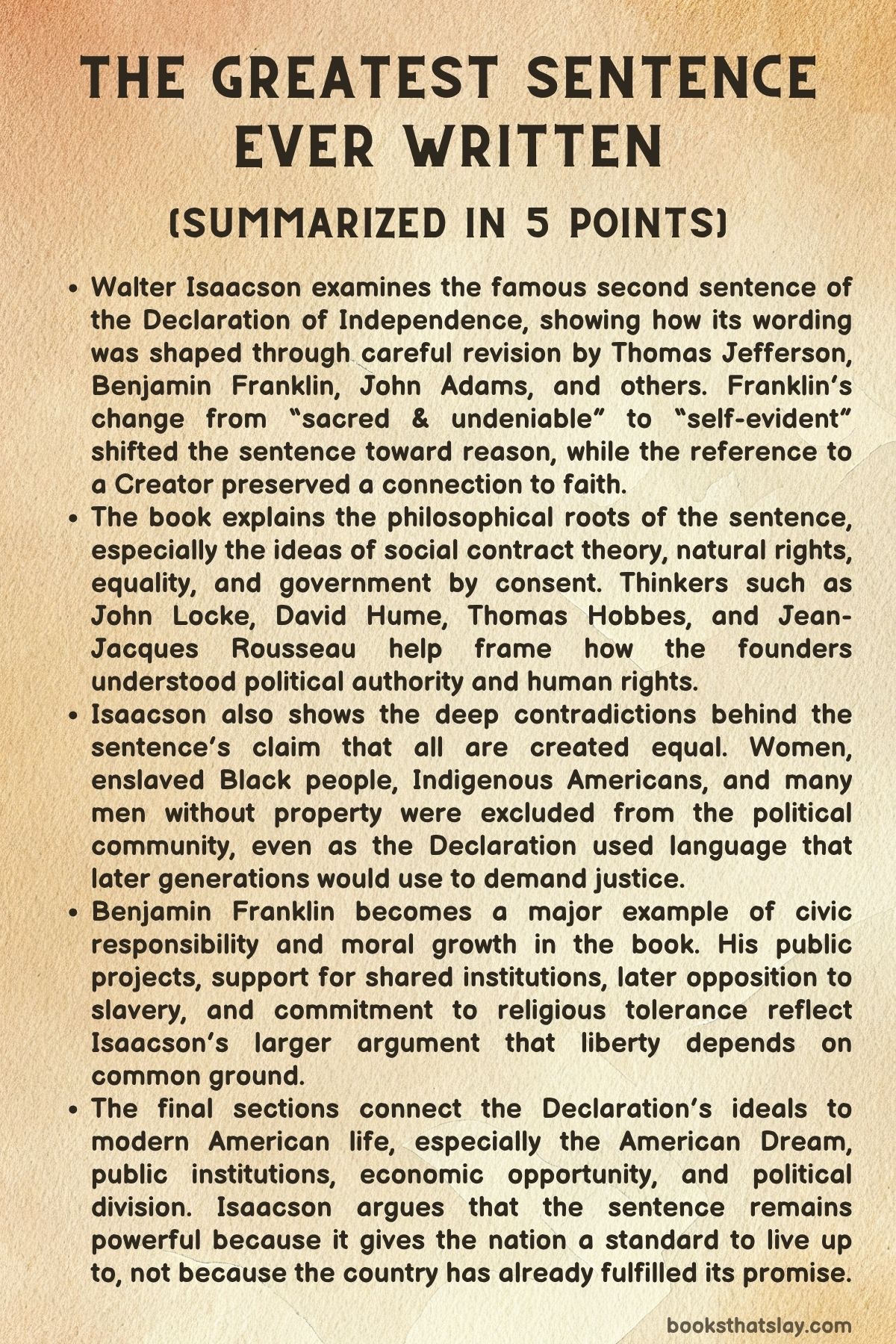
The book begins with the act of writing itself, showing that the sentence was not the work of one mind alone. Thomas Jefferson drafted it, but Benjamin Franklin, John Adams, and other members of the drafting committee helped shape its final form.
The sentence became powerful partly because it was revised with care, and those revisions changed the philosophical weight of its language.
Jefferson’s early wording described certain truths as “sacred & undeniable.” Franklin crossed out that phrasing and replaced it with “self-evident.” This was a major change. The first version rested more heavily on religious authority, while Franklin’s revision shifted the sentence toward the language of reason.
A self-evident truth is not one that needs to be proven through observation or defended by church doctrine. It is a truth that can be grasped by rational thought.
Isaacson connects this change to Enlightenment philosophy, especially the work of David Hume, whose ideas about reason and truth influenced Franklin. By calling equality and rights self-evident, the Declaration presented them as principles available to human understanding itself.
At the same time, the final wording did not abandon religious language. Jefferson’s original phrasing said that people derived rights from their equal creation.
The final version stated that they were endowed by their Creator with rights. Isaacson suggests that this change may have reflected the influence of John Adams, who held somewhat more religious views than Jefferson.
The result was a sentence that balanced reason and faith. Its truths were self-evident, yet the rights it named were also connected to a Creator.
This balance reflected the religious outlook of many founders, especially their Deism, which accepted a divine creator while rejecting much of traditional miracle-based theology.
The book then moves word by word through the sentence. It begins with the importance of “We.” That word establishes the people as the source of political authority.
Isaacson connects it to social contract theory, the idea that government comes from an agreement among individuals rather than from kings, aristocrats, or inherited power. Thinkers such as Thomas Hobbes, John Locke, David Hume, and Jean-Jacques Rousseau each shaped the understanding of political society.
Hobbes imagined life without government as dangerous and unstable, leading people to accept authority for safety. Locke, whose work deeply influenced Jefferson, argued that people form governments voluntarily to protect their rights.
Rousseau developed the idea of a collective general will. By beginning with “We,” the Declaration claimed that legitimate government begins with the people themselves.
Yet Isaacson does not allow this “We” to remain innocent. The word sounded broad, but in practice it excluded many people.
Women, enslaved Black people, Indigenous Americans, and often men without property were not included in the political community imagined by the founders. The book gives special attention to women’s exclusion through the exchange between Abigail Adams and John Adams.
Abigail urged her husband to “remember the ladies” and warned against leaving women completely under male power. John Adams dismissed her plea, revealing how firmly male authority was built into the political assumptions of the age.
The sentence claimed universality, but the society that produced it did not practice universality.
The phrase “all men” receives similar treatment. Isaacson explains that while the phrase could sometimes be used broadly to mean humankind, the founders did not apply it to everyone.
This is one of the book’s central tensions. The Declaration made a claim that could be read as universal, but many of its authors and signers accepted institutions that denied equality.
The most serious contradiction was slavery. Around one-fifth of the population in the colonies consisted of enslaved people who were legally treated as property.
Jefferson himself wrote against the slave trade, calling it a violation of human nature, yet he enslaved hundreds of people, including Sally Hemings and members of her family.
The book shows that this contradiction was not accidental or hidden. George Mason’s Virginia Declaration of Rights influenced Jefferson’s wording, but Mason inserted language that could restrict rights to those entering society, which served to exclude enslaved people.
Jefferson did not include that same qualification, making his wording more open and more morally dangerous for a slaveholding society. Congress later removed Jefferson’s anti-slavery passages from the Declaration.
Many signers were slaveholders, and they were unwilling to let the nation’s founding document directly challenge the institution that supported their wealth and power. Isaacson presents this not as a minor flaw but as a founding conflict that would shape American history for generations.
Benjamin Franklin stands out because his views changed over time. Earlier in life, he owned enslaved people, but later he became a leading abolitionist.
He eventually led the Pennsylvania Society for Promoting the Abolition of Slavery and used satire to expose the hypocrisy of pro-slavery arguments. Franklin’s moral development contrasts with Jefferson’s unresolved contradictions.
John Adams also opposed slavery personally, though he avoided making it a central public issue. Abigail Adams was more direct, calling out the hypocrisy of people who demanded liberty while denying it to others.
Through these figures, Isaacson shows how the sentence created a standard that even its authors failed to meet.
The phrase “created equal” is treated as both philosophical claim and historical challenge. Isaacson explains that the founders did not mean that all people were identical in talent, ability, or circumstance.
They meant that people were equal in their basic political standing before government. No one was born with a natural right to rule over others.
This rejected hereditary aristocracy and supported the idea that governments should rest on consent. But once the claim was written, it could not easily be contained by the limited intentions of the founders.
Later generations could use the same words to demand rights for those originally excluded. Abraham Lincoln and Martin Luther King Jr. would both draw power from this promise.
Isaacson also studies the phrase “unalienable rights.” These are rights that cannot be surrendered, sold, or legitimately taken away. The idea comes from social contract theory and was shaped by George Mason’s wording in the Virginia Declaration of Rights.
People may form governments, but they do not give up certain basic rights when they do so. Government exists to protect those rights, not to create them from nothing.
The spelling difference between “inalienable” and “unalienable” matters less than the principle itself. The Declaration insists that certain rights belong to human beings by nature and cannot be erased by rulers.
The famous list of rights, “Life, Liberty and the pursuit of Happiness,” is then connected to John Locke. Locke had written of life, liberty, and property as central rights.
Jefferson’s wording changed the emphasis from property to happiness. Isaacson notes that George Mason had already helped bridge this gap by writing about life, liberty, property, happiness, and safety.
Jefferson condensed these ideas into a cleaner and broader phrase. “The pursuit of Happiness” suggests more than material ownership.
It points toward personal fulfillment, opportunity, moral development, and the freedom to seek a meaningful life.
The later portions of the book move from the founding era to the present. Isaacson argues that the Declaration’s ideals can serve as common ground for a divided nation.
He develops the idea of the commons, beginning with shared lands in England and continuing through public spaces and institutions in America. The commons includes places and services that bring people together and give them shared opportunity.
Benjamin Franklin becomes the central example here. He helped create libraries, hospitals, fire companies, schools, insurance systems, and other civic institutions.
For Franklin, liberty was not only private independence; it was also the building of public goods that allowed people to flourish together.
Isaacson then connects the commons to the American Dream. Drawing on James Truslow Adams, he defines that dream not as mere wealth but as the chance for every person to develop their abilities regardless of background.
Public institutions make that dream possible. Yet the book argues that America’s common ground has been shrinking.
Economic inequality, divided schools, online echo chambers, and social separation have weakened shared experience. Michael Sandel’s idea of “skyboxification” captures this divide, where people no longer share the same public spaces and institutions but are separated by wealth and status.
The book closes by returning to unity. Isaacson recalls the need for the signers of the Declaration to stand together despite their differences.
He argues that Americans today face a similar challenge. The task is not simply to admire the Declaration but to apply its principles to modern problems, including healthcare, education, technology, economic policy, and public discourse.
The measure of a policy should be whether it strengthens common ground and expands opportunity. Franklin’s life offers a model of practical citizenship, religious tolerance, civic generosity, and public service.
The sentence from the Declaration remains great not because America has always lived up to it, but because it gives the nation a standard by which to judge itself and a goal toward which it must continue working.
Characters
Thomas Jefferson
Thomas Jefferson stands at the center of the book because he was the principal drafter of the Declaration of Independence’s most famous sentence. In The Greatest Sentence Ever Written, he appears as a brilliant stylist whose gift was to condense complex Enlightenment philosophy into memorable political language.
His wording gave lasting shape to ideas about equality, rights, consent, liberty, and happiness. Yet the book also presents Jefferson as a deeply contradictory figure.
He could write against the slave trade and describe it as an assault on human nature, but he also enslaved hundreds of people. His moral vocabulary was larger than his moral conduct.
This contradiction makes him one of the most important and troubling figures in the story. Jefferson’s strength lies in his ability to express universal ideals, but his weakness lies in his failure to apply those ideals to the people over whom he held power.
He represents the promise of America’s founding language and the limits of the society that produced it.
Benjamin Franklin
Benjamin Franklin is presented as the great reviser, civic builder, and practical moral force in the book. His edit from “sacred & undeniable” to “self-evident” changed the intellectual character of the Declaration’s sentence.
That single revision moved the wording away from purely religious assertion and toward reasoned truth. Franklin’s importance, however, goes far beyond editing.
He represents the habit of building institutions that serve the public good. His libraries, hospitals, fire companies, schools, and other civic projects show a belief that liberty must be supported by shared resources and communal responsibility.
Franklin is also notable because he changed. Though he had owned enslaved people earlier in life, he became an abolitionist and used his public influence against slavery.
In this way, he is one of the few figures in the book who seems morally capable of growth. His funeral, attended by people of many faiths, reflects the pluralism and public trust he cultivated throughout his life.
John Adams
John Adams appears as a serious, principled, and sometimes limited figure. He likely influenced the more religious phrasing of the Declaration, especially the reference to rights being endowed by a Creator.
His political thinking was shaped by both Enlightenment reason and a belief in divine moral order. Adams opposed slavery personally, which distinguishes him from many other founders, but he was cautious about challenging it directly in the political arena.
This caution reveals the gap between private conviction and public action. His exchange with Abigail Adams also exposes his limitations regarding women’s rights.
When Abigail urged him to remember women while shaping a new political order, he dismissed the request with humor and condescension. Adams therefore represents both moral seriousness and the boundaries of founding-era imagination.
He could recognize certain injustices, but he did not fully extend the logic of liberty and equality to all excluded groups.
Abigail Adams
Abigail Adams is one of the clearest moral voices in the book. Her request that John Adams “remember the ladies” exposes the gender exclusions built into the founding moment.
She understood that a revolution against tyranny could still preserve tyranny inside the household if men retained unchecked power over women. Her warning was sharp because she saw the contradiction between public liberty and private domination.
Abigail also criticized the hypocrisy of slaveholders who claimed to love freedom while denying it to others. Although she did not hold formal political power, her words reveal a broader moral imagination than many of the men who did.
She functions as a witness against the narrow meaning of “We” and “all men” as they were practiced in her time. Her presence in the story reminds readers that some excluded people recognized the failures of the founding from the beginning, even when those in power refused to listen.
George Mason
George Mason is important because his Virginia Declaration of Rights directly shaped the language and ideas behind Jefferson’s work. In The Greatest Sentence Ever Written, Mason appears as a precursor whose phrasing helped define inherent rights, equality, liberty, property, happiness, and safety.
His work gave Jefferson a model for expressing natural rights in political language. Yet Mason also represents evasion.
His wording included a qualification that rights applied when people entered society, a phrase that could be used to exclude enslaved people from the promise of equality. This makes him another contradictory figure.
He helped articulate principles that later generations could use in the struggle for justice, but he also lived within and protected the boundaries of a slaveholding world. Mason’s role shows how founding ideals were often written in language broad enough to inspire change, while being framed in ways that protected existing injustice.
John Locke
John Locke functions as one of the major philosophical ancestors of the Declaration. His theories of natural rights, government by consent, and social contract deeply influenced Jefferson and the broader founding generation.
Locke argued that people form governments to protect life, liberty, and property, and this framework shaped the Declaration’s later wording. In the book, Locke represents the rational foundation of liberal political thought.
His ideas help explain why hereditary monarchy could be rejected and why governments should be judged by whether they protect people’s rights. Yet Locke is also morally compromised.
Despite his writings on liberty, he profited from the slave trade. This contradiction mirrors the larger contradiction of the founding itself.
Locke’s philosophy could help produce a language of freedom, but his life showed that elegant theories do not automatically produce just conduct. His presence in the book reveals the power and danger of political ideas when they are applied selectively.
David Hume
David Hume appears as a key figure behind the phrase “self-evident.” His philosophy helps explain why Franklin’s edit mattered so much. Hume distinguished between truths known through observation and truths understood through reason and definition.
By using the language of self-evidence, the Declaration placed its central claims within a world of reasoned principles rather than merely empirical observation. Hume’s role in the book is not that of a political actor but of an intellectual influence.
He helps clarify the philosophical meaning behind the sentence’s authority. The claim that all are created equal was not being presented as a description of social reality, since society clearly did not treat people equally.
It was being presented as a rational principle. Hume therefore helps readers understand why the sentence could be revolutionary even in a world that contradicted it.
His influence shows how abstract philosophy can reshape political language.
Jean-Jacques Rousseau
Jean-Jacques Rousseau is used in the book to explain the meaning of collective political identity. His idea of the general will helps illuminate the importance of “We” in the Declaration.
Rousseau imagined political authority as arising from a people understood as a collective body, not merely from isolated individuals. This makes him useful for understanding how a community can claim the right to govern itself.
Yet Rousseau also represents the limits of Enlightenment thought, especially regarding women. His views placed women in domestic and subordinate roles, reinforcing the assumptions that excluded them from political equality.
In this sense, Rousseau’s place in the book is double-sided. He helps explain the democratic power of collective self-rule, but he also shows how influential theories of freedom could coexist with restrictive views of gender.
His thought expands the idea of popular sovereignty while limiting the people allowed to participate fully in it.
Thomas Hobbes
Thomas Hobbes appears as an early social contract thinker whose ideas help frame the Declaration’s political background. His view of the state of nature was harsh.
Without government, he believed human life would be insecure, violent, and short. People therefore accept authority to escape chaos and gain protection.
Hobbes’s version of the social contract differs from Locke’s because it gives stronger emphasis to order and security. In the book, Hobbes helps readers understand the larger philosophical conversation from which the founders drew, even when they did not adopt his conclusions fully.
His presence clarifies why social contract theory mattered: it shifted political authority away from divine-right monarchy and toward human agreement. Even though Jefferson’s Declaration is closer to Locke than Hobbes, Hobbes remains important because he helped establish the idea that governments arise to solve human vulnerability and insecurity.
Sally Hemings
Sally Hemings appears as a reminder of the human reality behind Jefferson’s contradiction. She is not treated as an abstract example of slavery but as a person whose life exposes the distance between Jefferson’s language of equality and his conduct as an enslaver.
Jefferson’s relationship with Hemings and the children connected to that relationship reveal how power operated within slavery. The book’s mention of her forces readers to confront the personal dimension of the founding contradiction.
It is not enough to say that Jefferson wrote universal ideals while living in a slave society. Hemings shows that this contradiction existed inside his own household.
Her presence gives moral weight to the discussion of equality because it reminds readers that those excluded from the Declaration’s promise were real people whose lives were controlled by the very figures who spoke of liberty.
James Jackson
James Jackson appears as a defender of pro-slavery arguments that Franklin later criticized through satire. His importance lies in what he represents: the organized political defense of slavery at the founding and early national period.
Jackson’s arguments show that slavery survived not merely because of silence or habit, but because powerful men actively justified it. Franklin’s satirical response exposed the weakness and hypocrisy of such reasoning.
In the book, Jackson serves as a contrast to Franklin’s later moral stance. He embodies resistance to the universal implications of the Declaration’s language.
If the sentence said all were created equal and had unalienable rights, then pro-slavery politics had to deny, narrow, or distort those claims. Jackson’s presence therefore helps show why the words of the Declaration became a battlefield over meaning.
Abraham Lincoln
Abraham Lincoln appears as one of the later figures who carried the Declaration’s promise beyond the limits of the founding generation. He understood the sentence about equality as a moral standard for the nation.
Lincoln’s importance in the book lies in his ability to treat the Declaration not as a finished achievement but as a guiding principle. He used its language to challenge slavery and to redefine the meaning of the Union.
For Lincoln, the Declaration’s claim that all are created equal gave America a purpose higher than political convenience. His role shows how words written in a compromised age could become tools for reform.
Lincoln did not erase the founding contradiction, but he made the equality claim central to the struggle over slavery and national identity. He represents the power of later generations to demand that America take its founding language seriously.
Martin Luther King Jr.
Martin Luther King Jr. appears as another major inheritor of the Declaration’s promise. In The Greatest Sentence Ever Written, he belongs to the long history of Americans who used the founding sentence to challenge exclusion.
King treated the language of equality and unalienable rights as a moral debt that the nation had not yet paid to Black Americans. His use of founding ideals was powerful because he did not reject the Declaration; he demanded that the country honor it.
King’s role shows how the sentence remained alive across centuries. Its meaning expanded because activists, reformers, and excluded communities insisted that its words must apply to them too.
King represents the continuing struggle between America’s ideals and its practices. Through him, the Declaration becomes not a relic but a living standard of judgment.
Alexis de Tocqueville
Alexis de Tocqueville appears as a thinker whose view of American society Isaacson partly challenges. Tocqueville famously described tensions between individualism and community in democratic life.
Isaacson disagrees with the idea that American society should be understood mainly through a conflict between private independence and communal belonging. Instead, the book argues that Americans have often built voluntary associations and civic institutions that allow independent individuals to serve common purposes.
Tocqueville’s role is useful because he frames a debate about the American character. Is democracy a force that isolates people, or can it encourage citizens to join together in shared work?
Isaacson uses Tocqueville as a point of contrast to emphasize the importance of civic life, local associations, and public goods. Tocqueville therefore helps sharpen the book’s argument about common ground.
James Truslow Adams
James Truslow Adams is important because he popularized the phrase “American Dream” and gave it a meaning broader than material success. In the book, his definition helps connect the Declaration’s ideals to opportunity.
The American Dream, as Adams described it, was not simply the chance to become wealthy. It was the hope that every person could develop their abilities and live with dignity regardless of background.
His example of the Library of Congress as an institution open to all supports Isaacson’s argument about the commons. Adams helps show that shared public resources are necessary for individual flourishing.
His role connects the founding promise of happiness to a modern social ideal. Through him, the pursuit of happiness becomes not only a private desire but also a public responsibility.
Michael Sandel
Michael Sandel appears as a modern philosopher whose idea of “skyboxification” helps explain the shrinking of common ground. The term describes a society in which shared experiences are increasingly separated by wealth and status.
People no longer sit in the same public spaces, use the same institutions, or share the same civic life. Sandel’s role in the book is to diagnose a modern danger.
When the wealthy withdraw into private schools, private services, premium spaces, and curated digital worlds, society loses the shared contact that supports mutual respect. His argument strengthens Isaacson’s concern that the American Dream weakens when the commons disappears.
Sandel helps shift the book from founding history to present-day social criticism. He shows how inequality damages not only income distribution but also civic connection.
Cotton Mather
Cotton Mather appears as an influence on Franklin’s civic imagination. Though Mather was a Puritan minister and Franklin became a more skeptical, Deist-minded figure, Franklin absorbed from him the idea of doing good as a practical duty.
This influence mattered because Franklin’s public life was defined by useful institutions. Mather’s role in the book shows that the American commons did not arise only from secular Enlightenment thought.
It also drew from religious traditions that valued service, charity, and community improvement. Through Mather, the book suggests that faith and reason could both contribute to public good.
He is not central in the same way as Jefferson or Franklin, but he helps explain the moral habits that shaped Franklin’s approach to citizenship.
John Hancock
John Hancock appears briefly but symbolically near the end of the book. His call for unity among the signers of the Declaration captures the danger and seriousness of the revolutionary moment.
The signers were not merely endorsing a document; they were risking their lives and futures. Hancock’s role is to remind readers that political ideals require solidarity when they face opposition.
His statement also prepares the way for Franklin’s famous response about the need to remain united. In the book, Hancock represents the practical need for common purpose.
The Declaration’s words could not succeed if the people behind them were consumed by division. His presence connects the founding moment to Isaacson’s modern concern about polarization and civic fracture.
Ezra Stiles
Ezra Stiles appears in connection with Franklin’s religious beliefs near the end of Franklin’s life. As president of Yale, Stiles asked Franklin about his views on faith and Jesus’s divinity.
Franklin’s response revealed a Deist outlook marked by belief in a creator, moral conduct, and tolerance, combined with uncertainty about traditional doctrine. Stiles’s role is mainly to draw out Franklin’s religious position.
Through this exchange, the book shows that the founders’ religious views were often complex. They could believe in a Creator and moral order without accepting every orthodox teaching.
Stiles therefore helps clarify the balance of reason, faith, humility, and practical goodness that shaped Franklin’s life and the Declaration’s language.
Themes
Equality as a Promise Still Under Construction
The claim that all people are created equal carries the force of a moral command, but the society that wrote it did not fully obey it. This tension gives the book much of its power.
Equality appears first as a philosophical claim drawn from Enlightenment ideas about natural rights and social contract theory. It rejects inherited rule and insists that no person is born with a natural right to dominate another.
Yet the founding generation narrowed the meaning of equality in practice. Women were excluded from political rights, Indigenous peoples were pushed outside the imagined community, and enslaved Black people were treated as property.
The book’s treatment of slavery makes this contradiction impossible to ignore. Jefferson’s words created a universal standard, but his life violated that standard.
The deeper point is that the sentence became greater than the intentions of many who approved it. Later figures such as Lincoln and King could use its words to demand broader justice.
Equality, then, is not presented as a completed founding achievement. It is a claim that exposes hypocrisy, pressures institutions, and challenges every generation to expand the circle of belonging.
The Balance Between Reason and Faith
The editing of the Declaration’s sentence shows a careful balance between rational philosophy and religious belief. Franklin’s change from “sacred & undeniable” to “self-evident” moved the sentence toward reason.
The truth of equality was framed as something the mind could recognize, not merely something declared by religious authority. This choice reflects the influence of Enlightenment thought, especially the idea that human beings can use reason to understand moral and political principles.
At the same time, the final wording says that people are endowed by their Creator with rights. That phrase keeps the sentence connected to a divine source of human dignity.
The book does not treat reason and faith as simple enemies. Instead, it shows how the founders often held both together, especially through Deism.
Their Creator was not always the interventionist God of traditional doctrine, but a rational source of natural order and moral law. This balance gave the sentence wide appeal.
It could speak to those who valued philosophy and to those who grounded rights in divine creation. The result is a political statement that draws authority from both human understanding and spiritual belief.
The Commons and the Meaning of Freedom
Freedom in the book is never reduced to private independence alone. It also depends on the shared institutions, spaces, and resources that allow people to live with dignity and opportunity.
This is why Benjamin Franklin becomes so important. His public library, hospital, fire company, school, and other civic projects show that liberty needs social support.
A person may have rights in theory, but without access to education, safety, public knowledge, and basic civic infrastructure, those rights become weaker in practice. The commons gives people a place to meet, learn, cooperate, and build trust.
It also prevents society from splitting into isolated classes that no longer share common experiences. The Greatest Sentence Ever Written argues that common ground is essential for democracy because it turns abstract equality into lived possibility.
When people withdraw into separate schools, separate services, separate media spaces, and separate economic worlds, resentment grows and public trust declines. The commons therefore becomes a moral and political necessity.
It connects the pursuit of happiness to shared responsibility, reminding readers that individual flourishing often depends on institutions built for everyone.
The American Dream and the Crisis of Opportunity
The pursuit of happiness becomes a bridge between founding ideals and the American Dream. The book presents that dream not as a narrow chase for wealth, but as the chance for each person to develop their abilities and live a meaningful life.
This version of the dream requires more than ambition. It requires conditions that make opportunity real: education, public institutions, economic security, civic trust, and a society that does not reserve advancement for a privileged few.
Isaacson’s concern is that these conditions have weakened. Economic change has increased wealth for some while leaving many working-class people with less security and less respect.
Education has become a dividing line, creating a meritocratic elite that often looks down on those without elite credentials. Digital platforms add to the problem by separating people into echo chambers, where shared reality becomes harder to maintain.
The crisis of opportunity is therefore both economic and civic. When people feel excluded from the nation’s promise, the language of equality and happiness begins to sound hollow.
Restoring the American Dream means rebuilding shared pathways through which people can flourish, contribute, and feel that the country’s ideals include them.