Famesick Summary and Analysis | Lena Dunham
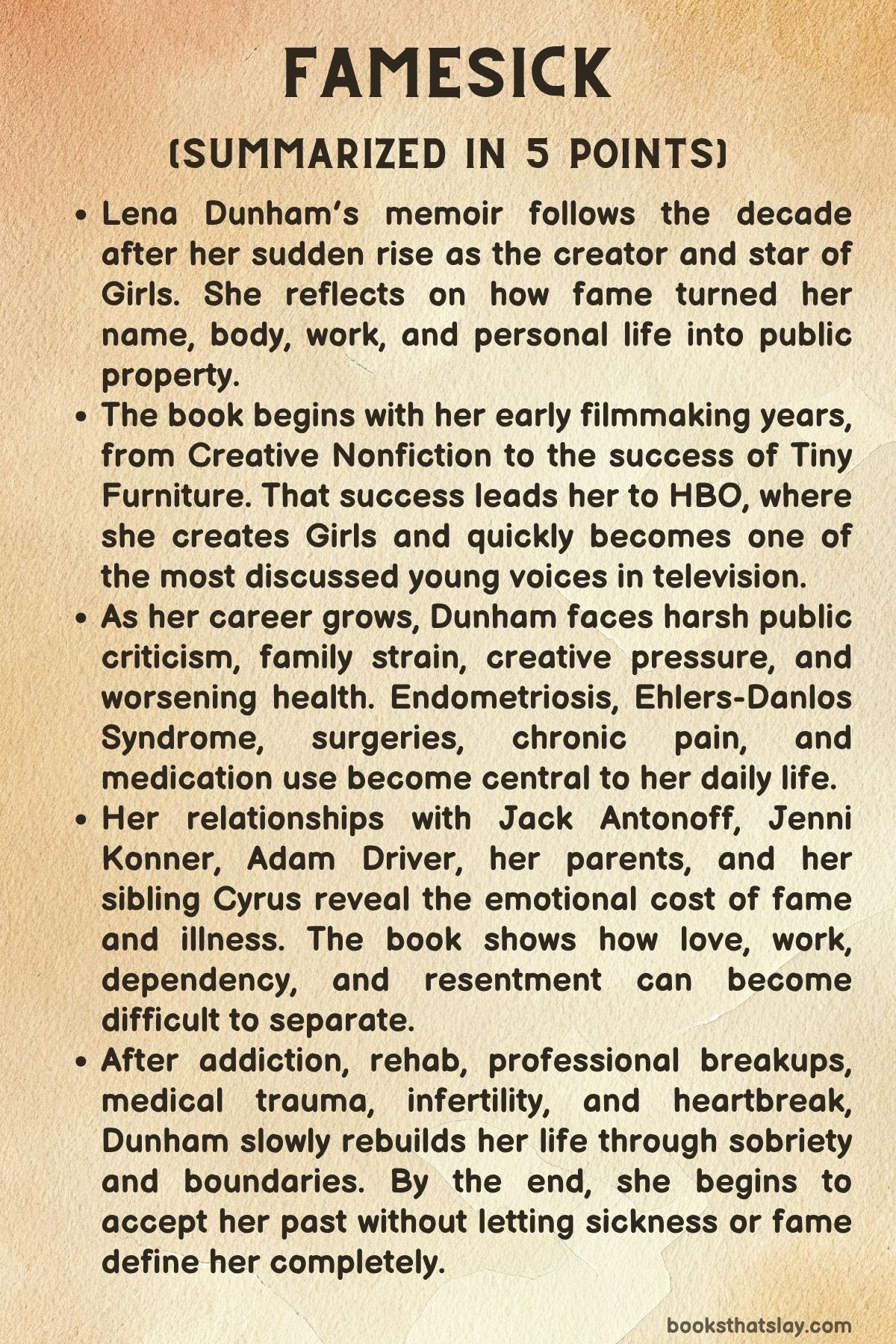
Famesick is Lena Dunham’s memoir about the years after sudden fame changed the shape of her life. Known as the creator and star of Girls, Dunham writes about what happened behind the public image: illness, addiction, creative pressure, family strain, unstable relationships, and the cost of being watched.
The book follows her from early artistic success to medical collapse and eventual recovery, showing how fame can turn a person into both a brand and a target. More than a celebrity memoir, it is a record of a woman trying to return to herself after years of pain, attention, and survival.
Summary
Lena Dunham opens Famesick by reflecting on the burden of her own name. Her mother, artist Laurie Simmons, gave her the name Lena, but as fame grew, that name began to feel like something owned by the public rather than by Dunham herself.
She recalls using aliases at hotels, hospitals, and treatment centers, not only to protect her privacy but also to escape the version of herself that strangers thought they knew. She frames the previous decade of her life around two conditions that shaped almost everything: sickness and fame.
Illness brought physical pain and fear, while fame brought judgment, surveillance, and a public identity that often felt hostile. Her father, Carroll Dunham, becomes one of the few people who understands both forces clearly.
He recognizes how badly her body is suffering and how poisonous the world around her public image has become.
The story moves back to Dunham’s early career, when she is a young filmmaker trying to find direction after college. At twenty, she makes Creative Nonfiction, a short film shot in her family home.
Its acceptance into a film festival feels like the beginning of the life she wants. She meets other young filmmakers, joins creative circles, and becomes hungry for the energy of independent cinema.
After graduating, however, she feels lost. She works disappointing jobs, lives with her parents, and struggles with the fear that adulthood has arrived without a clear purpose.
A major turning point comes when she finds her mother’s teenage journals. In those pages, Dunham sees Laurie not only as a parent but as a young woman full of pain, ambition, sexual confusion, body anxiety, and creative need.
The discovery helps her write Tiny Furniture, a film that becomes her first major success.
Tiny Furniture changes Dunham’s life quickly. With her mother’s support, she casts family and friends in the film, including Jemima Kirke.
When it wins major attention at a festival, Hollywood begins to call. She meets mentors and industry figures who help open doors, including journalist David Carr and agent Peter Benedek.
Eventually she gets the chance to pitch HBO. Instead of presenting a polished idea, she describes a show about young women in New York whose lives are messy, uncertain, and often unglamorous.
HBO responds with interest, and Dunham begins the process of creating Girls, the show that will make her famous.
During the development of Girls, Dunham meets Jenni Konner, who becomes her creative partner, mentor, and eventually one of the most important figures in her professional life. She also receives support from Judd Apatow, who joins the project as an executive producer.
The show’s characters grow out of Dunham’s own life, friendships, insecurities, and sexual history. Hannah, the lead role, is a version of Dunham herself.
Marnie, Jessa, and Shoshanna are shaped by people she knows and by the social world around her. The character of Adam comes from a degrading relationship with an older man who treated her carelessly.
Dunham’s attempt to impress him at a film event ends in humiliation when she finds him kissing another woman and spends the next day sick from alcohol and shame.
When HBO orders the pilot, Dunham is only twenty-four and suddenly responsible for a major production. She casts Allison Williams, Jemima Kirke, Zosia Mamet, Christopher Abbott, and Adam Driver.
Driver’s audition is intense and strange in a way that convinces the creative team he is right for Adam. Production begins, and the pressure almost immediately affects Dunham’s health.
She collapses from colitis before filming, a sign of how closely her body will respond to stress throughout the book. The pilot’s early table read is weak, but Apatow and Konner help her reshape it.
Their collaboration gives the project new force, especially through the scene in which Hannah’s parents cut her off financially. Dunham also has to navigate acting, directing, and exposing her body on screen.
A sex scene with Adam Driver becomes physically demanding but also establishes trust between them as performers.
After the pilot is picked up for a full season, Dunham’s life becomes structured around the demands of the show. She edits in Los Angeles, helps build the writers’ room, and tries to manage the fear of failure.
Anxiety leads her back to Klonopin, a medication she first used as a teenager after sexual trauma and severe OCD episodes. During production, she begins to experience dissociation, feeling disconnected from her own body.
Jenni Konner comments on her weight loss and tells her that losing weight weakens the show’s comic identity. Dunham responds by eating compulsively and quickly gains weight.
On set, Adam Driver becomes frustrated by her detached state and shocks her back into presence with an explosive outburst. Their relationship remains charged, complicated, and emotionally significant.
As money and success arrive, Dunham tries to build an adult life. She buys an apartment, receives advice from Nora Ephron, and moves between New York and Los Angeles.
But professional conflict and physical symptoms keep rising. When she withdraws from another film project because of scheduling conflicts, producer Scott Rudin sends threatening emails.
The stress contributes to a perforated eardrum. Her father comes to care for her, urging rest and offering steady love.
At the same time, her connection with Adam Driver becomes emotionally intense. When he comes to her parents’ apartment one night while his girlfriend is away, Dunham chooses not to open the door, understanding that acting on their tension could damage the show and her authority as director.
Soon after, he tells her he is engaged.
The public launch of Girls brings praise and attack in equal measure. Critics celebrate Dunham as an important new voice, but viewers and commentators also accuse her of privilege, nepotism, racial blindness, and physical unattractiveness.
The sudden scale of attention is brutal. Her sibling Cyrus begins to pull away, affected by the consequences of Dunham’s public life.
Around this time, Dunham begins dating musician Jack Antonoff after being introduced by his sister Rachel. Jack becomes a source of safety amid the hostility.
Their bond grows through shared anxiety, humor, cultural references, and emotional need. Yet even as the relationship deepens, Dunham’s friendships and professional relationships become more strained under the weight of the show’s success.
By her mid-twenties, Dunham is living through a strange contrast: visible achievement and private collapse. She attends elite fashion events, appears on television, and receives major awards attention, but she feels increasingly separated from old friends.
Some assume success has solved her problems, while others resent what her fame has made her. She becomes dependent on a smaller group of people, especially Jack, Jemima, and Jenni.
During awards season, online criticism and exhaustion push her into a breakdown. Her father helps her cancel press obligations, and Judd Apatow later tells her that early footage from the new season feels lazy.
Praise, criticism, illness, and grief arrive at the same time. She develops shingles and impetigo before a major fashion shoot, and on the day of an awards ceremony, her cousin dies from an overdose.
She attends both the ceremony and the funeral, moving between glamour and mourning in a way that shows how unnatural her life has become.
Dunham also writes a book of essays, Not That Kind of Girl, as a separate creative outlet. Its large advance and publicity create tension with Jenni Konner, who fears it will distract from their work together.
After publication, a conservative website accuses Dunham of abusing her younger sibling based on passages about childhood sexual curiosity. Dunham first sees the controversy as a bad-faith attack, but the damage to Cyrus is real.
She recognizes that she used her sibling’s private life as material without consent. As Cyrus comes out as trans and builds an identity apart from her, Dunham understands that fame has harmed her family as well as herself.
The scandal intensifies her physical pain, and while traveling for the book, her body seizes up, forcing her to return home.
Her health worsens as endometriosis becomes a central part of her life. She undergoes surgery, then hormone treatment that brings severe side effects.
At the same time, her uncle is dying, her relationship with her mother is tense, and the show continues to demand her labor. When her uncle dies while she is filming, Jenni persuades her to finish a scene before leaving, and Dunham arrives too late.
She receives only a brief bereavement period, and resentment toward her work begins to form. A later surgery by Dr. Tamer Seckin reveals extensive disease, validating the pain that others had doubted.
Jack’s reaction suggests that he finally sees how serious her suffering has been. Still, the pressure does not stop.
Dunham and Jenni launch Lenny Letter, further joining their professional lives.
The final season of Girls is marked by injury, medication, and emotional exhaustion. Dunham relies on Klonopin to keep functioning.
She breaks her elbow on set and continues filming, including an emotional scene with Adam Driver. Her grandmother is dying, and at her mother’s request, Dunham tells her a comforting lie that she and Jack are engaged.
A major ovarian cyst leads to hospitalization after a traumatic medical examination causes internal bleeding. On pain medication, Dunham experiences flashbacks to earlier medical and sexual trauma.
She becomes furious with the production for not protecting her. After refusing take-home opioids, she suffers withdrawal, and her doctor increases her Klonopin dosage, unknowingly deepening her addiction.
When the show finally ends, Adam Driver tells her he will always love her, but then disappears from her life.
Without Girls, Dunham feels unmoored. The structure that once controlled her days is gone, and unresolved trauma rises.
Her relationship with Jack deteriorates. He becomes distant, spending more time in his studio, while she becomes increasingly isolated in their apartment.
Her medical crises continue, including a collapse at a public event. Jack’s response makes her feel blamed rather than cared for.
She turns to Jenni, but that relationship is also shifting. During a retreat in Malibu, Dunham reflects on how their partnership has shaped her career and identity.
Later, when her pain becomes unbearable, she asks for a hysterectomy. Doctors resist at first, but a new diagnosis of Ehlers-Danlos Syndrome helps explain her lifelong symptoms.
After a long hospital stay and further trauma, surgeons remove her uterus and discover that it was badly diseased. Jack arrives after the operation is over.
Recovery from surgery occurs alongside emotional collapse. While heavily medicated, Dunham and Jenni release a public statement that Dunham later recognizes as damaging and shameful.
Backlash follows, and Dunham loses the will to defend herself. Her relationship with Jack ends after a painful fight in which years of resentment surface.
She begins an affair with Nick, a childhood boyfriend, desperate to feel wanted. Their relationship quickly becomes chaotic.
Nick proposes with a string ring, lies about his sobriety, and suffers seizures linked to alcohol withdrawal. Dunham, still using high doses of Klonopin and pain medication, is pulled into his instability.
A doctor finally tells her that her Klonopin use has become a serious problem. She accepts that she is addicted and enters rehab under an alias.
Rehab becomes the first place where Dunham sees the pattern clearly. She realizes that chaos has not simply happened to her; she has helped create and sustain it.
Through therapy, other patients, and the structure of treatment, she begins to understand the relationship between illness, fame, trauma, and dependency. She sees how far her actual values have drifted from the values of the world she has been living in.
A visit from Nick exposes the truth of his drinking, and she ends the relationship after understanding that their bond is based on mutual dysfunction. At the end of treatment, she feels her body respond with a new kind of energy and runs for the first time in years.
Life after rehab is difficult but slowly more honest. Dunham works to repair her relationship with Cyrus by learning that change must be shown through consistent action, not dramatic apologies.
She ends things with Nick, returns to work, and feels alienated from the production of Camping. Her bond with Jenni finally breaks after a therapy session in which both admit that their creative partnership has become harmful.
Dunham falls into depression, struggles to write, loses her dog, and deals with Nick stalking her at sober meetings. Directing Industry in Wales gives her an escape and helps her reconnect with work in a healthier way.
She begins writing again and slowly returns to herself.
The later sections follow Dunham through burns, infertility, celibacy, new relationships, and eventual marriage. A fire accident in London leads to serious burns and surgery.
Attempts to freeze her eggs fail, forcing her to grieve the loss of a biological child. During the pandemic, she has a brief painful affair, then meets a sober British musician with whom she builds a stable relationship.
Marriage, sobriety, and boundaries help her reframe illness as part of her life rather than the whole story. Near the end, she checks into the Sunset Tower under her real name after years of using aliases.
The moment suggests that she is no longer trying to escape Lena Dunham. She has not erased the past, but she can finally stand inside her own name again.
Key Figures
Lena Dunham
Lena Dunham is the central figure of Famesick, and the book presents her as both the subject and investigator of her own life. She is ambitious, funny, self-exposing, frightened, self-critical, and often painfully aware of her contradictions.
Her early hunger for creative recognition grows out of a need to turn confusion into art, but fame transforms that need into something more dangerous. Once Girls becomes a cultural event, Lena is praised as a bold new voice while also being treated as a public target.
She struggles to separate criticism of her work from hatred of her body, background, politics, and personality. This constant public judgment feeds her anxiety and worsens the fragile relationship she already has with her body.
Lena’s physical illness is not a side issue in the book; it is one of the main ways the story understands her life. Endometriosis, Ehlers-Danlos Syndrome, chronic pain, surgery, medication, and medical trauma shape her choices and relationships.
Her body repeatedly reacts to pressure that her public life refuses to acknowledge. She wants to keep working, proving herself, and being useful, even when her body is asking her to stop.
This creates a cycle in which performance becomes survival. She acts healthy enough, powerful enough, funny enough, and brave enough until the act collapses.
Her emotional flaws are treated with notable honesty. Lena often turns people into material before fully considering the cost to them.
She depends heavily on partners, mentors, doctors, family members, and collaborators, sometimes confusing support with rescue. Her relationships with Jack, Jenni, Nick, and Cyrus show different versions of this dependency.
At the same time, she is not simply passive. She makes harmful choices, avoids boundaries, seeks validation in unstable places, and sometimes lets chaos become her familiar language.
Her growth comes from recognizing that survival requires responsibility as well as care. By the end of the book, Lena is not cured, and she is not presented as morally pure.
She is someone who has learned that healing depends on time, sobriety, boundaries, and the difficult act of living without performing every wound for approval.
Carroll Dunham
Carroll Dunham, Lena’s father, is one of the book’s most steady and compassionate figures. He appears as a parent who understands his daughter without needing her to justify the extremity of her pain.
When others are confused by Lena’s illness, skeptical of her symptoms, or exhausted by her public crises, Carroll remains present. His support is practical and emotional: he helps her cancel work when she is breaking down, travels to care for her, witnesses her medical suffering, and offers a kind of calm that contrasts sharply with the instability of fame.
He sees the public life around her as harmful, but he does not treat her as foolish for having entered it. That balance makes him crucial to the book’s emotional center.
Carroll’s importance also lies in the way he recognizes the narrative Lena cannot always see clearly. He understands that her body and her public image have both become sites of conflict.
His care is not sentimental or shallow; it is often blunt, realistic, and protective. He does not save her from every mistake, but he gives her a place to return when the rest of her life becomes unbearable.
His presence also reveals how family can function as a witness. In a life where public opinion constantly distorts Lena into a symbol, Carroll insists on seeing her as a person.
He is not written as perfect, but as deeply reliable. His love does not erase her pain, yet it gives her a form of recognition that fame cannot provide.
Laurie Simmons
Laurie Simmons, Lena’s mother, is a complex figure whose influence reaches far beyond ordinary parental support. She is an artist, a producer, a model of female creativity, and at times a source of tension.
Lena’s discovery of Laurie’s youthful journals becomes a major creative awakening because it allows her to see her mother as a young woman with desire, fear, shame, and ambition. Those journals help Lena understand that artistic hunger and bodily insecurity did not begin with her generation.
Laurie becomes both mother and mirror, someone whose private history gives Lena permission to make work from uncomfortable emotional truth.
Laurie’s role in Lena’s career is significant. She supports Tiny Furniture, helps produce it, and believes in Lena’s talent before the broader industry does.
Yet the book also shows that this closeness can become strained. Lena’s fame sometimes seems to overshadow Laurie’s own artistic identity, creating tension between admiration and competition.
Their relationship includes humor, resentment, tenderness, and conflict. Laurie can be nurturing, but she can also be sharp, disappointed, or emotionally unavailable in ways that hurt Lena.
Still, the mother-daughter bond remains resilient. Their fights do not erase their attachment, and Laurie often reenters Lena’s life through humor, care, or practical intervention.
As a character in the book, Laurie represents inheritance: artistic inheritance, bodily inheritance, emotional inheritance, and the difficult knowledge that mothers and daughters can love each other deeply while still wounding each other.
Cyrus Dunham
Cyrus Dunham, Lena’s sibling, is one of the most important figures in the book’s moral development. Cyrus’s presence forces Lena to confront the consequences of treating family life as material.
When Lena writes publicly about childhood experiences involving Cyrus, she does not fully account for Cyrus’s privacy, autonomy, or future identity. The resulting controversy becomes more than a media scandal; it becomes a real wound in their relationship.
Cyrus is not simply upset by public attention but by the feeling that Lena’s fame has made their own life harder to own.
Cyrus’s distance from Lena is understandable and necessary. As Cyrus comes out as trans and forms a life apart from Lena’s public identity, the book presents separation as a form of self-protection.
Lena must learn that apology is not enough. Repair requires changed behavior over time.
Cyrus becomes central to Lena’s understanding of living amends, the idea that trust is rebuilt through consistent action rather than dramatic confession. The sibling relationship is painful because it exposes Lena’s blind spots.
She loves Cyrus, but love does not excuse the harm caused by making someone else’s private life part of a public persona. Cyrus’s role is therefore both personal and ethical.
Through them, the book asks what writers owe the people they write about, especially when those people are family.
Jenni Konner
Jenni Konner is Lena’s creative partner, mentor, protector, and eventual source of deep emotional pain. Their relationship begins with admiration and urgency.
Lena sees in Jenni a professional authority she wants to learn from and imitate. Together, they build Girls into a major cultural force, and Jenni becomes one of the people Lena depends on most.
She helps shape scripts, manage production pressure, and guide Lena through the demands of being a young showrunner. In the early parts of their collaboration, Jenni offers structure and confidence that Lena badly needs.
As the relationship develops, however, the balance becomes more complicated. Jenni’s authority can feel protective, but it can also become controlling or dismissive.
She comments on Lena’s body in relation to the show’s identity, pushes her to keep working during moments of illness and grief, and appears unsympathetic when Lena’s health crises interrupt professional demands. Their pay parity negotiation also shows how intimacy and business become difficult to separate.
Lena agrees to terms that unsettle her because she fears losing Jenni, revealing how professional partnership has become emotionally fused with dependency.
The end of their relationship is one of the book’s major breaks. In therapy, they both recognize that their collaboration no longer makes them happy.
Jenni’s request that Lena not immediately write about the separation shows her awareness of Lena’s instinct to turn pain into narrative. As a character, Jenni represents the danger of confusing creative partnership with emotional survival.
She helps Lena become powerful, but their bond eventually becomes one of the structures Lena must leave behind to recover.
Judd Apatow
Judd Apatow functions as a major professional validator in the book. His interest in Tiny Furniture gives Lena a powerful sense that her work has crossed into a larger world.
By joining Girls as an executive producer, he helps legitimize the project within HBO and the industry. He also plays an important creative role, especially when the pilot needs revision.
His ability to identify what is missing and help strengthen the script gives Lena practical support at a moment when she is still learning how to lead a production.
Judd’s presence also brings pressure. When he tells Lena that early footage from a later season feels lazy, his criticism lands heavily because she sees him as someone whose approval matters.
He is not portrayed as cruel, but as part of the professional world that constantly measures Lena’s output. His character represents a form of mentorship tied to standards.
He believes in her work, but he also demands that it remain sharp. In the book’s larger structure, Judd is one of the figures who helps Lena enter fame but cannot protect her from what fame becomes.
Adam Driver
Adam Driver is one of the book’s most charged and memorable figures. Cast as Adam in Girls, he brings an intensity that shapes both the show and Lena’s experience of making it.
Their professional chemistry is immediate and physically demanding, especially in scenes that require vulnerability, discomfort, and trust. Lena’s descriptions of acting opposite him suggest that he helps create some of the show’s most alive moments, but their relationship is never simple.
Adam’s behavior can be unsettling. He withdraws after seeing himself in the pilot, becomes frustrated by Lena’s dissociation, and at one point shocks her back into awareness through an explosive outburst.
Yet the book also presents him as tender, perceptive, and emotionally significant. Their unspoken romantic tension becomes a test of Lena’s judgment.
When he arrives at her parents’ apartment and she chooses not to let him in, she protects both the show and her authority as director. That decision shows her awareness of boundaries even during a period when she often struggles with them.
Adam’s final goodbye after Girls ends carries emotional weight. He tells Lena he will always love her, then disappears from her life.
This makes him a symbol of the intense intimacy of artistic collaboration: people can share extraordinary trust inside a creative world and then vanish when that world closes. In Famesick, Adam represents desire, performance, discipline, and the strange emotional bonds formed by making art under pressure.
Jack Antonoff
Jack Antonoff is Lena’s long-term partner and one of the central emotional figures in the book. Their relationship begins as a refuge from public hostility.
He understands anxiety, shares her cultural language, and offers affection at a time when Lena is being attacked by strangers and critics. In the early stages, Jack gives her a sense of safety.
He is validating, funny, and tender, and their love becomes one of the few places where fame seems briefly manageable.
Over time, however, the relationship becomes strained by illness, resentment, dependency, and distance. Jack’s career grows, and he spends more time in his studio while Lena becomes increasingly confined by pain and medication.
His absence during hospitalizations wounds her deeply. He sometimes appears to see her crises as self-created or exhausting, which intensifies her fear that her body and public persona have made her unlovable.
Their shared apartment becomes less a home than a quiet space of avoidance.
Jack is not written only as a villain. The book allows for the reality that loving someone through chronic illness, addiction, public scandal, and constant need can produce its own exhaustion.
His resentment is painful, but it is not treated as random. Their breakup is devastating because both understand that the relationship mattered.
They call each other their first great love, which gives the end a sense of grief rather than simple blame. Jack represents the limits of romantic rescue.
He helps Lena survive for a time, but he cannot become the structure on which her whole life depends.
Jemima Kirke
Jemima Kirke is Lena’s friend, collaborator, and one of the people whose real-life energy helps shape Girls. As the model for Jessa and as an actor in both Tiny Furniture and the show, Jemima belongs to the early creative world that makes Lena’s rise possible.
She brings glamour, unpredictability, and emotional force to the circle around Lena. Her presence suggests a friendship based on shared history, artistic risk, and mutual familiarity before fame changes the terms of everything.
The pressure of success affects Jemima, too. The book does not treat fame as something that harms Lena alone.
People close to her are pulled into the machine of public attention, production demands, and identity confusion. Jemima’s struggle with the show’s success reflects the difficulty of becoming part of a public story that began as private friendship and creative experiment.
As a character, she shows how fame can alter relationships that once felt natural. She is not as centrally examined as Lena, Jack, Jenni, or Cyrus, but she remains important because she belongs to the origin of Lena’s artistic life.
Through Jemima, the book shows the cost of turning friendship into fiction and then watching fiction become famous.
Nick
Nick is one of the book’s clearest representations of chaos disguised as comfort. He returns to Lena’s life after her breakup with Jack, when she is vulnerable, medicated, lonely, and desperate to feel wanted.
Because he is a childhood boyfriend, he carries the emotional pull of the past. He seems familiar at a time when Lena’s present has become unbearable.
Their relationship becomes intense almost immediately, but its speed is a warning rather than proof of stability.
Nick lies about major parts of his life, including his sobriety. His seizures, which at first appear mysterious or medical, are eventually revealed as connected to alcohol withdrawal.
His proposal with a string ring, his presence in hospitals, and the unstable intimacy between him and Lena all show how addiction can create a false sense of closeness. They are not truly building a life together; they are using each other to avoid facing their own emergencies.
Nick’s role becomes especially important in rehab, where Lena finally sees the relationship without the haze of her own addiction. His deception forces her to understand that she cannot recover while staying attached to someone whose life is built around denial.
Ending the relationship becomes an act of survival. Nick is not simply a bad partner; he represents Lena’s attraction to crisis when crisis has become familiar.
Through him, the book shows that recovery requires choosing peace even when chaos feels more recognizable.
Dr. Tamer Seckin
Dr. Tamer Seckin is one of the most important medical figures in the book because he helps validate Lena’s physical pain. After years of suffering, inadequate treatment, and doubt from others, his surgery reveals extensive endometriosis.
The discovery confirms that her pain is not imaginary, exaggerated, or merely emotional. This validation has deep psychological importance.
Lena has spent much of the book trying to convince others, and sometimes herself, that her body is telling the truth. Dr. Seckin becomes a figure of medical recognition.
At the same time, he is not presented as uncomplicated. When Lena asks for a hysterectomy, he initially resists and describes the uterus in symbolic terms that frustrate her.
His reaction reflects a larger medical tendency to attach cultural meaning to female reproductive organs, sometimes at the expense of the patient’s lived pain. This makes him both helpful and limited.
He can see parts of Lena’s illness clearly, but he also participates in the hesitation that delays the treatment she wants. His character reveals how medical care can save and wound at the same time.
In Lena’s story, doctors matter not only because they treat the body but because they decide whether a patient’s suffering will be believed.
Nora Ephron
Nora Ephron appears as a mentor whose guidance is specific, worldly, and practical. Her advice about renovating Lena’s apartment is more than a domestic detail.
It represents a kind of adult female authority that Lena admires: precise, confident, tasteful, and experienced. Nora’s presence connects Lena to a lineage of women writers and filmmakers who built public creative lives before her.
In a world where Lena is often treated as either a prodigy or a scandal, Nora offers something different. She treats Lena as a young woman entering adulthood and work, someone who needs useful instruction rather than public mythology.
Nora’s role is brief compared with other figures, but it matters because mentorship in the book often carries emotional weight. Lena is searching for models of how to live as an artist, a woman, and a public person.
Nora gives her a glimpse of authority without chaos. Her presence suggests that guidance can be generous without becoming possessive.
Unlike some of Lena’s later professional relationships, Nora’s mentorship does not appear to demand dependency. She is remembered as a stabilizing influence, someone whose clarity stands out in a book full of blurred boundaries.
David Carr
David Carr is another early mentor who helps usher Lena into a larger public and professional world. She meets him after the success of Tiny Furniture, and his attention matters because he is a respected journalist with the ability to recognize cultural significance.
His role shows how early fame is built through a chain of belief: one person sees promise, writes about it, talks about it, or connects it to someone else, and a young artist’s life begins to change.
In the book, David Carr represents validation from outside Lena’s family and immediate creative circle. That validation is important because Lena’s early work is so personal and family-based.
When someone from the broader cultural world takes it seriously, it helps transform her from a young person making films with friends into a public artist. His presence also reminds readers that fame is not only created by talent or ambition; it is shaped by institutions, critics, journalists, festivals, and timing.
David is not a central emotional character, but he is part of the network that makes Lena’s rise possible.
Peter Benedek
Peter Benedek, Lena’s agent, represents the professional machinery that forms around her after Tiny Furniture succeeds. Through him, she enters Hollywood meetings and gains access to opportunities that would have seemed impossible only shortly before.
His role is practical but important: he helps translate independent film attention into industry movement. The meetings he arranges lead to the HBO pitch that changes Lena’s career.
As a character in the book, Peter shows how quickly artistic success becomes business. Lena’s personal stories, friendships, anxieties, and comic instincts are suddenly placed inside rooms where executives evaluate their commercial potential.
Peter is part of that shift. He is not portrayed with the emotional depth of family members or partners, but his presence marks Lena’s entry into a system where creativity, money, contracts, and power operate together.
He helps open the door, but what waits behind it is far more complicated than opportunity alone.
Rachel Antonoff
Rachel Antonoff plays a small but meaningful role as the person who introduces Lena to Jack. By setting them up, she indirectly shapes one of the major relationships of the book.
Rachel belongs to the social and creative world that surrounds Lena during the rise of Girls, a world of artists, musicians, fashion events, and cultural visibility. Her introduction leads to a relationship that becomes central to Lena’s emotional survival and later emotional collapse.
Rachel’s role also shows how intimate networks structure Lena’s life. Professional, romantic, and social circles are not separate; they constantly overlap.
A fashion designer friend introduces a boyfriend. A boyfriend becomes a life partner.
That partner becomes tied to public scrutiny, illness, home, and heartbreak. Rachel is not developed as extensively as Jack, but her presence is a reminder that one social gesture can redirect a life.
Gaylen
Gaylen, the nineteen-year-old patient Lena meets in rehab, represents a younger and more visibly volatile version of addiction’s chaos. She is in treatment for the eighth time, and her presence forces Lena to see that rehab is not a symbolic retreat but a place where people are fighting for survival.
Gaylen’s instability is unsettling, but it also strips away some of Lena’s exceptionalism. In treatment, fame matters less than honesty, withdrawal, fear, and the difficult work of staying alive.
Through Gaylen and the other patients, Lena begins to understand herself outside celebrity language. She is not the famous creator being analyzed by critics; she is a patient among patients.
This leveling is crucial. Gaylen’s presence helps create an environment where Lena can no longer rely on public identity, professional accomplishment, or clever self-description.
She has to face her behavior, values, and addiction directly. Gaylen is not merely a side figure; she helps show the community context in which Lena begins to recover.
Mark
Mark, the kind doctor in rehab, becomes an important guide during Lena’s early recovery. His role is less dramatic than that of the surgeons, partners, and collaborators, but his calm therapeutic presence allows Lena to begin sorting through the wreckage of her life.
He helps her examine the accumulation of illness, fame, trauma, addiction, and unhealthy relationships without reducing any one issue to a simple cause.
Mark’s importance lies in his steadiness. Unlike the public world, he does not reward performance.
Unlike some professional relationships, he does not ask Lena to keep producing. Unlike unstable romantic partners, he does not need rescue.
He offers a space where she can begin to tell the truth without turning that truth into spectacle. His character represents the kind of care that recovery requires: patient, structured, honest, and resistant to drama.
Through him, the book shows that healing is not a grand revelation but a series of difficult recognitions made in safe enough conditions.
Nathan
Nathan, the musician Lena meets through the sober community, appears during her attempt to build a life after rehab. Their relationship is casual, but it matters because it belongs to a different stage of Lena’s life.
Rather than emerging from fame, childhood nostalgia, or crisis, the connection comes through sobriety. This gives it a different emotional texture from her relationships with Jack and Nick.
Nathan represents Lena’s effort to reconnect with intimacy without immediately turning it into rescue or destiny. His presence suggests that sobriety changes not only what a person stops doing but also how they relate to desire, companionship, and vulnerability.
He is not a final partner or a major dramatic force, but he belongs to the transitional space between addiction and healthier love. In that sense, he helps mark Lena’s movement away from crisis-based attachment.
Craig
Craig is the emotionally distant man Lena becomes involved with during the pandemic. Their brief affair shows that even after recovery has begun, Lena remains vulnerable to projection and longing.
She interprets their connection as meaningful, gives him a cherished necklace and an emotional letter, and is wounded when he responds coldly and disappears. Craig’s role is brief but revealing.
He shows how loneliness can make a person mistake intensity for intimacy.
Craig also serves as a final test of old patterns. Lena is no longer in the same condition she was with Nick, but she can still attach quickly to someone unavailable.
His ghosting hurts, especially during quarantine, when isolation makes rejection feel larger. Yet the episode does not destroy her.
Instead, it becomes part of the path toward a more stable relationship. Craig represents a last echo of the kind of longing that once ruled her life: the desire to be chosen by someone who cannot truly meet her.
Lena’s Husband
Lena’s husband, the sober British musician she meets after Craig, represents a healthier form of love. Their relationship develops quickly, but unlike her bond with Nick, it is grounded in honesty, sobriety, and shared understanding of trauma.
He does not appear as a savior who fixes Lena’s life. Instead, he helps her see illness differently.
Rather than treating sickness as the defining tragedy of her identity, he supports her in understanding it as one part of a manageable life.
His presence helps Lena create new boundaries around work, fame, and health. With him, she begins to experience partnership without constant crisis.
The marriage suggests that love can be intense without being destructive and intimate without requiring self-erasure. By the end of Famesick, his role is tied to Lena’s growing ability to live without making pain the organizing principle of every relationship.
He is important not because he completes her recovery, but because he enters after she has already begun the harder work of becoming responsible for herself.
Themes
Fame as a Loss of Personal Ownership
Fame in Famesick is not presented as simple success. It is a force that takes Lena’s name, body, work, family, and mistakes and makes them available for public use.
At first, recognition seems like proof that her art matters. Festivals, HBO meetings, reviews, awards, and magazine attention all appear to confirm that she has found her purpose.
Yet the same visibility quickly becomes a trap. Strangers claim authority over her appearance, politics, privilege, sexuality, trauma, and family relationships.
Her name no longer feels private. It becomes a public object, something people can praise, mock, accuse, or consume.
This loss of ownership explains why aliases become so meaningful. Using another name is not only a privacy tactic; it is a way to feel briefly free from the public version of Lena Dunham.
The book shows that fame can shrink a person even while making her more visible. Instead of allowing Lena to be fully known, it reduces her into arguments, headlines, opinions, and projections.
The cost is not just discomfort but a deep confusion about where the real self ends and the public character begins.
The Body as a Record of Pressure
Lena’s body carries the evidence of what her life refuses to slow down and process. Chronic illness, endometriosis, Ehlers-Danlos Syndrome, rashes, shingles, injuries, cysts, surgeries, withdrawal, burns, and infertility are not isolated medical events in the story.
They form a physical record of exhaustion, trauma, overwork, and disbelief. Her body repeatedly speaks before the people around her are willing to listen.
It collapses during production, reacts to scandal, worsens under professional pressure, and demands care when the public image of success says she should be grateful and functional. The medical system often becomes another place where she has to fight to be believed.
Doctors can validate her pain, but they can also delay treatment, attach symbolic meaning to her reproductive organs, or expose her to further trauma. The theme is powerful because the body is not treated as a metaphor alone.
It is material, painful, inconvenient, and real. Lena’s eventual recovery depends partly on accepting that her body is not betraying her for no reason.
It is warning her that the life built around constant performance, codependency, and public judgment cannot continue without consequences.
Codependency and the Search for Rescue
Many of Lena’s closest relationships are shaped by the hope that another person can make her life survivable. Jack offers safety during public attack, Jenni offers creative authority and professional structure, Nick offers desire after heartbreak, and doctors offer the promise of explanation or relief.
These attachments are understandable because Lena is often in genuine pain, but the book shows how easily support can become dependency. When one person becomes the center of emotional stability, the relationship begins to carry more weight than it can bear.
Jack cannot be lover, nurse, witness, and shield forever. Jenni cannot be mentor, collaborator, manager, and emotional anchor without the partnership becoming distorted.
Nick’s chaos feels like intimacy because Lena is already accustomed to crisis. The book’s treatment of codependency is honest because it does not condemn the need for help.
Lena truly needs care. The problem begins when care is confused with rescue and when rescue becomes a way to avoid responsibility.
Recovery requires her to separate love from dependence, creativity from control, and intimacy from emergency. Boundaries become less like rejection and more like the conditions that make real connection possible.
Recovery as Time, Action, and Responsibility
Recovery in the book is not a dramatic transformation that happens the moment Lena enters rehab or gets sober. It is slower, less glamorous, and more demanding.
Rehab gives her a place to see her addiction and chaos clearly, but leaving treatment does not automatically repair her body, career, family, or relationships. She has to end unhealthy attachments, continue therapy, rebuild trust with Cyrus, face professional loss, manage chronic illness, and learn how to work without destroying herself.
The idea of living amends is especially important because it changes apology from language into behavior. Lena cannot undo the ways her fame and writing hurt Cyrus, but she can practice respect, patience, and consistency.
Sobriety also changes her relationship to time. Instead of seeking immediate relief through medication, romance, work, or public confession, she has to accept a slower kind of repair.
This theme gives the book its clearest sense of maturity. Healing is not shown as purity or completion.
It is the ongoing practice of making choices that protect life rather than intensify damage. Lena’s final movement toward marriage, boundaries, and acceptance suggests that survival is built through repeated actions, not single revelations.