The Great Fire Summary, Characters and Themes
The Great Fire by Jim Murphy is a young-adult work of historical nonfiction about the Great Chicago Fire of 1871. Rather than treating the disaster as a distant event, the book follows ordinary people, firefighters, reporters, city officials, and families as they face a citywide catastrophe.
Murphy explains why Chicago was so vulnerable, how mistakes and weather helped the flames spread, and how survivors responded when their homes, streets, and assumptions collapsed around them. The book also examines the myths that followed the fire, especially the unfair blame placed on Catherine O’Leary and her cow.
Summary
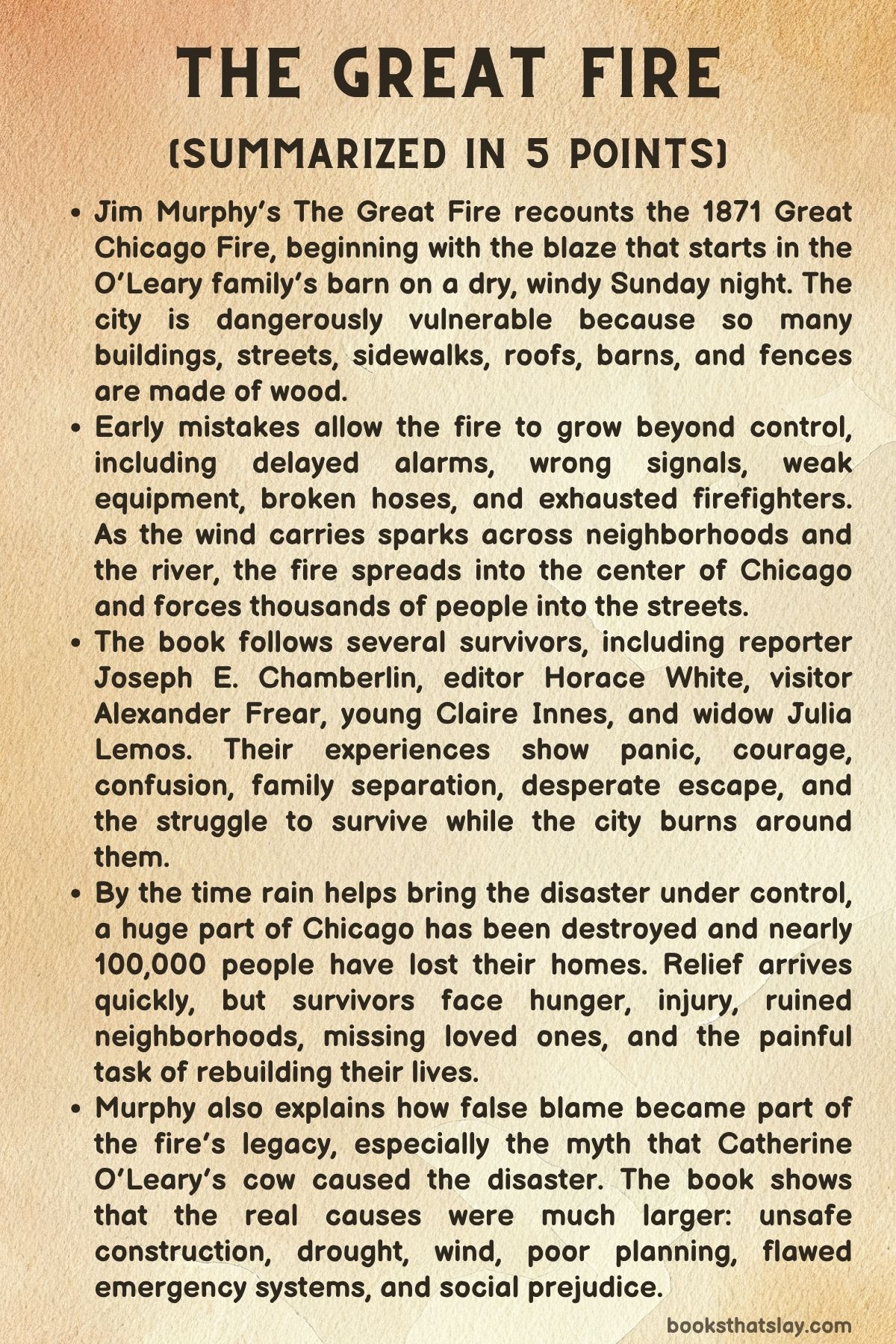
Jim Murphy’s The Great Fire tells the story of the 1871 Great Chicago Fire by combining historical explanation with the experiences of people who lived through it. The disaster begins on a warm Sunday night in early October, when Daniel “Peg Leg” Sullivan notices flames coming from the O’Leary family’s barn on De Koven Street.
Patrick and Catherine O’Leary are asleep inside their home, unaware that the barn behind them is already burning. Sullivan runs to help save the animals, but the fire spreads quickly through the dry wooden structures nearby.
He manages to escape with a singed calf after losing his wooden leg in the panic, while neighbors rush out with buckets and cries of alarm.
The fire grows dangerous so quickly because Chicago is already prepared for disaster. Most of the city’s buildings are made of wood, and even structures advertised as fireproof hide wooden frames, tar roofs, and decorative wooden features.
Wooden sidewalks, pine-block streets, crowded houses, sheds, barns, and fences all provide fuel. A long drought has dried out the city, and a strong southwest wind turns a local fire into something far more destructive.
The blaze moves from yard to yard, and although neighbors try to protect the O’Leary home, the flames continue to gain strength.
Early mistakes make the situation much worse. William Lee, a neighbor, runs to a nearby drugstore to send in a fire alarm, but the alarm is not properly recorded.
At the courthouse, watchman Mathias Schaffer sees smoke but mistakes the location of the fire because another fire from the previous night is still smoldering. He sends firefighters to the wrong place.
When the mistake becomes clear, William J. Brown, his assistant, refuses to send a corrected signal because he fears it will create confusion. The result is deadly delay.
Some nearby fire companies are sent away from the real danger, while others that might have responded do not move.
Reporter Joseph E. Chamberlin reaches the area early and sees the fire spreading across a poor, crowded neighborhood. His observations are sharp, but his view of the residents is shaped by class prejudice.
That bias later contributes to the public’s eagerness to blame Catherine O’Leary and the immigrant neighborhood where the fire began. Firefighters finally gather around the blaze, but their equipment is weak, their hoses break, and exhausted crews struggle against wind, heat, and flying embers.
Chief Marshal Robert A. Williams tries to form a defensive line, but spot fires break out behind the firefighters. The flames escape their control and begin moving toward the heart of the city.
As the fire advances, many Chicagoans remain strangely calm at first. Some people are out drinking, walking, or attending church.
Horace White, editor of the Chicago Tribune, hears alarm bells but does not immediately rise. Claire Innes, a 12-year-old girl living with her family, is briefly awakened but goes back to sleep.
Alexander Frear, a visitor from New York, leaves his hotel out of curiosity and moves toward the glow without understanding how serious the danger has become. Gradually, the scale of the disaster becomes impossible to ignore.
Flames leap across rooftops, embers fall through the streets, and crowds begin to flee.
The fire crosses the Chicago River and spreads into new districts. Chamberlin watches the city descend into confusion as wagons, pedestrians, horses, and families crowd the streets.
Some people help one another, while others panic, steal, drink, or block escape routes. Claire’s family leaves home, carrying bundles and trying to reach safety across a bridge.
In the crowd, her father orders everyone to drop their belongings and hold hands, but Claire refuses to release her bundle. In the crush of people, smoke, and flames, she is separated from her family.
Claire’s ordeal becomes one of the most frightening parts of the story. Alone in a burning city, she waits, searches faces, calls out, and tries to move with the crowd.
Eventually she becomes trapped in an alley with fire blocking both exits. Doors around her are locked or filled with smoke.
She shelters near a construction site behind a pile of bricks, pressing herself low to the ground while buildings burn around her. Heat, collapsing walls, and flying debris threaten her life.
When the flames finally pass, she discovers that her dress has caught fire and that she has burns on her body. Still, she gets up and begins searching for her family.
Alexander Frear also spends the night in desperate motion. He reaches his sister-in-law’s house and helps move her children to what he believes is safety, but then learns that the new location may also be threatened.
He rushes from place to place, looking for the children and for other family members. Streets are blocked by wagons and abandoned goods.
Rumors spread faster than facts. Hotels, restaurants, bridges, and wealthy neighborhoods all show the same disorder.
Frear sees terrible scenes: injured people, looters, burning buildings, frightened crowds, and people who die or suffer while others are too overwhelmed to help. He eventually crosses a damaged bridge shortly before it collapses.
Horace White’s experience is different but still marked by shock and loss. He reaches the Tribune building, a structure believed to be fireproof, and finds workers trying to protect it.
At first the building seems to survive as surrounding structures burn. However, when the waterworks are destroyed and the city’s water supply fails, the people trying to save the building can no longer keep the roof wet.
The Tribune building burns after all. White gathers his family and belongings, including a caged parrot, and tries to escape by wagon.
He later learns that his home has burned, and he takes his family to a cottage outside the city, where they watch the fire glow from a distance.
While individuals flee, others attempt to stop the fire. James H. Hildreth proposes using explosives to create firebreaks.
At first his blasts are ineffective and even make some buildings more vulnerable by opening them to air. Over time, he improves the method and helps stop the fire’s southward spread.
But in the north, the flames continue. Firefighters are exhausted from fighting major fires on consecutive nights, and outside help from other cities takes time to arrive.
The mayor sends urgent requests for assistance, and fire engines and supplies eventually begin coming from surrounding places.
By Monday, vast areas of Chicago are in ruins. Julia Lemos, a widowed artist responsible for five children and elderly parents, shows the courage of ordinary survivors.
She retrieves her children from an asylum, bargains for help moving belongings, confronts her father’s refusal to leave, and leads her family toward the prairie. Even there, burning debris ignites dry grass and forces them to move again.
Thousands of others crowd into Lincoln Park or seek safety near Lake Michigan. Some people stand in the cold lake water to escape the heat.
Late Monday night, rain begins to fall, and by early Tuesday morning the long drought has finally broken. The rain helps bring the fire under control.
After the fire, Chicago looks like a ghost city. More than four miles of destruction stretch across what had been a crowded, ambitious urban center.
Thousands of buildings are gone, streets are ruined, the water supply is damaged, and nearly 100,000 people have no homes. Bodies are found in the ruins, though the full death toll can never be known with certainty.
Relief arrives quickly through donations, trains loaded with supplies, military assistance, tents, food, and charity work. Claire searches for her family by returning to what she thinks is the site of her home.
She waits there for hours before discovering that she has been standing at the wrong place. At last, she sees her father and learns that her mother and siblings are alive.
The city begins rebuilding almost immediately. People open small businesses, sell souvenirs from the ruins, put up temporary shelters, and return to work.
Newspapers resume publication, laborers pour into the city, wages rise, and thousands of new buildings appear within months. Yet Murphy does not present rebuilding as a simple triumph.
He shows how the fire exposes and deepens social divisions. Many citizens and newspapers look for someone to blame, and the false story that Catherine O’Leary’s cow kicked over a lamp becomes widely accepted despite lack of evidence.
Catherine and her family are unfairly mocked, harassed, and driven from their neighborhood.
The fire department is also blamed by some writers, but Murphy explains that firefighters were not careless drunkards; they were exhausted men working under impossible conditions with limited equipment and unlucky errors. The deeper problem was not one person, one cow, or one department.
The disaster grew from unsafe building practices, bad planning, drought, wind, class prejudice, and a city’s refusal to recognize its own vulnerability. In the end, The Great Fire is not only about flames destroying Chicago.
It is about fear, survival, blame, memory, and the complicated rebuilding of a city that changed forever.
Characters
Catherine O’Leary
Catherine O’Leary stands at the center of one of the most lasting myths in American disaster history, even though the book makes clear that she is more victim than culprit. In The Great Fire, she is presented as a hardworking woman who is asleep when the fire begins, not as the careless figure later invented by newspapers.
Her family earns a respectable living, and the popular image of her as an irresponsible poor immigrant is shown to be false. Catherine’s importance lies less in what she does during the fire and more in what is done to her afterward.
She becomes a scapegoat for a city desperate to explain a catastrophe that was too large and frightening to accept as the result of many combined causes. Her treatment shows how easily public fear can turn into cruelty when class, ethnicity, and rumor shape the search for blame.
Catherine’s tragedy is that history remembers the false story more easily than the truth.
Patrick O’Leary
Patrick O’Leary is a quieter figure, but his role helps correct the false public image of the O’Leary family. He is shown as a laboring man who has gone to bed early because he must work the next day.
When the fire is discovered, he helps get his children out of the house and joins neighbors in trying to protect the family cottage. His response is practical and immediate, and it contrasts sharply with later accusations that the family caused the disaster through carelessness.
Patrick represents the ordinary working people of Chicago who lived in modest homes and were later treated as if poverty itself were proof of guilt. His character matters because he helps humanize a family that public rumor turned into a symbol.
Through him, the story shows that the people blamed for the fire were also people who had to survive it.
Daniel “Peg Leg” Sullivan
Daniel “Peg Leg” Sullivan is one of the first people to act when the fire begins. His attempt to save the animals in the O’Leary barn shows courage, instinctive compassion, and physical bravery.
Because he has a wooden leg, his struggle inside the burning barn becomes especially dangerous. When his leg gets caught between the floorboards and comes off, he is nearly trapped, yet he manages to escape with the calf.
Sullivan’s presence also matters because later blame theories try to connect him to the fire. The book does not treat him as a villain but as a witness and participant caught in the first moments of disaster.
His character shows how quickly an ordinary evening can become life-threatening and how the first responses to catastrophe are often made by neighbors rather than officials.
Joseph E. Chamberlin
Joseph E. Chamberlin is a young reporter whose role gives the book much of its eyewitness immediacy. He moves toward danger rather than away from it, watches the fire from close range, and records scenes of panic, destruction, and human behavior.
His courage as an observer is clear, but so are his limitations. Chamberlin carries strong class prejudice against the poor neighborhood where the fire begins, and that bias affects how he sees the people around him.
He is valuable as a witness, yet not always fair as an interpreter. This makes him one of the more complex figures in the story.
He helps readers see the fire’s movement, the crowded bridges, the failing escape routes, and the terror in the streets, but he also shows how reporting can shape public memory in damaging ways when social bias enters the account.
Horace White
Horace White represents the educated, professional class of Chicago, and his experience shows both confidence and misunderstanding. At first, he does not respond urgently to the alarm bells, even though the newspaper he leads has warned of dangerous fire conditions.
Later, he goes to the Tribune building and trusts in its supposedly fireproof design. His confidence reflects the city’s broader belief in its own modern progress.
When the building burns after the waterworks fail, White’s assumptions are shattered. His later account emphasizes order, cooperation, and dignity among the fleeing citizens, which may reflect part of the truth but also his social position.
He does not experience the fire in the same way as Claire, Frear, or the poorer residents. As a character, White helps show how people with status interpreted the fire and how their interpretations influenced the public story afterward.
Alexander Frear
Alexander Frear is a visitor to Chicago, which makes his experience especially useful because he observes the disaster without the confidence of a longtime resident. At first, he approaches the fire with curiosity, but fear soon takes over as he realizes the scale of danger.
His search for his sister-in-law’s children becomes a night of exhaustion, confusion, and repeated disappointment. Frear’s character is marked by responsibility.
He keeps moving even when streets are blocked, bridges are uncertain, and rumors are everywhere. Through him, the book shows the emotional cruelty of disaster: not knowing whether loved ones are alive can be almost as painful as direct danger.
His eventual relief when the children are found safe gives his part of the story a powerful sense of release. Frear is not heroic in a grand public way; he is heroic because he keeps trying when no clear path remains.
Claire Innes
Claire Innes is one of the most vulnerable and memorable figures in the book. As a 12-year-old child separated from her family, she experiences the fire not as an observer or official but as someone physically small, frightened, injured, and alone.
Her refusal to drop her bundle is a childlike decision, but it also helps make her feel real rather than symbolic. Once separated, she must survive without guidance.
Her time trapped in the alley is especially intense because she has no power over the forces around her. Yet Claire shows remarkable endurance.
She protects herself as best she can, survives burns and smoke, and continues searching for her family afterward. Her reunion with her father gives the story one of its clearest emotional rewards.
Claire’s journey turns the disaster from a citywide event into a deeply personal test of courage and hope.
James H. Hildreth
James H. Hildreth is a determined civilian who believes drastic action is necessary to save parts of Chicago. His proposal to blow up buildings seems extreme, and at first his attempts are clumsy and even harmful.
Yet he keeps working, adjusting the method until the explosions help create a firebreak in the south. Hildreth’s character shows the thin line between recklessness and necessary boldness during a crisis.
He does not wait for perfect authority or perfect conditions. Instead, he acts because the usual methods are failing.
The book treats him as imperfect but important. His actions also raise a moral question: in order to save a city, some homes must be deliberately destroyed.
Hildreth’s role reminds readers that disaster decisions are rarely clean. Even successful choices can look brutal to those who suffer immediate loss from them.
Chief Marshal Robert A. Williams
Chief Marshal Robert A. Williams is the leader of Chicago’s fire department during the catastrophe, and his character must be understood in context. He faces a fire that begins after his men have already been worn down by earlier fires, and he must work with limited equipment, flawed alarm systems, bad information, broken hoses, and powerful wind.
Later critics blame him and the department, but the book shows that this judgment is unfair. Williams works actively to surround the fire, redirect crews, and protect bridges and streets where possible.
His failure to stop the fire does not make him incompetent; it shows that the disaster has grown beyond the capacity of the city’s firefighting system. Williams represents the limits of human control when preparation, infrastructure, and chance all fail at once.
Mathias Schaffer
Mathias Schaffer plays a small but crucial role because his mistake helps delay the proper firefighting response. As the courthouse watchman, he is responsible for identifying fire locations and sending alarms.
When he sees smoke, he misjudges where the fire is because another burned area is still smoldering nearby. His mistake sends engines to the wrong location.
Schaffer is not presented as malicious, but his error has enormous consequences. His character shows how disaster can turn a single misjudgment into a citywide failure when systems are fragile.
He also reveals the weakness of relying on a few individuals and visual signals in a fast-moving emergency. Schaffer’s mistake matters because it is one part of a chain, not the single cause.
The fire becomes catastrophic because many failures meet the same dry, windy night.
William J. Brown
William J. Brown is important because hesitation and rigid thinking worsen the early response. When Schaffer realizes that the first alarm location may be wrong, Brown refuses to send the corrected signal because he believes it will cause confusion.
His fear of procedural confusion leads to a far greater practical disaster. Later, Brown sends additional alarms without permission, but those alarms are also misdirected.
He is not a villain, but he is an example of how uncertainty can paralyze judgment. Brown’s role shows that in emergencies, doing nothing or doing the wrong thing for the sake of order can be as damaging as open carelessness.
His character also reinforces the book’s larger point that the fire cannot honestly be blamed on one person. Brown makes serious mistakes, but those mistakes occur inside a flawed system.
Julia Lemos
Julia Lemos is one of the strongest examples of practical courage in the story. As a widow responsible for five children and elderly parents, she must make decisions under pressure with little support.
She retrieves her children, bargains for transportation, handles her father’s resistance, and keeps her family moving when danger follows them even to the prairie. Her actions challenge accounts that portray women mainly as helpless during the fire.
Julia is protective, forceful, resourceful, and emotionally steady when her family depends on her. Her son’s question about whether the disaster is the last day captures the terror surrounding them, but Julia’s response is action rather than collapse.
She represents countless women whose labor and courage were often minimized in male accounts of public disasters.
William Lee
William Lee is the neighbor who tries to alert authorities early, and his experience shows how close the city came to having a better chance at containment. He sees the danger while the fire is still young and runs to turn in an alarm, but his effort is blocked by hesitation and confusion at the drugstore.
Lee’s role is brief but important because it proves that some ordinary citizens recognized the danger quickly and tried to respond. His later experience with his wife and infant, watching from a vacant lot while the fire grows, gives his story a helpless quality.
He does what he can, but the larger system fails to support his warning. Lee represents the ordinary resident whose urgency is not matched by institutional effectiveness.
Alfred L. Sewell
Alfred L. Sewell appears as both observer and later commentator. Before the fire becomes undeniable, he notices people moving casually through the warm night, drinking and socializing as if the city is not in danger.
Afterward, his writing contributes to criticism of the fire department, including claims that firefighters were drunk or incompetent. His role is significant because he helps shape public interpretation.
As a character within the historical record, Sewell shows that eyewitnesses and commentators do not simply record events; they also influence blame. His perspective is useful but limited, and Murphy’s treatment of him reminds readers to question confident explanations that appear after disasters, especially when they target convenient groups rather than examining deeper causes.
Mayor Robert B. Mason
Mayor Robert B. Mason becomes important once the scale of the disaster is clear. His urgent telegrams to nearby cities show that Chicago cannot handle the fire alone and must depend on outside help.
Mason’s leadership is more visible in the relief and emergency response than in the early firefighting effort. He helps create organized aid by establishing a relief society, which becomes necessary because nearly 100,000 people lose their homes.
His role reflects the shift from fighting the fire to managing survival after it. Mason represents municipal responsibility in a moment when local systems have failed.
The speed with which aid is requested and organized also shows how modern communication, especially telegraphy, changes disaster response.
Joseph Medill
Joseph Medill, publisher of the Tribune, helps represent the voice of civic shock after the fire. His description of the burned city captures the sense that Chicago has suffered not just property loss but a near-total emotional and symbolic collapse.
As a newspaper publisher, Medill belongs to the group that helps define what the disaster means to the public. His importance lies in the power of language after catastrophe.
Figures like Medill can mourn, inspire, shape pride, and influence how a city presents itself to the nation. In the book, he stands among those who see the ruins as a test of Chicago’s identity.
His perspective contributes to the idea that the city must not only rebuild buildings but also rebuild confidence.
Margaret O’Toole
Margaret O’Toole’s chestnut stand may seem like a small detail, but it carries large meaning. By reopening business in the burned district, she becomes a symbol of immediate recovery.
Her action is not grand, wealthy, or political. It is practical and public.
She shows that rebuilding begins not only with architects, investors, and officials but also with ordinary people trying to resume daily life. Her stand represents the return of commerce, routine, and human persistence in a ruined landscape.
Margaret’s role also balances the story’s destruction with signs of renewal. She is not remembered because she commands a major institution, but because her small act announces that life in the city has not ended.
General Philip Sheridan
General Philip Sheridan enters the story as a figure of organized relief and authority. His troops help distribute tents and supplies, showing how military resources can be redirected toward civilian survival after disaster.
His presence reflects the scale of the crisis: Chicago’s needs are so large that ordinary charity alone cannot immediately house and support the displaced. Sheridan’s role also adds structure to the chaotic aftermath.
Where the fire produces panic, separation, and homelessness, relief work requires order, movement, and distribution. He is not central to the emotional narrative, but he matters as part of the machinery that helps the city stabilize after the flames.
Claire’s Father
Claire’s father is shown as protective, practical, and burdened by the responsibility of guiding his family through danger. When the family joins the crowd, he tries to impose order by telling everyone to drop their bundles and hold hands.
That command reveals his priorities clearly: survival matters more than possessions. His agony is mostly implied after Claire is separated, but his later appearance near the ruins shows that he has been searching too.
The reunion between father and daughter gives his character emotional weight. He represents the many parents who had to make impossible decisions in smoke, heat, and crowds, often without knowing whether every child was still behind them.
Mrs. Innes
Mrs. Innes is a quieter character, but she plays an important role in the family’s escape. She wakes Claire, helps gather the children, and moves with them into the crowd.
Like many women in the book, she is not passive; she is part of the family’s survival effort. Her presence also helps shape Claire’s fear after separation, because Claire’s search is not only for safety but for the restoration of the family unit.
Mrs. Innes represents the domestic world that the fire destroys. The family leaves home believing they can cross into safety, but the disaster breaks apart the normal structures of childhood, parenting, and shelter.
Her survival, revealed near the end of Claire’s story, helps restore a measure of emotional order.
Themes
Urban Growth Without Safety
Chicago’s rapid rise creates pride, wealth, and ambition, but it also creates danger that many residents fail to take seriously. In The Great Fire, the city’s wooden sidewalks, pine-block streets, crowded lots, barns, sheds, tar roofs, and decorative wooden features turn progress into fuel.
The disaster is not simply a matter of bad luck. It grows out of choices made over years: building quickly, building cheaply, trusting appearances, and assuming that economic success proves civic strength.
Even so-called fireproof buildings are exposed as vulnerable because their protection is partial and often cosmetic. The Tribune building is a strong example.
It looks modern and secure, but its wooden roof and dependence on the city water supply leave it helpless once the waterworks burn. The fire reveals the difference between confidence and preparedness.
Chicago believes in its own greatness, yet it has not built the systems needed to protect that greatness. The theme remains relevant because cities often grow faster than their safeguards.
Murphy shows that disaster exposes hidden weaknesses already present in everyday life.
Human Behavior Under Extreme Pressure
The fire brings out courage, selfishness, confusion, discipline, panic, kindness, and cruelty, sometimes in the same streets at the same moment. Some people run toward danger to rescue animals, family members, children, or strangers.
Others loot, drink, block escape routes, or ignore people in need because fear has narrowed their world to personal survival. Claire’s lonely struggle, Frear’s search for the children, Julia Lemos’s protection of her family, and Hildreth’s use of explosives all show different forms of action under pressure.
Murphy does not reduce human behavior to a simple moral lesson. The disaster creates conditions so intense that normal social rules break down.
A man can fall into the river unnoticed, while elsewhere strangers help children, carry belongings, share shelter, or sing in the park while fire closes in. The theme is powerful because it shows that crisis does not create one kind of person.
Instead, it reveals how complicated people already are. Fear can make people generous or brutal, clear-minded or irrational, brave or numb.
Scapegoating and Class Prejudice
The search for blame after the fire exposes deep social prejudice. Catherine O’Leary becomes the most famous target because she is poor, Irish, female, and associated with the neighborhood where the fire begins.
The story of her cow kicking over a lamp is easy to repeat, easy to mock, and easy for newspapers to sell, but it is not supported by the facts Murphy presents. The myth survives because it satisfies a public need for a simple explanation.
Blaming Catherine allows Chicago to avoid facing harder truths about wooden construction, weak planning, flawed alarm systems, exhausted firefighters, and civic overconfidence. The treatment of the O’Learys also reveals how poverty is wrongly linked with guilt.
Their neighborhood is described by some commentators as criminal and degraded, though Murphy shows that many residents are hardworking people living modest lives. This theme gives the book much of its moral force.
The disaster itself destroys buildings, but the aftermath damages reputations and communities. Rumor becomes a second fire, burning through truth long after the flames are gone.
Rebuilding and the Unequal Cost of Progress
Chicago’s recovery is impressive, but Murphy makes clear that rebuilding is not equally generous to everyone. Businesses reopen, newspapers return, workers arrive, wages rise, and thousands of structures appear within months.
These signs of energy support the city’s image of resilience. Yet the rebuilding process also pushes poor residents toward the margins.
New building laws requiring brick or stone are presented as safety measures, but they favor people with money, credit, and access to resources. Working-class homeowners who cannot afford the new standards are effectively excluded from returning to central areas.
The city becomes safer in some ways, but also more divided. This theme complicates the idea of recovery.
A city can rebuild quickly while also deepening injustice. The rise of stronger architecture and the later development of more fire-resistant design are genuine achievements, but they come alongside displacement and class separation.
Murphy’s account suggests that progress should be judged not only by taller buildings and faster commerce, but also by who is allowed to belong in the rebuilt city.