A Ghastly Catastrophe Summary, Characters and Themes
A Ghastly Catastrophe by Deanna Raybourn is a mystery set in 1890 London, centered on Veronica Speedwell and her partner Stoker. After a quiet stretch spent sorting Lord Rosemorran’s collections, the two are drawn into a strange investigation involving suspicious deaths, secret societies, occult performances, and the fear of vampires.
The story uses gothic imagery and Victorian anxieties, but its real concern is human greed, manipulation, and the dangers of shame. Veronica’s sharp mind and Stoker’s steady courage guide the case as they uncover a plot built on deception rather than the supernatural. It’s the 10th book of the Veronica Speedwell series by the author.
Summary
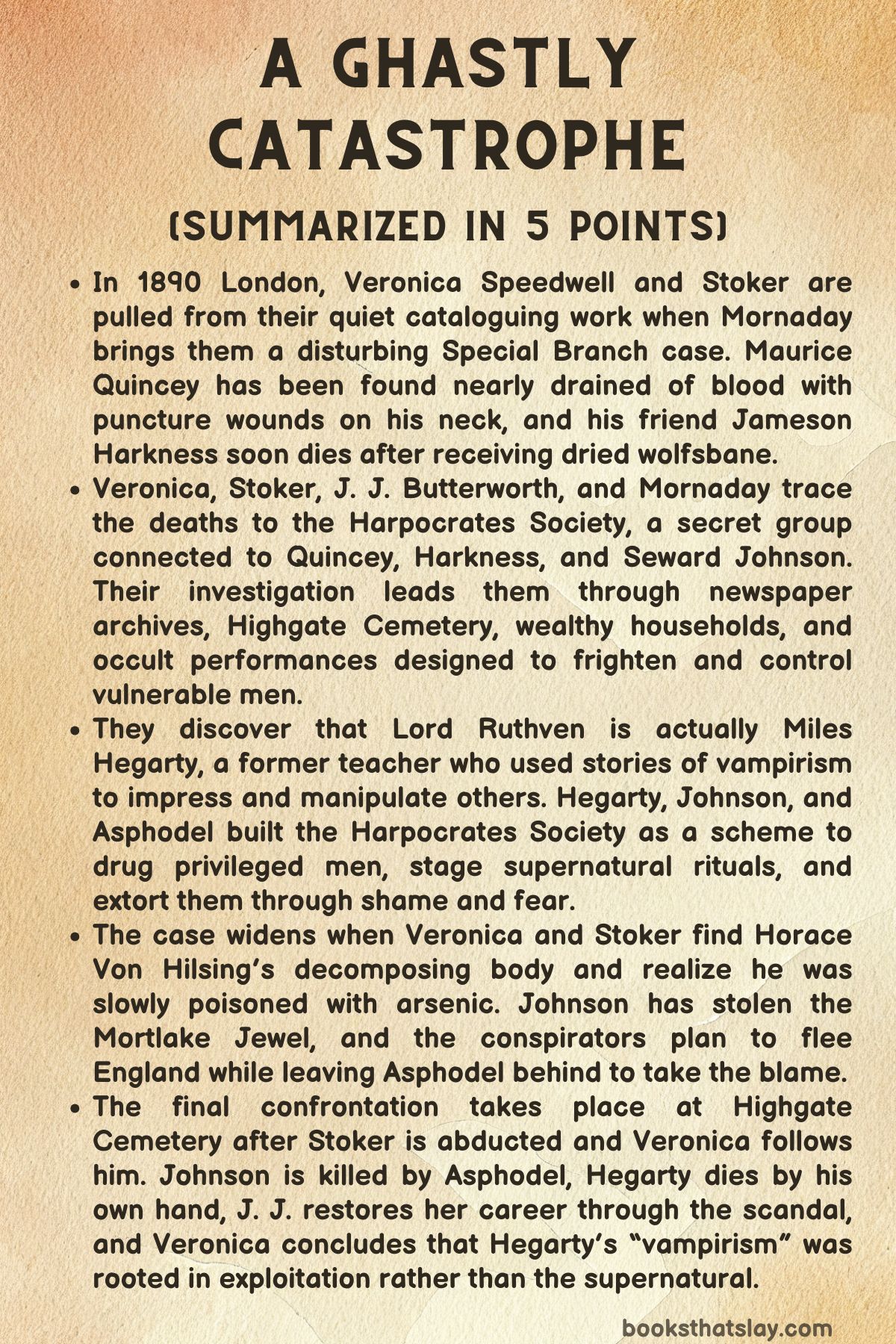
In London in 1890, Veronica Speedwell and Stoker are beginning to feel the strain of an uneventful period. After months without a proper mystery, their lives have settled into the quieter work of cataloguing Lord Rosemorran’s vast and unusual collections at Bishop’s Folly.
The task is useful, but it does not satisfy their taste for danger, inquiry, or intellectual challenge. That changes when Mornaday of Special Branch arrives with a case that is too strange to ignore.
A young man named Maurice Quincey has been found dead in a carriage near Highgate Cemetery. His body appears to have been almost drained of blood, and there are two puncture wounds on his neck.
The details suggest something impossible, or at least something designed to appear impossible. The matter has already been handled with secrecy because Quincey belongs to a family powerful enough to suppress scandal.
Soon afterward, another young man, Jameson Harkness, dies in disturbing circumstances. He receives dried wolfsbane in the post, becomes terrified, and throws himself from a balcony.
Like Quincey’s death, Harkness’s end is quietly covered up by relatives who prefer silence to public disgrace.
Veronica and Stoker recognize that the two deaths are connected, and Mornaday needs help from people willing to look where official channels cannot. They are joined by J. J. Butterworth, a bold journalist whose career has just suffered a serious blow.
She has been dismissed from her newspaper after exposing a corrupt landlord, and she temporarily moves into Bishop’s Folly. Her skills with archives and public records become essential to the investigation.
While searching old newspaper reports, J. J. discovers that Quincey, Harkness, and a third man, Seward Johnson, had all attended meetings of a secretive group called the Harpocrates Society.
Johnson is employed as secretary to Horace Von Hilsing, an eccentric and wealthy American collector. When Veronica and Stoker visit Von Hilsing’s house to question Johnson, he claims to remember very little of importance.
His manner is guarded, and his answers are too vague to be convincing. Veronica and Stoker leave with the strong impression that Johnson knows far more than he is willing to say.
His connection to Quincey and Harkness makes him a central figure, though it remains unclear whether he is a victim, witness, or criminal.
With assistance from Tiberius Templeton-Vane, Veronica and Stoker make contact with Nicholas and Julia Brisbane, who help them trace a Romany boy seen near Quincey’s body. The boy’s account strengthens the link between the deaths, Highgate Cemetery, and strange ceremonies that seem to involve occult symbols and staged supernatural effects.
The cemetery becomes more than a backdrop; it is part of the performance surrounding the crimes.
Their search leads them to Lord Ruthven, a theatrical and unsettling figure associated with the Harpocrates Society. Ruthven presents himself with deliberate vampiric style, relying on atmosphere, suggestion, and the fears of his audience.
His companion, Asphodel, adds to the effect with potions, ritual objects, and knowledge of substances that can alter perception. The society appears to attract wealthy, bored, unhappy, or reckless young men by promising forbidden experiences.
Its meetings involve mesmerism, drugs, ceremonies, and carefully arranged supernatural illusions. Members are encouraged to believe they have crossed into a hidden world, when in truth they are being manipulated.
As Veronica and Stoker press further, they discover that Lord Ruthven is not a nobleman at all. His real name is Miles Hegarty, and he once worked as a teacher at a school called Little Saints.
There he impressed his pupils with dark stories about vampires and the occult. His talent for storytelling, performance, and control over others later became the foundation of a criminal enterprise.
Hegarty joined forces with Seward Johnson, who is not only his accomplice but also his lover. Together, and with Asphodel’s help, they created the Harpocrates Society as a means of trapping privileged men.
Their method is cruel and effective. They lure men into secret rituals, give them drugs, frighten them with staged supernatural scenes, and then exploit the shame, secrets, or confusion that follow.
Some are robbed of valuables. Others are pressured for money.
The society depends on its victims being too embarrassed or afraid to go to the police. In Victorian society, reputation can be as powerful a weapon as any blade or poison, and Hegarty and Johnson know how to use that weakness.
The case becomes even darker when Veronica and Stoker learn that Horace Von Hilsing has not gone abroad, despite what Johnson has claimed. They break into his house and find his decomposing body.
Evidence shows that he had been slowly poisoned with arsenic. Johnson has also stolen the famous Mortlake Jewel from him.
The murder of Von Hilsing reveals that the crimes are not limited to theatrical blackmail or staged horror. Johnson and Hegarty are willing to kill for money and escape.
The conspirators plan to leave England aboard a ship called the Greville, taking the stolen jewel and abandoning the wreckage of their scheme behind them. Asphodel, however, seems to have been marked as a possible scapegoat.
She has assisted in the society’s deceptions, but Johnson and Hegarty do not intend to protect her. Their loyalty is only to each other and to their own survival.
The danger becomes personal when Stoker is abducted and taken to Highgate Cemetery. Hegarty, Johnson, and Asphodel prepare one of their dramatic rituals, using the cemetery’s atmosphere to heighten fear and confusion.
Veronica follows, determined to save him and expose the truth. In the confrontation that follows, the real story behind the deaths is revealed.
Maurice Quincey had discovered Johnson and Hegarty together and attempted to blackmail them. To silence him, they killed him and arranged the body to resemble a vampire attack, using the puncture wounds and blood loss to create a sensational explanation that would confuse witnesses and terrify anyone who heard the rumors.
Jameson Harkness died because the conspirators feared Quincey might have confided in him. By sending him dried wolfsbane, they triggered his terror and drove him to suicide.
His death was murder by manipulation rather than by direct violence.
During the confrontation, Johnson shoots at Veronica. Asphodel then realizes that Johnson and Hegarty have used her and intended to leave her behind.
In anger and self-preservation, she stabs Johnson. Veronica and Stoker become trapped in a crypt with Hegarty and Johnson’s body, and the situation grows desperate until J. J. and Mornaday arrive to rescue them.
Hegarty, devastated by Johnson’s death and unwilling to live without him, secretly cuts his femoral artery and dies.
After the immediate danger passes, Asphodel visits Veronica and explains more about how the Harpocrates Society operated. She describes the tricks, drugs, and psychological tactics used to create the illusion of supernatural power.
She insists that she did not know Von Hilsing was dead, though she does not surrender herself. Instead, she escapes, leaving her exact future uncertain.
Mornaday understands that the official version of events must be shaped carefully. Because Quincey and Harkness came from influential families, their deaths are politically impossible to reopen.
Public truth would cause scandal that powerful people will not allow. The case is therefore framed around the murder of Von Hilsing and the theft of the Mortlake Jewel.
It is not complete justice, but it is the version that can survive public scrutiny.
J. J. Butterworth uses the scandal to repair and rebuild her career, proving again that she is too talented and determined to be pushed aside for long. Veronica reflects on the nature of the villain they have defeated.
Hegarty was not a supernatural vampire, but he lived by feeding on fear, weakness, money, and life itself. In that sense, the name fits him.
The horror at the center of A Ghastly Catastrophe is not the existence of monsters from legend, but the human ability to create terror, exploit trust, and destroy others for gain.
Characters
In A Ghastly Catastrophe by Deanna Raybourn, the characters are shaped by secrecy, performance, fear, ambition, and moral courage. The book uses its central mystery not only to uncover crimes, but also to reveal how different people respond when confronted with danger, shame, power, and deception.
Veronica Speedwell
Veronica Speedwell is the central force of intelligence, courage, and emotional control in the book. She approaches the deaths of Maurice Quincey and Jameson Harkness with a sharp investigative mind, refusing to be distracted by the theatrical suggestion of vampires or supernatural forces.
Her strength lies in her ability to separate performance from truth. While others may be frightened by the staged horror surrounding the murders, Veronica remains practical and observant, noticing evasions, inconsistencies, and human motives behind the elaborate disguises.
She is also fearless in a physical sense, following Stoker into danger and confronting criminals even when she is threatened directly. At the same time, Veronica is not simply cold or detached.
Her loyalty to Stoker, her respect for J. J. Butterworth’s talents, and her willingness to understand even morally compromised figures like Asphodel show that she is emotionally perceptive as well as intellectually brilliant. In the story, Veronica represents reason, independence, and moral clarity in a world where secrets are often protected by class, wealth, and reputation.
Stoker
Stoker is Veronica’s partner in investigation and one of the most grounded presences in the book. He brings physical courage, scientific understanding, and deep loyalty to the mystery.
His work with Lord Rosemorran’s collections shows his patience and discipline, but his restlessness also reveals that he needs challenge and danger in order to feel fully alive. Stoker’s abduction near the end of the story places him in direct physical peril, but it also emphasizes his importance to Veronica and to the emotional structure of the plot.
He is not merely an assistant or companion; he is someone whose absence immediately changes the atmosphere of the investigation. Stoker’s character combines toughness with vulnerability.
He can withstand danger, but he is also deeply affected by betrayal, cruelty, and the suffering caused by greed. His partnership with Veronica is built on trust and shared courage, making him both her equal and her emotional anchor throughout the book.
Mornaday
Mornaday of Special Branch is a character who represents the uneasy relationship between justice and political convenience. He brings the case to Veronica and Stoker because he understands that the official channels are limited by power, reputation, and family influence.
His presence gives the mystery a wider social and political dimension, since the deaths are not simply private tragedies but events being deliberately hidden by influential people. Mornaday is practical, controlled, and aware of the limits of what can be publicly exposed.
This makes him morally complicated, though not corrupt. He wants the truth, but he also knows that the official version of events may have to be shaped carefully.
By the end of the book, his decision to focus the public story around Von Hilsing’s murder and the stolen jewel shows his willingness to compromise in order to secure at least some form of justice. Mornaday is therefore a figure of institutional realism: he understands truth, but he also understands power.
J. J. Butterworth
J. J. Butterworth is one of the most energetic and resourceful characters in the book. Having been dismissed from her newspaper after exposing a corrupt landlord, she enters the story as someone who has already paid a price for telling the truth.
Her temporary move into Bishop’s Folly allows her to become more closely involved in the investigation, and her skill with newspaper archives proves essential in connecting Quincey, Harkness, and Seward Johnson to the Harpocrates Society. J. J. is ambitious, clever, and resilient.
She does not collapse after professional humiliation; instead, she turns the new scandal into an opportunity to rebuild her career. Her character shows how journalism can serve justice when official systems are compromised.
She also provides a lively contrast to Veronica. Both women are intelligent and unconventional, but J. J.’s strength lies especially in public exposure, research, and narrative power.
She knows how stories are made, hidden, and weaponized.
Maurice Quincey
Maurice Quincey is important because his death begins the central mystery, but he is more than simply a victim. His involvement with the Harpocrates Society reveals a young man drawn into a world of secrecy, thrill, and staged transgression.
Quincey’s death, arranged to resemble a vampire attack, shows how completely Hegarty and Johnson understood the power of fear and spectacle. Yet Quincey’s own actions are not entirely innocent, since he discovered Johnson and Hegarty’s relationship and attempted to blackmail them.
This makes him a morally flawed victim rather than a purely helpless one. His character illustrates the dangers of curiosity mixed with privilege, boredom, and recklessness.
Quincey becomes trapped in the very world of secrets he hoped to exploit. In the book, his death exposes the larger pattern of manipulation, shame, and violence behind the Harpocrates Society.
Jameson Harkness
Jameson Harkness is one of the most tragic figures in the book because his death is caused not by direct violence, but by terror. After receiving dried wolfsbane, he is psychologically driven into suicide because Hegarty and Johnson fear that Quincey may have confided in him.
Harkness’s fate reveals the cruelty of the criminals’ methods. They do not need to kill him with their own hands; they understand his fear well enough to make him destroy himself.
His character demonstrates how powerful suggestion, guilt, superstition, and panic can become when carefully manipulated. Harkness also expands the emotional consequences of Quincey’s murder.
His death proves that the conspiracy is not limited to one desperate act, but has become a pattern of predation. He is a victim of fear turned into a weapon.
Seward Johnson
Seward Johnson is one of the central villains of the story, but his character is not built on simple brutality alone. He is evasive, calculating, and deeply involved in the machinery of deception that surrounds the Harpocrates Society.
As secretary to Horace Von Hilsing, Johnson occupies a position of trust, which he abuses for greed and escape. His theft of the Mortlake Jewel and his role in Von Hilsing’s poisoning show that he is capable of long-term betrayal, not merely sudden violence.
Johnson’s relationship with Miles Hegarty adds emotional complexity to his character, because love and criminal ambition are intertwined in his choices. However, his love does not make him noble.
He is willing to abandon Asphodel, kill Quincey, terrify Harkness, and shoot at Veronica in order to protect himself and flee. Johnson represents selfish survival disguised beneath charm, secrecy, and dependence.
His death at Asphodel’s hands is fitting because he is ultimately destroyed by someone he considered disposable.
Horace Von Hilsing
Horace Von Hilsing is an eccentric American millionaire whose wealth makes him both powerful and vulnerable. Although he is absent for much of the story, his hidden death becomes one of the most important revelations in the investigation.
The claim that he has gone abroad is part of Johnson’s deception, and the discovery of his decomposing body exposes the deeper criminal plot. Von Hilsing’s slow arsenic poisoning suggests that he was not killed in a moment of panic, but deliberately removed so that Johnson could steal from him and cover his tracks.
His character represents the danger of isolation within wealth. He possesses valuable objects and social importance, but those very things make him a target.
Von Hilsing’s death also shifts the mystery from theatrical horror to cold financial crime, proving that beneath the vampire imagery lies ordinary human greed.
Lord Rosemorran
Lord Rosemorran is not central to the crimes, but his presence matters because he provides the setting from which Veronica and Stoker begin the story. His collections and Bishop’s Folly represent routine, scholarship, and domestic stability, which contrast strongly with the dark world of Highgate Cemetery and the Harpocrates Society.
Through him, the book shows Veronica and Stoker in a period of restlessness before the mystery begins. Lord Rosemorran’s world is orderly and intellectual, but it cannot fully satisfy characters who are drawn toward danger and investigation.
He therefore functions as part of the stable background against which the central mystery becomes more dramatic.
Tiberius Templeton-Vane
Tiberius Templeton-Vane serves as a useful social bridge in the investigation. His connections help Veronica and Stoker reach Nicholas and Julia Brisbane, which allows them to pursue information that would otherwise be harder to obtain.
Tiberius is valuable because he understands the networks of privilege, reputation, and influence that shape the world of the book. He belongs to the same broad social environment that allows scandals to be hidden, but he uses his position to assist rather than obstruct the search for truth.
His character shows that aristocratic power is not automatically corrupt, though it can easily protect corruption when used wrongly. Tiberius adds elegance, access, and social intelligence to the investigation.
Nicholas Brisbane
Nicholas Brisbane is a supporting figure who contributes to the investigation through his ability to help locate the Romany boy connected to Quincey’s death. His role is not as extensive as Veronica’s or Stoker’s, but he is important because he helps move the inquiry beyond rumor and into testimony.
Brisbane’s involvement gives the investigation access to communities and knowledge outside official channels. His character suggests competence, discretion, and a willingness to assist when the truth is at stake.
He also strengthens the sense that Veronica and Stoker operate within a wider world of capable allies, not in isolation.
Julia Brisbane
Julia Brisbane, like Nicholas, plays a supporting but meaningful role in the investigation. Her assistance helps Veronica and Stoker reach the Romany boy whose account connects the deaths to Highgate and to the strange rituals surrounding the Harpocrates Society.
Julia’s presence brings social grace and practical support to the inquiry. She is not presented as a passive background figure; instead, she contributes to the chain of discoveries that allows the truth to emerge.
Her character reflects the book’s interest in capable women who operate intelligently within and around the restrictions of their society.
The Romany Boy
The Romany boy is a minor character, but his account is important because it helps connect Quincey’s body, Highgate Cemetery, and the ritualistic elements of the case. He represents the kind of witness who might easily be ignored by official investigators, especially in a society shaped by class prejudice and social hierarchy.
Veronica and Stoker’s willingness to take his information seriously shows their strength as investigators. The boy’s role also reminds the reader that truth often survives in overlooked places.
His testimony helps puncture the theatrical mystery surrounding the deaths and brings the investigation closer to the human actions behind the staged supernatural events.
Lord Ruthven / Miles Hegarty
Lord Ruthven, whose real identity is Miles Hegarty, is the most theatrical and predatory figure in A Ghastly Catastrophe. As Ruthven, he creates an atmosphere of vampiric glamour, mystery, and danger, using performance to attract and control vulnerable or reckless men.
As Hegarty, the former teacher, he is revealed to be a manipulator who learned how powerfully stories of vampirism could affect impressionable minds. His genius lies in understanding desire and fear.
He knows how to make wealthy, bored, or unhappy young men believe they are entering a forbidden supernatural world, when in reality they are being drugged, frightened, exploited, and robbed. Hegarty is morally monstrous because he feeds on weakness, shame, and secrecy.
Yet he is also emotionally dependent on Johnson, and his final suicide after Johnson’s death shows the depth of that attachment. This does not redeem him, but it makes him more tragic and psychologically complex.
He is not a supernatural vampire, but the label fits because he drains money, safety, dignity, and life from others.
Asphodel
Asphodel is one of the most morally ambiguous characters in the book. She is involved in the Harpocrates Society and helps create the potions, occult effects, and ritual atmosphere that make Hegarty and Johnson’s deceptions convincing.
She understands performance, illusion, and the power of fear, and she plays her role within the criminal enterprise. However, she is not presented as identical to Johnson or Hegarty.
Her later conversation with Veronica suggests that she did not know the full extent of every crime, particularly Von Hilsing’s death. Her decision to stab Johnson comes from betrayal as much as justice, because she realizes that Johnson and Hegarty planned to abandon her and possibly leave her as a scapegoat.
Asphodel is neither innocent nor purely villainous. She is clever, dangerous, self-protective, and wounded by her own misplaced trust.
Her escape leaves her as an unresolved figure, someone who has helped evil but has also been used by it.
The Harpocrates Society
Although the Harpocrates Society is not a single person, it functions almost like a collective character in the story. It represents secrecy, performance, temptation, and exploitation.
The society attracts men who are wealthy, bored, unhappy, or hungry for forbidden experiences, and then turns their desires against them. Its rituals combine mesmerism, drugs, occult imagery, and staged supernatural terror, creating a world where victims are made to feel both fascinated and ashamed.
The society’s name and ceremonies suggest mystery and ancient power, but beneath the surface it is a criminal machine designed to extract money, valuables, and secrets. It reveals how easily people can be controlled when fear and desire are carefully manipulated.
Themes
Manipulation Through Fear
Fear becomes a tool of control, not just an emotional response. In A Ghastly Catastrophe, the criminals understand that people can be guided, silenced, and ruined when their deepest anxieties are targeted.
The staged vampire-like deaths, the use of wolfsbane, the cemetery rituals, and the occult atmosphere are not random dramatic details; they are carefully chosen methods meant to make victims believe they are facing something beyond ordinary human crime. This makes fear more powerful than physical force because it causes people to act against their own interests.
Harkness’s death shows how terror can become fatal when a person is pushed into panic and isolation. The Harpocrates Society also depends on fear after the ceremonies end, since its members are too ashamed or frightened to expose what happened.
Through this, the story shows that superstition can be manufactured and sold, especially to those who already feel trapped by reputation, secrecy, or guilt.
The Abuse of Privilege and Reputation
Social position protects many of the wrong people and makes justice difficult. The deaths of Quincey and Harkness are hidden because their relatives have enough influence to suppress scandal.
This creates a world where truth is less important than public respectability. Wealthy families prefer silence over exposure, even when silence allows criminals to continue harming others.
The victims are not treated simply as men who died violently; they become problems to be managed by people who fear embarrassment. The Harpocrates Society survives because it feeds on this weakness.
Its members are privileged enough to seek forbidden thrills, but also vulnerable because their reputations matter so much. Johnson and Hegarty exploit that contradiction.
They know that shame can be as useful as money. The investigation challenges this system by forcing hidden facts into the open, yet the ending also shows the limits of justice when powerful families and official institutions choose a controlled story over the complete truth.
Performance, Deception, and False Identity
Many characters use performance to create power. Hegarty’s transformation into Lord Ruthven is not merely a disguise; it is a full role designed to impress, frighten, and dominate others.
His theatrical manner, his connection to vampiric imagery, and his command of ritual allow him to appear larger than life. Asphodel also participates in this world of illusion through potions, occult objects, and staged ceremonies.
Together, they turn crime into spectacle. Their victims are manipulated because they cannot easily separate acting from reality, especially when drugs and mesmerism are involved.
Johnson’s evasive behavior adds another layer of deception, since he hides behind ordinary respectability while helping run the scheme. The theme suggests that identity can become dangerous when it is used as a mask for exploitation.
The supernatural appearance of the crimes hides very human motives: greed, ambition, jealousy, and self-preservation. The mystery is solved only when Veronica and Stoker strip away the performances and identify the people behind them.
Moral Courage and the Search for Truth
The investigation depends on people who are willing to pursue truth even when official channels are limited or compromised. Veronica, Stoker, J. J., and Mornaday each confront different risks while trying to uncover what really happened.
Veronica and Stoker face physical danger, especially when the case leads them into hidden rooms, secret rituals, and direct violence. J. J. shows courage in another form.
After losing her newspaper position for exposing corruption, she continues using her skill and intelligence rather than retreating from public life. Her work in the archives proves that truth often depends on patience, research, and persistence, not only dramatic confrontations.
Mornaday’s role is more complicated because he works within a system shaped by politics and reputation. The final official explanation is incomplete, yet the private truth still matters.
The theme shows that moral courage does not always produce perfect justice, but it prevents lies from having total control over the lives of the victims and survivors.