A Latte Like Love Summary, Characters and Themes
A Latte Like Love by Michelle Harris is a contemporary romance about trust, recovery, and the quiet courage it takes to be seen. The story follows Audrey Adams, a hardworking NYU electrical engineering student and café barista, whose ordinary mornings change when she notices Theo Sullivan, a mysterious customer carrying deep physical and emotional scars.
What begins with coffee orders and careful conversations grows into a tender relationship shaped by art, fear, family pain, and healing. A Latte Like Love is about two people learning that love does not erase trauma, but it can create a safe place to face it.
Summary
Audrey Adams is balancing two demanding parts of her life: working as a barista at Déjà Brew and finishing her electrical engineering degree at NYU. Her days are busy, practical, and often exhausting, but the café gives her a familiar rhythm.
One Tuesday morning, she notices a new customer who immediately stands out. He is very large, clearly nervous, and almost hidden beneath a hoodie, cap, and mask.
He arrives at exactly 8:17 a.m., orders an extra-hot Americano, tips generously with nearly all his change, and takes a seat in the corner with a black notebook. He never drinks his coffee inside the café, and he avoids attention as much as possible.
Audrey becomes curious about him, not in a careless way, but because there is something lonely and guarded about him. She starts to draw small pieces of conversation from him.
He answers carefully, giving little away, yet his repeated presence becomes part of her morning. She sees that he is not rude or unfriendly; he is afraid.
His routine seems like something he uses to stay steady in a world that feels unsafe to him.
That fragile routine breaks when Patricia, a rude regular at the café, shoves him and pulls off his mask. The moment exposes the severe scar across his face, still fresh enough to shock everyone around him.
The man is horrified by the sudden attention. Feeling exposed and humiliated, he runs out of the café and accidentally leaves his black notebook behind.
Audrey keeps the notebook safe, intending to return it. When she looks inside, she realizes it is not just a notebook but a sketchbook filled with remarkable artwork.
There are designs, city scenes, lettering, and detailed images that reveal a gifted artist’s eye. Hidden among the pages is a portrait of Audrey, made with coffee.
The discovery changes the way she sees him. His silence now feels less like mystery and more like protection.
His notebook shows a part of him that he is not ready to share openly.
After the incident, he stops coming to Déjà Brew. Audrey worries that he has disappeared from her life completely.
Later, she sees him entering the office of Dr. Amelia Harper, a trauma therapist. Instead of confronting him, she leaves a note with her number.
It is a small gesture, but it gives him the choice to reach out. The next day, he returns to the café.
Audrey gives back the notebook, and the tension between them begins to soften. They admit that they are interested in each other.
He finally tells her his name: Theo Sullivan.
Theo explains part of what he has been facing. He has nerve damage in his hand, and because of that he can no longer safely work in his usual artistic medium, glass.
This loss is not only physical but emotional. Art is central to his identity, and his injury has cut him off from the work that once gave him purpose.
Audrey listens without treating him like a problem to fix. Her patience allows Theo to feel less judged and more understood.
They begin texting and spending Audrey’s café breaks together. Their connection grows slowly at first, built through ordinary messages, shared time, and careful honesty.
Their first date is a walk through Central Park. Theo brings flowers and Levain cookies, a thoughtful combination that shows how much attention he pays.
During the date, he draws another portrait of Audrey and speaks about his family. Their time together feels warm, but Theo’s fear is still present.
He wants to be close to Audrey, yet he is not fully ready to let her see every part of him.
Theo takes Audrey to see Casablanca and then brings her to a birria food truck run by his friend Diego’s uncle. The evening gives Audrey a fuller view of his personality.
He is romantic, observant, and generous, but also careful with his vulnerability. When he walks her home, they share a powerful first kiss.
Even then, Theo asks Audrey to keep her eyes closed so she will not see his uncovered face. The request shows how deeply his scar and trauma still affect him.
Audrey respects his boundary, even while wishing he could trust that she already sees him as more than his injury.
As their relationship continues, Theo becomes more present in Audrey’s life. He brings her dinner, visits her small apartment, and slowly allows himself to be less hidden.
Eventually, he shows her his face voluntarily. This is a major step for him, not because Audrey needs proof of his trust, but because Theo needs to reclaim control over how he is seen.
Audrey’s response confirms what he has been afraid to believe: she is not there out of pity, and his scar does not reduce her desire for him.
Theo also reveals a major secret. He is Lightm4st3r, a famous anonymous neon and glass artist whose work sells for enormous amounts at charity auctions.
Audrey is stunned, but the revelation helps her understand the scale of what Theo has lost since the accident. His talent is not a hobby; it is a life he built and then felt forced to abandon.
She visits his home and studio, where she sees the world he has kept hidden. His studio represents both who he was and who he fears he can no longer be.
Audrey supports Theo as he tries to create again despite his injuries and anxiety. She does not pressure him to return to art before he is ready.
Instead, she offers steady encouragement. Theo, in turn, supports Audrey with her engineering project.
His knowledge of wiring and electrical work surprises her and creates another point of connection between them. Their relationship becomes more balanced as each of them brings skill, care, and belief into the other’s life.
At a Halloween party for Audrey’s student organization, Theo dresses as the Invisible Man, a costume that reflects his desire to stay covered while also allowing him to participate. Audrey dresses as “Fifty Shades of Grey,” bringing humor and confidence to the event.
Their bond deepens, but Theo’s trauma is not gone. It surfaces sharply when his estranged mother, Eleanor, appears.
His reaction reveals years of pain, anger, guilt, and grief.
The truth behind Theo’s suffering becomes clearer. A car accident involving a semitruck killed his father, Henry, and left Theo badly injured.
Theo believes he caused his father’s death, and that belief has trapped him in shame. His scar is visible, but his guilt is the deeper wound.
Audrey helps him begin to understand the accident differently. She encourages him to see that his father died saving him, not because Theo failed him.
This realization does not instantly cure Theo, but it gives him a new way to begin grieving.
Theo and Audrey eventually confess their love and become fully committed to each other. Their relationship becomes a place where both ambition and healing can exist.
Theo begins repairing his relationship with Eleanor through therapy, taking cautious steps toward forgiveness and understanding. Audrey completes her degree and graduates from NYU.
Theo attends proudly and hides less than before, showing how much progress he has made. His presence at her graduation is not only a romantic gesture but also a sign that he is learning to face public spaces without letting fear control him.
Theo completes a new Lightm4st3r sculpture for a black-tie charity gala. Audrey attends with him, wearing borrowed Redmond family jewelry.
The event brings intense public attention, including paparazzi. For Theo, this could easily become overwhelming, but he manages it with Audrey by his side.
His new piece sells for a record amount, proving that his artistic voice has not disappeared. His return to art is also a return to himself.
After the gala, Theo and Audrey celebrate together. A few weeks later, Audrey moves into Theo’s home, marking a new stage in their shared life.
Theo also reveals his secret studio to Violet, showing that he is becoming more open not only with Audrey but with others he trusts. The spaces he once guarded are no longer only places of fear and isolation.
The story closes with Theo reflecting on the two years since the accident. His scar has faded to a faint line, and his anxiety has eased.
He has returned to making art and has raised more than five million dollars for a domestic violence shelter. His relationship with his mother has improved, and he has received his grandmother’s emerald ring.
These details show how much his life has changed, not because the past vanished, but because he learned to live beyond it.
Theo takes Audrey to Paris, where he plans to propose at a café surrounded by flowers. The setting brings their story back to where it began: coffee, quiet attention, and the possibility of love.
He is finally ready to stop measuring his life by the accident and the days since it happened. With Audrey, he can imagine a future defined not by fear, guilt, or hiding, but by choice, hope, and a life fully shared.
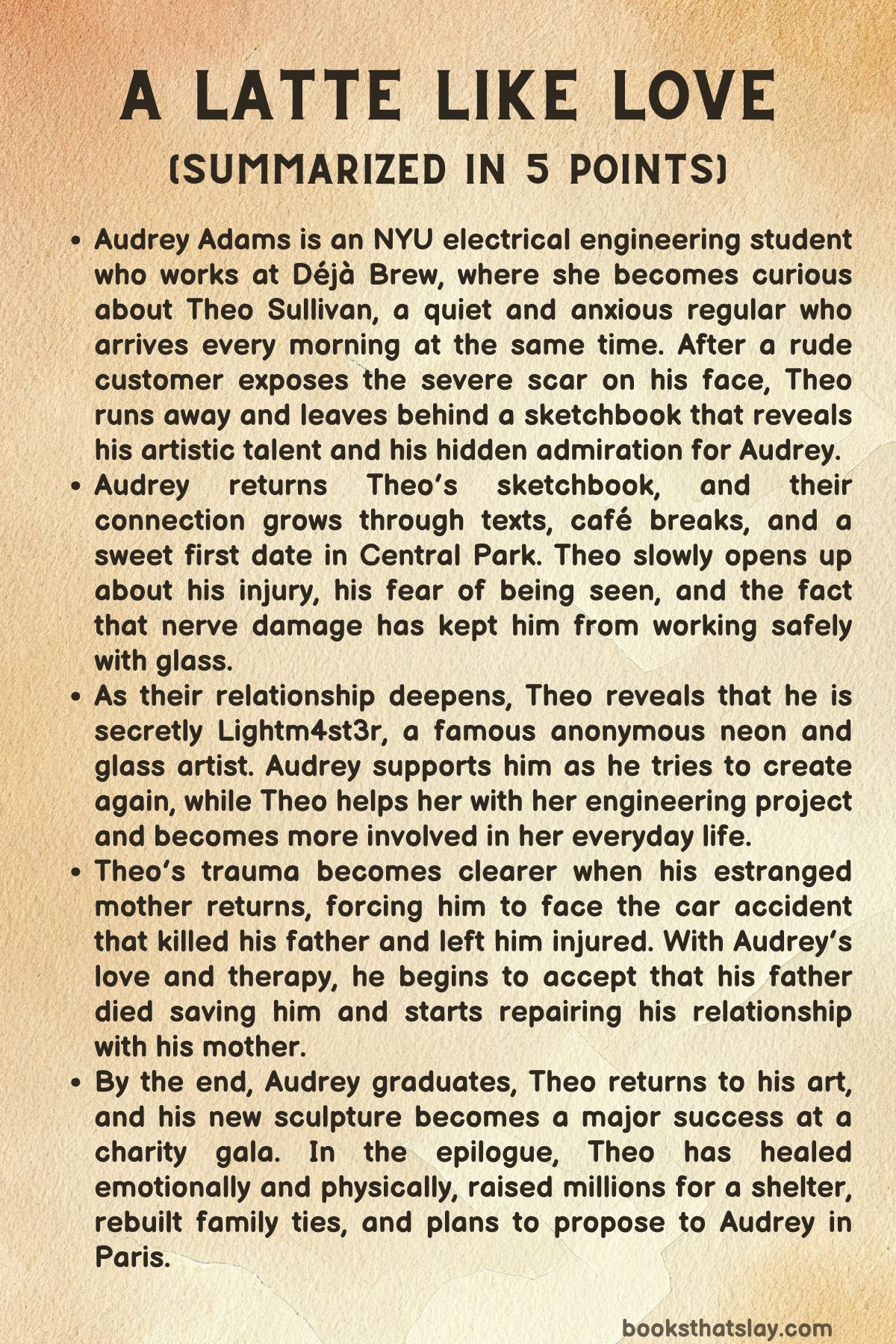
Characters
In A Latte Like Love, the characters are built around themes of healing, courage, love, guilt, creativity, and emotional recovery. Each character contributes to the emotional movement of the story, either by helping the central relationship grow or by revealing the pain and fear that the main characters must learn to face.
Audrey Adams
Audrey Adams is the emotional heart of the book because she represents warmth, patience, curiosity, and quiet strength. She works as a barista at Déjà Brew while finishing her electrical engineering degree at NYU, which immediately shows that she is hardworking and determined.
Audrey is not presented as someone whose life is effortless; she is balancing school, work, financial limits, and personal ambition. Her character becomes especially important through the way she notices Theo.
While other people in the café either ignore him or react to his strange routine with suspicion, Audrey pays attention to him with interest rather than judgment. This makes her compassionate, but not intrusive.
She slowly draws conversation from him, showing that she understands emotional boundaries and does not force intimacy before Theo is ready.
Audrey’s kindness is one of her strongest qualities, but the book also shows that her kindness is active rather than passive. When Patricia humiliates Theo by ripping off his mask, Audrey’s horror comes from empathy, not curiosity.
She understands that Theo’s privacy has been violated. Her decision to protect and return his notebook reveals her respect for him, even after discovering the hidden portrait of herself.
Audrey is deeply moved by his art, but she does not treat it as something she is entitled to understand immediately. As her relationship with Theo develops, she becomes a steady source of emotional safety for him.
She encourages him to return to art, supports him through his trauma, and helps him reinterpret the guilt he carries about his father’s death. Audrey’s role is not to “fix” Theo, but to love him in a way that helps him believe healing is possible.
Audrey is also significant because she has her own intelligence and ambitions outside the romance. Her electrical engineering background matters because it allows her to connect with Theo’s artistic world in a practical and meaningful way.
She understands wiring, structure, design, and problem-solving, which makes her more than just an admirer of his work. When Theo helps her with her engineering project, their relationship becomes a partnership of minds as well as hearts.
Audrey’s growth lies in her willingness to enter a deeper emotional life with Theo while still moving forward with her own future. By the end of the story, she has graduated, chosen love, and stepped into a more permanent life with Theo, but she remains her own person: capable, intelligent, loving, and brave.
Theo Sullivan
Theo Sullivan is one of the most emotionally complex figures in the book because he is shaped by trauma, guilt, secrecy, and a deep longing to be seen without being feared. At first, Theo appears mysterious and almost unreachable.
He comes to the café at the same exact time, hides behind a hoodie, cap, and mask, orders the same coffee, and isolates himself in a corner with his notebook. These habits show how controlled his life has become after the accident.
He uses routine as protection, and he hides his face because he is terrified of being exposed to pity, disgust, or judgment. His large physical presence contrasts with his emotional fragility, making him a character who looks intimidating from the outside but is deeply wounded within.
Theo’s scar is not only a physical mark; it represents the emotional damage he has not yet learned to live with. When Patricia exposes him in the café, his panic shows how raw his trauma still is.
His running away is not cowardice, but a survival response from someone who has already been through too much. The sketchbook he leaves behind becomes a window into the part of him he has hidden from the world.
Through his drawings, city scenes, lettering, and coffee portrait of Audrey, readers see that Theo is observant, sensitive, and intensely creative. His identity as Lightm4st3r adds another layer to his character.
Publicly, he is a famous anonymous artist whose work is admired and highly valued, but privately, he is a man afraid to be looked at directly. This contrast makes his character especially poignant.
Theo’s deepest struggle is not only with his appearance or injured hand, but with guilt over his father Henry’s death. He believes he caused the accident, and that belief traps him in grief.
His inability to safely work with glass after the nerve damage adds another loss: he has not only lost his father, but also the medium through which he expressed himself. Audrey’s love helps Theo begin to separate truth from guilt.
When he realizes that Henry died saving him, Theo begins to understand that survival does not have to be a punishment. His gradual decision to reveal his face, return to art, reconcile with Eleanor, attend Audrey’s graduation more openly, and eventually plan a proposal in Paris shows his transformation.
By the end of the novel, Theo is not magically cured, but he has learned to live again. His healing feels meaningful because it is slow, emotional, and earned.
Patricia
Patricia is a minor but important character because she acts as a force of cruelty and social judgment. As a rude regular at the café, she represents the kind of person who feels entitled to invade another person’s space simply because she is curious or irritated.
Her action of shoving Theo and ripping off his mask is one of the most harmful moments in the story because it turns Theo’s private pain into public spectacle. Patricia’s behavior shows a complete lack of empathy.
She does not see Theo as a person with fear, trauma, and dignity; she treats him as an object of suspicion and gossip.
Although Patricia does not have a large role, her presence is essential because she exposes the danger Theo fears from the outside world. Until that moment, Theo’s habit of covering his face may seem extreme, but Patricia proves that his fear is not irrational.
Some people really are careless and cruel when faced with difference or vulnerability. Her action also becomes a turning point in Audrey and Theo’s connection.
Audrey’s reaction to the incident shows Theo that not everyone will look at him with cruelty. In this way, Patricia functions as a contrast to Audrey.
Where Audrey is patient, Patricia is invasive. Where Audrey protects, Patricia exposes.
Her role strengthens the book’s message about compassion, privacy, and the harm caused by thoughtless judgment.
Dr. Amelia Harper
Dr. Amelia Harper plays an important role as the professional figure connected to Theo’s healing. As a trauma therapist, she represents the structured and difficult work of recovery.
Her presence in the story shows that Theo’s healing does not happen only because of romance. Love helps him, but therapy is also necessary.
This makes the emotional journey more believable because Theo’s trauma is serious, and the book does not reduce it to something that can be solved by affection alone.
Dr. Harper’s role also helps reveal that Theo is trying, even when he seems closed off. Audrey sees him entering her office, which shows that behind his silence and avoidance, he is already taking steps toward survival.
Dr. Harper becomes especially important in Theo’s reconciliation with Eleanor. The mother-son relationship is painful and complicated, and therapy gives them a space where anger, grief, guilt, and love can slowly be addressed.
Dr. Harper may not dominate the story, but she helps support one of its most important ideas: healing requires honesty, time, guidance, and the courage to face what has been buried.
Eleanor
Eleanor, Theo’s estranged mother, is one of the most emotionally painful characters in the story because her relationship with Theo is shaped by shared grief and separation. When she appears, Theo reacts with anger, which immediately shows that their bond has been deeply damaged.
Eleanor is connected to the central wound of Theo’s life: the accident that killed Henry and left Theo physically and emotionally scarred. Her presence forces Theo to confront not only his grief for his father, but also the pain of what happened afterward between him and his mother.
Eleanor’s character is important because she shows how grief can divide people who are suffering from the same loss. Theo’s anger toward her suggests that he feels abandoned, misunderstood, or unable to face her because she reminds him of everything he believes he destroyed.
Eleanor, in turn, represents the family connection Theo has avoided because it is too painful. Their eventual reconciliation through therapy shows that their relationship is not beyond repair.
Eleanor is not simply a source of conflict; she is part of Theo’s return to life. By repairing his bond with her, Theo begins to accept that his past can be grieved without controlling his entire future.
Henry
Henry, Theo’s father, is a powerful presence in the book even though he is no longer alive. His death shapes Theo’s guilt, trauma, and emotional isolation.
For much of the story, Theo believes that he caused Henry’s death, and that belief becomes one of the heaviest burdens he carries. Henry therefore functions as both a memory and a moral center in Theo’s journey.
The truth that Henry died saving Theo changes the meaning of the accident. It transforms Theo’s survival from something he sees as a source of guilt into something that can be understood as an act of love.
Henry’s importance lies in what he represents to Theo. He is the father Theo lost, the person whose death Theo cannot forgive himself for, and the proof that love sometimes appears as sacrifice.
Once Audrey helps Theo understand that Henry saved him, Theo begins to see his life differently. Henry’s death remains tragic, but it no longer has to mean that Theo is guilty or undeserving of happiness.
In this way, Henry’s character continues to influence the living characters. His love becomes part of Theo’s healing, helping Theo move toward art, family, and a future with Audrey.
Diego
Diego is a supporting character who helps widen Theo’s world beyond trauma and isolation. He is connected to the birria food truck that Theo takes Audrey to, and through him, the story shows that Theo still has ties to friendship, community, and ordinary pleasures.
Diego’s presence suggests that Theo has not been completely alone, even if he has emotionally withdrawn from much of life. He also helps create a warmer, more grounded side of Theo’s world, one that includes food, friendship, and familiar places.
Diego’s role may be smaller than Audrey’s or Eleanor’s, but he contributes to the atmosphere of trust around Theo. By bringing Audrey into a place connected to Diego’s family, Theo is sharing more of his life with her.
This matters because Theo’s healing is shown through small acts of openness. The food truck scene is not only romantic; it is also a sign that Theo is allowing Audrey to enter spaces that matter to him.
Diego therefore represents friendship, normalcy, and the social world Theo slowly begins to rejoin.
Diego’s Uncle
Diego’s uncle is a minor character, but his food truck adds warmth and realism to the story. Through him, the book creates a sense of community outside the café, Theo’s studio, and Audrey’s apartment.
The birria food truck becomes part of Theo and Audrey’s first date, making it a meaningful setting in their growing relationship. It shows that romance is built not only through dramatic confessions, but also through shared meals, familiar places, and simple experiences.
His role also adds texture to Theo’s character. Theo choosing that food truck suggests that he values personal connections and local places rather than only wealth, fame, or high art.
Even though Theo is secretly a famous artist, he still finds meaning in something humble and familiar. Diego’s uncle therefore helps reveal the grounded side of Theo’s life and supports the story’s contrast between public success and private emotional need.
Violet
Violet appears later in the story and is important because Theo reveals his secret studio to her. This moment suggests trust, inclusion, and the expansion of Theo’s private world.
Theo’s studio is not just a physical space; it represents his hidden identity, his creativity, and the part of himself he has guarded carefully. Allowing Violet into that space shows that Theo is becoming more open and less controlled by fear.
Violet’s role also emphasizes how far Theo has come. Earlier, he could barely allow Audrey to see his face, but later he is able to share deeply private parts of his life with others.
Violet helps mark that progress. Even if she is not central to the romance, her presence supports the broader theme of healing through connection.
Theo’s world is no longer limited to secrecy, trauma, and isolation; it is becoming a place where trusted people can enter.
The Redmond Family
The Redmond family is connected to the world of wealth, public attention, and social elegance surrounding the charity gala. Audrey wears borrowed Redmond family jewelry, which places her temporarily inside a world that is far from her ordinary life as a student and barista.
The jewelry becomes more than decoration; it symbolizes Audrey stepping into Theo’s public world, where fame, money, paparazzi, and social expectations are all present.
The Redmond family’s role also highlights the contrast between Audrey’s modest daily life and the glamorous spaces connected to Theo’s artistic success. Audrey does not become less herself in that setting.
Instead, her presence at the gala shows that she can stand beside Theo even when his hidden identity becomes public and overwhelming. The Redmond family therefore helps frame the social world around Theo’s success and the pressure Audrey must navigate as their relationship becomes more visible.
The Paparazzi
The paparazzi function less as individual characters and more as a public force. They represent exposure, pressure, and the loss of privacy.
Their presence at the charity gala is especially significant because Theo has spent much of the book hiding from being seen. The paparazzi swarm him and Audrey at a moment when his artistic identity is being publicly celebrated, which creates a strong contrast between recognition and vulnerability.
For Theo, the paparazzi symbolize one of his greatest fears: being looked at without control. However, by this point in the story, he is stronger than he was at the beginning.
He is still affected by public attention, but he no longer runs from every gaze. For Audrey, the paparazzi introduce the reality of loving someone whose private pain is tied to public fame.
Their role helps show that Theo’s healing is not about escaping attention forever, but about becoming strong enough to face the world with Audrey beside him.
Lightm4st3r
Lightm4st3r is not a separate person from Theo, but this identity deserves attention because it represents the hidden artistic self he has kept apart from his wounded public body. As Lightm4st3r, Theo is admired, mysterious, successful, and powerful.
His neon and glass art sells for enormous amounts, and his work carries public value. As Theo Sullivan, however, he feels damaged, afraid, and ashamed.
This division between the artist and the man reveals the central conflict of his character.
The Lightm4st3r identity shows that Theo has never lost his brilliance, even when he believes he has lost himself. His struggle to return to art after nerve damage in his hand is not only about physical ability; it is about whether he can still believe in beauty after trauma.
When he completes a new sculpture for the charity gala and raises a record amount, it becomes a sign of rebirth. Lightm4st3r begins as a mask that protects Theo, but by the end of A Latte Like Love, it becomes part of a more whole identity.
Theo no longer has to hide completely behind the name. He can be both the scarred man and the celebrated artist, both wounded and worthy of love.
Themes
Healing from Trauma
Audrey’s connection with Theo shows that healing is not a sudden recovery, but a slow movement toward trust, courage, and self-acceptance. Theo’s scar is visible, but his deeper wounds come from guilt, grief, and fear after the accident that changed his life.
He hides behind a mask, avoids attention, and controls small routines because they make the world feel safer. Audrey does not force him to recover on her timeline.
Instead, she offers patience, warmth, and steady presence. Her kindness helps Theo face the parts of himself he has tried to bury, including his fear of being seen and his belief that he caused his father’s death.
The emotional power of A Latte Like Love comes from showing that love cannot erase trauma, but it can create a space where a wounded person feels safe enough to begin healing. Theo’s progress becomes meaningful because it comes through therapy, honesty, family reconciliation, and his own decision to live again.
The Courage to Be Seen
Theo’s journey is shaped by his fear of exposure, both physically and emotionally. At first, he hides his face from strangers, from Audrey, and even from parts of his old life because being seen feels dangerous.
His mask and strict café routine give him control, but they also keep him isolated. Audrey’s curiosity begins as simple interest, but it grows into a deeper recognition of the person behind the silence.
When Theo finally shows Audrey his face by choice, the moment matters because it is not about appearance alone. It is about allowing someone to witness his pain without running from him.
This theme also connects to his identity as Lightm4st3r, since he has built a public reputation while remaining personally hidden. His return to public life at the gala shows that being seen no longer has to mean shame.
It becomes an act of strength, honesty, and self-ownership.
Love as Patience and Support
The romance between Audrey and Theo is built not only on attraction, but on patience, emotional care, and practical support. Audrey does not treat Theo as a mystery to solve or a broken person to fix.
She respects his boundaries, notices his fear, and gives him room to speak when he is ready. Theo, in return, supports Audrey’s ambitions and takes her engineering work seriously, showing that love also means valuing the other person’s goals.
Their relationship grows through small gestures: coffee, notes, shared breaks, walks, meals, drawings, and quiet conversations. These ordinary moments become the foundation for trust.
The theme shows that love is strongest when it does not demand immediate perfection. Audrey helps Theo return to art, and Theo helps Audrey feel seen in her own dreams.
Their bond works because it is mutual, not one-sided. Each gives the other confidence to step into a fuller future.
Art, Identity, and Renewal
Theo’s art represents more than talent; it is tied to his identity, grief, and recovery. Before the accident, glass and neon gave him a way to shape light into beauty.
Afterward, his injured hand and anxiety make creation feel dangerous, turning art into a reminder of what he has lost. His sketchbook becomes a private place where his creativity survives even when he cannot return to his old medium.
The hidden portrait of Audrey shows that art is still alive in him before he is ready to admit it. As Audrey encourages him, Theo slowly reconnects with his work, not by becoming exactly who he was before, but by accepting who he is now.
His new sculpture at the charity gala becomes a symbol of renewal because it proves that pain has not destroyed his gift. Through art, Theo transforms suffering into purpose, beauty, and generosity, especially through the money he raises for others in need.