A Lady for All Seasons Summary, Characters and Themes
A Lady for All Seasons by T. J. Alexander is a queer historical romance about identity, survival, desire, and the courage to choose an unconventional life. Set in Regency society, the novel follows Verbena Montrose, a young woman pressured by family ruin and social expectations, as she searches for a safe marriage.
Her practical plan grows complicated when she becomes involved with Étienne, Miles, Flora, and William, each carrying secrets of their own. The story explores love beyond social rules, the masks people wear to survive, and the freedom found in being fully known and fully accepted.
Summary
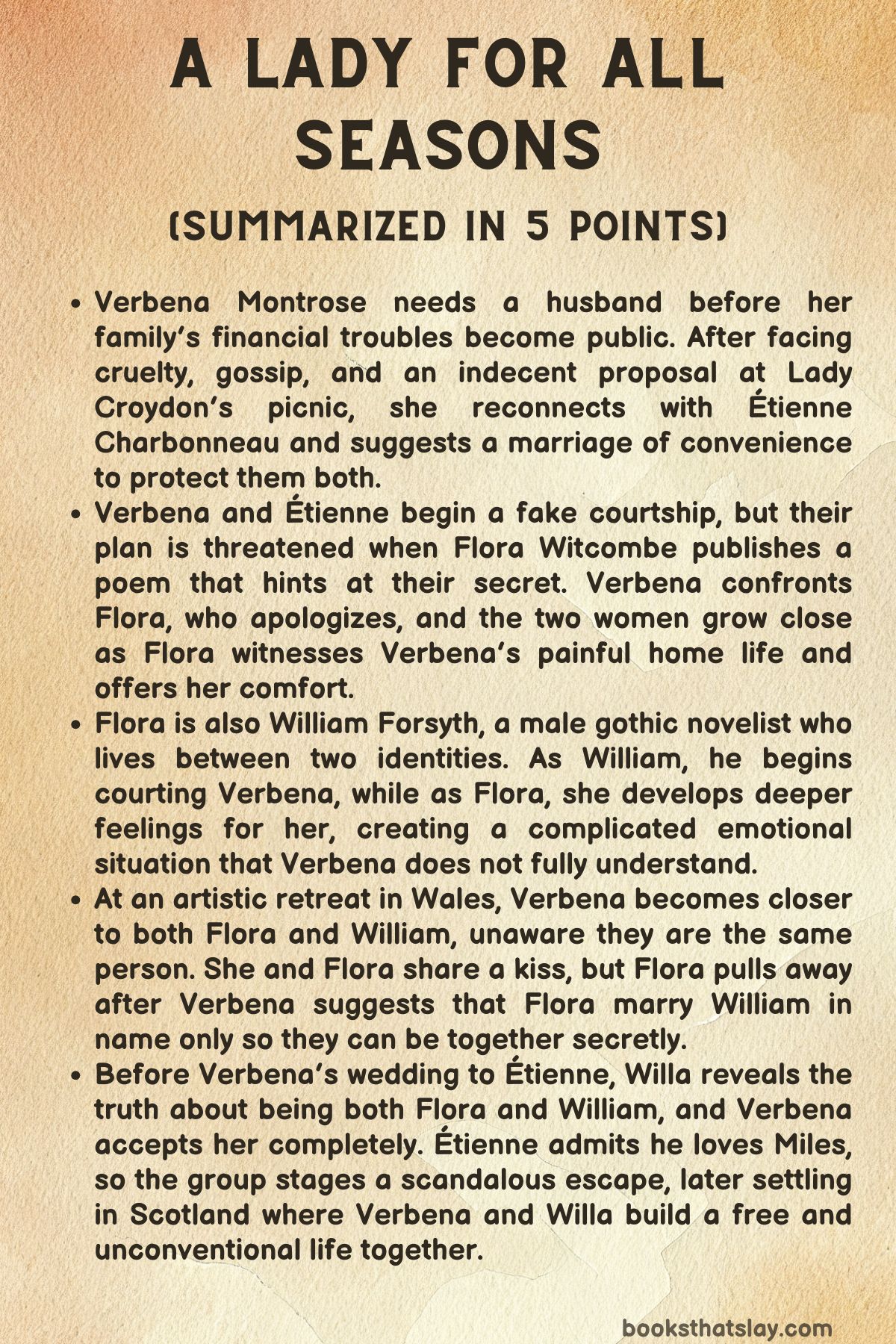
Verbena Montrose is under intense pressure to marry before her family’s fragile social position collapses. Her family’s financial troubles are becoming harder to hide, and her mother’s cruelty only makes her situation worse.
Verbena understands that marriage is not merely a romantic matter in her world. It is security, shelter, reputation, and survival.
At Lady Croydon’s picnic, she moves through a society built on gossip, performance, and quiet cruelty. She must manage conversation, social games, and the constant threat of humiliation while pretending that everything in her life remains orderly.
During the gathering, Lord Newham makes an indecent proposal to Verbena, assuming her family’s vulnerability leaves her with little power. Instead of shrinking from him, she turns the situation against him.
She threatens to expose a scandal in his own household, forcing him to retreat. The encounter shows her sharpness and her refusal to be treated as helpless, even when her circumstances are desperate.
At the same event, she meets Miles McDonald, a gentle Scotsman who is kind but not wealthy enough to solve her problems. She also hears from Diedre Hollyhock that Étienne Charbonneau, a tailor she once knew, has mysteriously been given a house in Bloomsbury after a public quarrel.
Verbena suspects there is more to the story and visits Étienne. She finds him heartbroken after a painful fight with Bernard, the man he loves.
Étienne’s situation is dangerous because gossip about his private life could destroy him. Verbena sees that both of them are trapped by the same social machinery, though in different ways.
She needs a husband to protect herself from ruin, and Étienne needs a respectable arrangement to protect his reputation. She proposes a marriage of convenience.
Étienne accepts, and they begin presenting themselves as a courting couple in public.
Their plan is practical, but it is not secure. Flora Witcombe, a poetess with a sharp eye for society’s secrets, publishes a veiled poem that suggests she knows the truth about Verbena and Étienne.
Verbena confronts Flora at the Calliope Club, fearing that the poem could expose everything. Flora apologizes and promises to draw attention elsewhere by publishing a new poem about Lord Byron’s supposed secret return to England.
This encounter begins an unexpected friendship between Verbena and Flora.
As Flora and Verbena grow closer, Flora sees more of Verbena’s private pain. She visits Verbena’s home and witnesses the coldness and cruelty Verbena faces from her mother.
During a walk, Flora comforts her, and their connection deepens. Verbena begins to feel seen in a way she rarely has before.
Flora, however, is also living with a major secret. Flora Witcombe is also William Forsyth, a male gothic novelist who lives privately in Maiden Lane and moves between identities.
As Flora and William, this person occupies different spaces in society and expresses different parts of the self. William becomes increasingly fascinated with Verbena and decides to court her in that identity, even while Flora longs for her too.
At an archery outing, Verbena meets William and feels an immediate attraction. She does not know that William and Flora are the same person, so her feelings confuse her.
She is still committed to the arrangement with Étienne, but William unsettles her expectations. William also befriends Miles and reveals the truth about his identity to him.
Miles responds with warmth and acceptance, creating trust between them. Miles, who is interested in Étienne, invites the group to his aunts’ artistic retreat in Wales.
He hopes the setting will allow William to win Verbena while he becomes closer to Étienne. Verbena, meanwhile, forms a different plan of her own: she thinks William might become a suitable husband for Flora in name only, allowing Flora a kind of safety.
At Plas Tân in Wales, the group enters an eccentric artistic household that even includes Lord Byron. The retreat gives everyone space to step outside the strict rules of London society.
Verbena grows closer to both Flora and William, still unaware that they are one person. Her feelings become more complex because each identity draws something different from her.
Flora gives her intimacy, understanding, and emotional safety. William offers excitement, attraction, and the possibility of a different future.
Verbena does not see these as parts of the same whole, so she tries to make sense of her desires as separate attachments.
During the retreat, Flora and Verbena come close to confessing their feelings. Later, after swimming, they share a kiss in a bathing machine.
The moment confirms the depth of their attraction, but it also raises the question of truth. Flora considers revealing everything, but before that can happen, Verbena explains her own plan.
She imagines Flora marrying William in name only, creating a public arrangement that would allow Verbena and Flora to be together in secret. To Verbena, this seems like a clever solution.
To Flora, it is painful because Verbena is unknowingly speaking about him and her as though they are separate people. Unable to explain without risking rejection, Flora withdraws.
After the group returns to London, the pressure around Étienne increases. To protect him from suspicion, Verbena and Étienne announce their engagement.
The announcement is meant to secure both of them, but it also makes Verbena’s emotional life more painful. She later meets William in the park and realizes that her feelings for him are just as strong as her feelings for Flora.
She is torn not because she is fickle, but because she is drawn to the same person in two different forms without knowing it.
At a masquerade, Flora expects to meet a patron, but Verbena appears disguised as a man. In that temporary freedom, they dance, talk honestly, and kiss goodbye.
Both believe that their relationship must end because Verbena is going to marry Étienne. Flora is devastated.
After speaking with Byron, Flora decides to go to Eden, where the wedding is to take place. The decision brings the truth closer to the surface.
On the night before the wedding, Willa comes to Verbena. Willa is the chosen combined name for Flora and William, a name that holds the truth of both identities together.
Willa reveals everything: Flora and William are the same person. Verbena does not reject Willa.
Instead, she accepts all of him and her. The revelation transforms Verbena’s confusion into clarity.
The person she loved in two forms has always been one whole person. They spend the night together, knowing the wedding is still planned for the next day.
In the morning, Étienne admits that he cannot marry Verbena because he loves Miles. This confession changes everything, but it also opens a path for all four of them.
Verbena quickly creates a new plan. At the church, Étienne publicly declares that he loves Flora, and the four flee together.
Society is left to believe that Étienne and Flora have eloped. The false scandal protects the truth beneath it: Étienne and Miles can be together, and Verbena and Willa can build a life outside the rules that once trapped them.
They escape to Scotland and settle at Miles’s home. Verbena and Willa make a life together in a cottage, while Miles and Étienne begin their own shared future.
Eight months later, Verbena is writing, corresponding with friends, and preparing for a trip to London. She is no longer living under her mother’s control or society’s narrow expectations.
Her life may be unconventional, but it is honest and chosen. A Lady for All Seasons ends with Verbena content in a world she has helped create for herself, surrounded by love, loyalty, and the freedom to belong on her own terms.
Characters
Verbena Montrose
Verbena Montrose is the central figure of A Lady for All Seasons, and her character is shaped by urgency, intelligence, emotional hunger, and a growing desire for freedom. At the beginning of the book, she is trapped by her family’s financial decline and by the social expectation that marriage is the only respectable solution available to her.
This pressure makes her practical and strategic, but it does not make her weak. Verbena understands the cruelty of society and learns to use its rules against itself, as seen when she defeats Lord Newham’s indecent proposal by threatening to expose his own household scandal.
Her sharpness comes from survival, yet beneath her social cleverness is a woman who longs to be loved without performance or negotiation.
Verbena’s relationship with Étienne shows her capacity for loyalty and quick moral judgment. She proposes a marriage of convenience not because she loves him romantically, but because she recognizes that both of them are vulnerable to social ruin.
Her decision is practical, but it is also compassionate. She does not treat Étienne as a tool; instead, she sees his pain and tries to build a solution that protects them both.
This reveals one of Verbena’s strongest traits: she can think strategically while still caring deeply about others. Her bond with Flora and William, later Willa, reveals a more tender and conflicted side of her.
Verbena is drawn to Flora emotionally and physically, while also feeling a powerful attraction to William, not knowing they are the same person. Her confusion is not shallow indecision; it reflects how deeply she responds to different forms of honesty, beauty, and emotional intimacy.
By the end of the story, Verbena transforms from a woman trying to secure safety through marriage into someone willing to choose an unconventional life built on truth. Her acceptance of Willa is one of her most important moments because it shows that she is capable of loving beyond society’s categories.
She does not merely tolerate Willa’s truth; she embraces it. Verbena’s final life in Scotland represents emotional release, independence, and self-authorship.
She begins the book trying to survive within the rules of society, but she ends it by helping create a new life outside those rules.
Willa / Flora Witcombe / William Forsyth
Willa is one of the most layered and emotionally complex characters in the book because they live through multiple identities: Flora Witcombe, the poetess; William Forsyth, the male gothic novelist; and finally Willa, a chosen name that brings these selves together. As Flora, Willa moves through artistic and social spaces with wit, sensitivity, and theatrical confidence.
As William, Willa occupies a different literary and social role, one that allows them to court Verbena in a way society would understand. These identities are not simple disguises but expressions of different parts of Willa’s self.
The tension between them creates much of the emotional conflict in the story.
Willa’s fascination with Verbena begins through Flora, but it deepens as both Flora and William become connected to her. This creates a painful emotional knot because Willa is loved and desired by Verbena in separate forms, while Verbena does not yet know the truth.
Willa’s silence is not only deception; it comes from fear, longing, and uncertainty about whether they can be fully accepted. The bathing machine scene and the masquerade reveal Willa’s vulnerability most clearly.
As Flora, Willa comes close to intimacy and confession, but Verbena’s plan for Flora to marry William in name only wounds Willa because it proves how deeply Verbena misunderstands the reality of who Flora and William are.
Willa’s final confession before the wedding is the emotional turning point of their character arc. By revealing the truth, Willa risks losing Verbena entirely, but the confession also allows them to stop dividing themself for survival.
Verbena’s acceptance gives Willa the possibility of wholeness. Willa’s journey is therefore not only romantic but also deeply personal.
They move from secrecy, performance, and divided longing toward a life where love and identity can exist together. Their final life with Verbena in Scotland suggests peace, creativity, and the freedom to exist without constantly translating themself for society.
Étienne Charbonneau
Étienne Charbonneau is a tender, vulnerable, and quietly courageous character whose emotional life is threatened by gossip and social danger. As a tailor, he already occupies a position outside the highest ranks of society, and his relationship with Bernard places him at risk of public ruin.
When Verbena visits him, she finds him heartbroken after a quarrel with Bernard, and this moment reveals Étienne not as a comic or decorative supporting figure, but as someone deeply wounded by love and fear. His sudden possession of a house in Bloomsbury and the gossip surrounding him make him socially exposed, and his agreement to Verbena’s marriage plan comes from desperation as much as practicality.
Étienne’s engagement to Verbena is built on mutual protection rather than romantic affection. He understands the arrangement as a shield, and for much of the story he tries to play his part because society leaves him few safer options.
Yet Étienne’s heart belongs elsewhere, and his emotional honesty becomes stronger as the book progresses. His growing connection with Miles offers him a different kind of future, one based not on concealment alone but on affection, respect, and shared escape.
Étienne’s inability to go through with the wedding is not a failure of character; it is a moment of truth. He finally admits that he cannot continue a false marriage because he loves Miles.
Étienne’s public declaration that he loves Flora is part of the group’s final plan, but it also shows his willingness to participate in a bold act of collective liberation. He helps create the scandal that allows all four central characters to flee the lives society had prepared for them.
By the end, Étienne becomes more than a man trying to avoid exposure. He becomes someone who chooses love, even when that choice requires courage, deception, and escape.
His ending with Miles in Scotland gives him the emotional safety he had been denied earlier in the story.
Miles McDonald
Miles McDonald is introduced as kind, poor, and Scottish, and his gentleness makes him stand apart from the more predatory or performative men of society. Unlike Lord Newham, Miles does not use social situations to dominate or exploit others.
His warmth is quiet but important, and his acceptance of William’s secret shows his open-hearted nature. Miles is not shocked into cruelty or rejection; instead, he responds with friendliness and loyalty.
This makes him one of the book’s safest and most emotionally generous characters.
Miles’s attraction to Étienne gives him a more active role in the story. His invitation to the artistic retreat in Wales is partly practical and partly romantic, as he hopes to bring people together in ways that might allow hidden desires to become possible.
Miles is observant enough to recognize the emotional possibilities among the group, and his plan reflects both hope and kindness. He wants William to win Verbena, and he wants to grow closer to Étienne.
His actions show that he is not merely a pleasant companion; he quietly helps create the conditions for the main characters to discover what they truly want.
By the end of the book, Miles becomes Étienne’s partner in a life outside conventional expectations. His home in Scotland becomes a place of refuge for the group, and this is symbolically important.
Miles represents not only romantic possibility for Étienne but also a physical and emotional shelter from the society that has trapped them. His character is gentle, but his gentleness has strength.
He offers acceptance without spectacle, and that makes him essential to the final escape and resolution.
Flora Witcombe
Flora Witcombe, as one of Willa’s identities, deserves attention for the way she functions socially and emotionally within the story. Flora is a poetess whose words have the power to influence reputation, as shown when her veiled poem threatens to expose the truth about Verbena and Étienne.
At first, this makes her seem dangerous, because her art can turn private vulnerability into public gossip. However, her apology to Verbena shows that she is not malicious.
Flora is capable of recognizing harm and trying to repair it, which makes her far more sympathetic than a simple gossip figure.
Flora’s closeness with Verbena reveals her tenderness and emotional depth. When she visits Verbena’s home and sees the cruelty of Verbena’s mother, Flora becomes a source of comfort.
Their walk together strengthens their intimacy, and Flora’s presence allows Verbena to feel seen in a way she rarely does within her own household. Flora is artistic, sensitive, and emotionally perceptive, and these qualities help draw Verbena toward her.
Their near-confessions and later kiss show how Flora becomes associated with emotional truth, even while Willa’s larger truth remains hidden.
Flora is also a figure of performance. She moves through society as someone admired, watched, and interpreted.
This makes her both powerful and vulnerable. She can shape public attention with poetry, but she can also be trapped by the very identity she performs.
Flora’s pain after Verbena imagines a false marriage between Flora and William comes from the fact that Verbena unknowingly separates two parts of the same person. Through Flora, the story explores the ache of being loved incompletely before being known fully.
William Forsyth
William Forsyth is Willa’s male identity and another important expression of Willa’s inner life. As a gothic novelist, William carries mystery, imagination, and romantic intensity.
When Verbena meets him at the archery outing, she is unexpectedly drawn to him, which complicates her existing feelings for Flora and her practical arrangement with Étienne. William gives Verbena access to a form of attraction that society would recognize as more acceptable, yet his connection with her is not false.
The feelings between William and Verbena are genuine, even though they are built within a hidden truth.
William’s friendship with Miles is one of his most revealing relationships. By telling Miles his secret and receiving acceptance, William experiences a kind of trust that contrasts with the fear surrounding his feelings for Verbena.
Miles’s warmth allows William to exist with less fear, at least briefly. This friendship also helps move the plot toward Wales, where the emotional entanglements among the characters become more intense.
William’s role in the story is therefore both romantic and structural: he creates another path for Verbena’s desire and helps connect the characters who eventually escape together.
William’s pain lies in being desired separately from Flora. Verbena imagines William as a possible false husband for Flora, not realizing that such a plan divides Willa against themself.
As William, Willa can approach Verbena in one way; as Flora, Willa can approach her in another. But neither identity alone allows the whole truth to be loved.
William’s importance becomes clearest when Willa finally brings both identities together. He is not erased by Willa’s final name; rather, he becomes part of a fuller self.
Bernard
Bernard is not present as heavily as the central characters, but he plays an important role in Étienne’s emotional background. He is Étienne’s lover, and their quarrel leaves Étienne heartbroken and vulnerable.
Through Bernard, the book shows how private relationships can become dangerous when society is eager to punish or expose them. Even though Bernard does not dominate the action, his relationship with Étienne is the reason Étienne is emotionally shattered when Verbena finds him.
Bernard’s importance lies in what his absence and conflict reveal. He represents the instability of love under social pressure.
His fight with Étienne helps push Étienne toward the marriage arrangement with Verbena, not because Étienne stops loving men, but because he needs protection from the consequences of being known. Bernard therefore helps establish the stakes of the story.
His role reminds the reader that the danger facing Étienne is not abstract; it is tied to real heartbreak, fear, and social vulnerability.
Lord Newham
Lord Newham represents the predatory side of aristocratic society. His indecent proposal to Verbena shows how men with status can attempt to exploit women whose families are financially vulnerable.
He assumes that Verbena’s desperation makes her powerless, but he misjudges her. Verbena’s response, in which she threatens to expose his own household scandal, turns the power dynamic against him.
This scene reveals both his moral ugliness and Verbena’s intelligence.
As a character, Lord Newham is important because he embodies the hypocrisy of the social world Verbena is trying to navigate. He participates in a culture that polices women’s reputations while hiding men’s misconduct.
His presence makes the marriage market appear less romantic and more dangerous. He is not simply an unpleasant man; he is a symbol of the system that forces women like Verbena to bargain for security while men like him expect to act without consequence.
Lady Croydon
Lady Croydon is significant because her picnic serves as one of the social arenas where reputation, gossip, and marriage prospects are publicly tested. She represents the world of polite society, where games, conversation, and appearances carry serious consequences.
Her event brings together the pressures that shape Verbena’s early decisions: social performance, public judgment, and the need to appear desirable before financial ruin becomes visible.
Although Lady Croydon is not emotionally central to the story, she helps establish the atmosphere of surveillance that surrounds the characters. Her picnic is not merely a pleasant gathering; it is a stage where people watch, evaluate, and gossip.
In this way, Lady Croydon represents the respectable surface of a society that can be deeply cruel underneath. Her role helps show why Verbena feels such urgency to secure a future.
Diedre Hollyhock
Diedre Hollyhock functions as a carrier of information, and her conversation with Verbena helps move the story toward Étienne. By telling Verbena about Étienne’s sudden house in Bloomsbury and the public quarrel connected to him, Diedre gives Verbena the clue that something is wrong.
Her role shows how gossip can be both dangerous and useful. In society, gossip can destroy reputations, but it can also alert people to hidden crises.
Diedre’s character belongs to the social world of observation and talk. She may not intend to become a major force in the lives of the central characters, but the information she shares changes the direction of Verbena’s actions.
Because of Diedre, Verbena visits Étienne, learns the truth of his distress, and proposes the marriage arrangement that shapes much of the plot. Diedre therefore matters because she shows how small pieces of social knowledge can have large consequences.
Verbena’s Mother
Verbena’s mother is a source of emotional pain and domestic cruelty. Her treatment of Verbena helps explain why Verbena is so desperate for escape and security.
The pressure on Verbena does not come only from society at large; it also comes from within her own home. Her mother’s cruelty makes Verbena’s family situation feel suffocating, and it reveals that financial ruin is not the only threat Verbena faces.
She is also emotionally starved and belittled.
Flora’s reaction to seeing this cruelty is important because it allows Verbena’s suffering to be witnessed. Verbena’s mother helps reveal the private wounds behind Verbena’s public composure.
Much of Verbena’s strength comes from having to survive a home where tenderness is lacking. Her mother therefore acts as a contrast to the chosen family Verbena eventually builds with Willa, Étienne, and Miles.
The ending feels liberating partly because Verbena escapes not only social pressure but also the emotional damage of her household.
Lord Byron
Lord Byron appears as part of the eccentric artistic world at Plas Tân, and his presence adds theatricality, literary energy, and a sense of unconventional possibility. He belongs naturally to the retreat’s atmosphere, where art, desire, and social rebellion are more openly explored than in London’s rigid society.
His inclusion helps make Wales feel like a space outside ordinary rules, a place where hidden identities and forbidden emotions can come closer to the surface.
Byron also serves as a confidant at a crucial emotional moment. When Flora is devastated after the masquerade, speaking with Byron helps lead to the decision to go to Eden, where the wedding is planned.
In this way, Byron becomes part of the movement toward truth and resolution. He is not the emotional center of the book, but he strengthens its artistic and rebellious spirit.
His character helps connect romance with performance, literature, and the refusal to live only according to respectable society’s expectations.
Miles’s Aunts
Miles’s aunts are important because they create the artistic retreat in Wales, a place where the main characters can encounter one another outside the strictest expectations of London society. Their household is eccentric, creative, and freer than the world Verbena usually inhabits.
Even if they are not individually developed as deeply as the central characters, their presence shapes the environment that allows emotional discoveries to happen.
The retreat they provide becomes a turning point in the story. It is there that Verbena grows closer to both Flora and William, and it is there that feelings become harder to deny.
Miles’s aunts represent an alternative social world, one built less on respectability and more on art, personality, and unconventional connection. Their role is therefore symbolic as well as practical.
They help make space for the characters to imagine lives beyond the narrow limits society has set for them.
Themes
Marriage as Survival and Social Strategy
Marriage is treated less as a romantic ideal and more as a social tool shaped by fear, reputation, and financial pressure. Verbena’s search for a husband begins from practical desperation: her family’s financial collapse threatens her place in society, and marriage appears to be the only acceptable way to protect herself.
Étienne faces a different but equally dangerous pressure, since gossip about his private life could destroy his safety and respectability. Their proposed marriage of convenience shows how social systems force people to use public performance as protection.
The arrangement is not built on deceit for selfish gain, but on mutual defense against a world that punishes poverty, queerness, and social vulnerability. By the end, the failed wedding becomes meaningful because it rejects marriage as a cage.
Instead of obeying the expected structure, the characters reshape their futures through chosen loyalty, emotional honesty, and unconventional partnership.
Identity, Secrecy, and Self-Expression
Identity in A Lady for All Seasons is shown as something complex, private, and deeply connected to safety. Willa’s movement between Flora and William is not presented as a simple disguise, but as a way of expressing parts of the self that society cannot easily accept.
The need for secrecy creates emotional strain, especially because Willa’s love for Verbena grows while the truth remains hidden. Verbena’s attraction to both Flora and William reveals that her feelings respond to the whole person, even before she fully understands that person’s complete identity.
This theme becomes powerful when Willa finally reveals the truth and Verbena responds with acceptance rather than rejection. The moment matters because it replaces fear with recognition.
The novel suggests that love becomes more honest when identity no longer has to be divided into acceptable and unacceptable parts. Self-expression is therefore not only personal freedom, but also the foundation of real intimacy.
Reputation, Gossip, and Social Control
Gossip functions as one of the strongest forces controlling the characters’ lives. Public opinion shapes what people can say, whom they can love, and how safely they can exist.
Verbena understands this world well, using social knowledge to defend herself against Lord Newham, but she is also trapped by the same system. Étienne’s vulnerability shows how quickly rumor can become a weapon, especially against people whose private lives fall outside social expectations.
Flora’s poem also reveals the danger of art when it brushes too closely against hidden truths, even without cruel intent. Reputation is shown as fragile, unstable, and often unfair, because society cares more about appearances than character.
The characters survive by managing what others see, staging courtships, disguises, and scandals to redirect attention. Yet the ending challenges this system by turning gossip against itself.
The false elopement gives society a story to consume while the characters escape into lives that are truer than the rumors about them.
Chosen Family and Unconventional Freedom
The emotional heart of the story lies in the movement from social isolation toward chosen family. Verbena begins surrounded by judgment, cruelty, and expectation, especially within her own household.
Her growing bonds with Flora, Willa, Étienne, and Miles offer a different model of belonging, one based on care rather than duty. The retreat in Wales becomes important because it gives the characters a glimpse of a freer world, where art, eccentricity, and desire have more room to exist.
Scotland then becomes the fuller realization of that possibility. The final arrangement rejects the idea that happiness must look respectable to outsiders.
Verbena and Willa’s cottage, alongside Miles and Étienne’s partnership, creates a private community built on trust, affection, and mutual protection. This freedom is not presented as an easy escape from society, but as something carefully built through courage and cooperation.
The ending suggests that a meaningful life can be made outside the approved patterns, especially when people choose one another fully.