A Good Person Summary, Characters and Themes
A Good Person by Kirsten King is a dark psychological novel about obsession, shame, loneliness, and the stories people tell themselves to feel innocent. The book follows Lillian O’Malley, a woman who has spent much of her life feeling unwanted and misunderstood.
After a casual relationship ends badly, her need to be loved turns into fixation, and that fixation leads her toward violence, denial, and moral collapse. The novel studies how a person can see herself as wounded and wronged while ignoring the harm she causes. A Good Person is unsettling because it stays close to Lillian’s mind as she tries to escape the truth about herself.
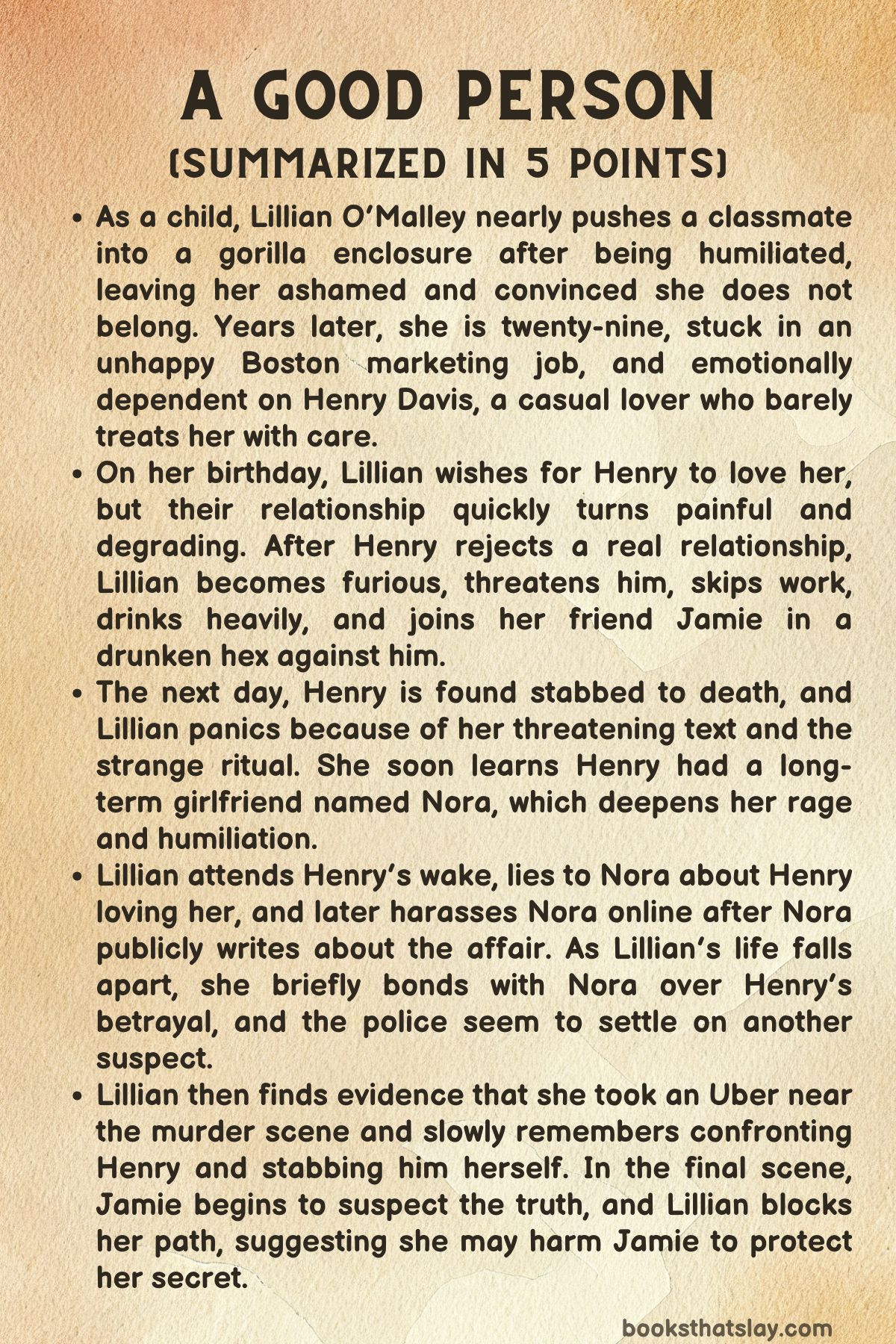
Summary
Lillian O’Malley’s life is shaped by an early memory of humiliation and rage. As a child, she is on a school trip when her classmate Melanie embarrasses her in front of others.
Lillian reacts with a sudden, frightening impulse and nearly pushes Melanie into a gorilla enclosure. Though the moment does not end in the worst possible way, it leaves a permanent mark on Lillian’s sense of herself.
She grows up believing that something inside her is different from other people, something dangerous and hard to control. From then on, she carries a deep fear that she is not the kind of person others can love or accept.
Years later, Lillian is twenty-nine and living in Boston. She works at a marketing company called Fizzle, where she feels overlooked, irritated, and trapped in work she does not respect.
Her coworkers do not understand her, her boss Candice piles more responsibility on her, and even her birthday becomes another reminder that no one is paying attention. The office gives her a cake with her name spelled wrong, which makes her feel both invisible and insulted.
Instead of celebrating, she waits for a message from Henry Davis, a man she has been sleeping with for four months.
Henry is not her boyfriend, but Lillian wants him to become one. She has built a fantasy around him, reading meaning into small gestures and hoping that their casual arrangement will turn into a real relationship.
When Henry finally comes over on her birthday, she is desperate for the night to become proof that he cares. After they have sex, he starts to leave.
Hurt by his casualness, Lillian blurts out that it is her birthday. Henry awkwardly tries to make up for forgetting by lighting a Yankee Candle and telling her to make a wish.
Lillian wishes that Henry will love her, revealing how much of her emotional life now depends on him.
In the days that follow, Lillian becomes more and more consumed by Henry. She meets her friend Jamie at a bar near Henry’s apartment, but the meeting is mostly an excuse to wait for his text.
When Henry contacts her, Lillian abandons Jamie and rushes to him. At his apartment, Henry is drunk and upset about losing a promotion.
His self-pity takes over the night, and during sex he ignores Lillian’s hesitation and pushes her into something she does not want. The next morning, he is tender enough to confuse her, accepting comfort and attention from her.
Then he tells her he does not want a relationship.
The rejection breaks something open in Lillian. She lashes out at Henry, insulting him and threatening that she might be pregnant and would keep the baby.
Her threat comes from pain and panic, but it also shows how quickly her need for love turns into a need for control. After leaving him, she falls into a spiral.
She skips work, drinks too much, tries to break into his apartment, and urinates on his doorstep. Her anger is messy, humiliating, and frightening, but she keeps framing herself as the wounded party.
Henry has hurt her, so she feels entitled to hurt him back.
At work, Fizzle is preparing a campaign involving an influencer known as the Wellness Witch. The Wellness Witch talks about spells, intention, control, and personal power, and Lillian becomes interested in the idea that ritual might give shape to her rage.
After another failed attempt to reconnect with Henry, Lillian and Jamie drunkenly perform a hex. They use the birthday candle Henry lit for her, a printed photo of him, and black string.
The ritual is not serious in a fully rational sense, but Lillian wants it to mean something. Afterward, she texts Henry, “You’re going to get what you deserve.”
The next day, Jamie tells Lillian that Henry has been stabbed to death outside a bar. Lillian is immediately terrified.
Her fear is not only grief or shock. She worries that the hex, the threatening text, and her unstable behavior will make her look guilty.
She also wonders whether the ritual somehow caused his death. This magical fear gives her a way to avoid a more direct question: what was she actually capable of doing?
As police begin asking questions, Lillian hires a lawyer named Hector and insists she had nothing to do with Henry’s murder.
Henry’s death also reveals that Lillian never really knew him. She discovers that he had an active Instagram account she did not know about and, more painfully, a long-term girlfriend named Nora.
Nora had been with Henry for almost ten years and was close to his family. Lillian realizes that she was not the central woman in Henry’s life.
She was not the girlfriend, not the chosen partner, not the person who would be publicly mourned beside his family. Her grief turns into rage at Nora, because Nora represents everything Lillian wanted: legitimacy, history, and recognition.
Against Hector’s advice, Lillian attends Henry’s wake, which is held at a hockey rink. Her presence there is inappropriate and risky, but she wants to claim a place in Henry’s story.
She meets Henry’s sister Amelia and later finds herself face-to-face with Nora in the locker room. Nora confronts her, and Lillian lies.
She says Henry loved her and was planning to leave Nora. The lie is cruel because it is meant to wound Nora at the place where Lillian herself feels wounded.
When Henry’s mother and sister interrupt the confrontation, Lillian insults the family before leaving, making herself even more isolated.
Nora later writes publicly about being cheated on, disguising Lillian’s identity but clearly casting her as the other woman. Lillian responds by harassing Nora online through an anonymous account.
Her behavior becomes more obsessive and unstable. She cannot accept that Nora has the public role of grieving girlfriend while she is reduced to a shameful secret.
She wants to punish Nora for having been loved by Henry, even though Nora was also betrayed by him.
Lillian’s life continues to fall apart. Her roommate Elise moves out, Fizzle places her on leave, and Lillian alienates people who try to help or challenge her.
She clashes with the Wellness Witch and resists therapy, unwilling to look too closely at her own actions. Yet her connection with Nora shifts in an unexpected way.
The two women meet for drinks and, for a time, bond over Henry’s betrayal. Their shared anger makes them feel less alone.
Lillian even spends the night at Nora’s apartment, as if the two of them can briefly turn their pain into a strange form of companionship.
When the police announce that they believe another man killed Henry, Lillian appears to be safe. The case seems effectively closed, and the danger of being blamed begins to fade.
But then Lillian discovers an Uber record showing that she took a ride to Somerville, near the scene of Henry’s murder, at 2:03 a.m. on the night he died.
This record breaks through the story she has been telling herself. Memories return in pieces.
She went to Henry. She confronted him.
She brought a knife. She stabbed him and left him bleeding.
The truth is devastating, but Lillian does not respond with full confession or responsibility. Instead, the same instincts that have guided her all along return: denial, self-protection, and the need to control the story.
Her mother tells her to move on and avoid talking about what happened, giving Lillian a model for silence rather than accountability. Lillian goes home and tries to cleanse the apartment with sage, as though ritual can remove guilt.
Jamie arrives, and the danger rises again. Jamie notices details that make her suspicious and asks Lillian directly if she killed Henry.
Lillian denies it, but Jamie is frightened. Lillian thinks about the knife in the bathroom sink and understands that Jamie may know too much.
She blocks Jamie’s path, offers her a drink, and decides she cannot risk Jamie telling anyone. The ending shows that Lillian’s violence was not a single accident caused by heartbreak.
It is part of a deeper pattern: when shame, exposure, and rejection threaten her, she protects herself by turning against others. A Good Person closes on the chilling gap between who Lillian wants to believe she is and what she is willing to do.
Characters
Lillian O’Malley
Lillian O’Malley is the central character of the book, and her personality is shaped by shame, loneliness, resentment, and an intense need to be chosen. Her childhood incident with Melanie establishes a pattern that follows her into adulthood: when Lillian feels humiliated, rejected, or pushed outside the circle of belonging, her emotions can turn frighteningly destructive.
She does not simply feel pain; she experiences rejection as proof that she has been marked as unwanted. This makes her both sympathetic and deeply alarming, because her desire for love is recognizable, but the way she responds to disappointment becomes increasingly unstable.
As an adult, Lillian appears dissatisfied with nearly every part of her life. Her job at Fizzle is unfulfilling, her coworkers make her feel unseen, her friendships are strained, and her romantic attachment to Henry becomes the center of her emotional world.
Her fixation on Henry reveals how desperate she is for validation. She interprets his attention as proof that she matters, even when his actions are careless, selfish, and cruel.
Her birthday wish that Henry will love her shows the depth of her longing, but it also foreshadows how dangerously she tries to bend reality around her desires.
Lillian’s character becomes more disturbing after Henry’s rejection and death. Her grief is mixed with humiliation, rage, jealousy, and fear.
She is less devastated by the loss of Henry as a person than by the collapse of the fantasy she had built around him. When she discovers Nora, Lillian feels robbed of the role she imagined for herself.
Her obsession shifts from Henry to Nora because Nora represents everything Lillian wanted to be: the legitimate girlfriend, the woman known by his family, and the person publicly allowed to mourn him. This rivalry exposes Lillian’s deep insecurity and her inability to accept emotional defeat.
By the end of the story, Lillian is revealed not only as emotionally unstable but also as capable of terrible violence and denial. Her recovered memory of killing Henry reframes her earlier panic and confusion as a form of self-protection.
She is not simply afraid of being wrongly accused; she is afraid of discovering what she has already done. Her final interaction with Jamie shows that Lillian has not truly changed or accepted responsibility.
Instead, she remains trapped in the same pattern that began in childhood: when someone threatens to expose her shame, she becomes dangerous. Lillian is one of the most morally complex figures in the book because she is both damaged and damaging, lonely and predatory, vulnerable and terrifying.
Henry Davis
Henry Davis is the catalyst for much of the story’s emotional and psychological collapse. He is charming enough to keep Lillian attached to him, but his behavior reveals selfishness, emotional cowardice, and cruelty.
Henry treats Lillian as convenient rather than important. He enjoys the benefits of intimacy without offering honesty, commitment, or care.
His casual presence in her life becomes devastating because Lillian invests deep emotional meaning in a relationship that he treats as temporary and disposable.
Henry’s treatment of Lillian is especially troubling because he repeatedly takes from her without considering her emotional or physical boundaries. His behavior during sex shows that he is not merely emotionally unavailable but also capable of violating her trust and comfort.
The next morning, when he accepts affection from her before telling her he does not want a relationship, he shows how easily he can separate his own desires from another person’s pain. This makes him a morally unpleasant character, even though his murder is still horrifying and unjustifiable.
Henry’s secret relationship with Nora further exposes his dishonesty. He has maintained a long-term relationship while also sleeping with Lillian, allowing both women to exist in separate versions of his life.
To Nora, he is the longtime partner connected to family and shared history. To Lillian, he becomes the imagined possibility of escape from loneliness.
Henry’s deceit damages both women, though in different ways. His death does not erase his selfishness, but it complicates the reader’s response to him because he becomes both a victim of violence and a source of emotional harm.
Nora
Nora is Henry’s long-term girlfriend and one of the most important figures in Lillian’s psychological unraveling. At first, Nora appears to Lillian not as a full person but as a rival and obstacle.
She represents legitimacy, history, and public recognition. Nora had years with Henry, knew his family, and occupied the position Lillian desperately wanted.
Because of this, Lillian’s anger toward Nora is less about Nora herself and more about what Nora symbolizes: proof that Lillian was never central to Henry’s life.
Nora’s grief is complicated by betrayal. She is mourning a man she loved while also learning that he deceived her.
This places her in a painful emotional position, because her public role as grieving girlfriend is disrupted by the humiliating discovery of infidelity. Her confrontation with Lillian shows anger, hurt, and a need to reclaim the truth of her relationship.
Nora is not simply jealous or bitter; she is trying to make sense of a loss that has been poisoned by deception.
As the story develops, Nora becomes more than Lillian’s rival. When Nora and Lillian eventually meet for drinks and bond over Henry’s betrayal, the relationship between them becomes strange and layered.
They are connected by pain, anger, and humiliation, even though they were placed in opposition by Henry’s lies. Nora’s presence reveals the possibility that women harmed by the same man might understand each other, but Lillian’s instability prevents this connection from becoming truly safe or healing.
Nora functions as both mirror and contrast: she is wounded by Henry, but unlike Lillian, she does not respond by losing her grip on moral reality.
Jamie
Jamie is Lillian’s friend and one of the few people who remains close enough to notice her decline. At the beginning, Jamie seems to occupy the role of the supportive friend, someone who meets Lillian for drinks and participates in her emotional chaos.
However, Jamie’s friendship is tested by Lillian’s selfishness. When Lillian abandons Jamie to go to Henry, it shows how completely Henry has overtaken Lillian’s priorities.
Jamie is present, but Lillian is often too consumed by obsession to value her properly.
Jamie’s participation in the drunken hex is important because it briefly makes her part of Lillian’s fantasy of revenge. To Jamie, the ritual may seem like a reckless, symbolic act of anger.
To Lillian, however, it becomes entangled with real violence, guilt, and fear. This difference matters because Jamie does not understand the full darkness of what Lillian is capable of.
She is drawn into Lillian’s world without realizing how dangerous that world has become.
By the end, Jamie becomes a threat to Lillian simply because she begins to suspect the truth. Her fear in the final scene shows that she recognizes something has shifted.
Jamie’s role changes from friend to potential witness, and this transformation reveals the emptiness of Lillian’s attachments. Lillian may want friendship and love, but when self-preservation takes over, even Jamie becomes disposable.
Jamie’s character helps expose the final horror of Lillian’s mind: anyone who sees too much can become unsafe to her.
Melanie
Melanie is primarily important because of the childhood incident that shapes Lillian’s self-image. Her humiliation of Lillian during the school trip becomes the first major wound in the story.
Whether Melanie intends lasting harm or not, the moment leaves Lillian feeling branded as an outsider. The gorilla enclosure incident shows that Lillian’s violent impulses do not begin in adulthood; they are present early, especially when shame and rejection become unbearable.
Melanie functions less as a fully developed adult character and more as the origin point of Lillian’s lifelong fear of exclusion. Through Melanie, the story shows how childhood humiliation can become part of a person’s identity.
Lillian does not simply remember being embarrassed; she remembers herself as someone capable of nearly doing something monstrous in response. Melanie’s role is therefore crucial because she helps establish the connection between shame and violence that defines Lillian’s later actions.
Candice
Candice, Lillian’s boss at Fizzle, represents the emptiness and frustration of Lillian’s professional life. She contributes to Lillian’s sense of being overlooked and undervalued, especially when she assigns extra work on Lillian’s birthday.
Candice does not need to be openly cruel to affect Lillian; her ordinary workplace demands become part of the larger pattern of Lillian feeling invisible, used, and disrespected.
Candice also helps show how little control Lillian feels she has over her daily life. The misspelled birthday cake and the unwanted work assignment are small humiliations, but for Lillian they add to a larger emotional atmosphere of failure.
Candice’s role is important because she grounds the story’s psychological intensity in everyday dissatisfaction. Lillian’s breakdown does not happen in isolation; it grows out of many ordinary disappointments that she experiences as deeply personal injuries.
The Wellness Witch
The Wellness Witch is a strange and symbolic figure in the story. As an influencer connected to Fizzle’s pitch, she brings language about spells, control, and self-transformation into Lillian’s life at exactly the moment when Lillian feels powerless.
Her ideas catch Lillian’s attention because they seem to offer a way to turn pain into action. The Wellness Witch’s presence blurs the line between performance, belief, and desperation.
For Lillian, the Wellness Witch becomes associated with the fantasy that emotions can control reality. The hex against Henry is not simply a joke; it reflects Lillian’s desire to make him suffer and to regain power after rejection.
The Wellness Witch therefore functions as a thematic device as well as a character. She represents the seductive promise that pain can be managed through ritual, branding, and control, even though Lillian’s real problem is not a lack of power but an inability to face herself honestly.
Hector
Hector, Lillian’s lawyer, represents caution, order, and practical reality. His role is to protect Lillian legally, but he also serves as a voice of reason in a situation where Lillian repeatedly acts impulsively.
When he warns her not to attend Henry’s wake, he understands the danger of her inserting herself into spaces where she is emotionally volatile and legally vulnerable. Lillian’s decision to ignore him shows her inability to act in her own best interest when obsession takes over.
Hector’s importance lies in his contrast with Lillian. He thinks strategically, while she thinks emotionally.
He wants silence and distance, while she wants recognition and confrontation. His presence reminds the reader that Lillian’s behavior is not just messy or embarrassing; it has serious consequences.
Through Hector, the story emphasizes how often Lillian is given chances to step back, and how often she refuses them.
Elise
Elise, Lillian’s roommate, reflects the damage Lillian’s behavior causes in her everyday relationships. Her decision to move out suggests that Lillian’s instability has become impossible to live beside.
Elise does not need to be central to the murder plot to matter; her departure shows that Lillian’s personal life is collapsing from the inside. People around her begin to protect themselves by creating distance.
Elise’s role also highlights Lillian’s isolation. As Lillian becomes more fixated on Henry, Nora, and the murder investigation, she loses the ordinary structures that might have kept her grounded.
Elise moving out is both a consequence and a warning sign. It shows that Lillian is not simply experiencing private distress; her behavior is becoming visible and intolerable to others.
Amelia
Amelia, Henry’s sister, represents Henry’s family world, a world from which Lillian is excluded. When Lillian meets her at the wake, the encounter emphasizes how little Lillian truly belonged in Henry’s life.
Amelia’s presence makes Lillian’s outsider status painfully clear. Henry had a family, a history, and relationships that Lillian could not access, despite her fantasy that she mattered deeply to him.
Amelia also helps intensify the discomfort of the wake scene. Lillian enters a space meant for legitimate grief, but her presence is disruptive because she is both connected to Henry and not recognized as someone who belongs there.
Amelia’s role is important because she embodies the social reality that contradicts Lillian’s private fantasy. Through her, the story shows how Lillian’s imagined intimacy with Henry collapses when placed beside the people who actually knew him.
Henry’s Mother
Henry’s mother represents family grief and the protective circle around Henry after his death. Her appearance at the wake reinforces Lillian’s outsider position and exposes the cruelty of Lillian’s behavior in that setting.
Lillian’s insults toward Henry’s family show how far she has fallen into rage and self-justification. Rather than respecting their grief, she lashes out because their presence reminds her that she had no accepted place in Henry’s life.
Henry’s mother also complicates the emotional atmosphere around Henry. To Lillian, Henry is the man who rejected and humiliated her.
To his mother, he is a son who has been violently killed. This contrast matters because it prevents the story from allowing Lillian’s pain to dominate the moral landscape completely.
Henry may have behaved badly, but his death creates suffering beyond Lillian and Nora. His mother’s role reminds the reader that violence spreads grief outward through families and communities.
Lillian’s Mother
Lillian’s mother appears near the end and represents a disturbing form of emotional avoidance. When she tells Lillian to move on and avoid discussing what happened, she does not guide her daughter toward truth, accountability, or moral clarity.
Instead, she encourages silence. This response helps explain, or at least deepen, Lillian’s own instinct to deny and suppress reality.
Her role is significant because she shows that Lillian’s avoidance may not exist in isolation. Lillian has learned, perhaps from her family environment, that unbearable truths can be pushed aside rather than confronted.
Her mother’s advice may sound practical on the surface, but in the context of Lillian’s actions it becomes chilling. It supports the same denial that allows Lillian to continue evading responsibility.
The Therapist
The therapist represents one of the few possible paths toward self-knowledge, but Lillian resists that possibility. Therapy should offer a space where Lillian can examine her pain, anger, and unstable behavior, yet she clashes with the process.
This conflict shows that Lillian does not truly want to understand herself if understanding requires responsibility. She wants relief from suffering, but not necessarily truth.
The therapist’s role is important because it reveals the limits of outside help when a person is unwilling to be honest. Lillian’s problems are not invisible.
There are people and structures around her that could help her slow down, reflect, or change direction. However, she repeatedly rejects anything that threatens her preferred version of events.
The therapist therefore highlights one of the story’s central tragedies: Lillian has opportunities to confront herself, but she chooses denial.
The Police
The police function as a source of pressure and fear throughout the murder investigation. Their questioning of Lillian, especially about her threatening text, forces her to confront the possibility that her actions have made her look guilty.
At first, their suspicion seems to place Lillian in the role of a panicked but possibly innocent woman who made a reckless mistake. Later, once the truth of Henry’s murder emerges in Lillian’s memory, their presence takes on a darker meaning.
The police are important because they represent external truth pressing against Lillian’s internal denial. Even when the case appears to move away from her, the investigation creates the conditions for her fear and paranoia.
Their eventual belief that another man killed Henry gives Lillian a temporary escape, but it does not erase what happened. The gap between legal suspicion and actual guilt becomes one of the most unsettling parts of the story, because Lillian may avoid punishment even though she knows the truth.
Themes
Outsiderness and the Fear of Not Belonging
Lillian’s life is shaped by the feeling that she has been permanently marked as someone who does not fit in. The childhood incident at the gorilla enclosure becomes more than a memory; it becomes the first proof, in her mind, that she is dangerous, strange, and unworthy of acceptance.
As an adult, that same insecurity follows her into work, friendship, and romance. The misspelled birthday cake at Fizzle may seem small, but it reflects how unseen she feels in ordinary spaces.
Her coworkers do not understand her, her job gives her no pride, and even her closest friendship with Jamie becomes strained when Lillian chooses Henry over emotional loyalty. Her desperate attachment to Henry is not only about love; it is about wanting someone to confirm that she matters.
When he refuses to choose her, the rejection touches an old wound. Lillian’s later actions show how loneliness can harden into resentment when a person begins to believe that belonging is something others are denying them.
Obsession, Control, and Emotional Dependence
Lillian’s fixation on Henry grows from desire into emotional dependence, making her sense of self revolve around his attention. She waits for his texts, rearranges her plans around him, and treats each small sign of interest as proof that he might eventually love her.
Her birthday wish shows how strongly she wants love to be forced into existence, as though longing alone can change another person’s feelings. This need for control becomes darker after Henry rejects her.
The hex, the threatening text, the online harassment of Nora, and the attempts to insert herself into Henry’s public mourning all show Lillian trying to regain power after humiliation. Yet the more she tries to control the story, the more unstable she becomes.
Henry’s death exposes the danger of confusing possession with love. Lillian does not simply want Henry; she wants the version of herself that she believes Henry’s love would create.
When that fantasy collapses, she becomes capable of treating reality as something to attack.
Betrayal, Rivalry, and Shared Humiliation
The conflict between Lillian and Nora begins as rivalry, but beneath it is a shared experience of betrayal. Lillian initially sees Nora as the woman who had the position she wanted: the real girlfriend, the accepted partner, the person Henry’s family knew and mourned with.
Nora, in turn, sees Lillian as the proof that her long relationship was built partly on lies. Their first encounter is full of anger because each woman becomes a symbol of the other’s humiliation.
Lillian lies that Henry loved her and planned to leave Nora because she cannot bear being reduced to a secret affair. Nora’s public writing casts Lillian as the other woman because she needs a version of events that gives shape to her pain.
Yet when they later drink together, their bond reveals that both have been manipulated by the same man. Their connection is uneasy because it is built on hurt, not trust.
The theme shows how betrayal can turn victims against each other before they recognize the person who truly harmed them.
Guilt, Denial, and Moral Self-Preservation
Lillian’s final discovery forces the story into a study of guilt and denial. For much of the narrative, she fears being blamed for Henry’s murder, but that fear is presented as panic over coincidence, bad timing, and the threatening message.
When the Uber record and memories return, her anxiety becomes something more serious: not fear of false accusation, but fear of the truth. Her mind has protected her by breaking the event into fragments, allowing her to continue seeing herself as chaotic but not murderous.
Once she understands what happened, her first instinct is not confession or moral reckoning, but survival. Her mother’s advice to move on reinforces the idea that denial can become a family habit, passed down as a method of avoiding consequence.
Jamie’s suspicion at the end threatens the fragile story Lillian has built around herself. By blocking Jamie and considering the risk she poses, Lillian shows that guilt has not led to remorse.
Instead, self-preservation has become stronger than conscience.