A Widow’s Charm by Caitlyn Paxson Summary, Characters and Themes
A Widow’s Charm by Caitlyn Paxson is a witty, romantic fantasy about grief, power, class, and the strange ways people learn to live again. Set among decaying estates, village rituals, hidden Charms, legal absurdities, and dangerous aristocratic politics, the story follows Lady Hildegarde Croft, a widow trying to save her home, and Lord Erol Elmwood, a disgraced Charmer whose ability to raise the dead has ruined his life.
Their relationship begins with blackmail and misunderstanding, then grows into trust, desire, and shared courage. The novel mixes comedy, sensuality, magic, and moral conflict while asking whether love can restore what fear has damaged.
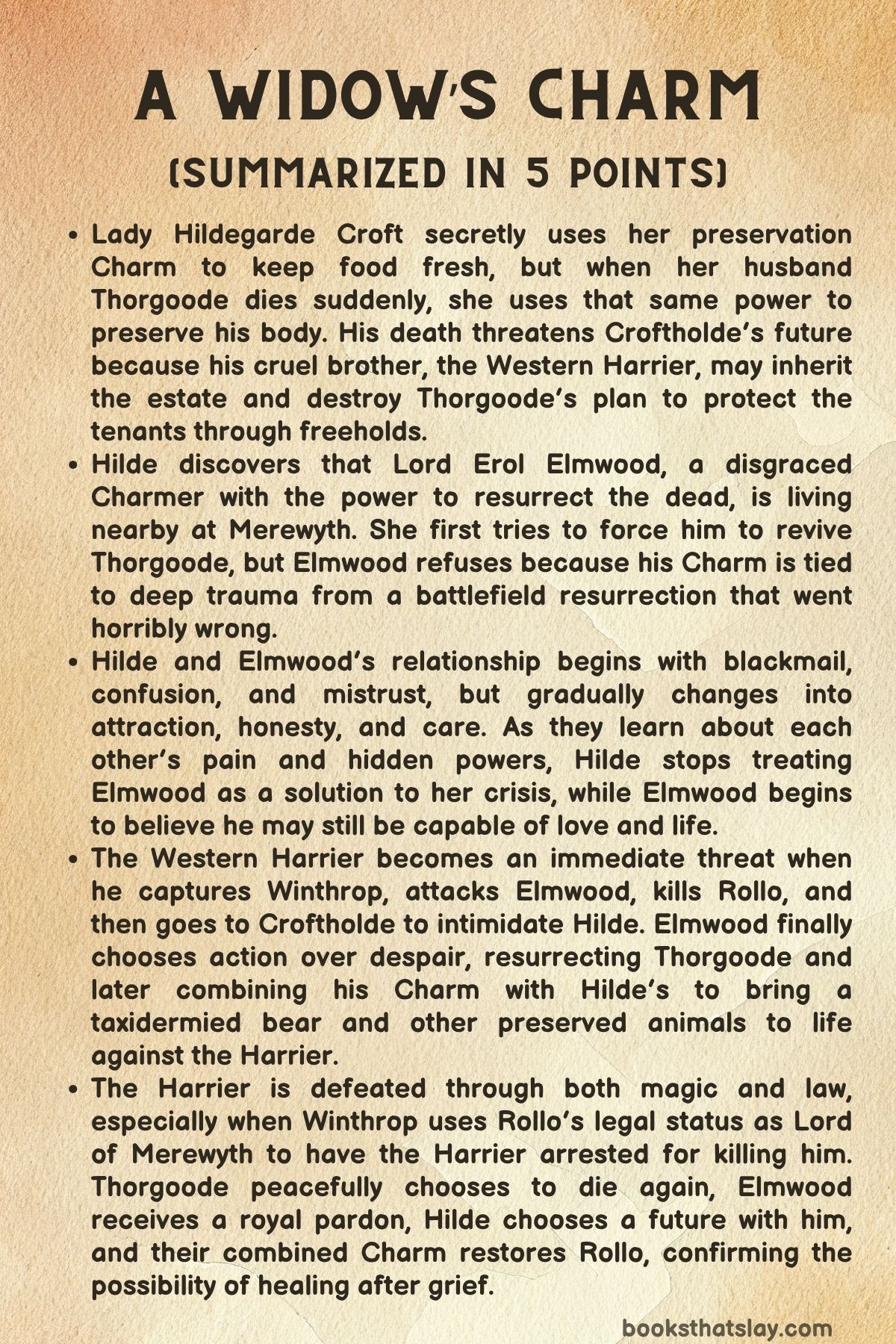
Summary
Lady Hildegarde Croft’s quiet life at Croftholde depends on secrecy, duty, and constant work. Her hidden Charm allows her to freshen decayed things, a power she uses practically in the root cellar to preserve stored food for the estate.
When her husband Thorgoode fails to return from the village, she searches for him and finds him dead on the road. His death is not only personal loss but a political disaster.
Without him, Croftholde may pass to his cruel brother, the Western Harrier, a violent aristocrat who would destroy the village and its tenants. In panic, Hilde uses her Charm to preserve Thorgoode’s corpse and hides him in the root cellar with help from her sister Han.
Hilde’s fear is sharpened by Thorgoode’s unfinished plan to divide Croftholde into freeholds for its tenants. The scheme would protect the villagers from aristocratic exploitation and the war tithe, but with Thorgoode dead, it may fail.
The Harrier arrives unexpectedly and orders Hilde to watch nearby Merewyth, where Lord Erol Elmwood has come to live. Elmwood is infamous because he is a Charmer with the power to resurrect the dead.
Hilde realizes that this ruined, dangerous man might be the only possible answer to her impossible situation.
Elmwood arrives at Merewyth after his lawyer and best friend, Winthrop, helps him escape prison and delay banishment. Merewyth survives through a ridiculous legal loophole: it belongs not to Elmwood but to Rollo, his late father’s badger hound, making Elmwood the dog’s guardian.
Elmwood himself is injured, traumatized, ashamed, and almost unwilling to go on living. His resurrection Charm has always marked him as unnatural.
As a child, he discovered it by reviving dead birds, earning disgust from his father rather than love. At Merewyth, he is lonely, bitter, and neglected, but Rollo slowly becomes a reason for attachment.
Hilde and Elmwood meet when Rollo falls into a ravine and Hilde helps rescue him. Their first exchanges are awkward, sharp, and charged with attraction.
When they touch, both recognize the physical thrill of Charm. Hilde invites Elmwood to dinner, hoping to force a bargain, but the evening becomes a disaster of double meanings.
She tries to speak indirectly about his resurrection power, while he assumes she is making a sexual proposition. Their flirtation grows increasingly confusing until she leads him to the root cellar.
He kisses her, still believing seduction is the point, and she panics before revealing Thorgoode’s preserved corpse. She demands that Elmwood resurrect her husband.
Horrified, he refuses, and she threatens to expose him.
Their relationship enters a period of hostility and reluctant care. Elmwood hides near Croftholde after Merewyth is rented out to hunters, and Hilde helps him find shelter in an empty cottage.
There, away from the pressures of estates and schemes, they begin to speak honestly. She explains her Charm, her orphaned childhood with Han, and her life of labor and responsibility.
Elmwood asks about her power without disgust, giving her a rare sense of being understood. Hilde teaches him simple household tasks, and their connection becomes strangely domestic.
Yet the matter of Thorgoode remains between them, and Elmwood’s refusal to use his Charm continues to wound her.
At a village Springtide celebration, Hilde brings Elmwood into Croftholde’s living community. Disguised in a ridiculous ritual costume, he experiences the warmth, humor, and belonging of village life.
He and Hilde discuss old stories, saintsongs, and the possibility that miracles may have once been Charms. Their intellectual intimacy grows alongside attraction.
But when Hilde admits she has used her Charm to preserve Thorgoode’s body, Elmwood feels reduced again to a useful magical tool. He lashes out cruelly and ends their acquaintance.
Hilde’s desperation deepens when she receives a letter proving the Harrier intends to recruit soldiers by promising them Croftholde tenancies, displacing the entire village. With legal hope fading, she considers seducing Elmwood to secure his help.
Han stops her before she can fully carry out the plan, forcing Hilde to confess both Thorgoode’s death and Elmwood’s ability. The sisters argue over choice, duty, and moral compromise.
Hilde believes every available path is tainted, while Han insists that surrendering her conscience is still a choice.
When Hilde goes to Merewyth, her attempted seduction fails because Elmwood sees that fear, not free desire, is driving her. Over strong drink, they speak more truthfully about the Harrier, Croftholde, Thorgoode’s plan, and Elmwood’s past.
They share a passionate kiss, but Winthrop’s arrival interrupts them. He brings Lady Isobel Warrit and her aunt, Miss Floret.
Isobel believes she is betrothed to Elmwood after an earlier romantic encounter, and Winthrop hopes that a public attachment to her, because of her royal connection, may save Elmwood politically.
Isobel’s arrival creates emotional chaos. Hilde is jealous and disgusted, believing Elmwood has misled another young woman while flirting with her.
Isobel is sweet, romantic, and painfully sincere, which makes the situation worse. Winthrop refuses to help Hilde pressure Elmwood into resurrection, warning that the matter is far more dangerous than she understands.
Elmwood refuses again to raise Thorgoode, and Hilde breaks with him. Meanwhile, Han and Isobel begin forming a connection of their own, especially through talk of horses and freedom.
A storm traps the Merewyth party at Croftholde, bringing everyone into one house full of secrets. Rollo disappears and reappears, Isobel mistakes fantasy for love, Han hides her own Charm, Winthrop becomes increasingly alarmed, and Hilde and Elmwood keep missing chances to speak clearly.
Elmwood wakes one night to find Isobel in his bed, still convinced of their romance. He realizes how much harm his old carelessness has caused and decides he cannot marry her.
Hilde, after learning more from Winthrop about the trauma behind Elmwood’s Charm, understands that she has treated his power as an answer rather than a wound.
At last, Hilde and Elmwood meet privately in her chamber. She apologizes for trying to coerce him and admits she should have listened when he said his Charm hurt him.
This apology changes everything. Instead of asking for Thorgoode, she asks for Elmwood himself.
Their intimacy becomes a turning point because it is based on consent, vulnerability, and mutual desire rather than manipulation. Rollo interrupts them in absurd fashion by bursting from the taxidermy room with a badger leg, but the emotional shift remains.
Elmwood asks Hilde for one week with him at Merewyth before the consequences arrive, and she agrees.
Their week together becomes a brief life of food, touch, learning, and honesty. Hilde teaches Elmwood practical skills, and he helps her see her Charm without shame.
They talk about guilt, marriage, desire, and survival. Elmwood begins to imagine being alive not as punishment but as possibility.
Hilde begins to want something for herself apart from Croftholde’s demands. Yet danger closes in when the Harrier discovers Elmwood’s location, seizes Winthrop, and comes for him.
Elmwood admits he always meant to surrender himself, believing this will protect Hilde. She begs him not to throw his life away, but he sends her away.
At Merewyth, the Harrier arrives with Winthrop captive. He abuses Elmwood, exploits his injured hip, and asserts his dominance.
When he realizes Rollo matters deeply to Elmwood and carries legal significance, he shoots the dog. Rollo’s death devastates Elmwood, forcing him back into the full memory of the battlefield horror that ruined him.
During the Battle of the Risen, trapped beneath his dead horse, Elmwood revived one dead soldier in terror, but the power spread across the battlefield, raising dead soldiers and horses into violent motion. This memory has defined his shame.
Yet after Rollo’s death, with help from Nimsby, Winthrop, and news from Ed that Hilde is in danger, Elmwood chooses action over self-hatred.
The Harrier goes to Croftholde, where Hilde and the household have prepared a plan. He sees through much of her resistance, belittles her competence, insults her marriage, and physically threatens her.
Just as the danger becomes immediate, Thorgoode appears alive with Elmwood. He is hungry, loud, confused, and astonishingly himself.
The resurrection unnerves the Harrier, especially when Thorgoode does not respond to Hilde’s affair in the brutal way his brother expects. But when the Harrier realizes Elmwood has used forbidden power, he turns his pistol on him.
Elmwood and Hilde flee into Thorgoode’s taxidermy room. Hilde understands that Thorgoode’s unusual return may have happened because her preservation Charm and Elmwood’s resurrection Charm worked together.
She asks Elmwood to trust her and use their powers on a preserved bear. Together, they awaken it.
The bear comes alive with powerful presence, and the combined Charm spreads through the room, stirring other preserved animals. The Harrier’s violence is finally answered by the very forms of life and death he cannot control.
After the confrontation, the legal reckoning begins. The Harrier tries to frame Hilde and Elmwood as dangerous Charmers, but Winthrop turns the absurd law against him.
Because Rollo had been legally recognized as Lord of Merewyth, killing him can be treated as the murder of a lord. The Harrier is arrested.
Elmwood still expects punishment for revealing his Charm, but Han arrives with a pardon from Queen Cherilandria, secured through Lady Isobel’s royal connection. Isobel, hurt but not small-minded, has helped save him.
Thorgoode weakens after his brief return. Hilde offers to let Elmwood, or both of them together, try to restore him fully, but he refuses.
He says death was not terrible and that returning feels wrong. He uses his remaining time to say goodbye, settle unfinished business, and help protect Hilde and Croftholde.
His second passing is peaceful.
In the aftermath, Winthrop handles the legal repairs. The Harrier will face trial and likely banishment, Thorgoode’s will protects Hilde, Croftholde can still become freeholds, and Merewyth passes permanently to Elmwood.
Hilde comes to Merewyth and proposes both a future with Elmwood and an attempt to resurrect Rollo through their combined Charm. The final miracle belongs to the dog.
Rollo, resting after a good life, hears Elmwood calling and returns because love, smells, walks, and his people are reason enough. He wakes, comforts Elmwood, kisses Hilde, and confirms that the new household has truly begun.
Characters
Lady Hildegarde Croft
Lady Hildegarde Croft is the emotional and moral center of A Widow’s Charm, a woman shaped by loss, labor, class insecurity, and an almost unbearable sense of responsibility. She begins as someone who believes survival depends on control.
Her Charm is practical rather than grand: she freshens vegetables, wood, and eventually her husband’s corpse. That power reflects her deepest instinct, which is to preserve what is about to decay.
Croftholde, its tenants, Thorgoode’s plans, Han’s safety, and her own fragile dignity all become things she tries to hold together by force of will. Hilde’s greatest flaw is not lack of love but the belief that love requires secrecy, sacrifice, and manipulation.
Her attempt to blackmail Elmwood shows how fear has narrowed her moral imagination. Yet she grows because she learns to apologize, to ask without coercing, and to desire without disguising that desire as duty.
By the end, Hilde becomes less a solitary guardian and more a woman willing to share power, risk, grief, and joy.
Lord Erol Elmwood
Lord Erol Elmwood is a wounded romantic hero whose charm, wit, and beauty hide a deep wish to disappear from the world. His resurrection power has made him feared, used, punished, and morally shattered.
The horror of the battlefield has convinced him that his gift is not life-giving but monstrous, and he treats his own survival as an error. Elmwood’s arc depends on learning that responsibility does not always mean self-destruction.
At first, he refuses Hilde not because he is cruel but because he understands the cost of his power better than she does. His shame, however, often makes him bitter and defensive.
Rollo, Winthrop, and Hilde each pull him toward life in different ways. Rollo gives him uncomplicated love, Winthrop fights for his future, and Hilde sees both his pain and his capacity for tenderness.
Elmwood’s final growth comes when he uses his Charm not from panic but from chosen love. He stops being ruled by the worst thing he has done and begins to imagine a future where his power can heal rather than only haunt.
Thorgoode Croft
Thorgoode Croft is unusual because he shapes much of the story while spending most of it dead. Through Hilde’s memories and the political stakes surrounding Croftholde, he emerges as a decent, affectionate, flawed man who wanted to protect his tenants from aristocratic greed.
His plan to turn Croftholde into freeholds reveals generosity and social vision, but his failure to fully secure the legal future of the estate also leaves Hilde trapped in fear. His return complicates any easy idea of marriage, love, and betrayal.
He does not become the angry husband the Harrier expects; instead, he responds with humanity, appetite, confusion, and a gentle acceptance of what has changed. His refusal to be restored permanently is one of the book’s most important moral choices.
Thorgoode recognizes that being brought back is not the same as truly belonging among the living. His second death gives Hilde permission to stop preserving the past and begin choosing the life that remains.
Han
Han is Hilde’s sister, foil, conscience, and hidden mirror. Where Hilde tries to manage everything, Han resists being managed.
She understands animals, longs for freedom, and sees more clearly than Hilde how control can become another form of fear. Her own hidden Charm shows that she shares Hilde’s danger but has responded to it differently.
Han’s secrecy hurts because Hilde has built her identity around protecting her, yet Han’s silence also reveals how suffocating that protection has become. Her attraction to Isobel opens another dimension of her character: she is not merely the blunt sister on the edge of Hilde’s life but a person with private desires, risks, and hopes.
Han’s decision to leave Croftholde is painful for Hilde because it proves that love cannot mean possession. Her eventual arrival with Elmwood’s pardon makes her both rescuer and independent actor.
Han’s growth lies in claiming her own life without abandoning her sister.
The Western Harrier
The Western Harrier is the book’s main embodiment of aristocratic violence, vanity, and entitlement. He presents himself as a military hero and rightful lord, but his reputation is built on manipulation, cruelty, and the suffering of others.
His plan for Croftholde is not merely legal inheritance; it is social destruction. He intends to trade homes and tenancies for military loyalty, treating ordinary people as pieces in his campaign for power.
His hatred of Thorgoode, contempt for Hilde, and abuse of Elmwood all come from the same source: he cannot tolerate forms of strength that do not resemble domination. The Harrier is especially dangerous because he understands law, reputation, and fear as weapons.
Yet he is also limited by his own imagination. He expects jealousy, obedience, cowardice, and violence because those are the only languages he trusts.
His defeat comes when people he dismisses as weak, foolish, improper, or unnatural act together against him.
Winthrop
Winthrop is Elmwood’s lawyer, friend, strategist, and occasional manipulator. He is one of the cleverest figures in the novel because he knows that survival often depends on technicalities, paperwork, timing, and social appearances.
His legal maneuver involving Rollo is absurd, comic, and brilliant, but it also shows how deeply he cares for Elmwood. Winthrop’s flaw is that he sometimes treats people as pieces in a rescue plan.
His attempt to use Isobel’s royal connection to save Elmwood may be practical, but it risks exploiting her sincere feelings and worsening Elmwood’s guilt. He resists Hilde’s attempt to pressure Elmwood because he knows the resurrection Charm is not a simple solution.
Winthrop’s friendship is protective, sharp, and imperfect. He understands law better than emotions, but he is not emotionally empty.
His anger at Elmwood often comes from terror of losing him. By the end, his legal intelligence becomes essential to turning the Harrier’s own system against him.
Lady Isobel Warrit
Lady Isobel Warrit begins as a romantic complication but becomes much more than an obstacle. She is young, beautiful, emotionally intense, and deeply invested in the story she has told herself about Elmwood.
Her belief that they are destined for love makes her vulnerable, but the novel does not treat her as foolish beyond repair. She is capable of jealousy, fantasy, anger, and generosity.
Her conversations with Hilde reveal both innocence and stubbornness: she wants love to obey desire, beauty, and drama, while Hilde tries to teach her that care matters more than conquest. Isobel’s heartbreak is real because Elmwood has encouraged her enough to wound her.
Yet her response to injury becomes one of the book’s most graceful surprises. Rather than let pain make her cruel, she uses her royal connection to help secure Elmwood’s pardon.
Her bond with Han also suggests that her future may be wider and freer than the romance she first imagined.
Rollo
Rollo is far more than comic relief or a legal joke. In A Widow’s Charm, he becomes one of the clearest symbols of loyal, ordinary love.
His legal ownership of Merewyth is absurd, but emotionally it is perfect, because Rollo is the creature who most consistently gives Elmwood a reason to care about tomorrow. He needs walks, rescue, food, warmth, and affection, and those needs keep Elmwood connected to the living world.
Rollo’s death is devastating because it attacks Elmwood at the exact place where he has begun to hope again. The Harrier kills him not only to punish Elmwood but to destroy proof that Elmwood can love and be loved.
Rollo’s resurrection closes the story with a miracle that is intimate rather than political. His return is not about power, reputation, or law.
It is about answering the call of someone he loves and choosing, in his doggish way, to come home.
Miss Floret
Miss Floret functions as a guardian of social expectation and family strategy. As Isobel’s aunt, she arrives with assumptions about propriety, marriage, and Elmwood’s obligation to repair the romantic situation he has helped create.
She is not as emotionally central as Isobel, but she represents the pressure of respectable society. Her presence makes the Merewyth household feel watched and judged, turning private confusion into public consequence.
Miss Floret’s concern for Isobel is genuine, even when it becomes intrusive or conventional. She helps show how women’s futures are often treated as marriage negotiations, reputation management, and family advancement.
Through her, the novel keeps the social stakes of Elmwood’s behavior visible. Isobel’s heartbreak is not only personal; it has consequences in the world of guardians, kinship, and marriage prospects.
Miss Floret therefore gives structure to the social trap that Winthrop tries to turn into a rescue plan.
Nimsby
Nimsby is the neglected caretaker of Merewyth, and his dry practicality provides a useful contrast to Elmwood’s despair and Winthrop’s schemes. He is not sentimental, yet he becomes important because he remains present when Merewyth is at its most chaotic and Elmwood is at his most vulnerable.
Nimsby’s renting out of the estate to hunters creates comic trouble, but it also reflects the decayed condition of the house and Elmwood’s lack of control over his own life. Later, when Elmwood is shattered by Rollo’s death and the return of battlefield memory, Nimsby’s care matters precisely because it is grounded and unspectacular.
He helps create the possibility of ordinary survival. By the end, as Elmwood begins learning how to live at Merewyth, Nimsby becomes part of the practical household that supports recovery.
He represents the kind of quiet continuity that makes healing possible after dramatic events have passed.
Cook
Cook is one of the strongest representatives of Croftholde as a community rather than merely an estate. She sees more than Hilde realizes and understands that the household has already been carrying parts of the truth together.
When Hilde finally confesses Thorgoode’s death, Cook’s reaction is not shock or betrayal but steadiness. She reminds Hilde that Croftholde has never depended only on its lord or lady.
This is crucial because Hilde’s greatest burden is believing that she alone must save everyone. Cook’s loyalty is not passive service; it is active judgment, care, and readiness.
She helps shift the story from isolated desperation to collective resistance. In her presence, domestic labor becomes political strength.
Kitchens, food, servants, and household routines are not background details; they are the foundation of the community the Harrier wants to seize. Cook’s wisdom helps Hilde understand that asking for help is not failure.
Ed
Ed is part of the Croftholde household’s practical courage. Though he is not as central as Hilde, Elmwood, or Han, his role matters because he helps show that the estate’s people are alert, loyal, and capable of action.
He is involved in the movement of information at crucial moments, including bringing news that the wider war may be shifting and that Hilde is in danger. Ed belongs to the world Hilde is trying to protect, but he is not merely someone to be protected.
Like Cook and Francie, he participates in the defense of Croftholde. His presence adds weight to the idea that ordinary people understand danger long before aristocrats admit it, and that their courage is practical rather than performative.
Ed helps ground the novel’s political conflict in the lives of workers whose homes and futures are at stake.
Francie
Francie contributes to the sense of Croftholde as a living household with its own eyes, loyalties, and emotional intelligence. She, like Cook and Ed, knows more than Hilde expects and responds to crisis with solidarity rather than panic.
Her presence during Hilde’s confession about Thorgoode helps break Hilde’s illusion that leadership requires perfect secrecy. Francie helps represent the younger, everyday life of the estate, the people whose futures would be uprooted by the Harrier’s tenancy scheme.
While she is not a central decision-maker, her inclusion in the household’s response is important. It shows that Croftholde’s resistance is not just noble strategy or romantic bravery; it belongs to the servants, villagers, and workers who have the most to lose.
Francie’s role strengthens the book’s argument that community survives through shared knowledge, trust, and action.
Rud and Janey
Rud and Janey are minor but useful figures because their empty cottage becomes a place of temporary refuge for Elmwood. They do not need much direct action to matter structurally.
Their cottage allows Hilde and Elmwood to meet outside the formal spaces of Croftholde and Merewyth, which are loaded with rank, secrecy, and danger. In that humbler domestic setting, Hilde’s competence and Elmwood’s vulnerability can appear more naturally.
The cottage becomes one of the first places where their relationship softens into care rather than threat. Rud and Janey also suggest the wider village network surrounding Hilde.
Croftholde is not an abstract property; it is made of homes, absences, neighbors, and practical arrangements. Even minor names help create the social world the Harrier would destroy if he gained control.
Forsyth
Forsyth represents the old social contempt that has helped shape Elmwood’s shame. His association with Elmwood’s father’s funeral and aristocratic judgment shows how deeply Elmwood has been trained to see himself as a disgrace.
Figures like Forsyth may not drive the central plot, but they matter because they form the social atmosphere in which Elmwood’s self-loathing has grown. He is a reminder that cruelty does not always appear as open violence.
Sometimes it appears as disdain, gossip, family reputation, and the quiet agreement that someone is defective. Forsyth helps explain why Elmwood is so vulnerable to banishment, scandal, and manipulation.
The Harrier may be the most active villain, but men like Forsyth create the respectable world that makes such punishment feel natural.
Brumdorf
Brumdorf’s importance lies in testimony and consequence. He is connected to the legal aftermath that helps expose the Harrier and support Winthrop’s case.
In a novel where law can be absurd, cruel, or unexpectedly useful, witnesses matter. Brumdorf represents the practical need for evidence in a world where reputation can distort truth.
His role also reinforces that the Harrier’s crimes are not private matters limited to Hilde and Elmwood. The wider world must be made to see what he has done.
Brumdorf’s testimony helps move the conflict from immediate survival to public accountability. He is not emotionally central, but he belongs to the machinery of justice that finally begins to work against aristocratic abuse.
Queen Cherilandria
Queen Cherilandria remains distant for most of the story, but her authority becomes decisive through Isobel’s intervention. Her pardon of Elmwood shows that political power can harm or protect depending on who gains access to it and how it is used.
She also complicates the novel’s view of hierarchy. Aristocratic and royal structures are often dangerous in the story, yet the queen’s action becomes a necessary correction to legal cruelty.
Her pardon does not erase Elmwood’s trauma or solve every social problem, but it gives him the chance to live without immediate banishment. Queen Cherilandria’s role also gives Isobel agency.
The pardon arrives not as random mercy but because a hurt young woman chooses generosity and uses her status to change the outcome.
Themes
Power, Consent, and Moral Responsibility
Magic in A Widow’s Charm is never treated as a simple gift. Hilde’s ability to preserve and Elmwood’s ability to resurrect both raise questions about what people are allowed to ask of one another in moments of fear.
Hilde first approaches Elmwood’s Charm as a solution to her crisis, and her desperation leads her toward blackmail, seduction, and emotional pressure. The book does not pretend her reasons are shallow.
Croftholde, its tenants, and her future truly are in danger. Yet the story insists that suffering does not give one person the right to use another person’s wound as a tool.
Elmwood’s refusal matters because his power is tied to trauma, shame, and moral terror. The turning point between him and Hilde comes when she stops demanding resurrection and apologizes for not listening.
Their later use of combined power works because it is chosen together. The same magic that feels monstrous when forced becomes restorative when consent, trust, and shared purpose guide it.
The theme asks readers to separate need from entitlement and help from coercion.
Love as Care, Not Possession
Romantic desire in the novel is repeatedly tested against care. Hilde initially confuses desire, duty, survival, and strategy because her life has taught her that love often comes tangled with necessity.
Isobel mistakes romantic intensity for destiny and believes passion should be enough to claim Elmwood. The Harrier, in his brutal way, assumes relationships are built on possession, dominance, and wounded pride.
Against all of these versions, the story gradually builds a different understanding of love. Elmwood loves Hilde not by demanding that she abandon Croftholde but by recognizing that she cannot be separated from her responsibilities.
Hilde loves Elmwood more honestly when she stops asking him to destroy himself for her. Han’s wish to leave Croftholde also tests Hilde’s love, forcing her to accept that protecting someone is not the same as owning their future.
Even Rollo’s love matters because it is simple, loyal, and freely given. The book’s healthiest relationships are not defined by control or dramatic claims.
They are defined by attention, patience, apology, and the willingness to let the beloved remain fully themselves.
Law, Class, and Collective Protection
Croftholde’s central danger is not only magical or romantic; it is legal and social. The Harrier’s threat works because inheritance law, military need, and aristocratic privilege allow him to treat tenants as disposable.
Thorgoode’s freehold plan is radical because it tries to move security away from noble goodwill and place it into the hands of ordinary people. Hilde’s panic after his death comes from knowing that kindness without legal protection may not survive a cruel heir.
Winthrop’s role sharpens this theme because he understands that law can be both ridiculous and lifesaving. Rollo’s legal status as lord of Merewyth is comic, but that absurdity later becomes the mechanism that traps the Harrier.
The novel repeatedly shows that systems are not neutral. They can protect vanity and violence, or they can be forced to protect the vulnerable.
Croftholde’s household also proves that protection is collective. Cook, Ed, Francie, Han, Winthrop, Isobel, and others all contribute to the final survival of the estate.
Hilde’s growth depends on learning that justice is not something she can secure alone through secrecy. It requires community, documents, witnesses, courage, and shared refusal.
Death, Restoration, and the Right to Let Go
Resurrection might seem to promise victory over death, but the novel treats return as morally and emotionally uncertain. Elmwood’s battlefield trauma shows resurrection at its most horrifying: life forced back into bodies without peace, context, or consent.
Hilde’s preservation of Thorgoode begins as love and necessity, yet it also traps her in refusal. She cannot grieve because she cannot let the body change.
Thorgoode’s brief return is therefore not a simple miracle. It is a gift, but it is temporary, strange, and incomplete.
His hunger and fading presence show that not every return is restoration. His choice to die again is one of the story’s wisest acts because it honors death as part of life rather than merely a failure to be corrected.
Rollo’s resurrection works differently because Hilde and Elmwood’s combined Charm creates something more whole, and because the emotional logic is not denial but welcome. The theme finds its power in contrast.
Some lives must be released with love, while others may be called back when the call is mutual, healing, and true.