Adult Braces Summary and Analysis
Adult Braces by Lindy West is a personal, comic, and reflective account of a woman trying to understand what freedom means inside a life that already looks settled. The memoir follows a Lindy facing physical discomfort, marital strain, fear, loneliness, and the strange humiliation of getting braces as an adult.
What begins as a restless fantasy about escape turns into a solo road trip across America, where movement gives her space to examine her marriage, her past, her body, and her sense of self. It is a story about discomfort, change, and learning how to live with uncertainty.
Summary
Note: The narrator here is Lindy West herself.
Adult Braces begins with the narrator waking early in the home of her friends Sam and Kirsten. A strange beeping noise alarms her, and because Sam has received death threats connected to her work, the narrator immediately fears that the sound may be coming from a bomb.
In a panic, she carries the suspicious package outside, trying to protect everyone in the house. The danger turns out to be imaginary.
Kirsten explains that the package contains a loud vintage alarm clock she bought for her son. The scene is funny, but it also shows the narrator’s strained state of mind.
She is alert to disaster, tired from worry, and ready for something in her life to change.
At home, she is caring for her dog after surgery and feeling stuck in an exhausting routine. During this period, she becomes fixated on the Beach Boys song “Kokomo.” The song gives her an image of escape, a place where anxiety might loosen its hold.
She decides that she wants to drive to Kokomo, only to learn that the place in the song is fictional. Instead of giving up, she chooses the Florida Keys as the real-world destination closest to that dream.
Her husband, Ahamefule, supports the idea, and she begins planning a monthlong solo van trip from Seattle to Key West and back. She decides to sleep in the van rather than stay in hotels, making the trip feel both practical and slightly wild.
Before the journey begins, the narrator explains the pressures that have brought her to this point. One problem is physical.
Her teeth hurt because cracked molars caused by a crossbite have made eating painful. The solution is adult braces.
She goes to an impersonal orthodontic office and gets them, but the experience unsettles her. She had once taken pride in having what she thought of as perfect teeth.
Now the braces make her feel awkward and exposed. They become a visible sign that the body can change, break, and demand attention no matter how carefully a person has built an image of herself.
A deeper problem is her marriage. While recording her audiobook, she learns from a stranger that Ahamefule, known as Aham, has kissed another woman.
The discovery hurts her, not only because of the act itself but because it forces her to confront something she has avoided for years. Aham had always identified as polyamorous.
When they reunited after an earlier breakup, she had technically agreed to this truth about him, but she had never fully accepted what it might mean in practice. She now has to admit that their marriage has been shaped by anxiety, silence, resentment, and fear.
She is terrified of being replaced. She also knows that pretending not to feel threatened has not made the fear disappear.
The other woman in Aham’s life is eventually identified as Roya, who lives in Portland. Roya is grieving the death of her best friend from cancer, and Aham begins visiting her every month.
At first, the narrator resents these visits. She feels pushed aside and worries that the life she built with Aham is being quietly revised without her permission.
Yet as time passes, the monthly separations begin to change her daily life in unexpected ways. When Aham is away, she has room to see friends, go to the gym, and remember that she exists outside the role of wife.
The arrangement still hurts, but it also creates space where she can rebuild parts of herself that had grown faint.
Before leaving on the road trip, she visits Rainbow, an old family acquaintance who runs a crystal and healing shop. Rainbow leads her through a “Rainbow Soul Journey,” giving her crystals and guiding her through meditation.
The narrator does not present the experience as a simple cure, but she leaves feeling more open and more ready to go. The visit marks a shift from simply running away to preparing herself to face whatever the trip brings.
On June 7, 2021, the narrator picks up her rental van. The moment begins badly.
She sees a mural on a van that features a sexualized Black woman and panics, horrified at the thought of driving across the country in it. Then she learns there has been a mix-up.
Her actual van is named BAAA and has a cartoon rabbit and sheep painted on it. The absurdity fits the tone of the trip: the journey is serious to her, but it also keeps being interrupted by embarrassment, mistakes, and strange comic details.
She begins driving east from Seattle the next day. Her first night is at a KOA near the Snake River.
Arriving after hours, she finds her campsite information, gets the van arranged, and manages to sleep. This small success matters because she is testing whether she can take care of herself alone.
During the night, however, her fear returns in dream form. She dreams of white spiders hatching from her finger.
Later she wakes to an enormous roar and is sure something terrible is happening, only to discover that the sound is a freight train passing near the campsite. Again, terror gives way to ordinary explanation, but the fear itself is real.
The next morning, she succeeds at showering but fails to make coffee. Instead of keeping a written journal, she begins recording voice memos.
As she drives through Washington and Idaho, the landscape and movement stir memories. She thinks about her father, whose personality carried a show-business brightness, and about her mother’s Scandinavian humility.
She remembers a failed childhood audition for a pudding commercial, a small humiliation that still has emotional force. She also remembers singing “The Elements” with her father, a shared ritual that continued until his death.
The road gives her mind room to move through old scenes without needing to solve them immediately.
As she continues toward Montana, she realizes that her schedule is tighter than she expected. The trip had seemed like an open-ended escape, but the plan leaves little space for detours.
This becomes one more lesson in the difference between fantasy and reality. Even freedom has logistics.
Even escape has deadlines.
At Yellowstone’s Edge RV park, the trip is interrupted by a call from Aham. He has been hospitalized with possible diverticulitis.
The narrator immediately offers to turn around and come home. Aham tells her not to.
Roya is coming to help him, and he wants the narrator to keep going. His answer brings up the old pain of being replaced.
In the past, she might have heard only rejection in this moment. Now, though, she is forced to consider a more complicated possibility.
Roya’s presence does not simply take something from her; it also means Aham is not alone, and the narrator does not have to abandon her trip in a panic.
Roya begins sending thoughtful medical updates, and these messages soften the narrator’s resistance. She starts to understand the practical comfort of having another caring woman involved.
This does not erase jealousy or fear, but it alters the shape of them. Instead of seeing Roya only as a threat, she begins to see her as a person acting with care in a difficult situation.
The narrator stays in Montana. She watches basketball in Livingston and spends time in a bar, where she rejects unwanted male attention.
These scenes show her continuing to practice independence. She is not suddenly fearless, and the trip does not transform her overnight.
Still, she makes choices for herself. She handles discomfort, loneliness, and uncertainty without immediately retreating.
By deciding to continue the journey, the narrator takes a meaningful step. The road trip is no longer just an escape from braces, marriage trouble, dog care, death anxiety, and routine.
It becomes a way to test a new understanding of her life. She can love Aham without making him the only center of her identity.
She can feel threatened and still remain curious. She can be scared and still move forward.
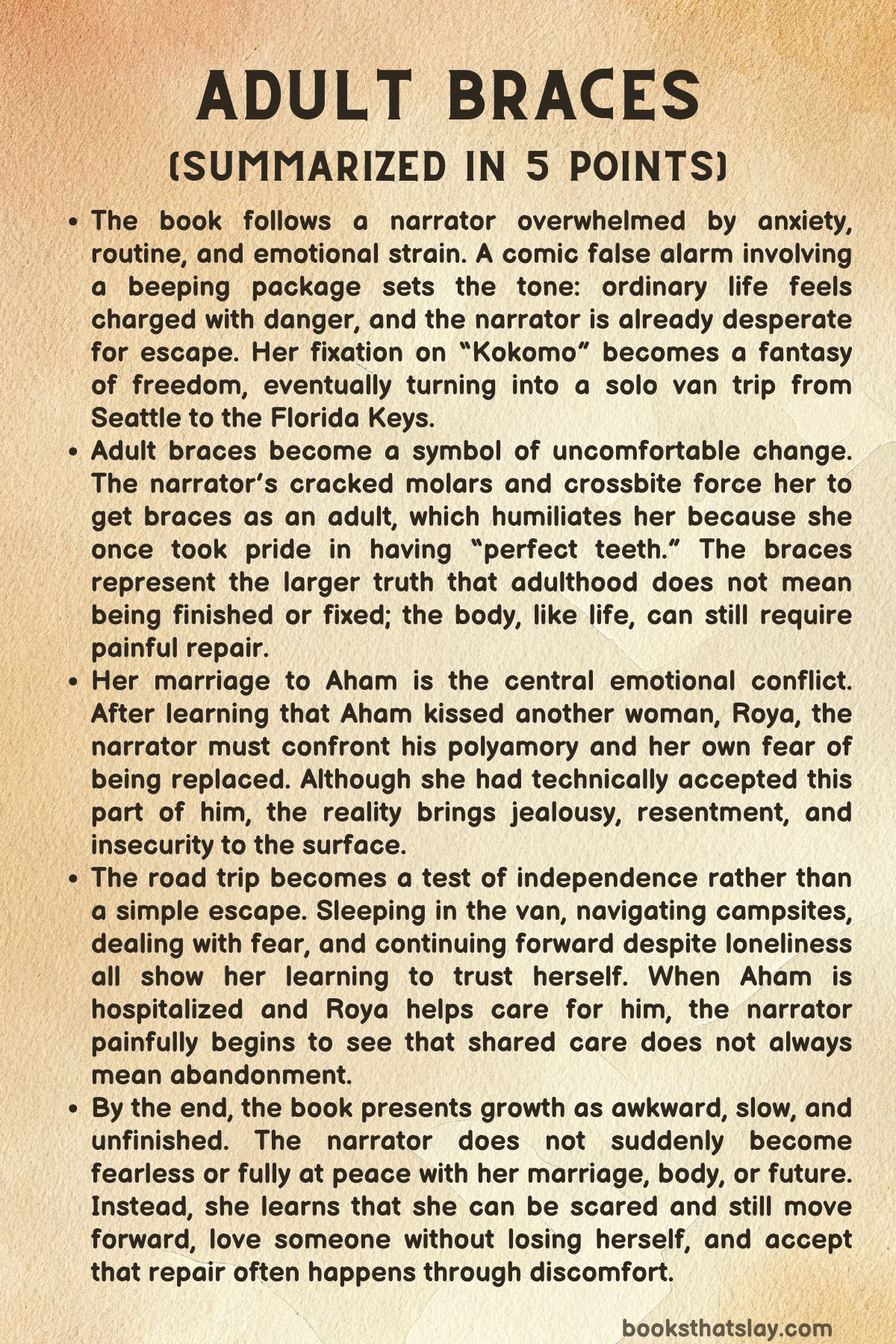
Adult Braces uses the awkwardness of teeth, vans, alarms, hospitals, dreams, and long drives to show a woman learning that adulthood does not mean becoming finished. It means accepting that repair can be uncomfortable, visible, and slow.
Key Figures
The figures in Adult Braces by Lindy West are shaped by anxiety, humor, emotional exhaustion, marriage, self-discovery, and the uneasy process of accepting change. Each of them contributes to the narrator’s movement from panic and resentment toward a more honest understanding of herself and the people around her.
Lindy West, the Narrator
The narrator is the emotional center of the book, and her character is defined by a mixture of sharp humor, fear, vulnerability, and deep self-awareness. She begins in a state of exhaustion, reacting to ordinary situations with intense anxiety, as seen when she mistakes a loud vintage alarm clock for a possible bomb.
This reaction is comic, but it also reveals how alert and overwhelmed she feels in her daily life. Her desire to escape to “Kokomo,” and later to the Florida Keys, shows that she is not simply craving travel; she is craving distance from worry, marriage tension, physical discomfort, and the version of herself that feels trapped.
Her adult braces become an important symbol of humiliation, change, and forced self-reassessment. She once took pride in having “perfect teeth,” so needing braces as an adult unsettles her image of herself.
The braces are not only a physical correction but also a reminder that parts of her life she believed were stable or complete still need repair. Her cracked molars and crossbite mirror the emotional pressure she has been carrying, especially in her marriage.
Through this, the book presents her as someone who must confront the gap between how she wants to appear and how she actually feels.
The narrator’s marriage to Ahamefule exposes some of her deepest fears. She is hurt by his relationship with Roya not only because of jealousy, but because it activates her fear of being replaced.
Even though Aham had identified as polyamorous before, she had never truly absorbed what that meant for their marriage. Her struggle is not presented as simple intolerance or possessiveness; rather, it comes from anxiety, avoidance, resentment, and a need for emotional security.
As the story develops, she begins to realize that being alone does not have to mean being abandoned. Time by herself allows her to rebuild friendships, exercise, think independently, and reconnect with a self that exists outside the marriage.
Her solo van trip marks a major stage in her growth. At first, she is frightened by practical tasks, unfamiliar places, strange dreams, and sudden noises.
Yet each small success matters: finding her campsite, sleeping in the van, showering, driving forward, and recording voice memos all become proof that she can function on her own. She remains funny and self-critical, but beneath that humor is a serious effort to become less ruled by fear.
In Adult Braces, the narrator’s journey is not about becoming fearless; it is about learning that fear does not have to control every decision.
Ahamefule / Aham
Ahamefule, often called Aham, is the narrator’s husband and one of the most emotionally complicated figures in the book. He is loving and supportive in some ways, especially when he encourages the narrator to take the solo trip instead of discouraging her escape.
His support suggests that he understands she needs space, movement, and independence. At the same time, he is central to the narrator’s pain because his kiss with another woman forces their long-avoided marital issues into the open.
Aham’s identity as polyamorous creates a major conflict in the relationship. He had told the narrator this before their marriage resumed, and she had technically agreed to it, but the emotional reality proves far more difficult than the abstract agreement.
His character therefore represents both honesty and emotional disruption. He is not portrayed simply as a villain, because the situation is more layered than betrayal alone.
He has been open about an important part of himself, yet the way that truth enters the marriage still leaves the narrator hurt, shaken, and insecure.
His hospitalization during the narrator’s trip adds another layer to his role. When he becomes ill, the narrator offers to return, showing that she still feels deeply responsible for him.
His refusal and his reassurance that Roya is coming to help create a difficult but important emotional turning point. For the narrator, this moment is painful because it makes her feel displaced.
However, it also reveals that Aham’s other relationship can provide practical care rather than only emotional threat. Aham’s character forces the narrator to confront love as something more complex than possession, exclusivity, or control.
Roya
Roya is Aham’s other partner and initially exists in the narrator’s mind as a source of fear, jealousy, and possible replacement. Because the narrator learns about Aham’s kiss through a stranger, Roya’s presence enters the story through shock and insecurity.
At first, she is less a fully known person than a symbol of everything the narrator dreads: being compared, abandoned, or made unnecessary in her own marriage.
As the story develops, Roya becomes more human and less symbolic. The fact that her best friend has died of cancer gives her character a background of grief and emotional vulnerability.
She is not merely an intruder in the narrator’s life; she is a person carrying her own pain. This detail changes the emotional shape of the situation, because the narrator must eventually recognize that Roya’s life is not organized around threatening her.
Roya has her own losses, needs, and relationships.
Roya’s most important contribution comes when Aham is hospitalized. She sends thoughtful medical updates, and her care begins to soften the narrator’s resistance.
This does not erase the narrator’s pain, but it complicates it. Roya becomes evidence that another woman’s presence does not automatically mean destruction.
Through Roya, the book explores the possibility that care can be shared in ways that feel strange, uncomfortable, and eventually even useful. Her character helps push the narrator toward a wider, less fear-driven understanding of love and support.
Sam
Sam is part of the narrator’s immediate world at the beginning of the story, and her presence helps establish the atmosphere of anxiety, humor, and danger. Because Sam has received death threats connected to her work, the narrator’s fear that the beeping package may be a bomb is not completely random.
Sam’s life brings the outside world’s hostility into the domestic space, making the narrator’s panic feel both exaggerated and understandable.
Sam’s character also helps show the narrator’s heightened emotional state. The beeping object turns out to be harmless, but the narrator’s reaction reveals how quickly her mind moves toward catastrophe.
Sam therefore functions as part of the environment that reflects the narrator’s stress. She is not the cause of the narrator’s crisis, but her situation adds pressure and realism to the narrator’s fear.
Even though Sam is not explored as deeply as the central figures in the marriage, she matters because she helps frame the opening mood. Her presence suggests a world where women’s public work can attract threats and where danger, whether real or imagined, seeps into ordinary life.
This makes the narrator’s longing for escape feel more understandable.
Kirsten
Kirsten brings comedy and normalcy into the opening scene. She reveals that the supposed bomb is actually a loud vintage alarm clock bought for her son, immediately turning the narrator’s panic into absurdity.
Her role is brief but important because she punctures the tension and shows how the narrator’s fear can transform ordinary objects into dramatic threats.
Kirsten’s character also helps establish the book’s tone. The story does not treat anxiety only as tragedy; it also presents it through embarrassment, surprise, and humor.
Kirsten’s practical explanation creates a contrast between reality and the narrator’s imagination. This contrast prepares the reader for the narrator’s larger journey, where many fears must be tested against actual experience.
Although Kirsten is not a central emotional figure, she contributes to the opening comic rhythm. She represents the ordinary domestic world that the narrator is temporarily unable to relax into.
Through her, the book shows how the narrator’s mind is already primed for escape before the road trip even begins.
Rainbow
Rainbow is an old family acquaintance who runs a crystal and healing shop, and her role is connected to spiritual openness, emotional preparation, and the narrator’s desire for transformation. The “Rainbow Soul Journey” could easily seem strange or overly mystical, but in the story it becomes meaningful because the narrator is searching for permission to change.
Rainbow offers a form of care that is symbolic rather than practical.
Rainbow’s crystals and guided meditation help the narrator enter a more receptive state before the trip. Whether or not the healing practice is treated as literally powerful, it gives the narrator a ritual of transition.
She is about to leave behind her familiar routines and drive across the country alone, and Rainbow’s presence helps mark that departure as emotionally significant.
As a character, Rainbow represents an alternative kind of wisdom. She does not solve the narrator’s marriage, health problems, or anxiety, but she gives her a space in which uncertainty can feel less frightening.
Her role is to help the narrator become more open to the road, to solitude, and to the possibility that change does not always have to be controlled or rationally explained.
Lindy’s Father
The narrator’s father appears through memory, and his character is associated with show-business energy, performance, music, and emotional inheritance. He seems to have had a vivid, theatrical presence in her life, shaping her sense of humor and her relationship to performance.
Her memory of singing “The Elements” with him until his death suggests intimacy, shared rhythm, and the deep emotional power of family rituals.
His influence helps explain part of the narrator’s personality. Her wit, timing, and tendency to turn fear into performance-like storytelling seem connected to the world he represented.
He is not physically present in the current action, but his memory travels with her, especially as the landscape gives her time to reflect. The road trip becomes not only a movement across the country but also a movement through memory.
The father’s death gives his presence a note of grief. The narrator’s recollections are affectionate, but they also remind the reader that love is tied to loss.
His character helps deepen the book’s emotional range by connecting the narrator’s present crisis to older experiences of family, identity, and mourning.
Lindy’s Mother
The narrator’s mother is remembered through her Scandinavian humility, which contrasts with the father’s show-business energy. This contrast helps shape the narrator’s understanding of herself as someone formed by different emotional inheritances.
From her mother, she seems to have absorbed modesty, restraint, and perhaps a tendency to minimize her own needs.
The mother’s influence is quieter than the father’s, but it is still important. Her humility may help explain why the narrator struggles with claiming space for herself.
The solo trip becomes, in part, an effort to take up room physically and emotionally: driving a van, choosing her own route, sleeping alone, and listening to her own thoughts. Against the background of maternal modesty, this independence feels especially significant.
Her character adds balance to the family portrait. The narrator is not shaped by one simple inheritance, but by a combination of flamboyance and restraint, performance and humility, boldness and self-doubt.
The mother’s presence in memory helps show that the narrator’s adult struggles are connected to long-standing patterns of identity.
The Dog
The narrator’s dog is not a human character, but the dog plays an important emotional role in the book. Caring for the dog after surgery adds to the narrator’s exhaustion and sense of being trapped.
The responsibility is loving, but it is also part of the routine from which she longs to escape. The dog’s surgery places the narrator in a caretaker role at a time when she herself feels depleted.
The dog also helps reveal the narrator’s emotional state before the trip. Her fixation on “Kokomo” happens while she is caring for the dog, suggesting that the desire to run away grows out of the pressure of daily responsibility.
She does not want to abandon love or duty, but she wants relief from constantly managing fear, care, and domestic strain.
As part of the story’s emotional landscape, the dog represents home, attachment, and obligation. The narrator’s need to leave does not mean she lacks love for the life she has; rather, it shows that even loving responsibilities can become overwhelming when someone has lost touch with herself.
Themes
Escape as a Response to Emotional Exhaustion
In Adult Braces, the narrator’s desire to travel begins less as a simple vacation and more as a reaction to mental overload. The false bomb scare, the constant worry about threats, the care required for her recovering dog, and the strain in her marriage all create a sense that ordinary life has become too loud and too demanding.
Her fixation on “Kokomo” shows how escape can begin as fantasy: a place imagined as simple, warm, distant, and free from responsibility. When she learns that Kokomo is not real, she redirects the fantasy toward the Florida Keys, suggesting that what matters is not the destination itself but the act of leaving.
The van trip gives her a physical form for an emotional need. Driving, sleeping alone, dealing with campsites, showers, fear, and uncertainty all become ways of testing whether she can exist outside the routines that have made her feel trapped.
Escape here is not avoidance alone; it becomes a rough path toward self-recognition.
Marriage, Jealousy, and the Fear of Replacement
The narrator’s marriage is shaped by love, resentment, avoidance, and fear. Aham’s polyamory forces her to confront an agreement she once accepted in theory but never truly absorbed emotionally.
The discovery that he kissed another woman feels like betrayal not only because of the act itself, but because it confirms her deeper fear that she can be replaced. Roya’s presence becomes especially painful because she represents a version of intimacy the narrator cannot control.
At first, Aham’s visits to Portland seem like proof that the marriage is being taken from her in pieces. Yet the situation gradually becomes more complicated.
When Aham is hospitalized and Roya sends careful updates, the narrator begins to see that another partner does not only mean competition; it can also mean shared care. This shift does not erase jealousy, but it challenges the narrator’s belief that love must be guarded through fear.
The marriage theme is powerful because it presents emotional honesty as messy, uncomfortable, and slow.
Change, Embarrassment, and the Body
The narrator’s braces become a visible symbol of unwanted change. Her cracked molars and crossbite force her into an orthodontic office that feels cold and impersonal, making the experience seem even more humiliating.
The embarrassment is intensified by her past pride in having “perfect teeth,” because the braces damage an image of herself she had quietly depended on. Adult braces are not just dental treatment in this narrative; they expose how fragile self-image can be when the body stops supporting the story a person has told about themselves.
The narrator is already facing emotional instability, marital uncertainty, and a need for escape, so the braces become part of a larger period in which she must accept discomfort she did not choose. They make private change public.
Every ache, wire, and awkward smile reminds her that growth often arrives through inconvenience rather than inspiration. The body becomes a record of stress, aging, and adjustment, but also of repair.
Solitude as a Path to Independence
Being alone begins as something the narrator fears, especially because loneliness is tied to her anxiety about Aham and Roya. Yet solitude gradually becomes a condition in which she can rebuild herself.
When Aham spends time away, she reconnects with friends, goes to the gym, and begins experiencing her life as something larger than the marriage. The solo van trip expands this process.
Her first night at the KOA is full of uncertainty: arriving after hours, finding the campsite information, sleeping in the van, waking from strange dreams, and mistaking a freight train for a terrifying roar. These moments show independence not as confidence from the start, but as the ability to keep going while afraid.
Even small acts, like showering successfully or recording voice memos, become signs that she is learning to rely on herself. Solitude gives her space to think about family, memory, landscape, and desire without immediately filtering those thoughts through someone else’s needs.
It becomes a difficult but necessary form of freedom.