Beneath by Ariel Sullivan Summary, Characters and Themes
Beneath by Ariel Sullivan is a dystopian survival story set in Haven, an underground refuge built after nuclear war leaves the surface deadly and broken. The novel follows Sasha Cadell, a former Hospital Ward assistant trying to escape guilt, loss, and the nickname “Death’s Angel.” When she is forced into Force Unit Seven as a medic, she is pulled into dangerous missions, political secrets, and uneasy bonds with soldiers who do not fully trust her.
The book mixes post-apocalyptic danger with medical urgency, betrayal, romance, and the slow discovery that Haven’s leaders may be hiding truths that could change everything.
Summary
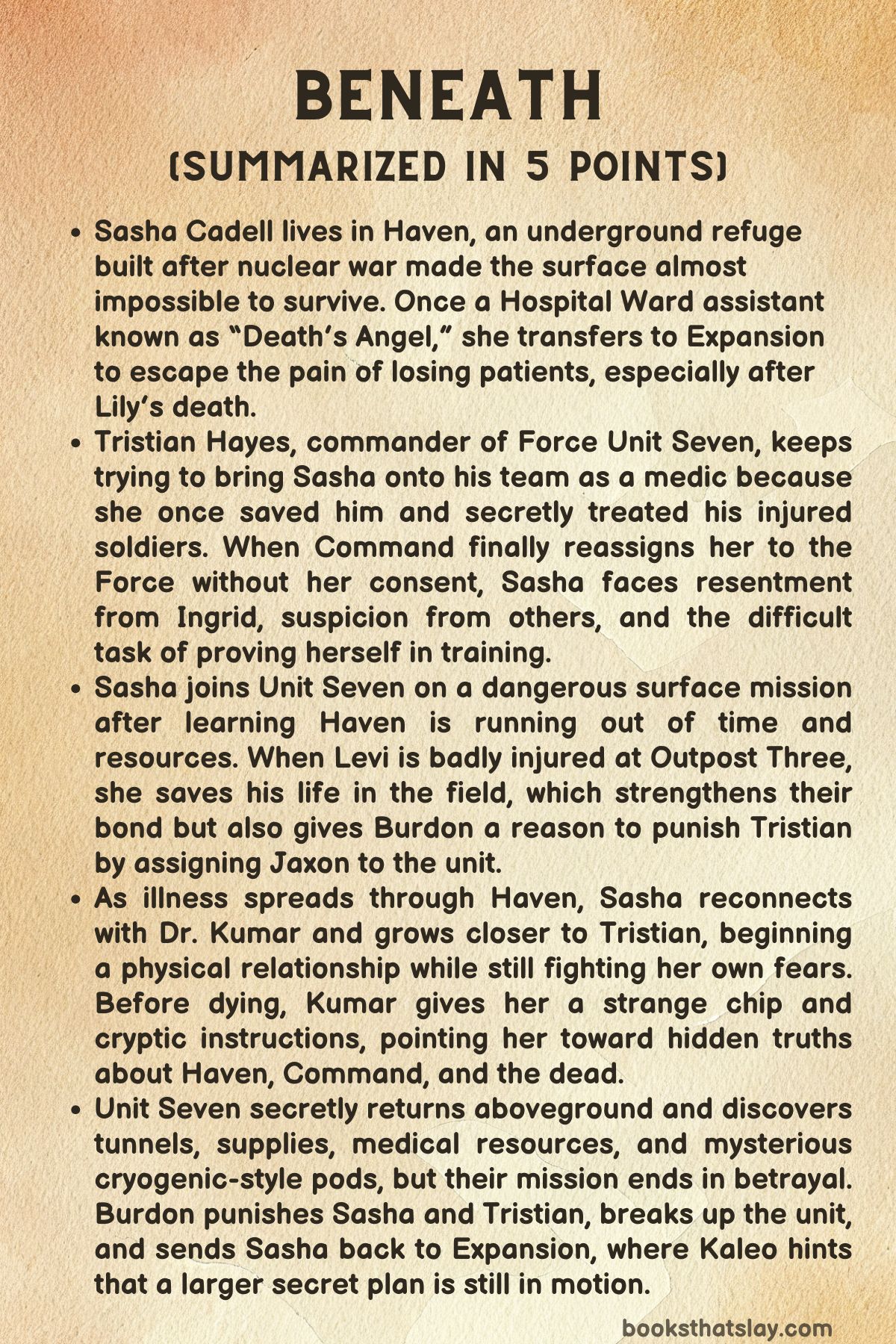
Sasha Cadell lives in Haven, an underground refuge where humanity survives after nuclear war ruins the surface and makes it almost impossible to live aboveground. Haven is built on strict rules, controlled work assignments, and health scores that determine a person’s value and future.
Sasha once worked in the Hospital Ward, where she became known as “Death’s Angel” because she sat with dying patients and somehow avoided becoming ill herself. The name follows her as both a mark of usefulness and a painful reminder of loss.
Wanting to get away from the constant grief of the Ward, she transfers to Expansion, where workers dig and clear space for Haven’s future.
During a lockdown, Sasha is attacked by three men from Sanitation. She fights them off, showing that she is tougher and more dangerous than people expect.
Soon after, she runs into Tristian Hayes, commander of Force Unit Seven. Tristian has wanted Sasha to become his unit’s medic for a long time, but Sasha wants nothing to do with him or the Force.
Their history began when Tristian arrived in the Ward with a deadly illness, and Sasha managed to save him. After that, he secretly brought injured members of Unit Seven to her so she could treat them without creating records that would damage their health scores.
Sasha helped them, but the arrangement ended after Lily, Ingrid’s partner, died despite Sasha’s efforts. Sasha blamed herself, left the Ward, and cut herself off from the unit.
Sasha’s attempt to stay away from the Force fails when Command suddenly reassigns her to Unit Seven. Tristian’s petitions for a medic have finally been accepted by Force Commander Lyssa Burdon, and Sasha is furious because no one asked for her consent.
Her arrival is tense from the beginning. Some members of the unit are curious or cautious, while Ingrid openly hates her because Sasha has taken Lily’s place.
Rumi, Levi, Isla, Damien, and Patrick each respond in different ways, testing her skills, judging her limits, or trying to understand her. Sasha must learn how to fit into a group that already has its own loyalties and wounds.
Training makes it clear that Sasha is gifted in some areas and weak in others. She proves to be an excellent shooter, surprising the unit with her precision and calm under pressure.
At the same time, she struggles with physical combat, obstacle courses, and the House simulation, which forces trainees into frightening scenarios. The simulation brings back memories of her brother Eli’s death and her failures during the war.
Sasha carries guilt not only for the patients she could not save, but also for the people she lost before Haven became her prison and shelter. Her assignment to Unit Seven forces her to face the very emotions she tried to bury.
Tristian eventually explains that Haven is in serious danger. The underground refuge is running out of time, and without new resources, everyone inside will eventually die.
Unit Seven must go aboveground to search for supplies, information, and possible solutions. Sasha prepares to serve as their medic, even though the surface is full of radiation, ruins, and danger.
When the unit leaves Haven, Sasha sees the dead, gray world outside and understands how much has been lost. The mission is risky, but it also begins to change her relationship with the team.
She starts forming a bond with Levi, who becomes her partner in the field.
At Outpost Three, the unit walks into a trap. Levi is badly injured, and Sasha must act quickly to save his life.
She treats him in the field under dangerous conditions and takes serious risks, including exposure to radiation, to keep his blood warm and give him a chance to survive. Her choices prove her skill and courage, even to those who doubted her.
The unit rushes Levi back to Haven, and he survives, but the crisis gives Burdon a reason to punish Tristian. She assigns Jaxon to Unit Seven, disrupting the group further.
Jaxon is Sasha’s former casual lover, and his arrival creates new tension between Sasha, Tristian, and the unit.
While Levi recovers, Sasha returns to the Ward and reconnects with Dr. Kumar, one of the few people who truly understands her abilities and past choices. She learns that Kumar always knew she had been falsifying medical records to help people, but he never stopped her.
At the same time, illness begins spreading through Haven, and Ingrid’s sister Bretta becomes one of the sick. Sasha starts searching for answers, driven by fear that the sickness may grow beyond anyone’s control.
Her connection with Tristian also deepens. Their bond becomes physical, but Sasha struggles to name what she feels.
She is used to loss, secrecy, and survival, not trust.
Kumar’s death changes everything. Before he dies, he gives Sasha a strange key-like chip and leaves her with cryptic instructions: keep hope alive, find the snake, and protect the dead.
Sasha does not fully understand what he means, but she knows the message matters. Soon after, she joins Unit Seven in secretly going aboveground again.
This mission reveals that Haven’s world is far larger and stranger than Sasha realized. The unit discovers hidden tunnels, large stores of supplies, medical resources, and cryogenic-style pods.
In one pod, Sasha sees a living woman, but when she returns, the woman has disappeared. The discovery suggests that Command has been hiding more than shortages and mission details.
The unit also encounters Kaleo and Unit Five, who reveal more about Haven’s secret systems and the lies surrounding the dead. Sasha begins to understand that Haven’s leadership has controlled information, buried evidence, and possibly manipulated people’s lives for years.
The supplies they find could help the refuge, but the truth behind them is dangerous. The hidden areas beneath Haven point to a deeper plan, one that involves the dead, stored resources, and people who may not be as gone as everyone believes.
Unit Seven brings supplies back, but the mission does not end in victory. Burdon catches Sasha and Tristian, and Kaleo betrays them.
Burdon uses the situation to punish them both. Tristian is removed from command, Sasha is sent back to Expansion, and Unit Seven is broken apart.
The people Sasha slowly came to rely on are scattered, and the fragile trust she built is damaged by Command’s control. Her return to Expansion feels like a deliberate attempt to reduce her to labor and silence her before she can expose what she has learned.
Back in Expansion, Sasha is forced to swing a pickax again, trapped in the life she thought she had escaped. Yet the secrets around her have not disappeared.
Kaleo, now exiled too, approaches her and reveals that he and Rumi had been involved and were “in on everything.” His words suggest that Rumi knew more than Sasha realized and that the hidden plans around Haven are still moving. Kaleo asks whether Sasha found the charts Rumi wanted, hinting that the information Sasha has seen may be only one part of a larger mystery.
He ends by saying he has been thinking about dying, leaving Sasha with the sense that something dangerous is still unfolding beneath the surface of Haven. The story closes with Sasha punished and isolated, but also carrying knowledge, unanswered questions, and clues that may be the key to Haven’s future.
Characters
Sasha Cadell
Sasha Cadell is the central character of Beneath, and her journey is shaped by grief, guilt, survival, and a deep but often resisted instinct to care for others. At the beginning of the book, Sasha is trying to escape the emotional weight of her past by working in Expansion instead of the Hospital Ward.
Her old nickname, “Death’s Angel,” reveals how closely she has lived beside suffering and death. She earned that name because she stayed with dying patients without becoming sick herself, but the title also reflects the emotional burden she carries.
Sasha is not cold or detached; rather, she has been forced to protect herself from constant loss. Her decision to leave the Ward after Lily’s death shows how deeply she blames herself, even when the circumstances were beyond her control.
Sasha’s reassignment to Force Unit Seven forces her back into a role she has tried to abandon. She resents the lack of consent because control matters greatly to her.
In a world where Command decides people’s futures, Sasha’s anger is not just personal rebellion; it is also a reaction to a system that treats people as tools. Her struggles during training show that she is not an effortless hero.
She is skilled with a gun and highly capable as a medic, but she is physically and emotionally tested by combat training, the obstacle course, and the House simulation. These moments reveal that her greatest wounds are internal.
Memories of Eli’s death and the war continue to shape how she sees herself, making her believe she has failed the people she loved.
As the book progresses, Sasha becomes more than a survivor. Her actions on the surface, especially when she saves Levi, show her courage and medical brilliance under pressure.
She risks radiation exposure to preserve his life, proving that despite her attempts to distance herself from attachment, she is still willing to sacrifice herself for others. Her relationship with Tristian also exposes her emotional conflict.
She is drawn to him, trusts him more than she wants to admit, and eventually begins a physical relationship with him, yet she struggles to name her feelings because vulnerability frightens her. By the end of the story, Sasha has become deeply entangled in Haven’s secrets.
Kumar’s final instructions and Kaleo’s revelations suggest that she may be central to uncovering the truth beneath the society she has always known. Sasha is a character defined by pain, but also by resilience, intelligence, compassion, and the growing realization that survival without truth is not enough.
Tristian Hayes
Tristian Hayes is the commander of Force Unit Seven and one of the most important figures in Sasha’s transformation. He is disciplined, persistent, and deeply committed to the survival of his unit and Haven as a whole.
His repeated efforts to have Sasha assigned as the unit’s medic show both strategic intelligence and personal faith in her abilities. Tristian understands Sasha’s value long before she is ready to accept it herself.
Their history begins when she saves him from a deadly illness, and from that point onward, he recognizes that she possesses not only medical skill but also unusual courage and emotional strength.
As a leader, Tristian is protective but not soft. He pushes Sasha because he knows the mission aboveground demands more than medical knowledge.
His command style reflects the harshness of Haven’s reality: mistakes can kill, hesitation can destroy a unit, and loyalty must be earned through action. Yet Tristian is not simply a soldier following orders.
His petitions for a medic, his willingness to secretly bring injured unit members to Sasha, and his later defiance of Command show that he has a moral code independent of the system he serves. He believes in the people under his care more than in the rules imposed on them.
Tristian’s relationship with Sasha is built on tension, respect, and shared trauma. He sees through many of her defenses, but he does not fully control or soften her.
Instead, their bond develops through danger, trust, and emotional recognition. His growing closeness with her reveals a more vulnerable side of him, especially as the pressures from Burdon and the secrets of Haven intensify.
When he is removed from command, the punishment is not only professional but deeply personal, because leadership is central to his identity. Tristian represents loyalty under pressure, the burden of command, and the difficult choice between obedience and truth.
Levi
Levi is one of the most emotionally significant members of Unit Seven because he becomes Sasha’s partner and one of the first people in the unit to form a meaningful bond with her. His relationship with Sasha develops through trust rather than immediate closeness.
In a group where she feels unwanted, tested, and judged, Levi’s presence helps her begin to belong. He becomes important not only because of his role in the mission but because he gives Sasha a reason to reconnect emotionally with the people around her.
Levi’s severe injury at Outpost Three becomes a turning point in the book. Through him, the danger of the aboveground mission becomes painfully real.
His injury also forces Sasha to confront the very fear she has been running from: the possibility of losing someone in her care. Her desperate effort to save him shows how much he has come to matter to her.
Levi’s survival is important because it proves that Sasha is not doomed to fail everyone she tries to help. In that sense, Levi becomes part of her healing, even though his suffering places her under enormous emotional pressure.
Levi also helps reveal the cruelty of Haven’s power structure. Instead of treating his injury only as a tragedy or medical emergency, Burdon uses the crisis to punish Tristian and interfere with Unit Seven.
This shows how individuals like Levi can become pawns in larger political struggles. Despite this, Levi remains a symbol of human connection within the story.
His bond with Sasha proves that even in a controlled and dangerous underground society, trust can still form, and that trust can change the way a person sees herself.
Ingrid
Ingrid is one of the most emotionally wounded members of Unit Seven, and her resentment toward Sasha comes from grief rather than simple cruelty. She openly resents Sasha because Sasha replaces Lily, who was Ingrid’s partner.
For Ingrid, Sasha’s arrival is not just a practical reassignment; it is a reminder of loss. Because Lily died despite Sasha’s efforts, Ingrid’s anger becomes focused on Sasha, even though the deeper source of her pain is helplessness and mourning.
Ingrid’s hostility adds emotional tension to Sasha’s integration into the unit. She represents the people who cannot easily forgive, especially when grief needs someone to blame.
Her reaction is understandable within the emotional logic of the story because Sasha herself also blames herself for Lily’s death. This creates a painful mirror between them.
Both women are trapped by the same loss, but they express it differently. Sasha withdraws and punishes herself, while Ingrid directs her pain outward.
The mention of Ingrid’s sister Bretta also gives Ingrid more depth. When illness spreads through Haven and Bretta is affected, Ingrid’s fear becomes tied not only to past loss but also to the possibility of losing another loved one.
This makes her more than an antagonistic presence within the unit. She is a person shaped by repeated vulnerability in a world where survival is never secure.
Ingrid’s character shows how grief can harden into anger, but also how that anger often hides love, fear, and unresolved sorrow.
Rumi
Rumi is one of the more mysterious members of Unit Seven, especially because later revelations suggest that he is connected to hidden plans and secrets beyond what Sasha initially understands. At first, Rumi appears as part of the unit’s effort to test, understand, or tolerate Sasha.
Like the others, he is part of the tense environment Sasha must enter after being reassigned. However, as the story develops, Rumi becomes more significant because of his connection to Kaleo and the possibility that he knew far more than he revealed.
The revelation that Kaleo and Rumi were involved together and “in on everything” changes the way Rumi must be understood. He is not merely a background member of Unit Seven; he may be part of a deeper network of knowledge or resistance.
His interest in charts and hidden information suggests that he is connected to the larger mystery surrounding Haven, the underground systems, and Command’s secrets. This makes him an important figure in the story’s hidden architecture.
Rumi’s character carries ambiguity. The reader is left to question whether he is loyal to Unit Seven, to Kaleo, to a secret cause, or to some combination of these.
His hidden involvement gives the story an added layer of uncertainty because it suggests that Sasha has been surrounded by secrets even among those who seemed to be her allies. Rumi represents the danger of partial knowledge: he may be working toward hope, but his secrecy also creates distrust.
Isla
Isla is a member of Unit Seven who helps define the unit’s social and emotional atmosphere after Sasha’s arrival. While she is not described as openly hostile in the same way as Ingrid, she is part of the group that must decide whether Sasha can be trusted.
This places Isla in an important position within the unit dynamic. Her response to Sasha contributes to the sense that Sasha has entered a tightly bonded group with its own history, wounds, and loyalties.
Isla’s role reflects the difficulty of joining a group that has already suffered loss. Sasha is not entering an empty position; she is stepping into the place once connected to Lily.
For characters like Isla, accepting Sasha may require balancing practical need with emotional memory. Even tolerance becomes meaningful in this context because the unit operates under intense pressure, and trust is essential for survival.
Although Isla is not given the same level of personal conflict as Sasha, Tristian, Ingrid, or Levi, her presence helps show that Unit Seven is not just a military group but a community. Each member’s reaction shapes Sasha’s experience of belonging or isolation.
Isla contributes to the realism of that group dynamic, where acceptance is gradual, cautious, and influenced by shared danger.
Damien
Damien is another member of Unit Seven whose importance lies in the way he contributes to the unit’s testing and adjustment to Sasha’s presence. He is part of the group that must evaluate whether Sasha can survive the demands of Force work and whether she deserves a place among them.
In a unit that depends on discipline and trust, Damien’s attitude toward Sasha helps create the pressure she must overcome.
His role also reflects the practical mindset of Force members. Sasha’s medical skill is valuable, but Unit Seven needs more than a medic who can work in controlled conditions.
They need someone who can endure the surface, react under threat, and remain reliable when missions turn deadly. Damien’s presence within this testing environment helps emphasize that Sasha must prove herself in multiple ways, not simply rely on her reputation from the Ward.
Damien may not dominate the emotional center of the book, but he helps build the structure around Sasha’s development. Through characters like him, the story shows that acceptance into Unit Seven is not automatic.
It must be earned through performance, courage, and persistence. Damien represents the collective standard of the unit, the expectation that every person must be strong enough to protect the others.
Patrick
Patrick functions as part of Unit Seven’s broader group identity, helping create the sense of a team with established bonds before Sasha joins. Like Damien and Isla, he is involved in the process of testing, understanding, or tolerating Sasha.
His presence matters because Sasha’s struggle is not only with Tristian or Ingrid but with an entire unit that has to decide what to make of her.
Patrick’s role supports one of the book’s central emotional tensions: the challenge of belonging after loss. Unit Seven has already been shaped by Lily’s death, Tristian’s leadership, and the dangerous work of Force missions.
Sasha enters this space as both an outsider and a necessity. Patrick’s reaction is part of the gradual process by which the group adjusts to her, and by which she begins to see herself as responsible for them.
Through Patrick and the other supporting members, Unit Seven feels like more than a plot device. It becomes a living group with internal loyalties and unspoken tests.
Patrick helps reinforce the idea that survival depends on collective trust. Even when individual members are not explored as deeply as Sasha or Tristian, their presence strengthens the emotional stakes of the missions and the consequences of the unit being broken apart.
Lily
Lily is absent for most of the present action, but her death shapes many of the relationships in the book. She was Ingrid’s partner, and her loss creates the emotional wound that makes Sasha’s arrival so painful for Ingrid.
Lily’s importance comes from the way her memory lingers over Unit Seven. She represents the person Sasha could not save, the partner Ingrid cannot stop grieving, and the role Sasha is forced to fill against her will.
For Sasha, Lily’s death is one of the defining sources of guilt. Even though Sasha tried to help her, the failure becomes unbearable.
It drives Sasha away from the Ward and away from Unit Seven, showing how deeply Sasha internalizes loss. Lily therefore functions as a symbol of Sasha’s fear that her care is never enough.
Every time Sasha is forced to act as a medic again, Lily’s memory is part of the emotional pressure behind that role.
Lily also shows how death continues to influence the living in a closed society like Haven. Because the community is trapped underground and resources are limited, every loss feels magnified.
Lily’s death does not end with her; it alters Ingrid, Sasha, and the unit’s ability to trust. Her character demonstrates how an absent person can remain powerful within a story because memory, grief, and blame continue to shape the choices of those left behind.
Eli
Eli is Sasha’s brother, and his death is one of the deepest wounds in her past. The House simulation triggers memories of him, revealing that Sasha’s trauma is not limited to her work in the Ward.
Eli’s death connects her personal grief to the larger devastation of war. He represents the family Sasha lost and the part of herself that remains trapped in the past.
Sasha’s memories of Eli show that her guilt has older roots than Lily’s death. She carries a sense of failure from the war, and Eli becomes the emotional center of that unresolved pain.
His death helps explain why Sasha reacts so strongly to danger, helplessness, and medical failure. She is not simply afraid of people dying; she is afraid of reliving the moment when she could not prevent loss.
Eli’s role is important because he reveals the vulnerability beneath Sasha’s anger and independence. Her toughness is not natural detachment but a defense built from grief.
By haunting Sasha’s memory, Eli helps shape the reader’s understanding of her emotional guardedness. He is part of what makes her both fragile and strong, because her pain has damaged her but has also made her fiercely determined not to abandon others.
Lyssa Burdon
Force Commander Lyssa Burdon is one of the clearest representatives of institutional power in the book. She has the authority to accept Tristian’s petitions and reassign Sasha to the Force, but her actions show little concern for Sasha’s consent.
Burdon treats people according to usefulness, discipline, and control. Her decision to place Sasha in Unit Seven may serve a practical purpose, but it also reveals how easily Command can override individual choice.
Burdon becomes increasingly antagonistic as the story develops. After Levi’s injury, she uses the crisis to punish Tristian by assigning Jaxon to Unit Seven.
This shows her political instincts and her willingness to exploit vulnerability. Rather than responding to danger with compassion or unity, she uses it to weaken Tristian’s authority.
Her later punishment of Sasha and Tristian after the secret mission aboveground confirms her role as a defender of Command’s secrets.
Burdon is not merely a harsh commander; she embodies the oppressive structure of Haven. Through her, the book explores how survival-based societies can become authoritarian, especially when leaders control information.
Her power depends on obedience, secrecy, and punishment. By removing Tristian from command, sending Sasha back to Expansion, and breaking apart the unit, Burdon shows that Command fears independent action and hidden truth more than it values courage.
Jaxon
Jaxon is Sasha’s former casual lover, and his assignment to Unit Seven complicates both Sasha’s emotional life and the unit’s stability. His arrival is not neutral; Burdon uses him as a punishment against Tristian after Levi’s injury.
Because of his past with Sasha, Jaxon becomes a tool of disruption. His presence threatens to create tension at a moment when the unit is already vulnerable.
Jaxon’s connection to Sasha reveals part of her earlier attempt to keep relationships controlled and emotionally limited. A casual relationship allows closeness without full vulnerability, which fits Sasha’s pattern of protecting herself from deeper attachment.
His reappearance contrasts with her growing bond with Tristian, making Jaxon a reminder of who Sasha was when she tried to avoid emotional commitment.
Although Jaxon’s role is shaped by Burdon’s manipulation, he is important because he exposes how personal history can be weaponized. In Haven, even relationships can become tools in power struggles.
Jaxon’s presence forces Sasha and Tristian to navigate not only external threats but also emotional complications created by Command’s interference. He represents the past returning at the worst possible moment.
Dr. Kumar
Dr. Kumar is one of the most significant guiding figures in Sasha’s life. As someone connected to the Ward, he understands her medical skill, her moral choices, and the risks she has taken.
When Sasha returns to the Ward and reconnects with him, she learns that he always knew she had been falsifying records to help people. This revelation is important because it shows that Sasha was not as alone in her quiet rebellion as she believed.
Kumar’s knowledge of Sasha’s actions reveals his own moral complexity. He does not simply enforce the system’s rules.
Instead, he recognizes that compassion sometimes requires disobedience. His awareness of Sasha’s falsified records suggests that he has been protecting her or at least allowing her to continue helping others.
This makes him a quiet ally, someone who understands that Haven’s official systems do not always serve humanity.
His death is a major turning point because he leaves Sasha with cryptic instructions and a strange key-like chip. His words, “keep hope alive,” “find the snake,” and “protect the dead,” suggest that he knows about hidden truths beneath Haven’s surface.
Kumar becomes a bridge between Sasha’s medical past and the larger mystery of Command’s secrets. Even after his death, his guidance pushes Sasha toward discovery, resistance, and a deeper understanding of what survival truly requires.
Bretta
Bretta is Ingrid’s sister, and her illness gives personal weight to the sickness spreading through Haven. Although she is not one of the most active characters, her role is emotionally important because she raises the stakes for Ingrid and for Sasha.
Through Bretta, the illness becomes more than a general crisis; it becomes a threat to someone connected to the unit’s emotional core.
Bretta’s condition also forces Sasha back into the kind of medical urgency she has tried to escape. Sasha’s search for answers is not abstract.
People are suffering, and Bretta’s illness reminds her that her skills are still needed. In this way, Bretta’s character helps pull Sasha further away from avoidance and back toward responsibility.
For Ingrid, Bretta represents family, fear, and the possibility of another devastating loss. Since Ingrid has already lost Lily, Bretta’s illness deepens the sense that the people in Haven live under constant threat.
Bretta’s role shows how illness can expose both personal vulnerability and institutional failure. If Command has hidden truths about Haven’s condition, then people like Bretta are the ones who suffer from that secrecy.
Kaleo
Kaleo is one of the most mysterious and morally uncertain characters in the book. He is connected to Unit Five and becomes important when Sasha and Unit Seven discover more about Command’s secrets, the dead, and the hidden systems beneath Haven.
At first, he appears to be someone who can reveal valuable information, but his later betrayal of Sasha and Tristian complicates any simple reading of his character.
Kaleo’s betrayal shows that he is willing to act in ways that harm others, but the ending suggests there may be more beneath his actions. After being exiled to Expansion, he approaches Sasha and reveals that he and Rumi were involved together and “in on everything.” This confession makes him seem less like a simple traitor and more like someone caught in a dangerous hidden plan.
His question about the charts Rumi wanted suggests that he is still searching for something important, or that he believes Sasha has unknowingly become part of a larger mission.
Kaleo’s final admission that he has been thinking about dying gives him a tragic and unsettling quality. He appears burdened by knowledge, guilt, fear, or despair.
His character represents the psychological cost of secrets. He may know too much, may have betrayed others for reasons not yet fully clear, and may be trapped between survival and hopelessness.
Kaleo adds uncertainty to the end of Beneath, leaving the sense that the deepest dangers are not only aboveground, but hidden within Haven itself.
Themes
Survival Under a Broken System
Survival in Beneath is not only about staying alive after nuclear destruction; it is about enduring a society that treats people as tools, scores, and replaceable bodies. Sasha lives in Haven, a place built to protect humanity, yet it often becomes another source of fear.
The underground refuge is full of strict rules, forced assignments, health scores, secrecy, punishment, and labor that strips people of choice. Sasha’s reassignment to Unit Seven shows how individual consent matters less than what Command wants.
Even medical care becomes political because injured soldiers hide their wounds to protect their scores, while Sasha risks punishment to treat them. The surface may be dangerous because of radiation, illness, and death, but Haven is also dangerous because its leaders control truth and survival.
This theme shows that a person can be physically sheltered and still be trapped. Sasha’s struggle proves that real survival requires more than food, medicine, and walls; it requires dignity, trust, freedom, and the courage to resist a system that keeps people alive while taking away their humanity.
Guilt, Grief, and Emotional Avoidance
Sasha’s choices are shaped by grief that she has never fully faced. Her time in the Hospital Ward leaves her surrounded by death, and the nickname “Death’s Angel” shows how closely her identity becomes tied to loss.
Instead of seeing her compassion as strength, she begins to view herself as someone connected to failure and suffering. Lily’s death deepens this wound because Sasha believes she should have been able to save her.
Her transfer to Expansion is not a fresh start but an escape from painful memory. Physical labor becomes easier for her than emotional attachment because the pickax demands effort without asking her to feel.
Her trauma also resurfaces during training, especially when simulations remind her of Eli’s death and her failures during the war. Sasha tries to protect herself by pulling away from Unit Seven, but isolation only keeps the guilt alive.
Her journey shows that grief cannot be outrun by changing jobs, avoiding people, or pretending not to care. Healing begins when she returns to responsibility, connection, and the possibility of forgiving herself.
Trust, Loyalty, and Found Family
Unit Seven becomes a difficult but important space where Sasha is forced to rebuild trust. At first, she enters the unit as an outsider, unwanted by some and tested by others.
Ingrid’s anger, the unit’s doubt, and Sasha’s own defensiveness make belonging feel almost impossible. Yet trust grows through action rather than easy acceptance.
Sasha proves her value not by asking to be liked but by showing skill, courage, and loyalty when lives are at risk. Her care for Levi after the trap aboveground becomes a turning point because it shows that she will risk herself for the unit, even while still carrying emotional scars.
The bond between Sasha and Levi shows partnership built on mutual reliance, while her relationship with Tristian reveals trust mixed with vulnerability, tension, and desire. Unit Seven is not a perfect family, but it becomes a place where damaged people depend on one another.
This theme shows that loyalty is not created by orders from Command. It is earned through sacrifice, honesty, shared danger, and the decision to protect others even when trust is painful.
Truth, Secrecy, and Rebellion
The hidden truths beneath Haven drive the story’s deeper conflict. Command survives by controlling information, deciding who knows what, and punishing anyone who gets too close to the truth.
Sasha’s secret medical work, Dr. Kumar’s warnings, the strange chip, the hidden supplies, the tunnels, the pods, and the vanished woman all suggest that the official version of Haven is incomplete or deliberately false. The phrase “keep hope alive” becomes important because hope depends on knowledge, and knowledge is exactly what those in power try to restrict.
Burdon’s actions show that secrecy is not only about protection; it is also about control. When Sasha and Unit Seven discover resources and hidden systems, they begin to understand that survival has been shaped by lies.
Their rebellion is not loud or organized at first. It begins with questions, secret missions, illegal care, and refusal to accept Command’s authority as truth.
This theme shows that truth can be dangerous, but ignorance is more dangerous when leaders use it to keep people obedient, divided, and afraid.