Almost Life Summary, Characters and Themes
Almost Life by Kiran Millwood Hargrave is a literary novel about love, memory, desire, and the lives people choose when they cannot choose everything. It follows Erica, a young English woman, and Laure, an older Parisian intellectual, from their first meeting in 1978 through decades of separation, reunion, marriage, loss, and regret.
The book traces how one summer affair becomes a lasting emotional force, shaping Erica’s marriage, Laure’s later relationships, and the private versions of themselves they carry through life. At its heart, Almost Life asks what happens when love is real but timing, fear, and social pressure make it almost impossible to live openly.
Summary
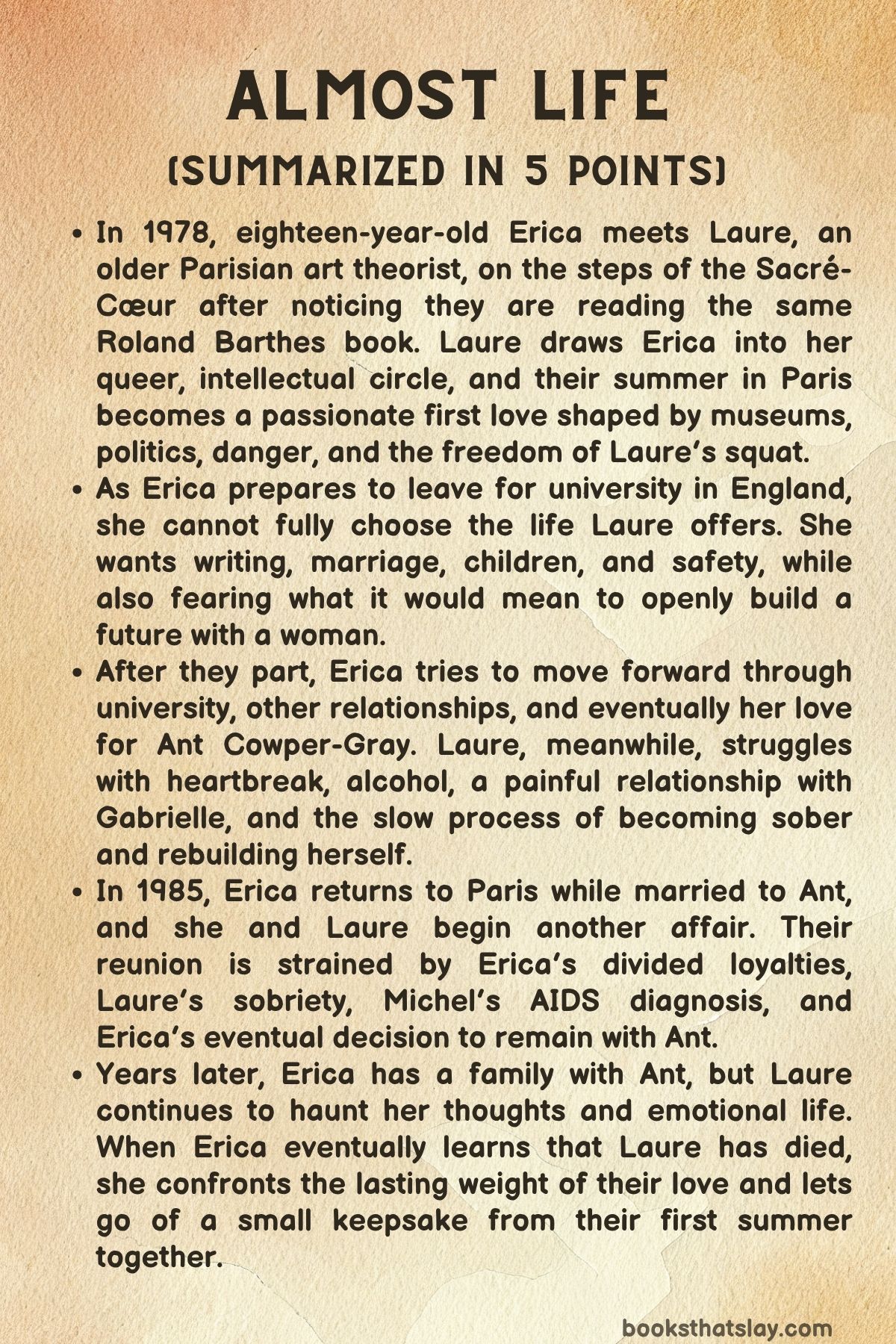
In 1978, eighteen-year-old Erica arrives in Paris as an English tourist, uncertain of herself and open to the city’s strangeness and promise. On the steps of the Sacré-Cœur, she notices an older woman reading the same Roland Barthes book she is carrying.
The woman is Laure, a sharp, self-possessed Parisian art theorist whose confidence immediately unsettles and attracts Erica. Their first exchange is tentative, but when a man follows Erica into the church and makes her feel unsafe, Laure steps in and helps drive him away.
That moment creates a sudden bond between them, and Erica lets herself be drawn into Laure’s world.
Laure invites Erica to a reading at Le Divan, where Erica meets a circle of queer, political, artistic, and intellectual friends. Michel, Léa, Marie, Agnès, Barbara, and Hilde live with wit, intensity, argument, and a kind of freedom Erica has never known.
Their conversations are full of art, theory, politics, sex, and survival. Erica, who is young and still shaped by English expectations of respectability, is fascinated and overwhelmed.
Laure kisses her, brings her to the squat where she lives, and the two begin an affair that quickly becomes central to Erica’s summer.
When Erica loses her bag and her room key, Laure helps her avoid the pension owner’s attempt to charge her unfairly. Erica leaves the pension and moves into Laure’s squat.
Their life together becomes improvised but deeply intimate. They clean the place, walk through Paris, visit museums, spend time at L’Orangerie, and move between private tenderness and the wider danger of being visibly queer in the city.
After a violent attack at a gay bar, Erica sees more clearly that Laure’s freedom carries real risk. Still, the summer becomes a time of discovery.
Erica falls in love with Laure and with the version of herself who exists beside her.
As Erica’s return to England approaches, the happiness between them grows strained. Laure suggests, indirectly, that Erica could stay in Paris.
Erica cannot answer with the same openness. She wants to write, but she also imagines marriage, children, and a safer kind of life.
She cannot picture herself openly choosing a woman, and she is frightened by the cost of staying. Laure senses Erica’s hesitation, but neither of them can fully say what they need.
At the coach station, they part in pain, promising to write, though both understand that letters may not be enough.
At university in England, Erica tries to become the person she is expected to be. She writes to Laure, and Laure writes back, but distance begins to change the shape of their love.
Erica dates Robert, then Donna, testing different versions of adulthood and desire. Laure, left behind in Paris, suffers more severely.
She drinks, grieves, and struggles to move on. When Erica later returns to Paris with Donna, the visit exposes the damage Erica’s leaving has caused.
Laure is still wounded, and Michel confronts Erica with the pain she has tried not to see. Laure finally admits how badly she has been hurt.
Erica continues into a creative writing MA at UEA, where she meets Ant Cowper-Gray, a wealthy and talented young writer. Ant represents a future Erica can understand: literary ambition, marriage, stability, and a public life that does not demand the same courage as life with Laure.
Their relationship develops, and after a New Year’s party they sleep together. Erica tells Ant she loves him.
Her love for him is not false, but it does not erase Laure. Instead, it adds another layer to the divided life Erica will continue to lead.
Laure also changes over the years. She enters a harmful relationship with Gabrielle, suffers inside it, and eventually escapes.
She becomes sober and tries to rebuild herself. She and Erica reconnect through letters, each presenting a version of life that is moving forward.
Erica is engaged to Ant and accepted onto the writing programme, while Laure is finishing her doctorate and staying with friends. Their correspondence keeps alive something neither has properly ended.
In 1985, Erica returns to Paris alone for a writing retreat. By then, she is married to Ant, but being back in Laure’s city brings old feelings quickly to the surface.
She meets Laure again, and their affair resumes. Erica forgets her first wedding anniversary, a sign of how completely Laure has returned to the centre of her attention.
She realizes she loves both Ant and Laure, and for a time she considers leaving her marriage. Yet the old fear remains: a life with Laure would require choices Erica still does not know how to make.
This reunion happens in a darker time. Michel is diagnosed with AIDS, and the circle that once seemed so alive is now shadowed by illness and grief.
Laure is sober, but Erica, drunk and jealous, accuses her of cheating with Barbara and brings wine into Laure’s apartment. To Laure, this is not only cruel but dangerous, a violation of the sobriety she has fought to protect.
Laure sends Erica away. Before Erica can properly repair the damage, Ant arrives unexpectedly in Paris.
Faced with the man she married and the woman she cannot stop loving, Erica chooses Ant. She and Laure end the affair over the telephone.
Laure says she will leave Paris one day, after Michel dies.
By 1993, Erica and Ant have two daughters, Sylvia and Elinor. Erica has entered the life she once imagined: marriage, motherhood, family routine.
Yet Laure remains unfinished in her mind. Through professional literary connections, Ant unknowingly befriends Laure and arranges a family visit to Laure’s farmhouse in Normandy.
Erica is forced to meet Laure again within the structure of the life she chose. The visit is charged with old feeling.
A trip to Giverny brings Erica and Laure close to the past, and both feel the pull that has never disappeared. But Erica’s children are present, and her marriage stands between them.
Whatever might still exist between the women cannot simply be reclaimed.
Laure later becomes involved with Barbara, while Erica continues her life in England. Through the mid-1990s and 2000s, Erica raises her daughters, works as a school librarian, and tries to commit fully to her marriage.
She does not stop loving Ant, but Laure remains a private wound and a private possibility. Ant eventually admits that he has long known about Erica and Laure’s affair.
His knowledge reframes their marriage: he has not been blind, only silent. He chose to stay, just as Erica chose to remain, and their life together has been built around both love and omission.
In 2010, Laure dies after repeated strokes. Near the end, her mind returns to the people and places that formed her: Barbara, Paris, Michel, and Erica.
Her death happens away from Erica’s knowledge, leaving their story without a final conversation.
Three years later, Erica sees news of same-sex marriage in France. The public recognition of a life she once could not imagine sends her searching for Laure online.
She finds Laure’s obituary and realizes Laure has been dead for years. The discovery breaks the illusion that there might still be time.
Erica retrieves an old photograph of Laure and the roll-up cigarette Laure once made for her. She walks to the sea with her dog and tries to smoke it, but age has ruined it.
The tobacco and paper fall apart and scatter in the wind.
In that final act, Erica releases what remains of the object, though not the memory. She thinks back to the beginning: the steps of the Sacré-Cœur, the shared book, the risk of speaking, and the first word she said to Laure, “Bonjour.” Almost Life ends with the sense that Erica’s life has been full, but also marked by the life she nearly chose and never fully stopped mourning.
Characters
Erica
Erica is the central emotional consciousness of Almost Life, and her character is shaped by the tension between desire and fear. At eighteen, she arrives in Paris with curiosity, loneliness, and a hunger for intellectual and emotional experience.
Her first approach to Laure shows both innocence and boldness: she is young enough to be uncertain of herself, but brave enough to reach toward someone who fascinates her. Erica’s relationship with Laure awakens parts of her identity that she has not yet learned how to name or defend.
Through Laure, she discovers passion, danger, beauty, and a kind of freedom that feels thrilling but also frightening. This makes Erica deeply human rather than simply indecisive.
She loves Laure, but she is also afraid of what choosing Laure would demand from her socially, personally, and emotionally.
As Erica grows older, her conflict becomes more complex. She tries to build the life she once imagined: university, writing, marriage, children, and stability.
Ant represents many of the things Erica thinks she should want, and her marriage to him is not false or empty. She genuinely loves him, and this makes her bond with Laure even more painful.
Erica is not simply torn between truth and lie; she is torn between two different truths. Her tragedy lies in her inability to fully choose one life without feeling haunted by the other.
Even when she becomes a mother and settles into a quieter existence, Laure remains an unresolved presence in her memory. By the end of the story, Erica’s grief is not only for Laure but also for the younger self who once stood at the beginning of a possible life and could not step completely into it.
Laure
Laure is one of the most magnetic and emotionally intense figures in the book. She is older than Erica, intellectually sharp, politically aware, and deeply connected to the queer artistic circles of Paris.
From the beginning, Laure appears confident and worldly, especially in contrast to Erica’s youth and uncertainty. She introduces Erica to a new world of art, theory, radical friendship, and sexual freedom.
Yet beneath her confidence lies vulnerability. Laure’s love for Erica is profound, and when Erica leaves, Laure’s pain becomes destructive.
Her drinking, heartbreak, and later damaging relationship with Gabrielle reveal how deeply abandonment wounds her.
Laure’s character is also defined by survival. She suffers, becomes sober, completes her intellectual work, rebuilds herself, and eventually leaves behind the life that once consumed her.
Her relationship with Erica never disappears from her emotional landscape, but Laure is not limited to being Erica’s lost love. She has friendships, politics, scholarship, desire, anger, and resilience.
Her bond with Michel shows her loyalty, while her later involvement with Barbara suggests that she continues to seek tenderness even after repeated loss. Laure’s final thoughts connect love, memory, illness, Paris, and the people who shaped her.
In this way, she becomes a figure of both passion and endurance: someone who loved intensely, suffered deeply, and still tried to live beyond heartbreak.
Ant Cowper-Gray
Ant is a complicated character because he is both a source of comfort and a symbol of the conventional life Erica chooses. Wealthy, talented, and socially secure, he offers Erica a future that feels recognizable and safe.
Their relationship begins with attraction and admiration, and Erica’s love for him is real. He is not merely an obstacle between Erica and Laure; he is someone who becomes central to Erica’s adult life.
Through Ant, Erica enters marriage, motherhood, and domestic continuity, all of which matter to her.
At the same time, Ant’s role carries quiet sadness. He eventually admits that he has long known about Erica and Laure, which changes the reader’s understanding of him.
His silence suggests patience, pain, pride, and perhaps fear of losing the life they built together. Ant’s endurance can be read as love, but also as a refusal to confront the full emotional truth of his marriage.
He benefits from Erica’s choice to stay, yet he also suffers because part of her remains elsewhere. His character shows that stability is not the same as simplicity.
He is not villainous, but he is part of a life that requires Erica to bury a powerful part of herself.
Michel
Michel is one of the most important members of Laure’s circle, and he represents friendship, loyalty, queer community, and the devastating historical reality of AIDS. He sees the emotional damage Erica causes Laure more clearly than Erica herself does, and his confrontation with Erica reveals his protectiveness.
Michel is not simply angry; he is defending someone he loves from being treated as an experiment or a temporary escape. His presence forces Erica to understand that her choices have consequences beyond her own confusion.
Michel’s diagnosis gives the later part of the story a heavier emotional and historical weight. His illness is not only a personal tragedy but also part of a wider atmosphere of loss within queer life in the 1980s.
Laure’s care for him and her eventual decision to leave Paris after his death show how central he is to her emotional world. Michel’s character embodies the fierce intimacy of chosen family.
He is witty, political, direct, and loving, and his decline marks the end of an era for Laure and her community.
Donna
Donna belongs to Erica’s university life and represents one of Erica’s attempts to understand her sexuality after leaving Paris. Erica’s relationship with Donna shows that her love for Laure was not a passing curiosity, but it also shows that Erica is still searching for a form of intimacy she can manage.
Donna is important because she becomes part of Erica’s effort to move forward, yet her presence also exposes the fact that Erica has not truly resolved her feelings for Laure.
When Erica returns to Paris with Donna, the visit reveals the emotional imbalance between past and present. Donna becomes caught in a situation shaped by memories and wounds she did not create.
Her relationship with Erica cannot compete with the intensity and unfinished pain of Laure. In this sense, Donna’s character highlights Erica’s pattern of trying to continue her life while carrying unresolved attachments beneath the surface.
Robert
Robert represents a more conventional stage in Erica’s university life. As someone Erica dates after leaving Laure, he reflects her attempt to enter the expected rhythms of young adulthood.
His role is not as emotionally central as Laure’s or Ant’s, but he is still meaningful because he shows Erica experimenting with the kind of life that feels socially legible and ordinary.
Through Robert, the story suggests that Erica is not ready to fully confront what Laure meant to her. Dating him becomes part of her movement away from Paris and toward a more acceptable identity.
However, Robert does not answer the deeper questions inside Erica. His character helps show the difference between moving on externally and truly resolving emotional truth internally.
Barbara
Barbara begins as part of Laure’s wider queer and intellectual circle, but her importance grows over time. She is connected to the world that first dazzles Erica: the world of political argument, art, friendship, and queer possibility.
Later, Barbara becomes emotionally significant in Laure’s life, especially after Erica has repeatedly failed to choose Laure fully. This makes Barbara a quiet counterpoint to Erica.
Where Erica hesitates, Barbara seems able to exist more openly within Laure’s world.
Erica’s jealousy of Barbara during the renewed affair in Paris reveals Erica’s insecurity and possessiveness. Even though Erica cannot fully commit to Laure, she still fears being replaced.
This contradiction exposes one of Erica’s deepest flaws. Barbara’s later relationship with Laure suggests that Laure’s life continues beyond Erica, even if Erica remains important to her.
Barbara is therefore a reminder that Laure is not frozen in Erica’s memory; she continues to desire, connect, and seek companionship.
Gabrielle
Gabrielle represents one of the darker periods in Laure’s life. Her relationship with Laure is damaging, and it comes after Laure has already been wounded by Erica’s departure and emotional uncertainty.
Gabrielle’s role shows how heartbreak can leave a person vulnerable to harmful attachments. She is not simply a romantic partner; she is part of the pattern of suffering Laure must escape in order to rebuild herself.
Through Gabrielle, the story deepens Laure’s character by showing that her pain does not end when Erica is absent. Laure’s life contains struggles Erica only partially understands.
The relationship also makes Laure’s eventual sobriety and recovery more significant. Gabrielle’s presence marks a period of danger and emotional damage, but Laure’s escape from that relationship shows her strength and capacity for survival.
Léa
Léa is part of Laure’s Parisian circle, and her presence helps create the atmosphere of queer, political, and intellectual community that transforms Erica’s understanding of life. Characters like Léa are important because they show that Laure does not exist alone.
She belongs to a network of people who argue, read, gather, love, and protect one another. For Erica, meeting this circle is part of her education in a broader sense: she is not only learning about Laure, but also about a way of living outside the expectations she has inherited.
Although Léa may not dominate the central romance, she contributes to the social world that makes Erica’s Paris experience so powerful. Her presence helps establish the difference between Erica’s solitary tourist identity and the collective life Laure inhabits.
Léa therefore functions as part of the community that both welcomes Erica and reveals how unprepared she is to fully belong to it.
Marie
Marie, like the other members of Laure’s circle, helps represent the artistic and political energy surrounding Laure. She belongs to a group that offers Erica a glimpse of intellectual freedom and queer belonging.
Marie’s significance lies in how she helps build the environment in which Erica’s transformation takes place. The circle’s existence makes Laure’s life feel vivid and rooted, not merely romantic or private.
Marie also helps show the contrast between temporary experience and lived commitment. For Erica, the group is fascinating and liberating, but she can still leave it behind.
For Laure and her friends, this world is not a summer adventure; it is their reality. Marie’s presence therefore contributes to one of the book’s central emotional tensions: Erica can visit this life, but she struggles to choose it permanently.
Agnès
Agnès is another figure within Laure’s intellectual and queer community, and her role helps widen the story beyond Erica and Laure’s private affair. She belongs to the social world that gives the Paris sections their sense of debate, resistance, and unconventional intimacy.
Through characters such as Agnès, the story shows that love between women exists within a larger culture of friendship, politics, and shared vulnerability.
Agnès matters because she helps make Laure’s life feel complete before Erica enters it. Laure is not waiting empty and alone; she has a world, a mind, and a community.
Erica’s attraction to Laure is also an attraction to this whole way of being. Agnès helps embody that world, making Erica’s eventual retreat from it feel more consequential.
Hilde
Hilde is part of Laure’s circle and contributes to the atmosphere of European intellectual and queer life that surrounds the early Paris scenes. Her presence adds texture to the group, suggesting a community made up of different voices, backgrounds, and forms of resistance.
For Erica, people like Hilde make Paris feel charged with possibility. They represent a life that is less bound by English respectability and more open to argument, art, sexuality, and political identity.
Hilde’s importance is collective rather than individually dominant. She helps create the social fabric that shapes Erica’s awakening.
Her presence reminds the reader that Erica and Laure’s relationship is not isolated from history or community. Their love unfolds among people who understand risk, desire, and marginality in ways Erica is only beginning to grasp.
Sylvia
Sylvia is one of Erica and Ant’s daughters, and her presence changes the emotional stakes of Erica’s later encounters with Laure. By the time Sylvia enters the story, Erica is no longer only a woman divided between lovers; she is a mother whose choices affect her children.
Sylvia represents the real life Erica has built, not as an abstract idea but as a living bond. Her existence makes Erica’s longing for Laure more painful because it is no longer simply a question of personal courage.
Sylvia also helps show why Erica cannot easily return to the past. Whatever Erica still feels for Laure, she has responsibilities and attachments that matter deeply.
Sylvia’s presence does not erase Erica’s desire, but it anchors her to the family life she chose. Through Sylvia, the book shows that love can be multiplied rather than neatly replaced, and that each form of love creates its own obligations.
Elinor
Elinor, Erica and Ant’s younger daughter, serves a similar but distinct role in the later part of the story. Along with Sylvia, she represents the domestic life that has grown around Erica over the years.
Elinor makes visible the passage of time and the consequences of Erica’s earlier decisions. The young woman who once feared choosing Laure has become a mother within a family structure that cannot be undone without deep harm.
Elinor’s presence also intensifies the sadness of Erica and Laure’s reunion in Normandy. The old pull between the two women remains, but Erica’s children stand as evidence that Erica’s life has continued in a direction that excludes a full return to Laure.
Elinor therefore represents innocence, continuity, and the emotional cost of belated desire. She is part of the life Erica loves, even as that life prevents her from reclaiming another love.
Themes
Love, Desire, and the Fear of Choice
Love in Almost Life is not presented as simple fulfilment but as a force that demands courage, self-knowledge, and sacrifice. Erica’s bond with Laure begins with intellectual recognition and quickly becomes emotional and physical intimacy, yet the relationship also exposes Erica’s fear of stepping outside the life she has been taught to want.
Her desire for Laure clashes with her longing for marriage, children, respectability, and safety. This conflict makes love feel both liberating and threatening.
Erica repeatedly returns to Laure, but each return is marked by hesitation, guilt, or retreat. Laure, by contrast, experiences love with greater emotional certainty, which makes Erica’s indecision especially painful.
The theme becomes more complex because Erica does not simply stop loving Laure when she chooses Ant, nor does her marriage erase her past. Love remains present as memory, regret, temptation, and unfinished feeling.
The novel shows that choosing one life often means grieving another.
Identity, Secrecy, and Social Pressure
Erica’s struggle is shaped by the pressure to live within acceptable social boundaries. Her relationship with Laure offers her a version of herself that feels honest and alive, but it also asks her to face a world where loving a woman can bring judgment, danger, and exclusion.
The attack at the gay bar makes this threat physical, showing that queer life is not only emotionally difficult but also socially unsafe. Erica’s fear is not just personal weakness; it grows out of a culture that makes certain forms of love costly.
Laure’s world, filled with queer friends, political arguments, art, and radical ways of living, gives Erica a glimpse of freedom, but it also feels unstable compared with the conventional future she imagines. Her secrecy follows her into marriage, motherhood, and middle age.
Even when the world changes, Erica carries the habits of silence formed in youth. The theme shows how social pressure can shape private choices for decades.
Memory, Regret, and the Life Not Lived
Memory functions as a powerful emotional force because Erica’s past never fully stays in the past. Laure remains attached to certain objects, places, and moments: the photograph, the cigarette, Paris, the first meeting, and the letters exchanged across years.
These memories do not simply comfort Erica; they accuse her, unsettle her, and remind her of the life she might have chosen. Regret grows not from one single decision but from repeated moments when Erica steps back from Laure.
Her marriage, children, and work give her a real life, yet the existence of that life does not cancel the other possibility. By the time Erica learns of Laure’s death, regret becomes irreversible.
There can be no reunion, explanation, or final conversation. The ruined cigarette scattering into the wind captures the painful fragility of what remains.
Memory preserves love, but it also proves that some chances, once lost, cannot be recovered.
Art, Writing, and the Search for Meaning
Art and literature shape the way characters understand themselves and each other. Erica and Laure first connect through a shared book, and their relationship develops in spaces filled with paintings, readings, theory, conversation, and creative ambition.
These artistic spaces offer Erica a language for desire and self-discovery, but they do not automatically give her the courage to live truthfully. Writing is especially important because Erica wants to become a writer, yet her own life contains emotional truths she struggles to face directly.
Laure’s intellectual and artistic confidence attracts Erica because it represents a fuller, braver engagement with experience. At the same time, art can become a way of circling pain rather than resolving it.
Museums, letters, books, and literary circles preserve feeling, but they cannot protect the characters from loss, illness, addiction, or death. The theme suggests that art gives form to longing and memory, helping people understand their lives even when understanding arrives too late.