Between Tides and Thunder Summary, Characters and Themes
Between Tides and Thunder by Leena Kazak is a fantasy romance about Princess Mayah of Tundrayn, a healer shaped by childhood trauma, war, and the cruel divide between wielders and nonwielders. Set between an icy kingdom and its enemy realm of Arbinj, the book follows Mayah as she is forced into a political marriage meant to save her people.
What begins as fear and resentment slowly becomes a bond built through danger, truth, and shared pain. At its core, the story is about power, loyalty, survival, and a woman learning that peace cannot be built on lies.
Summary
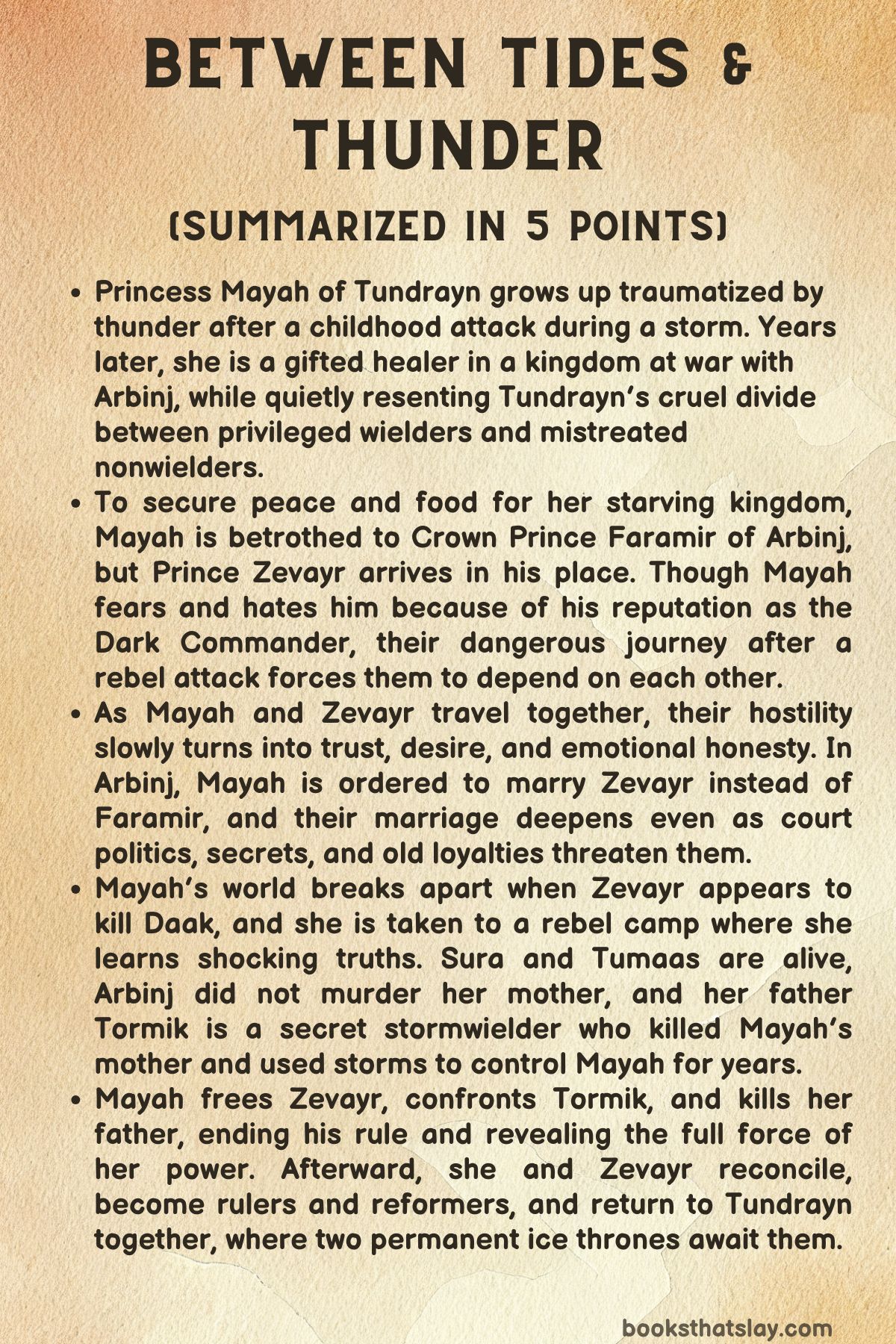
Princess Mayah of Tundrayn grows up marked by a night of violence and terror. As a child, she hides in a closet during a violent storm while attackers invade her home.
The storm, the fear, and the helplessness stay with her, leaving her with a lasting terror of thunder. Nineteen years later, she is no longer only a frightened child.
She is a princess, a skilled healer, and one of the most valuable people in Tundrayn, an icy kingdom locked in conflict with Arbinj.
Mayah’s position gives her status, but it also forces her to see the cruelty of her own kingdom clearly. Tundrayn is ruled by a harsh social order that favors wielders, people with magical abilities, while nonwielders are treated as lesser citizens and sent into war as if their lives matter less.
Mayah hates this system, partly because her mother was a nonwielder, and so were Sura and Tumaas, the childhood friends she believes she lost. Her healing work brings her face-to-face with the cost of the war when Arbinj breaks a ceasefire and wounded nonwielder soldiers are brought to her.
She saves who she can, but she cannot ignore how much suffering her father’s kingdom accepts as normal.
Her personal life is also shaped by duty. Mayah trains with Daak, captain of the guard, a man she loves and trusts.
Their bond offers her comfort in a world controlled by politics, but King Tormik has other plans. To secure peace and bring food to starving Tundrayn, he arranges for Mayah to marry Crown Prince Faramir of Arbinj.
The marriage is not presented as a choice. Mayah is expected to leave her homeland and become a bridge between two enemy kingdoms.
Instead of Faramir, Prince Zevayr arrives in Tundrayn to accept the betrothal on his brother’s behalf. Zevayr is known as the Dark Commander, feared for his role in the war and hated by Mayah before she truly knows him.
She expects arrogance and cruelty, but his behavior unsettles her expectations. During the ceremony, he kneels and treats her with a kind of restrained respect.
Still, his presence angers both Tormik and Daak, especially when he takes Mayah from Tundrayn almost immediately.
The journey to Arbinj does not go as planned. Rebels attack the convoy, killing Zevayr’s soldiers and throwing Mayah into danger.
A storm breaks around them, and her fear overwhelms her until she faints. Zevayr, already suspicious, believes she may have played a part in the attack.
He binds and questions her, treating her as a possible enemy. Over time, though, he begins to believe she is innocent.
With their escort gone, Mayah and Zevayr are forced to travel together on foot through hostile land.
Their journey changes them. At first, they clash constantly.
Mayah sees Zevayr as a monster from the enemy kingdom, while Zevayr sees her as a dangerous political burden who may be hiding secrets. Yet survival forces them into closeness.
They share food, cold nights, fear, and exhaustion. Mayah learns that Zevayr has been wounded by the war as well, especially by the loss of his best friend Lev.
Zevayr learns about Mayah’s grief over Sura and Tumaas, and about the way Tundrayn’s class system has shaped her anger. Their hatred softens into trust, and trust becomes attraction.
Their path remains dangerous. They face more threats, including another attack and an iron arrow that poisons Mayah.
Zevayr’s care for her during these moments reveals a side of him that his reputation hides. By the time they reach Arbinj, their relationship has become far more complicated than either expected.
In Arbinj, King Varad changes the political arrangement. Faramir will marry a Volcan princess instead, and Mayah is ordered to marry Zevayr.
Mayah agrees, not only because the marriage may help secure peace, but because her feelings for Zevayr have become real. Their wedding places her inside a dangerous court.
Faramir is cruel and threatening, Varad is calculating, and Mayah struggles to understand who can be trusted. She is far from home, surrounded by former enemies, and expected to become part of a royal family that has its own secrets and ambitions.
Zevayr protects her, and their marriage grows more intimate. The bond between them becomes one of the few steady things in Mayah’s new life.
She also reveals that she has hidden a second ability: she is not only a healer but also a waterwielder. This secret makes her even more powerful and dangerous in the eyes of those who would use or control her.
The fragile peace in her life breaks when Daak arrives in Arbinj. His presence pulls Mayah back toward her old loyalties and unfinished feelings.
Zevayr discovers her hidden connection to Daak and learns that she has been keeping plans from him. Consumed by rage and betrayal, Zevayr attacks Daak and appears to kill him.
Mayah is devastated. The man she had come to love has seemingly destroyed someone from her past, and the trust between them collapses.
Soon after, Mayah is taken by Tundrayni forces and brought to a rebel camp where Zevayr is held prisoner. There, the truth of her life begins to unravel.
She discovers that Sura and Tumaas are alive and are part of the Rebellion. Zevayr’s mother, Tairna, is also connected to the rebels.
Mayah’s understanding of the war, her family, and her own childhood is overturned.
The greatest truth concerns her mother’s death. Mayah has believed that Arbinj was responsible, but this was a lie.
Her own father, King Tormik, murdered her mother when she tried to flee with Mayah. Tormik is also secretly a stormwielder, the very kind of power tied to Mayah’s deepest fear.
Worse, he deliberately created storms for years, claiming he wanted to cure her terror, while actually using fear as a form of control. Mayah realizes that the man who shaped her life, arranged her marriage, and claimed to protect Tundrayn has built his rule on murder, manipulation, and lies.
Armed with the truth, Mayah frees Zevayr. Their escape leads into a wider conflict involving Tundrayn, Arbinj, and the Rebellion.
The battle brings every hidden loyalty into the open. Faramir attacks Mayah and nearly kills her, but Zevayr saves her.
Then Tormik appears and tries to reclaim control over his daughter. This time, Mayah refuses to be ruled by fear.
She faces him herself, using her power and strength to fight the man who destroyed her mother and shaped her trauma. Mayah kills Tormik, ending his rule and revealing the full force of who she has become.
After the battle, Mayah and Zevayr recover among the rebels. Their relationship has been damaged by secrets, rage, and manipulation, but they begin to repair it honestly.
Zevayr reveals that he is also a truthwielder, which means he could sense that some of Mayah’s feelings were real even when lies surrounded them. This truth helps them reconcile.
Their love is no longer only born from danger or forced proximity; it becomes a choice made with clearer eyes.
Three months later, the world has begun to change. Zevayr is king of Arbinj, and Mayah stands beside him as his Healing Queen.
Together, they begin reforms, build alliances, and work toward peace between divided peoples. Mayah returns to Tundrayn not as a frightened princess or a bargaining piece, but as someone ready to claim power on her own terms.
Sorka and the court acknowledge her claim, signaling a new future for the kingdom.
The story ends with Mayah and Zevayr entering the Great Hall, where two permanent ice thrones wait for them. The image marks the end of one brutal era and the beginning of another, one shaped by truth, healing, and shared rule.
Characters
Between Tides & Thunder presents its characters through war, political betrayal, fear, loyalty, grief, and healing. Each major figure in the book is shaped by the conflict between Tundrayn, Arbinj, and the Rebellion, but their importance also comes from the personal choices they make when love, power, and truth are tested.
Princess Mayah
Princess Mayah is the emotional and moral center of the book. As a child, she survives a violent storm and an attack that leaves her deeply afraid of thunder, and that fear becomes one of the most important wounds she carries into adulthood.
Nineteen years later, she is not weak or passive because of her trauma; instead, she has grown into a powerful healer who is compassionate, brave, and deeply aware of injustice. Her resentment toward Tundrayn’s hierarchy shows that she is not blinded by royal privilege.
Even though she is a princess, she understands the cruelty faced by nonwielders because her mother and childhood friends belonged to that oppressed group. This makes Mayah a character who constantly stands between power and suffering, privilege and empathy.
Mayah’s journey is also a journey from fear to self-command. At first, thunder controls her body and mind, reminding her of helplessness and loss.
Her father’s manipulation worsens that fear by turning it into a tool of control. However, as the story develops, Mayah begins to uncover the lies around her and understand that many of the things she feared were deliberately created to keep her obedient.
Her discovery of her waterwielding ability is especially meaningful because it reveals that her identity is larger than what Tundrayn allowed her to believe. She is not only a healer who repairs damage after violence; she is also someone with the strength to confront violence directly.
Her relationships reveal different sides of her character. With Daak, Mayah is tied to her past, her homeland, and a love that once felt safe.
With Zevayr, she is forced into discomfort, suspicion, and emotional risk, but that relationship eventually helps her see beyond propaganda and inherited hatred. Mayah’s love for Zevayr grows slowly because it is built through survival, honesty, and shared pain rather than convenience.
By the end of the book, Mayah becomes a ruler who has earned authority through suffering and choice. Her final act of killing Tormik is not only an act of rebellion against a cruel father but also a rejection of the system that used fear, bloodline, and power to control her life.
Prince Zevayr
Prince Zevayr is one of the most complex characters in the book because he is introduced through fear before he is understood through truth. Known as the Dark Commander, he enters Mayah’s life carrying a reputation for brutality, violence, and danger.
At first, he appears to represent everything Mayah hates about Arbinj and the war. Yet his actions begin to complicate that image almost immediately.
His decision to kneel during the betrothal ceremony shows that, beneath his frightening reputation, he has a sense of respect and restraint that Mayah does not expect from him.
Zevayr’s emotional depth appears gradually. His early suspicion of Mayah after the rebel attack makes him harsh and guarded, but it also shows how war has trained him to expect betrayal.
He is not naturally open or gentle; he has been shaped by loss, responsibility, and survival. The death of his best friend Lev is central to understanding him because it explains the grief and anger beneath his controlled exterior.
Zevayr is a man who has been turned into a weapon by war, yet he is not entirely consumed by that role. His time with Mayah forces him to become more human again, to speak honestly, to protect rather than only command, and to feel without hiding behind fear.
His relationship with Mayah is intense because it contains both tenderness and danger. He protects her, respects her strength, and becomes emotionally vulnerable with her, but he also makes devastating choices, especially when he appears to kill Daak in rage.
That moment shows the darker side of his possessiveness, pain, and insecurity. Zevayr is not a simple romantic hero; he is morally flawed and capable of cruelty when wounded.
However, his later reconciliation with Mayah depends on truth rather than denial. His revelation that he is a truthwielder deepens his character because it shows that he has been living with hidden knowledge and emotional burden.
By the end, Zevayr becomes a king whose power is joined with reform, healing, and partnership, suggesting that he is capable of becoming more than the feared commander others once believed him to be.
Daak
Daak represents Mayah’s old life, her first love, and the emotional pull of Tundrayn. As captain of the guard, he is associated with duty, protection, loyalty, and discipline.
His closeness with Mayah shows that he is not merely a soldier in her world but someone who has been part of her emotional foundation. Their training together suggests trust and familiarity, and his anger when Zevayr takes Mayah away reveals how deeply he cares for her.
In the early part of the story, Daak appears to be the safer and more familiar choice compared to Zevayr.
However, Daak’s role becomes more complicated as Mayah’s life changes. His presence in Arbinj pulls her back toward old loyalties at a time when she is trying to understand her new marriage, her changing feelings, and the political realities around her.
He becomes a symbol of the life Mayah might have had if her father had not used her as a political tool. At the same time, his connection to her creates secrecy and tension, especially because Mayah’s relationship with Zevayr has become emotionally real.
Daak’s importance lies not only in his love for Mayah but also in the way his presence exposes the conflict between memory and growth.
Daak’s apparent death at Zevayr’s hands is one of the most emotionally destructive turning points in the story. It shatters Mayah’s trust and forces her to confront the violent consequences of the loyalties surrounding her.
Whether seen as a romantic rival, a loyal protector, or a tragic figure caught between kingdoms, Daak matters because he represents the cost of love in a world ruled by war and possession. His character reminds the reader that even sincere devotion can become part of a larger conflict when politics, secrecy, and jealousy are involved.
King Tormik
King Tormik is one of the most dangerous characters in the book because his cruelty is hidden behind fatherhood, kingship, and the language of protection. At first, he appears to be a ruler making a harsh but necessary political decision by arranging Mayah’s marriage for peace and food.
However, the truth reveals that his concern for Tundrayn and for Mayah is deeply corrupted by control. He is not merely a flawed king; he is a manipulator who uses fear, lies, and power to shape his daughter’s life.
The revelation that Tormik is a secret stormwielder completely changes the meaning of Mayah’s childhood trauma. Her fear of thunder is not only a personal phobia or the result of one terrible night; it is something her father deliberately deepened for years.
His attempt to “cure” her by creating storms is especially cruel because it disguises abuse as care. Even worse, the truth that he murdered Mayah’s mother exposes the foundation of his character.
He destroys those who threaten his control, then rewrites the truth so that Mayah will hate Arbinj instead of him.
Tormik represents the worst form of authority in the story: power that calls itself love while demanding obedience. His treatment of nonwielders, his political manipulation, and his emotional abuse of Mayah all show a ruler who values control above justice.
Mayah’s final confrontation with him is therefore not only a daughter fighting a father but also a victim destroying the source of the lie that shaped her entire life. His death marks the collapse of the false world he built around her.
Prince Faramir
Prince Faramir is a character defined by entitlement, cruelty, and threat. Although he is originally meant to marry Mayah, his absence from the betrothal and later replacement by Zevayr already suggest that he is part of a political arrangement rather than a meaningful emotional bond.
When Mayah reaches Arbinj, Faramir becomes one of the clearest dangers inside the court. Unlike Zevayr, whose feared reputation hides pain and complexity, Faramir’s cruelty appears more direct and personal.
Faramir’s treatment of Mayah reveals his need for dominance. He does not respect her as a political figure, a healer, or a person with her own will.
His threatening behavior makes court life in Arbinj feel unsafe and unstable, showing that danger does not only come from battlefields or rebel attacks but also from palace corridors and royal ambition. He represents a kind of royal masculinity built on intimidation rather than honor.
His attack on Mayah near the end of the story confirms the violence that has always been present in him. He becomes a physical embodiment of the court’s corruption and of the danger Mayah faces as a woman used in political games.
Zevayr saving Mayah from him also highlights the difference between the two princes. Faramir wants power over Mayah, while Zevayr ultimately chooses to protect and stand beside her.
Faramir’s role is important because he sharpens the contrast between abusive possession and genuine partnership.
King Varad
King Varad is a manipulative ruler whose decisions show how easily people become pieces in royal strategy. He changes Mayah’s marriage arrangement after she reaches Arbinj, shifting her from Faramir to Zevayr when it suits his political purposes.
This reveals a character who values control, advantage, and dynastic planning more than emotional truth. He does not treat Mayah’s future as something that belongs to her; he treats it as a tool for strengthening Arbinj’s position.
Varad’s power lies less in open violence and more in calculation. He understands the usefulness of marriage, alliance, and appearances, and he uses them to shape outcomes.
His manipulation creates tension in Arbinj’s court because Mayah is forced to navigate a royal household where affection and loyalty are constantly entangled with politics. Unlike Tormik, whose betrayal is deeply personal and monstrous, Varad represents the colder cruelty of monarchy, where people are moved around for the sake of stability and power.
At the same time, Varad’s decisions indirectly create the conditions for Mayah and Zevayr’s relationship to deepen. This does not make him benevolent; rather, it shows how political manipulation can produce consequences even the manipulator cannot fully control.
His character helps expose the larger system that the story challenges: a world where rulers believe peace can be purchased by sacrificing the freedom of others.
Sura
Sura is one of the most important links between Mayah’s childhood, her grief, and the truth about Tundrayn. For much of the story, Mayah believes Sura died in battle, and that belief strengthens her pain and anger.
Because Sura was a nonwielder, her supposed death also reflects the cruelty of Tundrayn’s social order, where nonwielders are treated as expendable. In Mayah’s memory, Sura represents innocence, friendship, and everything the war has taken from her.
When Sura is revealed to be alive and part of the Rebellion, her character takes on new strength. She is no longer only a figure from Mayah’s past or a symbol of loss; she becomes a survivor who has chosen resistance.
Her presence proves that Mayah’s understanding of the war has been incomplete. Sura’s survival challenges the false story Mayah was given and helps her see that the real enemy is not as simple as one kingdom against another.
Sura’s importance also comes from her connection to nonwielder oppression. Through her, the rebellion becomes personal rather than abstract.
She embodies the lives that Tundrayn tried to devalue and erase. Her return gives Mayah both comfort and pain because it restores a lost bond while forcing her to confront how much she has been deceived.
Sura helps anchor the story’s larger message that the oppressed are not helpless background figures; they are active participants in the fight for truth and change.
Tumaas
Tumaas, like Sura, represents Mayah’s lost childhood and the hidden truth behind Tundrayn’s political lies. Mayah believes Tumaas died, and that belief becomes part of the grief that shapes her hatred, loyalty, and understanding of the war.
As a nonwielder, Tumaas also reflects the injustice of a society that values magical ability over human worth. His supposed death reinforces Mayah’s anger at the systems that send vulnerable people into danger while protecting the privileged.
The revelation that Tumaas is alive and part of the Rebellion gives his character a stronger political role. He is not only someone Mayah loved and mourned; he is someone who survived and chose to fight back.
This makes him part of the living resistance against both royal lies and social hierarchy. His survival forces Mayah to reconsider what she has been told about the past and who truly benefits from the war.
Tumaas’s character is significant because he helps turn Mayah’s private grief into public understanding. Through him, she sees that the rebellion is not simply a threat to order but a response to cruelty and deception.
His presence in the rebel camp gives emotional weight to the truth Mayah uncovers about her father, her mother, and the kingdoms. Tumaas stands as proof that the people Mayah thought were lost were not powerless victims but survivors with agency.
Tairna
Tairna is a crucial figure because she connects Zevayr’s personal history to the Rebellion and reveals that the conflict is more complicated than Mayah once believed. As Zevayr’s mother and a member of the Rebellion, she challenges simple divisions between Arbinj, Tundrayn, and rebel forces.
Her presence shows that resistance is not limited to one kingdom or one class of people. It grows out of betrayal, suffering, and the need to expose hidden truths.
Tairna’s role also deepens Zevayr’s character. The fact that his mother is connected to the rebels suggests that his life has been shaped by divided loyalties and painful secrets.
It helps explain why Zevayr is more complex than his reputation as the Dark Commander. He is not simply a weapon of Arbinj; he belongs to a family and history marked by rebellion, loss, and truth.
As a character, Tairna represents hidden resistance and maternal strength. She is important not because she dominates the story, but because her existence changes how Mayah understands the conflict.
Through Tairna, the Rebellion becomes tied to both Mayah’s and Zevayr’s personal lives, making the political struggle feel intimate and unavoidable.
Lev
Lev is important even though he is not physically present for much of the story. As Zevayr’s lost best friend, he functions as a major emotional influence on Zevayr’s personality.
His death helps explain the grief, guardedness, and anger that Zevayr carries. Without understanding Lev’s loss, Zevayr’s harshness could appear only as cruelty, but with that context, it becomes clear that he has been shaped by mourning and war.
Lev represents the personal cost of conflict. The war between Tundrayn and Arbinj is not just a political struggle between rulers; it destroys friendships, futures, and emotional stability.
Zevayr’s memory of Lev gives the reader insight into the private damage caused by public violence. It also allows Mayah to see Zevayr as someone who has suffered, not only as someone who has caused suffering.
Lev’s significance lies in how absence can shape a living character. His death continues to influence Zevayr’s choices, fears, and emotional walls.
Through Lev, the story shows that grief does not end when a person dies; it remains active in the people left behind.
Mayah’s Mother
Mayah’s mother is one of the most tragic figures in the book because her death becomes the center of a lie that shapes Mayah’s entire life. As a nonwielder, she represents the group most harmed by Tundrayn’s hierarchy.
Her attempt to flee with Mayah suggests courage, love, and a desire to protect her daughter from Tormik’s control. She is not simply a victim; she is someone who recognized danger and tried to escape it.
The truth that Tormik murdered her transforms the emotional foundation of the story. Mayah has spent years believing that Arbinj was responsible for her mother’s death, but the real murderer was her own father.
This revelation is devastating because it turns Mayah’s grief into a deeper betrayal. Her mother’s death was not only a personal loss but also a political weapon used to manipulate Mayah’s hatred and fear.
Mayah’s mother matters because she represents the truth that power tried to bury. Her love for Mayah stands in direct contrast to Tormik’s controlling version of fatherhood.
Even after death, her story helps guide Mayah toward freedom. When Mayah finally confronts Tormik, she is also confronting the man who stole her mother, her childhood, and her understanding of herself.
Sorka
Sorka appears near the end as a figure connected to Tundrayn’s court and Mayah’s political future. Her acknowledgment of Mayah’s claim is important because it signals a shift in power after Tormik’s fall.
In a kingdom shaped by fear, hierarchy, and royal deception, recognition from the court matters. Sorka’s role helps show that Mayah’s return to Tundrayn is not only emotional but also political.
Sorka represents the possibility of acceptance within a damaged system. Her acknowledgment suggests that Tundrayn can begin to move away from Tormik’s rule and toward a future shaped by Mayah’s legitimacy and reforms.
While she is not as central as Mayah, Zevayr, or Tormik, her presence supports the ending’s sense of transition. She helps mark the moment when Mayah is no longer only a princess who was controlled by others, but a ruler whose claim is publicly recognized.
Themes
Trauma and the Long Shadow of Fear
Mayah’s fear of thunder is not a simple childhood weakness but a wound created by violence, loss, and betrayal. Her terror begins when she hides during the attack that destroys her sense of safety, and it follows her into adulthood despite her strength, royal status, and healing power.
This fear becomes more painful because it is repeatedly used against her. The storms that seem like natural reminders of her past are later revealed to be part of her father’s cruelty, turning her trauma into something controlled and prolonged by the very person meant to protect her.
Her journey shows that fear cannot be cured through force, shame, or exposure without care. Real healing begins only when Mayah understands the truth behind her suffering and stops seeing herself as broken.
By facing Tormik, she confronts not only a political enemy but the source of her deepest terror. Her victory is emotional as much as physical, because she finally takes ownership of the fear that shaped her life.
Power, Class, and Injustice
The social divide between wielders and nonwielders exposes the cruelty beneath Tundrayn’s polished royal order. Mayah’s position as a healer princess gives her privilege, yet her love for nonwielders keeps her from accepting the kingdom’s hierarchy as normal.
Her mother, Sura, and Tumaas connect her personally to those treated as lesser, so the suffering of nonwielder soldiers is never distant or abstract to her. The war makes this injustice even sharper, since nonwielders are sent into danger while wielders hold status and protection.
Mayah’s anger at this system reveals her moral strength: she does not simply pity the oppressed but questions the structure that allows their lives to be spent so easily. The Rebellion further complicates her understanding by showing that resistance is born from real pain, not mere disloyalty.
By the end, leadership is measured not by bloodline or magical ability but by the willingness to repair what power has damaged. Reform becomes a necessary answer to inherited injustice.
Love, Trust, and Moral Conflict
The relationship between Mayah and Zevayr grows out of suspicion, anger, and shared survival rather than instant devotion. Their early hostility is shaped by war stories, political duty, and reputations built by enemies, so trust must be earned slowly through action.
Zevayr’s care during danger, Mayah’s honesty about grief, and their mutual recognition of loss create a bond that challenges everything they were taught to believe. Yet the romance is never simple, because love exists beside secrecy, divided loyalties, and violence.
Mayah’s connection to Daak and Zevayr’s rage over betrayal show how love can become dangerous when mixed with fear and possession. Their reconciliation matters because it does not erase the harm between them; it requires truth, remorse, and the choice to rebuild.
In Between Tides & Thunder, love becomes meaningful not because it is easy or pure, but because it survives the collapse of false stories and demands that both characters become more honest versions of themselves.
Truth, Identity, and Liberation
Mayah’s identity is built on stories told by others: Arbinj as the enemy, her mother as a victim of foreign violence, Tormik as a grieving father, and her own fear as something to be cured. As these stories fall apart, she must rebuild herself from truth rather than obedience.
The discovery that her father murdered her mother changes the entire moral map of her life. It forces her to see that loyalty to family and loyalty to justice are not always the same.
Her hidden waterwielding also reflects a self she has been unable to fully reveal, suggesting that identity becomes powerful only when it is no longer controlled by secrecy. Killing Tormik is not simply an act of revenge; it is the moment Mayah rejects the lies that kept her afraid, dependent, and politically useful.
Her later role as queen grows from this liberation. She steps into power with a clearer understanding of who she is, what was stolen from her, and what must change.