200 Monas Summary, Characters and Themes
200 Monas by Jan Saenz is a wild, darkly comic novel about grief, debt, desire, and the strange ways people survive when their lives go completely off course. The story follows Arvy Keening, a college student trying to finish finals, settle her dead mother’s estate, and claim the future that has been held just out of reach.
When she discovers a bag of mysterious pills in her mother’s closet, one bad decision leads to threats, blackmail, drug deals, public humiliation, and unexpected romance. Sharp, chaotic, and often absurd, 200 Monas turns mourning into a frantic fight for control.
Summary
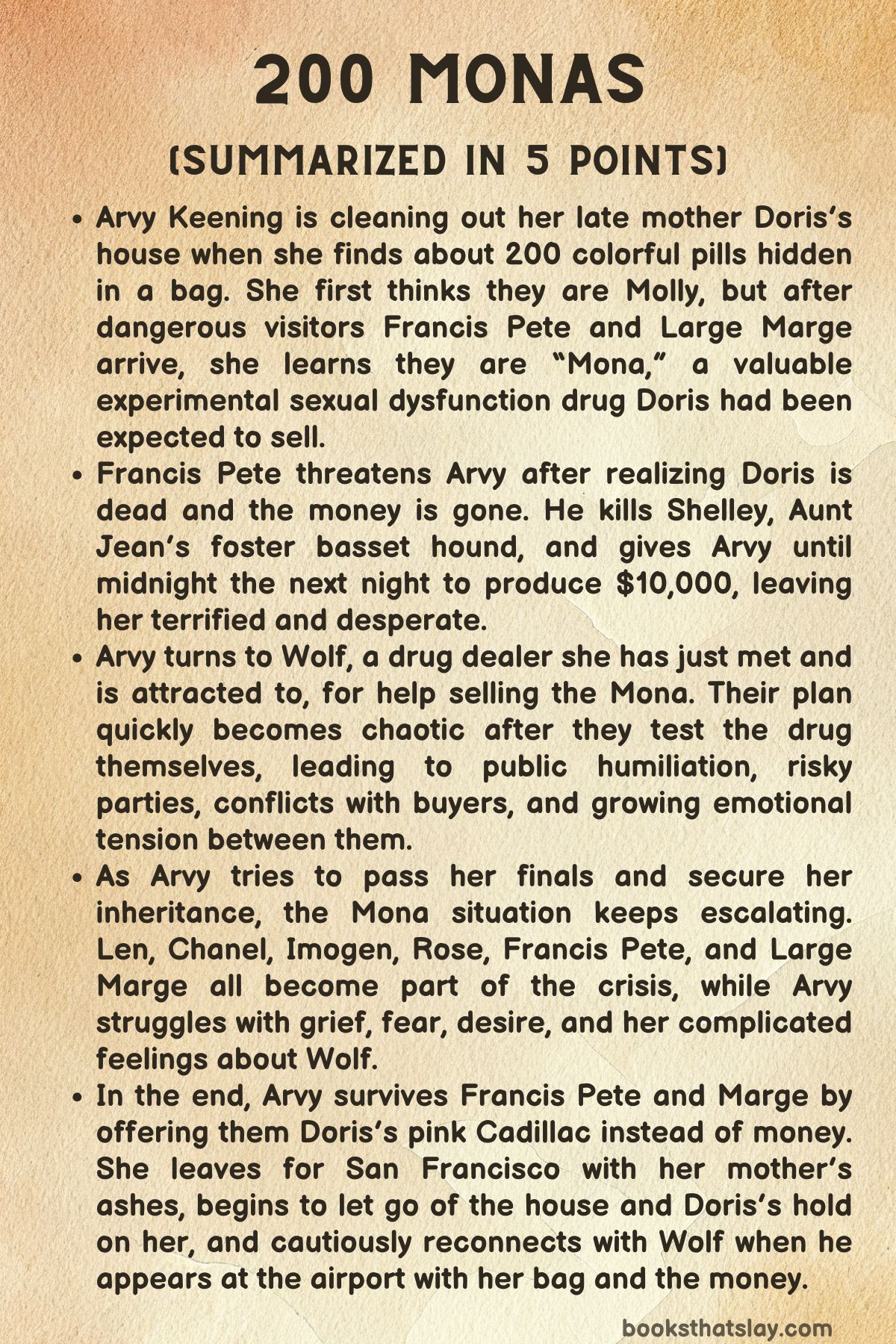
Arvy Keening is four weeks past her mother Doris’s death and still living inside the emptied shell of Doris’s house. Almost everything has been sold to cover expenses and prepare the property for closing, but Arvy is not ready to leave.
She sleeps in her mother’s bare bedroom, talks angrily to Doris’s ashes, and keeps hoping for some sign from the woman who believed in spirits, magic, and strange rituals. Instead of comfort, Arvy finds a Ziploc bag full of about 200 colorful pills in Doris’s closet.
She assumes the pills are Molly and sees them as one more mess her mother left for her to clean up. When Aunt Jean arrives unexpectedly, Arvy panics and hides the bag inside Doris’s urn.
Jean mistakes Arvy’s grip on the urn for grief and reminds her that the house must be empty soon, the utilities are being shut off, and Arvy needs to focus on finishing college. Doris’s will prevents Arvy from inheriting the estate until she proves she has earned her degree, leaving Jean in control until then.
Arvy needs to pass her finals and complete her internship in San Francisco if she wants the money and independence Doris left behind.
Arvy rushes to campus in Doris’s pink 1989 Cadillac with the urn buckled beside her. She takes her Analytical Chemistry final with the urn on her lap, but afterward finds the Cadillac booted because of unpaid parking tickets.
A casual acquaintance named Amy gives her a ride, only to stop for a drug deal with a dealer named Wolf. Arvy is awkwardly attracted to him right away.
When Amy gets too high to drive, Wolf offers to take Arvy home. During the ride, they talk about school, Doris, Arvy’s internship, and her future, and Arvy feels an unexpected pull toward him.
When they reach Doris’s house, two strangers are waiting. They introduce themselves as Francis Pete and Large Marge and claim to have known Doris.
Francis asks to use the bathroom, and Arvy lets them inside. Their behavior quickly turns suspicious.
They look around the empty rooms and question where Doris’s things have gone. Francis finally hints that Doris had something belonging to him.
Thinking he means the pills, Arvy retrieves the bag from the urn and gives it to him.
Francis is not grateful. He explains that the pills are not Molly but Mona, a valuable sexual dysfunction drug worth thousands of dollars.
Doris was supposed to sell them and give him the cash. Since Doris is dead, Francis decides Arvy now owes the money.
When Arvy refuses and says she has no access to the estate yet, Francis becomes violent. Shelley, Aunt Jean’s elderly foster basset hound, barks outside, and Francis shoots the dog through the back door.
Then he threatens Arvy at gunpoint and tells her she must bring him $10,000 by midnight the next night or die. He writes Marge’s number on Arvy’s arm before leaving.
Terrified, Arvy hides in Doris’s closet, covers Shelley’s body with a sheet, and tries to understand what has happened. Wolf texts her after getting her number from Amy, and Arvy begs him to come over.
She researches Mona and learns it may be an experimental drug connected to female sexual function. When Wolf arrives, he at first misunderstands the situation, but Arvy tells him she has nearly 200 Mona pills and needs to sell them fast.
Wolf says Mona is supposed to be only a myth, but when he realizes Arvy is being threatened, he agrees to help her sell the pills for a cut.
Wolf says they should test the drug before selling it. He and Arvy each swallow one.
At first nothing happens, and Arvy panics, thinking the pills are worthless. Then she remembers she has another final in minutes.
Wolf drives her to campus as Mona begins affecting her body. Arvy becomes sick, hypersensitive, and increasingly unable to control herself.
She reaches her exam but suffers an intense drug-induced episode in the hallway and then in front of her class. Humiliated, she still insists on taking the test, proving how desperate she is to graduate and escape her current life.
The drug works, which means the pills can be sold. Wolf becomes more cautious after his own reaction and argues that Mona should not be sold to men, but Arvy only sees the deadline and the danger.
Wolf brings her to Len, a wealthy client, hoping to connect with Chanel, a rich dealer who might buy the whole supply. Against Wolf’s warning, Arvy secretly sells Len two pills.
Later, Wolf takes her to Chad, an art student Arvy once hooked up with, and jealousy flares between the men. Arvy likes seeing Wolf care, but she is hurt when he reminds her they are not together.
That night, unable to face Doris’s house, Shelley’s body, or the silence inside, Arvy stays at Wolf’s apartment. She showers, eats, studies, and sees the more private side of him: his instruments, books, and carefully organized drug stock.
They smoke together, flirt, and nearly kiss, but Wolf pulls back. Restless and wanting to reclaim her first experience with Mona from public shame, Arvy secretly takes another pill.
Just after that, Chanel calls and offers to buy all the Mona. Wolf rushes Arvy to a theatre party in the countryside.
Arvy tries to hide that she took the drug, but Mona hits hard. She becomes sick, overwhelmed, and erratic as Wolf tries to guide her through the crowd.
In a bathroom, she throws herself at him, but Wolf refuses to take advantage of her while she is under the drug’s influence. Arvy blacks out after another intense episode and wakes to people accusing Wolf of assaulting her.
She insists he did nothing wrong, attacks a man who threatens him, and flees with Wolf before anyone can call the police.
Outside, they encounter Len and Chanel. Len reveals that Arvy sold him Mona, then tries to steal the fanny pack containing the pills.
Wolf throws him out of the car and is furious with Arvy for ignoring his warning. Their argument exposes the difference between them: Arvy is thinking only of survival, while Wolf understands how dangerous the drug can make people.
Since Len and Chanel now know where Wolf lives, he takes Arvy to Sayter House, a women’s residence run by Rose. Arvy sleeps near Wolf on the living room floor after they talk quietly and allow a little tenderness between them.
Morning brings more chaos. Rose accuses Wolf of stealing Mona from her safe and shows a livestream of Len’s mansion being raided after Chanel and Len’s party went out of control.
Rose also reveals a text claiming Wolf had sex with Imogen in a campus maintenance closet. Wolf denies it, Imogen denies it, and Imogen admits only that she contacted Chanel.
Arvy is overwhelmed, late for her Art Appreciation final, and emotionally crushed. She grabs Wolf’s keys and drives away in his car even as he says he has her money.
At campus, Arvy reaches the exam but cannot begin. Other students whisper about the viral video of her earlier Mona episode, and she runs out in tears.
In the parking garage, Francis Pete and Large Marge appear. They have seen the online chaos and assume Arvy has failed to bring their money.
Marge knocks her unconscious. Arvy wakes tied to a chair in Doris’s bedroom with a noose made from an orange extension cord hanging nearby.
Francis plans to stage her death as suicide.
Arvy saves herself by noticing Marge’s attachment to Doris’s pink Cadillac. She offers Marge the car, and the offer changes everything.
Francis and Marge take Arvy to recover the booted Cadillac, eat pizza with her, and help remove the boot. Francis then assists Arvy by pretending to be her grieving father so Professor Berry will let her retake the final.
Arvy takes the exam, gives Marge advice about caring for the Cadillac, and watches the car drive away.
Afterward, Arvy returns to Doris’s house, cleans up the signs of her near-death, packs for San Francisco, and says goodbye. At the closing, Aunt Jean points out how strange it was that Arvy had been carrying Doris’s ashes everywhere.
Arvy understands that Wolf helped break that fixation, even if their bond is messy and painful.
On the way to San Francisco, Arvy hears from Imogen, who admits she kissed Wolf but says he pushed her away. Arvy leaves Wolf a conflicted voicemail about anger, gratitude, attraction, and the strange connection between them.
At baggage claim, Wolf is waiting with her bag and the money. They reconcile carefully, not with perfect answers but with honesty.
As they move toward rideshares together, they kiss, while Aunt Jean calls asking about Shelley, reminding Arvy that even after escape, the unfinished pieces of life still follow.
Characters
Arvy Keening
Arvy Keening is the central character of 200 Monas, and her journey is shaped by grief, fear, desire, survival, and a desperate need to regain control of her life. At the beginning of the book, she is emotionally stuck in the aftermath of her mother Doris’s death, trapped in a nearly empty house that feels less like a home and more like a reminder of everything unresolved between them.
Her decision to carry Doris’s ashes everywhere shows how deeply she is unable to separate herself from her mother, even though much of her grief comes out as irritation, resentment, and sarcasm rather than open sadness. Arvy is not simply mourning Doris; she is also angry at her for leaving behind debts, secrets, strange belongings, and emotional confusion.
Arvy’s personality is a mixture of intelligence, panic, impulsiveness, and vulnerability. She is academically capable and close to graduating, yet her life is so chaotic that even ordinary responsibilities become nearly impossible.
Her finals, internship, inheritance, and future all depend on her ability to stay composed, but the discovery of the Mona pills forces her into a crisis that exposes how little control she really has. Her reactions are often reckless, such as hiding the drugs in the urn, trusting dangerous people too quickly, stealing Wolf’s keys, and taking Mona impulsively.
However, these actions do not make her foolish in a simple sense. They show a young woman under extreme pressure, trying to solve impossible problems with very little emotional support.
Her relationship with Mona reveals a great deal about her inner conflict. The drug becomes both a threat and a temptation.
It humiliates her publicly, endangers her physically, and pulls her into criminal danger, yet it also connects to her confusion about desire, intimacy, and control over her own body. Arvy’s experiences with the drug are frightening because they strip away her ability to manage how others see her.
This is especially painful for someone already trying to hold herself together in the face of grief and instability. Her public breakdowns during her exams deepen her shame, but they also push her toward a clearer understanding of how unsustainable her life has become.
By the end of the story, Arvy has changed because she begins to loosen her grip on the dead, the house, and the version of herself that is defined only by Doris’s absence. Giving up the Cadillac, leaving the house, going to San Francisco, and allowing Doris’s ashes to be carried differently all show that she is moving toward release.
Her reconciliation with Wolf is cautious rather than magically perfect, which suits her development. Arvy does not become suddenly healed, but she becomes more honest with herself.
She survives danger, confronts humiliation, and begins to understand that connection with others can help her move forward without erasing her grief.
Doris Keening
Doris Keening is dead before the main action begins, but she remains one of the most powerful figures in the book because her presence controls the emotional atmosphere around Arvy. Doris exists through her ashes, her house, her pink Cadillac, her will, her debts, her mysterious past, and the strange messes she leaves behind.
She is not physically present, yet almost every major problem in Arvy’s life begins with something connected to her. This makes Doris feel like a haunting presence, not in a literal ghostly way, but as a mother whose choices continue affecting her daughter after death.
Doris appears to have been eccentric, secretive, and drawn to magic, rituals, spirits, and unusual beliefs. Arvy’s expectation that her mother might send a supernatural sign suggests that Doris raised her in an atmosphere where the boundary between the ordinary and the mystical was often blurred.
At the same time, Doris was involved in practical and dangerous realities, including selling Mona for Francis Pete. This contrast makes her a complicated figure.
She was not merely a whimsical woman with odd beliefs; she was also someone capable of entering risky arrangements and keeping serious secrets from her daughter.
Her will reveals another side of her character. By making Arvy prove that she has earned a college degree before inheriting the estate, Doris exerts control from beyond the grave.
This condition can be read as manipulative, but it can also be read as Doris’s attempt to force Arvy toward independence and stability. The ambiguity matters because Arvy’s feelings toward her mother are also ambiguous.
She resents Doris, misses her, argues with her ashes, depends on her memory, and longs for some kind of sign from her. Doris’s character is therefore built through contradiction: loving yet burdensome, magical yet practical, absent yet overwhelmingly present.
Doris’s connection to the Cadillac and Mona also suggests that she had a life Arvy did not fully understand. Francis Pete’s later explanation that Doris was careful and sold Mona to people who needed it complicates the image of her as simply irresponsible.
She may have been involved in illegal activity, but she also seems to have operated with discretion and purpose. This late revelation forces Arvy and the reader to reconsider Doris as someone with hidden competence, not just hidden damage.
Doris remains mysterious, but that mystery is central to her role as a mother whose full self is only partly visible to her daughter.
Wolf
Wolf is one of the most morally complex living characters in the story. He is a drug dealer, but he is not written as a flat criminal figure.
Instead, he is careful, intelligent, emotionally guarded, and guided by a personal code that separates him from more predatory characters like Francis Pete. His first meeting with Arvy shows both his charm and his strangeness.
He enters her life through a drug deal, yet he treats her with unexpected gentleness, buys her food, listens to her, and notices when she is in trouble. This combination of danger and tenderness makes him both attractive and difficult to fully trust.
Wolf’s knowledge of drugs gives him power, but his caution around Mona shows that he understands danger in a way Arvy initially does not. He refuses to treat the pills as an ordinary product.
He wants to test them, sell them only for cash, avoid campus buyers, and avoid selling to men because he fears how the drug could affect behavior. His stance becomes especially important after his own reaction to Mona and the chaos involving Len, Chanel, and the party.
Wolf is not innocent, but he has boundaries. Those boundaries make him a stabilizing force in Arvy’s crisis, even when his life and work are part of the same underground world that creates the danger.
His relationship with Arvy is charged with attraction, distrust, misunderstanding, and genuine care. He is drawn to her, but he often stops himself from crossing certain lines, especially when she is under the influence of Mona.
In the bathroom scene at the party, his refusal to take advantage of her is crucial to his characterization. He is tempted, overwhelmed, and emotionally involved, yet he keeps saying no because he understands that consent is compromised.
This moment separates him from people who exploit chaos for their own benefit. It also shows why Arvy later defends him even when others assume the worst.
Wolf’s flaws remain important. He withholds information, acts possessive around Chad, blindfolds Arvy to protect his location, and does not always explain himself clearly.
His connection with Imogen creates jealousy and hurt, even though the later explanation shows he did not fully betray Arvy in the way she feared. He is protective, but sometimes controlling; kind, but secretive; responsible in some ways, but still involved in dangerous trade.
By the end, his arrival at baggage claim with Arvy’s bag and money suggests that he is trying to repair trust through action rather than words. His character works because he is neither savior nor villain, but a damaged person trying to act decently within a morally unstable world.
Francis Pete
Francis Pete is the clearest threat in the story, and his character represents violence, entitlement, and the danger hidden beneath the drug plot. When he first appears with Large Marge, he seems strange and suspicious but not immediately monstrous.
His behavior grows more threatening as he looks around Doris’s empty house and presses Arvy about what Doris had of his. Once he reveals the value of Mona, his role changes from unsettling visitor to violent creditor.
He treats Doris’s unpaid obligation as something Arvy must inherit, even though Arvy has no real knowledge of the arrangement.
His cruelty is most obvious when he shoots Shelley. The killing of the dog is sudden, unnecessary, and designed to terrify Arvy.
It shows that Francis Pete does not merely threaten violence; he uses it theatrically to establish power. Forcing the gun into Arvy’s mouth is another act of domination meant to destroy her sense of safety.
His demand for money is not just businesslike debt collection. It is sadistic, personal, and humiliating, especially when he increases the amount because he feels Marge has been insulted.
He uses fear as a tool and turns Arvy’s grief-filled home into a place of bodily danger.
At the same time, Francis Pete is not written as entirely one-dimensional. Later, when he accepts the Cadillac as a solution and even helps Arvy persuade Professor Berry, the story reveals a bizarre flexibility in him.
He can shift from attempted murderer to strange accomplice, which makes him unpredictable rather than sympathetic. His explanation that Doris was trusted because she was careful adds context to his relationship with her, but it does not excuse his violence toward Arvy.
He operates according to a distorted personal logic in which debts, loyalty, insults, and practical opportunities matter more than human decency.
Francis Pete’s final turn toward the penis-soap business gives him an absurd comic edge, but that comedy does not erase the fear he creates. He belongs to the book’s darkly comic world, where danger and ridiculousness often appear together.
His character is frightening because he can be both grotesquely funny and genuinely lethal. He forces Arvy into survival mode and becomes one of the main reasons she must stop drifting through grief and start making decisive choices.
Large Marge
Large Marge is intimidating, strange, and more emotionally readable than Francis Pete, even though she participates in his violence. At first, she appears as Francis Pete’s silent or near-silent companion, a physically imposing presence whose connection to Doris seems to involve the pink Cadillac.
Her love of the car becomes one of the most important details about her because it reveals that she is not driven only by greed or cruelty. She has attachments, desires, and a childlike longing for something beautiful or emotionally meaningful.
Marge’s violence is direct and frightening. She helps Francis Pete threaten Arvy, knocks Arvy unconscious, and prepares to take part in staging her death as a suicide.
These actions make her dangerous, not merely passive. She is not innocent simply because Francis Pete is more verbally dominant.
Her strength and willingness to use it make her a real threat. Yet she also seems responsive to emotional appeal in a way Francis Pete is not.
When Arvy realizes that the Cadillac can reach Marge emotionally, she finds the one opening that can save her life.
The Cadillac becomes a symbol of Marge’s softer, more vulnerable side. Her attachment to it suggests that Doris may have given her moments of joy or freedom through rides in the car.
Arvy’s decision to give Marge the Cadillac is partly a survival strategy, but it also becomes a strange act of recognition. Marge is moved not by money alone but by the possibility of happiness associated with the car.
Her later comforting hug complicates her character further, creating an uneasy mixture of menace and tenderness.
Marge’s role in the story shows how absurdity and danger can exist in the same person. She is capable of terrifying cruelty, but she is also capable of warmth.
This does not redeem her, but it makes her memorable. She helps turn the crisis away from murder and toward a bizarre negotiation, and through her, Arvy gives up one of the last major objects tying her to Doris.
In that sense, Marge becomes part of Arvy’s painful process of release.
Aunt Jean
Aunt Jean represents practical authority, family responsibility, and emotional distance. She is the person managing the estate until Arvy completes the conditions Doris set in the will.
Because of this, Arvy sees her partly as an obstacle. Jean controls the money, reminds Arvy about deadlines, and expects her to leave the house before the closing.
Her presence adds pressure to Arvy’s already unstable life, especially because Arvy needs to pass her finals and graduate before she can claim what Doris left behind.
Jean is not cruel, but she often misunderstands Arvy’s emotional state. When she sees Arvy holding the urn, she interprets it as a pure grief moment rather than a panic response involving hidden drugs.
This misunderstanding is both comic and revealing. Jean wants to comfort Arvy, but she does not truly see the depth or shape of Arvy’s crisis.
She seems more focused on practical matters such as utilities, the sale, and logistics. Her emotional care exists, but it is filtered through responsibility and order.
Her decision to leave Shelley with Arvy also reflects how she underestimates what Arvy is dealing with. To Jean, the dog is probably a manageable obligation.
To Arvy, Shelley becomes one more living thing she fails to protect, and the dog’s death becomes part of the trauma that Jean cannot see. Jean’s later observation that Arvy had been carrying Doris’s ashes everywhere for weeks shows that she does recognize something unhealthy in Arvy’s grief.
She may not understand everything, but she can identify when Arvy’s attachment to Doris has become abnormal.
Jean’s function in the book is important because she embodies the ordinary adult world that continues moving forward while Arvy’s private life collapses into chaos. Closings, utilities, inheritance conditions, and travel plans do not stop for grief or danger.
Jean’s pressure helps create the ticking clock around Arvy’s graduation and departure. She is not the villain of Arvy’s life, but she is part of the structure that forces Arvy to confront adulthood before she feels ready.
Shelley
Shelley, the elderly foster basset hound, is a small but emotionally important character. She enters Arvy’s life as an unwanted responsibility left by Aunt Jean, but her presence quickly becomes meaningful because she is vulnerable, dependent, and innocent.
In a house already filled with death, absence, and strange danger, Shelley represents a living creature that Arvy is supposed to care for. Her barking during the confrontation with Francis Pete and Large Marge shows her instinctive reaction to threat, even though she has no power to protect herself or Arvy.
Shelley’s death is one of the cruelest moments in the story because it is unnecessary and sudden. Francis Pete shoots her not because she is a true danger, but because he wants to frighten Arvy and prove that he is capable of violence.
The act transforms the house from a place of grief into a place of terror. Arvy’s reaction to Shelley’s body reveals her shock and guilt.
Covering the dog with a sheet is a small act of care in a situation where she has almost no control.
Shelley also deepens the emotional weight of Arvy’s conflict with Aunt Jean. Jean has entrusted the dog to Arvy, and by the end, Jean is still asking about Shelley, unaware of what happened.
This unresolved detail adds discomfort to the ending because Arvy has survived, but she still carries the consequences of the violence around her. Shelley’s role may be brief, but the dog’s death marks a turning point.
It shows that the danger surrounding Mona is not abstract and that innocent beings can be destroyed by the adult world’s debts and secrets.
Amy
Amy functions as the casual acquaintance who accidentally pulls Arvy deeper into the drug world. She begins as someone who simply gives Arvy a ride after the Cadillac is booted, but her stop in the Walmart parking lot changes the direction of Arvy’s day and introduces Wolf.
Amy is not malicious; she is careless. Her decision to get high instead of driving Arvy home leaves Arvy dependent on Wolf, which becomes one of the most important turns in the story.
Amy’s character shows how ordinary irresponsibility can have major consequences. She does not plan to endanger Arvy, but her choices place Arvy in contact with people and situations she would not otherwise have encountered.
Through Amy, the story connects Arvy’s campus life to the underground drug network. Amy’s presence also highlights Arvy’s isolation.
Arvy does not have a close friend she can rely on in the crisis, only casual connections who appear briefly and then vanish.
Her role is limited, but she is important because she serves as a bridge between Arvy’s academic world and Wolf’s world. Without Amy, Arvy may not have met Wolf at the exact moment she needed someone with drug knowledge.
Amy therefore helps set the plot in motion, even though she remains peripheral. She represents the randomness of crisis, where a ride, a parking lot, and one irresponsible choice can redirect an entire life.
Imogen
Imogen is a source of jealousy, suspicion, and later clarification. Arvy first notices her as the blonde who greets Wolf on campus, and from that moment Imogen becomes connected to Arvy’s fear that Wolf is not trustworthy.
The sight of Imogen emerging disheveled from the maintenance area intensifies Arvy’s suspicion that Wolf used the Mona experience as an opportunity to be with someone else. Because Arvy is already emotionally raw, Imogen becomes less a fully known person at first and more a symbol of possible betrayal.
As the story develops, Imogen becomes more complicated. She is connected to Chanel and later admits that she called her, which contributes to the chaos around the missing Mona and the raid at Len’s mansion.
Rose’s decision to order Imogen to pack shows that Imogen’s actions have serious consequences within the Sayter House community. She is not merely an innocent bystander.
Her choices help spread information and deepen the danger around Arvy and Wolf.
However, Imogen’s later call to Arvy changes the emotional meaning of her character. She admits that she kissed Wolf but says he pushed her away while high and frightened.
This confession does not erase the hurt Arvy felt, but it gives her the truth she needs to understand Wolf more fairly. Imogen becomes the person who confirms Wolf’s restraint, even though she was also involved in creating confusion.
This makes her role important in the repair of trust between Arvy and Wolf.
Imogen’s character reflects the book’s interest in partial knowledge. Arvy sees pieces of the truth and fills in the rest with fear.
Imogen’s presence shows how easily desire, drugs, secrecy, and jealousy can distort perception. She is not central in the same way as Arvy or Wolf, but she influences the emotional stakes of their relationship and helps reveal the difference between suspected betrayal and actual wrongdoing.
Rose
Rose is a protective and authoritative figure who offers temporary refuge when Wolf and Arvy can no longer safely return to his apartment. As the woman in charge of Sayter House, she represents structure, rules, and female community.
Her home is one of the few spaces in the story that feels designed to protect people, especially women. When she allows Arvy to stay and makes Wolf sleep on the couch, she immediately establishes boundaries that contrast sharply with the chaos outside.
Rose’s care is practical rather than sentimental. She gives Arvy a spare room, monitors Wolf’s behavior, and notices when Arvy has slept near him.
She is watchful because she understands risk. Her rules matter because the story repeatedly places Arvy in situations where desire, intoxication, and vulnerability overlap.
Rose’s insistence on boundaries makes her a moral counterweight to the uncontrolled environments of parties, drug deals, and Francis Pete’s threats.
At the same time, Rose is not soft or endlessly forgiving. When Mona goes missing and Chanel’s text implicates Imogen, Rose acts quickly and forcefully.
She accuses, investigates, and removes Imogen from the house. Her reaction shows that Sayter House depends on trust, and she will protect the community even if it means being harsh.
Rose is not simply a comforting maternal substitute; she is a leader responsible for maintaining safety in a world where safety is fragile.
For Arvy, Rose provides a glimpse of a different kind of adult female presence from Doris or Aunt Jean. Doris is mystical, secretive, and absent; Jean is practical but distant; Rose is protective, direct, and grounded.
Her role helps Arvy survive one stage of the crisis and also frames Wolf as someone connected to a community that trusts him, even if imperfectly. Rose strengthens the story’s emotional structure by showing that care can come through rules as much as affection.
Len
Len, also called Kitten by Wolf, is flamboyant, wealthy, and reckless. He belongs to the privileged side of the drug world, where money and indulgence can make danger seem like entertainment.
Wolf takes Arvy to him because Len may provide access to Chanel, the rich dealer who could buy the whole Mona supply. This makes Len useful, but never fully reliable.
He is the kind of character who treats risky substances as party objects rather than serious threats.
Arvy’s secret sale of two Mona pills to Len reveals both her desperation and Len’s lack of caution. Wolf specifically warns that Mona should not be sold to men, but Len’s money and Arvy’s urgency override that warning.
Len’s later behavior proves Wolf right. The raid at his mansion and the chaotic use of Mona show that Len is not capable of handling the drug responsibly.
His privilege does not protect him from consequences, but it does allow him to create consequences for everyone else.
Len’s attempt to steal the fanny pack makes him more than comic relief. He becomes dangerous because his selfishness threatens Arvy’s only possible way to satisfy Francis Pete’s demand.
He does not seem motivated by the same violent cruelty as Francis Pete, but his entitlement and impulsiveness still put people at risk. His chaos is social rather than murderous, but it is damaging all the same.
As a character, Len adds satire to the story’s treatment of wealth, drugs, and performance. He is theatrical, memorable, and absurd, but his absurdity has consequences.
He shows that danger does not always look brutal. Sometimes it looks glamorous, rich, and unserious until everything collapses.
Chanel
Chanel is a powerful offstage force for much of the story, representing money, access, and the possibility of solving Arvy’s problem quickly. Wolf sees her as their best chance to unload the entire Mona supply, which makes her seem like a solution.
However, Chanel’s involvement also makes the situation more dangerous because she belongs to a higher-stakes social and drug network. Her wealth and influence magnify the consequences of Mona entering circulation.
Chanel’s shifting decisions create instability. She first seems uncertain, then changes her mind and wants to buy all the Mona, which sends Wolf and Arvy rushing to the theatre party.
Her presence is tied to secrecy, rumor, and indirect communication. She often affects events through calls, messages, and connections rather than direct confrontation.
This makes her feel powerful but elusive, as if she can reshape the situation without always being physically present.
Her role in the Len mansion raid shows the danger of treating Mona as a luxury party drug. Once the pills enter Chanel’s world, the consequences become public, viral, and harder to control.
This destroys Arvy’s hope for a clean transaction and draws Francis Pete’s attention through online chaos. Chanel therefore turns what might have been a risky sale into a public disaster.
Chanel also affects the emotional plot through her connection to Imogen and the text claiming that Imogen had sex with Wolf. Whether acting out of gossip, anger, or self-interest, she spreads information that damages trust.
Her character represents a world where money, sex, drugs, and social power are tangled together. She is not the main antagonist, but her influence widens the crisis and makes Arvy’s private danger impossible to contain.
Chad
Chad is an art major from Arvy’s past and serves as a point of jealousy and tension between Arvy and Wolf. Arvy once hooked up with him, which makes him a reminder of her life before the current crisis and a potential source of sexual attention outside Wolf.
When Wolf brings Arvy to Chad’s place, the interaction quickly becomes competitive. Chad and Wolf clearly dislike each other, and Arvy notices and even enjoys the jealousy that emerges.
Chad’s flirtation with Arvy gives her a momentary sense of power. In a story where she is often frightened, humiliated, or physically out of control, being desired by Chad allows her to feel wanted on her own terms.
However, this feeling is complicated by Wolf’s reminder that he and Arvy are not dating. That comment hurts because Arvy wants emotional clarity from Wolf but cannot fully claim it.
Chad therefore becomes a mirror for Arvy’s uncertainty about what she wants from Wolf.
His role is also practical. Wolf suggests that Chad may be useful as a pretty male distraction for Chanel, which reduces him to a tool in the attempted Mona sale.
This reflects the transactional mood of the story’s middle section, where almost everyone becomes useful or dangerous depending on what they can provide. Chad is not deeply developed, but he is effective as a source of social friction and sexual comparison.
Chad’s character helps reveal Wolf’s possessiveness and Arvy’s mixed feelings about being protected, claimed, or desired. He also reminds the reader that Arvy’s romantic and sexual life existed before Wolf, even if the crisis makes Wolf feel suddenly central.
Chad is a minor character, but his presence sharpens the emotional tension between the two leads.
Professor Mathis
Professor Mathis represents the academic world that Arvy is desperately trying to remain part of while her life falls apart. During the exam scene, Mathis becomes an authority figure standing between Arvy and failure.
Arvy reaches her in a state of physical and emotional chaos because Mona is overtaking her body, yet Mathis responds at first as a professor dealing with a distressed student rather than someone who understands the true cause.
Her insistence that Arvy take her seat and proceed with the exam adds to the pressure of the scene. Mathis is not intentionally cruel; she simply does not know what is happening.
From her perspective, Arvy appears unwell, late, and unstable. The gap between what Mathis sees and what Arvy is experiencing creates both comedy and horror.
Arvy’s body is in crisis, but the classroom system continues to demand performance, composure, and completion.
Mathis also shows a measure of compassion when she offers to let Arvy postpone the exam after the public collapse. This matters because it gives Arvy an exit, but Arvy refuses it.
Arvy’s insistence on taking the exam reveals her desperation to graduate and secure her future. Mathis therefore becomes part of the external structure that tests Arvy’s endurance, not through villainy, but through institutional expectations.
As a character, Mathis highlights the contrast between ordinary academic life and Arvy’s hidden emergency. She does not know about Mona, Francis Pete, Shelley, or Doris’s secrets.
Her limited understanding makes Arvy’s isolation more visible. The classroom becomes a stage where Arvy’s private crisis erupts into public humiliation.
Professor Berry
Professor Berry enters later as another academic authority figure, but his role is shaped by Francis Pete’s bizarre intervention. Arvy needs to retake her Art Appreciation final after fleeing in panic, and Francis Pete helps persuade Berry by pretending to be her grieving father.
This scene is darkly comic because the man who nearly kills Arvy also helps her preserve her academic future.
Professor Berry’s importance lies less in his individual personality and more in what he represents. He is part of the system Arvy must satisfy in order to graduate, claim her inheritance, and leave for San Francisco.
Like Mathis, he belongs to the ordinary world of deadlines, exams, and permissions. The absurdity of Francis Pete helping Arvy deal with him shows how completely Arvy’s academic life and criminal crisis have become tangled.
Berry’s willingness to allow the retake suggests that he can be persuaded by a story of grief and family hardship. Ironically, the lie Francis Pete tells contains emotional truth even though the situation is false.
Arvy is grieving, her family situation is chaotic, and her life has genuinely been disrupted. Professor Berry therefore becomes a gatekeeper who briefly opens the gate, allowing Arvy to continue moving toward graduation.
His role is minor, but it matters because the story’s ending depends partly on Arvy completing her exams. Without that academic progress, Doris’s will would continue controlling her future.
Berry’s scene helps turn a near-death crisis into a strange step toward survival and independence.
Uncle Greg
Uncle Greg is a minor background character, but his presence helps define Aunt Jean’s world of ordinary family obligations. He leaves town with Jean, which is why Shelley is left with Arvy.
Although he does not play a direct role in the central crisis, his absence contributes to the setup that leaves Arvy alone in Doris’s house with the dog, the ashes, and the hidden Mona.
His limited role emphasizes Arvy’s isolation. The adults around her have their own plans, travels, and responsibilities, while she is left to manage the remains of Doris’s life.
Uncle Greg is part of the family structure, but he is not emotionally or practically available when the crisis begins. This absence matters because Arvy’s danger grows in the space left by unavailable adults.
Uncle Greg also reinforces the contrast between normal family life and Arvy’s chaotic reality. For Jean and Greg, leaving town may be ordinary.
For Arvy, their departure leaves her exposed. His character does not require deep development because his purpose is structural.
He helps explain why Arvy is alone at the exact moment when she most needs support.
The Sayter Girls
The Sayter girls function as a collective character representing female community, suspicion, and protection. They appear most strongly when Arvy wakes after the party and when Rose later confronts the missing Mona situation.
Their instinct is to protect Arvy when they believe Wolf may have assaulted her, which shows the importance of solidarity in a world where women are often vulnerable to male violence, intoxication, and exploitation.
Their reaction to the bathroom incident is understandable because they see a young woman emerging from a frightening situation with a man nearby. Even though they misread Wolf’s role, their response is rooted in concern rather than cruelty.
This makes them important to the book’s moral landscape. They are not trying to shame Arvy; they are trying to protect her based on the information they have.
At Sayter House, the girls also become part of the pressure surrounding Wolf, Imogen, and the missing Mona. As a group, they intensify the sense that secrets cannot remain private forever.
Their presence turns individual choices into community matters. Mona is not just Arvy’s problem once it enters shared spaces; it becomes a threat to everyone’s safety.
The Sayter girls help balance the story’s darker elements by showing that community can respond to danger, even imperfectly. They may misunderstand certain situations, but their protective instincts are meaningful.
Through them, the story suggests that survival is not only individual; it also depends on groups willing to intervene.
Themes
Grief, Denial, and the Need for Release
Arvy’s grief is messy, physical, and unresolved rather than calm or poetic. Four weeks after Doris’s death, she is still sleeping in her mother’s empty bedroom, carrying the ashes around, speaking to the urn, and waiting for some impossible sign that Doris is still present.
Her attachment to the ashes shows that she has not accepted death as final; she keeps dragging her mother into every crisis, exam, car ride, and dangerous encounter. In 200 Monas, grief is not shown as quiet sadness but as confusion, anger, embarrassment, and dependence.
Arvy resents Doris for leaving behind debt, secrets, drugs, and emotional chaos, yet she also cannot separate herself from her. The urn becomes both a burden and a comfort, holding not just ashes but Arvy’s unfinished arguments with her mother.
By the end, letting the ashes travel separately and moving toward San Francisco suggest that healing begins when Arvy stops treating grief as something she must physically hold at all times.
Control, Power, and Vulnerability
Arvy spends much of the story trying to regain control over a life that keeps slipping away from her. Doris’s will controls her future, Aunt Jean controls the estate, Francis Pete controls her through threats, and Mona controls her body in humiliating and frightening ways.
Even school, which should represent escape and achievement, becomes another place where she feels exposed and powerless. Her finals are not just academic obstacles; they are tied to inheritance, independence, and the possibility of leaving her mother’s house behind.
The drug sharpens this theme because it takes away Arvy’s ability to manage how others see her. Public embarrassment, viral attention, and physical helplessness force her to confront how fragile control really is.
Yet the story does not leave her powerless. Arvy survives by improvising, bargaining, lying, and making desperate choices under pressure.
Her control is imperfect and often chaotic, but it grows from her ability to keep acting even when fear, shame, and danger threaten to silence her.
Desire, Consent, and the Danger of Misused Intimacy
Mona turns desire into something unstable, exposing how easily intimacy can become frightening when choice is weakened or misunderstood. The drug is connected to pleasure, but its effects are often terrifying because Arvy cannot fully control her body, her reactions, or the situations around her.
This creates a sharp contrast between real intimacy and forced or chemically driven desire. Wolf’s refusal to take advantage of Arvy during her drug-induced episodes becomes important because it shows that attraction alone is not enough to justify closeness.
His restraint separates genuine care from selfish desire, even when the situation is emotionally and physically intense. Arvy’s confusion around Wolf, Imogen, Len, and Chanel also shows how jealousy and insecurity can distort trust.
The story treats desire as powerful but risky, especially when drugs, money, fear, and secrecy are involved. True intimacy is shown not through physical urgency but through protection, honesty, patience, and the willingness to stop when another person is vulnerable.
Escape, Independence, and Self-Reinvention
Arvy’s goal is not only to survive Francis Pete or pass her finals; she wants to escape the life Doris left behind. The house represents grief, debt, family pressure, and a version of herself trapped in old patterns.
Graduation and San Francisco stand for independence, but the path toward that future is chaotic and painful. Arvy must face the consequences of Doris’s secrets while also proving that she can make decisions for herself.
Selling the furniture, preparing the house for closing, taking exams, and packing for the internship all show a life being dismantled so another one can begin. However, escape is not presented as simple freedom.
Arvy carries guilt, fear, grief, and unresolved feelings with her, even when she physically leaves. Her final movement toward San Francisco matters because she is no longer frozen inside her mother’s room or defined only by Doris’s choices.
Independence begins when Arvy accepts that leaving does not erase the past, but it can stop the past from owning her.