If We Never End Summary, Characters and Themes
If We Never End by Laura Taylor Namey is a young adult romance with mystery, magical realism, and a story about grief, family, and learning how to face pain instead of hiding from it. The book follows Sylvie Castellano, an eighteen-year-old who feels abandoned by her parents and trapped in a life she did not choose.
A summer in a remote Oregon town becomes stranger when she finds a mysterious gold watch and meets Penn, a boy who appears only when the watch ticks. As Sylvie tries to solve his mystery, she slowly uncovers the truth about herself, her aunt, and the accident that changed everything.
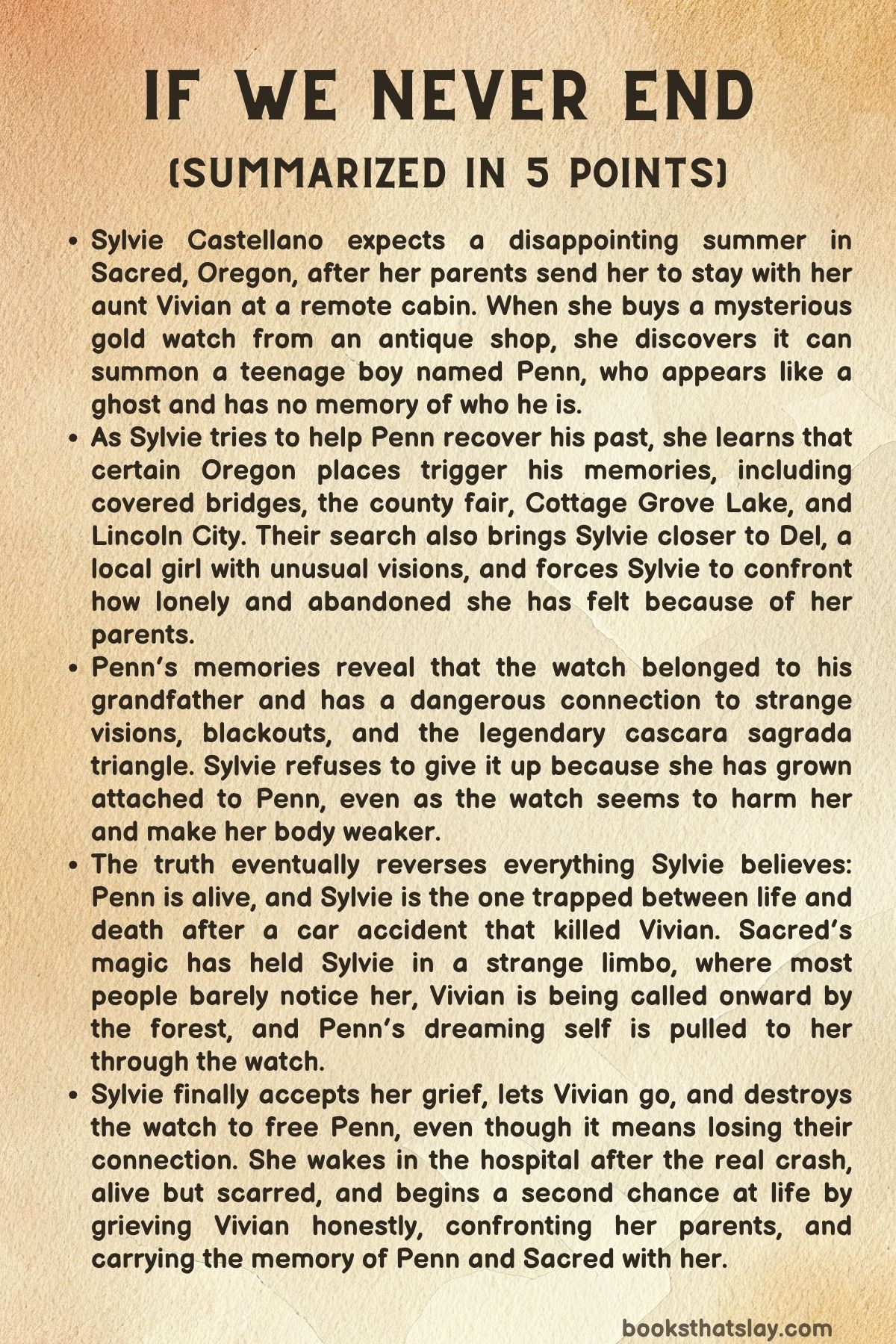
Summary
Sylvie Castellano begins the summer after high school feeling forgotten and frustrated. Her parents work aboard a luxury yacht in Europe, and once again she has been left behind while other people seem to be living brighter, freer lives.
She had hoped that graduation might bring independence, travel, or at least a summer with her best friends, Ana and Grier. Instead, her parents send her to Sacred, Oregon, with her aunt Vivian, who has taken a well-paid art commission at a remote cabin.
Sylvie loves Tía Vivian, but she resents the trip. She is eighteen, yet her parents still make decisions for her from far away.
She feels as if they prefer their yacht life without her and only remember their responsibilities when they need to control her. Sacred seems like the last place she wants to spend the summer.
On the way into town, Sylvie and Vivian stop at an antique shop called Spines and Pines. Sylvie buys a leather notebook, a graduation snow globe, and a broken gold watch that catches her attention.
The watch seems ordinary at first, but Vivian later recognizes it as a valuable vintage Vacheron Constantin. Sylvie immediately sees it as a possible way out.
If the watch can be repaired and sold, she may have enough money to move out, attend community college, work, and begin the independent life she wants.
That plan changes when the watch begins ticking, even though it should be broken. At Bearberry Cabin, where Vivian sets up her woodworking and stained-glass workshop, Sylvie winds the watch and a teenage boy appears in her room.
He looks real, but objects pass through him. He has no memory of who he is, how he died, or why he is connected to the watch.
Eventually, he remembers his name: Penn. When the watch stops, he disappears.
Sylvie tries to understand what has happened. She returns to Spines and Pines to ask about the watch, but the owner claims he never sold it to her.
The receipt lists only the notebook and snow globe. This makes Sylvie believe the watch came to her for a reason.
While in Sacred, she also meets Del, a friendly girl who tells her about the town’s strange history. Sacred is named for cascara sagrada trees, and local legend says three magical cascara trees sometimes appear in a triangle, creating a place of unusual power.
At first, Sylvie wants nothing to do with the watch. She is frightened by Penn and worried that her headaches and concussion symptoms might be affecting her mind.
But after feeling the watch pull her back whenever she tries to distance herself from it, she accepts that Penn is real and trapped. She decides she cannot sell the watch while he is tied to it.
Penn wants Sylvie’s help. He needs to recover his memories and understand why he cannot move on.
Sylvie begins keeping notes and searching for clues. She learns that Penn knows ordinary facts and reacts to certain places in Oregon.
When they visit Currin Bridge near Cottage Grove, Penn remembers details about the area. Sylvie realizes that familiar locations may help unlock his past.
As she helps him, Penn also pushes Sylvie to talk about herself. She admits that her parents’ long absences have hurt her for years.
She feels like an inconvenience in their lives, someone they leave behind while they enjoy the Mediterranean. Penn listens without dismissing her.
His attention makes Sylvie feel seen in a way she rarely has.
Sylvie’s life in Sacred grows more complicated. Del brings her a red tabby cat named Anne Shirley, whose owner has died.
Del says she has a hunch Sylvie should care for the cat. Anne Shirley immediately bonds with Sylvie and seems able to sense Penn.
Sylvie also discovers that Del once had a vision that helped her save a child from an accident. Del does not want people treating her like a fortune-teller, but her abilities make her different from everyone else in town.
Penn’s memories return in pieces. He remembers he was nineteen.
He recalls a concert shirt, family outings, boating at Cottage Grove Lake, and his grandfather Patrick. The watch, he remembers, once belonged to his grandfather, who believed it was dangerous and tried to get rid of it.
Penn also remembers that wearing the watch as a child caused strange visions, exhaustion, and blackouts. He begins to fear that the watch may be hurting Sylvie too.
Sylvie refuses to take it off. She is no longer helping Penn only out of pity or curiosity.
She has grown attached to him. Their bond becomes romantic, even though he is not fully alive in the ordinary sense.
Penn manages to kiss her in a faint, ghostly way, and both of them wish they had met under normal circumstances.
The watch’s effects become harder to ignore. During a horseback riding lesson at Del’s stable, the horse panics and throws Sylvie.
Her arm is cut, and the wound does not heal properly. Penn notices and worries.
Sylvie begins to weaken while Vivian seems strangely stronger and more at peace in the forest surrounding Bearberry Cabin.
A trip to Lincoln City brings Penn more memories. He remembers his real mother, Joanie, his grandfather Patrick, his father leaving, and a birthday trip where he found a blue glass float that became a symbol of hope.
Sylvie finds a red glass float, but it is broken. When she cuts her hand on it, Penn is terrified.
He asks her not to look for him until he returns, but Sylvie cannot stop searching.
At the library, the truth begins to break open. Penn remembers that his real name is Patrick Gerrity, though his grandfather called him Penn.
Then he reveals something that changes everything: he is not dead. The watch took a part of him during a childhood seizure.
When the real Penn sleeps, his dreaming self is pulled to Sylvie through the watch.
Penn gives Sylvie search terms connected to Vivian and a red Camaro. The results show that Vivian and Sylvie died in a car accident near Sacred after the car went off a cliff.
Sylvie realizes she has misunderstood the entire situation. Penn is not the ghost.
She is the one caught between life and death.
Sylvie and Penn start to understand the strange rules around her existence. People in Sacred barely notice Sylvie and quickly forget her.
Del remembers her because of her sensitivity to supernatural things. Vivian, meanwhile, has known something is wrong.
She has become younger, stronger, and more connected to the forest, while Sylvie has been weakening. Vivian admits that years earlier she found the legendary cascara triangle and took wood and berries from it to make a dream box after a painful heartbreak.
Since then, she has carried the consequences of that choice.
The forest is calling Vivian forward, and Vivian is ready to go. Sylvie is not.
She does not want to lose her aunt, and she is not ready to accept death. She searches for the real Penn and finds him in Eugene.
Awake, he does not remember the time they have shared through the watch. He recognizes the watch only as something cursed and painful.
When Sylvie tries to make him understand, he tells her to leave. The rejection devastates her.
Back at Bearberry Cabin, Sylvie finally stops running from her pain. She steps into the creek, removes her bandages, and allows herself to feel everything she has buried: her parents’ emotional absence, her loneliness, the distance from her friends, Vivian’s sacrifice, and her love for Penn.
She understands that holding on to Vivian would be selfish. Vivian deserves peace.
Sylvie then makes the hardest choice. She takes Vivian’s mallet into the woods and destroys the gold watch.
By doing so, she frees Penn’s dreams, even though it may mean losing him forever. The watch’s hands move backward before it disappears, and Sylvie blacks out.
She wakes in a hospital. The accident was real, but Sylvie has survived.
Vivian died, and the watch has somehow returned Sylvie to the moment after the crash, giving her a second chance. Sylvie must now live with grief rather than avoid it.
She confronts her parents honestly about the years they made her feel unwanted, and they begin to face the harm they caused.
When Sylvie returns to Sacred, she is alive, scarred, and changed. She carries the memory of Vivian, Penn, Del, Anne Shirley, and the strange in-between place that forced her to choose life.
If We Never End closes as a story about accepting loss without letting it erase the future. Sylvie’s second chance is not painless, but it is real, and this time she is ready to live it fully.
Characters
Sylvie Castellano
Sylvie Castellano is the emotional center of If We Never End, and her character is shaped by loneliness, resentment, fear, longing, and eventual courage. At the beginning of the book, she feels trapped in a life where everyone else seems to move forward while she is left behind.
Her parents’ work aboard a luxury yacht makes her feel abandoned, and their decisions for her future make her feel controlled even after she has turned eighteen. This creates a deep frustration in Sylvie, not only because she wants independence, but because she wants proof that her feelings matter.
Her desire to sell the gold watch and use the money to build a separate life shows how strongly she wants control over her own future.
Sylvie’s relationship with Penn reveals her softer and more vulnerable side. At first, she is frightened and overwhelmed by his appearance, but she gradually becomes invested in helping him understand who he is.
Through Penn, Sylvie begins to talk about pain she has spent years hiding, especially the hurt caused by her parents’ emotional distance. Her bond with him becomes both romantic and healing because he sees her clearly and encourages her to stop dismissing her own suffering.
However, Sylvie’s attachment to him also exposes her fear of loss. Even when Penn warns her that the watch may be dangerous, she refuses to remove it because losing him feels unbearable.
As the truth about the accident emerges, Sylvie’s character becomes even more tragic and layered. She realizes that the strange world around her is not simply a mystery involving Penn, but a reflection of her own suspended state between life and death.
Her physical deterioration contrasts with Vivian’s growing peace, showing that Sylvie is not ready to move on because she still has unfinished emotional work. Her final decision to destroy the watch is a major act of maturity.
She gives up the one thing connecting her to Penn because she understands that love cannot be based on possession or fear. By the end of the story, Sylvie becomes someone who can face grief honestly, confront her parents truthfully, and accept life with all its pain and possibility.
Penn / Patrick Gerrity
Penn, whose real name is Patrick Gerrity, is one of the most mysterious and emotionally significant figures in the book. He first appears as a ghostlike boy tied to the gold watch, with no memory of who he is or what happened to him.
His confusion gives him an air of sadness, but he is not merely a helpless spirit. He is curious, observant, funny, and emotionally perceptive.
Even before he understands his own identity, he pushes Sylvie to look more honestly at herself. This makes him more than a supernatural mystery; he becomes a mirror through which Sylvie begins to understand her own wounds.
Penn’s gradual recovery of memory gives his character depth and tenderness. His recollections of Oregon, bridges, county fairs, lake trips, his grandfather, his mother Joanie, and the blue glass float show that he is connected to family, place, and memory in powerful ways.
These fragments suggest that he was a boy shaped by both love and abandonment. His father’s absence hurt him deeply, while his grandfather Patrick gave him stability and affection.
The nickname “Penn” itself becomes meaningful because it comes from his grandfather, linking his identity to a relationship that helped define him. His memories make him feel real long before the truth reveals that he is not dead.
Penn’s fear of the watch reveals another important part of his character. Once he remembers that the watch harmed him as a child, he becomes protective of Sylvie and urges her to take it off.
His love for her is not selfish; he would rather lose contact with her than see her suffer. This makes his relationship with Sylvie deeply bittersweet.
He longs for connection but does not want that connection to endanger her. When Sylvie later meets the real Penn, his fear and anger show the trauma the watch has left behind.
Dream Penn and waking Penn seem divided, but both versions carry the same history of loss, confusion, and fear. As a character, Penn represents memory, unfinished longing, and the painful difference between loving someone in an impossible space and meeting them in reality.
Tía Vivian Rojas
Tía Vivian is one of the warmest and most spiritually complex characters in the novel. She begins as Sylvie’s aunt and temporary guardian, bringing Sylvie to Sacred while she works on her art commission.
At first, Vivian may seem like another adult limiting Sylvie’s freedom, but her role quickly becomes more compassionate and protective. She gives Sylvie space, treats her with gentleness, and offers a kind of emotional steadiness Sylvie does not always receive from her parents.
Her woodworking, stained glass, carved bridge, and dream boxes show that she is an artist who transforms pain into beauty.
Vivian’s connection to the cascara legend gives her character a mystical and sorrowful dimension. Years before the main events, she found the legendary cascara triangle and took wood and berries from it to make a dream box after heartbreak.
This choice suggests that Vivian once tried to use magic or sacred energy to manage grief, but she later understood that such acts carried consequences. Her decision to stop making dream boxes until she was ready again shows self-awareness.
She is not simply magical or wise; she is someone who has made mistakes, suffered from them, and learned humility.
After the accident is revealed, Vivian’s character becomes heartbreaking. Unlike Sylvie, she grows stronger, younger, and more peaceful in the limbo-like world, suggesting that the forest is calling her forward.
Her readiness to move on does not mean she loves Sylvie less. Instead, it shows that Vivian has accepted something Sylvie cannot yet face.
Sylvie’s decision to let her go is one of the most emotional moments connected to Vivian’s character because it proves that love sometimes means release. Vivian represents sacrifice, artistry, healing, and the quiet acceptance of death.
Her presence continues to shape Sylvie even after Sylvie returns to life.
Del
Del is an important bridge between the ordinary world of Sacred and the supernatural forces surrounding Sylvie. She is friendly, quirky, and welcoming, giving Sylvie a connection to the town when Sylvie feels isolated and resentful.
Through Del, Sacred becomes more than just a place Sylvie has been sent against her will. Del introduces her to local legends, the cascara sagrada trees, the strange energy field, and the town’s unusual history.
Her openness makes her one of the first people to soften Sylvie’s loneliness.
Del’s psychic sensitivity makes her character especially important. Her past vision at Needles, where she saved a child from being crushed by a Jeep, shows that she has abilities she does not fully want or understand.
She does not want to be treated like a fortune-teller, which makes her power feel like a burden rather than a gift. This detail gives Del emotional realism.
She is not proud or dramatic about her visions; she is uncomfortable with the attention and responsibility they bring. Her message at the lake, “It’s not your time,” becomes one of the strongest clues that Sylvie’s condition is more serious than she understands.
Del’s ability to remember Sylvie and Vivian when others cannot shows that her gift allows her to perceive what most people forget. She becomes one of the few living connections Sylvie has to the real world, even if Del does not fully understand what Sylvie is.
Her friendship with Sylvie is gentle but meaningful because it is based on instinct, kindness, and trust. Del also has her own personal life and problems, including her difficulties with Ethan, which prevents her from existing only as a supernatural helper.
She is a full character who brings warmth, intuition, humor, and emotional grounding to the story.
Anne Shirley
Anne Shirley, the aggressive red tabby cat, is a small but memorable character whose presence adds humor, comfort, and mystery to the book. She enters Sylvie’s life after her owner dies, and Del’s hunch that Sylvie should foster her immediately connects the cat to the story’s supernatural atmosphere.
Anne Shirley is not an ordinary pet in the emotional sense. She chooses Sylvie quickly, obeys her unexpectedly, and even tolerates Vivian despite Vivian’s cat allergy.
These strange details suggest that the cat belongs naturally in the unusual space around Sylvie.
Anne Shirley’s ability to sense or see Penn makes her especially important. Because most people cannot perceive him, the cat’s reactions help confirm that Penn is real and not simply a symptom of Sylvie’s concussion or imagination.
This gives Sylvie reassurance at a time when she is questioning her own mind. Anne Shirley also provides companionship during Penn’s absences, when Sylvie is lonely and afraid he may never return.
Her presence softens the darker parts of the story by giving Sylvie something living, affectionate, and immediate to care for. As a character, Anne Shirley represents instinct, comfort, and the quiet awareness animals often seem to have in supernatural stories.
Corbin
Corbin, the owner of Spines and Pines, is a minor but important character because he deepens the mystery of the gold watch. When Sylvie returns to ask about it, he insists that he never sold it to her, and the receipt confirms that only the notebook and snow globe were officially purchased.
This moment is crucial because it proves that the watch did not enter Sylvie’s life in a normal way. Corbin’s role is not emotionally central, but he helps establish the strange rules of the story.
Corbin’s antique shop also reflects the book’s interest in objects that carry memory and history. Spines and Pines is not just a shop; it is the place where Sylvie unknowingly receives the object that connects her to Penn, Vivian, and the truth about the accident.
Corbin’s confusion makes the watch feel even more powerful because it seems to have chosen Sylvie rather than simply being bought by her. His character functions as a gatekeeper to the mystery, even though he does not understand the role he has played.
Sylvie’s Parents
Sylvie’s parents are not physically present for much of the story, but their emotional influence shapes Sylvie’s entire character arc. They work aboard a luxury yacht in Europe, and their lifestyle leaves Sylvie feeling unwanted and inconvenient.
She believes they are happier at sea than they are with her, which creates a deep wound in her sense of self-worth. Their repeated absences make Sylvie feel as though she has been left behind not only during summers, but in the larger emotional structure of her family.
Their control over Sylvie’s post-graduation summer adds another layer to her resentment. Even though she is eighteen, they still direct her life from a distance, sending her to Sacred instead of allowing her the freedom she wants.
This makes Sylvie’s desire for independence understandable. She is not simply rebellious; she is trying to escape a pattern where her needs are ignored.
By the end of the book, Sylvie’s confrontation with her parents is essential because it allows her to name the hurt she has carried for years. Their relationship with her does not magically become perfect, but the honesty after the accident creates the possibility of a more truthful family bond.
Ana and Grier
Ana and Grier are Sylvie’s friends, and although they are not central to the supernatural mystery, they represent the life Sylvie feels she is missing. At the beginning of the story, Sylvie compares her own disappointing summer to the exciting trips and freedom her friends seem to have.
This comparison intensifies her feeling of being left behind. Ana and Grier become symbols of the ordinary teenage life Sylvie wants but cannot seem to access.
Their importance lies less in direct action and more in what they reveal about Sylvie’s emotional state. Sylvie’s distance from them shows that she feels abandoned not only by her parents, but also by the natural movement of life after graduation.
Everyone else appears to be stepping into a brighter future, while Sylvie is stuck in Sacred with an aunt, a strange watch, and unresolved pain. In this way, Ana and Grier help define the loneliness that makes Penn’s arrival so powerful.
Patrick, Penn’s Grandfather
Patrick, Penn’s grandfather, is one of the most meaningful figures in Penn’s backstory. He owned the gold watch before Penn, and his belief that the watch was dangerous shows that the object’s curse or supernatural power existed long before Sylvie encountered it.
Patrick’s attempts to get rid of the watch suggest that he understood its threat but could not fully escape it. This makes him part of the larger mystery surrounding the watch and its ability to harm or trap people.
On an emotional level, Patrick is also a source of love and stability for Penn. Penn’s memories of boating, tubing, burgers, and family outings with his grandfather show that Patrick gave him joy and belonging.
The fact that “Penn” was his grandfather’s nickname for him makes Patrick central to his identity. Even after Penn loses his memories, the nickname remains, proving how deeply his grandfather’s love shaped him.
Patrick represents family history, warning, affection, and the painful inheritance of the watch.
Joanie
Joanie, Penn’s mother, appears through Penn’s recovered memories, and her importance lies in the way she helps restore his identity. Remembering Joanie helps Penn reconnect with the life he had before the watch damaged him.
She is part of the emotional map that leads him back to himself. Through her, Penn’s past becomes more human and specific, moving beyond vague clues into real family relationships.
Joanie also helps show that Penn’s life was marked by both care and instability. His memories of her exist alongside memories of his father leaving and returning, suggesting that his childhood carried emotional complications.
Joanie’s presence gives Penn roots, reminding the reader that he is not only a mysterious boy connected to a watch, but a son with a real family, real losses, and a real life outside the dreamlike space he shares with Sylvie.
Penn’s Father
Penn’s father is important because his absence leaves a lasting emotional mark on Penn. Penn remembers his father leaving the family, and later remembers his return.
These memories suggest instability, longing, and unresolved hurt. His father’s departure parallels Sylvie’s experience with her own parents in a subtle way.
Both Sylvie and Penn know what it feels like to be emotionally abandoned by people who should have stayed close.
Although Penn’s father is not explored as deeply as other characters, he helps explain Penn’s sensitivity to Sylvie’s pain. Penn understands abandonment because he has lived with it.
His compassion for Sylvie is not abstract; it comes from his own experience of being hurt by a parent’s absence. This makes their connection stronger because they recognize similar wounds in each other.
Ethan
Ethan is a minor character connected to Del’s personal life, but his presence helps show that Del exists beyond her role in Sylvie’s mystery. Del’s problems with Ethan suggest that she has her own emotional struggles, relationships, and disappointments.
This matters because it prevents her from functioning only as a guide or magical helper.
Through Ethan, the story hints at Del’s vulnerability. She may be friendly and intuitive, but she is also dealing with ordinary human complications.
Her supernatural sensitivity does not protect her from confusion or hurt in relationships. Ethan’s role is small, but he adds realism to Del’s life and reminds the reader that every character in the story carries private concerns.
Winnie
Winnie, the gentle Morgan horse at Del’s stable, is not a major character, but she plays an important role in showing the watch’s disturbing influence. Del presents Winnie as a calm and suitable horse for Sylvie’s riding lesson, but when Sylvie mounts, Winnie panics and throws her.
This sudden reaction suggests that the watch may be affecting animals or disturbing the natural world around Sylvie.
Winnie’s panic also reinforces the idea that animals sense what humans often miss. Like Anne Shirley, Winnie responds to the supernatural energy surrounding Sylvie, though in a much more fearful way.
The incident leaves Sylvie physically injured and emotionally unsettled, adding to the growing evidence that the watch is not only mysterious but dangerous. Winnie’s role is brief, yet the scene connected to her helps increase the tension around Sylvie’s condition.
Themes
Emotional Neglect and the Need to Be Seen
In If We Never End, Sylvie’s deepest pain comes from years of feeling unwanted in her own family. Her parents’ work on the yacht is not only a physical absence but an emotional one, making her feel like someone they manage rather than someone they truly notice.
This feeling shapes many of her choices: her anger about being sent to Oregon, her desire to move out, and even her past act of stealing at Disneyland. That theft was not about the necklace itself, but about trying to force a reaction from parents who seemed distant from her unhappiness.
Her bond with Penn becomes powerful because he listens to her without treating her feelings as an inconvenience. Through him, Sylvie slowly names the hurt she has avoided.
The story shows that neglect does not always look cruel on the surface; sometimes it appears as busyness, excuses, and missed chances to ask what someone needs.
Grief, Acceptance, and Letting Go
Sylvie’s journey is shaped by the painful difference between holding on out of love and holding on out of fear. At first, she refuses to lose Penn, even when the watch may be harming her and trapping him.
Later, she also struggles to let Vivian move forward, because accepting Vivian’s death means accepting a loss that cannot be repaired. The supernatural situation forces Sylvie to face grief before she is ready, and that makes her choices more meaningful.
Letting go does not mean she stops loving Vivian or Penn; it means she stops using love as a reason to keep them bound to her. Destroying the watch becomes an act of courage because Sylvie chooses another person’s freedom over her own comfort.
The theme suggests that grief becomes survivable only when pain is allowed to exist openly, instead of being hidden, denied, or controlled.
Identity, Memory, and Truth
Penn’s missing memories and Sylvie’s mistaken understanding of her own condition make identity uncertain throughout the story. Penn believes he may be dead, while Sylvie believes she is alive and helping him move on.
As clues appear through places, objects, and emotional moments, both characters discover that memory is not just information; it is a path back to truth. Penn’s name, family history, and connection to the watch slowly restore his sense of self, while Sylvie’s discoveries force her to question everything she thought was real.
The watch creates confusion, but it also exposes what has been buried. Sylvie’s identity is not complete until she accepts the accident, Vivian’s death, and the emotional wounds that shaped her before the crash.
The theme shows that truth can be frightening, but false comfort keeps people trapped. Healing begins when reality is faced directly.
Second Chances and Choosing Life
Sylvie’s return to life is not presented as a simple rescue, but as a second chance that carries responsibility. Before the accident, she wanted independence mainly as escape: from her parents, from loneliness, and from feeling powerless.
After surviving, that desire becomes deeper and more honest. She still wants a future of her own, but she now understands that freedom also requires facing pain, speaking truth, and living with loss.
Her hospital awakening does not erase what happened in the strange limbo; it gives meaning to it. Vivian is gone, Penn may not remember everything in the same way, and Sylvie’s family problems are not magically solved.
Yet she returns with the strength to confront her parents and admit how deeply their absence hurt her. The theme suggests that a second chance is not about returning to the old life unchanged.
It is about choosing to live differently because of what has been learned.