I Love You, Don’t Die Summary, Characters and Themes
I Love You, Don’t Die by Jade Song is a dark, sharp, and emotionally charged novel about loneliness, friendship, desire, depression, and the strange ways modern culture turns even death into a product. Set in New York City, the story follows Vicky, a copywriter whose life is shaped by grief, avoidance, and a deep fascination with objects made for the dead.
Through her work at a death-industry start-up and her fragile relationships with Jen, Kevin, and Angela, the novel examines what it means to want connection while fearing the demands of being truly known.
Summary
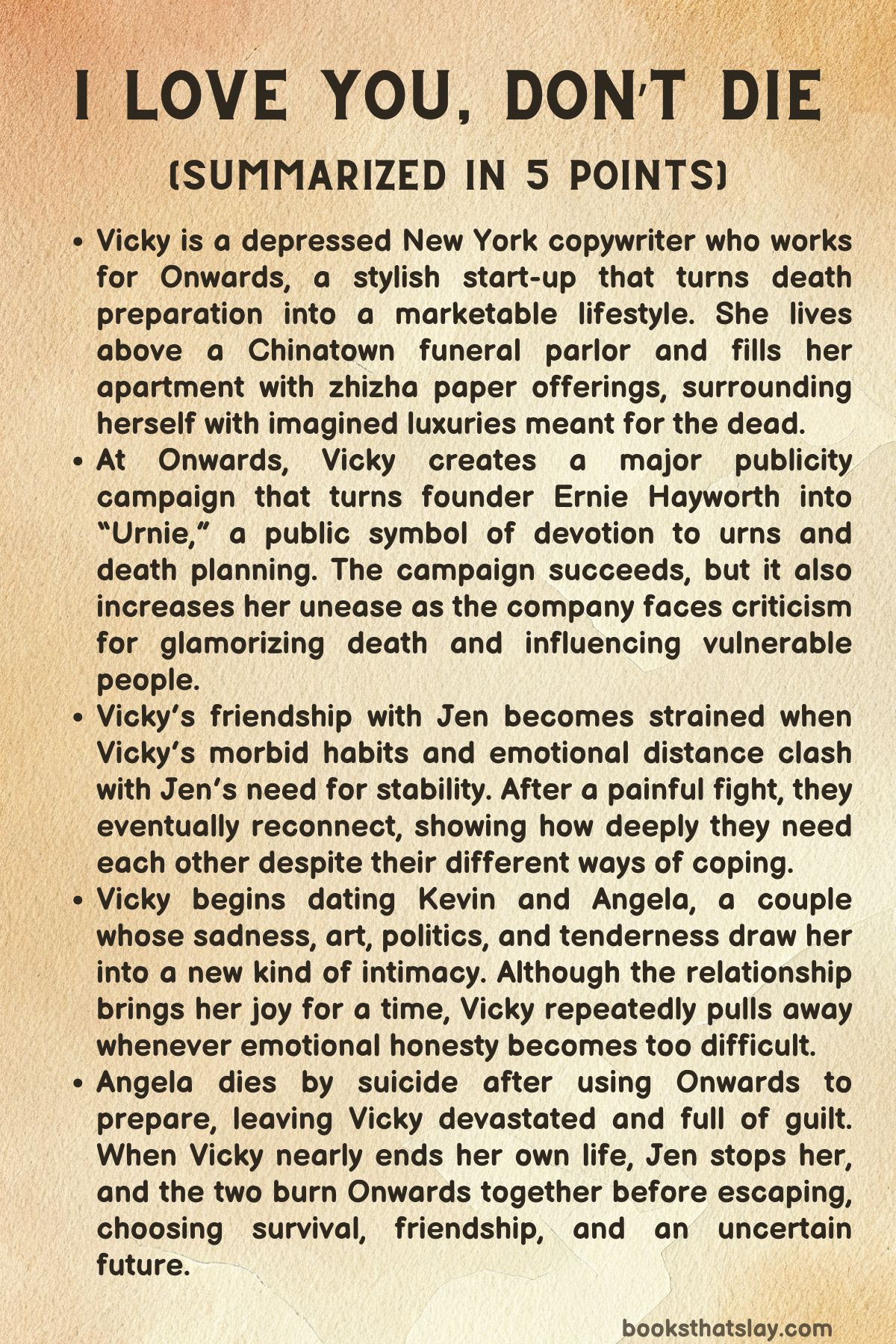
Vicky is a copywriter living in New York City, though much of her life happens from bed. She works remotely for Onwards, a stylish start-up that sells death preparation as if it were a lifestyle brand.
The company is founded by Ernie Hayworth, a famous and self-important public figure who has turned grief, burial, cremation, and remembrance into marketable products. Vicky’s job is to write words that make death sound elegant, modern, and desirable.
She is good at this work, but the better she becomes at it, the more uneasy her role feels.
Vicky lives alone above a Chinatown funeral parlor, surrounded by zhizha, the paper offerings traditionally burned for the dead. Her apartment is full of paper versions of the things she cannot afford or cannot hold onto in real life: mansions, cars, food, luxury goods, electronics, and other symbols of comfort and status.
These objects make her home feel crowded, haunted, and strangely alive. They also show how deeply Vicky thinks about death.
She is depressed, isolated, and often more comfortable imagining the afterlife than facing the present.
Her closest connection is Jen, her best friend from college. Jen works in wellness advertising at Roller and has built a more stable life with her boyfriend, Eric.
Compared with Vicky, Jen seems organized, practical, and closer to what society would call normal. Still, their friendship is intimate and long-standing.
They know each other’s habits, jokes, weaknesses, and old patterns. Yet even this relationship is fragile.
Jen is under pressure at work and terrified of layoffs, while Vicky often responds to ordinary situations with thoughts about death, burial, and decay.
At Onwards, Vicky is assigned a major campaign centered on Ernie. She comes up with a strange but memorable idea: Ernie should publicly change his name to “Urnie” to prove his devotion to urns and death preparation.
The idea sounds absurd, but in the world of Onwards, absurdity can become branding. The campaign is staged outside the Marble Cemetery, where Ernie gives a dramatic speech about death, grief, transformation, and rebirth.
He announces himself as Urnie, and the event becomes a publicity success. Vicky receives professional credit, but success only brings her more work and more responsibility.
Her boss, Dan, pushes her toward more identity-based campaigns. One of these is an LGBTQ+ campaign meant to improve Onwards’ public image and answer criticism that the company glamorizes death.
Some people believe Onwards may be influencing vulnerable young people by making death seem beautiful, prepared, and even aspirational. Vicky understands the criticism more than she wants to admit.
She knows the company is selling a fantasy of control over death, and she knows she is helping shape that fantasy.
Outside work, Vicky and Jen begin to strain against each other. During one of Jen’s photoshoots for Roller in Fort Greene Park, Vicky arrives late and does not wear the sample clothes Jen had given her.
Instead of supporting Jen in the way Jen needs, Vicky talks about the park’s burial history. Jen, already anxious and overwhelmed, snaps.
She asks why Vicky cannot simply be normal. The comment hurts because it names something Vicky already fears about herself.
Vicky leaves angry and wounded.
After the fight, both women retreat into pride and sadness. They miss each other, but neither reaches out right away.
Their silence shows how much they rely on each other and how hard it is for either of them to admit need. Eventually Jen comes to Vicky’s apartment.
They smoke together, soften toward each other, and apologize in their indirect way. The reconciliation does not fix everything, but it restores the old closeness between them.
Jen remains one of Vicky’s strongest ties to life.
Vicky also begins a new romantic relationship after matching with a couple, Kevin and Angela, on an app. Their first date takes place in Green-Wood Cemetery, a setting that suits Vicky’s interests and emotional state.
Kevin is an artist, curious and attentive, while Angela is intense, sad, politically engaged, and emotionally open in a way that both attracts and frightens Vicky. Vicky feels drawn to Angela’s sorrow and to Kevin’s creative gentleness.
The relationship soon grows more physical and intimate after Vicky meets them again at a queer dance party and goes home with them.
For a time, this relationship makes Vicky’s life feel larger. She has Jen and Eric, Kevin and Angela, karaoke nights, dinners, parties, sex, work success, and moments when happiness seems possible.
These moments matter because they show that Vicky is not beyond connection. She can laugh, desire, create, and belong.
Yet she repeatedly pulls away whenever closeness requires honesty or care. She enjoys being wanted but struggles with being responsible to others.
When emotional demands become too heavy, her instinct is to disappear.
Angela, in particular, needs more from Vicky than Vicky knows how to give. Angela is vulnerable and often depressed.
She cares about politics, suffering, and the pain of the world, but she is also fighting private despair. Kevin loves Angela, yet he also needs room for his art and his own life.
Vicky enters their relationship as both comfort and complication. She brings tenderness, but she also brings avoidance.
At an Onwards party, Vicky’s discomfort with her work becomes harder to ignore. She is surrounded by the company’s polished emptiness, Urnie’s influence, and the realization that she has helped make death attractive and consumable.
The party exposes the moral rot beneath the brand’s style. On the rooftop, she has a painful disagreement with Angela.
Instead of staying and speaking honestly, Vicky leaves. This becomes another example of her pattern: when a person asks her to be present, she chooses escape.
Afterward, Vicky withdraws from Kevin and Angela. Kevin leaves for an artist residency and asks Vicky to spend time with Angela while he is gone, knowing Angela has been struggling.
Vicky does not fully accept the responsibility. She becomes absorbed in work, numbness, and her own depression.
She avoids Angela even though she knows Angela needs care. This avoidance is not cruel in a simple way, but it has consequences.
Vicky’s inability to remain present becomes one of the story’s central wounds.
Eventually Vicky visits a museum exhibition about death. Surrounded again by objects and ideas connected to mortality, she begins to understand something about herself.
She texts Angela an apology and admits that she thinks about death constantly. She also says she wants to stop leaving people.
It is a rare moment of direct honesty from Vicky, a sign that she may be ready to change. But the reply does not come from Angela.
It comes from Kevin, who tells Vicky they need to talk.
Kevin meets Vicky and gives her a letter from Angela. Angela has died by suicide.
In her farewell note, Angela explains that Onwards helped her prepare for death. She chose the Lucy urn because Vicky once said it was her favorite.
Angela also writes that she thought about burning Vicky’s zhizha self so they could be together in the afterlife, but she returned it instead because she wanted Vicky to live. The letter devastates Vicky.
It combines love, accusation, tenderness, and finality in a way she cannot escape.
Vicky blames herself for failing Angela. She also blames Onwards for creating a system that made death feel organized, elegant, and available.
Angela’s death forces Vicky to confront the real harm behind the company’s beautiful language. What had once seemed strange, clever, or ironic now feels dangerous.
Vicky’s work has helped sell death to people who may already be close to the edge.
Overwhelmed by guilt and despair, Vicky sends Jen a goodbye text. She asks Jen to burn all her zhizha offerings, as though preparing herself for the afterlife.
Then she goes to the Onwards rooftop intending to jump. In this moment, Vicky is caught between the pull of death and the small, stubborn bonds that still connect her to the living.
Jen arrives in time. She stops Vicky from jumping, not with perfect words or easy answers, but by being there.
Her presence interrupts Vicky’s isolation. Instead of ending her life, Vicky turns her pain outward against Onwards.
She starts a fire inside the building. The act is reckless and terrifying, but it is also a rejection of the company’s power over death, grief, and vulnerable people.
Vicky and Jen escape together and watch Onwards burn. They are frightened by what they have done, but they are also holding onto each other.
The ending does not pretend that grief, guilt, or depression have vanished. Angela is still dead, Vicky is still damaged, and the future is uncertain.
Yet the final movement is away from surrender and toward life. Vicky chooses connection over disappearance.
With Jen beside her, she runs toward whatever comes next, carrying love, fear, responsibility, and the possibility of staying alive.
Characters
Vicky
Vicky is the central character of I Love You, Don’t Die, and she is presented as a deeply lonely, emotionally exhausted woman whose life is shaped by depression, avoidance, grief, and a constant closeness to death. She works as a copywriter from bed, which immediately shows how detached she has become from ordinary routines, physical movement, and social life.
Her apartment above a Chinatown funeral parlor reflects her inner world: it is filled with zhizha, paper offerings for the dead, including paper mansions, cars, food, electronics, and luxuries she cannot afford in real life. These objects reveal both her fascination with death and her dissatisfaction with the life she is living.
Vicky does not simply think about death in an abstract way; she surrounds herself with symbols of it, turning her home into a strange, beautiful, and disturbing space where fantasy, mourning, consumer desire, and self-erasure all exist together.
Vicky’s work at Onwards makes her inner conflict even sharper. She is talented, imaginative, and capable of producing bold ideas, as seen through her campaign that transforms Ernie Hayworth into “Urnie.” Her creativity brings success, but it also traps her more deeply inside a company that turns death into a fashionable product.
Vicky understands the emotional power of death, grief, and longing, which is why she is so good at selling them. At the same time, this talent becomes morally painful because she begins to recognize that her work may be helping a company glamorize death for vulnerable people.
Her professional success therefore does not bring stability or pride. Instead, it increases her guilt, pressure, and alienation.
She is both a victim of Onwards’ culture and one of the people helping to strengthen it.
In her personal relationships, Vicky often longs for intimacy but struggles to remain present when intimacy becomes difficult. Her friendship with Jen is one of the strongest emotional bonds in the book, yet Vicky still hurts Jen through lateness, emotional distance, and an inability to act normally in situations where Jen needs support.
With Kevin and Angela, Vicky briefly experiences tenderness, desire, excitement, and belonging. However, when Angela’s sadness and vulnerability demand real responsibility, Vicky withdraws.
This pattern shows that Vicky does not lack love; rather, she is frightened by the demands of love. She wants closeness, but she often escapes when closeness requires honesty, care, or emotional labor.
Vicky’s lowest point comes after Angela’s death, when grief and guilt push her toward suicide. Her decision to text Jen goodbye and go to the Onwards rooftop shows how completely she has internalized the same death-centered logic that the company profits from.
Yet her survival also becomes one of the most important parts of her character arc. Jen’s arrival interrupts Vicky’s attempt to disappear, and the fire at Onwards becomes a destructive but symbolic rejection of the system that has fed her despair.
By the end, Vicky is not magically healed, but she chooses movement, connection, and life over numbness and death. Her character is tragic, flawed, intelligent, and emotionally complex because the story does not present her as simply broken or saved.
Instead, it shows her as someone fighting to remain alive in a world that has repeatedly taught her to turn suffering into something private, marketable, or beautiful.
Jen
Jen is Vicky’s best friend from college and one of the most emotionally important characters in the story. She works in wellness advertising at Roller and appears, at first, to have a more stable life than Vicky.
She has a job, a boyfriend named Eric, and a clearer connection to the ordinary social world. However, Jen is not simply a symbol of normalcy.
She is also anxious, pressured, and afraid, especially because of the layoffs threatening her workplace. Her fear of professional instability helps explain why she becomes so upset during the photoshoot in Fort Greene Park.
In that moment, Vicky’s lateness, refusal to wear the sample clothes, and comments about burial history feel to Jen like another reminder that Vicky cannot or will not participate in the world Jen is trying so hard to survive in.
Jen’s conflict with Vicky reveals the strain that depression and emotional imbalance can place on friendship. When Jen asks why Vicky cannot be normal, the question is cruel, but it comes from exhaustion as much as anger.
Jen loves Vicky, yet she is tired of managing the unpredictability of their relationship. She wants Vicky to show up, to cooperate, and to understand that Jen’s life also contains fear and pressure.
This makes Jen a realistic character because she is neither perfectly patient nor selfish. She can hurt Vicky, but she is also one of the few people who truly sees her and continues to care.
The reconciliation between Jen and Vicky is understated but meaningful. Jen comes over, they smoke, and they apologize indirectly rather than through a dramatic emotional speech.
This reflects the rhythm of a long friendship where both people understand each other’s silences, flaws, and defensive habits. Jen’s love is not idealized; it is messy, familiar, and sometimes resentful, but it is also durable.
She represents the kind of connection that survives conflict because it has been built over years of shared history.
Jen becomes especially important at the end of the book because she is the person who saves Vicky from jumping. Her arrival at the Onwards rooftop shows that their friendship is not merely background support but a life-saving force.
Unlike Onwards, which turns death into branding, Jen responds to Vicky’s despair with action, presence, and love. She does not offer a perfect solution, but she refuses to let Vicky disappear.
By escaping with Vicky after the fire, Jen becomes part of the story’s final movement toward survival. She represents the imperfect but essential human bond that can pull someone back from the edge.
Angela
Angela is one of the most tragic and emotionally intense figures in the book. She enters Vicky’s life as part of a couple with Kevin, but she quickly becomes much more than one side of that relationship.
Angela is vulnerable, politically aware, passionate, depressed, and deeply affected by the pain of being alive. Vicky is drawn to her sadness, which suggests that Vicky recognizes something familiar in Angela.
Their connection is powerful because it is based not only on attraction but also on a shared intimacy with despair. Angela’s emotional intensity makes her magnetic, but it also makes her fragile.
Angela’s relationship with Vicky exposes both the beauty and danger of being seen through sadness. Vicky feels connected to Angela’s pain, but she does not fully know how to care for it.
Angela needs attention, honesty, and emotional responsibility, while Vicky often responds to difficulty by withdrawing. This creates a painful imbalance.
Angela becomes attached to Vicky in a way that is tender but also frightening, especially because Vicky’s avoidance leaves Angela alone at moments when she most needs connection. Their bond is therefore not simply romantic or sexual; it is also haunted by emotional dependency, missed responsibility, and the limits of what one wounded person can provide for another.
Angela’s suicide is the emotional turning point of the story. Her farewell letter reveals that Onwards helped her prepare for death and that she chose the Lucy urn because Vicky once said it was her favorite.
This detail is devastating because it shows how deeply Angela absorbed Vicky’s words and how closely love, death, and consumer choice have become entangled. Angela’s consideration of burning Vicky’s zhizha self so they could be together in the afterlife shows the extremity of her longing, but her decision to return it because she wanted Vicky to live reveals that her final act is not simple possession.
Even in death, Angela expresses a complicated love that wants closeness but also wants Vicky’s survival.
Angela’s character shows the human cost of a culture that aestheticizes death without truly caring for the living. She is not treated as merely a plot device; she represents a person whose pain is real, whose love is real, and whose vulnerability is dangerously met by a company willing to package death as preparation, empowerment, or style.
Her death forces Vicky to confront the consequences of avoidance, emotional numbness, and her work at Onwards. Angela remains one of the most haunting characters because her presence continues to shape the story even after she is gone.
Kevin
Kevin is Angela’s boyfriend and Vicky’s other romantic partner in the couple’s relationship. He is an artist, and his character brings a quieter, more reflective energy into the story.
Kevin loves Angela, but he also wants space for his work, which makes him a figure caught between devotion and personal ambition. His artistic identity matters because it separates him from the corporate world of Onwards and Roller.
He is interested in creation rather than advertising, but he is still not free from emotional complications. Like Vicky, he is connected to Angela but cannot fully save her.
Kevin’s relationship with Vicky is tender and curious, especially at the beginning. During their first date in Green-Wood Cemetery, he responds to the setting with artistic interest rather than discomfort.
This helps create the unusual emotional atmosphere that allows Vicky to feel seen. Kevin is open to unconventional forms of intimacy, and his relationship with Angela is flexible enough to include Vicky.
However, that openness does not mean the relationship is simple. Kevin’s love for Angela remains central, and Vicky’s presence complicates the emotional balance between all three of them.
Kevin’s decision to leave for an artist residency is important because it reveals both his need for independence and his trust in Vicky. When he asks Vicky to spend time with Angela, he is not merely making a casual request.
He understands that Angela is struggling, and he expects Vicky to show up for her. Vicky’s failure to do so becomes one of the key moral failures of the story.
Kevin’s absence therefore exposes the fragility of the relationship between Vicky and Angela, while also showing the burden Kevin has carried as someone who loves a deeply depressed person.
After Angela’s death, Kevin becomes the messenger of grief. He brings Vicky Angela’s letter, forcing her to face what has happened and what her own role may have been.
His presence in this moment is restrained but devastating. He does not need to accuse Vicky directly because the letter itself carries the emotional weight.
Kevin’s character represents love mixed with helplessness. He cares for Angela, but he cannot prevent her death.
He trusts Vicky, but that trust is broken by Vicky’s avoidance. Through Kevin, the book shows how grief spreads through the people left behind, especially when love has been complicated by silence, absence, and guilt.
Ernie Hayworth / Urnie
Ernie Hayworth, later publicly renamed Urnie, is the celebrity founder of Onwards and one of the most important symbols of the story’s critique of death as a marketable lifestyle. As Ernie, he already possesses fame, charisma, and cultural power.
As Urnie, he becomes a manufactured icon of death preparation, turning even his own identity into a branding opportunity. Vicky’s campaign works because Ernie is willing to transform himself into a spectacle.
His dramatic speech outside the Marble Cemetery about death, grief, and rebirth shows how easily sincere human emotions can be converted into performance.
Urnie is not simply a comic or absurd figure. He represents the dangerous charm of companies that use emotional language to sell products connected to vulnerability.
He speaks about grief and mortality in a way that sounds profound, but the purpose is publicity. His public transformation gives Onwards enormous attention, and the campaign’s success places more pressure on Vicky to continue producing identity-based and emotionally charged marketing.
In this sense, Urnie benefits from the creative and emotional labor of people like Vicky while remaining above the consequences.
His power becomes especially disturbing because Onwards is criticized for glamorizing death and possibly influencing vulnerable people. Rather than responding with genuine accountability, the company turns to more campaigns, including one centered on LGBTQ+ identity, to manage its image.
Urnie’s leadership is therefore tied to a broader culture of corporate manipulation. He stands for a world where even criticism can become a marketing problem to be solved, rather than a moral warning to be taken seriously.
By the end of the story, Urnie’s company becomes the physical target of Vicky’s rage and despair. The fire at Onwards is not only an attack on a building; it is a rejection of the world Urnie has helped create.
He represents the seductive emptiness of branding that uses death, grief, identity, and rebirth as aesthetic materials. His character is important because he shows how dangerous charisma can become when it is joined with capitalism and emotional exploitation.
Dan
Dan is Vicky’s boss at Onwards, and his role is important because he represents the ordinary managerial machinery behind the company’s disturbing glamour. He is not as publicly visible as Urnie, but he helps translate Onwards’ values into daily workplace demands.
After Vicky’s successful campaign, Dan gives her more responsibility and pushes her toward additional identity-based marketing work. This shows that he views Vicky’s creativity primarily as a resource to be used for the company’s growth.
Dan’s character is unsettling because he does not need to be openly cruel to be harmful. He functions like many corporate managers: he identifies what works, increases pressure, and treats ethical discomfort as secondary to strategy.
When Onwards faces criticism for glamorizing death, Dan’s response is not moral reflection but brand management. The LGBTQ+ campaign he assigns to Vicky is meant partly to counter criticism, which reveals how identity can be used by corporations as a shield against accountability.
Through Dan, the book shows how harmful systems depend not only on visionary founders like Urnie but also on practical enforcers who keep the work moving. Dan may not be the face of Onwards, but he helps maintain the environment that pushes Vicky deeper into guilt and numbness.
He is important because he shows that exploitation often arrives through ordinary professional language: assignments, campaigns, opportunities, and expectations.
Dan also intensifies Vicky’s internal conflict. His praise and pressure make it harder for her to step away from work that is damaging her.
He recognizes her talent, but he does not recognize her pain. This makes him a symbol of a workplace that extracts creativity from emotionally vulnerable people while ignoring the emotional cost of that extraction.
Eric
Eric is Jen’s stable boyfriend, and although he is not as central as Vicky, Jen, Angela, or Kevin, he plays an important supporting role. He represents a more conventional form of adulthood and stability.
Through his relationship with Jen, the story shows a life that appears more grounded than Vicky’s: partnership, routine, and emotional steadiness. His presence helps highlight the contrast between Jen’s attempts at normalcy and Vicky’s more chaotic, death-saturated existence.
Eric is important because he forms part of the social world Vicky sometimes joins when her life briefly feels fuller. Dinners, karaoke, parties, and shared moments with Jen and Eric give Vicky glimpses of ordinary happiness.
These scenes matter because they show that Vicky is not incapable of joy. She can participate in friendship, humor, and community, even if she often retreats afterward.
Eric’s presence helps make that world feel more complete.
At the same time, Eric’s stability can also make Vicky’s instability more visible. He belongs naturally to Jen’s life in a way Vicky sometimes does not.
This does not make him an antagonist, but it does place him within the emotional tension between Jen’s desire for a functional life and Vicky’s inability to consistently inhabit one. Eric helps define what Jen is trying to protect: a future, a relationship, and a version of adulthood that is not ruled by crisis.
Eric’s role is quieter than the others, but he contributes to the emotional texture of the book. He stands for the ordinary connections surrounding the central characters, the kind of life that continues alongside depression, grief, and corporate absurdity.
His importance lies less in personal transformation and more in what he reveals about Jen’s world and Vicky’s distance from it.
Themes
Death as a Marketable Product
In I Love You, Don’t Die, death is not treated only as a private fear or spiritual mystery; it becomes a business opportunity shaped by branding, celebrity, and consumer desire. Onwards turns grief, preparation, and mortality into stylish products that can be advertised, purchased, and displayed.
Vicky’s work shows how language can soften something frightening until it becomes fashionable. Her “Urnie” campaign succeeds because it makes death feel bold, clever, and aspirational rather than painful.
This success is disturbing because it reveals how easily emotional vulnerability can be converted into profit. The company claims to help people face death, but its methods often glamorize it, especially for people who are already fragile.
Angela’s use of Onwards before her suicide exposes the danger of making death feel organized, aesthetic, and accessible without offering real care. The theme criticizes a culture where even grief and despair can be packaged, sold, and celebrated.
Depression and Emotional Avoidance
Vicky’s depression appears not only through sadness but through numbness, withdrawal, and the habit of leaving difficult moments unresolved. She works from bed, lives among objects meant for the dead, and repeatedly turns away from people when they ask for emotional honesty.
Her fascination with death gives her language for her pain, but it also helps her avoid confronting her need for help. When conflict arises with Jen, Angela, or Kevin, Vicky often retreats instead of explaining herself.
This avoidance creates distance even when love is present. The novel presents depression as something that distorts responsibility and connection: Vicky wants closeness, but closeness demands presence, and presence feels unbearable to her.
Angela’s death forces Vicky to face the consequences of absence, though the story does not reduce suicide to one person’s failure. Instead, it shows how silence, shame, and emotional paralysis can make suffering more dangerous when people are unable to ask for or offer care clearly.
Friendship as Survival
Jen and Vicky’s friendship becomes one of the strongest forms of protection in the story, even when it is strained by anger, fear, and misunderstanding. Their bond is imperfect because both women carry their own insecurities.
Jen wants stability and normalcy, while Vicky often brings death, discomfort, and disorder into everyday life. Their fight shows how friendship can become painful when one person feels judged and the other feels helpless.
Yet their reconciliation matters because it is not dramatic or perfectly spoken; it grows through familiarity, shared habits, and the comfort of being known. Jen understands Vicky in a way no company, romance, or public performance can.
At the end, her arrival on the rooftop becomes an act of life-saving love. She does not solve Vicky’s depression with advice or perfect words, but she interrupts the final moment of isolation.
The story suggests that survival often depends on one person refusing to let another disappear alone.
The Desire to Live Despite Despair
The ending does not present life as suddenly easy or healed. Instead, it shows the desire to live as fragile, messy, and chosen in a moment of terror.
Vicky reaches the rooftop believing death may be the only answer to guilt, grief, and emptiness. Angela’s death has made her feel responsible, while Onwards has made death seem both near and strangely available.
Yet Jen’s intervention changes the direction of the moment. Vicky’s decision to burn the company rather than herself becomes symbolic: she turns her rage outward against a system that made death attractive and profitable.
This act is dangerous and morally complicated, but emotionally it marks a refusal to vanish. Running away with Jen does not erase loss, depression, or guilt.
It simply proves that Vicky has not fully surrendered to death. The final movement toward life is uncertain, but that uncertainty is the point.
Living is not shown as purity or peace, but as continuing anyway.