Just Friends Summary, Characters and Themes | Haley Pham
Just Friends by Haley Pham is a second-chance romance about love, grief, fear, and the courage it takes to choose a life that feels true. The novel follows Blair Lang, a recent college graduate who returns to her seaside hometown of Seabrook, California, when her great-aunt Lottie enters hospice care.
Back home, Blair is forced to face old wounds, including her unfinished history with Declan Renshaw, her childhood best friend and first love. As Blair mourns, reconsiders her future, and slowly reconnects with Declan, Just Friends explores how people heal from loss, misunderstanding, and the choices they once made out of fear.
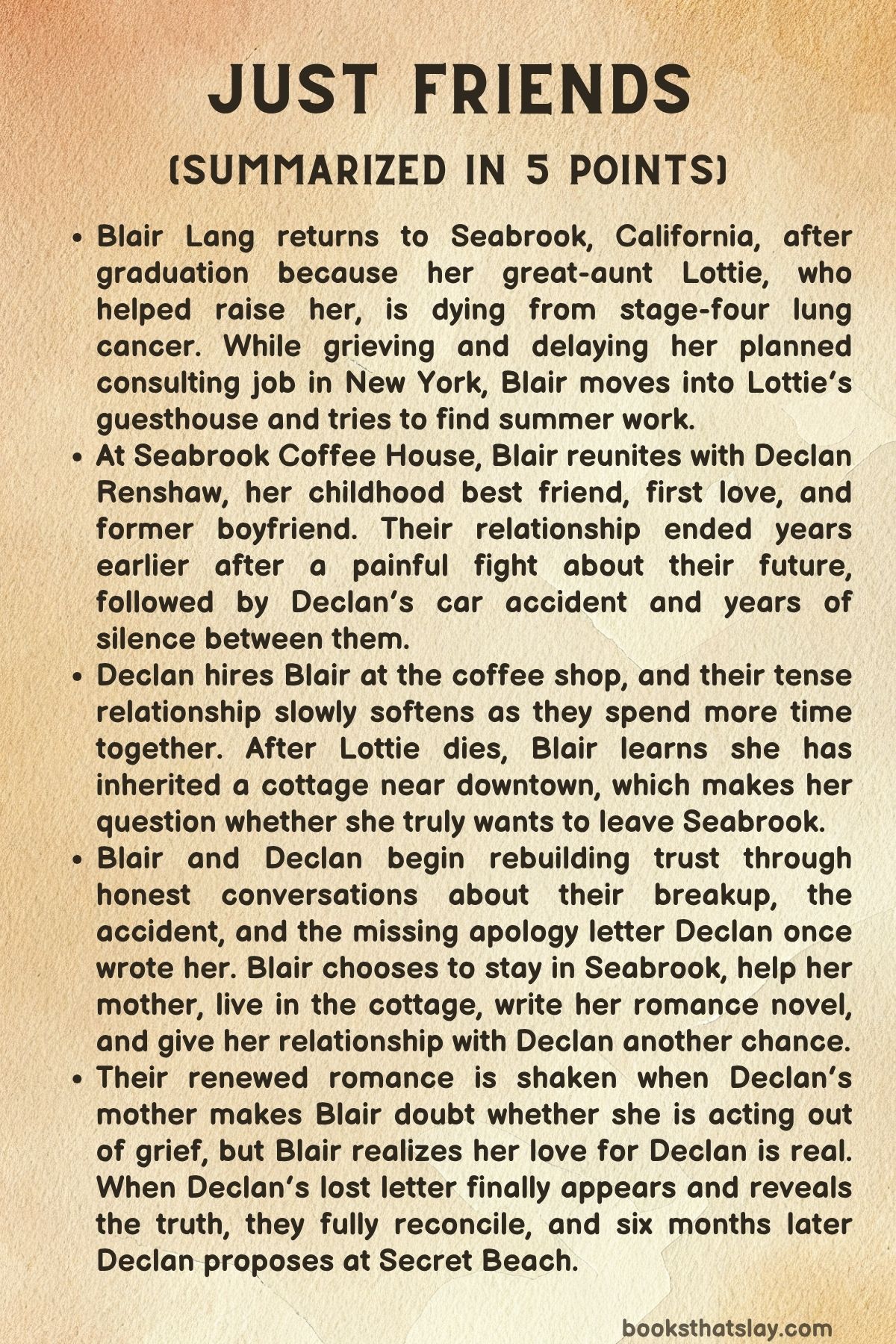
Summary
Blair Lang returns to Seabrook, California, after graduating from Pepperdine, but her homecoming is not the joyful kind. Her great-aunt Lottie, who has been one of the most important people in her life, is dying from stage-four lung cancer and has entered at-home hospice care.
For Blair, Lottie is far more than a relative. When Blair was five, she and her mother escaped Blair’s abusive father, and Lottie helped them rebuild their lives.
She gave them safety, stability, work, and love. Because of that, Blair sees Lottie almost as a second mother.
When Blair arrives, she finds Lottie fragile and confined to a hospital bed, though still warm, loving, and determined not to let Blair spend the entire summer sitting beside her in sorrow. Blair moves into the guesthouse, delays the consulting job she was supposed to begin in New York, and tries to find temporary work in town.
She wants to be useful, but she is also afraid of what life will look like without Lottie.
Her search for work takes her to Seabrook Coffee House, where she unexpectedly comes face-to-face with Declan Renshaw. Declan was once her childhood best friend, her first love, and the boy who knew her better than anyone.
They have not spoken in four years. Now he manages the coffee shop, though Blair later learns he owns it.
He also walks with a limp, the result of the accident that ended the football career he once seemed destined to pursue.
Their reunion is tense because their past is still unresolved. Blair and Declan grew up inseparable.
Over the years, friendship turned into love. After a championship football game, they kissed, and during senior year they began dating.
Their relationship fell apart when Declan was accepted to Notre Dame and asked Blair to follow him there instead of attending Pepperdine on a full scholarship. Blair panicked.
She feared becoming dependent on him the way her mother had once depended on Blair’s father. Instead of explaining herself calmly, she left in anger.
That same night, after another championship win, Declan was hit by a car. Blair tried to visit him afterward, but he refused to see her.
Hurt and confused, she stayed away, and neither of them reached out again. Their silence stretched into years.
Despite the awkwardness, Declan hires Blair at the coffee shop. Working together forces them into each other’s lives again, even as Blair is dealing with Lottie’s decline.
Lottie’s condition worsens soon after Blair starts the job. She is placed on a morphine drip and does not wake again.
Blair lies beside her, holds her hand, thanks her for everything, and tells her she can rest. Lottie dies while Blair is beside her, leaving Blair devastated.
At Lottie’s funeral, Blair sees Declan, who has come to support her. His presence matters, even though things between them are still uncertain.
Their connection begins to soften. Declan admits he kept track of her through Instagram, and Blair learns that the woman she had believed was his girlfriend is actually his cousin.
This small truth removes one of the assumptions Blair had been carrying.
After Lottie’s death, Blair learns what Lottie left behind. Her mother receives the main house and Lottie’s seven convenience stores, while Blair inherits a small cottage near downtown Seabrook.
The cottage is beautiful, with a lavender garden, and it happens to be directly across the street from Declan’s house. Blair now faces a serious choice: she can sell or rent the cottage and leave for New York, or she can stay in Seabrook and build a different kind of future.
Blair has always believed her mother’s life was limited by staying in Seabrook and working for Lottie. But her mother explains that she never felt trapped.
She wanted independence, safety, and the chance to give Blair a stable childhood. She loved the life she built.
This changes Blair’s understanding of her past. It also makes her question whether the future she planned in New York is truly what she wants, or whether she chose it because she thought ambition had to look a certain way.
As Blair and Declan spend more time together, the distance between them begins to shrink. They work on renovations at the coffee shop, go bowling with coworkers, visit Blair’s cottage, and share meals.
Blair sees more of the life Declan has built since the accident. He tells her that his father sued the family of the negligent driver who hit him, and Declan used the settlement money to buy and renovate his house and later open the coffee shop.
He has created something meaningful from the wreckage of his lost football future.
Blair also learns that Declan made the whimsical birdhouses displayed in the shop, and she realizes he has kept memories of her close all these years. The old feelings between them are still there, but now they are mixed with pain, regret, and the question of whether they can trust each other again.
Eventually, Blair and Declan talk honestly about the accident and the long silence that followed. Declan reveals that he wrote Blair a letter after the accident.
In it, he apologized and asked to see her. When she never responded, he assumed she wanted to move on.
Blair is shocked because she never received the letter. This discovery makes them understand that their separation was not only caused by pride and fear, but also by a missing piece neither of them knew about.
Blair begins to choose Seabrook for herself. She decides to stay, live in the cottage, help her mother with the stores, and write the romance novel she has wanted to create.
This decision is not simply about Declan. It is about recognizing the kind of life she wants and accepting that staying does not mean failing.
It can mean choosing love, family, creativity, and belonging.
Blair and Declan admit they do not want to remain only friends. They begin again, this time with more honesty and caution.
Their relationship seems ready to grow into something steady, but another obstacle appears at a charity gala hosted by Declan’s father. Declan’s mother, Gwen, suggests that Blair may be using Declan as comfort while grieving Lottie.
The comment hits Blair’s deepest fears. She worries she may be repeating unhealthy patterns, leaning on Declan because she is lost rather than because she truly loves him.
Overwhelmed, Blair runs and asks Declan for space. Her friends Roshi and Faye come to Seabrook and help her sort through her emotions.
Through their support, Blair realizes that her love for Declan is real. Her grief may be part of her life, but it is not the reason she wants him.
She wants Declan because she loves him, because he knows her, and because the life she is choosing in Seabrook is truly her own.
Then the missing letter appears on Blair’s doorstep. The truth comes out: Gwen had taken Declan’s letter years earlier, believing she was protecting her son.
The letter shows Declan’s regret, love, and longing after the accident. Blair finally understands that he had tried to reach her, and Declan learns that she had never rejected him.
The misunderstanding that kept them apart was built on fear, pain, and interference.
Blair runs to Declan. They apologize fully, speak honestly, and confess their love.
This time, there is no hidden letter, no old assumption, and no silence standing between them. They choose each other with a clearer understanding of who they are and what they want.
Six months later, Blair has written her first book, and her mother has retired after selling the convenience stores. Blair’s life in Seabrook has become something she chose freely, not something she fell into.
Declan then proposes at Secret Beach, using a pebble, a hidden note, and a ring placed inside a birdhouse he made for her. The proposal reflects their history, their private memories, and the future they are ready to build.
Blair says yes, ending Just Friends with reconciliation, commitment, and a new beginning shaped by love and self-trust.
Characters
In Just Friends by Haley Pham, the characters are shaped by grief, old love, family wounds, independence, and the difficult process of forgiving the past. Each character plays an important role in Blair’s emotional journey, either by helping her understand herself more clearly or by forcing her to confront the fears she has carried for years.
Blair Lang
Blair Lang is the central character of the book, and her journey is deeply tied to grief, love, independence, and emotional healing. When she returns to Seabrook after graduating from Pepperdine, she is not simply coming home for a visit; she is returning to the place that holds both her safest memories and her most painful heartbreak.
Her great-aunt Lottie’s illness forces Blair to face the possibility of losing one of the most important people in her life. Blair’s love for Lottie reveals her tenderness and loyalty, especially because Lottie was more than a relative to her.
She was a second mother, a protector, and a steady figure during Blair’s childhood. Blair’s decision to postpone her consulting job in New York shows that, although she values ambition and independence, she is also emotionally devoted to the people who matter most to her.
Blair’s biggest internal conflict comes from her fear of depending on someone else. Because she grew up after escaping an abusive father, she associates emotional dependence with danger and loss of control.
This fear affected her relationship with Declan when they were younger. When Declan asked her to follow him to Notre Dame instead of taking her full scholarship to Pepperdine, Blair did not only hear a romantic request; she heard the possibility of becoming trapped in someone else’s life.
Her reaction came from fear, not lack of love. This makes Blair a complex character because her choices are understandable even when they cause pain.
She wants to protect herself from repeating her mother’s past, but in doing so, she also closes herself off from the person she loves.
Throughout the story, Blair slowly learns that independence does not have to mean isolation. Her mother’s explanation that she chose her own life and never felt trapped working for Lottie changes Blair’s understanding of her childhood.
Blair realizes that strength is not only found in leaving, achieving, or refusing help. It can also be found in staying, building a home, accepting love, and making choices from desire rather than fear.
Her decision to remain in Seabrook, live in the cottage, help with the stores, and write her romance novel marks a major transformation. She stops running toward a future that only proves she is independent and begins choosing a future that actually makes her happy.
Blair’s relationship with Declan is central to her emotional growth. At first, she is guarded around him because their past is unresolved and painful.
However, as they work together and spend time near each other again, Blair begins to see that their connection has not disappeared. Her love for Declan is not presented as a weakness, but as something she must learn to trust.
When Gwen suggests that Blair may be using Declan as comfort during grief, Blair panics because it touches her deepest insecurity: the fear that her feelings are unstable or dependent. Yet with the support of Roshi and Faye, Blair recognizes that her love for Declan is real.
By the end of the book, Blair becomes more emotionally honest, more open to love, and more confident in choosing a life rooted in both independence and connection.
Declan Renshaw
Declan Renshaw is one of the most emotionally significant characters in the book because he represents both Blair’s past and the possibility of a healed future. As Blair’s childhood best friend and first love, Declan carries years of shared memories with her.
Their bond began with friendship, grew into romance, and then broke apart through fear, misunderstanding, and tragedy. When Blair sees him again at Seabrook Coffee House, Declan is no longer simply the boy she once loved.
He is a man who has endured physical pain, emotional disappointment, and the loss of the football future he once expected. His limp is a visible reminder of the accident that changed his life, but his emotional restraint also shows how deeply the past affected him.
Declan’s character is marked by quiet resilience. After the accident ended his football career, he did not remain trapped in bitterness.
Instead, he used the settlement money to build a new life for himself. He bought and renovated his house, opened the coffee shop, and created a space filled with warmth and personal meaning.
The birdhouses he builds show his gentle, creative side. They also suggest that Declan is someone who finds beauty in small, handmade things.
His coffee shop is not just a business; it is a symbol of how he rebuilt himself after losing the future he thought he would have. This makes him a character defined not by what happened to him, but by what he chose to create afterward.
Declan’s love for Blair is patient, wounded, and enduring. Even though he was hurt by their breakup and by the years of silence, he never fully stopped caring about her.
His admission that he checked on her through Instagram shows that Blair remained important to him, even when they were apart. The lost letter reveals the depth of his regret and longing.
Declan had tried to apologize and reconnect, but because Gwen hid the letter, both he and Blair were left believing the other had chosen distance. This misunderstanding makes Declan’s pain more tragic because he was not indifferent; he was waiting for a response that never came.
Declan’s growth comes through his willingness to be vulnerable again. He could have protected himself by keeping Blair at a distance, especially after everything that happened between them, but he slowly allows their relationship to reopen.
He listens, apologizes, and gives Blair room when she asks for space, even though it hurts him. His love is not possessive.
By the end of the story, Declan’s proposal at Secret Beach reflects his romantic sincerity and his deep understanding of Blair. The pebble, hidden note, ring, and birdhouse all connect to their shared history and his careful attention to meaning.
Declan is a character whose strength lies in tenderness, loyalty, and the courage to love again after being hurt.
Great-Aunt Lottie
Great-aunt Lottie is one of the most loving and emotionally powerful figures in the book. Even though she dies early in the story, her influence continues to shape Blair’s decisions long after her death.
Lottie helped raise Blair and her mother after they escaped Blair’s abusive father, which makes her a figure of safety, stability, and unconditional love. For Blair, Lottie is not simply an older relative; she is a second mother.
Her home represents protection, memory, and belonging. Because of this, Lottie’s illness is especially painful for Blair.
Watching someone so central to her life become frail in hospice forces Blair to confront loss in a very intimate way.
Lottie’s character is gentle but strong. Even while dying, she does not want Blair to spend all her time grieving beside her bed.
This reveals her selflessness and emotional wisdom. She understands Blair’s love, but she also wants Blair to live.
Lottie’s final days show the tenderness between the two of them, especially when Blair lies beside her, thanks her, and tells her she can rest. That moment captures the depth of their bond.
Lottie’s death is heartbreaking because it represents the loss of one of Blair’s emotional anchors, but it also becomes the beginning of Blair’s deeper transformation.
Lottie’s legacy is practical as well as emotional. By leaving Blair the cottage near downtown, she gives Blair more than property.
She gives her a possible home, a place where Blair can imagine a different future. The cottage, with its lavender garden and its location across from Declan’s house, becomes a symbol of choice.
Blair can sell it, rent it, or live in it, and each option represents a different version of her future. Lottie’s gift quietly asks Blair to consider whether the life she planned is truly the life she wants.
In this way, Lottie continues guiding Blair even after death.
Lottie also represents the idea that family can be chosen through care, sacrifice, and presence. She stepped in when Blair and her mother needed safety, and she built a life that allowed them to heal.
Her role in the story reminds the reader that love does not disappear after a person dies. It remains through memory, inheritance, values, and the choices the living make because of that love.
Lottie’s presence is brief in the active events of the story, but her emotional importance is lasting and central.
Blair’s Mother
Blair’s mother is an important character because she helps reshape Blair’s understanding of the past. For much of Blair’s life, Blair seems to believe that her mother’s dependence on others after leaving an abusive marriage was something to fear or avoid repeating.
This belief affects Blair’s own relationships, especially with Declan. Blair wants to be independent because she thinks dependence can lead to being trapped.
However, her mother’s explanation changes this view. She tells Blair that she never felt trapped working for Lottie and that she wanted to build an independent life for her daughter.
This conversation is essential because it helps Blair separate her fears from the truth.
Blair’s mother is a survivor. She fled an abusive relationship when Blair was young, which required courage and strength.
Her decision to leave Blair’s father protected both herself and her child. She then built a new life with Lottie’s support, showing that accepting help does not make someone weak.
Her character challenges Blair’s mistaken belief that independence means never relying on anyone. Instead, Blair’s mother shows that independence can grow from support, community, and wise choices.
Her life proves that receiving help and building one’s own strength can exist together.
She is also a loving mother who wants Blair to understand the truth rather than live under a distorted version of the past. Her explanation is not defensive; it is clarifying.
She helps Blair see that her childhood was not a story of helpless dependence, but of rebuilding. This allows Blair to reconsider her own future.
When Blair chooses to stay in Seabrook and help with the stores, it is partly because her mother’s words have freed her from the fear that staying means surrendering independence.
By the end of the story, Blair’s mother also experiences her own transition. After inheriting the main house and the convenience stores, she eventually retires after selling the stores.
This suggests that she, too, is moving into a new stage of life. Her role in the book is quiet but deeply meaningful because she helps Blair understand that the past does not have to control the future.
Through her, the story presents survival not only as escape from harm, but also as the ability to create peace afterward.
Gwen Renshaw
Gwen Renshaw, Declan’s mother, is one of the more complicated characters in the story because her actions cause significant pain while coming from what she believes is protection. Years earlier, she secretly took Declan’s letter to Blair, preventing Blair from receiving his apology and his request to reconnect.
This choice prolonged the separation between Blair and Declan and allowed both of them to believe that the other had moved on. Gwen’s decision is harmful because it interferes with their ability to choose for themselves.
She takes control of a situation that belongs to them, and her interference becomes one of the major reasons their misunderstanding lasts for years.
Gwen’s behavior at the charity gala shows that she still views Blair with suspicion. When she suggests that Blair may be using Declan for comfort during grief, she triggers Blair’s insecurities and causes her to run.
Gwen’s words are damaging because they attack the sincerity of Blair’s feelings at a vulnerable time. Blair is already grieving Lottie and trying to understand her future, so Gwen’s accusation pushes her into fear.
This moment shows how Gwen’s protectiveness can become controlling and emotionally harmful.
At the same time, Gwen is not a simple villain. Her actions seem rooted in fear for Declan’s well-being.
After Declan’s accident and heartbreak, she likely wanted to shield him from more pain. However, the book shows that protection becomes destructive when it denies others honesty and choice.
Gwen’s mistake is believing that she knows what is best for Declan better than he does. In trying to protect him, she prevents him from healing properly and keeps him separated from someone he deeply loves.
Gwen’s character adds tension to the story because she represents outside interference in a relationship that already carries internal wounds. Blair and Declan must overcome not only their own fears and misunderstandings, but also the damage caused by Gwen’s secrecy.
Her role emphasizes the importance of honesty in love and family. Even well-intentioned actions can become harmful when they are built on control rather than trust.
Declan’s Father
Declan’s father is a less central but still important character because his actions help explain how Declan was able to rebuild his life after the accident. After Declan was hit by a car, his father sued the negligent driver’s family.
The settlement money became the foundation for Declan’s future, allowing him to buy and renovate his house and eventually open Seabrook Coffee House. This makes Declan’s father part of the practical aftermath of the accident.
Through him, the story shows how one tragic event changed Declan’s life but also created the means for a different path.
His decision to pursue legal action suggests a protective and determined side. He wanted accountability for what happened to Declan, and his actions helped secure some form of compensation after a life-changing injury.
While money could not restore Declan’s football career or undo his pain, it gave Declan resources to begin again. This makes Declan’s father indirectly connected to Declan’s resilience and independence.
The charity gala also places Declan’s family within a world of status, public appearances, and social expectations. This setting contrasts with the warmth of the coffee shop and the intimacy of Blair and Declan’s relationship.
Declan’s father is not explored as deeply as Gwen, but his presence helps build the background of Declan’s family and the world Declan comes from. He is part of the structure around Declan, even if he is not the emotional focus of the story.
Overall, Declan’s father functions as a supporting character whose influence is felt through consequences rather than direct emotional scenes. His legal action shapes Declan’s adult life, and his family environment helps create some of the pressure surrounding Blair and Declan’s reunion.
His role is smaller, but it adds context to Declan’s recovery and the life he builds after losing football.
Roshi
Roshi is one of Blair’s supportive friends and plays an important role when Blair becomes emotionally overwhelmed. After Gwen suggests that Blair may be using Declan as comfort during grief, Blair begins to doubt herself and asks Declan for space.
Roshi’s arrival in Seabrook, along with Faye, gives Blair the outside perspective she needs. Roshi helps Blair examine her feelings honestly instead of letting fear make the decision for her.
This makes Roshi an important grounding presence in the book.
Roshi represents friendship that is active, loyal, and emotionally clear. She does not simply comfort Blair in a shallow way; she helps Blair recognize the truth of her own heart.
Blair is vulnerable to overthinking because she has a long history of associating love with dependence and risk. Roshi helps interrupt that pattern.
Her presence reminds Blair that she does not have to process grief, romance, and fear alone.
Roshi also helps show that Blair has built meaningful relationships outside Seabrook. Even though much of the story focuses on Blair’s return home, Roshi’s friendship connects Blair to the wider life she has lived.
This matters because Blair’s choice to stay in Seabrook is not a retreat from the world. It is a decision made after considering who she is and what she wants.
Friends like Roshi help make that decision clearer.
As a supporting character, Roshi’s main purpose is to help Blair move from confusion toward emotional honesty. She strengthens the story by showing the value of friendship during moments of romantic uncertainty.
Her role proves that love stories are not only shaped by the couple involved, but also by the friends who help them see themselves clearly.
Faye
Faye, like Roshi, is an important friend to Blair and helps her during one of the most emotionally uncertain moments in the story. When Blair runs from Declan after Gwen’s accusation, Faye comes to Seabrook and helps Blair understand that her love for Declan is genuine.
Faye’s role is supportive, but it is also meaningful because she helps Blair separate fear from truth. Blair is afraid that grief may be clouding her judgment, but Faye helps her see that her feelings for Declan existed long before Lottie’s death.
Faye represents the kind of friendship that offers emotional steadiness. She helps Blair avoid making a permanent decision based on panic.
Blair’s instinct, when frightened, is often to create distance. This is what happened years earlier when Declan asked her to follow him to Notre Dame, and it happens again after Gwen’s comment.
Faye’s presence helps Blair break that cycle. Instead of running from love, Blair learns to question the fear behind her impulse to leave.
Faye also adds warmth to the story because her friendship with Blair shows that Blair is cared for beyond her family and romantic relationship. Her support makes Blair’s emotional world feel fuller.
Faye and Roshi together function as a reminder that healing often requires honest conversations with people who know us well. They help Blair return to Declan not out of pressure, but out of clarity.
Faye’s role may not be as central as Blair’s or Declan’s, but it is still important to the emotional structure of Just Friends. She helps Blair reach the realization that her love is not simply a reaction to loss.
Through Faye, the story emphasizes that good friends can help a person find courage when fear makes the truth difficult to see.
Blair’s Father
Blair’s father is not physically central in the present events of the story, but his influence is deeply important because of the lasting damage he caused. He was abusive, and Blair’s mother fled from him when Blair was five.
This part of Blair’s childhood shapes the way she understands love, dependence, and safety. Even though he is not active in Blair’s adult life, the fear created by his abuse continues to affect her choices.
His role in the book is mainly psychological. Because of him, Blair grows up associating dependence with danger.
She sees what happened to her mother and becomes determined never to lose control of her own life. This fear is one of the reasons she reacts so strongly when Declan asks her to follow him to Notre Dame.
She does not want to become someone who gives up her own path for a relationship. In that sense, Blair’s father’s harm echoes into her romance with Declan, even though Declan himself is not like him.
Blair’s father also helps explain why Lottie’s role is so significant. After Blair and her mother escaped him, Lottie became a source of safety and stability.
The contrast between Blair’s father and Lottie is important. One represents fear and harm, while the other represents protection and unconditional love.
This contrast helps shape Blair’s emotional world and explains why losing Lottie is so devastating.
As a character, Blair’s father functions more as a source of trauma than as a developed person in the story. His importance lies in how his actions affect others, especially Blair and her mother.
Through him, the book explores how childhood wounds can influence adult relationships, even when the harmful person is no longer present.
Themes
Grief, Love, and Letting Go
Grief in Just Friends is shown as a deeply personal process that changes how Blair sees home, family, and her future. Lottie’s illness forces Blair to return to Seabrook not as the girl who left, but as an adult who must face loss without being able to control its timing or outcome.
Her relationship with Lottie is not treated as ordinary affection; Lottie is a second mother, a source of safety, and a symbol of the life Blair survived after childhood fear. This makes her death painful, but also meaningful, because Lottie’s final wishes push Blair toward living rather than freezing beside the sickbed.
Blair’s grief does not disappear after the funeral. It affects her choices, her fear of depending on Declan, and her uncertainty about staying in Seabrook.
Yet the story shows that grief can exist beside hope. Blair learns that letting Lottie go does not mean leaving her behind; it means carrying her love into a fuller life.
Fear of Dependence and the Search for Independence
Blair’s strongest fear comes from watching her mother escape an abusive marriage and rebuild life through Lottie’s help. Because of that childhood, Blair associates dependence with danger, weakness, and the loss of freedom.
This fear shapes the breakup with Declan when he asks her to follow him to Notre Dame instead of accepting her own scholarship. To Blair, choosing him feels like repeating her mother’s past, even though Declan is not her father.
Her decision to attend Pepperdine is not only about education; it is about proving she can stand on her own. However, returning to Seabrook complicates her understanding of independence.
Her mother reveals that working with Lottie was not a trap but a chosen path built on love and effort. This helps Blair see that independence does not always mean leaving, refusing help, or choosing ambition over connection.
True independence becomes the freedom to choose love, home, work, and creativity without fear making the decision for her.
Second Chances and Honest Communication
Blair and Declan’s relationship is shaped by silence as much as love. Their separation begins with a painful argument, but it lasts for years because both believe the other has chosen distance.
Declan thinks Blair ignored his letter, while Blair believes he refused her completely after the accident. This misunderstanding shows how easily love can be damaged when hurt people rely on assumptions instead of truth.
Their second chance does not come simply because they still have feelings for each other; it comes because they slowly begin speaking honestly about what happened, what they lost, and what they still want. The discovery of the hidden letter proves that outside interference can wound a relationship, but it also reveals that both Blair and Declan carried regret, longing, and unfinished love.
Their reunion is meaningful because it is not built on pretending the past never happened. They have to apologize, listen, and trust that the person in front of them is different from the one they lost years before.
Home as a Place of Healing and Choice
Seabrook begins as a place Blair returns to because of illness, memory, and obligation, but it gradually becomes a place where she can imagine a future. At first, the town carries the weight of old pain: Lottie’s decline, Declan’s presence, the breakup, and the life Blair thought she had outgrown.
The cottage Lottie leaves her becomes a turning point because it gives Blair more than property; it gives her a physical sign of belonging. Its lavender garden, closeness to downtown, and location across from Declan’s house all place Blair between memory and possibility.
Staying in Seabrook does not mean surrendering her dreams. Instead, it allows her to reshape them.
She chooses to help her mother, write her novel, live in the cottage, and rebuild love with Declan. Home is therefore not presented as a place that limits her.
It becomes a chosen space where she can heal, create, and build a life based on love rather than fear.